
One of my favorite chefs is Clifford A. Wright. He has some excellent videos on techniques –from keep the kitchen clean to shucking oysters. There excellent recipes on this site as well! Lots of really great food history too!
Category Archives: Cooking Techniques
Trying to keep the New Year’s resolutions…
I’m really trying to keep my New Year’s resolutions, though sometimes I think that I should simply resolve each year to try to do better on keeping LAST year’s resolutions. But it’s a new year, new start, so here goes!
I’ve just gotten back from the grocery store–with only one thing that wasn’t planned–That was a veggie that I’ve never seen in this Harris Teeter before–a Boniato (Cuban sweet potato). While I gripe loudly and constantly about how crowded the grocery store always is on Sundays, it’s what seems to work for me–so I gripe and still shop on Sundays–unless I ran out of milk on Saturday!
The grocery shopping took a bit longer than usual, but I went with the idea of doing some meal planning on the hoof. (I like to shop by what looks good and what’s on special, so meal planning at home doesn’t necessarily work for me.) I went with a set number of meals in mind–and the meat (at least vaguely) in mind, then walked around looking to see what was on special, and what looked good–in other words, produce and meat.
Knowing that we can expect some cooler weather over the next week did influence my shopping, and so did the fact that I’m still knee deep in course prep for the medical terminology courses that I’m teaching. I need cool-weather dishes that I can pop into the oven (Römertopf is out on the counter–and I can scarcely believe that I’ve not posted about cooking something in them before this.)
The result of my meal planning on the fly was this and I’m going to keep you posted on how well I succeed with this–hoping for some peer-pressure here:
- It’s really too-warm-for-the-season weather here today, so I’m having something light (and “leftover”)–cod re-warmed with the tomato sauce that I brought home from the Italian restaurant, and cauliflower and black olive gratin (had all the ingredients in the fridge except the cauliflower. I purchased enough for one good-size serving from the salad bar–cheaper than a whole head of cauliflower when I know part will likely go to waste.)
- Lamb (shoulder chops to be cut up) braised with veggies–in the Römertopf–with an under-appreciated vegetable–turnips. Personally I love them raw too, and like the sweetness that they add to soups, so they get used a lot. Doesn’t hurt that they store so well either.
- Chicken thighs to roast (most likely Römertopf again) with some root vegetables (have carrots, turnips, parsnips, and some cabbage). There will be at least two meals from the chicken thighs.
- Since I have some lovely ham stock (courtesy of a friend sharing ham and the ham bone with me) I’m going to make some bean and kale soup for one warm cozy supper.
- While I was perusing the New York Times Health section and stumbled onto a recipe for a turnip gratin that is a possible for a side dish with some of the chicken.
- Then last, but not least, is a fresh black pepper and onion sausage that most likely headed into the Römertopf with some potatoes, to be accompanied by some cabbage that’s been quickly microwaved with a bit of extra-virgin olive oil.
After my meal planning, I’ve got a couple servings of meat (chicken thighs and pepper-onions sausages) that are flexible and should lend themselves to other things if my appetite doesn’t fit my plans. The sausages could always end up in another “one-pot” dish. There are also some salad makings in the fridge, and some fruit (Fuyu persimmons, apples, and oranges) for dessert.
One of the things that I like about recipes like those for the cauliflower-black olive gratin and the turnip gratin, is that even though they say “serves 6” they are SO easy to cut down to size for single-serving cooking.
So that’s my plan for this week–regular cooking that is healthy, and doesn’t promote waste from things that just don’t get used. There are some lunches to be made during the week since most of my courses are online this term–meaning I’m home to fix brunch or lunch for myself. Maybe that Boniato will fit there.
I’ll be posting more about these meals, but, please, wish me luck with the New Year’s resolution! Now, off to the kitchen to do the cauliflower-black olive gratin to go with my cod in tomato sauce!
A new take on a Southern tradition…
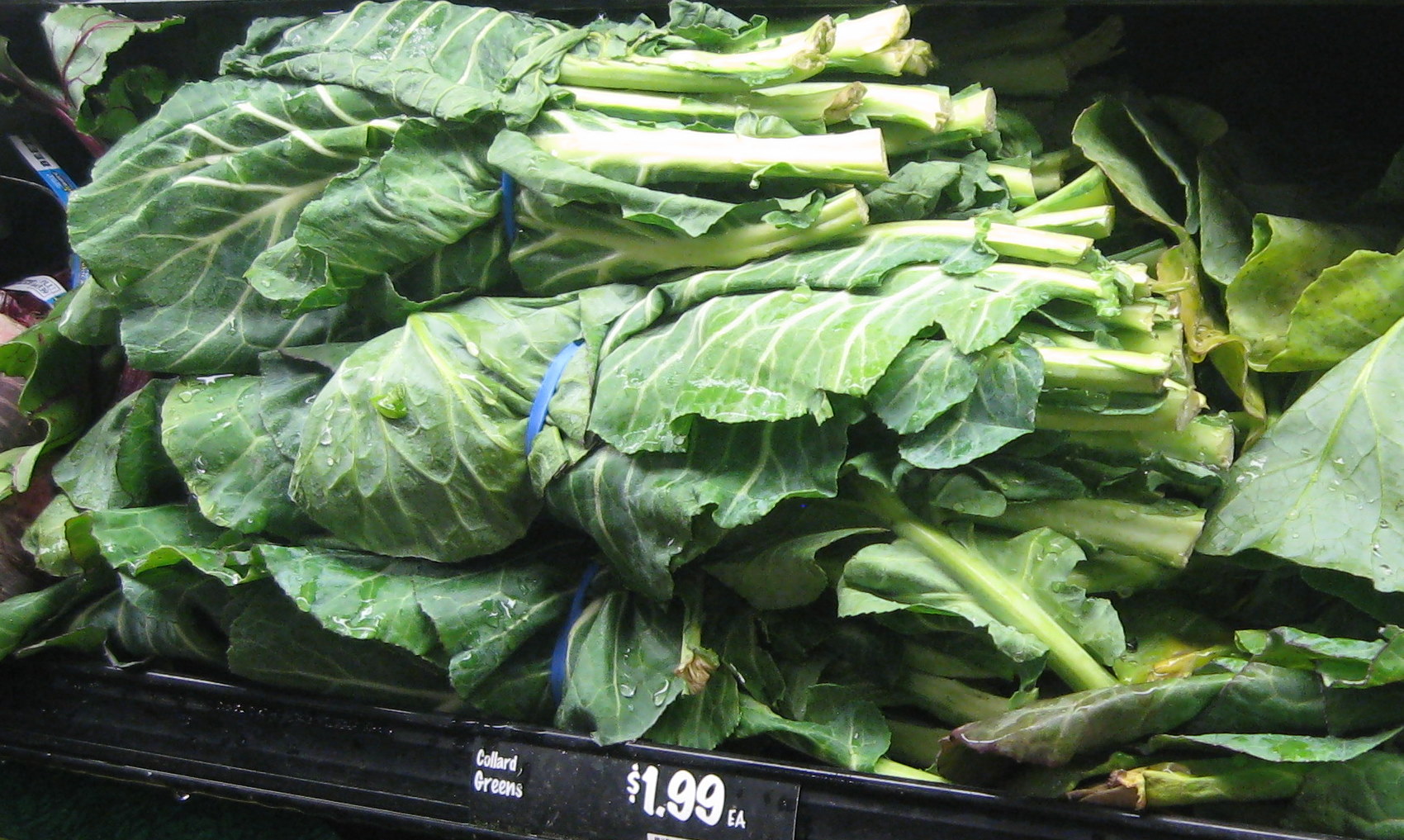
collard greens
I’m not a native to the “real” South, so I was intrigued to learn about the custom of having collard greens and black-eyed peas as a mandatory part of New Year’s day dinner. I like greens–so not big thing about the collard greens. I like pulses, legumes, and all those things too. Again, no big deal. Unfortunately, I may be a less finicky eater than some of my friends and acquaintances.
On several occasions I’ve been the delegated to prepare those dishes for New Year’s day meals. So–dinner for eight or so, I prepare collard greens and black-eyed peas in a traditional Southern style–well, talk about leftovers–everyone had the mandatory dishes–about a teaspoon of each! Next year, I lucked out again–make collards and black-eyed peas. I made a much smaller quantity of each, but still had mega-leftovers. Enough of that!
Next time I was delegated to bring collard greens and black-eyed peas to a New Year’s Day gathering, I decided that something had to be done to make those palatable to the kind of guests at the meal–true we’re all foodies, but some of us more than others. I decided that the problem was not collards and black-eyed peas per se, but rather that they just did not fit with lovely roast duck with a nice fruit sauce. I decided that I needed to present them differently.
Personally, I’d happily make a one-dish casserole of the collard greens, some sausages, and the black-eyed peas–a variation on one of my favorite recipes from Jacques Pepin’s The Short-cut Cook. That still did not fit with New Year’s Day festivities.
My next though was that all these people (in fact, most people I know) really like risotto. After perusing a number of recipes, it seemed that as long as you could add most anything to basic risotto, as long as you did the appropriate pre-cooking.
I decided that it was time for collard greens and black-eyed peas to make a début as risotto ingredients. Thankfully, the frozen vegetable case at my local supermarket came to the rescue: frozen collard greens (chopped), and frozen black-eye peas! Happiness.
I started the basic risotto recipe with onions, white wine, olive oil, and sautéed the rice. I used home-made chicken stock for the liquid. Frozen collard greens are already blanched, chopped, so all I did was to thaw them, give them a bit more in the way of a rough chop, and since they are rather “tough” greens, steam-sautéed them (without adding any more liquid) until close to being done.
The black-eyed peas seemed a bit more problematic since I knew that those can turn to mush easily as they’re fragile; I cooked those separately until almost done (according to the directions on the package).
When the risotto was close to being done, I added the collard greens and the black -eyed peas, and then finished the risotto with the Parmigano-Reggiano as usual.
Taking into account my earlier “luck” with collards and black-eyed peas, I made less than I though eight or so people would eat. Wrong again–needed more–these foodies wanted seconds!
A son goût!
Christmas Spiced Biscuits
Sounds like real holiday treat. Good discussion on biscuits (English and American), and scones, too.


If there’s one time of the year at which biscuits should be made and eaten in prodigious quantity, it is at Christmas. There’s something clean and joyful about a proper English biscuit that makes them a smidge more festive than, to give one example, a cookie. It’s far easier to pick out individual flavours in biscuits than in food that is excessively sugary – a cookie, for instance, is something of a devilish experience.
Not only are biscuits rather light on one’s stomach, they are also one of the more frugal bakes one can embark upon. Of course, this is largely due to the dearth of expensive superlatives, such as chocolate, that are often added to cookies or cake. Instead, biscuits are often left plain or flavoured with spices or citrus fruits – as is the case in this recipe. Indeed, if the spiciness of these biscuits doesn’t appeal…
View original post 420 more words
A food science cookbook!
 Even if you think that you have enough cookbooks, The Science of Good Cooking is one you should at least check out of the library and read. I’m sure it’s obvious from my posts that I like to understand cooking, rather than just following a recipe slavishly. You’ve probably also noticed that I’m a fan of Cook’s Illustrated, Cook’s Country, and America’s Test Kitchen, so it probably won’t come as a surprise that I’m recommending this book.
I consider myself a reasonably accomplished cook, and pretty good at improvisation, but I’ve benefited from reading and using this book. It’s like a cooking school in a book.
While there are lots of good recipes, the presentation is by techniques and concepts to help you understand what actually goes on when you apply heat, or use salt in a recipe, or why the yolk and the white of eggs cook differently. And there’s experimental data, too. This book is not just telling you what to do but why to do it–there are experiments to show why a technique works. Mastering the techniques in this book will give you so much freedom in the kitchen, because you’ll understand the changes taking place while you’re cooking. The information is presented without a lot of heavy-duty chemistry or physics that you sometimes find in food science books, too.
Every recipe that I’ve used from this book has improved my cooking! The extra-thick strip steak that I cooked using the technique from this book was the best I’ve ever eaten. Same for the baked fish.
Cucumber mango salad

mangoes
Yesterday I had a minor food crisis–fruit overload. I went to Costco (for cat food and laundry detergent) but while walking past the huge stacks of produce I smelled first peaches, and then pears–and then there were the mangoes. The difficult decision was pears or peaches, and/or mangoes. The pears won over peaches though the peaches smelled as good as the pears, but the price was such that I brought both mangoes and pears home with me. Both were much more reasonably priced than in the supermarket. So it was a no-brainer–I eat all the pears and mangoes that I want and share some with friends and I’m still ahead on the cost. (The pears were absolutely luscious–every bit as good as they actually smelled!)
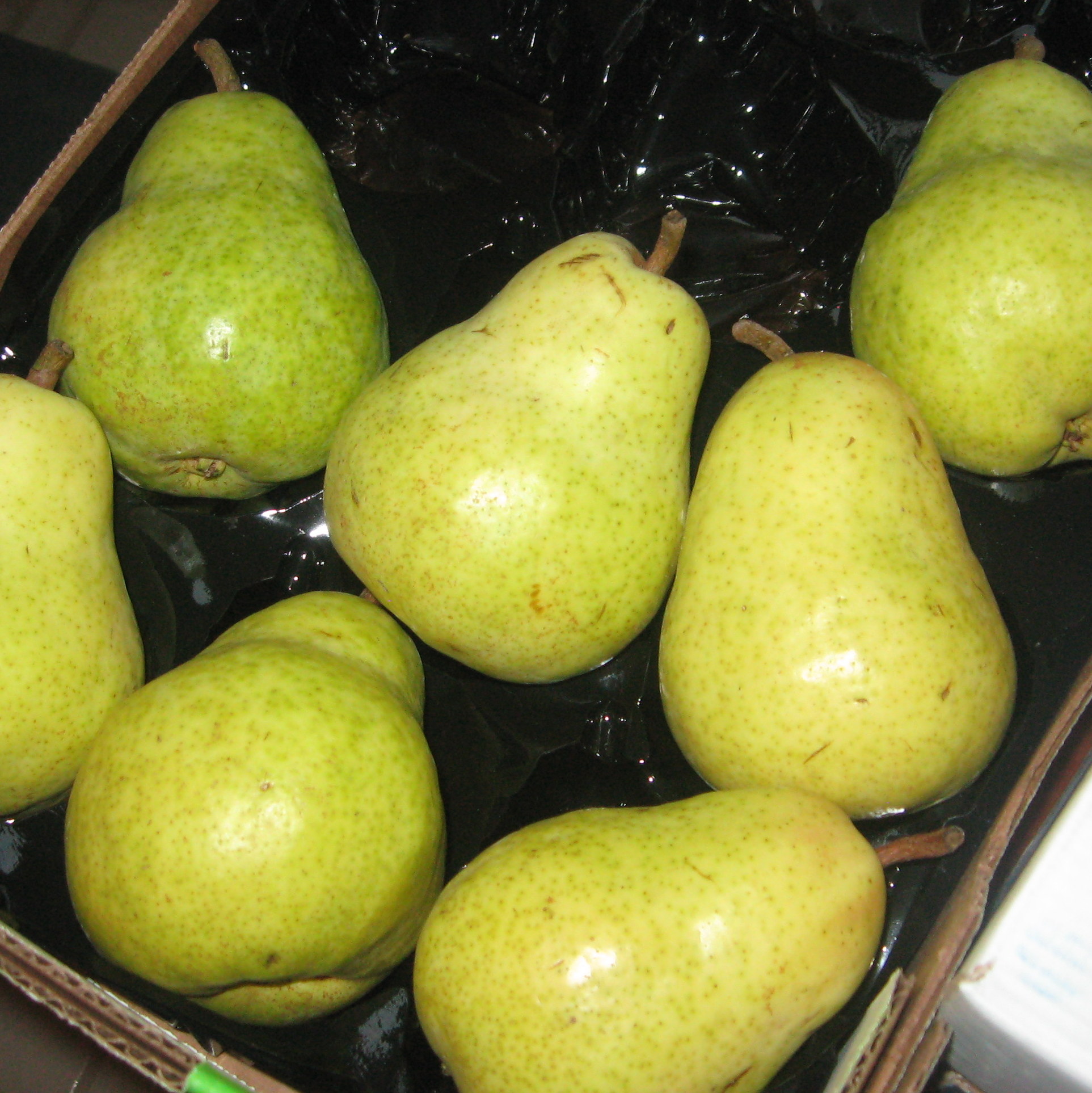
Bartlett pears
That quantity of fruit does have you looking for some things to do other than just eat it out-of-hand. I had some mangoes that needed to be used; I had eaten lots and shared some, but I needed to eat some more! (Not that eating big, juicy, ripe mangoes is really any hardship.) Saved by inspiration that struck when I started smelling my supper cooking.
I was roasting some pork (on which I’d used a dry adobo seasoning rub given to me by a friend as a birthday present)–just a single big meaty spare rib for supper. This was one that was extra from making the chili con carne--simply would not fit in the pot so it became a small pork roast for one with just a tad left over.
I couldn’t think what to have with it until I smelled the roasting pork with the spicy adobo seasoning, something said “sweet and cool”–I thought of mangoes and cucumbers (which were sitting right there in the refrigerator just waiting to be used).
Not being particularly inspired about what to do with these two things, I headed for my laptop and Google! As I was entering the “cucumber and ma….” the instant search which I’ve enabled popped up “cucumber and mango salad”. That sounded just right with spicy roast pork.
I perused a number of recipe sites and blogs and found several interesting ones for cucumber and mango salads (and somehow I thought I was being very original when I visualized that combination):
- from Daily Bites blog mango and cucumber, lime, ginger, honey (or coconut nectar–something new to explore), and optional cilantro.
- from Eating Well which added avocado, brown sugar, rice vinegar, canola oil, and fish sauce as well as red pepper flakes.
- from Herbivoracious using Thai sweet chili sauce, rice vinegar, mint and cilantro leaves, and toasted sesame seeds.
- from My Recipes the simplest of all–cucumber, mango, lime juice and ground red pepper.
- from Rookie Cookie with the addition of jacima, red bell pepper, honey, rice vinegar, and chile powder.
- from The Full Plate Blog those basics but with champagne vinegar in the dressing, and suggestions for optional pea shoots (yum!), and slivered almonds, with romaine lettuce.
Those certainly gave a place to start for concocting for what I needed that night’s supper. Then I found recipes with suggestions for adding grilled shrimp…seems like these need to be explored much more carefully next time I’m that flush with mangoes.

pear and mango
Since my adobo rub had given me quite a spicy seasoning for the pork, I decided that I did not want to add chile powder, or even ginger–anything at all spicy to the salad–I wanted something cool and contrasting with the spicy meat.
I opted for the bare basics: cucumbers (the little baby ones), mango, shallot (no red onion in the house), and since I didn’t have fresh mint (I’ve now killed my second plant), I used frozen cilantro (from Dorot) in the dressing which was just a simple vinaigrette made with olive oil and sherry vinegar (drat–no lime or champagne vinegar) and I didn’t think that rice wine vinegar would stand up to the adobo seasoning of the pork).
Even one mango and cucumber gave me some extra, so I dressed only what I was going to eat right then. (What was left became another salad, with very thinly sliced pork right in with the fruit, and I added some of those luscious Bartlett pears to it as well–threw that over some mixed greens and it made an awesome lunch. I dressed with a fig-infused white balsamic vinaigrette since I added the pear.
The combination of mango, or other sweet fruit, and cucumber is definitely one that I’ll be playing with in the future–probably with chicken, shrimp or maybe even crab, or scallops to “bulk it up” a bit for a complete meal.
(I know, it’s not a beautiful plate, but I was too hungry to go outside in the dark to find garnish–I almost didn’t even take a picture.)
A son goût!
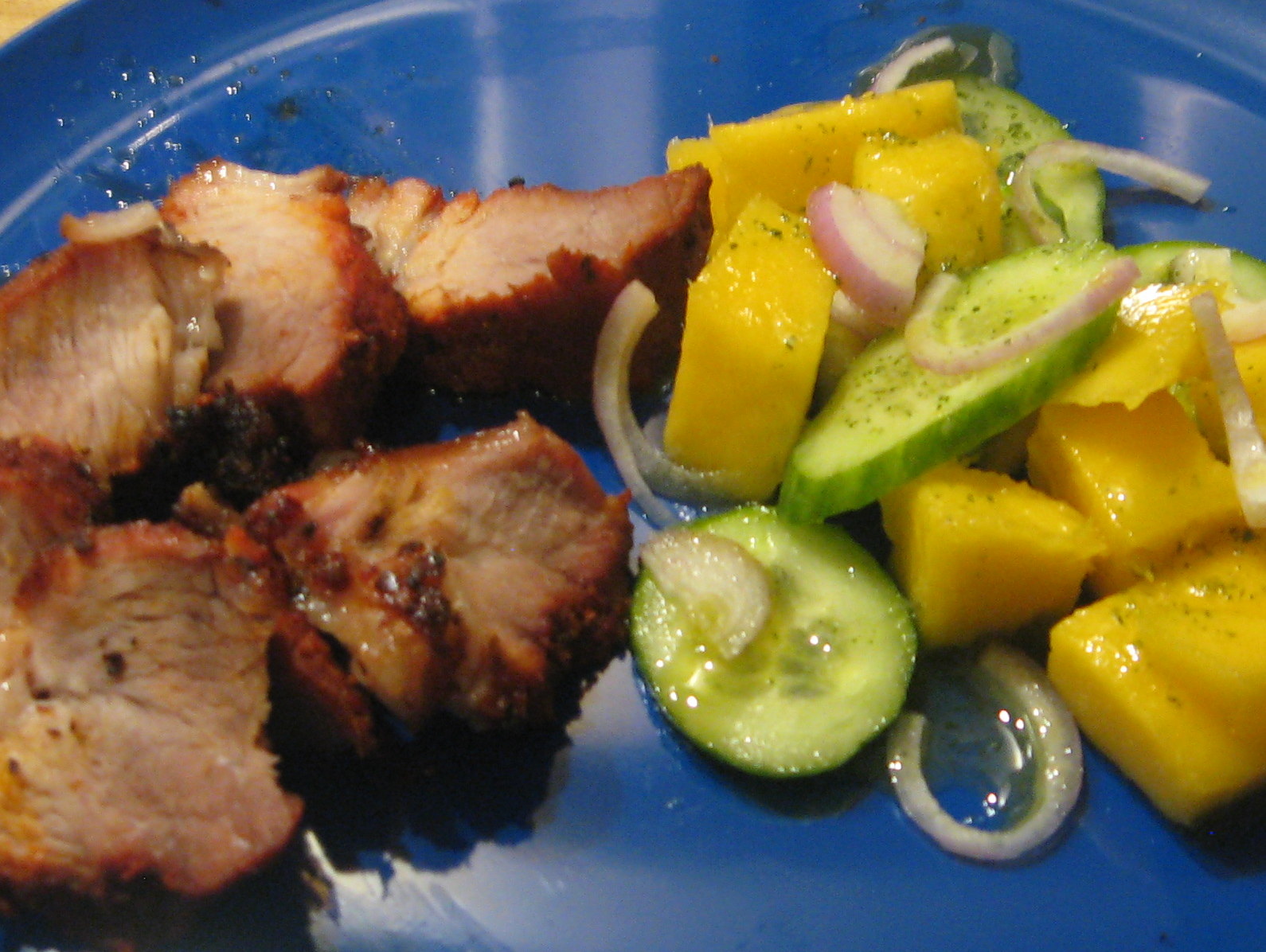
supper
Spicy Peach Chicken Wings Two Ways!
Image
What’s the best way to say this? I. LOVE. TO. GRILL! Now that you know this little secret about me, let me share one of my favorite sauces that I like to make while cooking. First I want to acknowledge that a lot of people are intimidated when it comes to dealing with MEAT and FIRE. This type of cooking has been going on way before Man realized that wearing white after Labor Day was unacceptable. Besides eating sushi or raw fruits/veggies I can’t imagine a more natural way to enjoy food. Regardless of your belief of how and when we got here once Man found fire he also found his love for a Medium T-Bone steak. I’m just saying.

In this article I’m going to share with you TWO different ways to prepare chicken wings. One will be for you go-getters out there who love to put meat on fire, and the other will be for the less adventurous group who likes to play it safe.
If you are ready to receive your fire badge in scouting then you will take the road I love to travel by and go fire up that grill! Even with grilling you still have options on how you actually want to achieve AWESOMENESS. You can use “Propane, and Propane accessories”-Hank Hill or you can use Charcoal. I personally prefer using gas since you can control the heat and when you’re done, you’re done! With charcoal you will have to move up to the advance cooking class since this will require a lot more concentration and skill set to master this form of cooking. Charcoal will definitely give you that authentic home cooked flavor, however it will also give your wings 5th degree burns really quickly if you don’t pay attention!
Ok so enough about that. Let’s cook!
Propane: Cut your grill up to medium-high heat to get the grates nice and hot for the initial sear when you lay the wing down. After placing the wings on the grill for a couple of minutes, lower the heat and flip those bad boys over. At this point there should be a little color as well as grill marks on outside so that you can keep up with when to turn your wings. Keep rotating so that each sides gets crispy brown skin. Don’t wait to long to add the sauce, the last 10-15 minutes of cooking should give you enough time to let the flavors marinate all the way through.
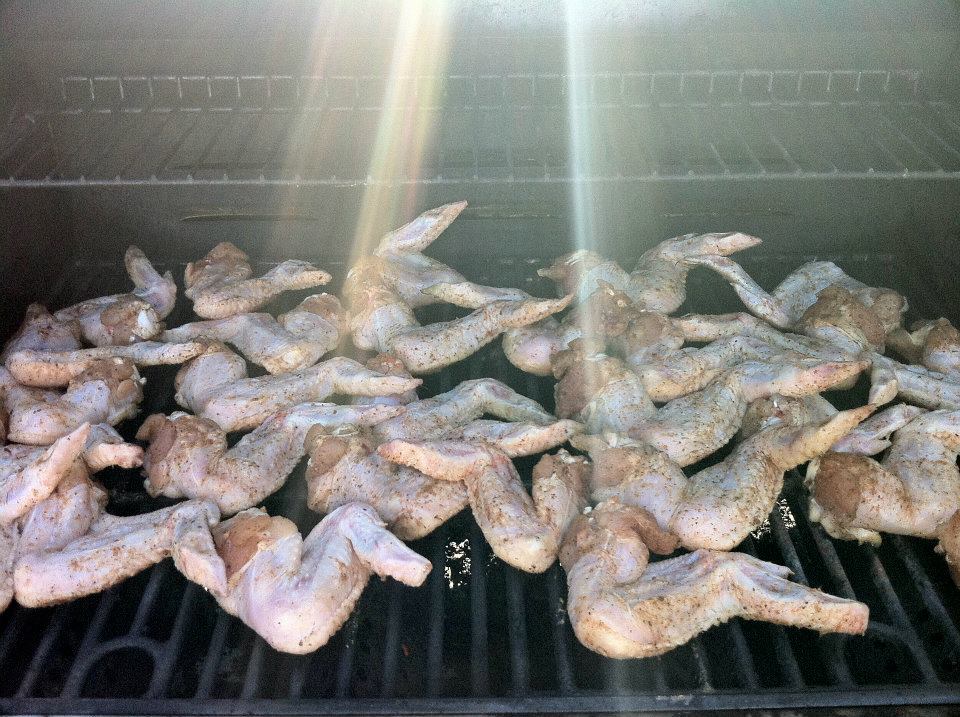
Charcoal: After you have your nice and red hot you will have to work a lot harder than your gas friend up there because now it’s all about the Indirect Heat method. Ten out of 10 times your grill is going to be extremely hot in the center where you have nonchalantly piled all the charcoal and set it on fire with half a can of lighter fluid. Once you have brought the level 3 fire down to burning red coals you will need to place the wings on the outer perimeter so that you can control how quickly your wings will cook. 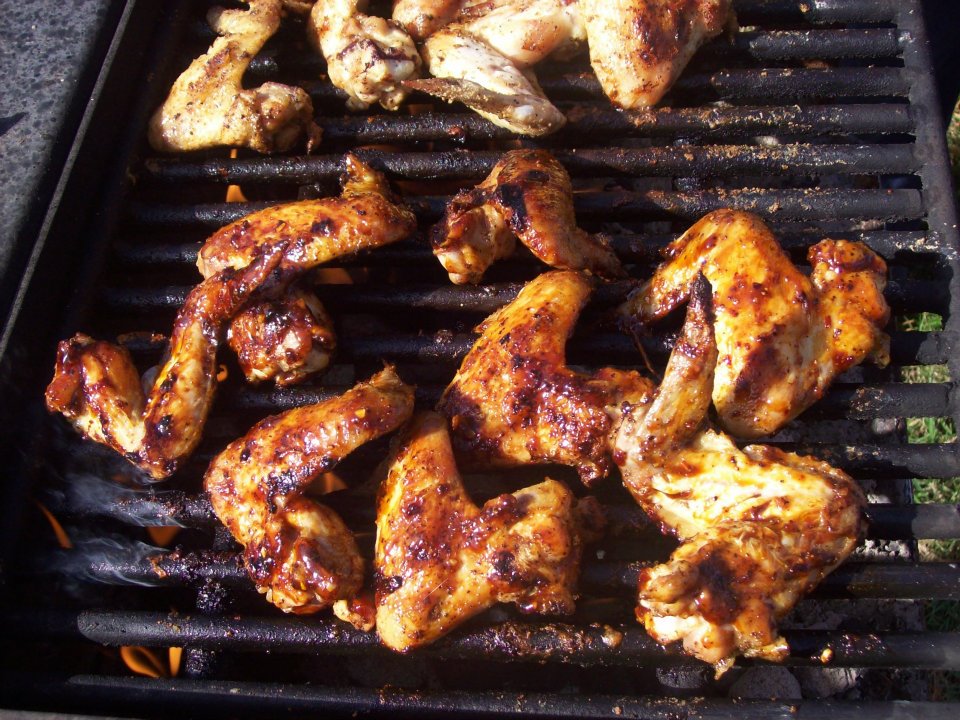
There is no way I’m going to say it will take approximately (fill in the blank) minutes and your wings will be perfect. I can’t sell myself out like that. But I can tell you that the food will let you know when it’s done. Chicken wings start of pale, soft and flabby-just like a newborn baby! Then in the toddler years they will make a lot of noise by hissing and spitting juices everywhere (terrible two’s phase). This is when you have to constantly watch them and move them around to make sure they don’t burn up. Once they become teenagers they have more color to them, stay to themselves and become firmer. They think that they are grown however on the inside they still haven’t developed yet. (I’m 15 and I know everything and my parents are lame phase) And then we come to the adult phase. Now it’s time to sauce em’ up. They have graduated college and ready for the real world. CONGRATULATIONS! You raised your wings right. They have earned the privilege to become a part of the meal.

Now for those of you who choose to bake/broil the wings instead of grilling not only do I give you a serious side eye but I will give you what you need to attempt to duplicate that outdoor flavor without actually going OUTDOORS!!
After seasoning your wings with the dry ingredients (salt, pepper, paprika and garlic powder) your oven should already be on and ready for action at 400 degrees. You are going to lay the wings out in the pan and leave them uncovered. The point is to get that skin crispy as if it had been lying out in the sun all Summer. That crunch is what you are looking for, we want savory crispy wings not soggy chicken pieces. So after 50 minutes (half a Lifetime movie) you want to check and see if those wings have plumped up
and start turning brown like this.

Alrighty then, your wings are ready to be sauced up! At this point you want to add all that finger licking goodness to the chicken so that they can be joined for eternity in flavor heaven. I actually would add the sauce probably around the 40 min mark just so that it gets in there all the way to the bone! Once you have the wings sauced and crispy now it’s time to crank up the heat and cut the broiler on. This will allow the wings to get more color and tighten up the skin just as if you had grilled them. Now is the time to pay attention to what’s going on in the oven instead of pouring that next glass of wine. Things can go from happy-go-lucky cooking time to OH GOD WHERE’S THE FIRE EXTINGUISHER?! Please check on your wings every 5 minutes until they are at the level that you prefer. The sugar in the peach preserves will heat up and become sticky, this will also cause the wings to “burn” more on the outside so unless you want wings that look like tar I suggest you watch them carefully.
This is what I have come up with after cooking in the oven and plating.
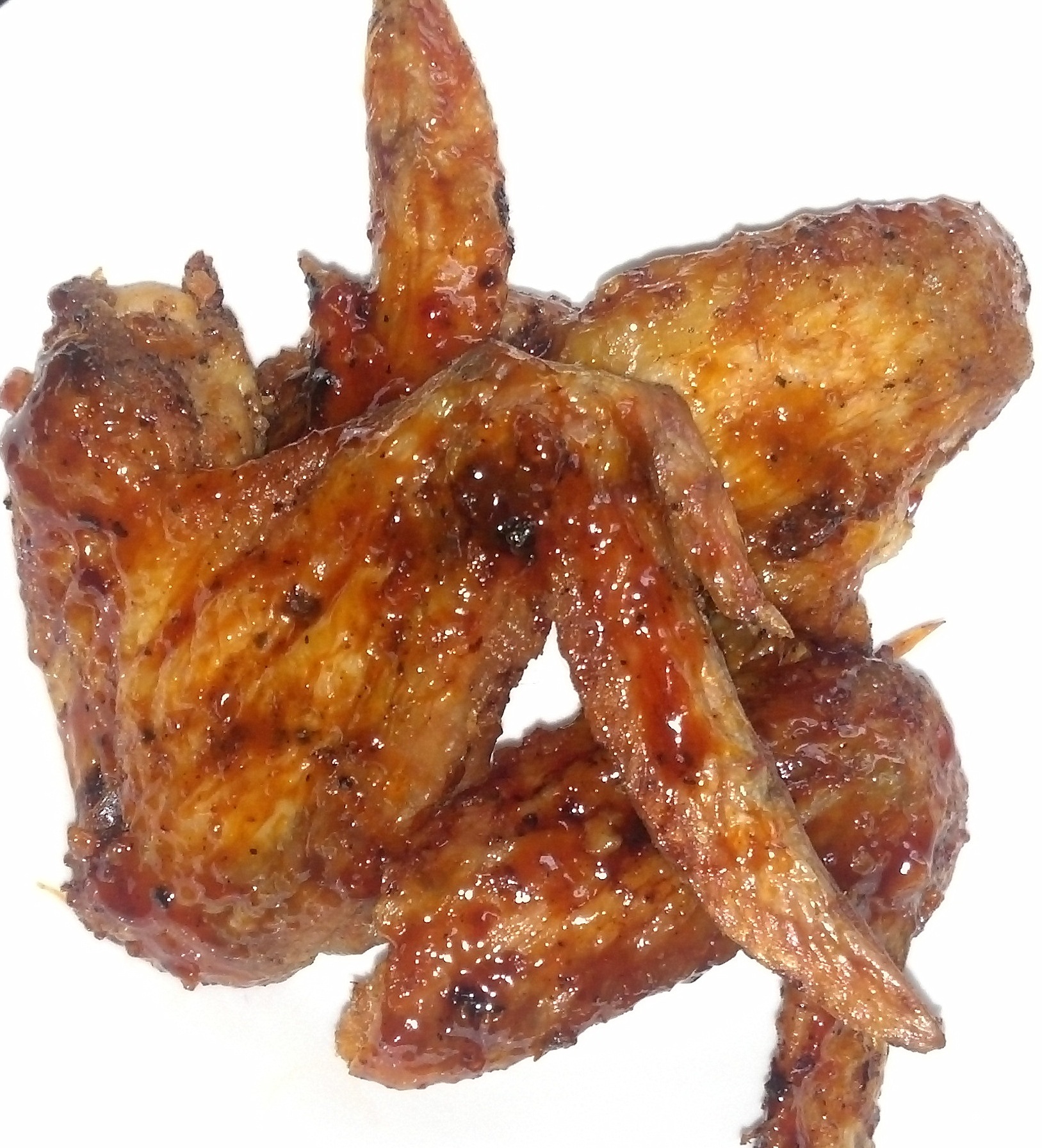
So below you will find the recipe for the Spicy Peach Sauce that I have talked about this whole time. The great part about this is the fact that almost any sauce can be substituted based on whatever flavor your palate is looking for at the time. I love complex sauces that make you think about what you are actually tasting. If you are going to eat something good, you might as well do it right!
Ingredients
- 2 tablespoons table salt
- 1 teaspoon black pepper
- 1 teaspoon smoked paprika
- ½ teaspoon garlic powder
- ½ stick butter
- 2 ounces of minced garlic
- ½ cup peach preserves
- ¼ cup hot sauce
- 1 tablespoon soy sauce
- Sesame seeds (optional)
Preparation & cooking
- Prepare wing mixture in advance to let them marinate. Mix salt, black pepper, paprika and garlic powder in a small bowl.
- Add chicken wings and toss to coat.
- Grill the wings.
- Melt the butter in medium saucepan with the garlic.
- Stir in the peach preserves, hot sauce, and soy sauce. Cook until syrupy and thick (stir so it doesn’t clump) about 5 minutes.
- Transfer sauce to a large bowl.
- Add the wings to the sauce and toss.
Enjoy!!!!
Chilli con carne redux update
I’ve finished the “fast” version of the chilli con carne that I posted about in Chilli Con Carne Redux! I’ll concede that it’s only sort of faster in terms of the active prep time–it still needs to cook long and slowly, but it is a success. I don’t think that I can tell the difference (tasted side-by-side with the more laborious version from the freezer) and friends have given it the nod of approval. So here are the changes and additions to the original chilli con carne that I posted.
- After the bacon browned, 3 tablespoons of tomato paste was added while the onions were sautéed, and this was browned–again to enhance the umami, not to add tomato flavor.
- None of the meat (pork or beef) was browned before adding liquids.
- Added bay leaves to increase the earthiness (used five large for this 6 pounds of meat).
- Added Mexican oregano–about 2 rounded teaspoons. (You really do want Mexican oregano for this–much different flavor than Turkish or Greek (Mediterranean) oregano–after all it is an unrelated plant, but worth having in the kitchen if you like chili.)
- Sun-dried tomatoes (about 1/2 cup chopped) were added for more umami even though this was NOT made in a slow cooker, I was not aiming for tomato-flavored chili.
- During the cooking time I tasted some in a bowl with a little fish sauce added (yep, I did get up the nerve to try this) and it tasted wonderful; so I added about 4 or 5 tablespoons of fish sauce. (I suspect that if you don’t have fish sauce a couple of anchovy filets thrown in would have the same effect.)
- The final thickening was one with a brown roux made with masa harina. For the fat in this roux I reserved about 1/4 cup of the fat from the de-fatting step. I heated this and made sure that all liquid was evaporate, then added about 6 tablespoons of masa harina and cooked it until it was a medium brown and toasty smelling.
- Because of my work schedule, this was cooked in a lower oven (about 195° F) for about 10 hours.
After another run on this I’ll have to post a revised recipe for the “fast” and easier version, but if you feel so inclined you can work with these changes–after all chili con carne is one of those things that really doesn’t need a recipe to be followed strictly.
Dandelion greens
I finished my teaching week this afternoon and found myself in need of an attitude adjustment. It’s been a busy, hectic week but I still can’t figure out what I supposedly accomplished in all that business. Still laundry to do and other household chores….

dandelion greens
In prowling through the grocery store (my local Harris Teeter) the other day I found absolutely lovely dandelion greens. I haven’t had dandelion greens very often since I was a kid growing up on the farm. Then they were a springtime treat–the young tender ones in a wilted salad with bacon dressing. I thought that I’d try them in a one-dish meal based on a recipe from Jacques Pepin’s Shortcut Cook–quick, easy, and in the comfort-food category. I decided that a good complement to the bitterness of the dandelion greens would be Siciliansausage which Harris Teeter makes in the meat department. It’s a bit like Italian, but spicier and with much less fennel.

freshly made sausages
Remove sausage from casing, brown; add chopped onion and continue with the browning, then add a couple of garlic cloves, minced. Add the chopped dandelion greens, stems about 10 minutes before the leafier parts (still wet from washing), cover and simmer. Depending on the spiciness of the sausage you might want some red pepper flakes. This particular sausage is strongly enough flavored that I did not add anything else. When the greens are almost cooked, add some cooked pinto beans (in this case I’m resorting to canned ones). For a change from beans, add some diced potatoes to cook with the sausage and the greens.
Finish with a tiny drizzle of good fruity extra-virgin olive oil and it’s good to go, add some of my homemade oat bread, and ripe and fragrant Bartlett pears.
It’s certainly easy, reasonably quick–it takes about 15 to 20 minutes for the greens to cook, but it sure does contribute to attitude adjustment! (Sorry, no pictures–it’s not photogenic.) It’s good for single-serving cooking since I can buy the sausages individually, and if I’m using mustard, kale, I can buy those loose in the amount needed I don’t have leftovers. If there is more than I’m going to use at once, I’ll take out some of the sausage and greens to be used later, perhaps as an omelette filling.
A son goût!
How to plan a week of meals
A great article for some ideas on how to deal with “leftovers” and efficient cooking for one or two.

One of the main obstacles that I’ve heard about for why people don’t cook very often is that it’s hard to buy groceries without wasting a lot of food. If you are only cooking for one or two people, I can understand how this is challenging. What works for me is to plan a few meals before I go shopping, and to try to overlap some of the main ingredients. I’ve outlined a few examples below.
When you are shopping for the week, be realistic about how often you cook. If you know that you will probably go out to eat one or two nights of the week, don’t buy enough groceries to make five dinners. If possible, shop somewhere where you can buy custom-sized portions (i.e., somewhere with a butcher’s counter and that allows you to buy produce by weight).
Sample week 1:
Grilled Chicken with Caprese Topping
Clams…
View original post 149 more words
 a-single-serving.com