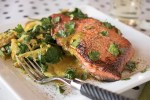
This gallery contains 12 photos.
Simple, quick meal with Indian flavors.

Epoisses is one of my most favorite cheeses–not necessarily easy to get. I don’t usually think of cheese with fish, but I want to give this a try. Now to find some Epoisses. . . .
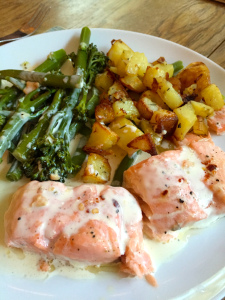
What I want to prove here is how well you can pair a cheese sauce with fish. The EpoIsses sauce is lighter than the one I would normally have with meat – and the flavour really enhances the flavours of the salmon. I used 100gm of Epoisses cheese chopped up and melted slowly in a dry pan. Then sprinkle with a grind or two of black pepper, and then add 150 ml of single cream. Gently warm through – it will thicken a little but not too much.
I served it with poached salmon, asparagus and oven cubed potatoes roasted with thyme and garlic.
If you have never thought to try this – you must. Not an obvious pairing but …..IT WORKS!
 I could scarcely believe my eyes when I wandered past the seafood display in the newly opened Fresh Market. There was Chilean sea bass (this name is really a marketing ploy)! Or really, Patagonian toothfish. It’s not pretty when as the whole fish, but it’s luscious in the pan. It’s also NOT cheap. And there are some that are considered “sustainable”, so I wasn’t being totally irresponsible–just fiscally irresponsible for my budget. But it had been, literally, years since I’d eaten this luscious fish. No will power effort here–I brought some home.
When I spend this kind of money for special fish (how about 7 ounce piece for $13.00–yes fiscally irresponsible, and the hock-your-soul category) I’m going to make very sure that I don’t screw up the cooking or seasoning. The texture is firm and meaty with large flake (in that respect somewhat like monkfish, tuna, or swordfish, but still has character of its own) and moderately oily so it doesn’t dry out during cooking. The flavor is often characterized as mild, buttery, somewhat like cod, halibut, or stripped bass; not fishy in an undesirable way. It’s the combination of flavor and texture that makes the toothfish so special–and nothing else can really be substituted if you want that particular flavor-texture combination.
If you’re looking at something called just “sea bass” it’s probably not toothfish–that’s usually sold as “Chilean”. There are, however, a lot of fish sold as “sea bass”–white-fleshed, and lovely as well, but not as special, or expensive, as the toothfish, but still well worth trying.
The toothfish is oily enough to allow for lots of flexibility in method  of cooking–even broiling or grilling. To keep it simple and let this special fish really shine, I took the really easy route: seasoned with salt and baked in a covered dish in a 425°F oven for about 25 minutes since it was a thick (almost 2 inches) piece of filet. While that cooking was going one, I made a pan sauce of brown butter, shallots, and white wine, salt and pepper.
Efforts are being made to legally harvest toothfish, so before you buy check the source, but then break the budget and enjoy! (This image is from the Coalition of Legal Toothfish Operators, Inc.)
The wine? Well, another glass of my Alandra Portuguese white since this was a really simple preparation–and that’s a good all purpose white wine for causal use on a weeknight when I want a rather short glass.
 Just a quick follow-up on the shad roe post from yesterday: The seasoning and cooking method from The Garum Factory was a success–absolutely as good as I thought it would be from looking at the recipe.
The purging over night in salt water does make a difference–I like the roe either way. If it’s your first time preparing roe, I’d recommend doing the salt-water soak.
Cooking the roe over low heat–kind of a steam-sauté) works well–it eliminates the popping and spattering that you usually get over higher heat and the texture of the roe more tender than cooked over higher heat.
The ginger added to the more traditional bacon, capers, garlic, lemon, and butter definitely adds a nice sparkle to the roe. I’d certainly recommend this as an introduction to shad roe if you’ve not tried it before.
 (The roe image above is from The Garum Factory–the picture that I took did not come out well at all so–clicking on that image will take you to the original post which I reblogged.)
I just had steamed potatoes (small Yukon Golds) and a salad. A glass of the Alandra white (Portugal) was a lovely accompaniment to the roe.
A son goût
Just to add another post on shad roe for a different perspective, here is a link from Saveur, The Daily Fare on shad roe

pair of shad roe
Sometimes it’s a bit dangerous for me to venture into the grocery store–I happen on to something that I hadn’t planned to buy. That happens especially with some seasonal specialties that appear without warning because you never know quite when they are going to be available.
So we’ve had groundhog day, and we’re looking toward the vernal equinox (20th of March, I believe)–all suggesting that spring is on the way. I have a particular sign of spring that I’m always looking for: shad roe. Today I made its unpredictable appearance at my local Harris Teeter fish market. I never know quite how I’m going to fix it once I get it home–but it usually comes down to something with brown butter and some other seasonings like lemon, or something very simple so that the focus is the shad rod itself.
Whilst skulking about on the web, I found this delightful post on The Garum Factory about its history and preparation that I want to reblog –I couldn’t do it better. This looks like a great way to prepare it. Another post worth reading if you’re new to shad roe is from the second lunch.
Now off to put my shad roe in the salt water! I’m now ready to think that spring really is on the way!
George Washington Ate Here – Shad Roe with Brown Butter, Capers and Ginger from The Garum Factory appears below.

You will never see it on a restaurant menu. The TV Food Network is unlikely to devote an hour to its history and preparation. It is one of the great forgotten foods of American culinary culture. I’m talking about the shad. The sole remnant of its once mighty role in the diet of Americans is its roe, and for a certain segment of avid pescavores it’s the line in the sand between winter and spring. This week we’re going where food blogs don’t usually tread – Shad Roe with Brown Butter, Capers and Ginger. Believe me, it’s worth it.
There is a story–a fish story?–proffered by historian Henry Emerson Wildes in his book Valley Forge about the importance of shad to the revolutionary war effort. In the spring of 1778 the tattered and hungry Continental Army was encamped in Valley Forge, Pennsylvania, where it had been since the onset of…
View original post 1,902 more words
Andrea is passing close to us and the rain is the kind that makes you want to have quality time with the cat and a good book–so glad to be indoors. But, my unpreparedness did make me venture out (cat litter very low–very serious problem!); fortunately, out and back before the heavy rain started.

tuna
I came home with an impromptu purchase–the local HT had lovely looking tuna (wild caught) on sale. I’m going to make a small batch of tuna confit to use with my summer salads, though I suspect that one of the small “steaks” is going to supplement the grilled or griddled shrimp for supper.
I’m really intrigued by the sous vide cooking technique–and I’m constantly drooling over recipes from Stefan’s Gourmet Blog! Such perfectly cooked meat, and the veggies, too. But, as Stefan points out, it takes equipment! I’d love to try tuna like that as it seems that fish do well that way.
For now, I will settle for the very slow “poaching” as an alternative. It certainly beats the average canned tuna (unless you can get one of the canned variety that is hand packed, and cooked only once.
I keep wondering if there are any low-budget ways of trying the sous vide technique! I think some research is called for here.
TGIEOT—yes, that’s a bit more than TGIF! It’s end-of-term. The Spring term was the school term from hell, starting right at the end of Fall term! Over the winter break I had unexpected course preparation to do for two online classes—switching from Blackboard to Sakai—for content management. Top that off with an ongoing indexing project, and it’s—well, let’s just say it left very little time for cleaning, cooking, or writing! Then, add to that a hard-drive failure for my computer….but it’s over now.
I’ve taken some time to work on revising the on-deck herb garden since I had plants that needed to go into their home pots, and a couple of days to do nothing but have quality time with the cat. All that has left me yearning for some relaxation time and some really good food—cooked by me.
My day was absolutely made when I got my email delivery of the “Fresh Catch” specials from my local Harris Teeter this morning: they had monkfish! In terms of favorite fish, that’s right up there with Chilean sea bass for me. Needless to say, I scarfed down my morning coffee and headed right off to HT.

fennel, leeks and garlic
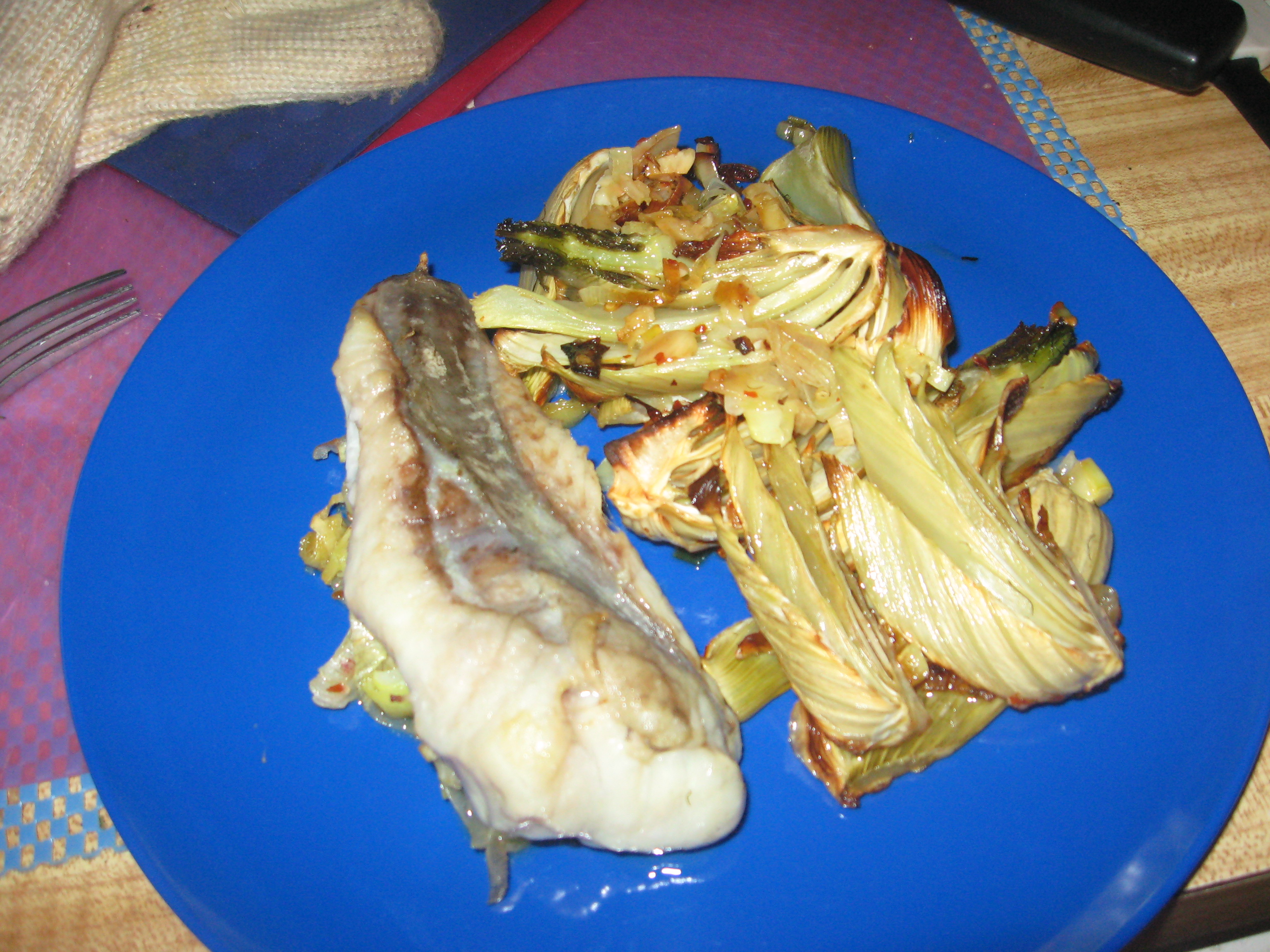
Supper this evening was roasted monkfish, with roasted fennel with leeks, garlic, and a dash of red pepper flakes, with a nice un-oaked chardonnay. The fennel was an in-store, spur of the moment thing since it looked so gorgeous.
Even though it is warm this afternoon, I opted to cook in the oven because I wanted roasted fennel as well. I’ve done monkfish in hobo-pack style before but I thought I’d try roasting it this time and see if I couldn’t have a one-pot dinner.

monkfish
I’d seen a post by Edward Schneider in Mark Bittman’s NY Times column (Diner’s Journal) about roasting monkfish, and the differences in monkfish on both sides of the Atlantic. After reading that I salted my monkfish for about an hour, and then roasted it. I did manage to make a one-pan meal out of it. Since I had to allow about 40 minutes for the fennel to roast, I started that first. After about 15 minutes, I laid the monkfish on top of the leeks, pushing the fennel wedges to the side, and popped it back into the oven for about 15 minutes. I used very simple seasoning on the fish—olive oil and salt before going into the oven, and nothing for than fresh-ground black pepper and a pat of unsalted butter after it came out of the oven. So very simple—so very good, and even healthy.
(The only thing I wish I had done differently would have been to add some sweet red (or orange or yellow) bell pepper with the fennel. A glass of un-oaked chardonnay complemented the meal very nicely.)
The “leftover” cod to which I alluded in a previous post was the result of beginning-of-term course preparation frenzy (always happens no matter how well I think that I’ve planned). It was an OMG-I’m-starving-what-have-I-got-in-the-fridge, what-can-I-put-into-the-oven-so-I-don’t-have-to-watch-it, panic situation.
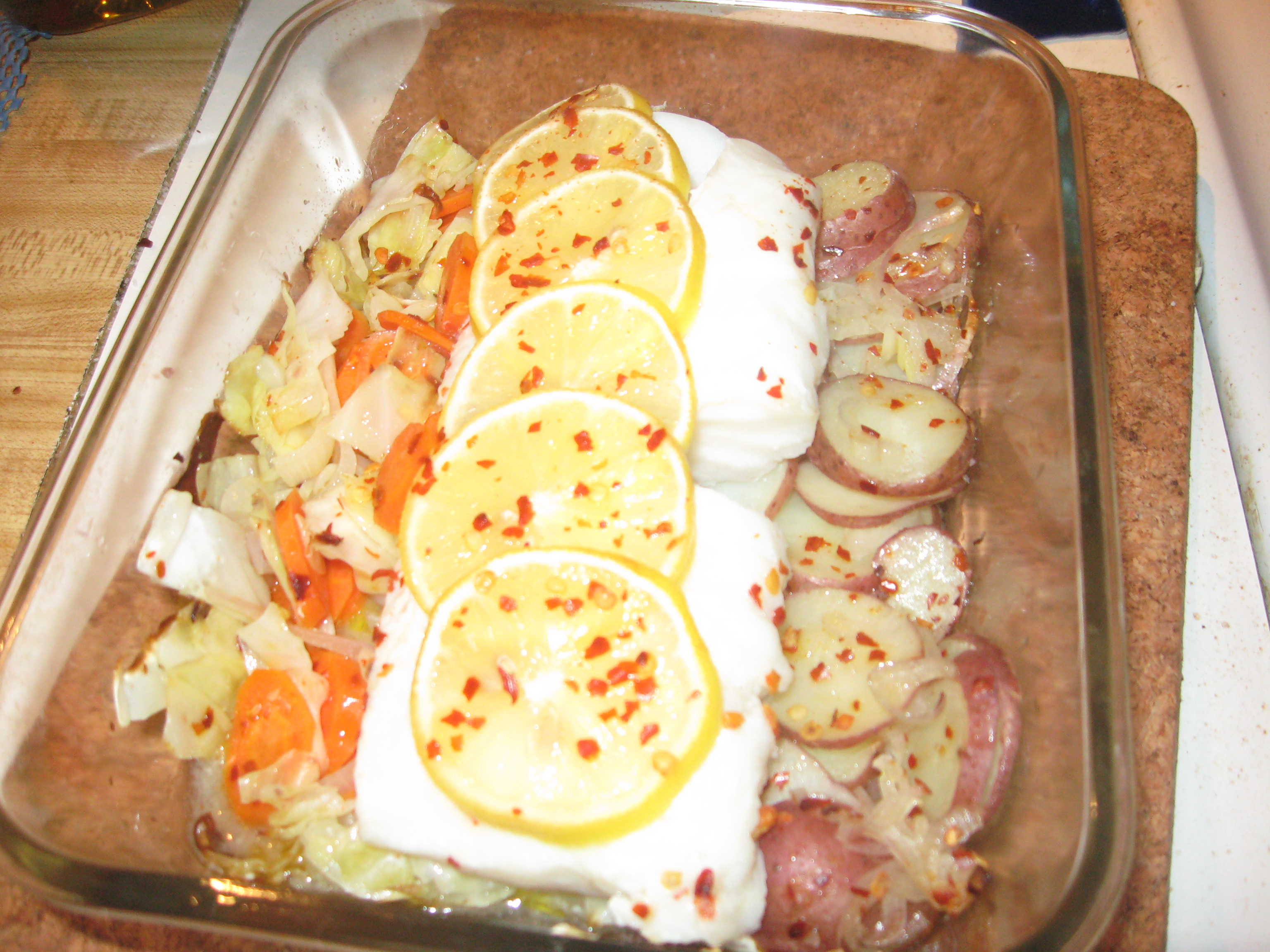
cod & vegetables ready for oven
I had the cod fillet, but I was really pressed for time. After madly rummaging in the vegetable crisper, and came up with cabbage, carrots, potatoes, lemons, and onions. The cabbage got cut into bite-size pieces, the carrots and potatoes sliced into about 3 mm (1/8-inch) pieces. I tossed the cabbage and very thinly sliced onions with some extra-virgin olive oil and a pinch of salt. I gave the carrots and the potatoes the same treatment, threw in one of the few herb mixes that I keep on hand–herbes de Provence (my go-to in panic mode), some red pepper flakes put the fillet on top, plopped some lemon slices in, covered it, and stuck it in the partially preheated 325°F oven for about 45 minutes since it was a very thick cod fillet–and set a timer! (Since there were lemon slices, and the cabbage was still damp from rinsing, the cover for this baking dish fit very well, and I knew there would be a bit of liquid from the fish, I didn’t add any water.)
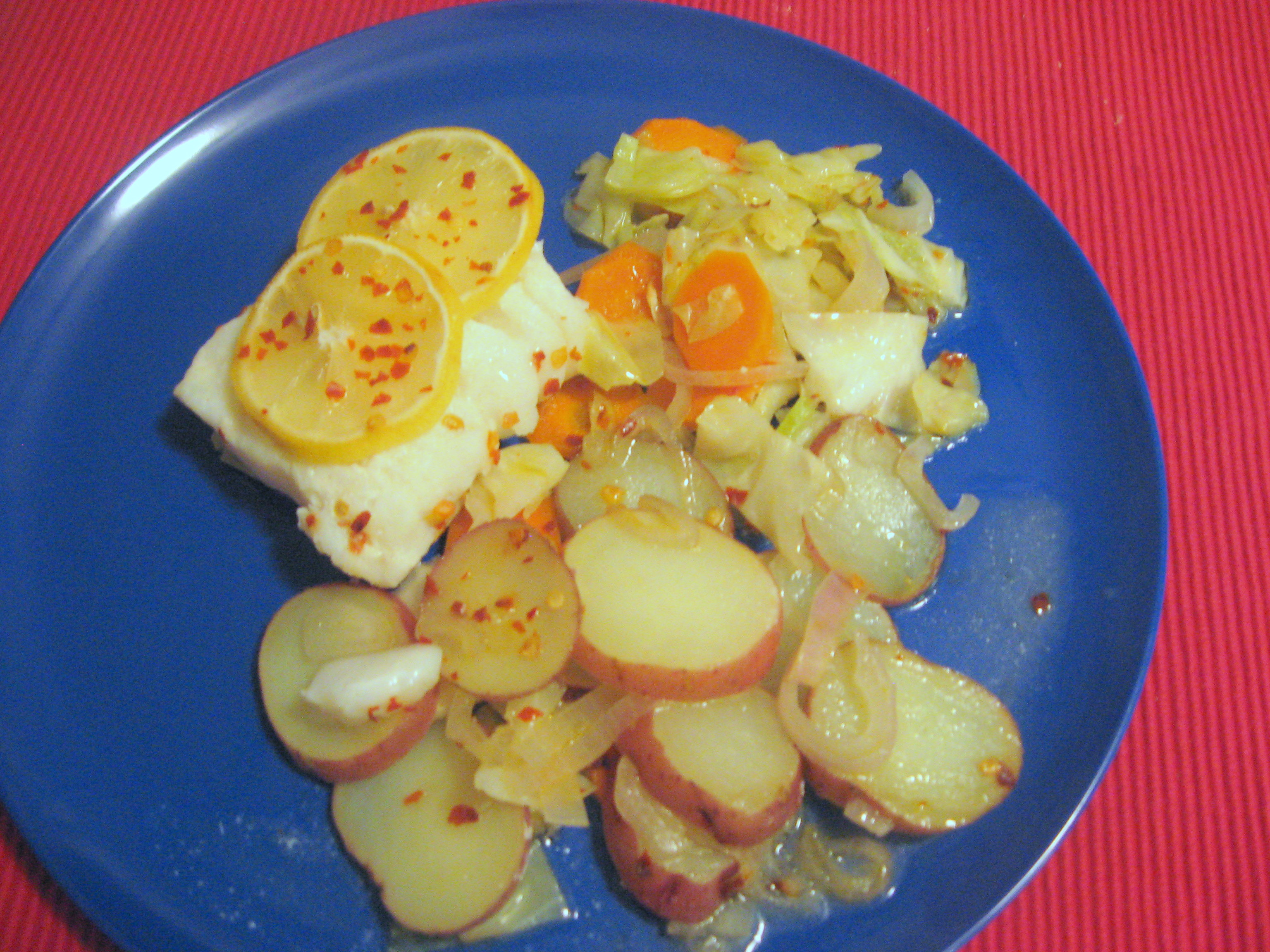
one-dish meal
When the timer went off I went back to see what I had–the thinly sliced carrots and small red potatoes were tender, the cabbage was tender but still slightly crisp, and the fish flaked nicely–success on the fly! If you don’t like a little crunch with your cabbage, you might remove the heavier ribs.
Good results for minimal effort, and a really healthy meal. The lemon and extra-virgin olive oil complemented all the veggies and the fish. The red chili pepper flakes spiced things up just a little. Yes, pretty simple, but tasty. Good food doesn’t have to be complicated if you have good things to start with.
This is so simple, and so easily adapted to cooking for one that I just had to share it.
Poaching fish is my favorite way to cook fillets. The liquid used can be very simple or very complex. Sometimes I will reduce it into a sauce afterward, and sometimes I like to leave it as a thin broth. This recipe is very quick and is perfect for a nice weekday meal or second course in a large dinner party. Always use fresh fish with firm flesh.
I like to buy whole fish and fillet them myself. Then I use the bones and heads to make a quick fish stock. The butcher should be able to cut the fish into fillets for you if that is too much work.
Poached Fish
Season fillets with salt and pepper. In a saute…
View original post 102 more words


 a-single-serving.com