Pheasant with Green Chiles

I’ve done my usual scrounge through the post-holiday leftover at the grocery store, as usual, come home with some goodies. My local Harris Teeter had pheasants on sale so I’m looking for inspiration.

Admittedly, I’m starting with farm-raised pheasant rather than wild. The flavor is different–milder–and as the wild are not so fat and sassy as farm-raised, the wild can be trickier to cook.  I have farm-raised (still good eating) so I have a bit more freedom in how to cook them.  If you’re fortunate enough to have wild pheasant, here’s some information on cooking those. (If you have wild ones, I’d love to help you eat those–and perhaps pick a wine to go with them.)

The post that I’ve reblogged below provided some inspirations for a starting place.

Roast pheasant for dinner

Two Whole Pheasants- Pheasant MeatOn a recent troll of the after-holiday, year-end goodies at my local Harris Teeter, which includes the free-standing freezer in the meat department (as well as the carts at the front of the store), I found pheasants on sale so I decided we (neighbors and friends) needed to have pheasant–especially since at least one had not tasted pheasant.

This is a first for me–I’ve never cooked farm-raised pheasant before; I’ve always cooked the wild birds that we got by hunting. Those we always braised since they could be old and tough.  I went to the McFarlane website Pheasant for Dinner to see what information I could find. I guess these are not likely to be either old  or tough, so I thought about roasting–then I decided that cooked in my Romertopf might be best since pheasants–even farm raised don’t have a lot of fat on them.  I decided that brown basmati rice would cook at the same time under the cut up birds; kind of self-seasoning with the pheasant juices–and whatever else I decided on.

Pheasant dinnerSince this was my first crack at farm-raised birds, I decided to seek expert consultation–from Mike Thomas in the meat department at Harris Teeter, thinking it likely that he’d be able to tell me more about the birds and how they would cook.  He agreed that the Romertopf should be a good way–so that decision was made.

As for seasoning, I was still debating. I wanted tangerines, but couldn’t find them. Tangelos? Well, maybe.  The meat of the tangelos was not very tasty, so I  got Mandarin oranges as well, but use only the tangelos as the mandarin oranges were too sweet.

I originally planned to do fingerling potatoes in the Romertopf with the birds, but I couldn’t get my head around orange and potato together, so I changed to brown basmati rice instead since it could also cook right with the birds in the Romertopf.

My next decision was whole or cut up. I finally decided that cut up would be best–so that I could use the carcasses to make some stock for cooking the rice. So get out the knives! I found a good demonstration on cutting up a pheasant at the McFarlane website–as I thought it’s like disjointing a chicken.  Since it’s not something I do all that often when doing single-serving cooking, it did take a bit, but I got them cut up.  I left bones in–even in the breasts since I think there is a lot of flavor in meat on the bone.

Pheasant dinner-2

into the oven

The backs, wings, necks, and other miscellaneous pieces, with carrot, onion, and bay leaves went into the stockpot (after browning). Simmered and skimmed I had a good start on the rice.

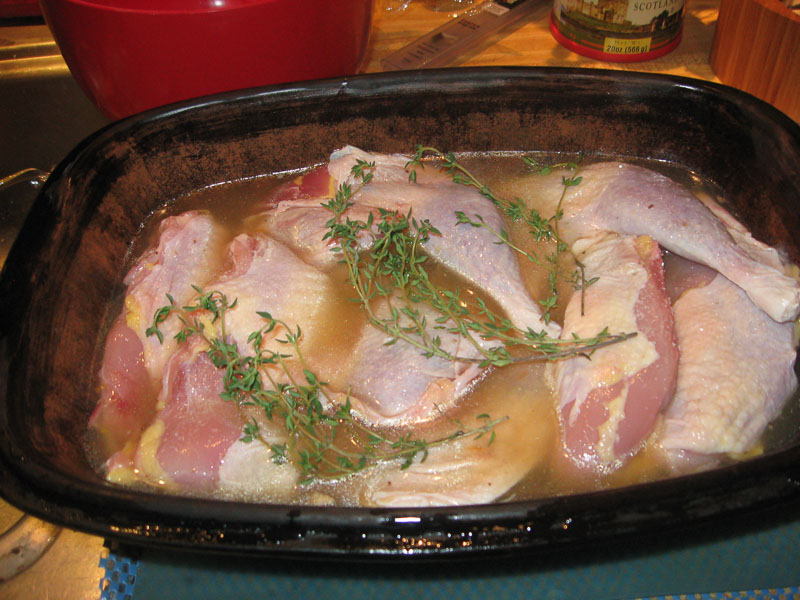
I minced two medium onions, four large cloves of garlic, and sautéed these with the rice before adding it to the soaked Romertopf with the rinsed basmati rice (two cups) with stock.  I added the zest of two tangelos to the rice. I pulled the meat from the stock bones and the giblets, chopped them finely, and added those to the rice–kind of a “dirty” rice here. That plus the 4 cups of stock went into the soaked Romertopf with the pheasant pieces on top, and into a cold oven, as usual with the Romertopf.

For a sauce, I modeled it after the one used for duck with fresh figs; I reduced the remaining pheasant stock and the juice of one tangelo slowly to about 1-1/2 cups–it’s not intended to be thick–more “au jus”. It needed a bit of sweetness despite the tangelo juice. After tasting both thyme honey and leatherwood honey, I opted for the leatherwood, since there was thyme with the bird and the leatherwood added a “dark” contrast to the tangelo and the meatiness of the stock.

(It looked great when I opened the Romertopf, but I was too intent on eating to stop and take pictures.)

My friends brought some awesome roasted Brussels sprouts (with bacon and garlic) to accompany the pheasant–a good meal, with good company!

<>^<>

I used the ratio suggested for the brown basmati rice, but it was just a bit soupy. Next time I’ll use 1 part rice to 1.5 water. Otherwise I was pretty happy with the results–we certainly made a dent it the rice and the pheasant.

The farm-raised pheasants are more chicken-like than wild-pheasant-like–a little disappointing if you are used to the wild ones. I’d cook them again–if I find them on sale, but I’d really rather have the wild ones, though I certainly wouldn’t have been roasting them.

Not knowing the flavor of the farm-raised birds made choosing a wine a bit difficult. We drank a 2012 Ravenswood “Besieged” with it, and it worked well. This limited release is a blend containing 35% Carignane, 20% Petite Sirah, 18% Zinfandel, 13% Mourvedre, 9% Alicante Bouschet, and 5% Barbera. (This was a wine that I stumbled upon while doing my shopping one Saturday at the local Harris Teeter. I’m a definite Alicante Bouschet fan and this blend was very mellow, and fruity so I did something that I don’t do often–I bought a half case of it–and I think I’m going to wish I had more of it.

Now there is chicken soup….

Since I cooked a whole chicken for Christmas dinner (chicken-in-a-pot), I have cold chicken for sandwiches and salad, and I’m getting another two meals from that same bird from what meat left on the carcass.

Rather than spend lots of time picking bits of meat off the carcass when I needed to be indexing, I popped it into a very low oven (I guess I could have used the rice-cooker/slow-cooker) overnight, since I don’t mind having the oven on in chilly weather to help warm the place up; it reduces other heating.  This morning, what meat was left simply fell off the bones.

The chicken-in-a-pot made some serious broth, some of which went with Christmas  chicken au jus. There were onions and garlic in the pot with the chicken that the recipe called for discarding after straining the broth.  They actually tasted good so I put them back in with the carcass.  I added lentils and barley to that broth, both of which cook in about 30 minutes, some aleppo pepper and a few red chilli flakes, seasoned to taste with sea salt, for a very hearty chicken soup for supper–all with very little effort on my part. (And there another serving of that which is going in the freezer for another chilly day.)

Though this was a pricey chicken, I can’t complain–the flavor was worth it, and I’ve had enough additional meals that tasted so good to make it not such an extravagance as it seemed at first.

…and now it’s turkey soup!

Remember those turkey thighs that I roasted a couple days ago? They have really been a bargain.  I spent about $5 on the package of thighs–two small-to-medium ones.

I had my roast turkey with sides of potatoes and cabbage (with juniper berries). Then I had two full-size sandwiches, and a half sandwich for lunches. Now I’m finishing the turkey thighs with a very hearty bowl of soup (and a  glass of good wine).

small Rival Crockette

a crockette

I popped those thigh bones (with what meat wasn’t easy to carve for sandwiches) in to my tiny little single-serving crock-pot to make some stock–I just added a little salt, a bay leaf, the brown stuff that I deglazed from the roasting pan, and enough water to cover the bones. After slow cooking overnight, I removed the thigh bones.  The meat just fell off into the pot.

In the same little crock-pot (don’t want extra dishes to wash), I added a small handful of barley, some dried mushrooms of various sorts–including shiitake, chanterelle, and porcini. The other things that went into this soup were the leftover cabbage (with juniper berries) and a few potatoes that were roasted with the turkey.  (You may be thinking that this is pretty heavy on starch, but to finish the soup, I added some green stuff.)

small leaves of greens

mixed greens

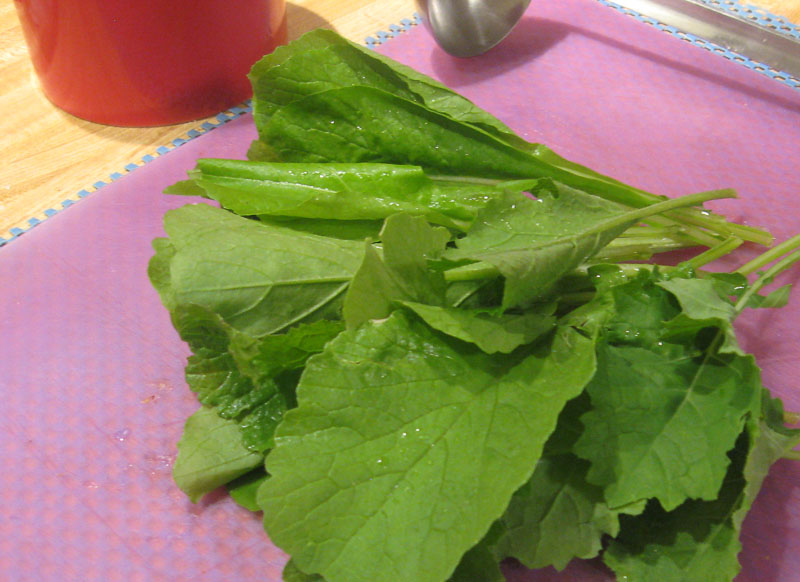
About half an hour before I was ready to eat, I went out to the garden (which I share through the good graces of a neighbor) and picked a good size handful of small kale, turnip, and mustard greens.

After washing, I cut these in bite size pieces (though that was almost unnecessary as they were really not as big as my hand). They went into the crock-pot; in about 20 minutes they were still bright green but tender.

I did a final adjustment of salt using French Grey sea salt, and finally added several drops of black truffle oil to finish the soup.

-<>^<>-

I’ve had my bowl of soup for supper this evening–and it looks as if I’ll get one more meal out of those turkey thighs–with the barley, and the amount of meat that was left on the bones, there is easily another serving of this soup for lunch or supper tomorrow. (I’m sure that by the time I reheat it, those greens won’t be quite so bright green, but the flavors may have melded with the other ingredients so it should be good–maybe even better than this evening.

bowl of soup with greens

a warm, hearty supper

-<>^<>-

I opened a bottle of wine this evening that was a completely unknown to me. It was a limited release called “Dark” from Apothic. I was completely beguiled by the description that said that it “blends dark fruit flavors of blueberry and blackberry with opulent notes of coffee and dark chocolate”.  How could I possibly pass that up? (I found it while shopping at Harris Teeter–just after I had bought a case of something called “Besieged”–more about that one later.)

I was surprised how dark it was when I poured it into the glass! (I even tried to take a picture–but it just looks almost black–so forget that.) It is definitely a “big” wine and right out of the bottle it was fruity and mellow–but after breathing for a bit it lives up to its description.

I thought it might overwhelm my bowl of turkey soup, but with the juniper berries, the rather emphatic mushrooms, the flavors of the greens, and the truffle oil, it turned out to be a great combination.  Fortunately there is some of the wine left for tomorrow’s soup! This is one time when I’m looking forward to the “leftovers”.

It’s turkey time–again!

At the risk of being considered heretical, perhaps even un-American, and definitely not in the proper holiday spirit, I’m going to come right out and say that turkey would be my last choice for the main course of a holiday feast.  I’d much rather have duck, goose, roast pork, prime rib, or even roast chicken, (unless we’re going to talk wild turkey).  The problem is that it’s an achievement to get a whole turkey to be edible (and I do have a friend who does that well, so I eat her turkey–it’s the best I’ve had when the bird is roasted whole). The problem is the turkey–not the cook!

It seems to me that turkey is all about presentation, and NOT about cooking it to the best advantage. We’ve bred turkeys to have a huge chunk of breast meat, which really isn’t that flavorful. That white meat is attached to the legs, dark meat.  Now dark and white meat cook very differently, and here they are attached to the same bird, so that you have to cook them together–a real cooking dilemma.

Not to mislead you, some of the same problems exist with chicken, or Cornish game hen/poussin, though it’s easier to find ways to have both come out reasonably well on the smaller bird. The white meat still is not as flavorful as the dark, even on free-range chickens. I do use the breast meat–I usually cook it separately from the dark meat, but do sometimes roast a whole bird (French style in a dutch oven, in the Romertopf, or sometimes just uncovered in the oven). 

It’s not that I don’t like turkey–at least occasionally–even the white meat.  I just want it like I want all my food–to have the best taste and texture possible. It’s always seemed to me that when you have two things as different as turkey legs and breast, that you should not try to cook them together–neither will be at its best.  Cook’s Illustrated has provided a recipe for optimizing turkey, and it involves taking it apart, but it also provides for stuffing, and presentation, too. I’d like to try this out with a whole turkey to see how complicated it is to get it done.

I’ll buy turkey breast fillets almost any time for a quick sauté–just like I’d do chicken breasts, but I still like dark meat best. I’m actually glad to see turkeys in the market–especially the pieces–light and dark meat separately. While you can almost always get turkey breast and sometimes even the drumsticks, what I really like are the thighs–without the drumsticks attached. I was happy to find turkey thighs at Harris Teeter when I went to do my marketing yesterday.

roasted turkey thigh in roasting pan

turkey my way

Yes, even though turkey-eating season is about to get into full swing, I came  home with a package of turkey thighs–and tonight I had roast turkey–thigh that is.

It’s ideal for cooking for one–and inexpensive as well. One roasted turkey thigh will give me several meals: hot roast turkey, a cold turkey sandwich, and a serving of turkey soup.

-<>^<>-

Since I was working on an indexing job today, I really did not get fancy with my turkey thighs. I just let the thighs sit for a couple hours in the refrigerator, uncovered, so the skin would dry.  I plopped them into the roasting pan with some wedges of potatoes, and salted the skin liberally so it would be crisp and golden brown. Then, into the oven (350°F) for about an hour, and out came my roast turkey.

roast turkey thigh partially carved

ready to serve

I let it rest just like a whole bird, and then carved off my supper. Since I was after as few dishes to wash as possible, I made a cabbage dish that I wanted to try, and had potatoes roasted right along with the turkey–no gravy or stuffing tonight. (Cook’s Illustrated did give instructions for making stuffing with the disassembled bird, and I do want to try to adapt that for my single-serving quantity–but just not today. It was an easy, inexpensive, and tasty meal.

I’d eat more turkey if I were able to get thighs year round.  I’m looking forward to more roast turkey in the next few days as I have another thigh that’s been roasted.  I suspect there will be more than one turkey sandwich, and some will end up in with the bones in some hearty turkey, barley or lentil, and mushroom soup from my tiny single-serving size slow-cooker.

plate of turkey

Check out this recipe….

We’re into hot, humid weather now so I’m always looking for hearty, meal-type salads.  I just found this one which has gone into my must-try category.  From The Honor System:  Chipotle Chicken Salad.

After-holiday sales…love ’em!

My favorite most-frequented supermarket is my local Harris Teeter, though I do occasionally wander into the Kroger. I’m a pretty frequent shopper since I don’t do well at meal planning.

Right after the holidays I always seem to find  some goodies in those end-of-holiday-season, reduced-price carts that I wouldn’t purchase otherwise.  Last year it was black truffle oil which has been put to good use this past year, and even recently when I was trying to do some wine-food pairing. (It’s been drizzled on baked potatoes too–my serious, decadent comfort food.)

A couple years ago, I was planning to do a roast goose (obviously requires friends in attendance).  When I got to the checkout, the price of the goose was SO low that I got a second one.  Good thing because we had snow and ice on the day I’d  planned the dinner.  You really can’t undo the thawed goose, so I toured the neighborhood within walking distance with impromptu invitations to eat goose–and found willing neighbors.  (These who missed that got to help eat the second goose when the weather permitted.) So the freezer case has become a place that I also skulk through at this time of the year as well as those “manager’s special” carts.

Two Whole Pheasants- Pheasant Meat

Dinner!

This year so far my “find” is pheasants on sale. I’m planning a pheasant dinner with friends shortly.

I get the pleasure of planning the meal, picking a wine, and then eating and drinking with good company. It’s in the planning stages now–braise or roast? Maybe the Romertopf since I do have a very large one?

Perusing recipes and thinking about wine is pleasurable activity. I’m leaning toward a bottle of the Ravenswood “Besieged”, but I might have to check with my favorite wine store before I make a final decision, and after I’ve decided what seasoning these birds will get.

Spicy Peach Chicken Wings Two Ways!

Image

What’s the best way to say this? I. LOVE. TO. GRILL! Now that you know this little secret about me, let me share one of my favorite sauces that I like to make while cooking. First I want to acknowledge that a lot of people are intimidated when it comes to dealing with MEAT and FIRE. This type of cooking has been going on way before Man realized that wearing white after Labor Day was unacceptable. Besides eating sushi or raw fruits/veggies I can’t imagine a more natural way to enjoy food. Regardless of your belief of how and when we got here once Man found fire he also found his love for a Medium T-Bone steak. I’m just saying.

In this article I’m going to share with you TWO different ways to prepare chicken wings. One will be for you go-getters out there who love to put meat on fire, and the other will be for the less adventurous group who likes to play it safe.

If you are ready to receive your fire badge in scouting then you will take the road I love to travel by and go fire up that grill! Even with grilling you still have options on how you actually want to achieve AWESOMENESS. You can use “Propane, and Propane accessories”-Hank Hill or you can use Charcoal. I personally prefer using gas since you can control the heat and when you’re done, you’re done! With charcoal you will have to move up to the advance cooking class since this will require a lot more concentration and skill set to master this form of cooking. Charcoal will definitely give you that authentic home cooked flavor, however it will also give your wings 5th degree burns really quickly if you don’t pay attention!

Ok so enough about that. Let’s cook!

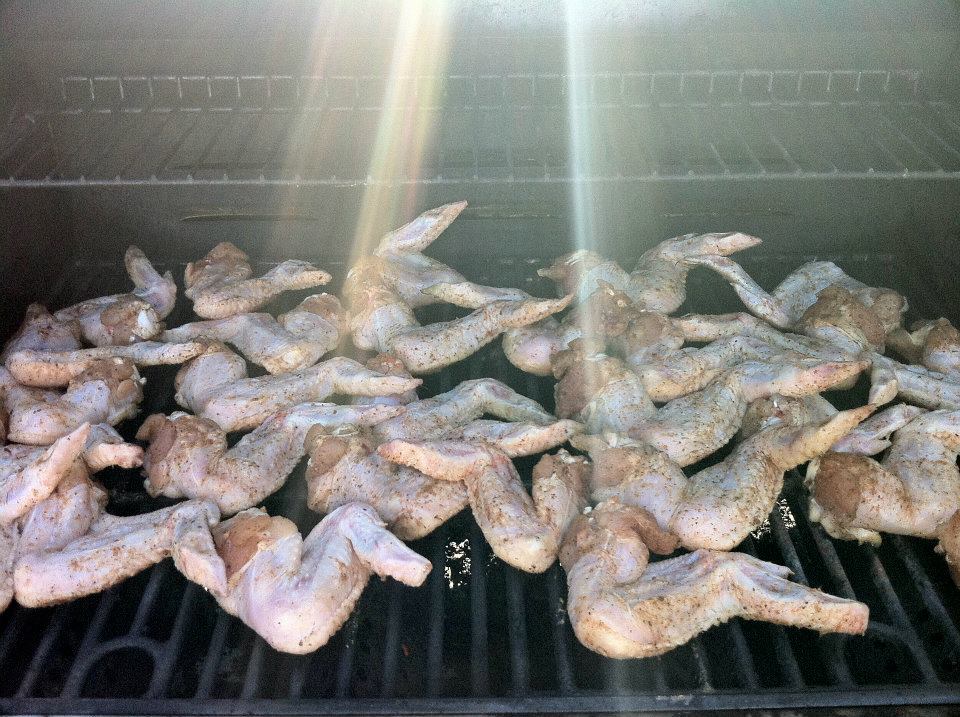
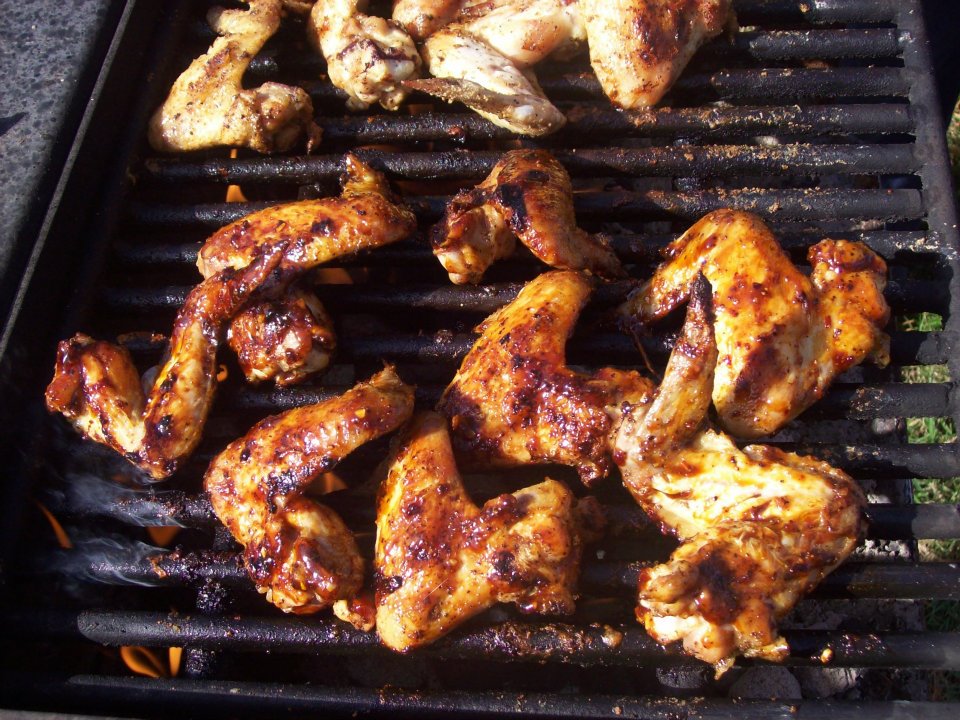
Propane: Cut your grill up to medium-high heat to get the grates nice and hot for the initial sear when you lay the wing down. After placing the wings on the grill for a couple of minutes, lower the heat and flip those bad boys over. At this point there should be a little color as well as grill marks on outside so that you can keep up with when to turn your wings. Keep rotating so that each sides gets crispy brown skin. Don’t wait to long to add the sauce, the last 10-15 minutes of cooking should give you enough time to let the flavors marinate all the way through.

Charcoal:  After you have your nice and red hot you will have to work a lot harder than your gas friend up there because now it’s all about the Indirect Heat method. Ten out of 10 times your grill is going to be extremely hot in the center where you have nonchalantly piled all the charcoal and set it on fire with half a can of lighter fluid. Once you have brought the level 3 fire down to burning red coals you will need to place the wings on the outer perimeter so that you can control how quickly your wings will cook. 

There is no way I’m going to say it will take approximately (fill in the blank) minutes and your wings will be perfect. I can’t sell myself out like that. But I can tell you that the food will let you know when it’s done. Chicken wings start of pale, soft and flabby-just like a newborn baby! Then in the toddler years they will make a lot of noise by hissing and spitting juices everywhere (terrible two’s phase). This is when you have to constantly watch them and move them around to make sure they don’t burn up. Once they become teenagers they have more color to them, stay to themselves and become firmer. They think that they are grown however on the inside they still haven’t developed yet. (I’m 15 and I know everything and my parents are lame phase) And then we come to the adult phase. Now it’s time to sauce em’ up. They have graduated college and ready for the real world. CONGRATULATIONS! You raised your wings right. They have earned the privilege to become a part of the meal.

Now for those of you who choose to bake/broil the wings instead of grilling not only do I give you a serious side eye but I will give you what you need to attempt to duplicate that outdoor flavor without actually going OUTDOORS!!

After seasoning your wings with the dry ingredients (salt, pepper, paprika and garlic powder) your oven should already be on and ready for action at 400 degrees. You are going to lay the wings out in the pan and leave them uncovered. The point is to get that skin crispy as if it had been lying out in the sun all Summer. That crunch is what you are looking for, we want savory crispy wings not soggy chicken pieces. So after 50 minutes (half a Lifetime movie) you want to check and see if those wings have plumped up
and start turning brown like this.

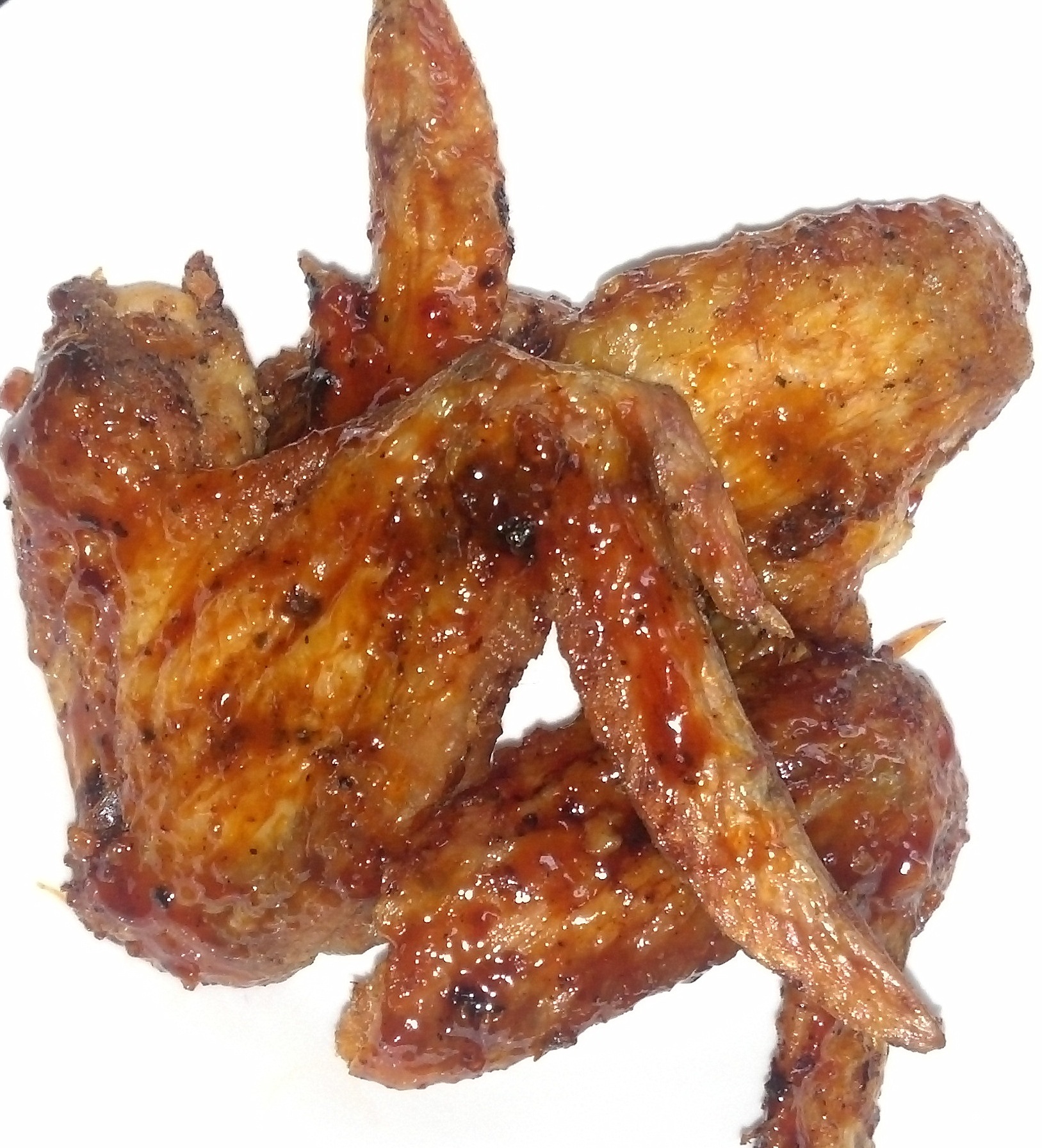
Alrighty then, your wings are ready to be sauced up! At this point you want to add all that finger licking goodness to the chicken so that they can be joined for eternity in flavor heaven. I actually would add the sauce probably around the 40 min mark just so that it gets in there all the way to the bone! Once you have the wings sauced and crispy now it’s time to crank up the heat and cut the broiler on. This will allow the wings to get more color and tighten up the skin just as if you had grilled them. Now is the time to pay attention to what’s going on in the oven instead of pouring that next glass of wine. Things can go from happy-go-lucky cooking time to OH GOD WHERE’S THE FIRE EXTINGUISHER?! Please check on your wings every 5 minutes until they are at the level that you prefer. The sugar in the peach preserves will heat up and become sticky, this will also cause the wings to “burn” more on the outside so unless you want wings that look like tar I suggest you watch them carefully.

This is what I have come up with after cooking in the oven and plating.

So below you will find the recipe for the Spicy Peach Sauce that I have talked about this whole time. The great part about this is the fact that almost any sauce can be substituted based on whatever flavor your palate is looking for at the time. I love complex sauces that make you think about what you are actually tasting. If you are going to eat something good, you might as well do it right!

Ingredients

  • 2 tablespoons table salt
  • 1  teaspoon black pepper
  • 1 teaspoon smoked paprika
  • ½ teaspoon garlic powder
  • ½ stick butter
  • 2 ounces of minced garlic
  • ½ cup peach preserves
  • ¼ cup hot sauce
  • 1 tablespoon soy sauce
  • Sesame seeds (optional)

Preparation & cooking

  • Prepare wing mixture in advance to let them marinate.  Mix salt, black pepper, paprika and garlic powder in a small bowl.
  • Add chicken wings and toss to coat.
  • Grill the wings.
  • Melt the butter in medium saucepan with the garlic.
  • Stir in the peach preserves, hot sauce, and soy sauce. Cook until syrupy and thick (stir so it doesn’t clump) about  5 minutes.
  • Transfer sauce to a large bowl.
  • Add the wings to the sauce and toss.

Enjoy!!!!

A one-dish meal.

A lot of us eventually reach the point when we realize we are getting a bit rotund (or worse) and start thinking about watching (or losing) weight, or maybe just being more conscious about nutrition.  With several of those things in mind (or should I really say on my mind) I did some web browsing.

I found a website that I’d like to share with you:  A Slice of Nutrition.  I found this through another blog that I follow, My Imperfect Kitchen, that had a post by Avital Greenbaum as a guest blogger–Chicken, Zucchini, and Quinoa. 

One dish meals are very appealing to me–at least some of the time, because I can be lazy, have a good meal and not have to wash lots of pots and pans.  (No, Frankie refuses to do that!)  I’ve had quinoa in breakfast cereals, and things like that but after reading how healthy it is, I decided I need to try it in a main dish and this looked like a great place to start.

Garlic scapes lying next to a basket of strawberries

garlic scapes

I do have to admit that, as well as being constitutionally unable to make a small pot of soup, I seem to be unable to leave a recipe alone when I’m making it.  I did almost follow this one.  Instead of garlic powder, I had fresh, green garlic scapes from the farmers’ market.  Those went it, and I added some mushrooms; otherwise, I left it alone.  This one-dish meal is now in the oven (despite the heat) getting ready for my supper.

Since my veggies are included with the dish, I think that all I’ll need to add is some of those luscious ripe strawberries as dessert!


Baking dish with chicken and quinoa

Chicken, zucchini & quinoa

This is a keeper–only a few minutes prep, and it’s unattended cooking with tasty results. The quinoa is very light–good in hot weather.  I think that it might make some very tasty “salads” with lentils for satisfying summer meals when the weather is sweltering and I want a light meal.

Cornish hen braised in milk

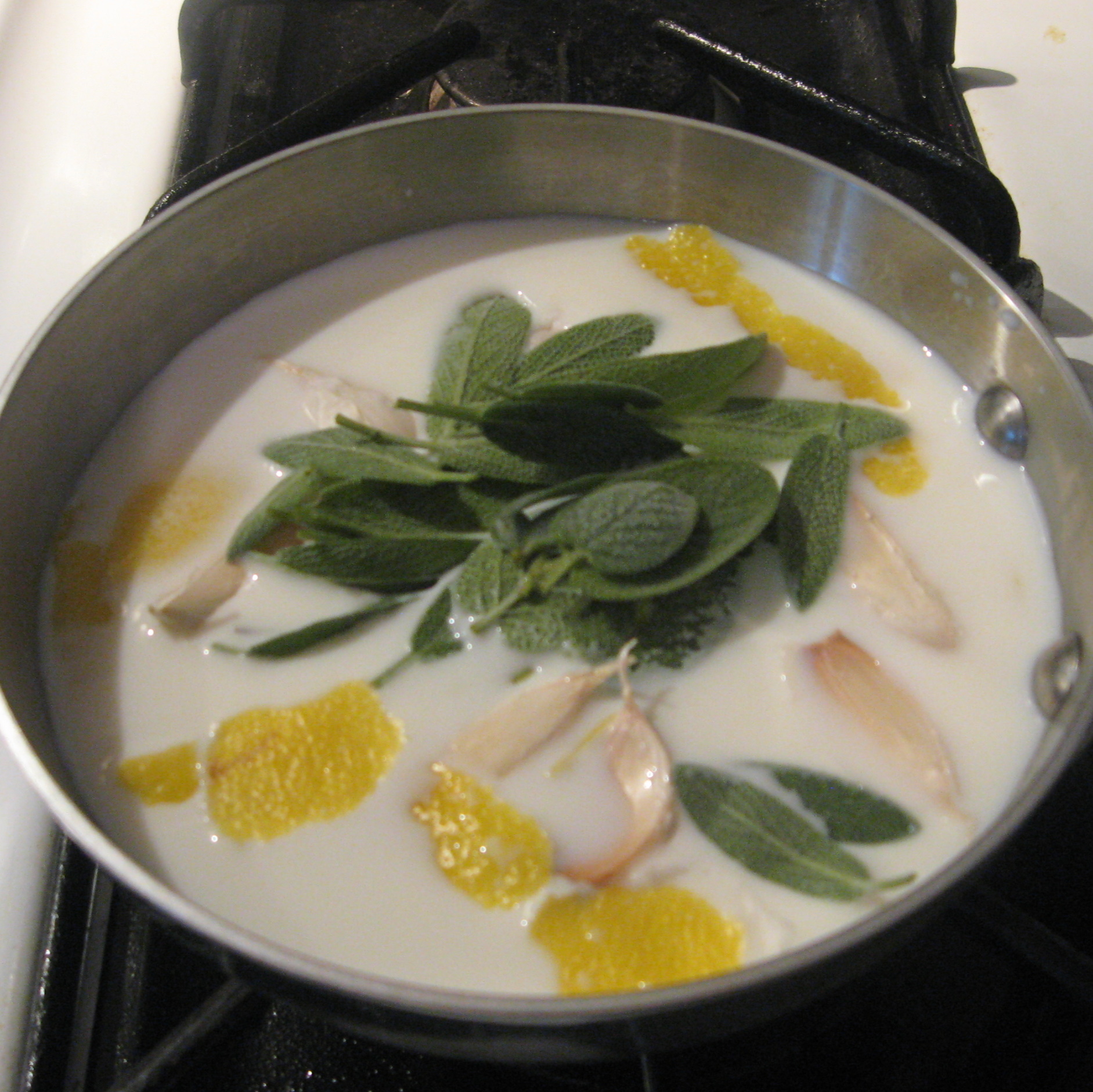
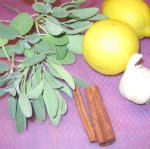
sage, cinnamon, garlic and lemon

I had an earlier post about braising chicken in milk, when I tried the recipe using chicken pieces since that gave me something more like a single serving.  Flavor was great, but I thought that for something a bit scaled down, but more in keeping with the original recipe, I would try this with a Cornish  hen and see how that worked. One of the advantages of these little birds is that they are more in keeping with  Jamie Oliver’s recipe, rather than the chicken parts that I tried originally. This might be a way to keep with the spirit of the original recipe, but scale it down to something closer to single-serving size.  While this is a recipe that might do well on second runs, I really don’t want as much as whole chicken would make.

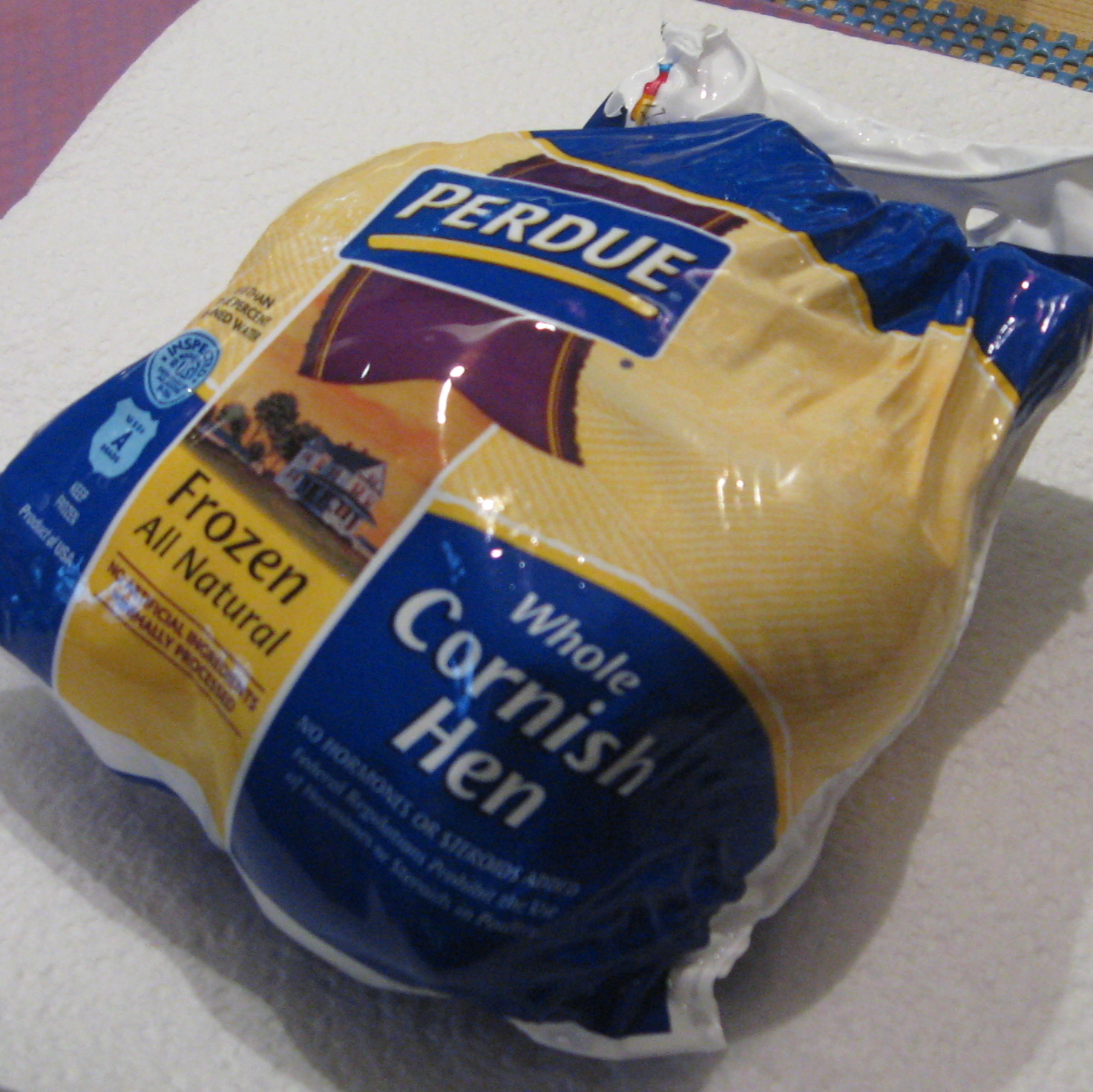
Well, the weather has turned to fall with blowing leaves, and chilly temperatures so this seems an excellent time to try this again…and my grocery shopping provided me with a lovely price on a pair of (frozen) Cornish hens–about 1 to 1-1/4 pounds each.

A Cornish hen–either male or female regardless of calling it a “hen”–is a special breed of chicken (in the USA sometimes also called a poussin, though that is really French for a very young, small chicken that is usually about a pound in weight).  Since my supermarket does not offer poussins, but does have the Cornish hen (which is a young, hybrid chicken–of Rock Cornish with some other breed–not over 2 pounds by USDA specifications) that’s what I’ll use; I was fortunate enough to find some hens that were just about a pound or a pound and a quarter each.

While browsing some of my favorite blogs, I found a discussion of Jamie Oliver’s recipe–where an oversight  of lid on instead of off for part of the time was compared to the bird braised in an open pot.  This made me think of the French chicken in a pot that I had cook recently–one of the things that was  impressive about that was how the flavors seemed to permeate the meat itself.  I decided to try this with the  lid on for part of the time just for that reason.  (I do have two Cornish hens–so maybe I need to do the same here–one each way!
One of the things I discovered when doing the chicken parts was that just because you are using 1 pound of chicken instead of 4 pounds, you might not want to just take a quarter of the seasoning ingredients–the flavor was good, but perhaps a bit on the wimpy side; so I have to find a way to optimize that when cutting the recipe to single-serving size.  I decided that this time, I will make up the seasonings and milk as if I were doing the large chicken (in the 2 cups of milk).  I thought I’d simmer the seasonings in the milk and taste to see what that was like, cool it and add what seemed appropriate for the size of my bird and my pot.

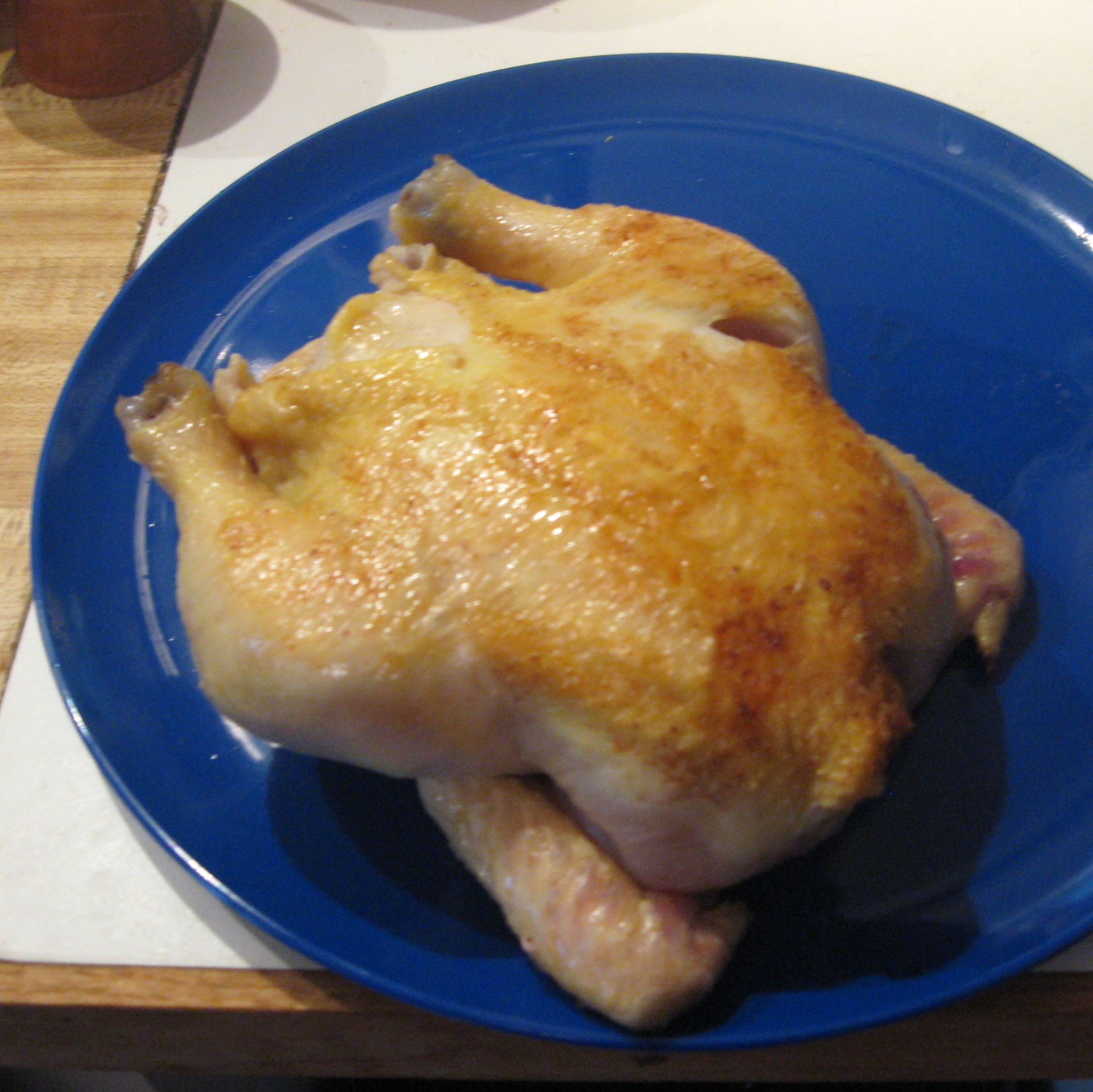
The petit brasier was a no go–too big around–so I used my 4-quart All-Clad pot as being the closest thing to a “small” dutch oven.  The whole stick of butter was obviously not necessary so I used just enough (about 2 tablespoons) with the olive oil (about 2 tablespoons as well) to brown the hen.  (One thing I did discover is that the skin on a Cornish hen is much more fragile and has much less fat under it than does a more mature chicken.)  Just the smell of the hen browning in the butter and the olive oil is fabulous!

browned bird on plate

There was not much fat in the cavity either so I returned about half of the butter/olive oil mixture to the pot with the chicken.  Giblets were mostly not included–just the neck, but I browned that and included it in the braising pot for  extra flavor.

So here’s my bird, browned, and ready to go back into the pot to braise with the seasoned milk.  (Next time I’m doing a Cornish hen or poussin, I think that I’ll try using just half the milk with half to three-quarters of seasonings even though these birds are only about a quarter the weight of the chicken called for in the original recipe.)

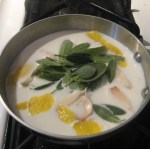
browned bird in the pot with milk and seasonings

After steeping the other seasonings in the warm milk, and then letting it cool a bit, I tasted it–very lemony and sage-y, but not much garlic or cinnamon yet; (that came out later in the braising process).  I divided the milk and the other seasonings in about half since that looked like about the right amount of liquid (the eyeball test!!).  It took about 1 cup of milk (and I added half the solids) so the rest went into the freezer for a repeat, or perhaps just to braise some chicken thighs or poach some breasts. ( I did put the cinnamon into the braising pot with this bird).

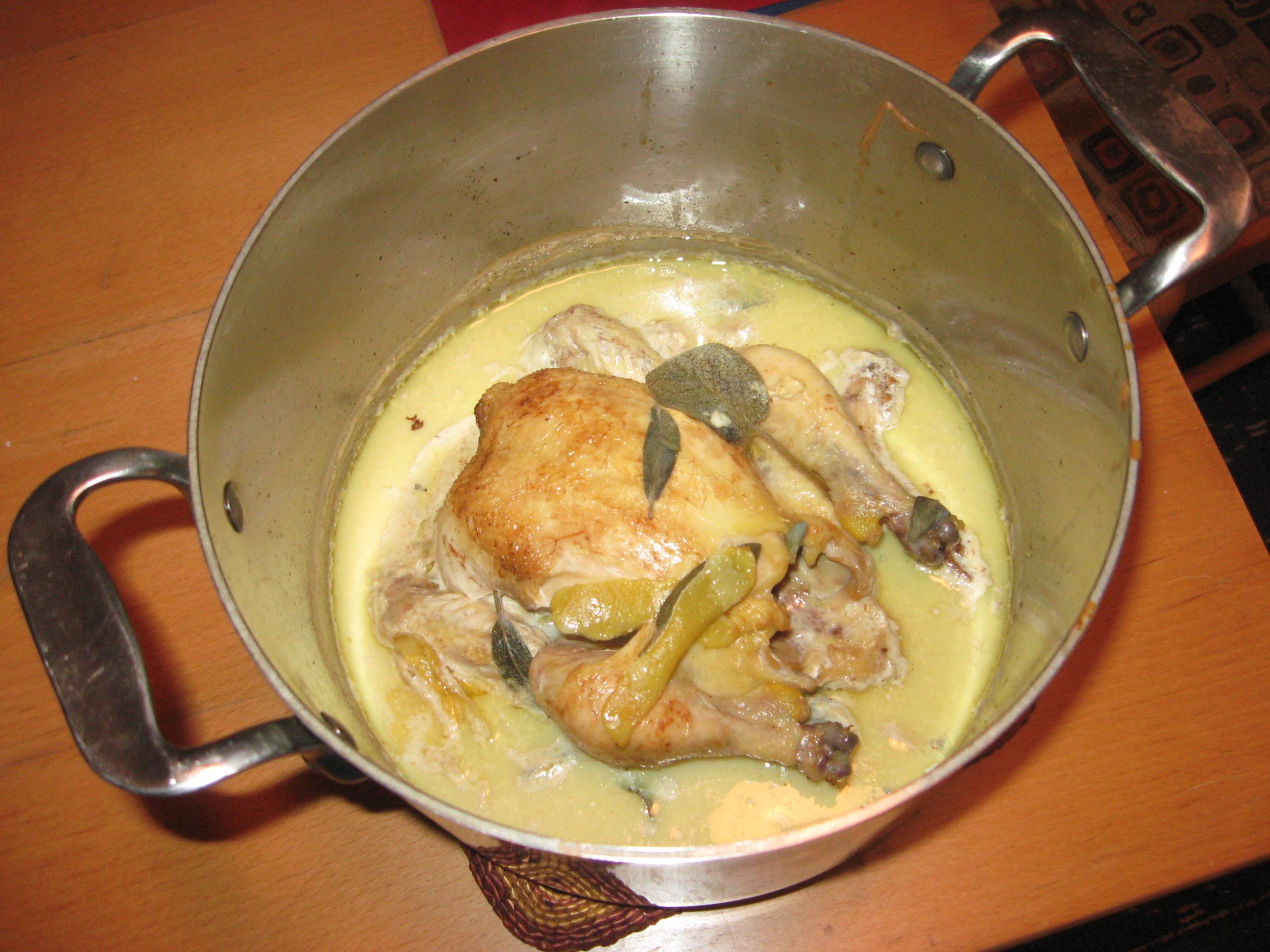
braised Cornish hen

Since it was a smaller bird and the braising liquid was already warm, I reduced the oven temperature to 325 ° F since I wanted enough braising time to let the flavors actually get into the meat (as it did in the French chicken in a pot).  I decided to go with lid-on for about 30 or 35 minutes and see how it looked then, and finish the braising with the lid off so that the liquids reduced more.
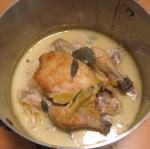
bird in pot after 30 minutes in the oven with lid off

lid off for about 30 minutes

After another 30 minutes in the oven with the lid off, the sauce has reduced some and it looks falling-off-the-bone tender.

Somewhere along the way, all those unlikely, highly individual, and potent seasonings have turned into a complex, earthy  taste and aroma.

I’m ready to eat!

Admittedly this does not look like it’s going to be a dish that lends itself to elegant presentation, but it’s certainly a keeper for comfort food.  Braised in a container that could go directly to the table it would make a nice casual presentation as the skin does brown more after the lid comes off.

•♦•«»•♦•

The  pot  that I used was just a bit deeper than I might have liked, but better too deep than too wide since that would need too much liquid to reduce by the time the hen was done.  Unfortunately, the bird was just a bit too tall to fit into my small chef’s pan–but this was close enough.  The sauce does look “curdled” but tastes wonderful!  Just the thing for a damp, drizzly, autumn or winter evening!

chocolate mug with sage-lemons IMG_4796The original recipe for a whole chicken would be great for causal company–this is definitely a keeper!   I had this with basmati rice, roasted baby carrots and baby zucchini.  Sautéed  spinach, or maybe broccoli raab would be good too.  I think that the slight bitterness of the broccoli raab would be a great contrast to the way that these seasonings meld into a very earthy background to the chicken.

A son goût!