
Even though it’s colder than some parts of a witches anatomy (for here, at least), I have to pass on the link to Ice Cream Magazine. Although I doubt I’m going to be digging out the ice cream maker for a while this looks like a fun website to explore this summer–since ice cream is one of my favorite sweet things. There are some savory tarts and things like that, too.
Cake is in the oven…
…and I’m waiting, none too patiently for it to be done–it smells heavenly: buttery, coffee-y, nutty, with a little caramel-molasses-like overtone from the brown sugar.
(It’s a very easy cake to put together–you don’t even really need to use a mixer–but since it was sitting there on the counter, I did use it.)
The recipe from Promenade Plantings called for walnuts. I have to confess to not liking English walnuts–even when good and fresh they have a bitter overtone that I don’t like, so I substituted pecans in the recipe since I really like them.
The house is smelling SO good–it smells like it needs some good dark chocolate–hmmmm, coffee, chocolate, and nuts. If it tastes like my nose tells me it will, I may try it with some chocolate bits in it too. I can already tell that waiting for it too cool is going to be some sort of ordeal!
_<>_<>_
Finally, it’s cool enough–just couldn’t stand it any longer. All the time I’ve been smelling it, I’ve resisted making some ganache–so far successfully, but the longer I smell that cake….
OMG, is that every good! Tastes every bit as good as I though it would–and as it smelled. It doesn’t scream coffee at you either–I suspect that even non-coffee drinkers would like this.
I’m enjoying it with a big glass of cold milk right now, but I definitely want to try it with coffee–probably with my breakfast coffee in the morning. This could be habit-forming!
A cake I want to bake
You can tell from the posts here that I don’t do a lot of desserts. I usually satisfy my sweet tooth with fruit (dried or fresh) or dark chocolate. Sometimes something like the brioche filled with chocolate ganache. I will admit to really liking so-called “pound cake” or pâte à quatre-quarts; otherwise, I pretty much leave cakes and pies, and the like alone; but then there are some like the bay-infused pound cake (which is fantastic by the way), or the lavender-lemon cake….you get the general idea.
Browsing about on one of the blogs that I follow (Promenade Plantings), I found a recipe for a coffee and walnut cake that looks like one that I might really like, so I though I’d pass this link on to all of you who don’t want gobs of terribly sweet icing or gooey glazes.
This image is from Promenade Plantings. If you think that looks delicious a click here will take you to the recipe for a cake that makes me want to bake–and make some espresso and sit and visit with friends and neighbors.

from Promenade Plantings: Coffee walnut cake
A jar opener that actually works

.It works!
I’m not one for a lot of kitchen gadgets but I have one that I wouldn’t want to be without–a Black & Decker Lids Off jar opener. I had tried all sorts in the past and really given up on all of them until a friend brought me one of these that she found on a prowl through a thrift shop–so it was cheap. From Amazon.com they are NOT cheap–but if mine were to crump on me I’d be trolling through thrift shops or Amazon.com looking for another one.
I’ve only found two jars that it wouldn’t open–one was a Costco-sized jar of roasted red peppers–in other word, huge–so the upper grips wouldn’t spread quite enough to hold the lid. The other was a jar with very rounded edges to the lid–also a jar of roasted red peppers–though smaller size.
This is not a bottle opener–it’s not designed for beer bottles or lids less than about 1-1/2-inches in diameter–I’ve not had occasion to try smaller than that. I used it on jars about 2-1/2-inches in height. The jar with the lid that was too big was a 4-inch diameter, so it does do a good range of sizes. (Have another gadget from the hardware store to handle these now.)
Even with those two “failures” this is a kitchen must if you have difficulty with opening jars for any reason. It folds down for storage so it doesn’t have to stay on the counter all the time, but the handle on top lets you move it easily–altogether a worthwhile kitchen gadget!
Posole
There is one good thing about having to hike out to the dumpster with the trash, especially when you’re cooking something. If you stay in the kitchen too long you olfactory sense habituates to the aromas. Take out the trash and you get a great new olfactory preview when you get walk back into the kitchen–especially if you spend a bit of time chatting with the neighbor who is also taking out the trash.
 This cold weather has me cooking stew-y sorts of things. A friend sent me a care package from New Mexico recently: blue and white corn with a recipe for making posole (or pozole, if you’d rather). Today was the day, since I was organized enough to remember to soak the dried corn overnight. By the time I had sauteed everything, browned the pork, onions, garlic, added the oregano (had to do Turkish rather than Mexican until I do another Penzeys order), and the chilli pods I wasn’t fully appreciating the aroma of the cooking. I popped the covered dutch oven into the oven and took– out the trash.
When I opened the door and walked into the living room, I was definitely getting a fresh sensation: the browned pork, the oregano, the chillis–this smells like warmth and comfort on a cold day!
White Corn Posole
This is the recipe that came with the package of Los Chileros de Neuva Mexico package of white corn posole. I more or less followed the recipe–
Ingredients
- 6-8 chile pods
- 2 pounds cubed pork (or beef)
- 3 cloves garlic minced
- 1/2 teaspoon Mexican oregano
- 1 teaspoon of salt.
Preparation & assembly
- Soak the posole (12 ounces) in water to cover overnight.
- Boil the posole in salted water for about 2 hours.
- Add meat, chilli pods, oregano and garlic.
- Cover and simmer for another hour or until the posole is tender, stirring occasionally.
<>\/<>
My first deviation from the recipe was to brown the pork (in a little bacon fat) before adding the liquid and the other ingredients. My second deviation was to use 4 chilli pods (ancho and guajillo) and then about 2 teaspoons of Hatch chilli powder. I had tasted before adding the chilli powder–and it’s wasn’t spicy enough. I’ll see what it’s like when I reheat it. My other deviation was to add way more garlic.
I’d looked at other recipes for posole online, and found lots of recipes calling for other ingredients–cumin, coriander, and even tomatoes. I decided to start with this simple, rather a straightforward one for my first try at posole.
I really think that Mexican oregano is a must–the Turkish just isn’t quite right here–it’s sweeter than the Mexican to my taste and would fit better with the corn flavor. I’m likely to add some cumin and coriander next time around as well. I may add onions (caramelized) as well. It’s a recipe in evolution now. I think a little more “brown” in the flavor would be good, as well as some smoke from either chipotle peppers or from pimentón–but definitely Mexican oregano next time. I used water here and not pork stock, but I think that pork stock would be tastier–especially if the bones/meat were browned before making the stock.
Even though this is a simple soup/stew, a bowl of this is very satisfying on a cold day when you need warmth and a full tummy!
My friend also sent blue corn–which I’ve only had in tortilla chips, so it will be interesting to see how that compares to the white. I do suppose you could make this with canned hominy, but this seems to have more corn flavor that I remember from canned hominy. I’m going to enjoy trying out different seasonings here.
Roast pheasant for dinner
 On a recent troll of the after-holiday, year-end goodies at my local Harris Teeter, which includes the free-standing freezer in the meat department (as well as the carts at the front of the store), I found pheasants on sale so I decided we (neighbors and friends) needed to have pheasant–especially since at least one had not tasted pheasant.
This is a first for me–I’ve never cooked farm-raised pheasant before; I’ve always cooked the wild birds that we got by hunting. Those we always braised since they could be old and tough. I went to the McFarlane website Pheasant for Dinner to see what information I could find. I guess these are not likely to be either old or tough, so I thought about roasting–then I decided that cooked in my Romertopf might be best since pheasants–even farm raised don’t have a lot of fat on them. I decided that brown basmati rice would cook at the same time under the cut up birds; kind of self-seasoning with the pheasant juices–and whatever else I decided on.
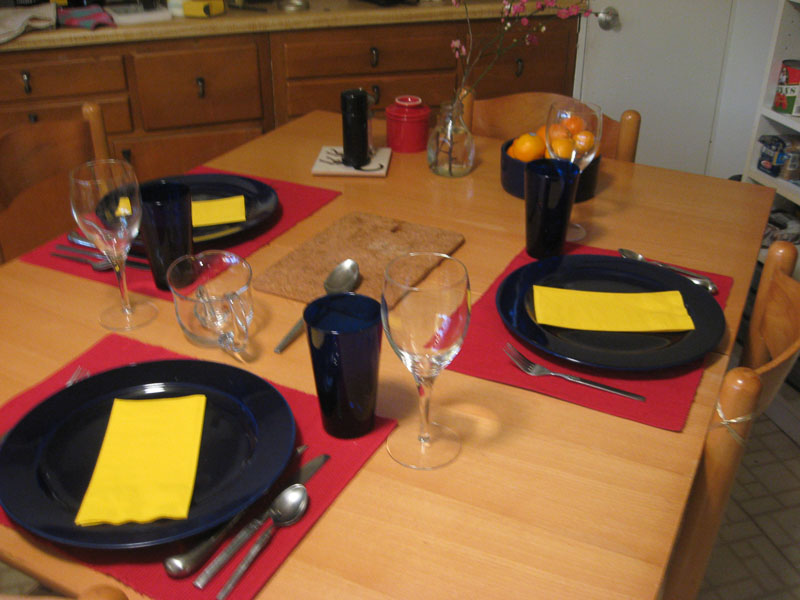 Since this was my first crack at farm-raised birds, I decided to seek expert consultation–from Mike Thomas in the meat department at Harris Teeter, thinking it likely that he’d be able to tell me more about the birds and how they would cook. He agreed that the Romertopf should be a good way–so that decision was made.
As for seasoning, I was still debating. I wanted tangerines, but couldn’t find them. Tangelos? Well, maybe. The meat of the tangelos was not very tasty, so I got Mandarin oranges as well, but use only the tangelos as the mandarin oranges were too sweet.
I originally planned to do fingerling potatoes in the Romertopf with the birds, but I couldn’t get my head around orange and potato together, so I changed to brown basmati rice instead since it could also cook right with the birds in the Romertopf.
My next decision was whole or cut up. I finally decided that cut up would be best–so that I could use the carcasses to make some stock for cooking the rice. So get out the knives! I found a good demonstration on cutting up a pheasant at the McFarlane website–as I thought it’s like disjointing a chicken. Since it’s not something I do all that often when doing single-serving cooking, it did take a bit, but I got them cut up. I left bones in–even in the breasts since I think there is a lot of flavor in meat on the bone.
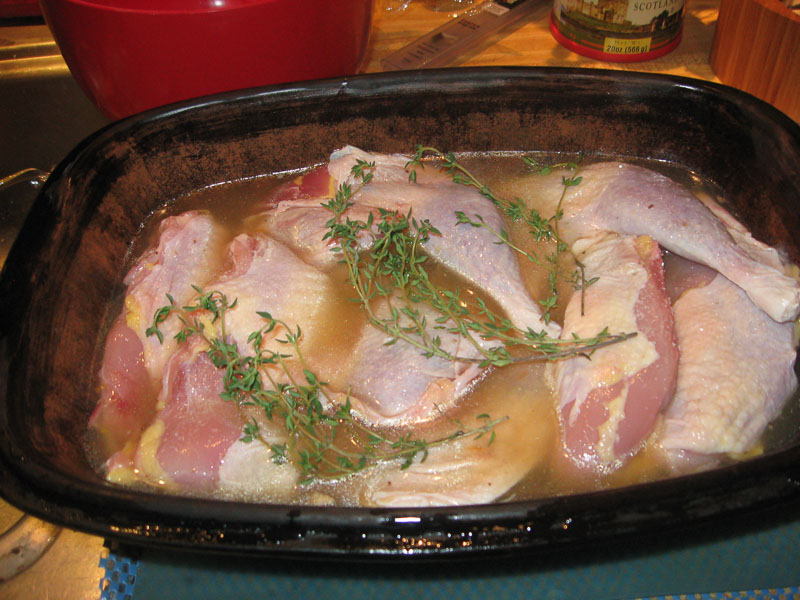
into the oven
The backs, wings, necks, and other miscellaneous pieces, with carrot, onion, and bay leaves went into the stockpot (after browning). Simmered and skimmed I had a good start on the rice.
I minced two medium onions, four large cloves of garlic, and sautéed these with the rice before adding it to the soaked Romertopf with the rinsed basmati rice (two cups) with stock. I added the zest of two tangelos to the rice. I pulled the meat from the stock bones and the giblets, chopped them finely, and added those to the rice–kind of a “dirty” rice here. That plus the 4 cups of stock went into the soaked Romertopf with the pheasant pieces on top, and into a cold oven, as usual with the Romertopf.
For a sauce, I modeled it after the one used for duck with fresh figs; I reduced the remaining pheasant stock and the juice of one tangelo slowly to about 1-1/2 cups–it’s not intended to be thick–more “au jus”. It needed a bit of sweetness despite the tangelo juice. After tasting both thyme honey and leatherwood honey, I opted for the leatherwood, since there was thyme with the bird and the leatherwood added a “dark” contrast to the tangelo and the meatiness of the stock.
(It looked great when I opened the Romertopf, but I was too intent on eating to stop and take pictures.)
My friends brought some awesome roasted Brussels sprouts (with bacon and garlic) to accompany the pheasant–a good meal, with good company!
<>^<>
I used the ratio suggested for the brown basmati rice, but it was just a bit soupy. Next time I’ll use 1 part rice to 1.5 water. Otherwise I was pretty happy with the results–we certainly made a dent it the rice and the pheasant.
The farm-raised pheasants are more chicken-like than wild-pheasant-like–a little disappointing if you are used to the wild ones. I’d cook them again–if I find them on sale, but I’d really rather have the wild ones, though I certainly wouldn’t have been roasting them.
Not knowing the flavor of the farm-raised birds made choosing a wine a bit difficult. We drank a 2012 Ravenswood “Besieged” with it, and it worked well. This limited release is a blend containing 35% Carignane, 20% Petite Sirah, 18% Zinfandel, 13% Mourvedre, 9% Alicante Bouschet, and 5% Barbera. (This was a wine that I stumbled upon while doing my shopping one Saturday at the local Harris Teeter. I’m a definite Alicante Bouschet fan and this blend was very mellow, and fruity so I did something that I don’t do often–I bought a half case of it–and I think I’m going to wish I had more of it.
It’s that time of year again….
Yes, the New Year is almost here. I’m sure I’ll do like most of you and make some resolutions–but really all I should do is make a resolution to try to keep the ones that I made last year…and the year before that, too. My big one has to be one that was only partially successful last year–lose weight and exercise more. I guess that’s really two. Duh!
I’m trying to plan how to be more successful with keeping my well-intentioned resolutions this year–after all, my doctor did tell me (again) that I really need to lost weight (and I know that the exercise really does go with that effort). Just like so many other people needing weight loss, I’ve read, though not just about weight loss, but about responsible eating, too. Recent reading includes:
- Gary Taubes, Good Calories, Bad Calories (incredible bibliography)
- Mark Bittman, V6B (another good bibliography and interesting that it’s written by someone who is a serious “foodie”)
- Eric Westman, The New Atkins for a New You (Duke University)
- Richard Wrangham, Catching Fire: How Cooking Made Us Human (fascinating physical anthropology discussion of how cooking changed our evolution)
- Pierre Desrochers and Hiroko Shimizu, The Locovore’s Dilemma: In Praise of the 10,000-Mile Diet (interesting for the energy analysis that they do regarding the various energy expenditures related to putting food on the table)
- even some Kindle samples on the “flat belly” diet, and the “Paleo” that never got past the “sample” stage!
I have to confess that I’ve done the high-protein, low-carbohydrate one—it does work, but….true to promises made in the books, I wasn’t hungry. Now here’s the kicker, I wasn’t hungry, but I really, really, really missed some things that were “forbidden”: milk, fruit, and some of the higher carbohydrate veggies, and legumes. Even though I like greens and use a fair amount of them, I got SO tired of greens—spinach, lettuce, kale, collards, arugula, and the like. I found that as soon as I tried adding back some carbohydrates, weight loss came to a standstill. Not a sustainable program, especially when you consider the amount of energy it takes to raise meat, particularly in the quantities that we in the US consume. I’m a meat-eater, but my mind boggles at the statistics about how much meat Americans eat. Then we could go on to the “factory farming” issues.
Some of these (Gary Taubes, Eric West (MD) and Mark Bittman) actually do some impressive and almost-scholarly nutritional and metabolic literature reviews. Some have prefaces written by medical people with credentials that are impressive. The studies cited are from reputable journals. The data presented on insulin resistance and metabolic syndrome were convincing though–we really cannot continue to ignore obesity issues and the disease consequences of these.
No matter how scholarly or well documented, or which particular method they tout, it all comes down to cut calories and increase your energy expenditure. One of the ways to do that is to eat more plant-based foods since many are not as calorie-dense as animal products–more fruits and veggies. I’m not planning to give up meat or animal products, but I will opt for better quality and less to keep the budget in balance and be somewhat “green”. I am an omnivore!
I can’t escape that if I’m going to lose weight I have to expend more energy than I take in; that’s the physics of the situation–so I’m right back where I started: eat less and exercise more. Seems this is where I started this year….
But all that aside, I wish all of you a healthy, happy, prosperous 2014 with lots of good food, wine, and friends!
Search for a perfect wine
I’ve told you about my Christmas eve oysters with black truffle cream–and the cava that we had with them. Well, here’s a follow-up on the wine conundrum. While it was excellent cava, it just didn’t do quite what I wanted with that particular combination. So I headed back to Wine Authorities here in Durham for another consultation. After a lot of consultation, I came home with two wines to try.
I had enough black truffle cream left to try a repeat of the combination with different wines, and my neighbor was willing to do a repeat, too. Here’s what we tasted:
- 2012 Viré-Clessé (Gandines, Domaine des, France) Domaine des Gandines, Viré-Clessé, Macon, Burgundy, France 2012, 100% Chardonnay.
 2002 Muscadet “Le Legendaire” Vieilles Vignes (Herbauges, Domaine des, France)
Dom. Herbauges, Muscadet “Le Legendaire”, Cotes de Grand Lieu – Sur Lie, Loire Valley, France, 2002, 100% Melon de Bourgogne.
We gave some close attention to the wine as well as the oysters. Both these are excellent wines which I would definitely buy again. Both were definitely closer to what I was looking for than then cava–though I’d certainly not refuse that again (even with oysters and black truffles).
After some very serious consideration, we decided that the white burgundy worked extremely well with the oyster/truffle combination. It just seemed to flow right in with both tastes–bridging the briny oyster and the earthy truffle with the fruit. I was not familiar with the Viré-Clessé though I do have a particular fondness for white burgundies–thank you Wine Authorities for expanding my horizons. It is an Appellation d’Origine Contrôlée (AOC) for white wine in the Mâconnais subregion in Burgundy in central France. It is a wonderful wine.
The more I considered this, I thought that the Muscadet would be good with oysters alone, and perhaps with truffles alone. Being in experimental mood, this evening I have made a simple dish of pasta, truffle oil and butter to continue the tasting experiments.
As I expected, the white burgundy is very good with the pasta–it’s not overwhelmed by the flavor and aroma of the truffle, and the fruit is a great contrast to the earthiness of the truffle; the fruit here is not as sharply contrasting as with the Muscadet citrus–but enough fruit with a mineral nature to accentuate, while blending with the woodsy truffle (that tiny hint of oak?). Bottom line, and awesome combination. I hope there will be more of this!
The Muscadet is also excellent with the truffle pasta–in fact I think I prefer it to the burgundy with just truffle flavor and aroma–the bright, citrus and honey are a contrast to the earthiness of the truffles. I think that it must be the notes of goat cheese and the gouda (definitely an aged gouda) that tie in with the truffle’s woodsy, earthy flavor. The citrus then cuts the richness of the butter–a very delightful contrast. Bottom line here, an awesome combination again.
I can’t honestly say which of these I’d choose to go with something featuring truffle–I’d have to decide after considering the other foods served–this was a very unadorned taste test–just pasta and truffle!
Thanks to my little experiment of oysters with black truffle cream, I’ve been introduced to three very special wines–two which were good but just not quite right, and an exquisite burgundy which seemed to bridge the gap between the briny oyster and the woodsiness of the truffle.
Unfortunately, I don’t have oysters to hand so I can’t taste these two with just oysters, which seems the next logical step….though I’m sure both will be excellent with just oysters alone.
This was such a striking flavor combination that it’s very likely to be the new Christmas Eve tradition in my house.
Now as for the wine? Will I be satisfied with a white burgundy, or will the search continue?
A son goût!
Now there is chicken soup….
Since I cooked a whole chicken for Christmas dinner (chicken-in-a-pot), I have cold chicken for sandwiches and salad, and I’m getting another two meals from that same bird from what meat left on the carcass.
Rather than spend lots of time picking bits of meat off the carcass when I needed to be indexing, I popped it into a very low oven (I guess I could have used the rice-cooker/slow-cooker) overnight, since I don’t mind having the oven on in chilly weather to help warm the place up; it reduces other heating. This morning, what meat was left simply fell off the bones.
The chicken-in-a-pot made some serious broth, some of which went with Christmas chicken au jus. There were onions and garlic in the pot with the chicken that the recipe called for discarding after straining the broth. They actually tasted good so I put them back in with the carcass. I added lentils and barley to that broth, both of which cook in about 30 minutes, some aleppo pepper and a few red chilli flakes, seasoned to taste with sea salt, for a very hearty chicken soup for supper–all with very little effort on my part. (And there another serving of that which is going in the freezer for another chilly day.)
Though this was a pricey chicken, I can’t complain–the flavor was worth it, and I’ve had enough additional meals that tasted so good to make it not such an extravagance as it seemed at first.
Chicken in a pot for Christmas day
It’s brisk and breezy, but sunny outside. I’m wallowing in Christmas music (classical and choral from WCPE). The heirloom chicken that I bought at Rose’s Meat Market and Sweet Shop yesterday is in the oven now.
I decided that I would do the traditional French chicken in a pot rather than just roasting the bird–it seemed so appropriate for the weather. I browned the breast side in a little olive oil, added onions, garlic, and bay leaves. After covering the pot with foil and putting on the lid, I put it into a 250°F oven for an about an hour–the basic technique from America’s Test Kitchen.
The chicken that came out was not photogenic, but tasty. Cooking the closed, steamy pot didn’t let me have the luxury of savoring the aroma of roasting chicken, but when I lifted the lid and took off the foil, the aroma was awesome. Another bonus of this method is the juice that in the pan–strained and reduced it’s wonderful to serve the chicken au jus. While not impressive for presentation, it takes the chicken to another level for comfort food.
This was a bird that had serious chicken flavor. Supermarket birds don’t hold a candle to this for richness. Admittedly pricy (but not overpriced for the quality), there will be several more meals off of this bird–and likely some soup too. It can’t be my “everyday” chicken–that will still have to be the free-range or organic from the supermarket, but for a special treat I would certainly get another of these birds.
 a-single-serving.com