French chicken in a pot

I’ve been wanting to try this method of cooking a chicken for a long time, but just haven’t wanted to pay the price of a free-range chicken this big.  While marketing the other day I found on marked down so I thought it was finally time to try this out.

The basic recipe is from Cook’s Illustrated (Published January 1, 2008. )  Since this was the first time that I’ve cooked a chicken by this method, I wanted to follow the recipe rather closely before I try  changes, so all that I altered was the herbs and vegetables:  I used shallots instead of onions and garlic, and  sage instead of the rosemary).  The chicken is browned and in the oven now.

♥♦♥

Later, after the chicken is out of the pot…It’s definitely a keeper recipe.  I’m amazed at how well the seasonings penetrated the bird.  With it sealed up in the pot you don’t get to smell it as you would open roasting, but when you open the pot, it’s a real blast of wonderful smells.

We had this with roasted potatoes and haricots verts, and baked figs for dessert…a simple, but delicious meal.  We had this with Paul Lehrner cuvée Claus 2007 which is 85% Zweifelt and 15% Blaufränkisch.  Wonderful!

Next step is to try this with a game hen or petit poussin to adapt this for single-serving cooking.

Tuna salad

Not that there’s anything wrong with traditional American tuna salad, but there are lots of other things to do with  tuna.  I like tuna, but I don’t want “tuna salad” in the traditional sense every time, so I’ve come up with lots of variations.  Some of the best are made with the “leftovers” from grilling a lovely big tuna steak or with my homemade tuna confit.

My “salad” might have onion and celery (if present in the refrigerator) but it’s certainly not a requirement; no mayonnaise either (though I do like the stuff).   Home from work, not going back out to the grocery store; it’s warm enough that I don’t want anything hot for lunch.  What have I got to work with from the pantry and the refrigerator?

If you think about the basic American tuna salad, it has very few ingredients:  usually mayonnaise, celery, onions, and maybe hard-boiled egg, or sometimes pickle relish.

Personally I find the usual supermarket canned tuna to be unappetizing–dry and crumbly if it’s water-packed white albacore, sometimes mushy  and fishy lacking in any real texture,  so I understand why it’s often hidden in the mayonnaise, but there are now  reasonably priced alternatives available.  If I don’t have homemade confit, I’ll be using a single-cooked canned tuna that more nearly approximates the quality of European canned tuna.

Starting with good quality  tuna, unless you want to go all the way and make salad à la niçoise you really don’t need many ingredients.  You don’t really want to overwhelm the tuna (since we are using good tuna here) so the components you need are:

  • some contrasting texture and flavor ingredients
  • just a bit of oil
  • a little acid to brighten it up.
  • fresh-ground black pepper
  • some fresh herbs for extra flavor

Starting with a six-ounce can of tuna, here are some possible things to do:

  • For something light, refreshing  and crunchy for a sweltering day, I like to use diced cucumber, scallions, red onion or sweet onion like Vidalia (depending on what’s in the fridge), fresh-ground black pepper, salt (if the tuna has no added salt), about a teaspoon of very fruity extra-virgin olive oil, a squeeze of lemon juice, and some finely chopped spearmint.
  • For something really quick, I’ve  added some  fresh onion, sweet bell pepper,  diced chile peppers for texture and some salsa  from a jar.  Chipotle salsa can give you a warmer, smoky taste.
  • If you want a heartier salad, add to your tuna some drained, rinsed white beans (great northern or cannellini are my favorites), tomatoes, chopped onion, green or black olives, some extra-virgin olive oil or aïoli (easy to make a quick version if you have decent mayonnaise in the fridge) and some fresh oregano.
  • If you have some pesto in the fridge, try chopped onion (almost always use this), diced tomato, capers, or olives. If there’s pasta around, that can be added too.
  • I usually have a jar of a fruit salsa in the fridge as well and that makes a good start.  Add sweet onion like Vidalia or Walla Walla, more fruit such as peaches or mango, some ripe bell peppers.
  • Black beans, diced tomatoes, onions, chile pepper, ripe bell pepper (I’m just not fond of green bell peppers so I don’t use them), celery, and even some corn and a vinaigrette with a light touch of chilli powder added.
  • For an oriental take on the tuna salad,  a bit of sesame oil (the kind from roasted sesame seeds) with some ginger, green onions, a little garlic if you like, with cucumbers, celery.
  • That extra serving of roasted vegetables–even potatoes–with cherry tomatoes, and a splash of vinaigrette, maybe some fresh thyme.

Obviously, a many of these suggestions would work equally well with chicken if you have that instead, or don’t like tuna.  It’s easy to improvise a quick salad if you start with a serving of meat. The possibilities are really almost endless–just follow your own taste.

A son goût! 

Tuna confit…

Steaks and chops lend themselves beautifully to cooking for one.  One of my favorites is tuna steak, griddled or grilled–served with a side of spinach risotto  and a salad it’s a very quick, easy meal.  If there is leftover from the tuna steak, it can be used in tuna salad.  But sometimes I want to tuna salad when I don’t have leftover tuna steak.  What to do then?

I dislike the “average” can to tuna that is fishy, mushy, and buy the “solid white albacore” which is likely packed in water, but still dry since it’s cooked twice in the processing (Cook’s Illustrated, July/August 2011). I love the expensive, olive-oil packed European tuna–but my budget doesn’t permit it so I’m always looking for alternatives.

One of the things that I like about Cook’s Illustrated is the comparison of products readily available in the American supermarket–that is, after all, where I do most of my shopping. Those products are reviewed without knowledge of the manufacturer, and are not supplied by the manufacturer–so I do tend to give them some credence.
American Tuna image of canIn the July/August issue, there is a comparison of major brands of canned tuna and some newcomers on the market.  The two newcomer brands were Wild Planet Wild Albacore Tuna and American Tuna Pole Caught Wild Albacore. Both these were single-cooked products and had much less liquid and more tuna.  True there were a bit more expensive but not nearly so prohibitive as the European canned products.  There are a variety of different products available from both companies (salmon, sardines). In both cases, products are available with no salt added, or with sea salt add–such a simple ingredient list on the tuna:  albacore tuna (and maybe sea salt)–nothing else.
Image of Wild Planet albacore canSince I like tuna and use it both as a salad ingredient and as a staple in my “emergency” food supply, I wanted to check this out.  I went in search of some of both.  I found the Wild Planet albacore tuna and tried it in a simple non-mayonnaise tuna salad.  I was impressed–I’ll definitely be buying this for my tuna.  I have yet to find American Tuna, but given the review in Cook’s Illustrated, I suspect that I’ll like that one too.  I found the Wild Planet tuna at Whole Foods.  Though Kroger was listed on the retail list, the one closest to me did not have it on the shelf.  The American Tuna products are listed as being available at Whole Foods but apparently have not reached out local Whole Foods yet.  I’ll be watching.

I’ve tasted (and love) the expensive “gourmet” European tuna, but it’s not in my budget, so these products at a more reasonable price are welcome.

There is another alternative for good tuna which will approach the European canned tuna, though not really for the “emergency” food supply since that needs to be canned.  That is to make your own tuna confit.

Confit was originally a way of preserving meats–pork, goose, and duck–by cooking them very gently in their own fat, straining the fat and using it to seal the meat away from air for storage.  It produces meats that are markedly different in texture from those cooked in other ways–smooth, velvety are the adjectives that come to mind, at least in reference to duck and chicken.

I’m lucky to live close to a Harris Teeter which has high-grade tuna.  Every once in a while they will have it on a managers special, or will have smaller pieces left from cutting the tuna steaks which are sold at a reasonable price as “tuna medallions”.  Every time I see those (or steaks) on sale I get some and make my own tuna confit.  So for you tuna lovers, here is a master recipe from Fine Cooking 46, pp. 68-69, January 6, 2004.  I usually halve the recipe since I’m a solo cook.

Tuna Confit

Ingredients

3 cups good-quality olive oil (but not best); more if needed to cover the tuna during cooking
1 medium yellow onion, cut in 1/2-inch slices
2 sprigs fresh rosemary
6 sprigs fresh thyme
1 bay leaf
1 tsp. black peppercorns, coarsely cracked
Zest of 1 lemon, pared in strips
3 Tbs. coarse salt
2 lb. top-quality fresh tuna (yellowfin or ahi), cut into 1-inch-thick steaks

Preparation

  • Combine the oil, onion, herbs, peppercorns, lemon zest, and salt in a deep sauté pan or Dutch oven.  Heat to between 140° and 150°F, stirring occasionally and cook for 20 minutes to infuse the flavors of the aromatics into the oil and to pasteurize it for a long shelf life. Taste the oil; it should be slightly salty. Leave to cool and infuse for about 30 minutes; the oil will be warm.
  • Put the pan back over medium-low heat and slip the tuna into the barely warm oil. (Add as many pieces as will fit in one layer. The tuna must be covered by the oil; add more if needed.) Slowly bring the oil to 150°F again. Turn off the heat, take the pot off the heat, and let the tuna cook slowly in the warm oil. After a minute or two, test for doneness by breaking into the flake of the tuna. The fish should be cooked to medium rare-slightly pink inside and still tender to the touch. If the tuna isn’t quite done, return it to the oil for another minute. Repeat with any remaining pieces of tuna.
  • Transfer the tuna to a storage dish (I prefer glass or crockery, but an airtight plastic container will  do fine) and let it cool. Let the oil cool separately and then strain the oil over the fish, discarding the aromatics. If the tuna isn’t completely covered in  oil, add more fresh olive oil to the storage dish. If not using right away, cover the container tightly and refrigerate. The tuna will keep, covered in oil and refrigerated, for up to 2 weeks.

Nutrition information (per ounce of tuna)

  • Calories (kcal): 60
  • Fat (g): 3
    • Fat Calories (kcal) 30
    • Saturated Fat (g) 0.5
    • Monounsaturated Fat (g) 2
    • Polyunsaturated Fat (g) 0.5
  • Protein (g)  7
  • Carbohydrates (g) 0
  • Sodium (mg) 85
  • Cholesterol (mg) 15
  • Fiber (g) 0
♦♦♦

It’s easy to make this with much less than a pound of tuna–I occasionally do it with a single tuna steak in the summer when I’m really eating lots of salads and want to have them be a meal.

I use the confit to make tuna salad–but usually without mayonnaise–this is not dry so it’s not necessary to have the mayo to make it edible.  I generally pat it dry and use just a drizzle of extra-virgin olive oil with herbs, and some scallions, or cucumbers, or really splurge and do a salad à la niçoise.

Budget shopping

Mostly I don’t like shopping–unless it’s food related shopping.  So most of the time, I like going to the grocery store (even if it’s just the supermarket). I make lists for things like dish detergent, or paper towels, and the like, but I don’t make lists for my food except in a very general way.  I want to shop for what looks good, is priced right, or maybe even something unusual.  In short I do meal-planning on the hoof.

Yesterday was one of those shopping days–I came out feeling like I had gotten some bargains and that doesn’t happen often.  I went to get milk specifically, but my general list was for meals for the weekend and into the first of next week.  Since I have had a bit of a splurge on eating out recently (OnlyBurger two days in a row) it’s time to eat in.

When I’m shopping where I’m comfortable about the quality of the meats and produce and the handling of perishables , I’ll sometimes find some real bargains.  Yesterday was one of those days.

I found tuna medallions at a great price which means that I’m going to be making some tuna confit to have for lunches or light suppers since that will keep in the refrigerator for two or three weeks (if it lasts that long).

My next “find” was a rib-eye steak that had a healthy mark-down tag on it–its sell by date was yesterday evening, but it looked good so that came home with me for supper last night.  (It was really tasty.)

My other glorious find was a plump 4-1/2 or 5 pound, free range chicken that had been marked down to half price since the sell-by date was today.  That means that as long as I’m planning to cook the chicken tomorrow and treat it appropriately in the intervening day (I keep my refrigerator really cold, about 34 or 36 ° F, constantly monitored with a thermometer), I’ve gotten a real bargain and something that I would not usually buy.

True, it’s a lot of chicken for one person and I may be looking to invite friends for a meal and still have more meals for me (and the cat) but I haven’t made roast chicken in a while.  Now I can have fun perusing the wine selection and thinking about how I’m going to cook that bird.  Weather permitting, it may go on the grill to be smoked, but I’ll see what tomorrow brings.

Bean and ham soup

The arrival of cooler weather means that it’s time to start restocking the freezer with hearty winter comfort foods.  Some of the mac ‘n’ beef now resides in the freezer.  Another favorite that needs to be stashed in the freezer along with the chili con carne is some ham and bean soup.

Mix of 15 kinds of beans

a 15-bean mix

For my bean soup, I start with a one-pound bag of soup mix of fifteen different beans and lentils.  The first step is to discard the seasoning packet that comes in the bag with the beans.

The dried beans need to be soaked so it does require a little planning.  Use a brine of 3 tablespoons of table salt or equivalent amount of kosher salt (see Conversions page) in one gallon of water and soak over night at room temperature.

The next important ingredient is some country ham (a hock is good or a slice will do too)–not the “city” or deli ham.  If you’re lucky you’ll find real country (dry, salt cured) ham in your supermarket (not in the refrigerated meat section, but somewhere in the meat department), or maybe even in your local hardware store (right next to the new-crop pinto beans there in the bushel basket).

American country ham is dry, salt cured–like Italian prosciutto or Spanish Serrano ham.  (Deli or “city ham” is wet cured in brine and is a different matter.  You can use it for ham soup, but it’s a different flavor and complexity when you use country ham.)

Because the country ham is SO salty, it needs to soak in water (or milk) to remove some salt.  If your ham is a thick chunk like a hock,  it  needs to soak at least 24 hours, with the water changed about every six to eight hours, to remove salt.  For a thick slice of country ham, or even “biscuit” slices, an overnight or 8-hour soak would be adequate with a couple changes of water.

The “hock” is the small end of the hind leg that has been cured.  It will have some skin, bone and fat on it.  Don’t remove the skin, bone or fat…it has connective tissue that will “melt” with the slow cooking and give the soup a nice silky texture.

When you’re ready to start the soup, sauté  chopped onions, celery, and carrots in a bit of olive oil until they start to brown.  This caramelization adds an extra layer of flavor to your soup.  I like to add lots of whole garlic cloves for the last few minutes of the sauté. You can slice or mince the garlic if you want, but whole cloves will give mellow background flavor after they’ve cooked with the beans and almost fall apart.

Two cautions when making this soup:

  • First, you do not want to add acid ingredients (like tomatoes) to your soup until the beans are tender.
  • Even though the ham was soaked, it’s still going to be saltier than “city” or deli ham, so don’t add salt until you’ve tasted the cooked beans.

Drain the soaking water from the beans.  Put the beans and ham hock  into a Dutch oven with the aromatics (onions, carrots, celery) and herbs (a couple large bay leaves and about a tablespoon of classic herbes de Provence) and enough liquid (water or part chicken broth) to cover the beans by a couple inches.  Bring to a simmer on the stove top.  Once simmering, cover the pot with a tight-fitting lid put it on the middle rack of a 295 ° F  to 300 ° F oven.  It can simmer unattended for about an hour  to an hour and a half later when you should check to see how tender the beans are.

When the beans are almost tender, remove the pot from the oven. Take out the ham hock and remove the skin, fat and bones.  Chop the meat into bite-sized pieces and return it to the pot.

Now that the beans are tender, you can add acid ingredients to your soup.  I like to add two 14.5-ounce cans diced fire-roasted tomatoes, or just diced or crushed tomatoes–what ever strikes your fancy.  Either return the soup to the oven  for another 30 to 40 minutes, or simmer on the stove top to allow flavors of the soup and the  tomatoes to meld.

You now have some serious bean soup.  Just before serving I like to add a few drops of sherry vinegar to brighten the flavor. Some minced parsley would make a great garnish, adding some bright, fresh notes to this hearty, earthy soup.

This does make a lot of soup so some is destined for the freezer for that really cold, damp winter day when you need comfort food.

A son goût! 

Macaroni & beef with tomatoes

The sudden arrival of a day that is about 30 degrees cooler that what we’ve been having has sent me scurrying into the kitchen to make a serious, hearty ham and bean soup, maybe some chili, and something quick, warm and cozy for today while the rest of the weekend cooking is in progress.

I love the multiple flavors and textures of a 15-been soup, but one of the frustrations is how differently the various beans cook.  This sent me to Cook’s Illustrated for information on how best to soak my beans.

They recommended a brine for the soak:  3 tablespoons of table salt per gallon per 1 pound of dried beans.  (If you’re using kosher salt see Conversions page for equivalents).  So the beans are soaking!  I’m doing the full pound so that I can stock the freezer with bean soup for the winter since it’s a favorite meal.

Since I did not plan ahead I have wait for the beans to soak, I’ll have to cook something else for today’s cool weather food– mac ‘n’ beef sounds like good cool weather food.

♦♦♦

I found a recipe that looked easy and quick in Cook’s Country–a skillet version.  Only drawback was that I needed to be out running errands and wanted food when I got back.  Since I’d discovered that I can make a decent macaroni and cheese in my rice cooker, I decided to try making it in that.  The other thing I like with my macaroni and beef is chunks of tomatoes, not just some tomato sauce so I did a little modification of the recipe, and enjoyed my comfort food on a chilly day.

Ingredients

  • 10 ounces of elbow macaroni (or any small tubular pasta)
  • 3/4 pound of lean ground beef
  • 1 large onion, chopped
  • 1 14.5-ounce can of diced fire-roasted tomatoes, drained reserving liquid
  • 1 10-ounce can of diced tomatoes and green chilies, drained reserving liquid
  • 1 tablespoon of olive oil
  • 6 medium cloves of garlic, put through press
  • 1 teaspoon of dried oregano
  • 1 teaspoon of Hungarian half-sweet paprika or smoked Spanish paprika
  • salt and pepper to taste
  •  2-1/2 cups of liquid (juice of tomatoes brought up to this volume with water)

Assembly

  • Cook onion in the olive oil until just starting to brown in a skillet on the stove-top.
  • Add ground beef and break up, and brown.
  • Add garlic, paprika and oregano, and continue to cook until fragrant.
  • Transfer to bowl of rice cooker and add drained tomatoes and the liquid.
  • Add macaroni and mix well.
  • Set on the rice cooking cycle; it switches to warm/hold when done.
I got back from running errands and there was my mac ‘n’ beef ready to eat.  I have several more servings…a couple are destined to go into the freezer for future use.   Some will get reheated in the oven in the next few days (topped with some cheddar cheese and put under the broiler until it’s nice and brown).

♦♦♦

I don’t have a lot of specialty appliances in my kitchen, but one that has earned a permanent spot on my counter is my Krups rice cooker which also functions as a steamer and a slow cooker–and you can steam and cook rice at the same time.  You can also use it to cook pasta.

One of the things I discovered in the recipe book that came with it was a recipe for macaroni and cheese cooked using the rice cooking mode.  I was pleased with the results with a bit of modification in the ingredients.  The pasta does not overcook–just like rice does not overcook so I was inspired to try the macaroni and beef in it and it  worked well.

Storing things….

One of the problems that single-serving cooks continually face is things that change texture and colors as they languish in the refrigerator.  These are not always leftovers from the meal you cooked a week ago, or the little box you brought home from the restaurant when you couldn’t clean your plate (even though you knew then it was unlikely that you’d actually eat what was inside).  Having things “go bad” is a perpetual problem for those of us cooking for one…that head of celery, that whole head of romaine lettuce….

There are lots of tips, tricks, and suggestions that I’ve found about how to store things that plague the single-serving cooks but I’m always looking for better ways to store those bits and pieces until I can use them.   I’m always on the lookout for things that actually do work.

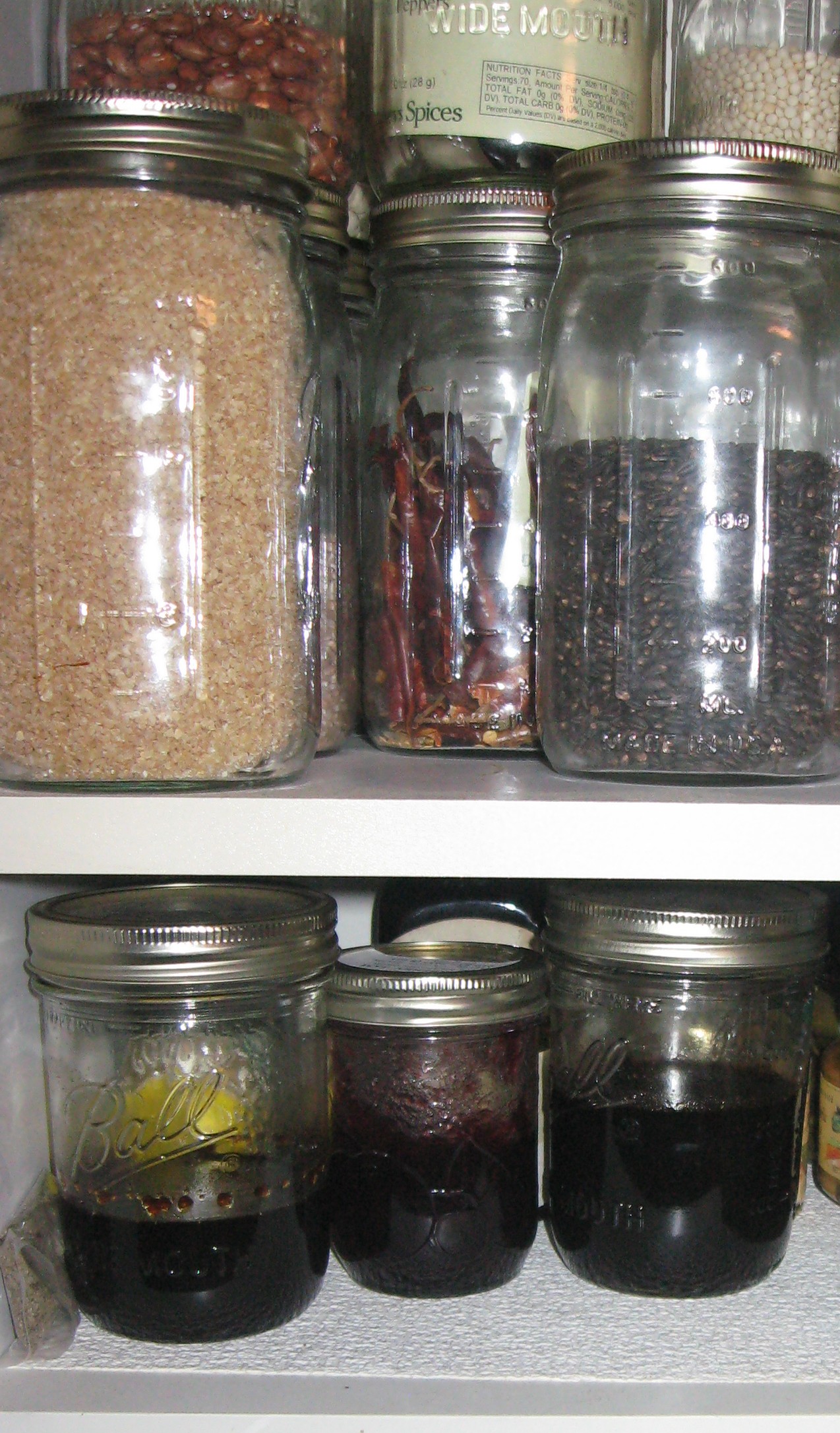
Ball-Mason jars for storageOne of my favorite sources for information like this is Cook’s Illustrated because they actually do experiments to find out what works and what does not.  This doesn’t seem to lend itself well to a post for each suggestion, so I thought I’d add a reference page on Storing Stuff as a place to collect information about storage methods for the things that you are likely to use as a single-serving cook.   If you have a successful method that you use as a solo cook, please post it.

New harvest potatoes with sorrel…..

We’ve dug the red LaSota potatoes and I was trying to find an authoritative source on whether they are LaSota or LaSoda…that issue remains unresolved at present, but I found a recipe that is absolutely making my mouth water.

Sorrel

Garden sorrel (Rumex acetosa)

Sorrel is one of my favorite herbs (or vegetable if you can actually get enough of it) so when I found it mentioned in a recipe with newly harvested potatoes, you can imagine that I was trying really hard not to drool on my keyboard.

This recipe, by Stephen Pavy,  is adapted from the Joseph Phelps Vineyard website.  True I haven’t made it yet, but it looks like a good recipe and my imagination is working on the flavors.

Potatoes with Sorrel  (Serves eight)

Ingredients

  • 24 large sorrel leaves.  ( (You must have large ones. If you simply purchase tiny leaves often seen in the herb section of your market, this recipe will not work.)
  • 3 tablespoon unsalted butter
  • 3 pounds of “waxy” potatoes like red LaSota or Yukon Gold.
  • 2 cups heavy cream
  • 1/4 cup grated Gruyère cheese
  • 4 tablespoon grated Parmigiano Reggiano cheese
  • freshly grated nutmeg to taste
  • salt and fresh-ground pepper to taste.

Preparation

  • Coat the inside of a large “gratin” style baking dish with 1 tablespoon of the butter.
  • Remove the center stems from the large sorrel leaves, and coarsely chop the sorrel.
  • Melt 2 tablespoons  butter in large skillet or sauté pan over medium low heat.
  • Add chopped sorrel and stir constantly until all leaves have darkened.
  • Add cream, stir in sorrel, and remove from heat.
  • Preheat oven to 375°F
  • Peel potatoes and thinly slice.
  • Distribute half of potatoes over the bottom of the buttered gratin dish.
  • Liberally sprinkle potatoes with salt and pepper, and then add a small dusting of nutmeg.
  • Pour the cream and sorrel mixture evenly over potato layer.
  • Distribute remaining potato slices over the top.
  • Repeat salt, pepper, nutmeg .
  • Distribute cheeses (Gruyère first, then Parmigiano Reggiano).
  • Place dish in oven and bake for about 1 hour checking to see when surface has browned, potatoes are tender, and liquid is nearly gone.

This sounds like it would be wonderful with grilled/griddled wild-caught salmon, a simple vegetable like haricots verts, or just a salad .  I know I won’t be able to get 24 large sorrel leaves, but I think that I can get enough to make about a quarter of this recipe.  I’m really looking forward to tasting this.

I haven’t made a wine decision yet–but there are some suggestions at the Joseph Phelps Vineyard website.

A son goût!

Further notes on baba ghanoush…

I’ve made another batch of baba ghanoush this week as eggplants are still plentiful. This week I had the large purple, globe ones.

These large globe eggplants are significantly “wetter” than the oriental style or the white eggplants and will benefit from a longer draining time before you puree and add the other ingredients. They were still quite “drippy” after about 15 minutes so I let them drain for almost half an hour before I added the lemon, extra-virgin olive oil, tahini paste, and other seasonings.

Whole wheat pita bread

Baba ghanoush with olive oil and parsleyNow that you have baba ghanoush, you need something to dip in it.  Crudities are always good—and healthy, especially in the summer when there are grape tomatoes, cucumbers, celery, or even blanched green beans.  The traditional thing to have with baba ghanoush, however, is pita bread.  I’m sure that you can find pita at your market but it’s very easy to make and tastes so good freshly baked.

I’ve posted about the no-knead bread dough that can be kept in the refrigerator for about two weeks.  You can use that same dough to make flat breads (pita included), crackers, pizza crust, and the like as well.  It’s just a matter of how you treat the dough.

The same authors who did Artisan Bread in Five Minutes a Day now have another book out:  Healthy Bread in Five Minutes a Day.  This no-knead method is SO easy, and works so well for single-serving cooking that I had to try this one too.

The master recipe in this is for a whole-wheat bread.  That basic dough can be used for pita bread as well.   That master recipe can be found on one of my favorite food-related blogs, Former Chef–so I’ll not reproduce it here.   I’ve made this recipe using white whole wheat flour.  I’ll admit that I’m partial to King Arthur flours; it’s available in my supermarket–so that is what I’ve used.

Pita bread

just out of the oven…

To make pita bread you don’t need to let the dough rise before baking so it’s very quick.  Just develop the gluten cloak  in the usual way. Since I wanted to do smaller pitas, I used about 75 to 100 grams of dough for each portion, “cloaking” each small portion and flattening it, rolling it out to about 1/8 inch thickness.

Since I did four at a time, I baked them on parchment paper on a baking sheet rather than directly on the stone.  With the 450 to 500 ° F oven it takes only about

Remove from the oven and wrap in a towel on a cooling rack.  They may “deflate”,

but the “pocket” is still there.   Pitas made from whole-grain flours may not puff as much as if made from unbleached all-purpose  white flour.

Since these are not crusty, you can store in a plastic bag.