Cooking beets…

The indexing project for The Polar Times has really taken over my life right now–which is not unexpected–but it does have its problems. I think any work where there is a deadline does that, but I need to get something for quick meals around here, and it has to meet my “hot weather” requirements!

Beets image from Swallowtail Garden seedsLooking over the Durham Farmers’ market this last week I was seeing lots of lovely beets–and with the weather warming up (from my point of view getting hot!) the cold beet soup came to mind as something that would be pretty easy, keep well, and is great in hot weather.

To prepare the beets for cooking, I cut off the tops (greens) a bit above where they attach to the root; some of the greens will go into the soup, but if there are extras, they are good as a vegetable, or an omelette filling.

Cutting the tops and leaving about an inch of the stems will keep the beets from bleeding and losing flavor.  If there is a slender root tip attached, I leave that on too.  Just scrub the beets with a fairly soft vegetable brush so that the skin is not broken–again, prevents bleeding.

No matter how you cook them, you can tell  they are done when they pierce easily with the tip of a small paring knife.   When done, the skins will slip off easily.  You can cook them a number of ways–One of my favorite ways is to roast them: well and good if it is a cool day but if it is not and you don’t want the oven on for an hour or so, then consider steaming (I use my rice cooker) or microwaving them (see below).  Test for doneness as above.

Roasting:  For four medium-large (about 6 ounce) beets, rub them with oil, place them in a covered casserole or wrap in foil and bake at 400° for about 1-1 ½ hours..  Cool them and then trim off the stems, roots and peel.

Steaming: Place the beets over simmering water and steam for about 1 hour, or until done. Cool, trim and peel. Baby beets will take about 20 minutes.  I sometimes do this using my rice cooker.

Microwave:  For the size beets mentioned above, put the unpeeled beets in a microwave-safe dish with a lid or cover tightly with plastic wrap.  Cook on high for 8 minutes and let rest for 5 minutes without uncovering.  Turn the beets microwave for 3 minutes on high and let stand again without removing the cover for 10 minutes.  Test for doneness with a small paring knife.  If they still offer some resistance to the knife, cover them again and microwave for an additional 3 minutes.  Cool, peel and go ahead with the recipe.

Grilling:  After peeling, slice medium raw beets about 1/4 to 1/2 inch thick, brush with oil and grill until tender. Very intense flavor. (I’ve not used grilled beets in the cold soup; I might if I ever have any “leftover” grilled beets, or manage to cook extras.)

Beet greens: Don’t forget the greens that you trimmed off before you cooked the roots! Some will go into the soup, but there might be more than you need or that.  Stem them like you would spinach–they are edible too.  If the stems are very large, cook them a bit before you put in the leaves.  They are excellent eating too. All they need is a quick braising, boiling, or steaming.  You can substitute beet greens in any recipe calling for chard.
Umami in the slow cooker…

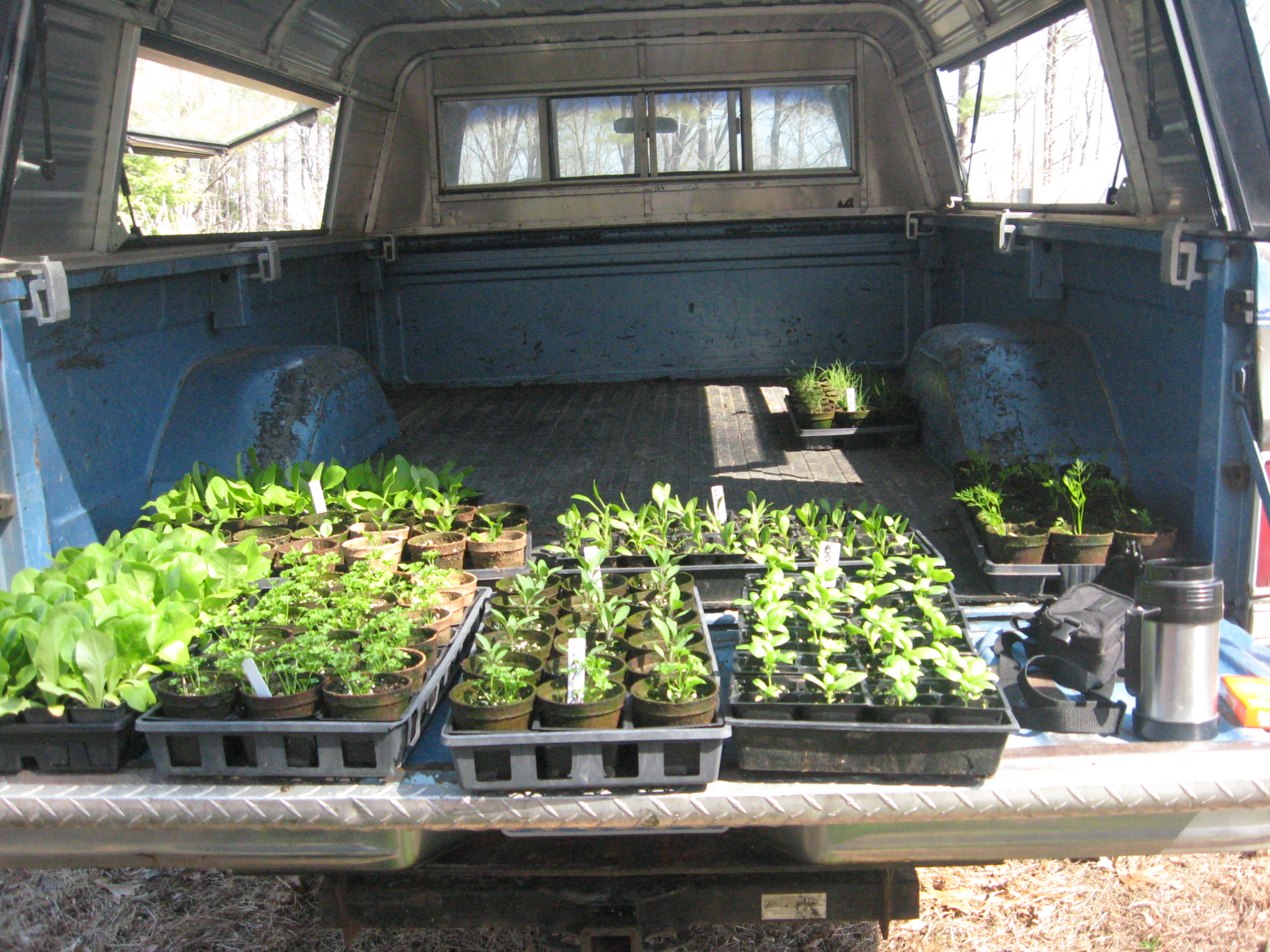
flats of plants on tailgate of truck to be loaded for the farmers' market.

for market

Obviously I’ve not been giving a lot of thought to cooking  things lately–it’s been end-of-term grading, indexing and proofreading, or getting  ready for the farmers’ market, or actually being at the farmers’ market, with more energy going to planting things, both for later harvest and for selling at the market than into cooking.

One of the down sides of working the farmers’ market is that I’m one of those people who wake up like a compact fluorescent bulb–pretty dim at first–so getting to the farmers’ market on time on Saturdays involves getting up before the birds just to give me time to be awake and functional. Even Fridays demand early rising, especially as the weather gets hotter–flowers to cut early in the morning and produce to be harvested before the heat of the day sets in and thing wilt…and just to avoid being out in the worst of the heat.

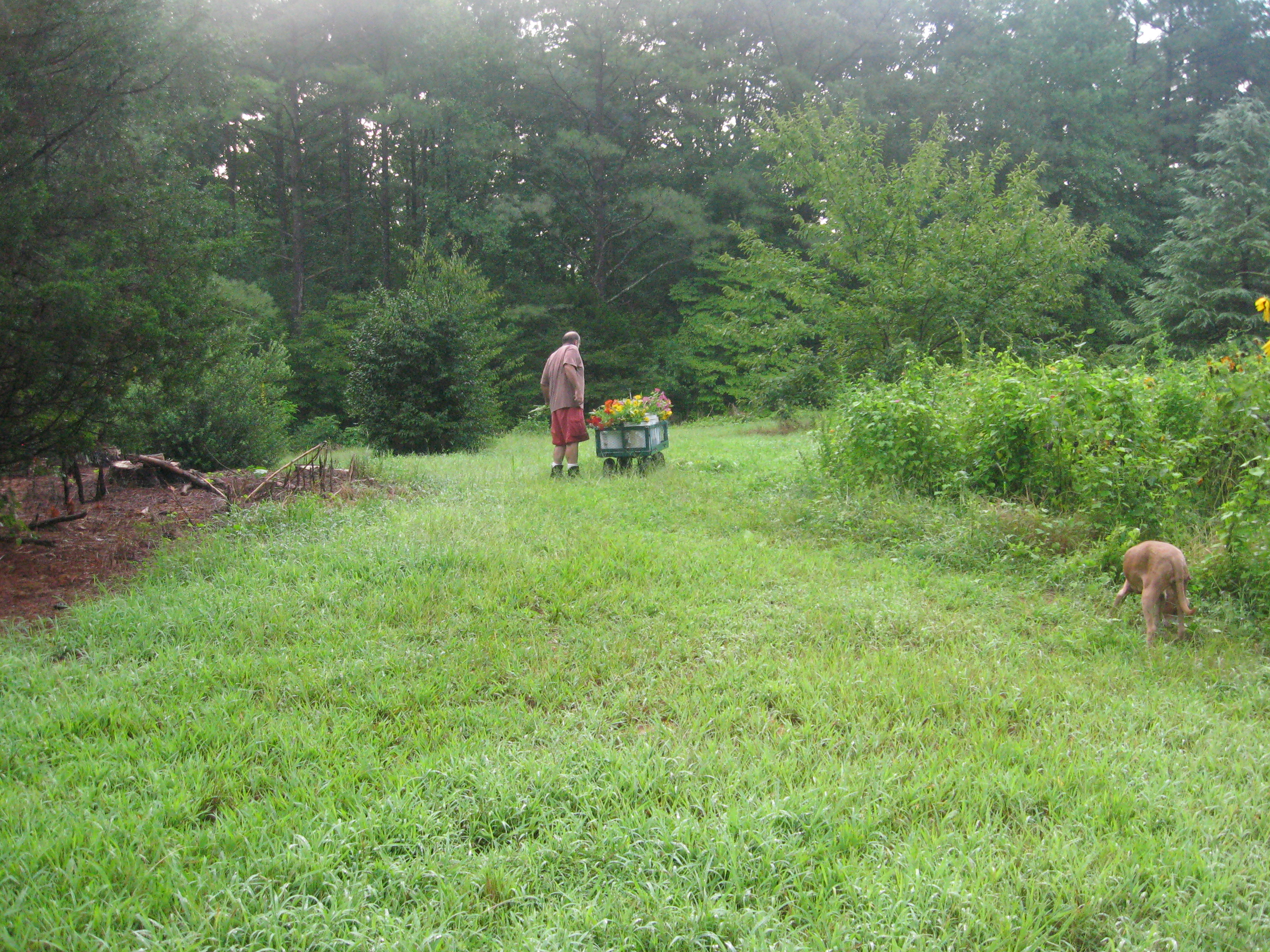
wagon of flowers in buckets

cutting flowers

I’m getting into the swing of that now but it still takes time for my lights to come on, though less painful now.  That early rising on Friday and Saturday makes me into a really lazy slob on Sunday.  Now that the Spring term is over, I’m not meeting classes during the week so I’m enjoying the summer hiatus from lecturing, but still working at freelance indexing so the absolute laziness has to be confined to Sundays and Mondays through Thursdays are still busy.

All this means that for Friday, Saturday, and Sunday cooking is likely to be focused on one-dish meals, and dishes that are good (or even better) when reheated.  Sometimes Saturday meal is not even something reheated–it’s my treat-yourself day–OnlyBurger for after-market meal before I devote the rest of the day to quality time with the cat!  (This past Saturday the treat was a Texan (burger with braised brisket on it) and a peach ice cream sandwich (handmade at OnlyBurger) after the market.  The evening meal was Carolina Moon cheese and strawberries–both from the farmers’ market.)

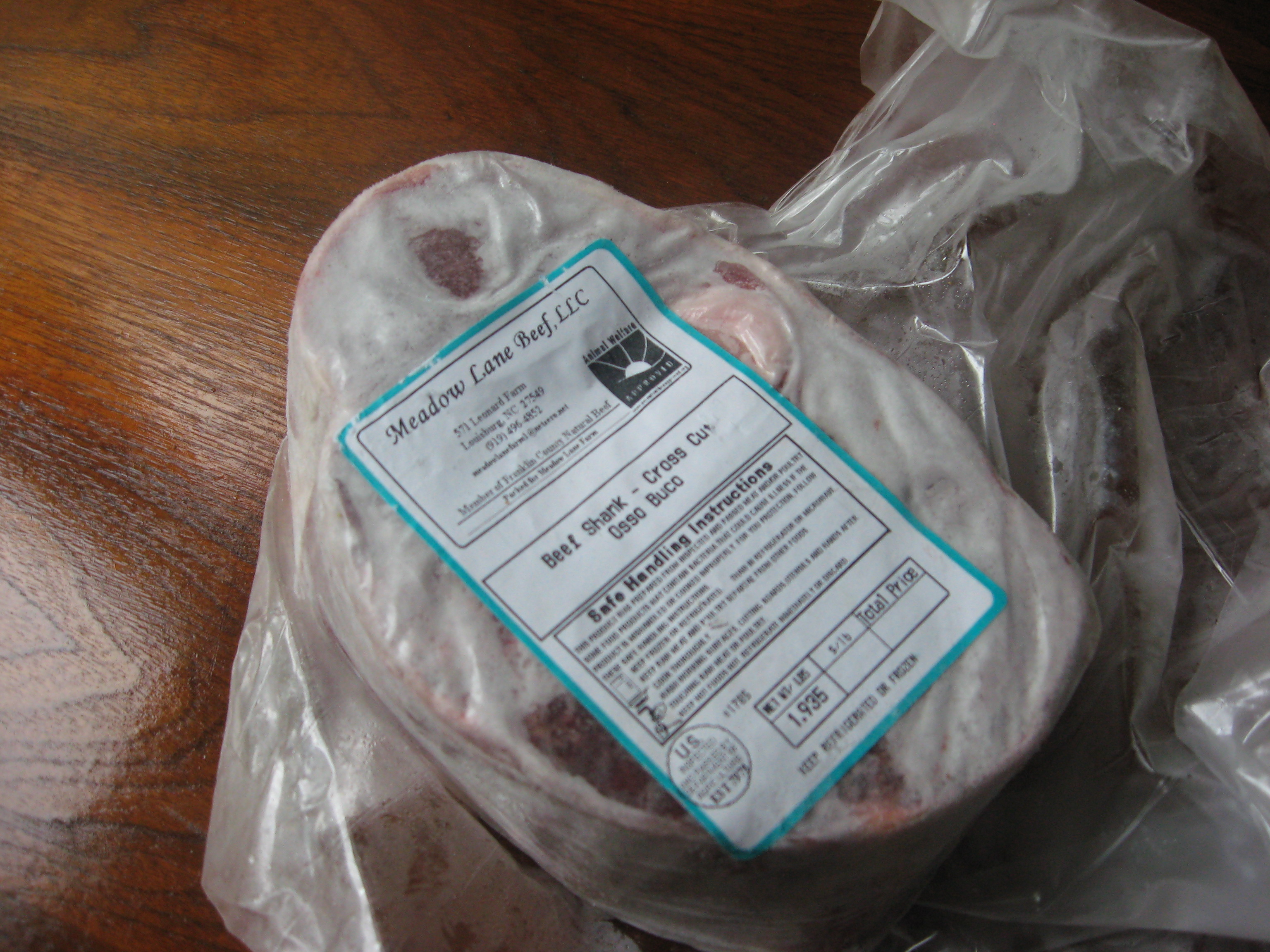
packaged cross-cut beef shank

beef shank

This weekend schedule means that I try to do some planning and cooking on Thursday to have reheatable food on Friday and Sunday.

This weekend’s meals are going to feature an absolutely lovely cross-cut beef shank from Meadow Lane Farms (also from the Durham farmers’ market)  in an easy dish that can cook mostly unattended: osso bucco, but with beef shank rather than veal shank. (The osso bucco really just means “bone with a hole” or marrow bone.)

It’s a dish that’s easily adapted for one person–there’s nothing fussy about it–no need to be exact or tedious in measuring ingredients, and to make even more “unattended”, it will go into the slow cooker (also serving as rice cooker and steamer) while I’m out working on the farm.

Krups rice cooker/slow cooker and steamer

Krups rice cooker

I have to admit that I’ve not been a fan of the slow cooker until recently, at least for anything much more than cooking dried beans, or poaching a beef tongue. The flavors and textures just aren’t the same as when the slow cooking was done in the oven where some evaporation, browning and concentration takes place even in a covered dutch oven.

My attitude about slow cookers has changed since I found the Cook’s Illustrated Slow Cooker Revolution (See Bibliography) and learned some techniques for making food out of the slow cooker more flavorful.  I’m not ready to quit slow-cooking in the oven despite that, but in hot weather I’ll certainly use the slow cooker more often with some of the “tricks” I learned from that cookbook.

What I missed most in slow-cooker dishes was that savoriness that comes from browning (Maillard reaction)  when you slow-cook in a traditional oven or brown/sear on the stove-top.  In the slow  cooker, you can make this absence less noticeable by adding ingredients that contribute “umami“.

Some of the most useful things I learned from that Slow Cooker Revolution are ways to use the microwave oven to facilitate the slow cooker, and using some “unusual” ingredients  in recipes–not esoteric ingredients, just pantry staples that boost  the umami flavor:

  • precooking aromatics like onions in the microwave so that they don’t stay crispy-crunchy in the slow cooker,
  • using tomato paste (for umami) by browning it with the aromatics either in a skillet or in the microwave before adding it to the slow cooker,
  • using dried mushrooms to boost flavor (again, umami),
  • using foil packets in the slow cooker to keep some ingredients from over cooking.
  • using soy sauce or fish sauce to add more of that umami that many slow-cooker dishes don’t get without the evaporation and browning as in the traditional oven.
  • using the microwave to precook some ingredients to get rid of excess moisture that would otherwise dilute the dish in the slow cooker.

These are all easy to do–they really don’t add significant extra prep time or effort, and do really make a difference in the flavor.  I expect an easy, flavorful meal (or two) from the braised beef shank that is going to emerge from my slow cooker on Friday evening, thanks to some added umami!

Quinoa pudding

I’m happily not intolerant/or sensitive to lactose or gluten, but this summer pudding looks like a must-try to me, since I really like quinoa!

foodrefashionista's avatarThe Food ReFashionista

Sweet, cool, soothing, filling, and easy to make—this is a pudding that’s just right for hot summer days.  This dish is also a new version of a versatile favourite. (Earlier warm pudding versions used dried cranberries and puréed pumpkin or squash.)

I keep finding myself coming back to this pudding recipe whenever a possible ingredient makes itself  known: in this case, aging bananas crying out to be puréed.   But bananas are calorie-expensive, my rational mind argued.  But they’d be delicious in this pudding, my stomach-inclined mind replied.  Think of something! 

That something was to tweak the original recipe by using liquid egg substitute instead of whole eggs and almond milk instead of soy milk.  That didn’t make a significant change in taste but it did lower the Weight Watcher points and, hence, calories.  My stomach-inclined mind immediately thought of adding chocolate or coconut, but I ignored it as best I could!

Printer-friendly…

View original post 181 more words

A one-dish meal.

A lot of us eventually reach the point when we realize we are getting a bit rotund (or worse) and start thinking about watching (or losing) weight, or maybe just being more conscious about nutrition.  With several of those things in mind (or should I really say on my mind) I did some web browsing.

I found a website that I’d like to share with you:  A Slice of Nutrition.  I found this through another blog that I follow, My Imperfect Kitchen, that had a post by Avital Greenbaum as a guest blogger–Chicken, Zucchini, and Quinoa. 

One dish meals are very appealing to me–at least some of the time, because I can be lazy, have a good meal and not have to wash lots of pots and pans.  (No, Frankie refuses to do that!)  I’ve had quinoa in breakfast cereals, and things like that but after reading how healthy it is, I decided I need to try it in a main dish and this looked like a great place to start.

Garlic scapes lying next to a basket of strawberries

garlic scapes

I do have to admit that, as well as being constitutionally unable to make a small pot of soup, I seem to be unable to leave a recipe alone when I’m making it.  I did almost follow this one.  Instead of garlic powder, I had fresh, green garlic scapes from the farmers’ market.  Those went it, and I added some mushrooms; otherwise, I left it alone.  This one-dish meal is now in the oven (despite the heat) getting ready for my supper.

Since my veggies are included with the dish, I think that all I’ll need to add is some of those luscious ripe strawberries as dessert!


Baking dish with chicken and quinoa

Chicken, zucchini & quinoa

This is a keeper–only a few minutes prep, and it’s unattended cooking with tasty results. The quinoa is very light–good in hot weather.  I think that it might make some very tasty “salads” with lentils for satisfying summer meals when the weather is sweltering and I want a light meal.