Unknown's avatar

About sa.fifer

Lover of good, wholesome food and wine. Cooks for one and the cat. Likes to paint-- a frustrated botanical illustrator and amateur (photographer) and fledgling birdwatcher, beekeeper, and Kindle addict. Works as a freelance indexer.

Shad roe redux

from The Garum Factory imagesJust a quick follow-up on the shad roe post from yesterday: The seasoning and cooking method from The Garum Factory was a success–absolutely as good as I thought it would be from looking at the recipe.

The purging over night in salt water does make a difference–I like the roe either way. If it’s your first time preparing roe, I’d recommend doing the salt-water soak.

Cooking the roe over low heat–kind of a steam-sauté) works well–it eliminates the popping and spattering that you usually get over higher heat and the texture of the roe more tender than cooked over higher heat.

The ginger added to the more traditional bacon, capers, garlic, lemon, and butter definitely adds a nice sparkle to the roe. I’d certainly recommend this as an introduction to shad roe if you’ve not tried it before.

The Reverse Wine Snob: The Best Box Wines - Esporao Alandra White 2013(The roe image above is from The Garum Factory–the picture that I took did not come out well at all so–clicking on that image will take you to the original post which I reblogged.)

I just had steamed potatoes (small Yukon Golds) and a salad. A glass of the Alandra white (Portugal)  was a lovely accompaniment to the roe.

A son goût

A “roast” beef sandwich

Sandwiches are not just something to be thrown together without thought–definitely NOT two thin slices of baloney and Wonder bread!  They are a special kind  of meal–sometimes comfort food (like grilled cheese sandwiches) and sometimes even need planning when cooking for one person.  I’m always on the lookout for good “recipes”–or maybe inspirations–for sandwiches–particularly roast beef.

As much as I like cooking for one, there are a few drawbacks. One is that  realistically you can’t do real roast beef.  One of the things I miss is a good roast beef sandwich–it’s just not the same when the roast beef comes from the deli–no matter how good the deli.

image from Lemony Thyme

roast beef sandwich

One of the ways to satisfy my craving for roast beef sandwiches is with the planned  “leftovers” from my  thick-cut  steak–intentional leftovers of nice rare, pink, juicy  steak to slice  thinly and make a sandwich.  Then the fun begins–it’s a happening.

  •  Start with good bread (my oat bread , if possible),
  • Add some  flavorful, spicy greens:  radish sprouts or possibly arugula, or endive.
  • Maybe tomato,  if in season.
  • Cheese:  something “bleu”– gorgonzola dolce, Cabrales,  or Danablu–is one of my favorites with beef, though nothing wrong with a good cheddar or Swiss.
  • Maybe some thinly sliced red onion (or Walla Walla, Maui, or Vidalia,   sweet onions, if those just happen to be lying around).
  • Maybe a good “smear” of horseradish or horseradish sauce, instead of onion.
  • Finally,  a thin film of butter, preferably European style cultured (salted or unsalted)!
  • The final touch would be a sprinkle of fleur de sel.

Now choose a beverage–beer, cider, or even a glass of wine. Enjoy.

Blood oranges….

blood orange slice

blood orange

I have to say that for the most part, I hate shopping–except food-related shopping. When I do food-related shopping, I almost always come home with something that was not on the shopping list (Yes, I do make shopping lists, but I don’t really do meal planning.)  do sometimes venture in to the food store without a list, though I do try not to go food shopping when I’m hungry. Sometimes I go to the grocery store impulsively and spontaneously–triggered by some extraneous event.

My last such foray was triggered by sitting at the counter of Hope Valley Diner discussing food with another regular lunch customer–also a foodie.  What sent me to the grocery store was his mention of a chocolate cake from Fresh Market: namely chocolate ganache cake.That definitely got my chocolate imagination going–after all ganache is basically chocolate and cream, maybe some butter–but it’s really serious chocolate–adult chocolate.

Being in need of a chocolate fix since I’d been indexing all morning, I detoured by the Fresh Market on my way home (it really wasn’t more than a half mile in the opposite direction) hoping that I would find chocolate ganache cake by the slice. So–my intent on entering the Fresh Market was to obtain a single slice of chocolate cake.

As I walked through the entrance into the vestibule I was immediately faced with packages of California-grown Moro blood oranges. I seem to be constitutionally incapable of walking away from blood oranges, so there was the first “additional” item, so I really did need to get a basket though I hadn’t thought I needed one.  Now the blood oranges were not individual–they came in a little easy to carry bag–meaning that I now had several blood oranges.

Continuing on my way to the bakery section, I detoured though the produce (around the edge of the store).  That took me past the Bolthouse juices. (Yes, I find daily grapefruit, orange, etc boring too many days in a row.) I noticed a couple that I’d not found at my Harris Teeter market, so those (Daily Golden Vedge and the Stone Fruit Smoothie–still haven’t found the Mango Ginger + carrot) )got popped into the basket.

I made it to the bakery counter after a brief detour around the cheese counter and the seafood salad bar. I first noticed a whole chocolate ganache cake–shiny top as you’d expect from ganache, very dark, with the sides of the cake covered with dark chocolate shavings or chopped. Thankfully, there was a single slice of this luscious looking cake in the case. That got put into the basket with a sigh of relief–after all, THAT was what I came for! I made it back past the chocolate bars and other candy without adding anything more to the basket, checked out, and headed for home.

Blood Orange and Sage Sparkling SodaOnce home I had a blood orange–and realized that I was going to be eating or juicing blood oranges for a bit. Though straight blood orange juice is certainly not a hardship, serendipity has a way of intervening. While I was perusing my favorite blogs, what should I find but a gorgeous photograph and a recipe for blood orange and sage sparkling soda.

The image at the left is from Snixy Kitchen blog–just too gorgeous not to “plagiarize” with attribution, and share. I’d not thought of the combination of sage and orange, but with the “imagery” of the blood orange I’d just eaten, and a brush of the sage wintering on my deck, I knew I had to try it. This as a beverage is definitely a keeper–I’m sure that I’ll be making sage simple syrup again, and I have to think this would make a great sorbet as well as something to put in a glass and drink.  This combination of orange and sage also has me thinking about veal, pork, maybe chicken….Thank you, Snixy Kitchen for a great combination!

ÒΔÓ

Now if you’re wondering about the chocolate ganache cake?  Well, I ate it before it even occurred to me to take a picture, and I haven’t found a chocolate cake image that even comes close–so I’ll have to go with words: very, very dark, moist, with ganache between the layers and as icing, not too thick.  Dark chocolate chips/shaving on the sides, not too sweet, but sweet enough–adult chocolate–absolutely luscious.  That’s probably where I’ll go look for my next chocolate fix.

Signs of spring

Shad Roe Sac

pair of shad roe

Sometimes it’s a bit dangerous for me to venture into the grocery store–I happen on to something that I hadn’t planned to buy. That happens especially with some seasonal specialties that appear without warning because you never know quite when they are going to be available.

So we’ve had groundhog day, and we’re looking toward the vernal equinox (20th of March, I believe)–all suggesting that spring is on the way. I have a particular sign of spring that I’m always looking for: shad roe. Today I made its unpredictable appearance at my local Harris Teeter fish market. I never know quite how I’m going to fix it once I get it home–but it usually comes down to something with brown butter and some other seasonings like lemon, or something very simple so that the focus is the shad rod itself.

Whilst skulking about on the web, I found this delightful post on The Garum Factory about its history and preparation that I want to reblog –I couldn’t do it  better.  This looks like a great way to prepare it. Another post worth reading if you’re new to shad roe is from the second lunch.

Now off to put my shad roe in the salt water!  I’m now ready to think that spring really is on the way!

George Washington Ate Here – Shad Roe with Brown Butter, Capers and Ginger from The Garum Factory appears below.

Jody and Ken's avatarThe Garum Factory

You will never see it on a restaurant menu.  The TV Food Network is unlikely to devote an hour to its history and preparation.  It is one of the great forgotten foods of American culinary culture.  I’m talking about the shad.  The sole remnant of its once mighty role in the diet of Americans is its roe, and for a certain segment of avid pescavores it’s the line in the sand between winter and spring.  This week we’re going where food blogs don’t usually tread – Shad Roe with Brown Butter, Capers and Ginger.   Believe me, it’s worth it.

There is a story–a fish story?–proffered by historian Henry Emerson Wildes in his book Valley Forge about the importance of shad to the revolutionary war effort.  In the spring of 1778 the tattered and hungry Continental Army was encamped in Valley Forge, Pennsylvania, where it had been since the onset of…

View original post 1,902 more words

Pheasant with Green Chiles

I’ve done my usual scrounge through the post-holiday leftover at the grocery store, as usual, come home with some goodies. My local Harris Teeter had pheasants on sale so I’m looking for inspiration.

Admittedly, I’m starting with farm-raised pheasant rather than wild. The flavor is different–milder–and as the wild are not so fat and sassy as farm-raised, the wild can be trickier to cook.  I have farm-raised (still good eating) so I have a bit more freedom in how to cook them.  If you’re fortunate enough to have wild pheasant, here’s some information on cooking those. (If you have wild ones, I’d love to help you eat those–and perhaps pick a wine to go with them.)

The post that I’ve reblogged below provided some inspirations for a starting place.

A good home-cooked steak

Steak is not something that I order when I splurge for a meal in a fine restaurant; it’s too easy to do at home and good for single-serving cooking since it’s portioned when it comes home, and it’s easy to cook.

A good thick-cut, home-cooked steak is one of the things that I don’t mind having left over, since it’s usable as “roast beef” for a yummy sandwich.  (No, the roast beef from the deli simply does not do it.) My favorite way to cook the steak is from Cook’s Illustrated, 01 May 2007–it does take a little time and minimal effort, but it’s well worth it.

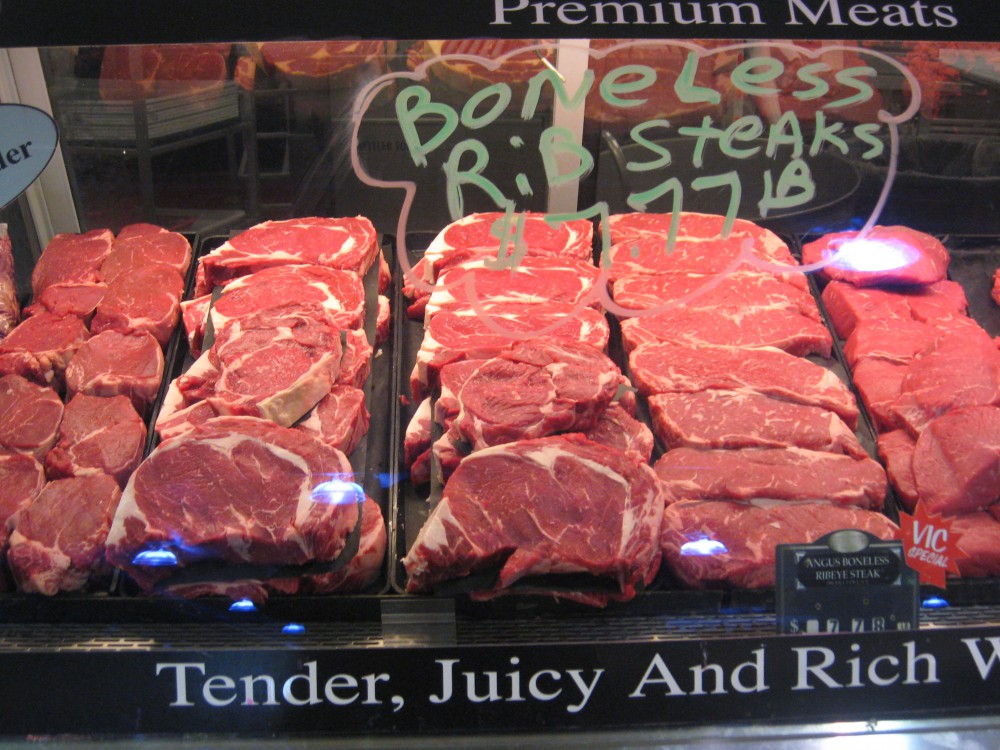
steaks in butcher caseMy usual choice of steak is a strip, or New York strip, cut 1-1/2 to 1-3/4 inches thick, with fat cap intact.  If I don’t find one lolling about   in the butcher case (you won’t likely find this in the pre-packaged section)  ask to have it cut the way you want it; my local Harris Teeter will cut to order but generally has thick-cut steaks in the butcher case.

This works fine with rib eye or with filet mignon, as long as it is thick-cut. Personally, I prefer strip or rib-eye to filet. Even with rib eye, it’s still not a substitute for real prime rib roast, but a good “second” so that I plan to have “leftovers”.

Ingredients

  • 1 boneless steak (1 1/2 to 1 3/4 inches thick (about 1 pound), strip or rib eye
  • Kosher salt and fresh ground black pepper
  • 1 tablespoon vegetable oil for searing

Preparation

  1. Adjust oven rack to  mid-position and pre-heat oven to 275 °F .
  2. Pat steaks dry with paper towel and season liberally with salt and freshly ground black pepper.
  3. Place steak on wire rack set in rimmed pan and place in oven.  (Steak does need to be raised rather in contact with pan).
  4. Cook until instant-read thermometer inserted in center of steak registers 90 to 95°F for rare to medium-rare, 20 to 25 minutes  (or 100 to 105°F  for medium, 25 to 30 minutes).
  5. Heat oil in  heavy-bottomed skillet over high heat until smoking.
  6. Place steak in the skillet and sear until well-browned and nicely crusty–about 1-1/2 to 2 minutes, lifting once halfway through to redistribute fat under the steak.
  7. Using tongs, turn steak and cook until well browned on the other side, about 2 to 2-1/2 minutes.
  8. Use tongs to stand steak on the sides and sear on all sides. (This really is worth the effort–and it really does not take long.
  9. Transfer to cooling rack, tent with foil, and let rest for about 10 minutes–this also is really worth the wait.
  10. You can prepare a quick pan sauce while the steak is resting, or simply add a pat of herb butter, horseradish,  or some blue cheese crumbles to the warm steak.

Add some simple sides like salad or baked potato. Now pour yourself a another glass of that luscious  red wine that was  breathing while you were cooking, and enjoy.

A son goût!

Instant Stew

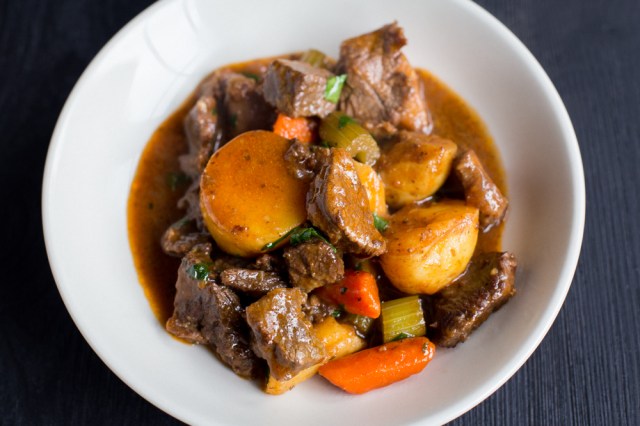
I’ve just recently started looking at what can be done with a pressure cooker; this looks like a good place to start so I thought I would share this.

Russ's avatarThe Domestic Man

First of all, sorry about that title. Just like the elusive free lunch, there is no such thing as an “Instant Stew”. You see, I recently asked my Facebook followers what dish they’d like to see me develop, and I received several requests for pressure cooker and stew recipes. We use (and love) an electric pressure cooker called an Instant Pot, so that’s what I used for this recipe (and hence the name).

At its heart, this dish is similar to many of my other stew recipes, but with a new approach. When it comes to simple weeknight recipes, many folks like the idea of crockpot stews (wherein you leave the ingredients to slow-cook while away at work). But I’ve found that more often than not, the vegetables become too mushy and tired after a long simmer. This is where a pressure cooker really shines, as it shaves a…

View original post 130 more words

OMG, what’s that smell?

Reading a Facebook post the other morning from a friend who posted about a situation that I’ve experienced–something presumably a mouse, dying in the wall (and the resulting olfactory stimuli that pervade the environs),  brought to mind another olfactory experience….

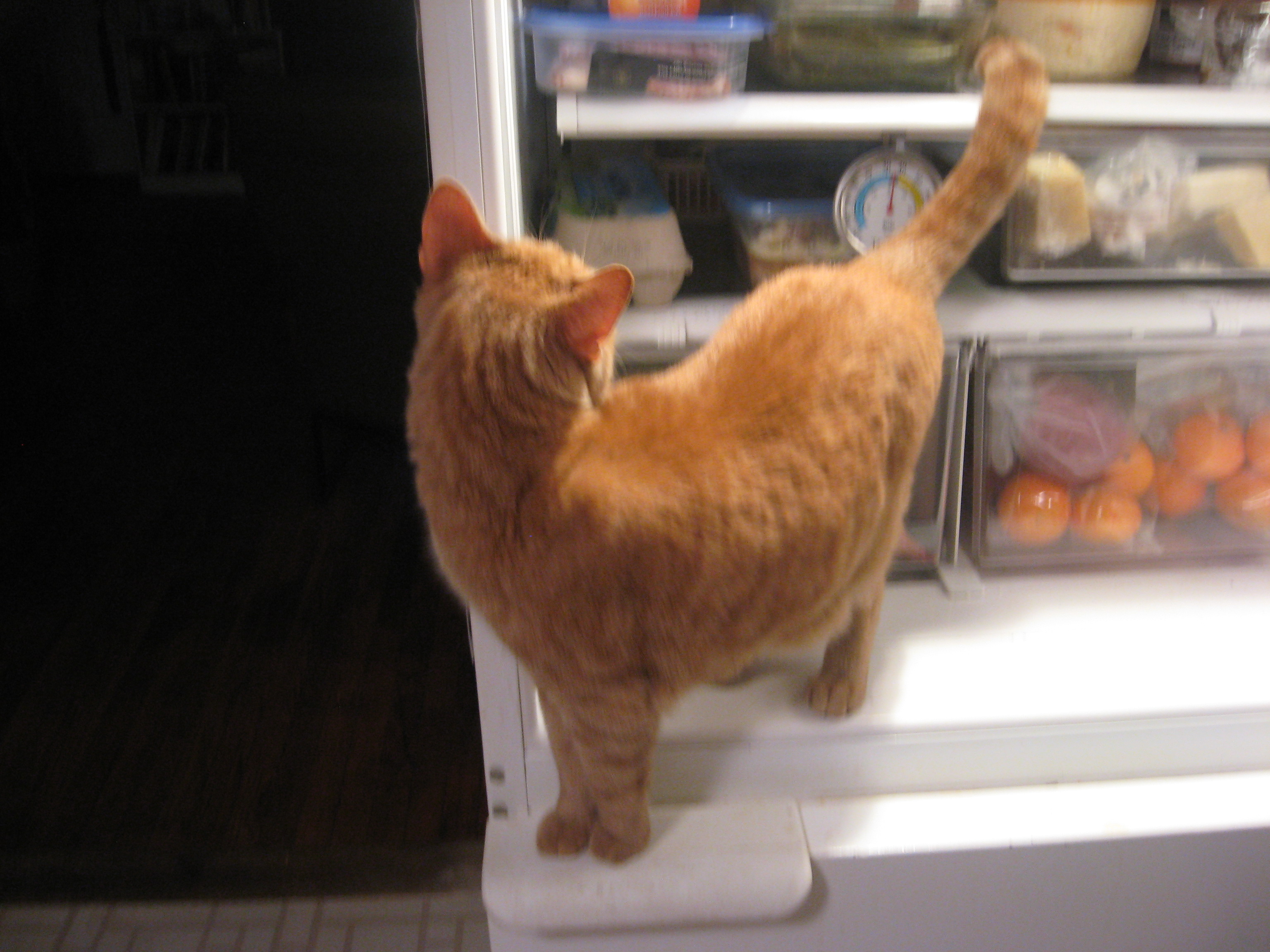
cat checking fridge

just checkin’

Early morning. Open refrigerator door to get milk for morning café au lait. Pour milk.  Open fridge door, put milk back. Something finally filters through to the conscious level even without the coffee yet. OMG! What is that smell? What has died in there? 

Drink coffee, come back for second  round.  Pour milk, put milk back.  Have second cup of coffee.  Recheck fridge.  Drat!  I really did smell something that needs to go away urgently. Something smells weird in there and it’s not  in the league of things handled by baking soda.

One of my least favorite morning events–I’ve just discovered that, even though I’ve thought about it for several days and procrastinated, I now HAVE to clean out the fridge.

It seems that the fridge is the best (most accurate?) reflection of the general state of life in this household. There are areas of my home which are constantly disaster areas, not a big deal–they just are; but I know I’m in trouble when the fridge becomes one.

When I’ve been hassled, harried, beleaguered, and generally frenetic, that’s when the fridge gets out of control. Usually when it’s least convenient to have to pull everything out to find the culprit, but there’s no escaping it–I have to  do it NOW!

The current fridge situation, corresponds to the very noticeable, or notable, hiatus here (sounds better than just saying gap or hole).  For the last several months I’ve dealt with a Clostridium difficile infection that has really turned by life kind of kitty-wampus (not over yet, but improved). Fortunately, since I work at home as a freelance indexer and the one course that I was teaching at a local community college was online, I was able to keep on with those things.

Cooking was another matter altogether since I had absolutely no appetite. At the best of times I can be a pernickety eater (as I’ve said before I don’t deal well with “leftovers”), but add don’t-feel-well-but-must-eat, and that just fills up the fridge with all sorts of odds and ends.

The places in my home that are usually disaster areas, are still, and even more, disastrous, and I’ve added new ones–but most urgently it’s the fridge!  I have to get that sorted so that I can get back to normal cooking since I’m beginning to regain an interest in food (eating and not just reading cookbooks) and actually cooking.

So, into the depths of the fridge….

Grilled cheese sandwiches

A grilled cheese sandwich is often a quick meal, and perhaps the ultimate in comfort food–with or without the tomato soup.  I love grilled cheese sandwiches and want to pass on this link for any of you who also love grilled cheese sandwiches.

It’s very easy to make a “plain” grilled cheese sandwich, but you can do so much more with them.  I found some wonderful suggestions at Spoon, Fork, Bacon. If you love grilled cheese here is a great place to find some exciting ideas.