Oven-braised lamb and garbanzo beans

It’s another grey day–unseasonably warm, but at least not hot, sticky, and terribly humid today–the kind of day when you need to smell something cooking–long, slow, and tantalizing.   I found lamb shoulder chops on special (2-1/2-pound package) at the grocery store, I decided to try the lamb/garbanzo slow-cooker thing in the oven since it’s not too hot (and I’ll use the oven to prepare a second dish for reheating tomorrow (acorn squash stuffed with Sicilian sausage).
Book coverThe slow cooker version of this concoction was really good, but I thought it could be improved by doing it in the oven. Even after reading the Cook’s Illustrated Slow Cooker Revolution (volume 1), I am still not a wild fan of the slow-cooker.  I use it because it does some things well, and is necessary at times to fit cooking into a working schedule.  The Slow Cooker Revolution has improved my slow-cooker results immensely, mostly because I’ve discovered some unusual ingredients that can improve flavor.

My impression was that many of these recipes required more preparation time than I would be able to put into a slow cooker recipe, given that I use it for utter simplicity.  I’m interested in seeing what comes from volume 2 of the Slow Cooker Revolution.  If I have to do a lot of preparation for the recipe, then I might as well not use the slow cooker.  I still find that I like over-braising when possible; however, I do find I’m using the slow cooker even more since I read the first volume of this book. That said, I still prefer oven braising, especially if I’m working at home.
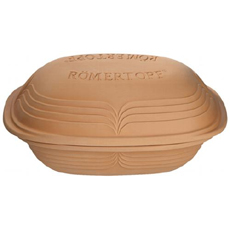
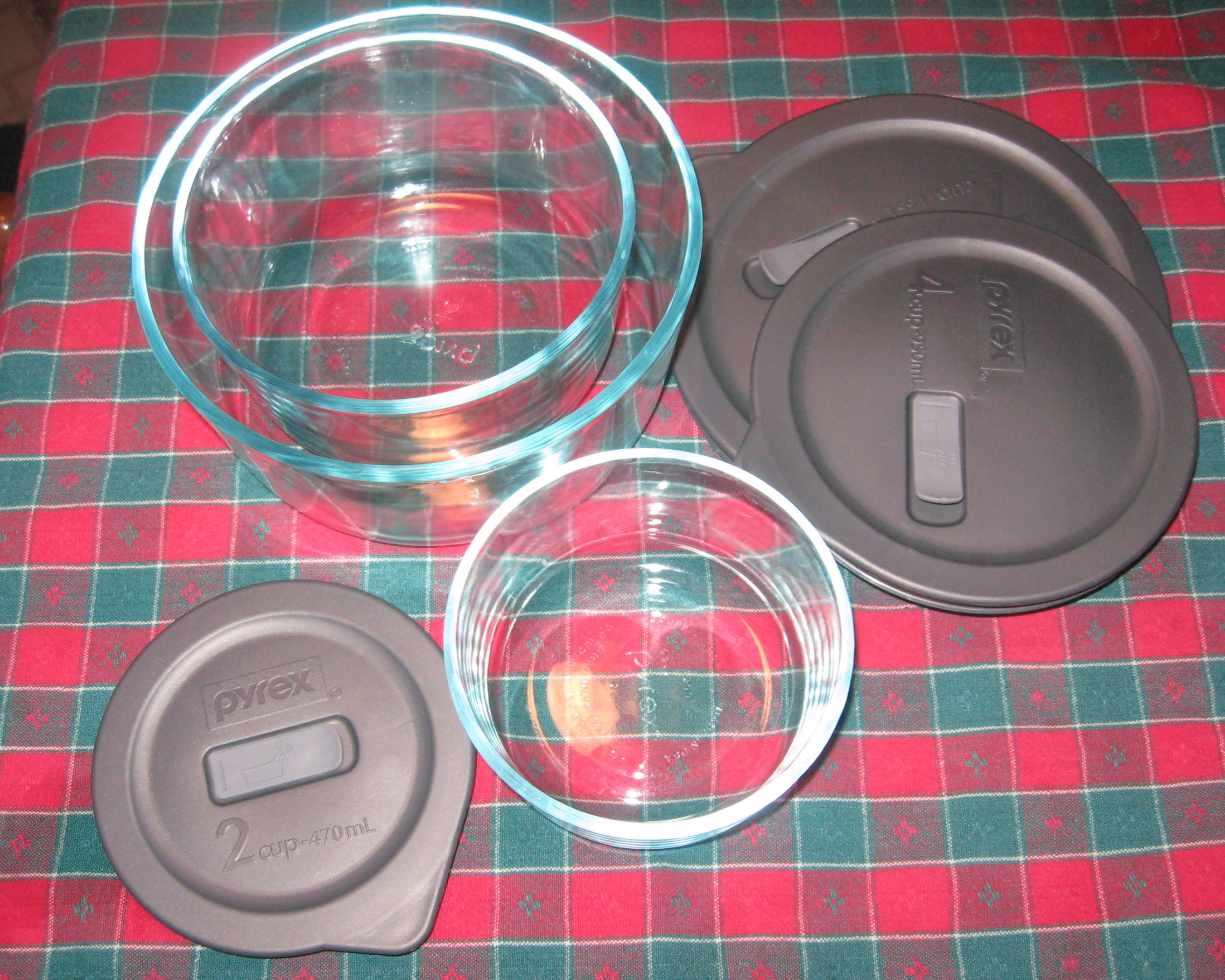
Romertopf clay baker (oval)I had intended to do this in the Romertopf, (one of my favorite things for roasting and baking hearty, peasant-style comfort food in the winter) but by the time I had boned the lamb and added other ingredients, it wouldn’t fit in either of my small ones (great for single-serving cooking), and was not enough to fit in my large Romertopf (for roasting whole chicken, for example)–so it was the Dutch oven for today.

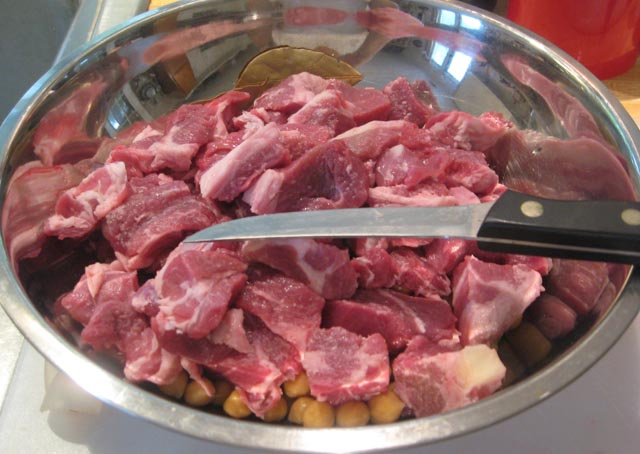
(Shoulder chops are reasonably priced, and the boning doesn’t take long if you use a boning knife rather than trying to do it with a paring knife or chef’s knife.  Those bone went into a saucepan with a tad of salt and some bay leaves to make stock.  After boning out, I had about 2 pounds of lamb, so that’s what I started with.)

Oven-braised lamb and garbanzo beans
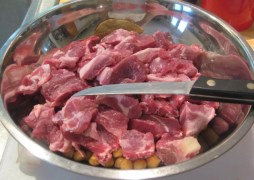
lamb from chopsIngredients

  • 2 pounds lamb (from boned shoulder chops)
  • 2 14.5-ounce cans of garbanzo beans, drained and rinsed
  • 3 large onions, chopped
  • 1 14.5-ounce can of fire-roasted, diced tomatoes with juice
  • 2 tablespoons of Hatch chilli powder (used for the slow cooker), but more added after tasting this halfway through cooking
  • 2 teaspoons of salt, or to taste
  • 1 tablespoon fresh Mexican oregano, minced
  • 1 cup water

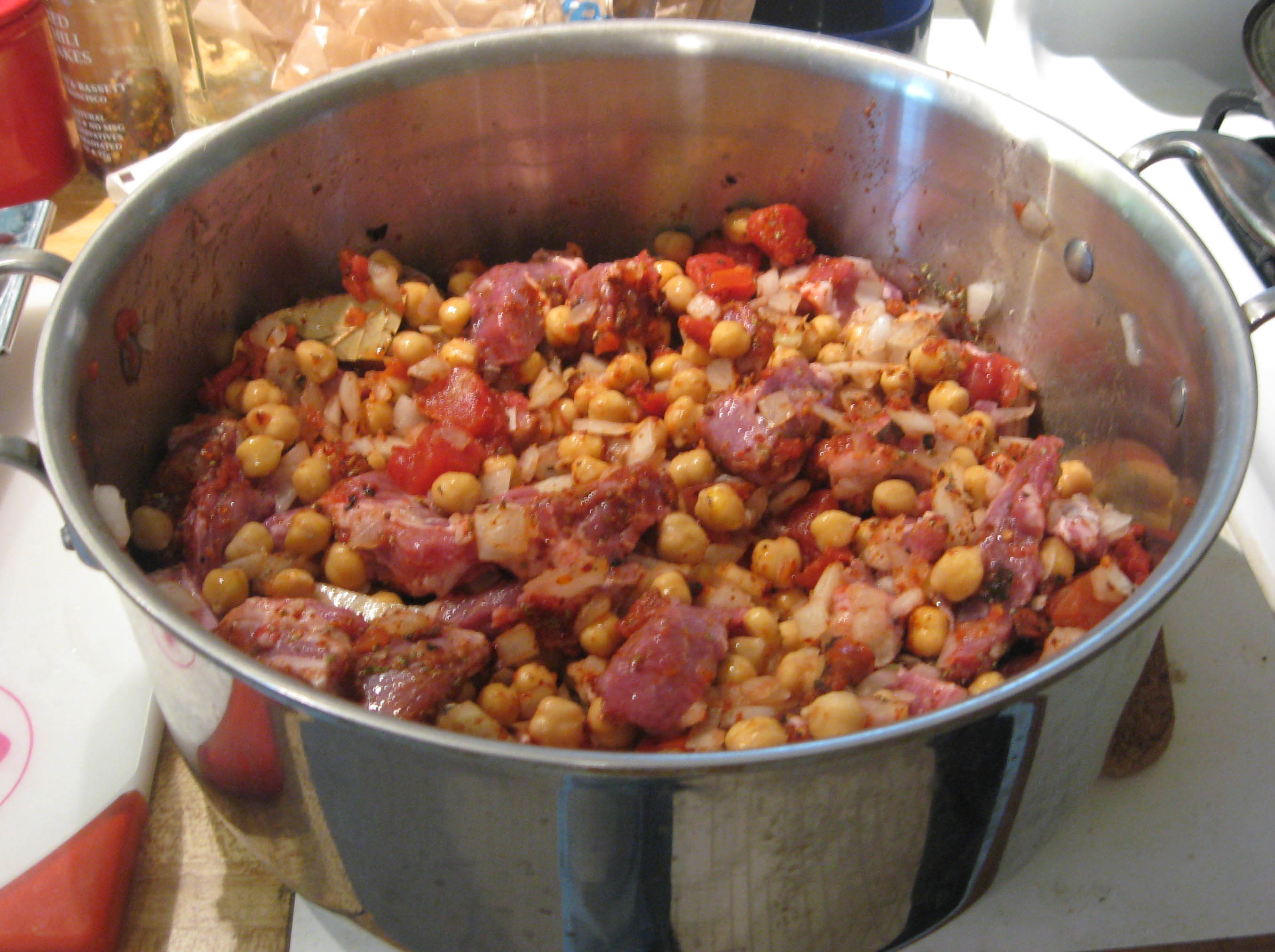
PreparationIMG_7667

  • Put everything in pot
  • Cover
  • Pop it into the oven, and check for liquid in an hour
  • Go get laundry or whatever, then check liquid again

-<>^<>-

In order to be as much like the slow-cooker, I did not brown the meat or cook the onions separately–just combined everything, covered, and put in a preheated, 300-degree Fahrenheit oven.  I added 1 cup of water to start, and checked in one hour but there was plenty of liquid.

On tasting, I found it needed more than the 2 tablespoons of chili powder so I added about 1 tablespoon more, stirred, covered, and let it continue to cook. There was plenty of liquid, so next time, I’ll not add any water–just rely on the juice from the tomatoes, onions, and meat.

-<>^<>-

The stock made with the bones smelled really good–if more liquid had been needed during baking, I would use some of the stock.  There was some meat from the bones in the stock, but I not enough to spend time picking off, although I’m not compulsive about trying to get every bit off when I bone meat like these chops. Since I started the stock in cold water, the meat that was left was pretty flavorless, but the stock was good.

-<>^<>-

There will be a next time for this–and unless I’m really pushed for time, or can’t leave the oven while I’m out, I’ll opt for the oven method to cook this–a much more complex flavor with the same ingredients, likely attributable to the bit of evaporation that takes place in the oven but not in the closed slow-cooker.

Getting this added flavor lead me to consider the energy used in the various cooking methods–the energy required for cooking is certainly part of the energy required to make that food edible–the energy  of production and transportation, and the cooking is all part of the picture: the footprint of feeding me. We cannot ignore the energy used for cooking when we talk about other energy costs associated with our food so I spent some time browsing to find information on different cooking methods.

In trying to research this issue, I’ve perused many different sources–and the gas/slow cooker comparison is difficult, and I get the feeling that the answer to which is more efficient is an “it depends” situation.

Interestingly, an article on slow cookers versus electric ovens from the University of Connecticut Sustainable Living suggests that there may not be a significant difference in energy use.  SFGate discusses gas versus electric energy use, which gets more complicated, but I’m not sure that there difference is significant enough to make me give up oven braising, even though I’d like to minimize my “carbon footprint” as much as possible. If my slow cooker requires eight or so hours of cooking, and my oven braise requires only two or three hours on low to medium heat, then it may be a toss-up, since the slow cooker doesn’t cycle, and the oven (gas or electric) does.

Oven braising in the wintertime helps warm the house so probably cuts my heating use some, but I’m certainly NOT going to oven braise in the summer and increase the use of air-conditioning.  There is lots of conflicting information out there on the ‘net.  The “best” I found was from the Consumer Energy Center (California Energy Commission)–from that information, I’m not going to give up oven braising for the slow cooker anytime soon, but I’ll still use the slow cooker for some things.
Cover, pressure cooker perfectionOne comparison that I’d really be interested in is slow cooker versus pressure cooker energy use, and taste of the same dish prepared in both. Most data that I found suggested that the slow cooker wins on convenience, and the pressure cooker on energy saving. A taste comparison would certainly be interesting.  I’m almost certain that a pressure cooker can’t replace a good old-fashioned slow braise in the over.

I’ve recently started playing with a pressure cooker–it’s a lot different than what my mother used. The recipes in Pressure Cooker Perfection have been a good starting point. I suspect that I’ll be using a pressure cooker more  in the future, as well as the slow-cooker. Climate, air conditioning, and heating, are all things that will enter into my decisions. I’m also trying out an portable induction unit which is supposed to be ore energy efficient.

So many options for energy efficiency–but what about taste?  I doubt that any other method is going to come out tasting like an oven braise, no matter how many umami-enhancing ingredients you add.

A son goût!
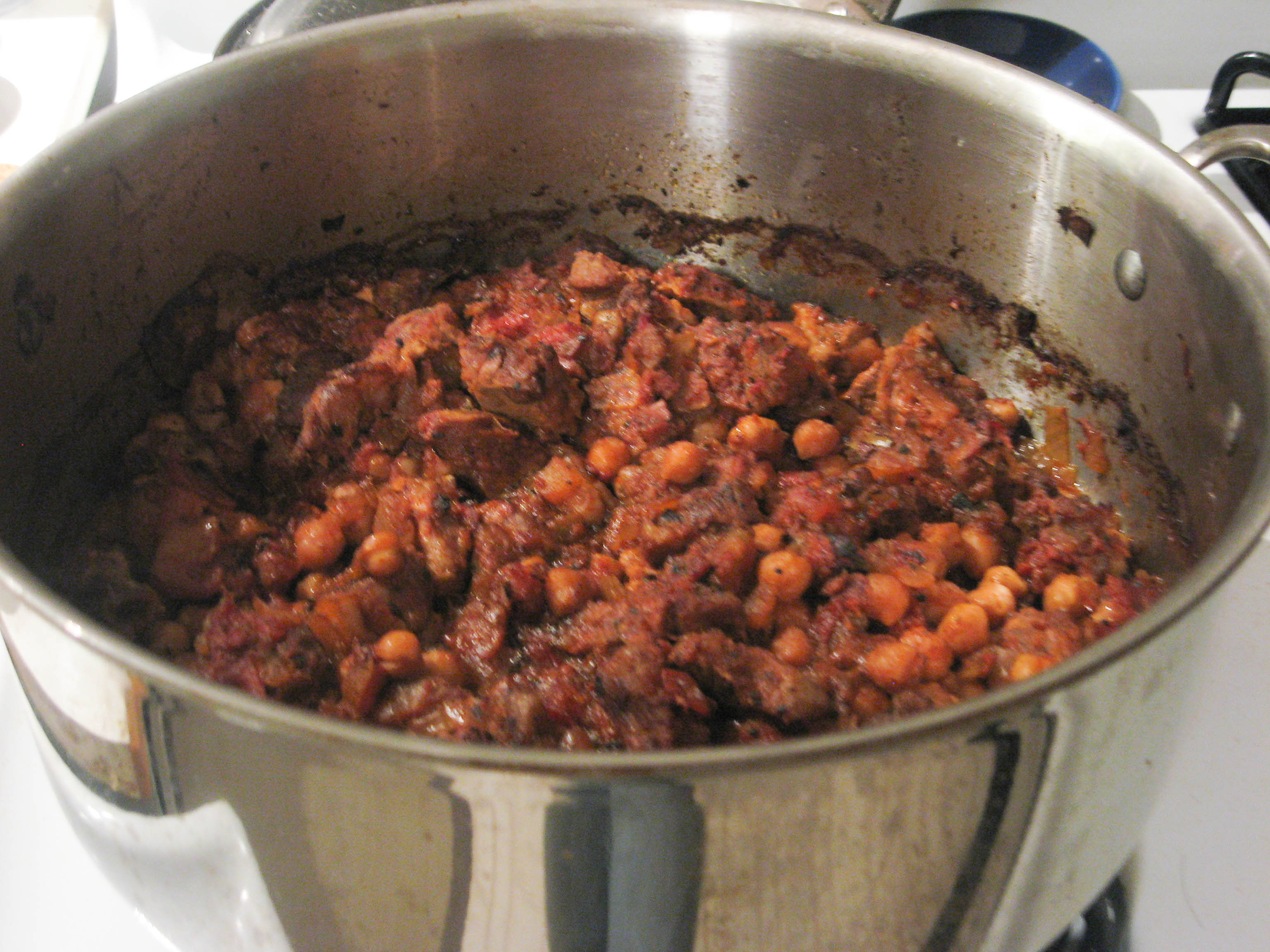
Dutch oven with lamb and garbanzos

very simple, very tasty

Celebrating the autumnal equinox.

I woke up to a lovely fall morning–sunny, breezy, cool–absolutely lovely day, some leisurely time over coffee in the sunny kitchen, and realized that I’ve gradually been shifting into autumn cooking mode–cooking urges that are very different from the hot, humid weather of summer.

I’ve been making meals in the multitasking rice cooker lately: whipped up a great spicy lamb and garbanzo bean stew and another of braised pork and collard greens.  Some of immediate use today, and some of each of those to stash in the freezer for quick meals on a cold winter day when I need serious comfort food.

The lamb and garbanzo “stew” was one that I literally threw together in about 15 minutes while I was finishing an index to send to a client. A good friend who knows how much I like to use chili peppers gave me a wonderful chile powder from Made in New Mexico.  I used lamb shoulder chops, a healthy batch of chile powder, some Mexican oregano,  Goya garbanzo beans, and a can of diced tomatoes. The lamb chops came out of the slow-cooking melt-in-your-mouth tender, with just enough spice to accumulate a bit of burn by the time you’ve eaten a bowl of it, but not enough to rip you taste buds out by the roots.  This chili powder is the best I’ve ever used–I’ll be ordering more of that one.

Another job that just could not be put off any longer was cleaning the gas stove. It is one of my very least favorite things to do so I do tend to procrastinate about it; that does not make the task any easier and I know that but I still procrastinate about it. (I think that a house elf would be a wonderful thing to have around!)

Now the stove has at least had a  lick and a promise as my grandmother would have said. Well, at least the lick, but still needs the promise though that is going to happen today. (Definitely no pictures here!)  So happy that the oven is self-cleaning since it gets lots of use in cool weather for carefree braising while I’m working at home.

Now I’m ready for a plate of braised pork and collard greens!

I do love science….

I’ve always been prone to analyze things, to want to understand the WHY behind what’s going on.  It’s not surprising that I view cooking as an applied science and like data.  That’s one of the reasons my favorite cooking magazines are Cook’s  Illustrated and Cook’s Country. (Nope, no affiliate program or anything like that–just my personal preference.) I particularly like the experimental data about what works and what doesn’t–and the same for kitchen equipment, supermarket products. What’s not to love about realistic data about how that piece of equipment is going to survive if you drop it?  Or how easy it really is to clean and reassemble?

I was just browsing my latest issue of Cook’s Illustrated–yes, the hard copy one, and I found a section titled “Common Cooking Myths, Debunked”.  If you’re not a subscriber, this is still worth reading–check the library or the magazine stand in your local grocery store.  The debunking includes information on which part of the tomato has most flavor (supports my predilection for NOT seeding and peeling tomatoes), where the hottest part of the chili pepper really is, among other myths that seem to float around amongst cooks. Understanding the how and why of cooking makes improvisation so much easier–which in turn makes cooking for one so much easier since you don’t have to depend on recipes nearly so much.

Another feature of these magazines that I like is the equipment review–I’ve just been researching portable induction units, since I’ve decided that is going to be my birthday present from Frankie (the cat) to me this year–seems a great idea for energy-saving–must be cooler than having a gas burner on for the time it takes to cook dried beans–which is something I’m inclined to do in the summertime; they make such good, hearty cool meals. I’ve read the Cook’s Illustrated reviews so now I’m ready to go shopping, with their review in mind–especially since no manufacturer knows about the reviews until after publication of the results.  (OK–I sound like I’m selling something–sorry!  It’s just enthusiasm of an inquiring mind!)

Cauliflower-black olive gratin (for one)

I started with the recipe from The New York Times that I had mentioned in an earlier post–and adapted it for single-serving cooking.

cauliflower, black-olives, garlic, shallot

just a few ingredients

My first “adaptation” was NOT to buy a whole head of cauliflower–I like it but I usually waste some of it, so I purchased 250 grams from the salad bar at my local Harris Teeter store already cut.  This was about 1/4 of what the original recipe called for (900 to 1000 grams).

My second adaptation was to use the rice cooker to blanch the cauliflower!  Put water in, add salt, close the lid and set the “rice cooker” mode.  In just a few minutes when I opened the lid I had boiling water.  I added the cauliflower, close the lid and blanched for about 5 minutes, then proceeded with the recipe–faster than a pan of water on the stove top!

My third adaptation is one I use often in cooking for one–I used shallot instead of onion since I don’t like bits and pieces of cut onion loitering in the fridge–so one medium to large shallot, prepped as for the onion in the above recipe.

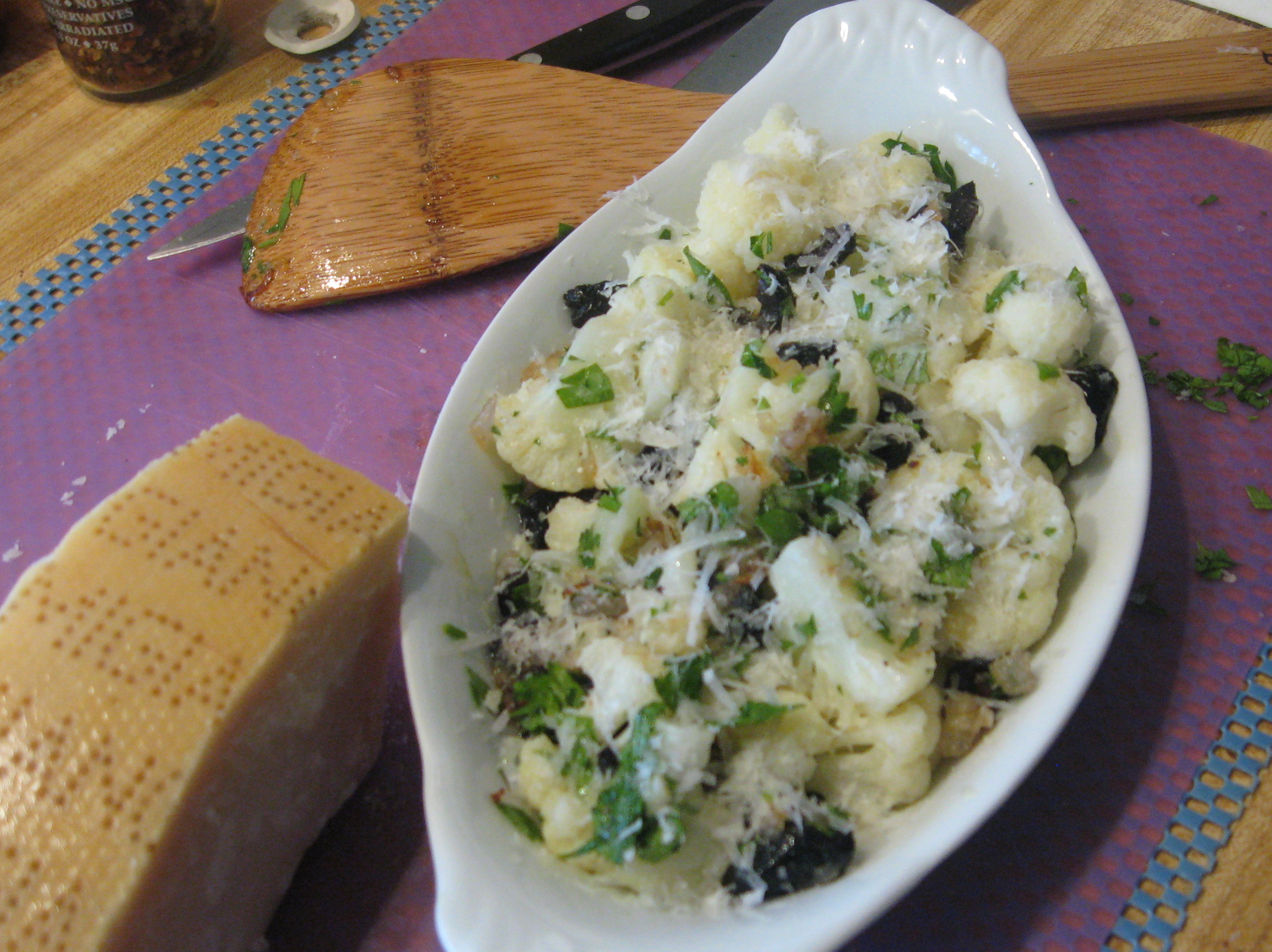
gratin dish with cauliflower

oven ready

That recipe called for 16 olives–well four olives just didn’t look like enough, so I used six. Garlic–well, I used two very small cloves. The rest of the ingredients were “measured” by eye: parsley, the Parmigiano-Reggiano were whatever looked like enough for the amount of cauliflower–maybe my adaptation is a bit cheesier than the original, but  that’s okay with me!

The results were fantastic, maybe even awesome! (Please note past tense–well, there was a tiny bit left, but that’s probably because of the rather large cod fillet–a leftover as I define leftovers–re-warmed in sugo alla puttanesca.)   This was one of the best things that I’ve ever done with cauliflower. It’s a keeper with lots of room to improvise: some red pepper flakes added to the shallot-olive mixture, or maybe some roasted red peppers.

browned gratin of cauliflower

ready to eat

I think that I might step down to 150 grams of cauliflower next time, and bake it in a slightly deeper dish–but it will definitely be made again. I do need to add more garlic, though. I can’t believe how easy it was.  This is my kind of recipe–not at all fussy and open to modification to fit my mood, the weather, and what else is served.

<><o><>

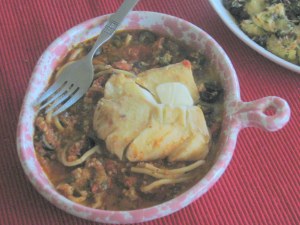
The cod fillet was a “leftover”–meaning planned.  The method of the “rerun” was unplanned.  After several days of intensive course preparation for online courses, I suffered a serious case of cabin fever.  On impulse, I called a friend, and we went out to dinner at one of my favorite causal places, Meelo’s Ristorante, here in Durham, since I had a serious craving for Andre Chabaneix’s spagetti alla puttanesca.  There was a bit of the puttanesca sauce left in the bottom of my plate, so I brought it home with me.  I used it to gently re-warm the cod fillet for supper this evening–now I’m going to have to see if I can match his sauce so that I don’t have to go out every time I want puttanesca sauce.

cod with puttanesca sauce

cod with puttanesca sauce

Umami in the slow cooker…

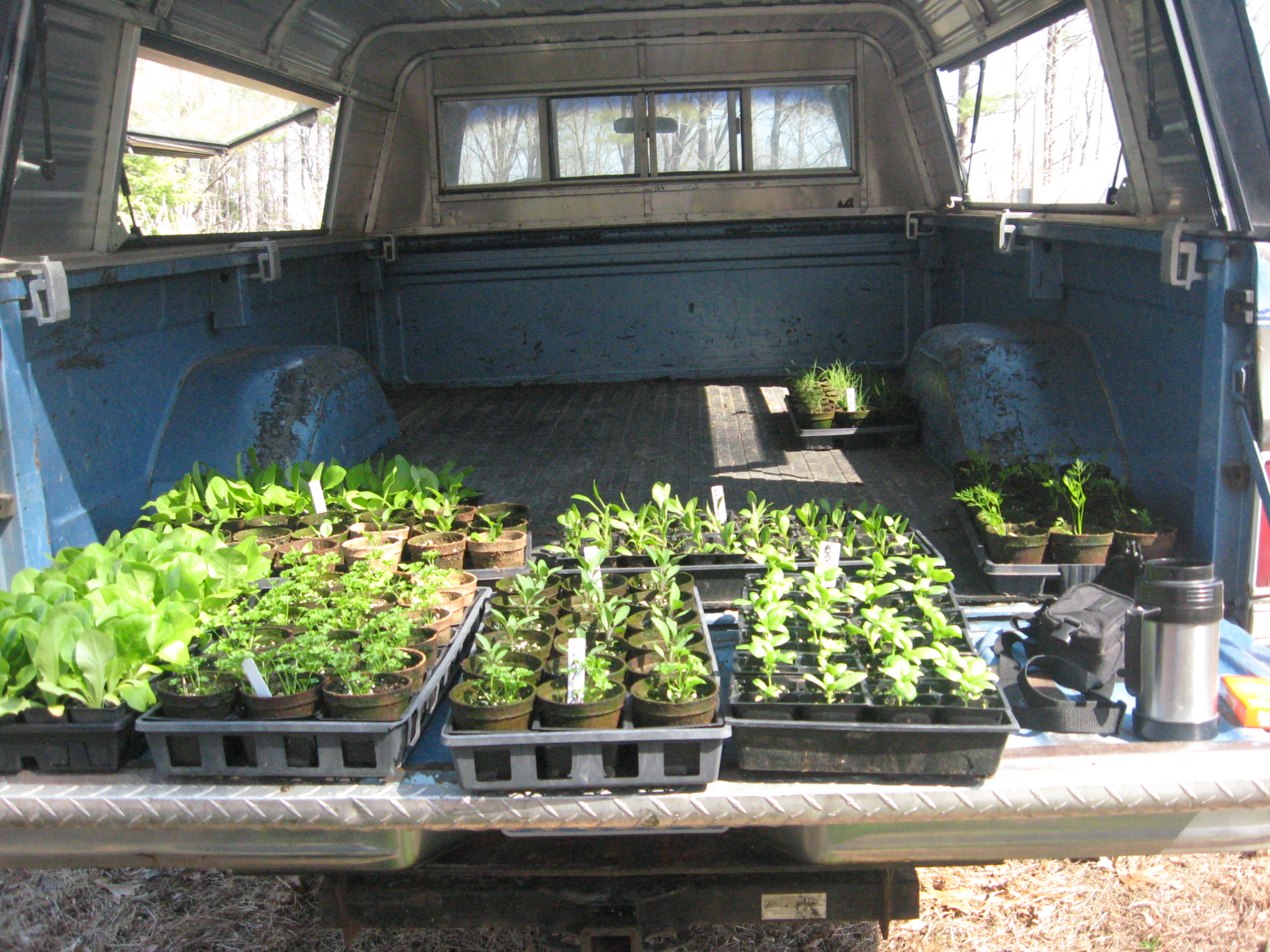
flats of plants on tailgate of truck to be loaded for the farmers' market.

for market

Obviously I’ve not been giving a lot of thought to cooking  things lately–it’s been end-of-term grading, indexing and proofreading, or getting  ready for the farmers’ market, or actually being at the farmers’ market, with more energy going to planting things, both for later harvest and for selling at the market than into cooking.

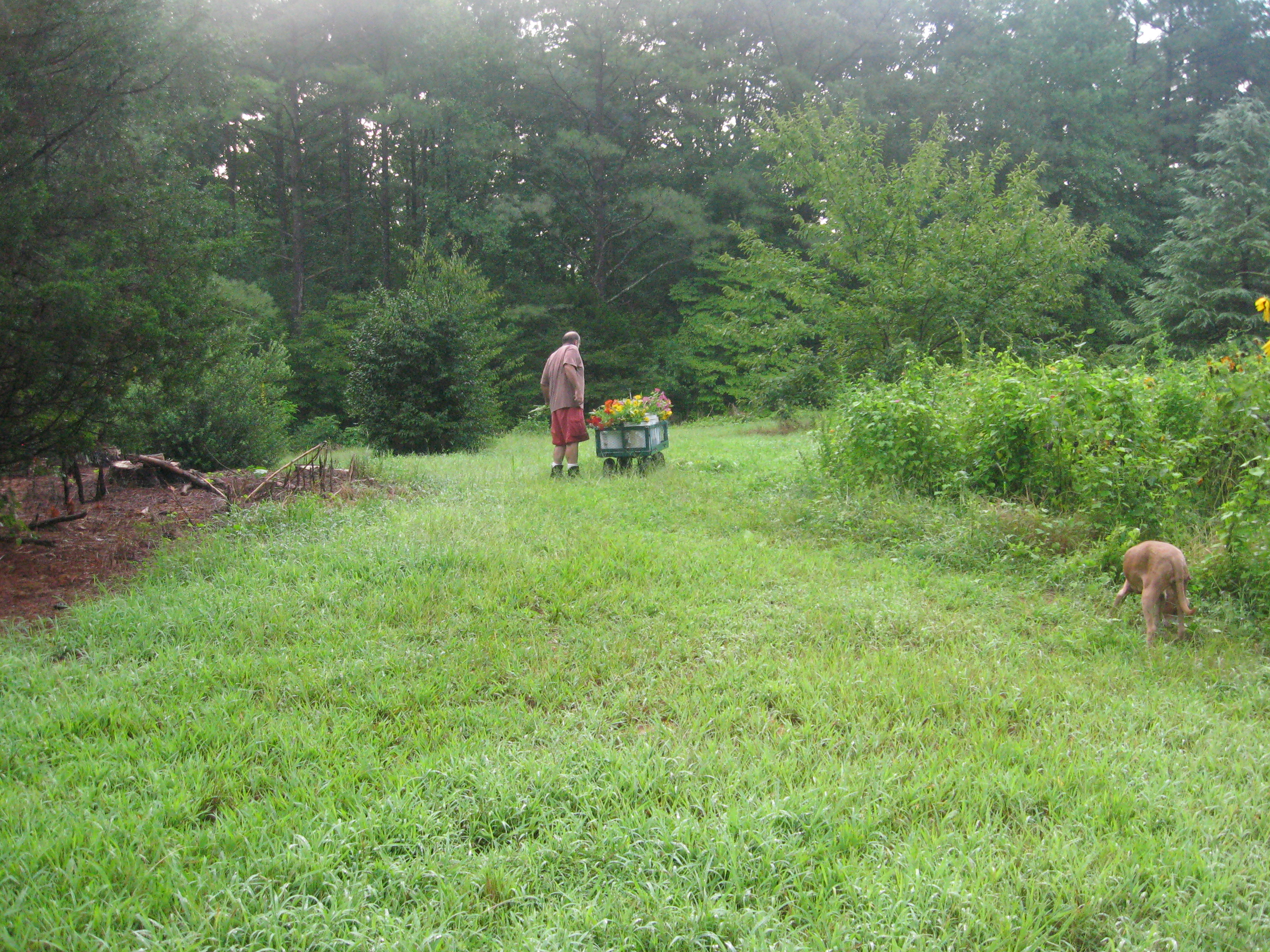
One of the down sides of working the farmers’ market is that I’m one of those people who wake up like a compact fluorescent bulb–pretty dim at first–so getting to the farmers’ market on time on Saturdays involves getting up before the birds just to give me time to be awake and functional. Even Fridays demand early rising, especially as the weather gets hotter–flowers to cut early in the morning and produce to be harvested before the heat of the day sets in and thing wilt…and just to avoid being out in the worst of the heat.

wagon of flowers in buckets

cutting flowers

I’m getting into the swing of that now but it still takes time for my lights to come on, though less painful now.  That early rising on Friday and Saturday makes me into a really lazy slob on Sunday.  Now that the Spring term is over, I’m not meeting classes during the week so I’m enjoying the summer hiatus from lecturing, but still working at freelance indexing so the absolute laziness has to be confined to Sundays and Mondays through Thursdays are still busy.

All this means that for Friday, Saturday, and Sunday cooking is likely to be focused on one-dish meals, and dishes that are good (or even better) when reheated.  Sometimes Saturday meal is not even something reheated–it’s my treat-yourself day–OnlyBurger for after-market meal before I devote the rest of the day to quality time with the cat!  (This past Saturday the treat was a Texan (burger with braised brisket on it) and a peach ice cream sandwich (handmade at OnlyBurger) after the market.  The evening meal was Carolina Moon cheese and strawberries–both from the farmers’ market.)

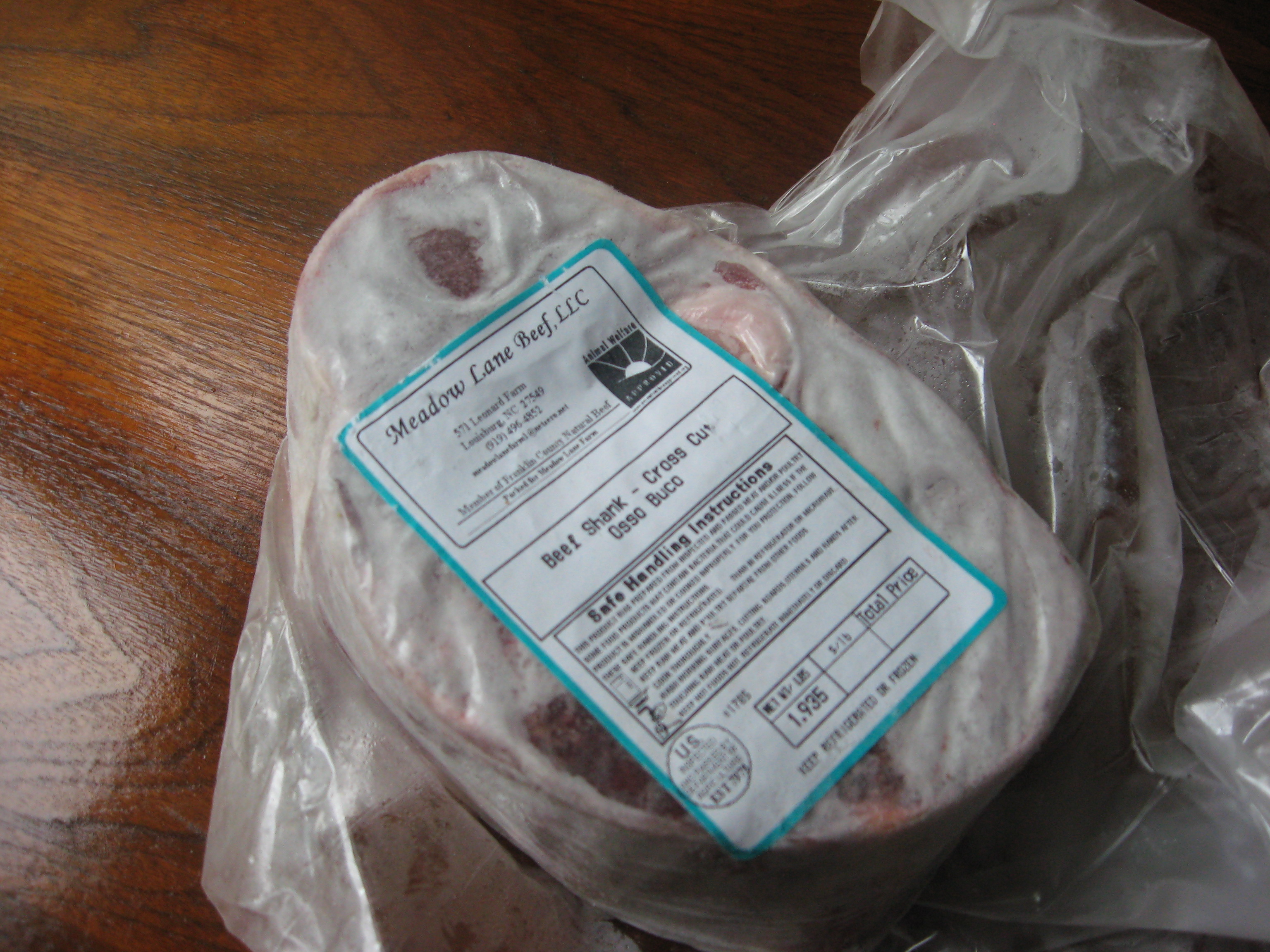
packaged cross-cut beef shank

beef shank

This weekend schedule means that I try to do some planning and cooking on Thursday to have reheatable food on Friday and Sunday.

This weekend’s meals are going to feature an absolutely lovely cross-cut beef shank from Meadow Lane Farms (also from the Durham farmers’ market)  in an easy dish that can cook mostly unattended: osso bucco, but with beef shank rather than veal shank. (The osso bucco really just means “bone with a hole” or marrow bone.)

It’s a dish that’s easily adapted for one person–there’s nothing fussy about it–no need to be exact or tedious in measuring ingredients, and to make even more “unattended”, it will go into the slow cooker (also serving as rice cooker and steamer) while I’m out working on the farm.

Krups rice cooker/slow cooker and steamer

Krups rice cooker

I have to admit that I’ve not been a fan of the slow cooker until recently, at least for anything much more than cooking dried beans, or poaching a beef tongue. The flavors and textures just aren’t the same as when the slow cooking was done in the oven where some evaporation, browning and concentration takes place even in a covered dutch oven.

My attitude about slow cookers has changed since I found the Cook’s Illustrated Slow Cooker Revolution (See Bibliography) and learned some techniques for making food out of the slow cooker more flavorful.  I’m not ready to quit slow-cooking in the oven despite that, but in hot weather I’ll certainly use the slow cooker more often with some of the “tricks” I learned from that cookbook.

What I missed most in slow-cooker dishes was that savoriness that comes from browning (Maillard reaction)  when you slow-cook in a traditional oven or brown/sear on the stove-top.  In the slow  cooker, you can make this absence less noticeable by adding ingredients that contribute “umami“.

Some of the most useful things I learned from that Slow Cooker Revolution are ways to use the microwave oven to facilitate the slow cooker, and using some “unusual” ingredients  in recipes–not esoteric ingredients, just pantry staples that boost  the umami flavor:

  • precooking aromatics like onions in the microwave so that they don’t stay crispy-crunchy in the slow cooker,
  • using tomato paste (for umami) by browning it with the aromatics either in a skillet or in the microwave before adding it to the slow cooker,
  • using dried mushrooms to boost flavor (again, umami),
  • using foil packets in the slow cooker to keep some ingredients from over cooking.
  • using soy sauce or fish sauce to add more of that umami that many slow-cooker dishes don’t get without the evaporation and browning as in the traditional oven.
  • using the microwave to precook some ingredients to get rid of excess moisture that would otherwise dilute the dish in the slow cooker.

These are all easy to do–they really don’t add significant extra prep time or effort, and do really make a difference in the flavor.  I expect an easy, flavorful meal (or two) from the braised beef shank that is going to emerge from my slow cooker on Friday evening, thanks to some added umami!

Another use for Ball/Mason jars…..

This was just on my Facebook news feed from Savory Simple.  I have never found a travel mug that cleaned up easily…and they are not cheap!  Since I use wide-mouth canning jars for so much of my storage, I have them around in various sizes.   Definitely have to have one of these gadgets!

Last-minute gift ideas for the cook

Knives are such an important and often used part of kitchen equipment!  Many times when you’re cooking for only one or two it’s much faster and easier to chop thing with a knife rather than use a food processor.   At least that’s true if your knives are in good condition–that is sharp–and sharp knives are much safer, and easier to use than dull ones.

Most knife sets come with a steel–but the purpose of a steel is NOT sharpening truly dull knives.  The steel is intended to even and straighten an edge–in other words,  to keep a knife sharp.

Even knives that have been well cared for eventually need sharpening.  It’s possible to sharpen with a stone–but most of us don’t truly have the necessary skill to do this–it’s time-consuming, tedious, and we likely won’t get the best results.  So, you might want to have your knives professionally sharpened.

However, there are some alternatives to professional sharpening or using a stone; there are now very good manual and electric sharpeners that can be used successfully by anyone.  That’s one possibility for a gift for the cook in your life, or for yourself. Cook’s Illustrated has tested both manual and electric sharpeners.

Anolon manual knife sharpener

For manual sharpeners, the AccuSharp knife and tool sharpener (model AccuSharp 001) is an inexpensive, easy to use possibility.  The Anolon Universal Knife Sharpener 3-Stage  Whetstone (model number 52255) are possible options.  I prefer the three-stage style.  Chef’s Choice also has manual knife sharpeners which have had generally good reviews as well, and are reasonably priced.

—<>—

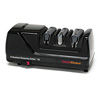
Electric knife sharpner image from Chef's Choice catalog

Electric sharpeners are predictably more expensive, but somewhat easier to use.  It’s a good investment for keeping knives  in good repair, and it’s something that might not buy for herself, and that makes it an especially appreciated gift. The Chef’s Choice electric sharpening products seem to generally have good reviews.

—<>—

steel for knives

A steel would also make a great gift for the cook–used every time you pick up a knife to cut, it evens and aligns the cutting edge.  It won’t replace a sharpener, but will help keep knives in good condition at each use between sharpening.

—<>—

To help those knives keep that sharp edge, some other kitchen accessories that your cook might welcome might be a knife block  or perhaps a magnetic strip which affixes to the wall. If knives are kept in a drawer, knife protectors might be welcome, or in-the-drawer

       —<>—

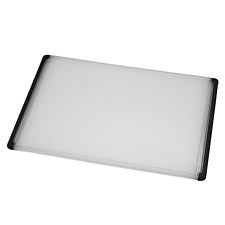
from OXO websiteAnother important way of keeping your knives in good condition is to use an appropriate cutting board–one that is “soft”.  Glass or ceramic boards will dull the knife edge so get plastic or wood/bamboo.  This need not be expensive–The OXO Good Grips cutting and carving board is an excellent choice.  The no-slip strips are great.  If the cutting board does not have these, you can always put a damp kitchen towel under it to keep it from sliding.

—<>—

Four color-coded flexible cutting mats

For safe food preparation, flexible plastic cutting mats or chopping mats are also great to have in the kitchen (and they are inexpensive, too).  Some come in different colors to make it easy to keep those used for meats, poultry, seafood/fish, and veggies to avoid bacterial cross-contamination.  Another nice thing about these is that they can be easily used to transfer chopped ingredients to pan or bowl.  Recommended by Cook’s Country is the set of four chopping mats by Progressive International Food Safety Chopping Mat set of four for around $10, but you don’t need to find that specific brand.

Both the cutting board and the chopping mats will eventually show wear and tear and will need to be replaced, but it’s a small investment to keep your costly knives sharp so that cooking is easier and more enjoyable.


A gift for the cook

Knive block with knivesYou don’t need a lot of equipment to cook for one or for many, but good knives are  necessary if you are going to cook efficiently and pleasurably.  Whether you’re purchasing for yourself or looking for a gift for the cook in your life, knives make a gift that keeps on giving over and over and over. Many times, especially for small quantities, a knife is better than the food processor–especially since it’s so much easier and faster to clean.  (But remember that knives are very personal in terms of how they feel to the user, so keep that receipt even if you’re giving the knives as a gift so that they can be exchanged if necessary).

When you’re buying knives, you should know that the “set” of knives in a storage block may not be the best way to go.  As with pots and pans, the sets are most likely devised by the vendor to get the most money out of your pocket and into theirs, without serious consideration of actual utility in the kitchen.  Just as with your basic pots and pans, I would advocate purchasing knives à la carte rather than in a set since most sets do not have the most useful selection of knives and can be expensive.

The knives that you see here are ones that I’ve collected over many years of cooking, both at home and in restaurants.  As you can see, it’s not a matched set!

The latest issue of Cook’s Illustrated (November & December 2011, pp. 25-27) evaluated knife sets for quality and usefulness.  If you’re thinking of buying knives (for yourself or as a gift) I’d recommend taking a look at this article. You shouldn’t just shop the “celebrity” knives  since (just like celebrity cookware)  many of those just aren’t really the best knives you can get. This article covers the basic knives that make up a functional set for most kitchen jobs.   I’ve collected mine independently but I find that my selections are very close to those in this article.

Chef’s knives are the workhorses of the kitchen–the knife that you’ll reach for most often.  I have two:  an 8-inch and a 6-inch.  The 8-inch is large enough to handle that butternut squash or head of cabbage, and the six-inch handles smaller jobs.  The eight-inch is a Wüsthof classic model.  I like this for tougher jobs as it’s a heavy knife.  The 6-inch is a Zwilling J.A. Henckels knife.  It’s lighter than the Wüsthof and works well for lighter chopping jobs.  I don’t use these (even the heavier Wüsthof for dismembering poultry or attacking bones as that’s hard on the edges and I want these to stay sharp–I use heavy duty scissors or a cleaver.

Straight-blad and bird's beak paring knives

Paring knives

Another real necessity for the kitchen is a good paring (peeling) knife with a 3-1/2- to 4-inch blade.  I’ve also added a Wüsthof bird’s beak paring knife that I find very comfortable for peeling jobs where an Oxo vegetable peeler won’t do the job.  The bird’s beak is light and very comfortable to use for shaping, or peeling small curvy things.

Carbon steel slicing knife

Slicing knife

A slicing knife has a thinner blade that is more flexible for carving that bird or roast, or smoked salmon or salami.  This is a carbon steel one that has been with me for many years.  I use it for tomatoes and  bread as well.  Were I to replace it now, I would get a 10- or 12-inch blade as this is just a bit too short to easily use on a free-form boule.

OXO bread knife

Bread knife

If you buy unsliced bread (or bake your own) you might want a bread knife–I do have one, although the slicing knife is often the one that gets used even for artisan style breads.  While the Cook’s Illustrated  tests recommended the Wüsthof classic 10-inch bread knife, I have an Oxo bread knife that I’m satisfied with–not that I wouldn’t love to have the Wüsthof bread knife, but my budget doesn’t stretch that far for a bread knife (but did for the chef’s knives and paring knives since they get used so much).

With almost all knife sets you find something called a “utility” knife–sometimes serrated, sometimes not.  These are not the kitchen workhorses that the chef’s and paring knives are.  Over the years, I’ve acquired two–one Victorinox/Forschner and one Henckels Friodur cutlery.  They don’t get used very often though they are nice to have around, but by no means essentials.  I’ll sometimes reach for these when I’m slicing smaller tomatoes, or meats since they also have thin blades similar to the slicing knife.

The other knives that I’ve added are a boning and fillet knives.  The 6-inch and the 4-inch boning knives, with the sturdy blade, and pointed tip let you work around joints and bones easily.  The 4-inch one gets a lot of use for boning chicken thighs (a staple in my chicken use).  The fillet knife (Sabatier) with the slender, flexible blade makes taking the skin off a piece of fish a breeze.

A steel is good to have, so long as you learn to use it properly, and realize that it does not sharpen your knives…it merely hones or realigns the edges.  For sharpening you can use a stone if you’re comfortable with that, or a knife sharpener if you want to do it yourself…or have your knives sharpened by a professional.  You do need to keep knives sharp–otherwise they are frustrating, and dangerous.

With proper care, your knives will last a lifetime:  they should NOT be put in the dishwasher, but hand washed, rinsed with very hot water, and dried immediately after use.  You should store them in a block or on a magnetic holder to protect the blades (and fingers).

Cook’s Illustrated testing recommendation was an à la carte set, including a storage block, which resembles what I’ve described above (without the fillet and second boning knife) which can ring in at about $334.  If you want to do less searching and pick up a set, then the Victorinox 7-piece set is a good bet–for around $189.  I’ve used the Victorinox knives and given price and functionality, they would be my choice for a set or as “best buy” in terms of the most bang for the buck.  Whether it’s a gift for yourself or someone else, I’d recommend checking that review keeping in mind that Cook’s Illustrated does not accept advertising, and they do not accept products for review from manufacturers, nor do manufacturers get any notice that their products are being  tested until the results are published.

Macaroni & beef with tomatoes

The sudden arrival of a day that is about 30 degrees cooler that what we’ve been having has sent me scurrying into the kitchen to make a serious, hearty ham and bean soup, maybe some chili, and something quick, warm and cozy for today while the rest of the weekend cooking is in progress.

I love the multiple flavors and textures of a 15-been soup, but one of the frustrations is how differently the various beans cook.  This sent me to Cook’s Illustrated for information on how best to soak my beans.

They recommended a brine for the soak:  3 tablespoons of table salt per gallon per 1 pound of dried beans.  (If you’re using kosher salt see Conversions page for equivalents).  So the beans are soaking!  I’m doing the full pound so that I can stock the freezer with bean soup for the winter since it’s a favorite meal.

Since I did not plan ahead I have wait for the beans to soak, I’ll have to cook something else for today’s cool weather food– mac ‘n’ beef sounds like good cool weather food.

♦♦♦

I found a recipe that looked easy and quick in Cook’s Country–a skillet version.  Only drawback was that I needed to be out running errands and wanted food when I got back.  Since I’d discovered that I can make a decent macaroni and cheese in my rice cooker, I decided to try making it in that.  The other thing I like with my macaroni and beef is chunks of tomatoes, not just some tomato sauce so I did a little modification of the recipe, and enjoyed my comfort food on a chilly day.

Ingredients

  • 10 ounces of elbow macaroni (or any small tubular pasta)
  • 3/4 pound of lean ground beef
  • 1 large onion, chopped
  • 1 14.5-ounce can of diced fire-roasted tomatoes, drained reserving liquid
  • 1 10-ounce can of diced tomatoes and green chilies, drained reserving liquid
  • 1 tablespoon of olive oil
  • 6 medium cloves of garlic, put through press
  • 1 teaspoon of dried oregano
  • 1 teaspoon of Hungarian half-sweet paprika or smoked Spanish paprika
  • salt and pepper to taste
  •  2-1/2 cups of liquid (juice of tomatoes brought up to this volume with water)

Assembly

  • Cook onion in the olive oil until just starting to brown in a skillet on the stove-top.
  • Add ground beef and break up, and brown.
  • Add garlic, paprika and oregano, and continue to cook until fragrant.
  • Transfer to bowl of rice cooker and add drained tomatoes and the liquid.
  • Add macaroni and mix well.
  • Set on the rice cooking cycle; it switches to warm/hold when done.
I got back from running errands and there was my mac ‘n’ beef ready to eat.  I have several more servings…a couple are destined to go into the freezer for future use.   Some will get reheated in the oven in the next few days (topped with some cheddar cheese and put under the broiler until it’s nice and brown).

♦♦♦

I don’t have a lot of specialty appliances in my kitchen, but one that has earned a permanent spot on my counter is my Krups rice cooker which also functions as a steamer and a slow cooker–and you can steam and cook rice at the same time.  You can also use it to cook pasta.

One of the things I discovered in the recipe book that came with it was a recipe for macaroni and cheese cooked using the rice cooking mode.  I was pleased with the results with a bit of modification in the ingredients.  The pasta does not overcook–just like rice does not overcook so I was inspired to try the macaroni and beef in it and it  worked well.

Storing things….

One of the problems that single-serving cooks continually face is things that change texture and colors as they languish in the refrigerator.  These are not always leftovers from the meal you cooked a week ago, or the little box you brought home from the restaurant when you couldn’t clean your plate (even though you knew then it was unlikely that you’d actually eat what was inside).  Having things “go bad” is a perpetual problem for those of us cooking for one…that head of celery, that whole head of romaine lettuce….

There are lots of tips, tricks, and suggestions that I’ve found about how to store things that plague the single-serving cooks but I’m always looking for better ways to store those bits and pieces until I can use them.   I’m always on the lookout for things that actually do work.

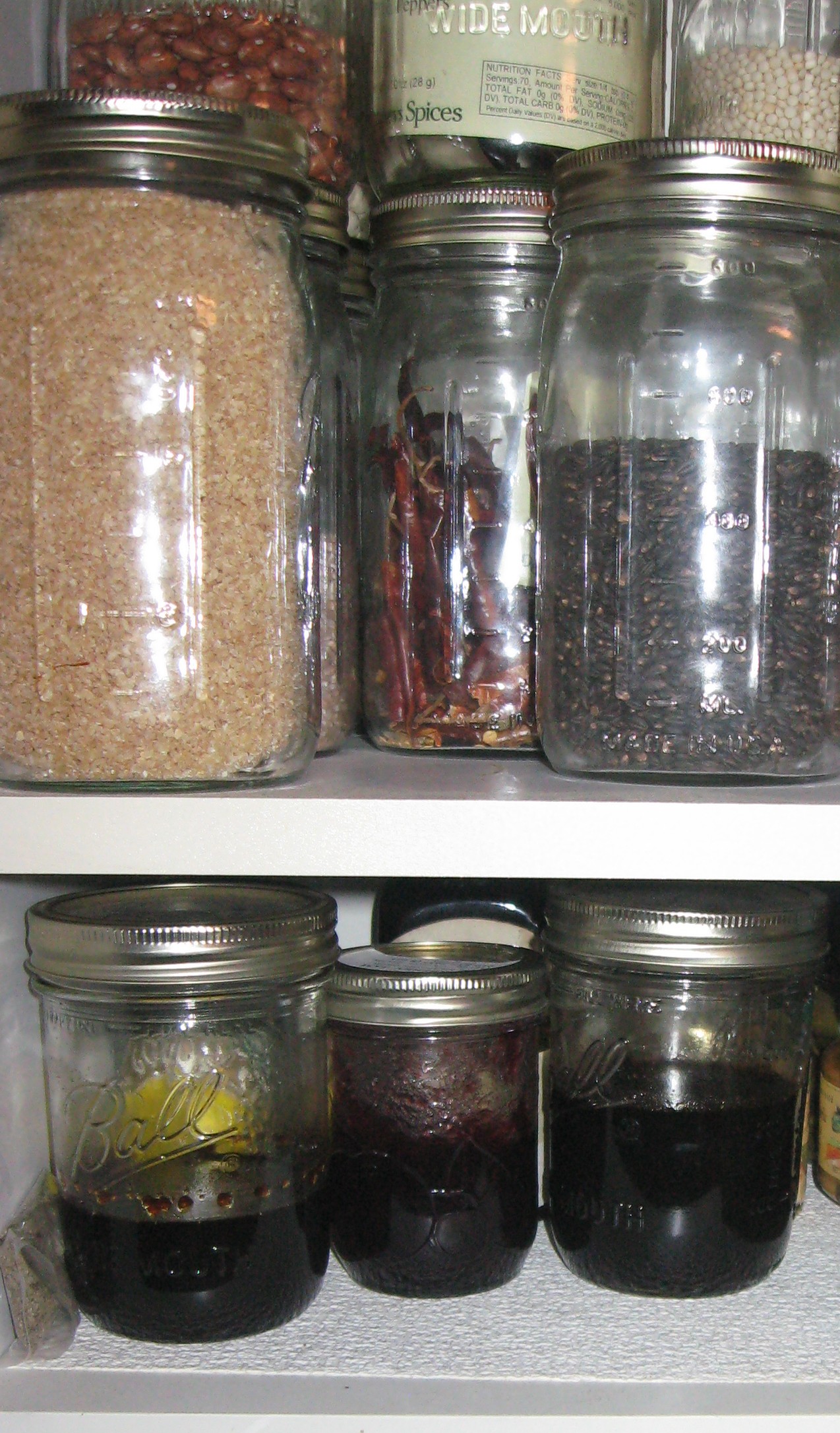
Ball-Mason jars for storageOne of my favorite sources for information like this is Cook’s Illustrated because they actually do experiments to find out what works and what does not.  This doesn’t seem to lend itself well to a post for each suggestion, so I thought I’d add a reference page on Storing Stuff as a place to collect information about storage methods for the things that you are likely to use as a single-serving cook.   If you have a successful method that you use as a solo cook, please post it.