Trying to keep the New Year’s resolutions…

I’m really trying to keep my New Year’s resolutions, though sometimes I think that I should simply resolve each year to try to do better on keeping LAST year’s resolutions.  But it’s a new year, new start, so here goes!

I’ve just gotten back from the grocery store–with only one thing that wasn’t planned–That was a veggie that I’ve never seen in this Harris Teeter before–a Boniato (Cuban sweet potato). While I gripe loudly and constantly about how crowded the grocery store always is on Sundays, it’s what seems to work for me–so I gripe and still shop on Sundays–unless I ran out of milk on Saturday!

The grocery shopping took a bit longer than usual, but I went with the idea of doing some meal planning on the hoof.  (I like to shop by what looks good and what’s on special, so meal planning at home doesn’t necessarily work for me.) I went with a set number of meals in mind–and the meat (at least vaguely) in mind, then walked around looking to see what was on special, and what looked good–in other words,  produce and meat.

Knowing that we can expect some cooler weather over the next week did influence my shopping, and so did the fact that I’m still knee deep in course prep for the medical terminology courses that I’m teaching.  I need cool-weather dishes that I can pop into the oven (Römertopf is out on the counter–and I can scarcely believe that I’ve not posted about cooking something in them before this.)

The result of my meal planning on the fly was this and I’m going to keep you posted on how well I succeed with this–hoping for some peer-pressure here:

  • It’s really too-warm-for-the-season weather here today, so I’m having something light (and “leftover”)–cod re-warmed with the tomato sauce that I brought home from the Italian restaurant, and cauliflower and black olive gratin (had all the ingredients in the fridge except the cauliflower.  I purchased enough for one good-size serving from the salad bar–cheaper than a whole head of cauliflower when I know part will likely go to waste.)
  • Lamb (shoulder chops to be cut up) braised with veggies–in the Römertopf–with an under-appreciated vegetable–turnips.  Personally I love them raw too, and like the sweetness that they add to soups, so they get used a lot.  Doesn’t hurt that they store so well either.
  • Chicken thighs to roast (most likely Römertopf  again) with some root vegetables (have carrots, turnips, parsnips, and some cabbage).  There will be at least two meals from the chicken thighs.
  • Since I have some lovely ham stock (courtesy of a friend sharing ham and the ham bone with me) I’m going to make some bean and kale soup for one warm cozy supper.
  • While I was perusing the New York Times Health section and stumbled onto a recipe for a turnip gratin that is a possible for a side dish with some of the chicken.
  • Then last, but not least, is a fresh black pepper and onion sausage that most likely headed into the Römertopf with some potatoes, to be accompanied by some cabbage that’s been quickly microwaved with a bit of extra-virgin olive oil.

After my meal planning, I’ve got a couple servings of meat (chicken thighs and pepper-onions sausages) that are flexible and should lend themselves to other things if my appetite doesn’t fit my plans.  The sausages could always end up in another “one-pot” dish.  There are also some salad makings in the fridge, and some fruit (Fuyu persimmons, apples, and oranges) for dessert.

One of the things that I like about recipes like those for the cauliflower-black olive gratin and the turnip gratin, is that even though they say “serves 6” they are SO easy to cut down to size for single-serving cooking.

So that’s my plan for this week–regular cooking that is healthy, and doesn’t promote waste from things that just don’t get used.  There are some lunches to be made during the week since most of my courses are online this term–meaning I’m home to fix brunch or lunch for myself.  Maybe that Boniato will fit there.

I’ll be posting more about these meals, but, please, wish me luck with the New Year’s resolution!  Now, off to the kitchen to do the cauliflower-black olive gratin to go with my cod in tomato sauce!

Tuna salad

Not that there’s anything wrong with traditional American tuna salad, but there are lots of other things to do with  tuna.  I like tuna, but I don’t want “tuna salad” in the traditional sense every time, so I’ve come up with lots of variations.  Some of the best are made with the “leftovers” from grilling a lovely big tuna steak or with my homemade tuna confit.

My “salad” might have onion and celery (if present in the refrigerator) but it’s certainly not a requirement; no mayonnaise either (though I do like the stuff).   Home from work, not going back out to the grocery store; it’s warm enough that I don’t want anything hot for lunch.  What have I got to work with from the pantry and the refrigerator?

If you think about the basic American tuna salad, it has very few ingredients:  usually mayonnaise, celery, onions, and maybe hard-boiled egg, or sometimes pickle relish.

Personally I find the usual supermarket canned tuna to be unappetizing–dry and crumbly if it’s water-packed white albacore, sometimes mushy  and fishy lacking in any real texture,  so I understand why it’s often hidden in the mayonnaise, but there are now  reasonably priced alternatives available.  If I don’t have homemade confit, I’ll be using a single-cooked canned tuna that more nearly approximates the quality of European canned tuna.

Starting with good quality  tuna, unless you want to go all the way and make salad à la niçoise you really don’t need many ingredients.  You don’t really want to overwhelm the tuna (since we are using good tuna here) so the components you need are:

  • some contrasting texture and flavor ingredients
  • just a bit of oil
  • a little acid to brighten it up.
  • fresh-ground black pepper
  • some fresh herbs for extra flavor

Starting with a six-ounce can of tuna, here are some possible things to do:

  • For something light, refreshing  and crunchy for a sweltering day, I like to use diced cucumber, scallions, red onion or sweet onion like Vidalia (depending on what’s in the fridge), fresh-ground black pepper, salt (if the tuna has no added salt), about a teaspoon of very fruity extra-virgin olive oil, a squeeze of lemon juice, and some finely chopped spearmint.
  • For something really quick, I’ve  added some  fresh onion, sweet bell pepper,  diced chile peppers for texture and some salsa  from a jar.  Chipotle salsa can give you a warmer, smoky taste.
  • If you want a heartier salad, add to your tuna some drained, rinsed white beans (great northern or cannellini are my favorites), tomatoes, chopped onion, green or black olives, some extra-virgin olive oil or aïoli (easy to make a quick version if you have decent mayonnaise in the fridge) and some fresh oregano.
  • If you have some pesto in the fridge, try chopped onion (almost always use this), diced tomato, capers, or olives. If there’s pasta around, that can be added too.
  • I usually have a jar of a fruit salsa in the fridge as well and that makes a good start.  Add sweet onion like Vidalia or Walla Walla, more fruit such as peaches or mango, some ripe bell peppers.
  • Black beans, diced tomatoes, onions, chile pepper, ripe bell pepper (I’m just not fond of green bell peppers so I don’t use them), celery, and even some corn and a vinaigrette with a light touch of chilli powder added.
  • For an oriental take on the tuna salad,  a bit of sesame oil (the kind from roasted sesame seeds) with some ginger, green onions, a little garlic if you like, with cucumbers, celery.
  • That extra serving of roasted vegetables–even potatoes–with cherry tomatoes, and a splash of vinaigrette, maybe some fresh thyme.

Obviously, a many of these suggestions would work equally well with chicken if you have that instead, or don’t like tuna.  It’s easy to improvise a quick salad if you start with a serving of meat. The possibilities are really almost endless–just follow your own taste.

A son goût! 

Caponata!

The first time I tasted “caponata” it was mostly eggplant, and it was absolutely buried in tomato sauce.  I liked the concept, but it had kind of languished until I was looking around the kitchen at the tomatoes and eggplants that I had there.  This has been such hot, humid, torrid weather that I’m turning into a very picky eater…must be flavorful, room temperature or cold.  Needless to say I’ve eaten a lot of melons and fruits…and raw tomatoes in caprese salad, but I really needed to do something with the tomatoes and eggplants.

I decided to go looking for a recipe for caponata that looked like something I want to eat with grilled or griddled king klip since that was on special in the market today.  I started by going to EatYourBooks.com to search for caponata recipes among the books that I own (that I’ve put on my bookshelf there).  I found that I had 6 recipes for caponata.  I don’t know if it’s the weather, or what, but none looked like something I wanted to tackle this afternoon.  So I went searching online in the blogs that I like to check on.

On All Things Sicilian and more, I found a recipe that “felt” like something to do this afternoon, and it seemed loose enough that I could do it with what I had–oriental-type eggplants and little grape tomatoes.  It involves several steps, but it’s seemed approachable. A slight variation put a little garlic and some red pepper flakes into the mix as the olives that I had were marinated in those things.   Admittedly I did take a few liberties with the recipe but I think it worked well.  I did not improvise with the agro dolce–I kept those proportions.

My only real variation (other than the tomatoes) was that I treated the eggplant as described in my post on how to cook eggplant (as suggested by Cook’s Illustrated: salted very lightly, microwaved it, pressed it) and I was able to sauté all the eggplant in about a tablespoon of olive oil.

Here is the recipe from All Things Sicilian blog–the best I’ve ever tasted.  (You should go to this blog and read for more information about caponata.)

Ingredients

  • extra virgin olive oil, 1½ cups (more or less – depending how much the vegetables will absorb)
  • eggplants, 1-2  large, dark skinned variety,
  • peppers, 3, preferably 1 green, 1 red, 1 yellow (variation of colour is mainly for appearance, but the red and yellow ones taste sweeter)
  • onion, 1, large, sliced thinly
  • red tomatoes, 2 medium size, peeled and chopped, or 2 tablespoons of tomato paste and a little water
  • capers, ½ cup, salted or in brine
  • green olives, ¾ cup, stoned, chopped
  • celery, 2-3 tender stalks and the pale green leaves (both from the centre of the celery)
  • white, wine vinegar, ½ cup
  • sugar, 2 tablespoons
  • salt and freshly ground pepper 

Preparation

For caponata vegetables

  1. Cut the eggplant into cubes (approx 30mm) – do not peel. Place the cubes into abundant water with about 1 tablespoon of salt. Leave for about 30 minutes – this will keep the flesh white and the eggplant is said to absorb less oil if soaked previously.
  2. Prepare the capers – if they are the salted variety, ensure they have been rinsed thoroughly and then soaked for about 30 minutes before use, and then rinsed again.
  3. Cut the peppers into slices (approx 20mm) or into rectangular shapes.
  4. Slice the onion.
  5. Slice the celery sticks and the green leaves finely.
  6. Peel, and coarsely chop the tomatoes (or use tomato paste).
  7. Drain the eggplants and squeeze them to remove as much water as possible – I use a clean tea towel.
  8. Heat a large frypan over medium heat with ¾ cup of the extra virgin olive oil.
  9. Add eggplant cubes and sauté until soft and golden (about 10-12 minutes). Place the drained eggplants into a large bowl and set aside (all of the vegetables will be added to this same bowl). If you want to, drain the oil from the eggplants back into the same frypan and re-use this oil to fry the next ingredients – the peppers.
  10. Add new oil (to the left-over eggplant oil) plus a little salt and sauté the peppers,until wilted and beginning to turn brown (about 10-12 minutes). Remove the peppers from the pan and drain the oil from the peppers back into the same frypan. Place the peppers in the bowl with the eggplants.
  11. Add a little more oil to the pan and sauté the celery gently for 5-7 minutes, so that it retains some of its crispness (in more traditional recipes, the celery is always boiled until soft before being sautéed). Sprinkle the celery with a little salt while it is cooking.
  12. Remove the celery from the pan and add it to the eggplants and peppers.
  13. Sauté the onion having added a little more oil to the frypan. Add a little salt and cook until translucent.
  14. Empty the contents of the frypan into the bowl with the other cooked vegetables.

For the agro dolce sauce

  1. Add the sugar to the frypan (already coated with the caramelised flavours from the vegetables).
  2. Heat it very gently until it begins to melt and bubble. Add the vinegar and evaporate.
  3. Incorporate the cooked vegetables into the frypan with the agro dolce sauce.
  4. Add ground pepper, check for salt and add more if necessary. Gently toss all of the ingredients over low heat for 2-3 minutes to blend the flavours.
  5. Remove the caponata from the pan and cool before placing it into one or more containers.

Ò¿Ó
It should hold well in the refrigerator–and I know it will be even better tomorrow when the flavors have melded  more.  I’m looking forward to this with some griddled king klip tomorrow.

A simple supper

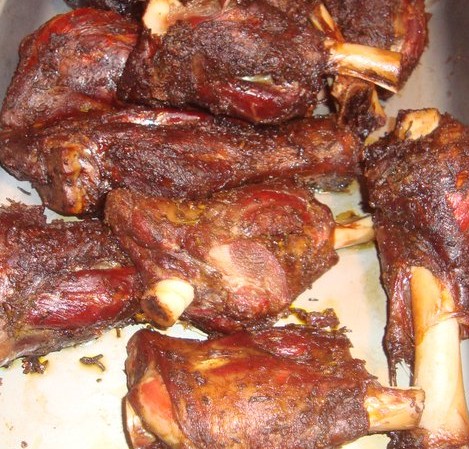
When I did the smoked lamb and goat shanks for the Fourth of July I deliberately added some extras, even after I had allowed for the appetites of my guests.  What was left after our dinner was not “leftover” but was planned (even though I had nothing specific in mind just then) as future food since I thought that these would lend themselves well to improvisation.

I sliced some of the meat very thinly from the cold shanks and used it in a salad.  The goat meat was especially good here, but the lamb made a nice salad addition too.  There was still enough for one all-meat meal, or two meals if supplemented with a grain or beans.

Lamb and beans heating in skilletI had envisioned using the rest of the meat with some cannellini beans  to make a kind of mini-cassoulet that would be topped with bread crumbs and baked briefly to meld the just-added seasonings. That was just not on the program!  It’s been so hot lately that I just did not want to have the oven on even with the air conditioning running, so I opted for a “skillet” meal.

My first step was to sauté some chopped onion (1 medium) until soft and starting to brown, then add  garlic (2 large cloves, minced).  Next I added the chopped meat from the lamb and goat shanks.  I had enough for two servings–and I decided to use it all in this concoction as I though I would like two meals from this as it would only improve with reheating. I added about 1 teaspoon of herbs de Provence(seemed rather cassoulet-like) and a healthy dash of crushed red chili peppers for some spice, and about 2 tablespoons of water.  Finally I drained, rinsed and added one can of cannellini (white) beans to the skillet, which I covered and allowed warm over low heat to hydrate the herbs de Provence and the pepper flakes.

Without further ado it was time to eat. With the last of the bottle of wine that was Lamb with white beans and sliced tomatoesserved with the original meal  it was a very satisfying, and easy, meal. There will be one more serving (and that’s not a “leftover” either–maybe that will make it into the baking dish with the bread crumbs and some rosemary added. This could adapt well to any extra pork, beef or chicken that happened to be hanging about the fridge as a leftover.  All this needed was a salad to complete the  meal.  Dessert was just some fresh fruit.

18 July 2011

Just a quick update here.  I’m glad I made two serving of this.  The improvement on re-heating was fantastic.  The smokey flavor came out more–next time I do something like this, I’ll plan to make it one day and reheat it later.  I’d love to try this with goat!

Cold beet soup

I’m back from the Durham Farmers’ Market–it was a great day, even though the market is not in full summer swing yet.  The Piedmont BioFarm’s booth, which was right next to mine, had absolutely gorgeous beets. Unfortunately, they  sold quickly so  I didn’t get any today, but I’m told that there will be more next week, so I’m planning to bring some home with me then.

beets with tops from Johnny's Select Seeds.The sunshine and warm weather made me think about beet soup.  This recipe was given to me years ago by a good friend, and it’s become one of my favorite summer things to have in the refrigerator for hot weather.  It’s cool and refreshing, yet very satisfying.

I first experienced this soup when Casey brought me some, just when it was most needed:  I was moving–in extremely hot, humid weather–from one apartment to another in the same building, so it was mostly carrying boxes and lugging furniture, all very hot sweaty work.  Air conditioning was out of the question with the constant coming and going, with the doors open.

Cooking was also out of the question–mostly for reasons of fatigue, sore muscles, disruption of the kitchen, and the heat, and maybe even a dollop of laziness thrown into the mix.   That soup was the most wonderful treat, particularly under those circumstances; I’ve made it many times since and it’s at least as good, if not even better, when had in much less dire straits.

It’s not a small recipe, but it holds very well in the refrigerator;  a “left-over” taste is not a problem–and I think that the flavors actually blend and grow with standing.  I suppose you could always halve the recipe, but it’s so good that I’ve never done that–I can easily enjoy  it several days in a row!

Šaltibaršciai (Casey’s Cold Beet Soup)

Ingredients

  • 1/2 medium-size onion, finely chopped (preferably Vidalia or Walla Walla sweet onions)
  • 1 tablespoon salt
  • 6-10 (depending on size) boiled, peeled, and grated beetroot
  • 2 cups water in which the beets were boiled.
  • Chopped stems and greens from the beets, steamed 3-5 minutes
  • 2 large cucumbers peeled, seeded, and chopped
  • 2 handfuls of fresh dill, finely chopped
  • 1 bunch of green onions, sliced thinly
  • 5-6 hard-boiled eggs, chopped
  • 1 cup of sour cream
  • 1/2 gallon buttermilk
  • 2 cups water from cooking the beets (cooled)
  • red wine vinegar (0 -4 tablespoons) to taste.

Assembly

  1. In a large bowl, place the 1/2 medium onion and about 1 salt. With the back of a wooden spoon, grind together the onion and the salt to draw out the onion juice. (You really need to do this “muddling” process–you don’t get the same “blend” of the onion flavor if you simply add minced onions.)
  2. Add the remainder of the ingredients to onion in the bowl and stir well.  Adjust the flavor balance with additional salt if needed, and a wine vinegar to taste.  Add more liquid if needed for the consistency you prefer.
  3. Chill thoroughly.  Serve with boiled or steamed potatoes, chilled.  (You want boiling potatoes, not baking potatoes for this; red or Yukon gold work well.)

Wine suggestions, courtesy of Casey, were as follows:

  • Sauvignon Blanc is excellent.  The soup needs a wine with more fruit and not too herbal or grassy.
  • A white Corbières was too herbal–it accentuated the dill in the soup until it was just overwhelming.

I did not try the Corbières; overwhelming dill did not strike my fancy and I trust this recommendation.  I can attest that Sauvignon Blanc is excellent with the soup.  I’ve probably eaten this for breakfast, lunch, and supper, with wine, and without.  It’s well worth the effort of making and it may well improve with standing a few days.

I have to confess that is a spate of utter laziness, I have replaced the potatoes with cubed extra-firm tofu with a very satisfying result.  I have always thought that it’s the eggs and the potatoes that make this such a satisfying, but cool, meal.  And, it a marvelous color, too–definitely shocking pink.  I’ve not tried it with the orange beets, but that might be interesting, too.

Think it looks like a lot? Well, invite a friend. Friends are usually glad to help in cases of an excess food crisis!

A son goût!

Storage containers

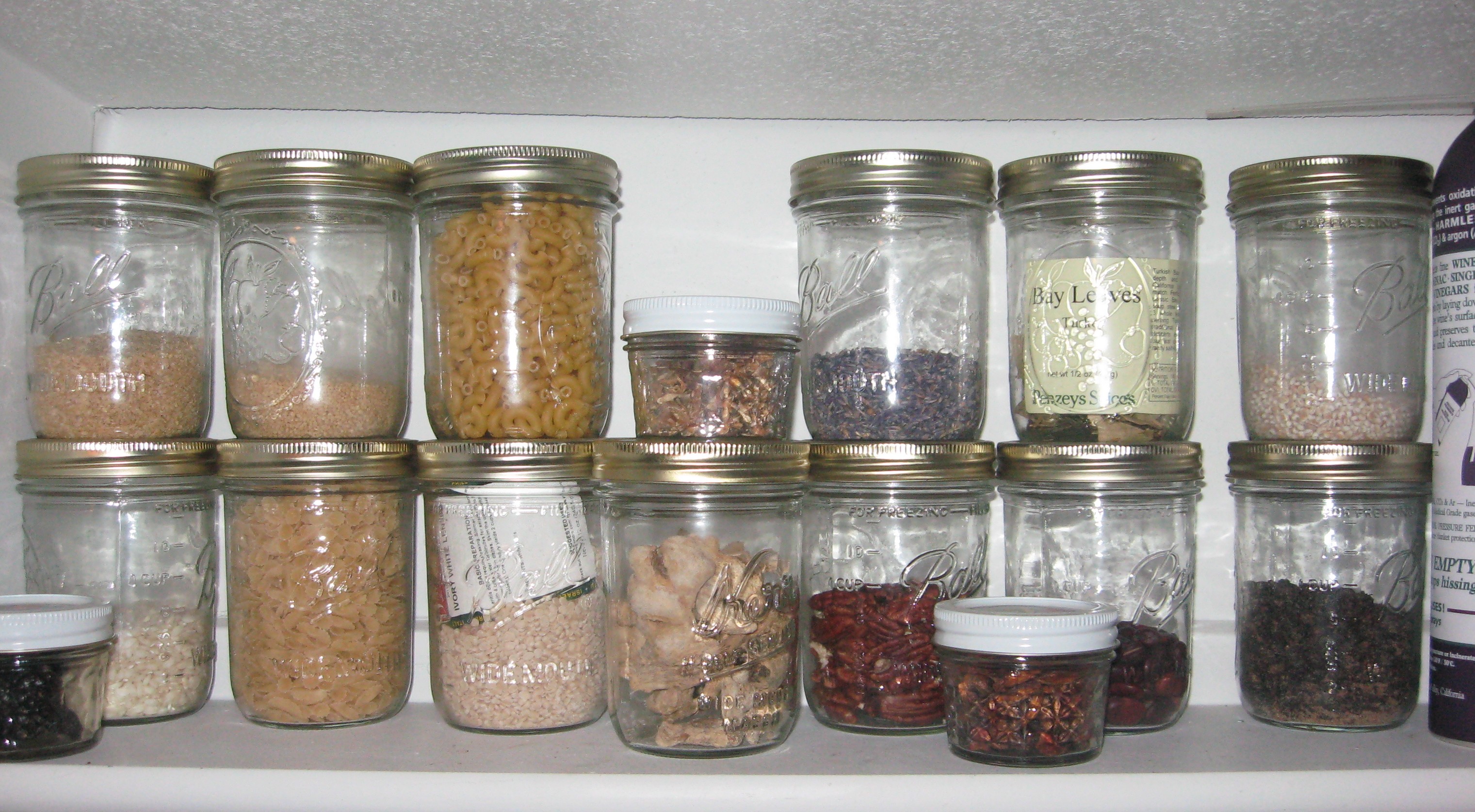
One of the perennial problems with liking to improvise, and wanting to have a well-stocked pantry is that one person uses things more slowly than you would cooking for a family of four.  I think that it’s important to store supplies carefully in closed containers rather than bags or boxes which can let some interesting beasties into your staple supplies.  For years, I carefully cleaned and saved glass jars and their lids.  Great solution?  Well–until the lid loses its seal.

Then what do you do?  My solution was to buy some Mason  canning jars (Ball or Kerr) with wide mouths, in the pint and quart sizes.  They are inexpensive, and lids are  no longer a problem.  The same lids fit all the jars, so I’m not standing around with a jar full of something and trying to find a lid to fit.  The rings last, and last–a bit like the Energizer bunny–and you can replace the seals as needed!  I think that my kitchen shelves even look rather nice…but then I kind of like a homey look.

If your pantry space is cramped,  the wide-mouth jars stack well!  Another advantage of the wide-mouth jars is that a 1/4-cup dry measuring cup will fit through the mouth of the jar easily–so you can dip and measure from the easily. Got to store that 10-pounds of rice that was such a great price?  Well the same lids will fit the half-gallon jars.

With some minimal additional equipment you can even put food by in these same jars–just be sure that you have new lids  if you’re going to use them for long-term preserving of foods.

Cannellini & Italian sausage supper

One Italian sausage provides seasoning and a bit of meat for two meals.  The starting point gives enough for two servings.  When I’m using the Italian sausage for two separate meals like this, I usually buy sweet instead of hot, since I can readily add the heat I’d like with crushed red pepper flakes at the time I’m preparing the meal.

  • 1 medium onion, halved lengthwise and thinly sliced
  • 1 sweet Italian sausage, meat removed from the casing and crumbled
  • 4 cloves garlic, minced
  • 1 tablespoon olive oil
  • 2 cups cooked, drained white beans (cannellini or great northern) or 15-ounce can rinsed and drained
  • 2 tablespoon water

In a 12 inch skillet with a tight-fitting cover, add the olive oil; when the skillet is heated add the sliced onion, and cook until it is beginning to brown. Add the sausage and brown.  Add minced garlic and cook about 2 minutes.  Add the rinsed beans, and cook covered about 5 minutes.

Remove half the bean/onion/sausage mixture to be used for a second meal.  Cool and refrigerate.

Meal 1:

  • Half the bean/onion/sausage mixture
  • about 15 grape/cherry tomatoes, halved
  • 1/4 cup antipasto salad mix (pitted olives, peppers, carrots) from the salad bar, chopped finely.
  • several sprinkles of crushed red pepper flakes
  • 2-3 teaspoons chopped fresh sweet marjoram or Turkish/Greek oregano, or 1/2 teaspoon dried herbs.
  • a single-serving size handful of haricots verts
  • 1 teaspoon water
  • salt and fresh-ground black pepper to taste (the antipasto salad is salty so taste before you add additional salt.

Add the herbs, the chopped antipasto salad, crushed red pepper flakes and mix well.  Over medium low heat, add the tomatoes, lay the haricots verts on top of the cannellini beans, add the water, cover tightly and continue to cook until  the haricots verts are tender.  Serve with shavings of Pecorino Romano over the canellinni beans, and the haricots verts on the side, drizzled with a few drops of extra-virgin olive oil.

Meal 2:

  • the reserved cannellini bean/onion/sausage mixture
  • about 15 grape/cherry tomatoes, halved
  • 3 generous handfuls baby spinach
  • 1 tablespoon water
  • salt and fresh-ground black pepper to taste

Place the cannellini bean/onion/sausage in sauté pan, add the water, halved tomatoes, and cover.  Heat gently for about 5 minutes (until starts to steam).  Add the spinach, cover, and allow spinach to wilt.  Toss to combine with the bean mixture.

I had this with some steam-sautéed carrots as an additional vegetable.  Add a glass of good friendly red wine and its a very satisfying meal that’s easy and economical.

That fourth chicken thigh…

As I mentioned in my previous post regarding what to do with a package of four chicken thighs when you are cooking for one (and the cat) and don’t do leftovers, chicken soup was in the making with some leftovers (rice, garbanzo beans) as a start.

The broth from cooking those four chicken thighs was so intense that I was able to add a bit of water to it, so I have two servings of chicken soup.  (Soup being a leftover that I tolerate better than other leftovers.)  To keep the time invested to a minimum, I did use a convenience product:  frozen soup mix vegetables .   I do use those for winter use since it lets me have a lot of variety without purchasing all the individual vegetables;  I can throw a handful or so into something for quick soup.  As you can see there was okra, peas, corn , celery, potatoes, green beans, and onion.Not having any canned tomatoes open, I used some of the grape cherry tomatoes, halved and tossed into the mix.

I boned the chicken thigh and added it to the broth and veggies, popped the whole thing into the microwave for six minutes to cook the veggies.  The broth from cooking the thighs had been seasoned only with a bit  of salt to allow for maximum flexibility in what I could do with the meat, so it was a tad bland. I supplemented the previous seasoning with a dash of herbes de Provence, and some crushed red pepper flakes to add a bit of zing.  Made and great bowl of soup

chicken soupGiven lots of veggies, the rice, and beans, and the very flavorful broth, the fourth chicken thigh provided reasonable portion f meat for the two servings of soup.  When we consider that most of us eat much more meat than we  need nutritionally, I was very pleased with the flavor of this quick meal.   All I added was a green salad with cucumbers, radishes, grape tomatoes, black grapes, fresh herb leaves, with a drizzle of extra-virgin olive oil and a squeeze of lemon juice.   With the addition of a glass of red wine (from a box) it was a very satisfying meal.  I have no idea of a calorie count–but I do think it was a healthy meal, particularly for evening when I know I’m going to be very sedentary.

Admittedly, there is a snack for later in the evening: some black grapes, grape tomatoes, and a few nuts, maybe pistachio, or Brazil nuts, or hazel nuts, or a mixture (only a tablespoon or two, though).

Lots of flexibility in terms of what you can do when you’re making a small quantity.   I suspect that the remaining serving, which will be used in a day or two, will get some additional “perking” before it becomes a meal, but I know I’m starting with a good base of tasty broth and a bit of meat.  In looking over what’s likely to be available , I suspect that I’ll add a bit of cabbage, and maybe some chile pepper to that last batch–but who knows.

Even though I bought the more expensive, free-range, organic chicken I think it was economical:  essentially five meals from that one package of chicken.  The extra flavor from the chicken paid off.

A son goût!

Take four chicken thighs…

If you are going to cook for one, you need to get away from recipes that specify exact quantities–it’s a step toward learning to improvise as you cook.  I’d urge you to take a look at Kitchen Express by Mark Bittman–you don’t have to buy it, thought it’s a great book to have; go to the library and check it out. (It’s also available for Kindle, too)  Other simple, and simply good recipes can be found at The New York Times, and at Mark Bittman.com.  You will find recipes that are easy to do for one because they are “quantity-less” in the sense of the typical recipes.  They don’t call him “minimalist” without a reason–a very few ingredients can make some wonderful eating.

Now for those four chicken thighs, cooked as described in “The Microwave in my Kitchen”, here’s what has been done with some, and what is intended for that fourth one:

1.  Chicken salad for a sandwich, quickly made by adding some minced red onion, a bit of cutting celery (See Herbs page) leaves and stems, salt, fresh-ground black pepper, a squeeze of lime juice (or lemon juice), and a drizzle of extra-virgin olive oil.

2.  A warm meal of chicken with  part of a can of chickpeas left from a previous use.  Sautéed a handful of onion in olive oil until softened, added a big clove of garlic, the chicken cut into bite-sized pieces, added some halved grape tomatoes, about a tablespoon of chopped sun-dried tomatoes, a dash of Syrian oregano (still growing on my deck); finish with salt and fresh-ground black pepper to taste.   Add a  single-serving salad of mixed greens and had a quick, satisfying meal.

3.   The third piece went to make some quick chicken hash for Sunday breakfast as follows:  In a 12-inch nonstick skillet sauté a handful of diced onion  in olive oil until just starting to brown.  Add two minced garlic cloves (I like lots of garlic),  and cook for two or three minutes.   Meanwhile, open a can of diced potatoes (I told you this was quick–obviously you can start with raw potatoes and sauté them until tender) and brown them lightly. Rinse and drain the potatoes, add to the skillet and sauté until they start to brown.

Remove half the potato mixture–this is destined for another use.  Remove the meat from the chicken thigh if it was bone-in and dice the meat.  Add this to the potato mixture in the skillet, along with some (about 1/2 teaspoon) fresh thyme (again still growing on my deck) and continue to sauté.  When the potatoes and chicken are slightly browned, remove to a plate and keep warm.  Cook one egg (or two if you are really hungry) to medium, and serve over the chicken hash.

The portion of potatoes that you removed from the skillet can be used in different ways: the are likely to become a kind of quick version of a Spanish tortilla by just  warming and adding a couple of eggs and serving with a salad or vegetable.

4.  With the broth obtained from cooking the thighs in the microwave, I plan make a meaty chicken soup using that fourth chicken thigh, using that bit of  rice left  from another meal.  I’ll add more veggies, perhaps a bay leaf, and some of my “lazy” favorite (and only) herb mix, herbs de Provence. I’ll see when the time comes–since I don’t do leftovers, I probably shouldn’t do predictions either.

There will be a follow-up on that fourth piece of chicken to let you know where my improvisation lead me.  I’ll give you another example, using a recipe from Kitchen Express for a lentil soup that just blew my mind (See An Awesome Lentil Soup).  It was such an unexpected combination of flavors, and it is one that I keep using to improvise with other ingredients, as well as coming back to the original.  It’s a recipe where I could also make use of the last piece of chicken.

Insalata caprese

One of my favorite things during tomato season is caprese salad.  It’s satisfying and easy to do.  I didn’t do mozzarella di bufala, but I did have fresh mozzarella from the Durham Farmers’ Market (Chapel Hill Creamery) and that was splendid.  Sometimes I get a little over-exuberant and I have leftovers from this.  Next day it’s not quite what I’d want just as is.  (There really can be too much of a good thing at times.)  I’d seen a post on Closet Cooking suggesting a caprese sandwich on ciabatta; that looked really sumptuous, but mine was a leftover.  Standing there staring into the refrigerator, I realized that though I did not have ciabatta, I had some good, homemade olive oil bread–how about turning this into a grilled cheese and tomato sandwich?  Lay the slices of seasoned tomato and mozzarella on my hearty bread, brush the outsides lightly with olive oil, and pop it on the cast-iron griddle that lives on top of my gas stove.  Wonderful way to use a leftover thanks to the inspiration of the post on Closet Cooking.

This is not the first time that I’ve gotten carried away with insalata caprese–I’ve also used the leftovers as a filling for an omelette.  I’m sure there must be other ways to use leftovers and I’m always looking for them especially in the summer time because, if not this summer, I’ll need them next summer, or the one after that.