
In the chilly, grey, damp weather we’re having now, I see this in the near future! Making the shopping list for tomorrow.
Category Archives: Meats
Slow-roasted pork
It’s a day that shouts that fall is finally, really here–steady, gentle rain, cool breeze, a bit dreary–the kind of day that says cook something savory and warming. As the weather has been getting cooler, I’ve been anticipating this kind of day, so on yesterday’s trip to the market, I had the butcher cut me two extra-thick, bone-in, loin end pork chops. When I got home, I “prepped” them for roasting–a generous sprinkle of salt (for a dry brine) and let them stand overnight in the fridge. Though it’s not cool enough to turn on the heat, just what I get from the oven while these roast will be cozy, and the smell of roasting pork….almost as good a baking bread.
I’ve gotten two chops because I actually want to have extra meat. Leftovers in this case are welcome (which is, admittedly, unusual for me). This kind of weather brings out a desire for soup-making and other hearty fare, and roasted meat is a good starter!
Slow-roasted loin-end pork chops
Note: The pork was roasted in the clay cooker–with very simple seasoning. I just wanted some big roasted pork flavor. I used loin-end chops here, but thick-cut shoulder chops, or country-style spare ribs will also work. I love the Schlemmertopf/Romertopf for cooking, but you can do this in a Dutch oven if you don’t have a clay cooker. It will still taste good!
 Ingredients
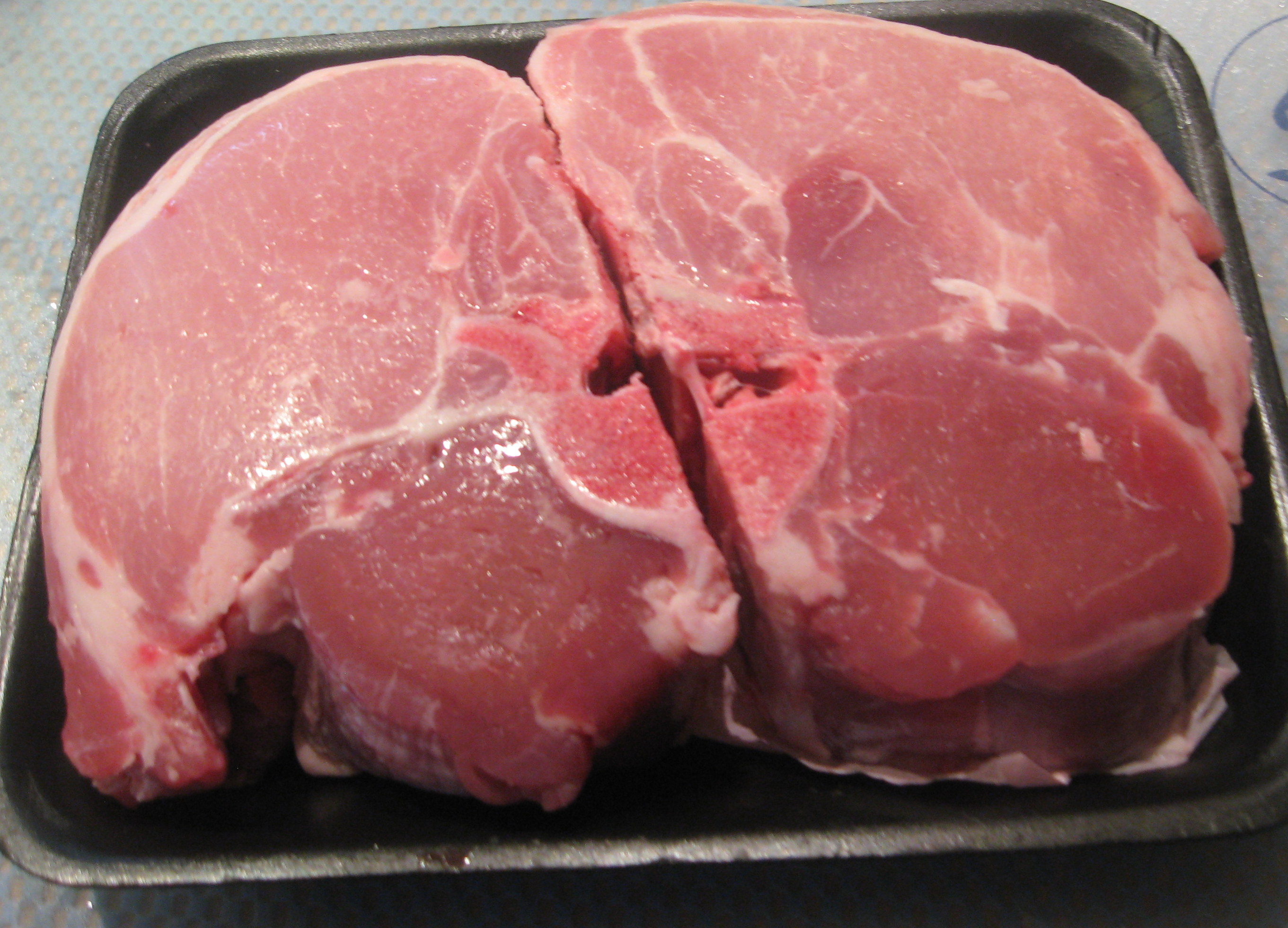
- 1 or 2 extra thick (1-1/2 to 2 inches) loin-end pork chops
- a generous tablespoon kosher salt (for the two chops)
- 2 large Yukon Gold potatoes scrubbed, cut into large chunks (eighths)
 Preparation
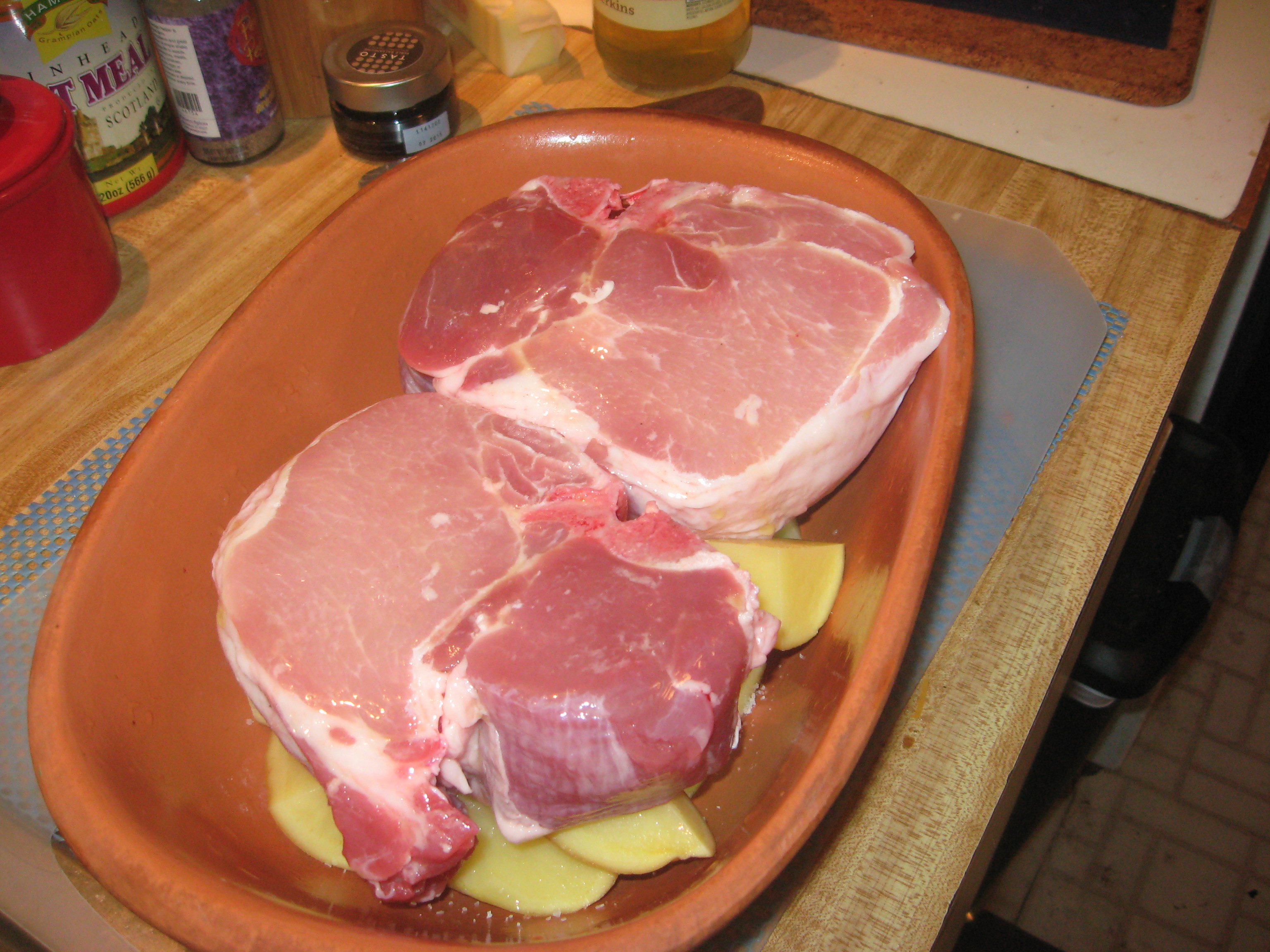
- Pat chops dry and sprinkle kosher salt evenly over the chops.
- Refrigerate overnight or for about 8 hours (up to 24)
- Soak clay cooker for at least 20 minutes, add chops and place in cold oven set for 295 °F until easily shredded with a fork (about 3 hours).
- Serve with roasting juices from cooker.
Ò¿Ó
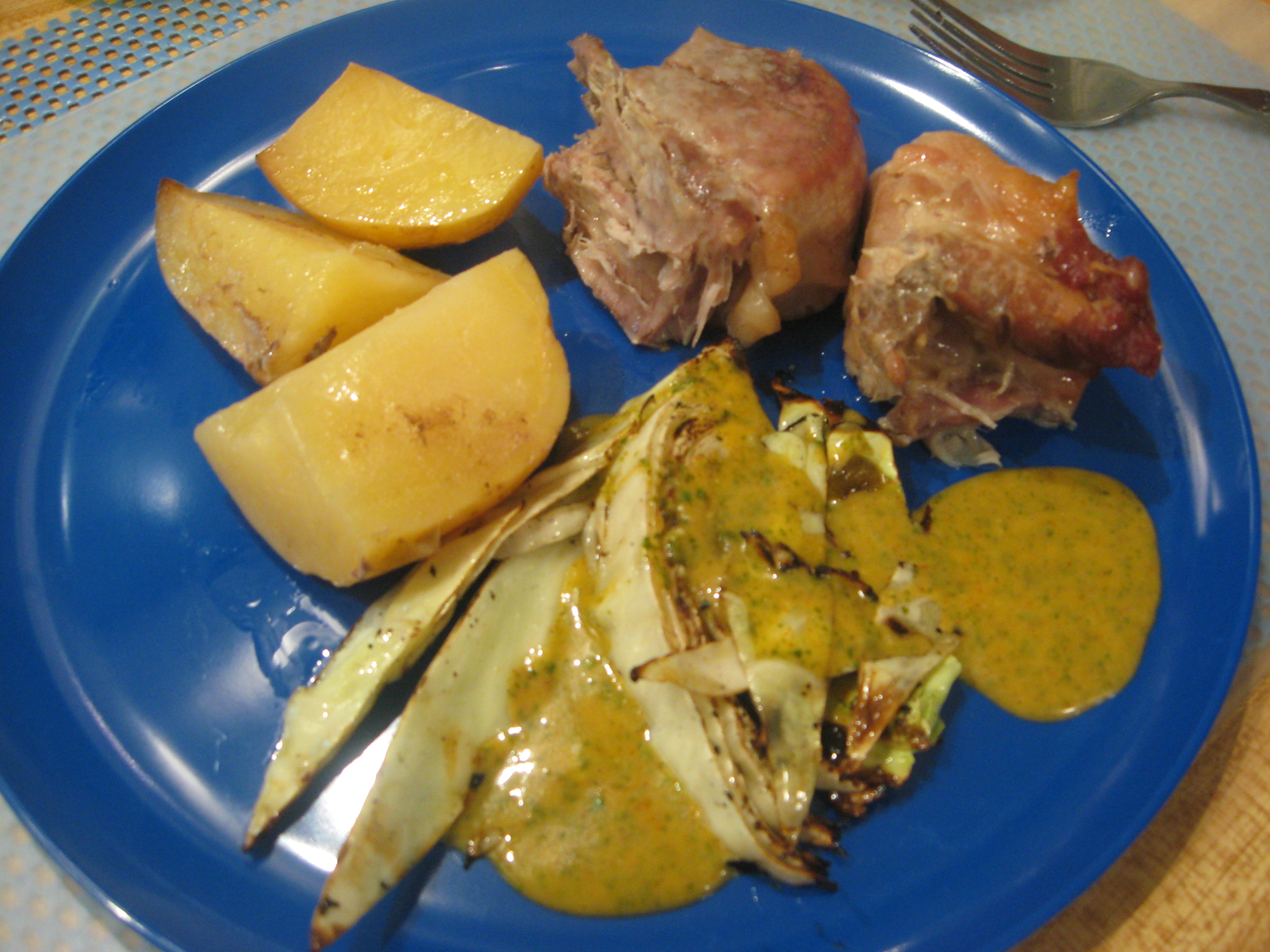
 I made the spicy grilled cabbage from The Kitchn, to go with this. The weather didn’t permit grilling (and lack of planning the oven, therefore the broiler, was in use) so I did a thinner wedge on a smoking hot cast-iron griddle. It was fantastic–no doubt this would be even better on the grill. The spicy lime sauce is yummy (and the bit that found it’s way onto the pork was good there, too).
I did make a couple changes to the sauce: since I was lacking the “smoky” grill, I added chipotle chili powder as well as the cayenne, and I used honey instead of sugar. (I would love to try this sauce with buckwheat honey in it, but none in the house today.) Definitely a keeper of a sauce!
Ò¿Ó
There are leftovers–but I’ve planned how to use them. The pork is seasoned only with salt at this point–deliberately so that I have lots of flexibility in using the rest of it. I want to try a pasta dish with the “pulled” pork, sage and brown butter sauce. There are roasting juices that will contribute to some good soup–maybe hot and sour soup, or maybe something with hominy and sort of southwestern flavor. I suspect that a serving of basic roast pork is headed to the freezer for a quick comfort-food meal in colder weather.
 A son goût!
Perfectly crispy roasted pork belly
Pork belly is showing up in the supermarkets now! Cooked like this is is a luscious meal!
Lamb leg steak–continued
 That lamb leg steak that I cooked a couple days ago was a big steak–weighing in just a bit under a pound. That’s a lot of meat–couldn’t possibly eat all that at one time. As vehement as I’ve been about not liking, or dealing well with leftovers, that does not apply here. I don’t really consider the part of this steak that I didn’t eat then as undesirable. I couldn’t have that luscious steak without some left for other uses–not when it needs to be at least an inch thick to cook well. You’re wondering what happens to the rest of this steak?
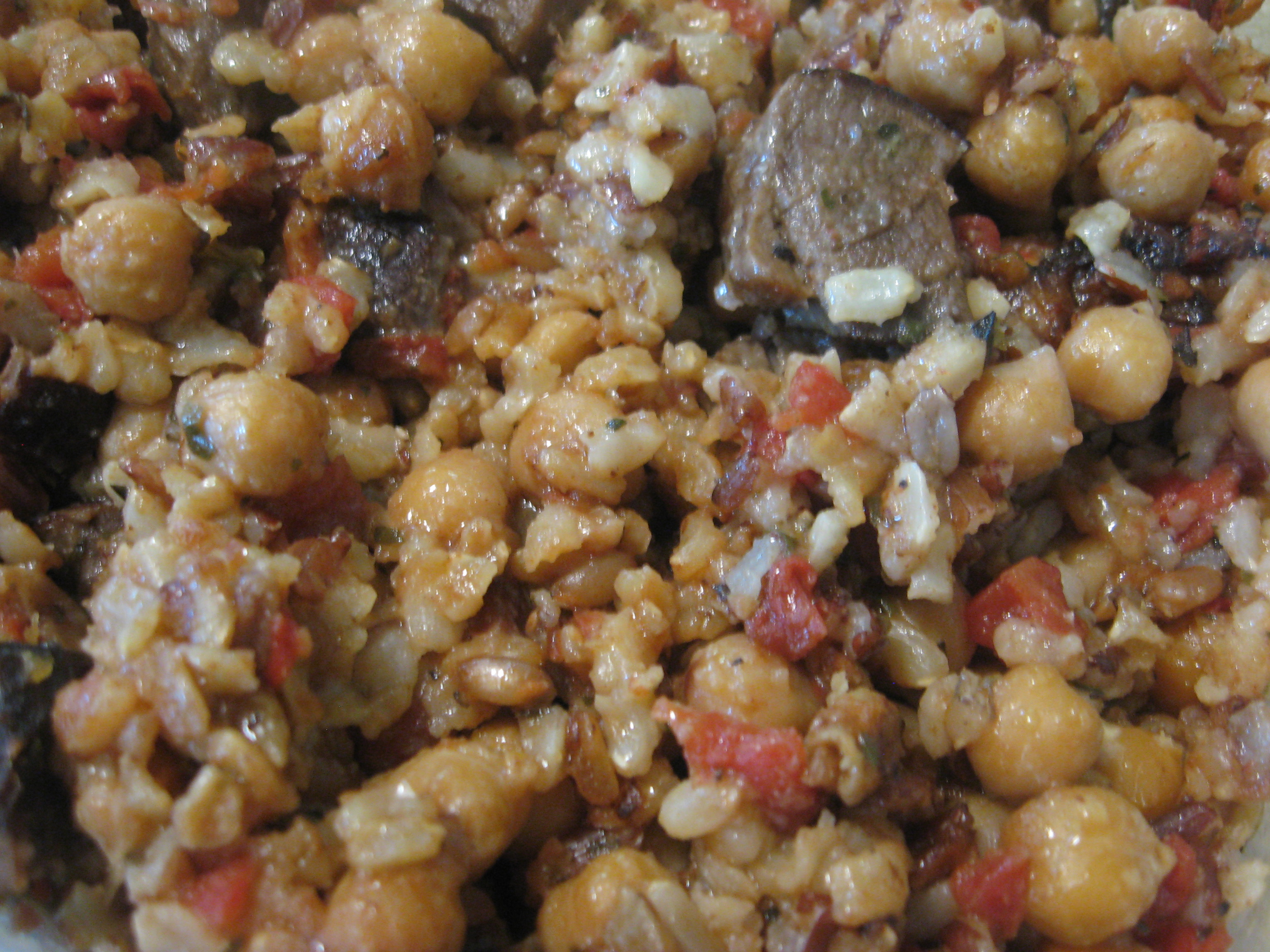
Often the remains of a beef steak or a pork chop goes into a sandwich–since roast beef, lamb, or pork is not on the single-serving menu. Other times it does some metamorphic changes. The remainder of this steak went into the rice cooker with a convenience mix of grains, some garbanzo beans to give me some additional meals that were not meat-centric.
Ingredients
- about 1/2 pound of cooked lamb steak, cut into 1/2-inch pieces
- one 15-ounce can garbanzo beans with liquid
- one 10 ounce can of diced tomatoes with jalapeños with liquid
- 1 cup of brown basmati rice, red rice, barley, and rye berry mixture (uncooked)
- 1 tablespoon olive oil
- 2 bay leaves
- 2 teaspoons dried Turkish oregano
- 1/2 to 1 teaspoon garlic powder
- 1 to 1-1/2 teaspoon onion powder
- 1 cup water (to bring total liquid to amount required for grains)
Preparation
- Add all ingredients to rice/multi-cooker, stir well.
- Set on rice cooking mode.
- When cycle finishes, check grain for doneness. If needed add more water in 1/2 cup increments until grains are done.
Ò¿Ó
Since the lamb steak had been well-browned on the griddle, it provided good rich flavor for the grains and the garbanzo beans. Some of this was an extra meal (with a side of ratatouille), and the rest was packed (with the Handi-Vac®) for the freezer for later (especially cooler weather) meals.
Lamb leg steak
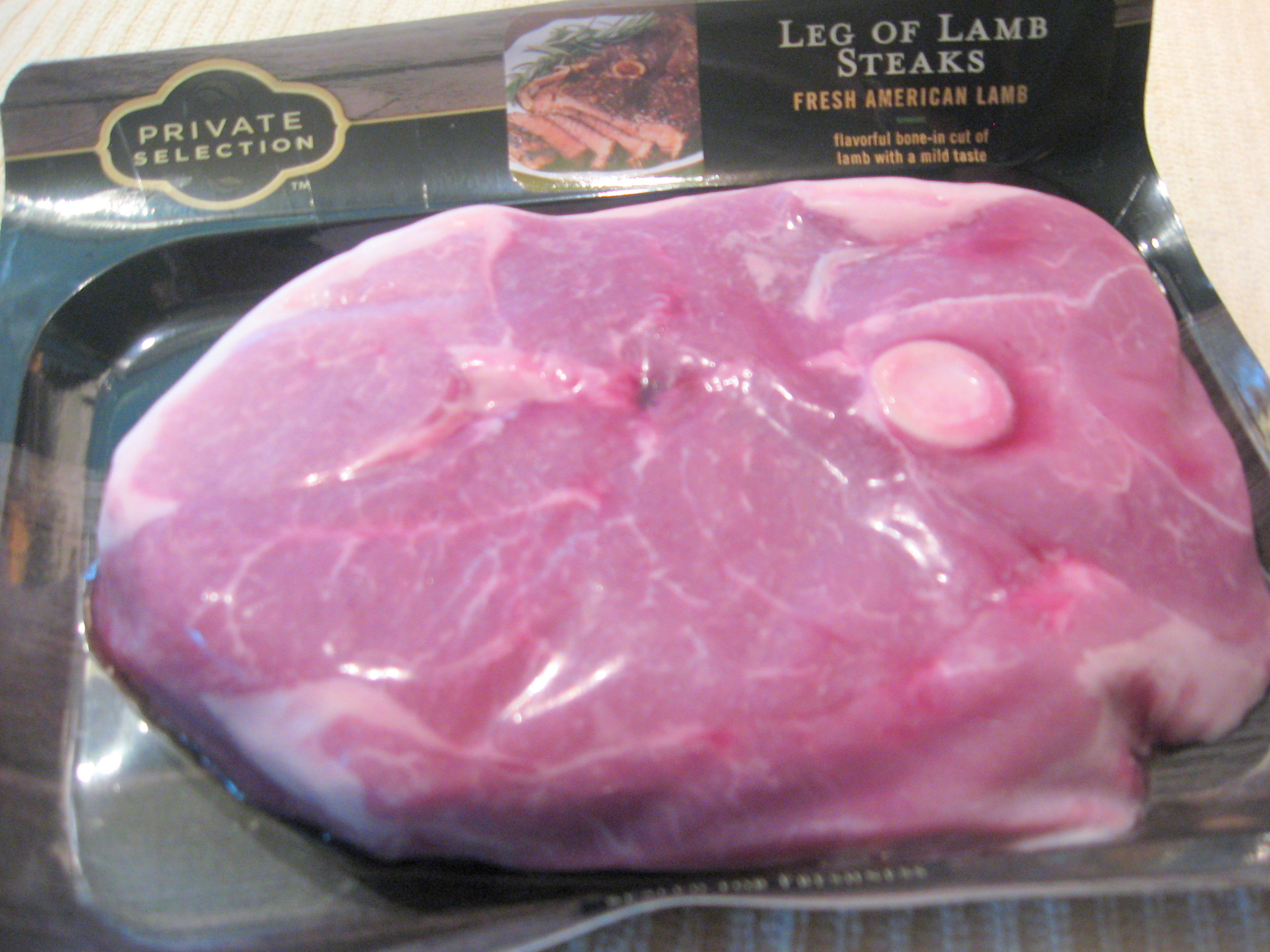 I’m an omnivore–and that definitely includes meat in judicious amounts. Lamb shoulder chops get frequent use in my kitchen since they are readily available, relatively inexpensive, and tasty. Lamb chops or a rack appear seldom, unfortunately, since they are expensive; braised shank will appear occasionally, but leg of lamb almost never–unless I’ve organized my self to invite lamb-loving friends to share. Even a half leg is just not in the single-serving category, so much as I like it, I don’t get it very often.
On a recent quick stop at the grocery store, I found a lamb leg steak! Fortuitous since I just happen to have made a batch of ratatouille (slow-cooker testing of a recipe) and somehow those two thing are appealing together. That lovely steak is going to be cooked indoors since it’s grey outside with spatterings of rain off and on–comforting sound on the metal roofing, suggesting a lazy day.
ÒσÓ
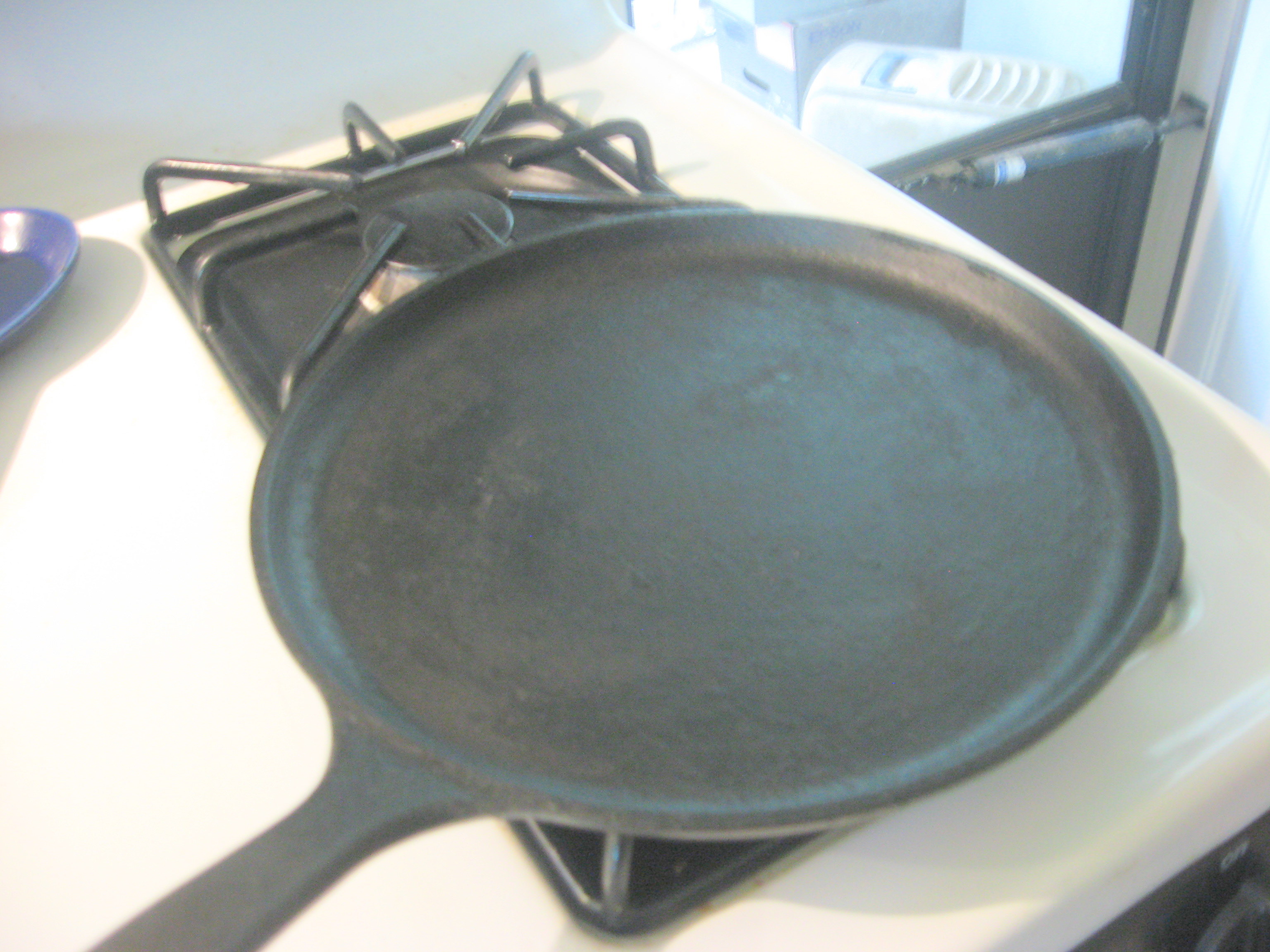 The omnipresent cast-iron griddle is my instrument of choice for cooking steaks or chops indoors. For steaks or chops that are up to an inch in thickness–or perhaps just a tad more–I like to cook them with the method described by Jamie Oliver for pork neck steak.
This 1-inch steak weighs in at just under a pound, so there will be leftovers, but as with beef steaks this isn’t a problem–easy to find uses for the leftovers before they spend enough time in the refrigerator to taste like something that has been in the refrigerator. Though this steak could be cooked right out of the package without any preparation, I’m going to give it just a bit of pretreatment.
Cook’s Illustrated (and America’s Test Kitchen) have repeatedly demonstrated that brining or salting improve texture and taste of meats. Salting has the advantage of not requiring planning–and it’s easier. The usual procedure is to sprinkle with  kosher salt and allow to stand at room temperature for an hour. I’ve found that salting and allowing to stand in the refrigerator overnight works well–I can prep my chop or steak immediately on bringing it into to the kitchen and it will be ready for later. The suggested amount of salt is 3/4 teaspoon for each 8 ounces of weight.
(This doesn’t call for a measuring device at all; two good three-fingered pinches, sprinkled from way above so that it spreads out evenly. When you see chefs sprinkling something from shoulder height, that’s not showmanship. Sprinkled from that height, the salt crystals have a chance to spread out and not just plop on the steak in one spot.)
Cooking instructions
 Notes: I prefer a griddle (or griddle pan), not a grill pan that has the ridges on it. The griddle will give you browning all over the surface of the meat, not just stripes on it. Stripes are pretty, but all-over sear really tastes better to me.
- Deactivate the smoke alarm–probably means taking out the battery. This is necessary before you start cooking because you need to be paying close attention while cooking. (You see the smoke in the picture, right?) There’s no way to do this without it smoking. If you try to do this without smoking, you won’t get the same results.
- Heat cast-iron griddle (or skillet) over high heat until it’s very hot–you want really high heat. This is why you deactivated the smoke alarm. Test heat by flicking a drop of water onto the griddle–it will sizzle and skitter around hectically, kind of like one of the really supper bouncy balls that my cat plays
- Pat steak dry and rub with a little oil (not extra-virgin olive oil–the heat will destroy flavor) on both sides.
- Put steak on the griddle–it should make some noise or the griddle is not hot enough, and cook for two (2) minutes without moving it. Don’t turn the heat down.
- Turn and cook the other side for two minutes.
- Return to the first side, and cook for one minute; turn over and cook that side for one minute.
- Repeat the one-minute cook-and-turn until the steak has been cooked for about 8 to 10 minutes total time. Check with an instant-read thermometer if you need to (insert through the side of the steak or simply press the surface with a finger. For medium it should feel the same as pressing on the palm of your hand at the base of the thumb).
- Let rest for 10 or 15 minutes for juices to distribute evenly, then eat!
- A dollop of gremolata would be a nice touch; you might even add a bit of mint when making the gremolata.
ÒΔÓ
Ever since I discovered this technique of cooking 1-inch chops or steaks, it’s all I’ve used for meats. For thicker steaks, I’ll use a combination of pan-searing and oven. I’m sure there’s a good food-science explanation for why this works so well, but I haven’t gone looking for it–I suspect that the heat transfer to the interior of the steak or chop is different than cooking one side at a time, as well as the extremely high heat.
True, the stove will need cleaning after you’ve done this, but the result is well worth it. There is no “overcooked” grey area to this steak. This works well with pork, veal, beef, and the lamb.
. . . don’t forget to put the battery back in the smoke alarm!

The less common parts of the beast
As you’ve seen in my posts on offal before, there are edible parts of the animal that you won’t find in the supermarket–Americans seem to focus on only the really choice (not referring to USDA grading here) parts of the animal–like steaks and roasts. We relegate some really tasty parts to pet food (not that I don’t love the cat–I’ll share).
 If you want to sample some of these tasty bits, you’ll need a local supplier who butchers their own animals or you can likely find some of these other edible parts in an Hispanic or Asian market, though I’ve noticed that pork belly has been showing up in the meat case at my local Harris Teeter recently.
For cooking instruction for the odd bits, some of my favorite cookbooks for this “nose-to-tail” or “everything but the oink” eating are by Fergus Henderson and Jennifer McLagen. See Bibliography page.
This really isn’t offal–it’s not an internal organ, but it is part of the beast that we don’t usually cook (except as bacon), kind of like jowels or cheeks. For some really luscious pork, you should try pork belly. This is going to be more like what you’d get if you attend a “pig pickin'”, rather than the usual pork roast that shows up on the dinner table. If these pictures from Eat the Earth don’t have you drooling on your keyboard, I can’t imagine what will.
The method used there was from Jamie Oliver.com; here is a recipe for roast pork belly. This is serious comfort food–and it’s good to be able to get this without having to wait for an occasion where the whole pig has been cooked. Now that you’re acquainted with “less common” parts of the beast you should check out true offal: heart, liver, lungs, kidneys, and even the stomach and intestines. (Frankly, I have cooked and eaten tripe (stomach) and chitterlings (intestines), and probably will not ever cook those two bit of offal again–unless it’s the intestines as the casing of sausages. That’s a whole different thing. I’ll happily have a go at most of the other organs.
Since I’ve an easy supply of offal from Rose’s Meat and Sweet Market and a large Li Ming’s Global Mart (Asian) I’ve no problem getting the odd bits–like duck gizzards–so there will be more about offal as we go along.
Offal–the other tasty bits
 When I look at the meat counter in the supermarket I always wonder why we use so few of the parts of the animals that we raise and slaughter for food. It seems wasteful and disrespectful of life, and we’re missing a lot of good eating that way. Obviously, I favor of using all of the beast if you’re going to slaughter it to have a steak or a roast (the skeletal muscle, in other words).
Maybe part of the reluctance to use organ meats is that many cooks don’t know how to prepare these other bits–they can be a bit more complicated to cook than a steak. Certainly many popular cookbooks don’t include recipes for them. It might also be because we are told that these are not good for us–that they are high in fats, and in cholesterol–which is supposed to be so terribly, horribly unhealthy for us. Maybe it’s also related to controversy about whether or not fat, and animal fat in particular, is actually bad for you–government and medical recommendations on what we should–or should not–eat.
There does seem to be increasing interest in “variety meats” as something other than pet food. (Yes, I will share the giblets with the cat when we’re cooking chicken or turkey but I will not give them all away.) There are some excellent cookbooks available now. I’ve added some of my favorites to the bibliography. Whatever the reasons, I’m glad to see it (and you can expect more of my opinions on the high-carb, low-fat controversy about how to get rid of the excess weight we tote around with us).
But to get to the thing that got me started on this particular topic. One of my favorite bits of offal is tongue and I found this delightful post on Fae’s Twist & Tango with a recipe for cooking tongue that is a good addition to my collection recipes for that particular bit of the beast.
(It’s really unfortunate that “offal” is pronounced like “awful” so that enunciating that word leaves a lot of people thinking that you’ve said “awful”–which is what many think of organ or “variety” meats. I’m sure there are people who love foie gras and caviar, and maybe even shad roe, who would not consider other organ meat from a cow, or a pig, or a chicken. But offal is not awful–it’s good stuff.)
Roast NY Strip Loin
This is a great way to do strip. If you’re cooking for one, you can use a strip steak cut about 2-2-1/2-inches thick. It gives some “leftovers” for a roast beef sandwich. It’s one way to cook roast beef for a single-serving meal with not too many leftovers.


The NY strip loin, sometimes called loin roast or top loin, is a cut taken from the top of the cow’s short loin. The short loin is located near the spine, past the ribs but before the tenderloin and round. This is a crowded area of the cow in terms of butchery, as the porterhouse and tenderloin also come from this section. In fact, this strip loin is basically an uncut series of NY strip steaks. Confused yet? Don’t worry, you don’t need to know how to break down a cow in order to cook up this delicious specimen.
We’re going to roast this loin in a method similar to my most popular post, this Perfect Eye of Round. We’ll blast the roast at 500F to create a nice crust, then reduce heat to 250F until it’s medium-rare.
Not one to leave a job half done, I also roasted…
View original post 108 more words
Corned Beef for St. Patrick’s Day
Though it’s too late to get your corned beef this way, you can be prepared for next year! Corned beef is easy, and really good it’s DYI!


Happy St. Patrick’s day! It’s an Irish-American tradition to eat corned beef with cabbage on St. Patrick’s day. I usually don’t celebrate St. Patrick’s day (most people in the Netherlands haven’t even heard of it), but when I came across a recipe for corned beef with cabbage I thought the cooking technique was very interesting. You see, beef brisket is first cured in salt and spices (similar to the first curing of pancetta or gravlax), and then it is cooked. What finally won me over is that the recipe requires saltpeter (potassium nitrate, KNO3 or E252). Ironically, this ingredient is not available in Ireland, and so I bought it for Conor so he could make spiced beef. Although Conor only needed 12 grams, the smallest amount I could order was 2.5 kilograms.

I mailed enough of the ‘dangerous substance’ to Ireland for Conor to make spiced beef twice, and…
View original post 711 more words
Baked Eggs and Black Pudding Hash
I really didn’t “do” St. Patrick’s Day–but I’d love to have had this. Love black pudding!

 I see Irish eyes a smiling
There are many high quality pre-packaged black puddings on the market. Finding them in the states is a difficult task and always expensive.
For a long time I had planned on making it from scratch but finding a butcher who sells fresh blood is impossible. All those vampire shows and movies where every corner has a butcher selling fresh blood are more of a myth than the vampires themselves.
By chance we found an authentic English restaurant in Little Rock that doubles as a grocery store stocked with true biscuits, bangers, sauces and other English specialties including black pudding.
Baked Eggs and Black Pudding Hash
- 4 eggs
- 1 lb red potatoes diced small
- 8 ounces black pudding quartered and diced
- 1 cup diced red onion
- 1 jalapeno diced fine
- 1/4 cup flour
- 1 tsp mace
- 6-8 basil leaves sliced into ribbons
- 10-12 grape tomatoes…
View original post 126 more words
 a-single-serving.com