Cauliflower-black olive gratin (for one)

I started with the recipe from The New York Times that I had mentioned in an earlier post–and adapted it for single-serving cooking.

cauliflower, black-olives, garlic, shallot

just a few ingredients

My first “adaptation” was NOT to buy a whole head of cauliflower–I like it but I usually waste some of it, so I purchased 250 grams from the salad bar at my local Harris Teeter store already cut.  This was about 1/4 of what the original recipe called for (900 to 1000 grams).

My second adaptation was to use the rice cooker to blanch the cauliflower!  Put water in, add salt, close the lid and set the “rice cooker” mode.  In just a few minutes when I opened the lid I had boiling water.  I added the cauliflower, close the lid and blanched for about 5 minutes, then proceeded with the recipe–faster than a pan of water on the stove top!

My third adaptation is one I use often in cooking for one–I used shallot instead of onion since I don’t like bits and pieces of cut onion loitering in the fridge–so one medium to large shallot, prepped as for the onion in the above recipe.

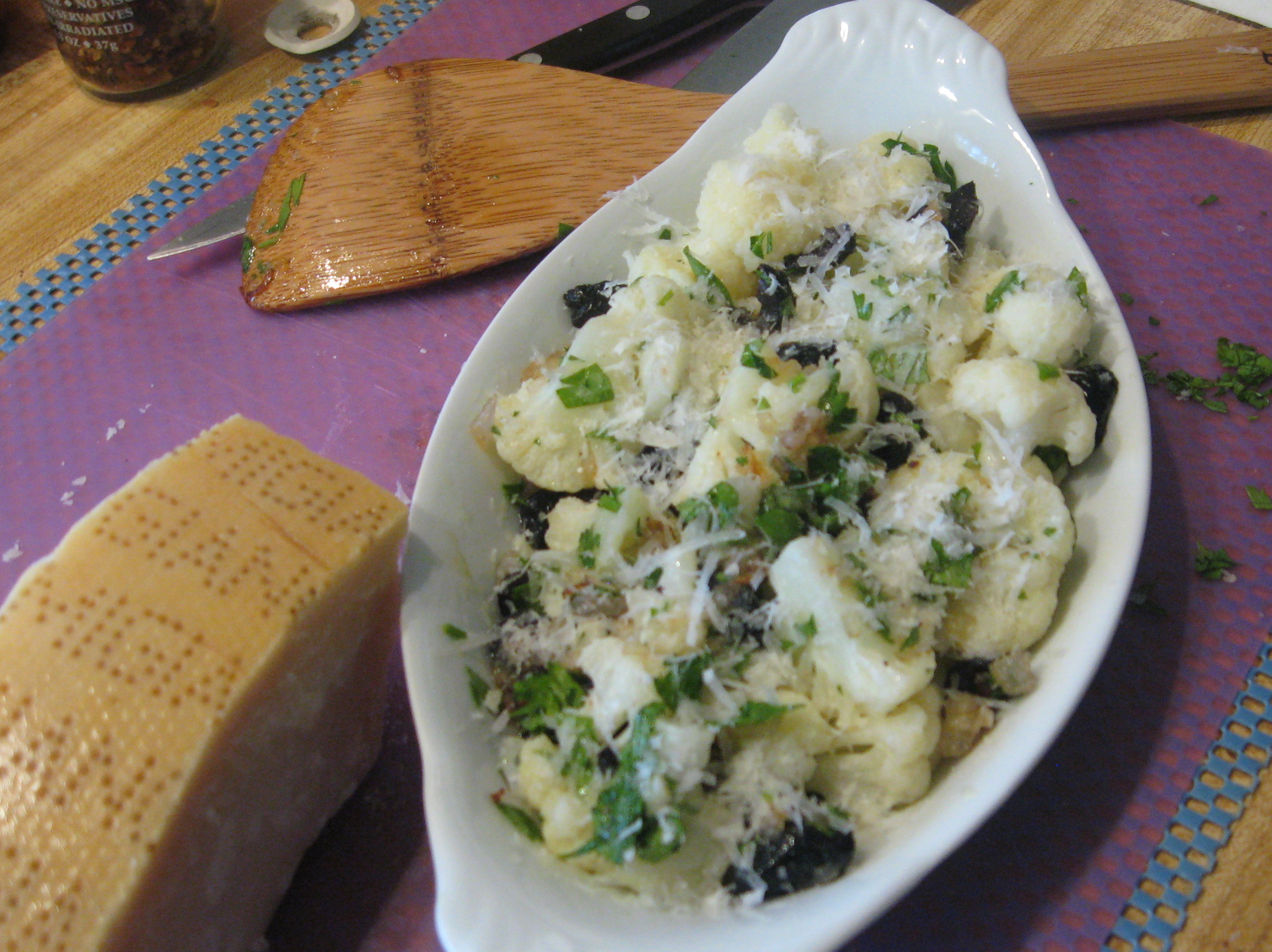
gratin dish with cauliflower

oven ready

That recipe called for 16 olives–well four olives just didn’t look like enough, so I used six. Garlic–well, I used two very small cloves. The rest of the ingredients were “measured” by eye: parsley, the Parmigiano-Reggiano were whatever looked like enough for the amount of cauliflower–maybe my adaptation is a bit cheesier than the original, but  that’s okay with me!

The results were fantastic, maybe even awesome! (Please note past tense–well, there was a tiny bit left, but that’s probably because of the rather large cod fillet–a leftover as I define leftovers–re-warmed in sugo alla puttanesca.)   This was one of the best things that I’ve ever done with cauliflower. It’s a keeper with lots of room to improvise: some red pepper flakes added to the shallot-olive mixture, or maybe some roasted red peppers.

browned gratin of cauliflower

ready to eat

I think that I might step down to 150 grams of cauliflower next time, and bake it in a slightly deeper dish–but it will definitely be made again. I do need to add more garlic, though. I can’t believe how easy it was.  This is my kind of recipe–not at all fussy and open to modification to fit my mood, the weather, and what else is served.

<><o><>

The cod fillet was a “leftover”–meaning planned.  The method of the “rerun” was unplanned.  After several days of intensive course preparation for online courses, I suffered a serious case of cabin fever.  On impulse, I called a friend, and we went out to dinner at one of my favorite causal places, Meelo’s Ristorante, here in Durham, since I had a serious craving for Andre Chabaneix’s spagetti alla puttanesca.  There was a bit of the puttanesca sauce left in the bottom of my plate, so I brought it home with me.  I used it to gently re-warm the cod fillet for supper this evening–now I’m going to have to see if I can match his sauce so that I don’t have to go out every time I want puttanesca sauce.

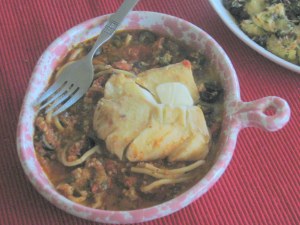
cod with puttanesca sauce

cod with puttanesca sauce

Trying to keep the New Year’s resolutions…

I’m really trying to keep my New Year’s resolutions, though sometimes I think that I should simply resolve each year to try to do better on keeping LAST year’s resolutions.  But it’s a new year, new start, so here goes!

I’ve just gotten back from the grocery store–with only one thing that wasn’t planned–That was a veggie that I’ve never seen in this Harris Teeter before–a Boniato (Cuban sweet potato). While I gripe loudly and constantly about how crowded the grocery store always is on Sundays, it’s what seems to work for me–so I gripe and still shop on Sundays–unless I ran out of milk on Saturday!

The grocery shopping took a bit longer than usual, but I went with the idea of doing some meal planning on the hoof.  (I like to shop by what looks good and what’s on special, so meal planning at home doesn’t necessarily work for me.) I went with a set number of meals in mind–and the meat (at least vaguely) in mind, then walked around looking to see what was on special, and what looked good–in other words,  produce and meat.

Knowing that we can expect some cooler weather over the next week did influence my shopping, and so did the fact that I’m still knee deep in course prep for the medical terminology courses that I’m teaching.  I need cool-weather dishes that I can pop into the oven (Römertopf is out on the counter–and I can scarcely believe that I’ve not posted about cooking something in them before this.)

The result of my meal planning on the fly was this and I’m going to keep you posted on how well I succeed with this–hoping for some peer-pressure here:

  • It’s really too-warm-for-the-season weather here today, so I’m having something light (and “leftover”)–cod re-warmed with the tomato sauce that I brought home from the Italian restaurant, and cauliflower and black olive gratin (had all the ingredients in the fridge except the cauliflower.  I purchased enough for one good-size serving from the salad bar–cheaper than a whole head of cauliflower when I know part will likely go to waste.)
  • Lamb (shoulder chops to be cut up) braised with veggies–in the Römertopf–with an under-appreciated vegetable–turnips.  Personally I love them raw too, and like the sweetness that they add to soups, so they get used a lot.  Doesn’t hurt that they store so well either.
  • Chicken thighs to roast (most likely Römertopf  again) with some root vegetables (have carrots, turnips, parsnips, and some cabbage).  There will be at least two meals from the chicken thighs.
  • Since I have some lovely ham stock (courtesy of a friend sharing ham and the ham bone with me) I’m going to make some bean and kale soup for one warm cozy supper.
  • While I was perusing the New York Times Health section and stumbled onto a recipe for a turnip gratin that is a possible for a side dish with some of the chicken.
  • Then last, but not least, is a fresh black pepper and onion sausage that most likely headed into the Römertopf with some potatoes, to be accompanied by some cabbage that’s been quickly microwaved with a bit of extra-virgin olive oil.

After my meal planning, I’ve got a couple servings of meat (chicken thighs and pepper-onions sausages) that are flexible and should lend themselves to other things if my appetite doesn’t fit my plans.  The sausages could always end up in another “one-pot” dish.  There are also some salad makings in the fridge, and some fruit (Fuyu persimmons, apples, and oranges) for dessert.

One of the things that I like about recipes like those for the cauliflower-black olive gratin and the turnip gratin, is that even though they say “serves 6” they are SO easy to cut down to size for single-serving cooking.

So that’s my plan for this week–regular cooking that is healthy, and doesn’t promote waste from things that just don’t get used.  There are some lunches to be made during the week since most of my courses are online this term–meaning I’m home to fix brunch or lunch for myself.  Maybe that Boniato will fit there.

I’ll be posting more about these meals, but, please, wish me luck with the New Year’s resolution!  Now, off to the kitchen to do the cauliflower-black olive gratin to go with my cod in tomato sauce!

Ripe fruit

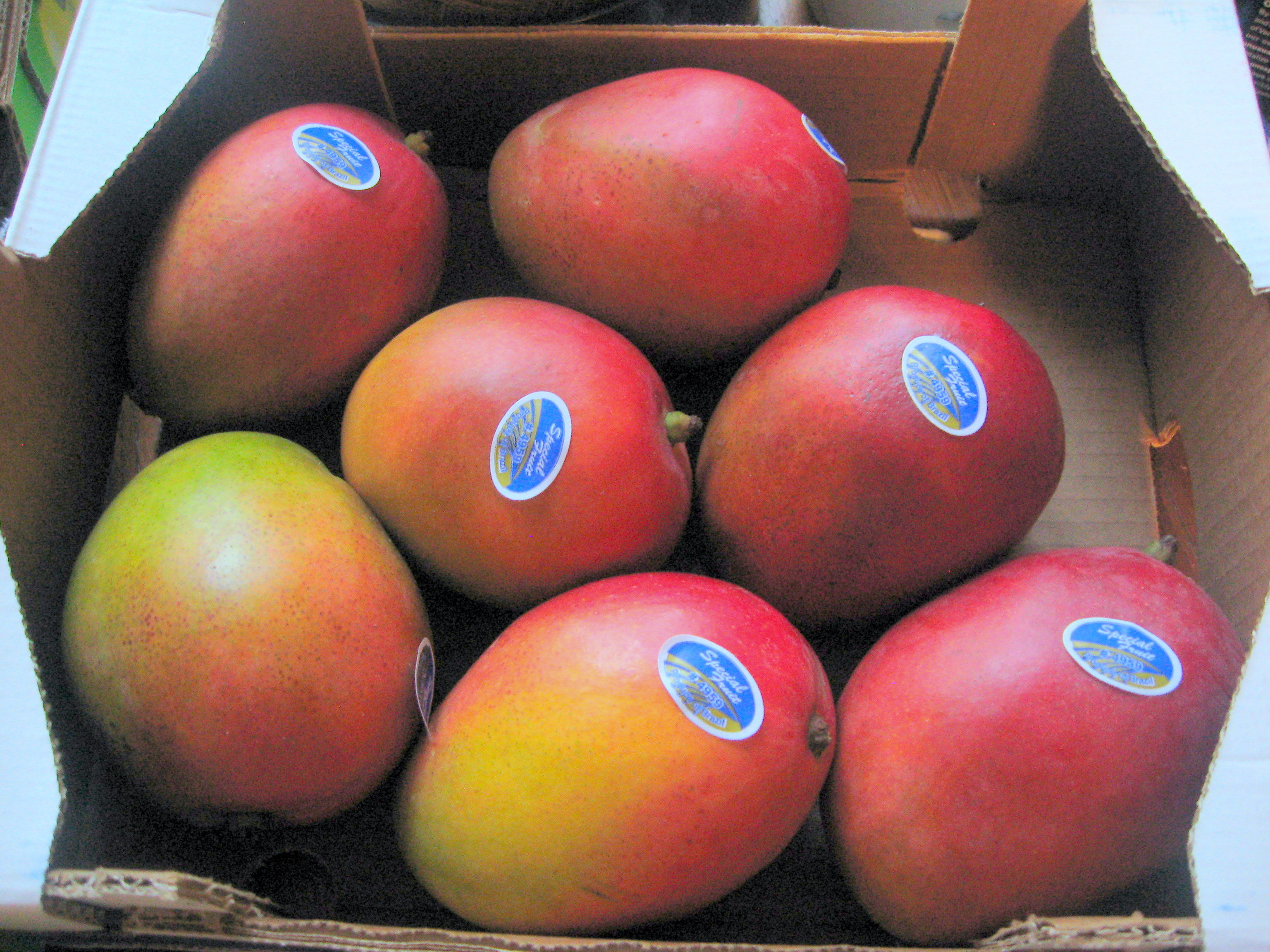
mangoes

After my last excursion to Costco, when I came home with LOTS of fruit (eight mangoes and a dozen Bartlett pears), which were all absolutely scrumptious, I got to thinking about buying fruit in the supermarket: how do you choose? (Even friends that I shared this abundance of fruit with commented on how good those pears and the mangoes were–that meant that every one of the pears and mangoes was good!

If you’ve ever been tempted by those luscious looking fruit displays in the market, succumbed, and then gotten that fruit home, let it “ripen”, and found out that it has all the flavor of sawdust or cardboard, you’re probably more inclined to pass it by and get something like an apple that you think is safe. Been there, done that, passed on the T-shirt, but decided that I needed to know more about how fruits develop and ripen. Looks alone aren’t really the basis on which to buy your fruit.
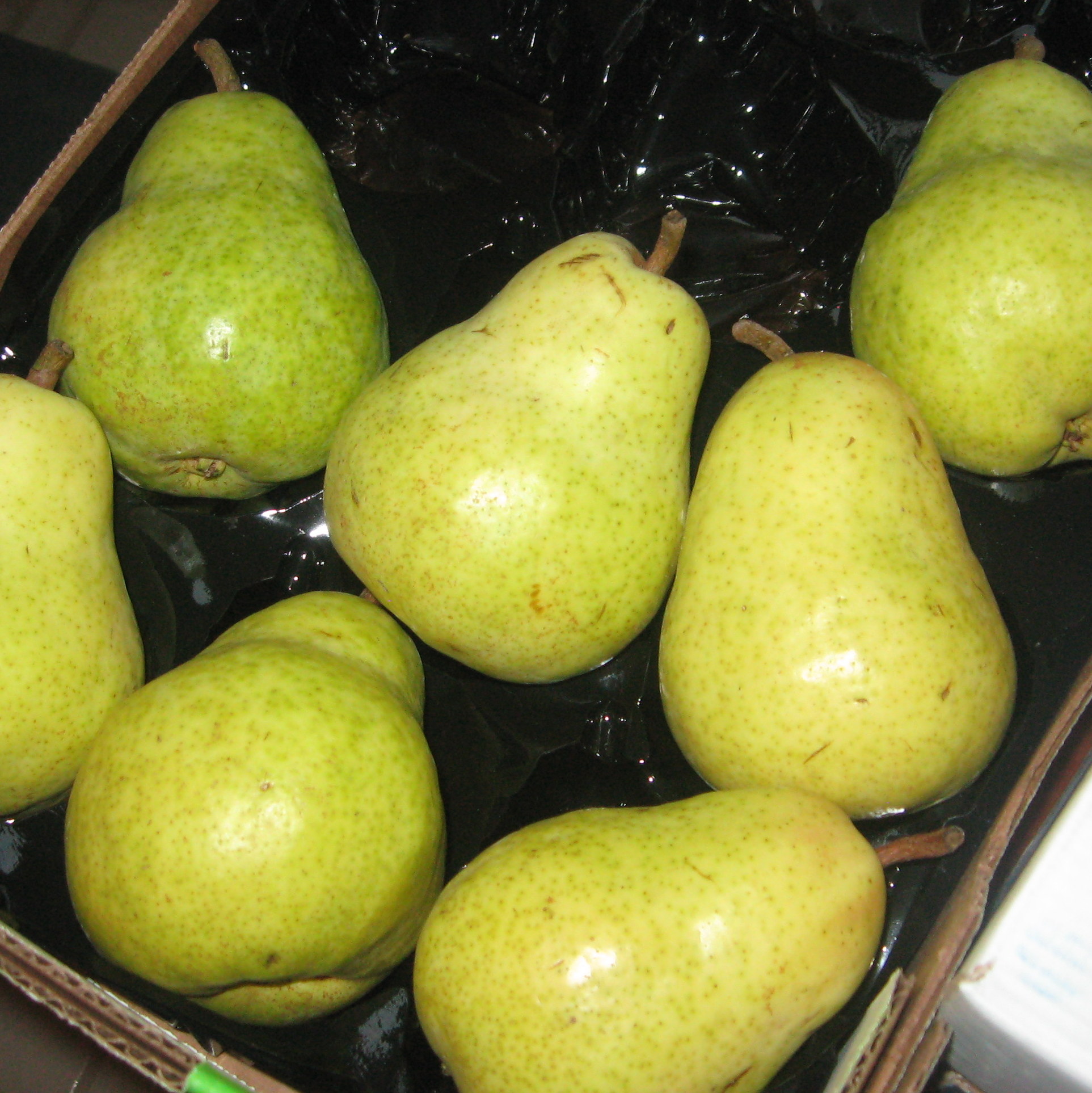
bartlett pears in case (from costco)

Bartlett pears

This quest started while shopping at Costco.  While I have always been pleased with fruit (including berries) bought there, I wasn’t specifically there for fruit–I was there for cat food and laundry detergent.  As I walked past the produce (not in the cool room) I was distracted by the lovely smell of pears.  The case contained a dozen lovely Bartlett pears–rosy cheeks, plump, and unblemished, nestled in their individual slots in the case.  Well, I popped those into the cart, and then encountered the mangoes–not as aromatic as the pears, but lovely.  (Both were much less expensive than in the supermarket–so much so that I could eat my fill and share some too.) With lots of fruit in my cart, I was further lured (but resisted) by the fragrance of peaches!  Mostly I don’t think that you usually smell peaches–they are not usually that ripe.  I had a long debate about pears or peaches, or mangoes, or not.  I left the peaches because I’ve so often gotten peaches or nectarines (even from the farmers’ market) that may smell good if you pick them up and sniff, but which have never made to luscious…they’ve stayed mealy.  So–here is the result of my exploration to see what I could learn any predictable way to ensure ripe, yummy fruit in my shopping bag.

With that goal in mind, I got out my Kindle and went to my favorite cooking and food science reference: Harold McGee, On Food and Cooking: The Science and Lore of the Kitchen  in search of more information on fruits (and vegetables–like tomatoes– that are really fruits). To save you a trip to the library (though this book is worth reading for lots of reasons) I’m going to summarize what I learned about fruit growth and ripening of fruits:

  • First, a definition of fruit:  the female tissue (ovary) of the flower–mostly the thickened wall of the ovary which will have three layers.  The peel (outermost), a thin membrane surrounding the central seed or mass of seeds, and that luscious, flavorful between those two thin layers.
  • To get this sweet, desirable flesh, fruits go through several stages–usually fertilization (by the male pollen), proliferation of the cells in the ovary wall, expansion of storage cells where sugar is stored, and maturation of the seeds and preparation for eating (ripening)!

Ripening is really leading to changes meant to attract beasties (animals, birds, and even people) to eat the fruit so that the seeds (now mature) can be carried away from the plant, and spread to other locations.  In order to be ready (and desirable) to eat, softening of the flesh, and sweetening needs to occur.  Unripe fruits are not desirable chow for man nor beast–there are defensive compounds, the meat/flesh is hard and not sweet and juicy–things that keep the fruit on the plant until appropriately mature and desirable as a food source.

Okay–that seems simple, huh? Unfortunately, there seems to be a lot of conflicting information on ripening of fruit.  The given is that fruits must reach a stage of appropriate maturity before they are harvested.  Ripening is a complex process involving enzymes and molecular changes–details best left to food scientists and biochemists, other than the fact that ripening can be triggered in some after harvest.  We don’t need the technical details in order to shop successfully for fruit: we only need to know that there are two ways in which fruit ripens once it is mature: on the plant or off the plant.  The ripening style determines how the fruits in our stores are handled. (Sorry, now we have to introduce a little technical terminology here just to make referring to the ripening styles a bit easier and less wordy.)

  • Climacteric: This is the form of ripening, triggered by ethylene gas (the paper bag trick?), which stimulates the fruit to begin to use oxygen and to produce carbon dioxide (respiration) at a much greater rate than pre-ripening. When this happens the flavor and texture of the fruit changes rapidly, and then declines equally rapidly. Stored starch is converted into sugar–the yum factor here.
  • Nonclimacteric: These are fruits that don’t store starch so there’s nothing to convert to sugar for ripening–they cannot improve after harvesting–they need to ripen “on the vine” (or the tree, or whatever) so that they can continue to produce sugars.  They need to be mature enough that the changes that result in sweetening and softening have started.  You cannot “artifically” trigger this process away from the plant. This means that these must be picked and shipped as close to ripe as possible–which means that they are more likely to be bruised in handling. Obviously, the distinction between climacteric and nonclimacteric is not black and white–it seems to me that there is a lot of grey here!

The reason I’m telling you this?  Well, knowing the ripening style is key to knowing how the fruit is going to respond once you’ve paid for it, toted in home in your grocery sack, and parked in on the kitchen counter, in the fruit bowl (or maybe the fridge).  You’re going to have to do a little memorization here to get an idea of which fruits are which and learn some general categories of fruits, other than apples and oranges.

Ripening in fruit involves changes in the respiration (yep, oxygen and carbon dioxide use and production). Climacteric ripeners are fruits like bananas, avocados, pears, and tomatoes (yes, tomatoes are a fruit even though we treat them as a vegetable) to give you a few with which you’re likely already familiar. They can be harvested hard (or firm) and green (but mature), and the ripening process initiated “artificially” in controlled environments.  They will  will continue to improve in flavor and texture, softening and sweetening.  Nonclimacteric ripening fruits (include pineapples, citrus fruits, most berries, and some melons)  will not ripen if picked hard and green–the ripening respiratory changes need to be initiated while on the plant, though it can continue after harvest to some degree.

Now to consider some of the fruits that we find in the market.

Pome fruits (Apples, pears):  These pome fruits are climacteric–the conversion of stored starch to sugar can be initiated after harvesting.

  • Apples are generally sold ripe and should be immediately wrapped and refrigerated–otherwise the “death” process continues and they will not be good to eat.  The ripening process has been started after harvesting mature, but still unripe, and later exposing them to ethylene in controlled conditions.
  • Pears are generally sold unripe; they should be ripened at relatively cool room temperatures, then refrigerated, without close wrapping. They have a higher rate of using oxygen and producing carbon dioxide than apples, so they will not store as well as apples.
  • Quinces (related to apples and pears) are not eaten out of hand–they must be cooked–even when ripe, but they have a wonderful floral aroma and flavor.  (But an extra one to just leave lying on the counter to perfume the room.)  When cooked they turn a translucent deep pink to red.  If you can find them in the fall it’s worth the effort to find some recipes and cook some.

Stone fruits (Peaches, plums, cherries, apricots for example):  These fruits (relatives of the pome fruits) are named “stone” fruits because of the large, hard seed that surrounds the seed in the center.

  • Apricots can be found in the market–but are often a waste of money–since they are really delicate, and all to often lack any real flavor and aroma. They do some ripening after harvest, but must be that lovely yellow-orange color, signifying that they are appropriately mature.  They need to be ripened at room temperature; recommendations seem to be to refrigerate them unripe and then ripen as needed.
  • Cherries, also stone fruits, can be either sweet or tart (outright sour if you will)–which is a tip-off that they differ in–you guessed it–sugar content. They do not improve after harvest, so that means that they are picked ripe, and fragile, and are going to be expensive because of the special handling that they need.
  • Peaches and nectarines (yellow or white, with a large seed) begin ripening on the tree and “are said to continue their flavor development even after harvest” (McGee, location 9749 of 27510, Kindle, third generation).  The “said to” suggests buyer beware to me.  When I see statements like the ripening of peaches is controlled by “endogeneous and exogeneous factors” I begin to think that this somewhere between!
  • Being tasteless is only one of the problems facing the purchase of peaches–if they’ve been in cold storage (perishable, remember?) the flesh can be mealy and they will not soften to the lush, juicy fruit we want, even if they smell good.  This has something to do with the pectin in the flesh; they should not be stored below about 45° F.
  • Mangeos are stone fruit that will ripen after harvest and do produce ethylene during ripening.  (Green mangoes are not simply unripe mangos–they are immature mangos and will not ripen.)
  • Plums (climacteric ripeners) will ripen after harvest–and can be stored cold and then allowed to ripen slowly at about 55° F.

Berries (grapes, kiwi fruit too):  We’re going to ignore the precise, strict botanical definition of a berry, and just go with the term berry as we are accustomed to it in everyday English.  These must ripen on the bush, or the cane, as the case may be and shipped ripe, so they are prone to damage from handling and spoilage–like mold.  I’m sure that you already know that they are fragile, perishable, and don’t keep well.  We’ll not go through each berry type–I’m sure you’re familiar with the common ones.  Once you take them home, it’s best to use them immediately–rinse thoroughly in a colander and   then you can spin them gently in a salad spinner lined with paper towels to dry (from Cook’s Illustrated website, “Caring for Berries”).  For longer storage, see Storing Stuff. (Yes, this really does work, and it doesn’t leave your berries tasting like vinegar.)

Melons:  Melons are related to cucumbers, but unlike the cucumber, are not good when “unripe”.  The melons that we are best acquainted with can be classified as “summer” or “winter” melons, depending on the kind of rind that they have.  While we can say that some are climacteric and some nonclimacteric, they do not store starch so they need to ripen on the vine.

  • Summer melons are the very aromatic, fragrant, sweet ones that need to ripen on the vine–that’s to say that they are climacteric -they don’t improve after harvest.  They will separate from the stem when ripe.  Summer melons would generally include Charentais/Cavaillon; muskmelons (cantaloupe is a misnomer), Galia (also known as Ha Ogen) to give you some of the more commonly available ones.
  • Winter melons are more like cucumbers and squashes–less sweet and aromatic than summer melons–and generally nonclimacteric.  Examples of these wold be honeydew melons, Casaba, Santa Claus, Canary melons.

Citrus fruits do not ripen after picking.

Other fruits you might want to eat: 

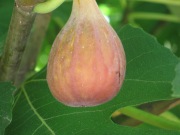
  • Figs are sort of climacteric–they will ripen some after harvest, but they must be harvested at an appropriate degree of maturity–I think that this means that the ripening process must have been initiated, or very close, on the tree.
  • Papayas are
fig on tree

Brown turkey fig

As a last attempt to make some generalizations about fruit types, I wondered if the starch content of the mature, but unripe, fruit would give some cohesion to how to select fruits.  What I found was not much information at all on starch content of mature but not ripe fruits.  There were studies of the changes in starch content of fruits at various stages of growth and maturation, but nothing that allows any easy to follow rules for predicting how a fruit ripens.

<><><>

This all started off seemingly nice and categorized, but–we are dealing with living tissues that don’t fit nicely into categories.  Other confounding issues are simple semantics–when articles say “maturity” are we talking physiological maturity or “commercial” maturity?  So it’s been interesting researching this–but have I come up with any hard and fast answers?  Well…maybe?

  • Knowing the predominant ripening style of a fruit will help you in  handling the fruit to get the most bang for your buck–the best taste and texture.
  • We cannot really make any general statements about specific categories of fruits–except possibly berries.
  • Climacteric or not, immature fruit will not ever ripen to that lush, sweet treat that we’re hoping for.  I would add a caveat about getting good fruit–no matter which style of ripening, the best fruits will be those that have spent more  time ripening while attached to the plant!
  • Use all your senses in fruit selection: if it does not smell good, it very likely will not taste good. When you’re testing for softness or give of the flesh–do it carefully.  Testing for softness doesn’t mean to poke a finger or thumb into that piece of produce–even fairly firm produce can bruise if squeezed hard enough. Learn the visual appearance of ripe fruits–color and shape.
  • Look for heavy fruit for its size–this is an indication of maturity at least, and maybe juiciness (e.g. in citrus).

<><><>

  1. Food and Agriculture Organization of the United Nations  Document for Production and Sale of Fruits and Vegetables.
  2. List of  Culinary Fruits (Wikipedia)
  3. Papaya selection and ripening, Hawaii Papaya Association
  4. Choosing ripe fruit, Fine Cooking. Includes a chart of which fruits ripen after harvest.

GMO or not?

I’ve seen posts on Facebook saying that the PLU codes indicate whether produce is genetically modified or not–wanting more information I did a little searching, including reading some FB posts.  I thought I’d share this commentary on the PLU codes from Snopes.com and the Huffington Post.  It would be nice if it were as simple as looking the PLU code for reliable information!

Tuna confit…

Steaks and chops lend themselves beautifully to cooking for one.  One of my favorites is tuna steak, griddled or grilled–served with a side of spinach risotto  and a salad it’s a very quick, easy meal.  If there is leftover from the tuna steak, it can be used in tuna salad.  But sometimes I want to tuna salad when I don’t have leftover tuna steak.  What to do then?

I dislike the “average” can to tuna that is fishy, mushy, and buy the “solid white albacore” which is likely packed in water, but still dry since it’s cooked twice in the processing (Cook’s Illustrated, July/August 2011). I love the expensive, olive-oil packed European tuna–but my budget doesn’t permit it so I’m always looking for alternatives.

One of the things that I like about Cook’s Illustrated is the comparison of products readily available in the American supermarket–that is, after all, where I do most of my shopping. Those products are reviewed without knowledge of the manufacturer, and are not supplied by the manufacturer–so I do tend to give them some credence.

American Tuna image of canIn the July/August issue, there is a comparison of major brands of canned tuna and some newcomers on the market.  The two newcomer brands were Wild Planet Wild Albacore Tuna and American Tuna Pole Caught Wild Albacore. Both these were single-cooked products and had much less liquid and more tuna.  True there were a bit more expensive but not nearly so prohibitive as the European canned products.  There are a variety of different products available from both companies (salmon, sardines). In both cases, products are available with no salt added, or with sea salt add–such a simple ingredient list on the tuna:  albacore tuna (and maybe sea salt)–nothing else.

Image of Wild Planet albacore canSince I like tuna and use it both as a salad ingredient and as a staple in my “emergency” food supply, I wanted to check this out.  I went in search of some of both.  I found the Wild Planet albacore tuna and tried it in a simple non-mayonnaise tuna salad.  I was impressed–I’ll definitely be buying this for my tuna.  I have yet to find American Tuna, but given the review in Cook’s Illustrated, I suspect that I’ll like that one too.  I found the Wild Planet tuna at Whole Foods.  Though Kroger was listed on the retail list, the one closest to me did not have it on the shelf.  The American Tuna products are listed as being available at Whole Foods but apparently have not reached out local Whole Foods yet.  I’ll be watching.

I’ve tasted (and love) the expensive “gourmet” European tuna, but it’s not in my budget, so these products at a more reasonable price are welcome.

There is another alternative for good tuna which will approach the European canned tuna, though not really for the “emergency” food supply since that needs to be canned.  That is to make your own tuna confit.

Confit was originally a way of preserving meats–pork, goose, and duck–by cooking them very gently in their own fat, straining the fat and using it to seal the meat away from air for storage.  It produces meats that are markedly different in texture from those cooked in other ways–smooth, velvety are the adjectives that come to mind, at least in reference to duck and chicken.

I’m lucky to live close to a Harris Teeter which has high-grade tuna.  Every once in a while they will have it on a managers special, or will have smaller pieces left from cutting the tuna steaks which are sold at a reasonable price as “tuna medallions”.  Every time I see those (or steaks) on sale I get some and make my own tuna confit.  So for you tuna lovers, here is a master recipe from Fine Cooking 46, pp. 68-69, January 6, 2004.  I usually halve the recipe since I’m a solo cook.

Tuna Confit

Ingredients

3 cups good-quality olive oil (but not best); more if needed to cover the tuna during cooking
1 medium yellow onion, cut in 1/2-inch slices
2 sprigs fresh rosemary
6 sprigs fresh thyme
1 bay leaf
1 tsp. black peppercorns, coarsely cracked
Zest of 1 lemon, pared in strips
3 Tbs. coarse salt
2 lb. top-quality fresh tuna (yellowfin or ahi), cut into 1-inch-thick steaks

Preparation

  • Combine the oil, onion, herbs, peppercorns, lemon zest, and salt in a deep sauté pan or Dutch oven.  Heat to between 140° and 150°F, stirring occasionally and cook for 20 minutes to infuse the flavors of the aromatics into the oil and to pasteurize it for a long shelf life. Taste the oil; it should be slightly salty. Leave to cool and infuse for about 30 minutes; the oil will be warm.
  • Put the pan back over medium-low heat and slip the tuna into the barely warm oil. (Add as many pieces as will fit in one layer. The tuna must be covered by the oil; add more if needed.) Slowly bring the oil to 150°F again. Turn off the heat, take the pot off the heat, and let the tuna cook slowly in the warm oil. After a minute or two, test for doneness by breaking into the flake of the tuna. The fish should be cooked to medium rare-slightly pink inside and still tender to the touch. If the tuna isn’t quite done, return it to the oil for another minute. Repeat with any remaining pieces of tuna.
  • Transfer the tuna to a storage dish (I prefer glass or crockery, but an airtight plastic container will  do fine) and let it cool. Let the oil cool separately and then strain the oil over the fish, discarding the aromatics. If the tuna isn’t completely covered in  oil, add more fresh olive oil to the storage dish. If not using right away, cover the container tightly and refrigerate. The tuna will keep, covered in oil and refrigerated, for up to 2 weeks.

Nutrition information (per ounce of tuna)

  • Calories (kcal): 60
  • Fat (g): 3
    • Fat Calories (kcal) 30
    • Saturated Fat (g) 0.5
    • Monounsaturated Fat (g) 2
    • Polyunsaturated Fat (g) 0.5
  • Protein (g)  7
  • Carbohydrates (g) 0
  • Sodium (mg) 85
  • Cholesterol (mg) 15
  • Fiber (g) 0
♦♦♦

It’s easy to make this with much less than a pound of tuna–I occasionally do it with a single tuna steak in the summer when I’m really eating lots of salads and want to have them be a meal.

I use the confit to make tuna salad–but usually without mayonnaise–this is not dry so it’s not necessary to have the mayo to make it edible.  I generally pat it dry and use just a drizzle of extra-virgin olive oil with herbs, and some scallions, or cucumbers, or really splurge and do a salad à la niçoise.

Pork stock

Not an instance of absolutely great planning, but here I am as the thermometer hits the 90s making pork stock.  Well…I never said that I was the greatest planner in the world–strawberry ice cream and stock-making in the kitchen all at one time.  My favorite meat supplier (Meadow Lane Farm, Louisburg NC)  had great meaty pork neck-bones at the market this past Saturday so I had to bring some home–so despite the heat it’s stock-making time.

These are very meaty bones, so I’ll have some meat to use after the stock is finished.  Since there is so much meat on these bones, and I want to use it, I’m not doing the quick stock–but rather the stove-top method (now you’re sure I’m not great at planning, right?).  But when you have the opportunity to get pork neck-bones, you take it.  Meadow Lane farms is doing more pork (as well as beef) so next time I can plan to do this is cold weather.  (I’m glad I’ll have more access to pork…love that “other white meat”.)

Basic Stove-top Pork (or Meat) Stock

Ingredients: 

  • about 4 pounds meaty pork neck bones
  • 2 medium onions, chunked up
  • 2 medium carrots, chunked
  • 3 bay leaves (dried ones)
  • about 2-3 teaspoons salt
Preparation:
  • Rinse the bones well.  If you feel that there is any old, or “off” odor, or they’re very bloody, blanch quickly in one change of water.
  • Add aromatics–onions, carrots, and bay leaves
  • Add water to cover.
  • Bring to a boil quickly, and then reduce to keep a bare simmer, and leave for about  2 or 3 hours.  Test after about 2 hours–when the meat is fork-tender and “fallin’ off the bone” (a country expression that means really tender), remove from heat.
  • Strain to remove bones/meat and aromatics.
  • Cool stock quickly in an ice bath, stirring frequently to help cool evenly;  then freeze or refrigerate. (Do not put the hot stock in the freezer or refrigerator as it will (1) warm up the refrigerator and affect everything in it, and (2) it does not cool evenly and quickly so that you could have bacterial growth.)
  • When the bones are cool enough to handle, remove the meat and save for another use.
I want a neutral white stock, so I’m not roasting bones.  The meat from making this stock may be a bit less flavorful than had it not been used to make stock, but it will still be good to use for  eating.  I don’t add celery to my stock unless I’m making stock for a specific recipe that needs it.  Carrots and onions, and bay leaves provide some sweetness and depth.  Because I may want to use the stock in a recipe calling for reducing it, I don’t add much salt; I do add a little, because I think that helps develop flavor of the stock as it cooks.   (Salt is for more than just making things taste salty!)  The meat and the stock will both likely need to have additional salt added to taste, but now I have stock that I can use in a reduction sauce if I wish. 

There was a bit of cursing in the kitchen as I removed the meat from the bones because I tried to do it before they had cooled quite enough, but for my efforts (sweaty through they were) I have bit over a gallon of pork stock that is cooling in the refrigerator to be de-fatted.

I have about a pound of very tender, succulent pork to use for another purpose, maybe a chili verde since the garden is rife with green chili peppers.  The meat recovered after making stock is not as flavorful as it would be had I cooked it primarily to use  just the meat, but it’s certainly great for a dish that is supplemented with herbs and spices like that.  I could also use it in hot and sour soup, or posole.

My active cooking time was about 45 minutes from setting the stockpot on the stove to washing the stock pot.  That includes the time to remove the meat from the neck bones!  Although not the ideal time of the year to make stock–it’s well worth the effort.  (Have to have some priorities–right?)  In the winter, I’d have put the pot in the oven for the cooking time, but I thought that, perhaps, the stove-top (very low simmer) would be a bit cooler way to do this. (No, I’m NOT planning to check that out any time soon!)

Healthier eating: More fruits, grains, and vegetables, please.

A couple of recent events and activities have made me give some serious thought to what I eat:  books I’ve been reading about the impact of food on environment, and the current obesity epidemic, and the fact that my doctor has said that I DO  need to lose weight, a lot of weight–at least I think that 25 or 30 pounds is a lot.  Obviously I have to find a way to do it as pleasurably as possible since I readily admit to being a hedonist.

All this has led me to look at what I have been eating–not that it’s exactly unhealthy or junk food, by any means; but it would seem that the weight loss is likely to be abetted by adding more fruits, vegetables and whole grains.  So, I’m going to try to do better what I’m sort of do already.

One of the things that I’m going to try to do is eat more salads.  Now I’ve already complained about the waste when I clean out the refrigerator and find all the slimy veggies that did not make it into the salads. This is going to be interesting–I truly dislike having to throw out food, especially after reading some statistics on the amount of energy that goes into producing the food that gets thrown away.  The challenge is going to be keeping the salads interesting enough that I will actually eat them every day.  If I can achieve that, I’ll likely not be throwing away so many veggies.

Another decision that I’ve reached (after reading the label on the salad dressing bottle) is that I have to re-think salad dressings.  I don’t like the list of ingredients on “low-fat” or “no-fat”, or really, any mass-produced dressing.

My first solution to that was with my salad this evening; I started with mesclun, added some fresh herb leaves (from my deck) which made the taste very complex.  Then I added veggies that I had brought home–ones that I think (hope) will find multiple uses: celery, cucumbers, cherry/grape tomatoes, onions as salad material and as snacks.  I had some black table grapes in the fridge, so I threw some of those into my single-serving salad bowl.  Now to dress my salad.

It’s easy to make a vinaigrette dressing, but being in a hurry and lazy this evening, I opted for the simplest thing that I could think of:  extra-virgin olive oil and an acid.  I did not want anything as tart as wine vinegar, so I added a squeeze of lemon juice.  With the sweetness of the grapes, spiciness of the radishes, and the fresh herbs it was great–and so simple, and so healthy.  In retrospect, I suspect that some nuts would have added some texture and different flavor to the salad too, but I did not think about that at the time.  (After all that extra-virgin olive oil provides some of those monounsaturated fatty acids (MUFAs) that are supposed to be so good for us, and according to some studies–more on that later–and even help in losing belly fat!  Pleasant thought that something that tasted that good could actually be good for me!  I’m sure that I’ll be trying out other citrus juices in combination with the oil for my dressing!  I’m sure that I’ll also get around to actually emulsifying the oil and the acid to make a good vinaigrette too, eventually.

Next project: getting more whole grains into my diet. Accompanying me home from the grocery store this evening in anticipation of  that first goal was a multi-grain cereal.   I’m going to make a serious effort to eat breakfast as I’m told that is helpful in losing weight too.  My problem with that is that I do not actually like food early in the morning.  I love hot cereals like steel-cut oats, multi-grain cereals; just not at the time I need to eat them before I go to work–and it’s not the cooking time that makes me not like them.  I can figure out lots of ways to have long-cooking cereal without spending time cooking it in the morning.  It’s more basic–I don’t like early-morning food.  I can’t take it to work with me to eat at my desk later, because “work” is delivering a lecture, so I’ll have to find some other way to do this–without getting up too much earlier!

The last, but not least, goal of this project is reducing my (already pretty low) meat consumption.  I’ve posted references to some of the books that I’ve been reading lately on the bibliography page.  The information on energy consumption related to meat (term used loosely to include poultry) production is–not sure what adjectives to use to describe some of that data–thought-provoking to say the least.  I’m reducing consumption, not giving up meat totally, nor am I giving up milk, eggs, cheese, or other animal products.  As much as I like meat this is going to be an interesting time for me.

I always liked grains and pulses (beans, lentils, peas and such) so that’s part should not be too difficult (famous last words?).  I expect I’ll be using  some new  grains and  pulses now, so it will be a learning experience.  I’ll be finding out how to cook and use these in small quantities, or single-serving amounts.  I was pleased to see that my supermarket had teff, spelt, and quinoa available as will as the more usual bulghur, kasha and brown rice of different varieties.

If I can get add some regular exercise, as well as eating food early in the morning, I might actually get to like this regimen, and succeed in doing what I need to do, and keep the weight off as well.

Now…let me go peruse a cookbook or two in search of recipe ideas that I can adapt for a single-serving.