
In this kind of weather (drizzly, gray, windy, leaves almost gone) you can never have too many soup recipes. Not long ago I posted about ham and bean soup. While perusing one of my favorite blogs (The Kitchen), I found another ham and bean soup recipe that looks great: Ham Bone, Greens, and Bean Soup. Though I haven’t made this one yet, I do frequently add greens to my winter bean soups. It’s a great way to have a hearty meal out of one bowl. All you need add is some freshly baked bread!
Category Archives: Soups & stews
Bean and ham soup
The arrival of cooler weather means that it’s time to start restocking the freezer with hearty winter comfort foods. Some of the mac ‘n’ beef now resides in the freezer. Another favorite that needs to be stashed in the freezer along with the chili con carne is some ham and bean soup.

a 15-bean mix
For my bean soup, I start with a one-pound bag of soup mix of fifteen different beans and lentils. The first step is to discard the seasoning packet that comes in the bag with the beans.
The dried beans need to be soaked so it does require a little planning. Use a brine of 3 tablespoons of table salt or equivalent amount of kosher salt (see Conversions page) in one gallon of water and soak over night at room temperature.
The next important ingredient is some country ham (a hock is good or a slice will do too)–not the “city” or deli ham. If you’re lucky you’ll find real country (dry, salt cured) ham in your supermarket (not in the refrigerated meat section, but somewhere in the meat department), or maybe even in your local hardware store (right next to the new-crop pinto beans there in the bushel basket).
American country ham is dry, salt cured–like Italian prosciutto or Spanish Serrano ham. (Deli or “city ham” is wet cured in brine and is a different matter. You can use it for ham soup, but it’s a different flavor and complexity when you use country ham.)
Because the country ham is SO salty, it needs to soak in water (or milk) to remove some salt. If your ham is a thick chunk like a hock, it needs to soak at least 24 hours, with the water changed about every six to eight hours, to remove salt. For a thick slice of country ham, or even “biscuit” slices, an overnight or 8-hour soak would be adequate with a couple changes of water.
The “hock” is the small end of the hind leg that has been cured. It will have some skin, bone and fat on it. Don’t remove the skin, bone or fat…it has connective tissue that will “melt” with the slow cooking and give the soup a nice silky texture.
When you’re ready to start the soup, sauté chopped onions, celery, and carrots in a bit of olive oil until they start to brown. This caramelization adds an extra layer of flavor to your soup. I like to add lots of whole garlic cloves for the last few minutes of the sauté. You can slice or mince the garlic if you want, but whole cloves will give mellow background flavor after they’ve cooked with the beans and almost fall apart.
Two cautions when making this soup:
- First, you do not want to add acid ingredients (like tomatoes) to your soup until the beans are tender.
- Even though the ham was soaked, it’s still going to be saltier than “city” or deli ham, so don’t add salt until you’ve tasted the cooked beans.
Drain the soaking water from the beans. Put the beans and ham hock into a Dutch oven with the aromatics (onions, carrots, celery) and herbs (a couple large bay leaves and about a tablespoon of classic herbes de Provence) and enough liquid (water or part chicken broth) to cover the beans by a couple inches. Bring to a simmer on the stove top. Once simmering, cover the pot with a tight-fitting lid put it on the middle rack of a 295 ° F to 300 ° F oven. It can simmer unattended for about an hour to an hour and a half later when you should check to see how tender the beans are.
When the beans are almost tender, remove the pot from the oven. Take out the ham hock and remove the skin, fat and bones. Chop the meat into bite-sized pieces and return it to the pot.
Now that the beans are tender, you can add acid ingredients to your soup. I like to add two 14.5-ounce cans diced fire-roasted tomatoes, or just diced or crushed tomatoes–what ever strikes your fancy. Either return the soup to the oven for another 30 to 40 minutes, or simmer on the stove top to allow flavors of the soup and the tomatoes to meld.
You now have some serious bean soup. Just before serving I like to add a few drops of sherry vinegar to brighten the flavor. Some minced parsley would make a great garnish, adding some bright, fresh notes to this hearty, earthy soup.
This does make a lot of soup so some is destined for the freezer for that really cold, damp winter day when you need comfort food.
A son goût!
Cold beet soup
I’m back from the Durham Farmers’ Market–it was a great day, even though the market is not in full summer swing yet. The Piedmont BioFarm’s booth, which was right next to mine, had absolutely gorgeous beets. Unfortunately, they sold quickly so I didn’t get any today, but I’m told that there will be more next week, so I’m planning to bring some home with me then.
 The sunshine and warm weather made me think about beet soup. This recipe was given to me years ago by a good friend, and it’s become one of my favorite summer things to have in the refrigerator for hot weather. It’s cool and refreshing, yet very satisfying.
I first experienced this soup when Casey brought me some, just when it was most needed: I was moving–in extremely hot, humid weather–from one apartment to another in the same building, so it was mostly carrying boxes and lugging furniture, all very hot sweaty work. Air conditioning was out of the question with the constant coming and going, with the doors open.
Cooking was also out of the question–mostly for reasons of fatigue, sore muscles, disruption of the kitchen, and the heat, and maybe even a dollop of laziness thrown into the mix. That soup was the most wonderful treat, particularly under those circumstances; I’ve made it many times since and it’s at least as good, if not even better, when had in much less dire straits.
It’s not a small recipe, but it holds very well in the refrigerator; a “left-over” taste is not a problem–and I think that the flavors actually blend and grow with standing. I suppose you could always halve the recipe, but it’s so good that I’ve never done that–I can easily enjoy it several days in a row!
Šaltibaršciai (Casey’s Cold Beet Soup)
Ingredients
- 1/2 medium-size onion, finely chopped (preferably Vidalia or Walla Walla sweet onions)
- 1 tablespoon salt
- 6-10 (depending on size) boiled, peeled, and grated beetroot
- 2 cups water in which the beets were boiled.
- Chopped stems and greens from the beets, steamed 3-5 minutes
- 2 large cucumbers peeled, seeded, and chopped
- 2 handfuls of fresh dill, finely chopped
- 1 bunch of green onions, sliced thinly
- 5-6 hard-boiled eggs, chopped
- 1 cup of sour cream
- 1/2 gallon buttermilk
- 2 cups water from cooking the beets (cooled)
- red wine vinegar (0 -4 tablespoons) to taste.
Assembly
- In a large bowl, place the 1/2 medium onion and about 1 salt. With the back of a wooden spoon, grind together the onion and the salt to draw out the onion juice. (You really need to do this “muddling” process–you don’t get the same “blend” of the onion flavor if you simply add minced onions.)
- Add the remainder of the ingredients to onion in the bowl and stir well. Adjust the flavor balance with additional salt if needed, and a wine vinegar to taste. Add more liquid if needed for the consistency you prefer.
- Chill thoroughly. Serve with boiled or steamed potatoes, chilled. (You want boiling potatoes, not baking potatoes for this; red or Yukon gold work well.)
Wine suggestions, courtesy of Casey, were as follows:
- Sauvignon Blanc is excellent. The soup needs a wine with more fruit and not too herbal or grassy.
- A white Corbières was too herbal–it accentuated the dill in the soup until it was just overwhelming.
I did not try the Corbières; overwhelming dill did not strike my fancy and I trust this recommendation. I can attest that Sauvignon Blanc is excellent with the soup. I’ve probably eaten this for breakfast, lunch, and supper, with wine, and without. It’s well worth the effort of making and it may well improve with standing a few days.
I have to confess that is a spate of utter laziness, I have replaced the potatoes with cubed extra-firm tofu with a very satisfying result. I have always thought that it’s the eggs and the potatoes that make this such a satisfying, but cool, meal. And, it a marvelous color, too–definitely shocking pink. I’ve not tried it with the orange beets, but that might be interesting, too.
Think it looks like a lot? Well, invite a friend. Friends are usually glad to help in cases of an excess food crisis!
A son goût!
Pot roast with brown gravy
You’ll notice that I said “gravy”–this is too much of a comfort food to use “sauce” because what you’re getting is plain, down-home gravy that needs bread or potatoes to complement it.
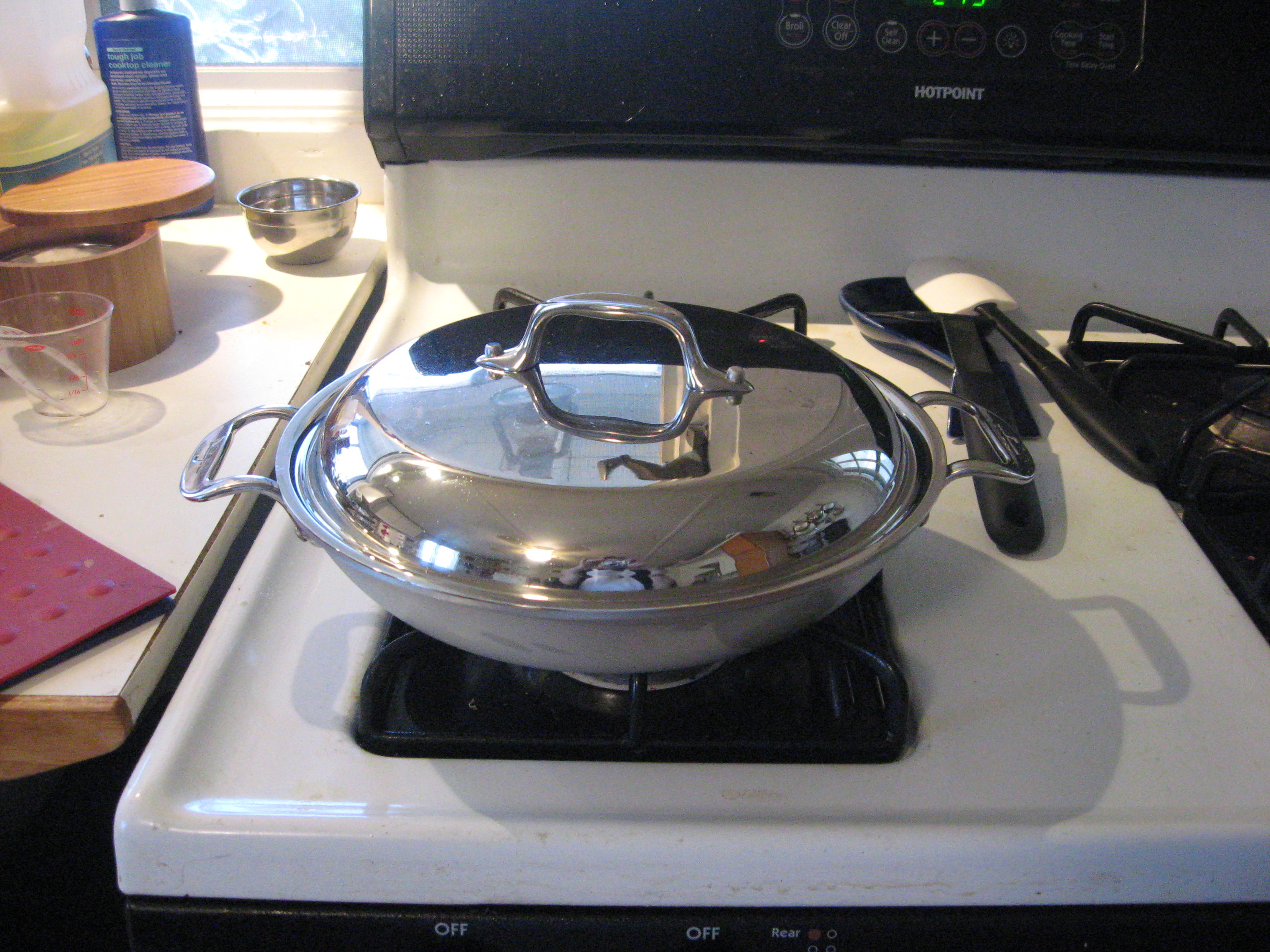 After I got my Christmas present (See The Petit Brasier) I had to give it an immediate test run. What better to test than a favorite braised dish: pot roast. This was nothing fancy at all. You’ll note that I’m not even saying it had a sauce–I really did mean good, old-fashioned, down-home, satisfying brown gravy, lots of onions, and good tender beef.
Even though I say I dislike leftovers, there are some exceptions and pot roast is one of the exceptions. Sometimes I get the great big chuck roast and make a lot of it and put it in the freezer in single-serving packages, right with the chili, the stock, and some soups so that I can have an “instant” meal–the microwave is great for defrosting and individual portion. I don’t always want to have to pack and freeze leftovers, so with the small braiser, and a cooperative butcher or meat department at the supermarket, I can make a small pot roast that’s good for two, or maybe three meals since there are some very easy ways to kind of spiff it up for the reruns.
This is really not a recipe–it’s a happening–quantities are approximate as the amount of oil you need will vary with the size of you pan, the amount of mushrooms and onions you are going to sauté–just use what you need. (Improvise! Wing it! Just do it–it will work.)
Ingredients
- 1-1/2 to 1-3/4 pound piece of chuck roast
- 4 or 5 small onions (or 3 medium to large ones) sliced moderately thinly
- 2 teaspoons flour, plus flour for dredging the beef
- about 3 tablespoons olive oil (divided as needed for sautéing mushrooms and onions.
- 8 ounces of mushrooms, sliced (more if you really like mushrooms)
- 1 to 1-1/2 cups of water or stock
- salt and fresh-ground black pepper to taste
- about 8-10 medium garlic cloves.
Preparation
- Pat the pot roast dry with paper towels and dredge in a flour seasoned with salt and pepper. Let it stand while you cook the onions and mushrooms.
- Slice the mushrooms and sauté in a little of the olive oil until they release their
 liquid and brown. When brown and liquid has evaporated, remove to a bowl.
 - Add a bit more olive oil, and sauté the sliced onions until they start to brown and caramelize. When partly browned, remove to a bowl with the mushrooms.
- Add the additional olive oil, as needed, and brown the beef well on both sides. Put it to the side for final assembly.
- Take the rest of the olive oil, and the 2 teaspoons of flour, and brown the flour in
 the oil until it turns a nice golden brown and smells toasty. Turn the heat down, add the stock or water to the browned flour.
 - Add the sautéd onions and mushrooms, and return the browned roast to the pan, with the onion/mushroom mixture around the sides, sprinkle the garlic cloves over the top.
- Bring to a simmer on the stove top, cover and place in a 295-300 ° F oven and
 cook until fork tender–about 2-3 hours (unattended). Check periodically to see if you need to add more liquid. You need just enough to make nice thick gravy, and the onions are going to cook down to help thicken the gravy.

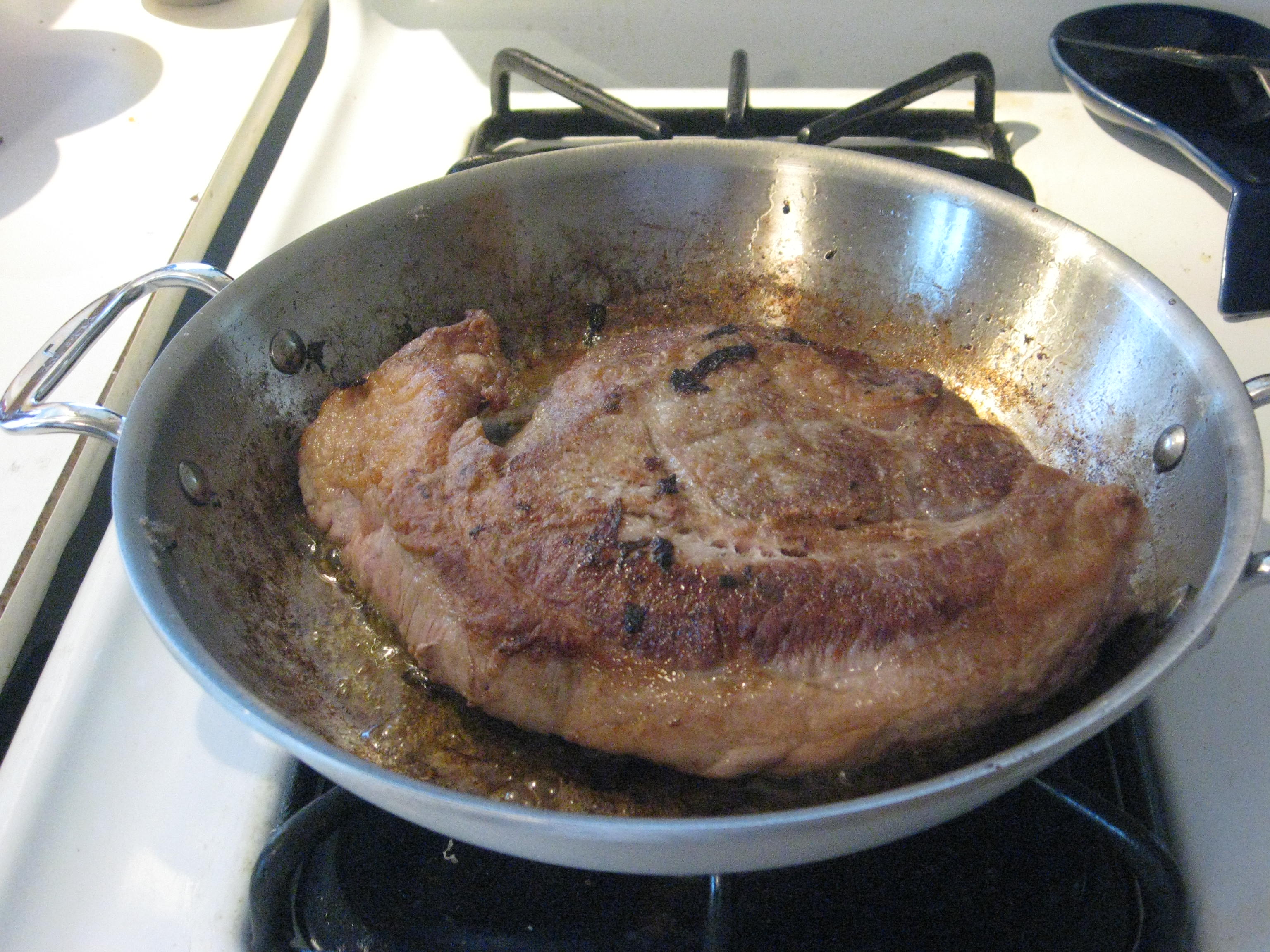
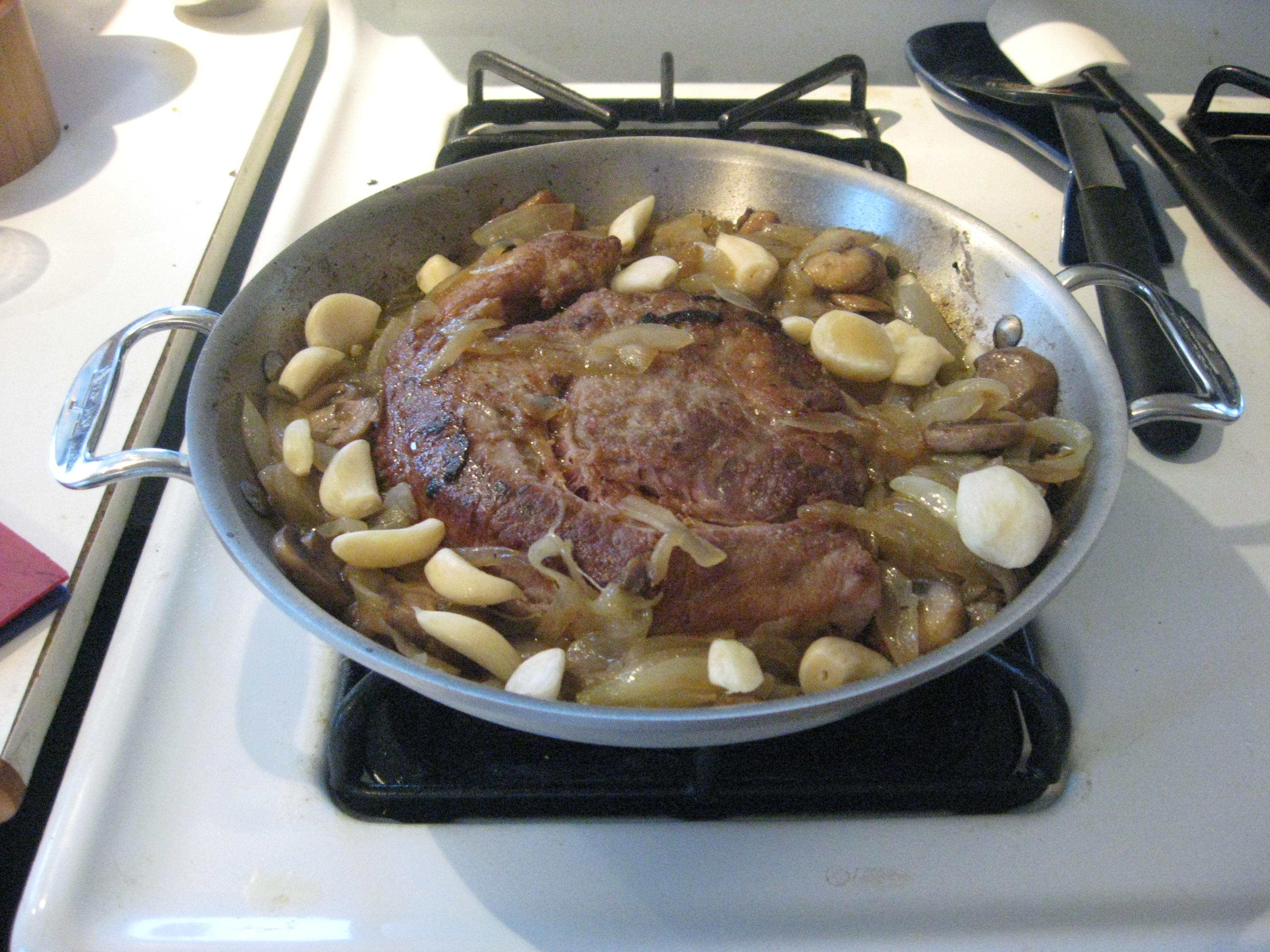
 For that first meal, all you really need is a salad, maybe a baked potato….or some noodles.For the second serving, stir a tiny dollop of sour cream into the portion of brown gravy for this serving to add some tang and be a bit “stroganoff-ish”, add some steam-sautéd (See Cooking Vegetables Quickly) carrots, or spinach as a side. What about the third? As you reheat, add some tomato paste, or some tomato sauce to the last bit for a different taste.
It’s pure unadulterated comfort food. Even if it’s not a single serving, it’s an appropriate quantity for small-time cooking, but it sure has big-time taste. It’s great what having the right size pan does for cooking for one.
A son goût!
Making stock quickly.
Despite occasionally using the microwave to make stock or broth quickly or in hot weather, I’m a fan of the long, slow, stove-top or oven method so that I can luxuriate in the wonderful smells when it’s cold and/or rainy outside. It’s such a comforting activity and, though it takes time, it does not require a lot of close attention. However, there are times when I need stock or broth and I need it quickly. I gave the basic recipe for chicken broth in an earlier post (See The Microwave in my Kitchen), but I want to show you it can be used for other stock, not chicken.
Cooking some chicken give enough good strong broth for a bowl or two of soup. There are times when I need more than that because I’ve run out of what I had stashed in the freezer. That’s likely to happen in the winter when I’m a real soup-hound.
I was happy to find a quick method that does produce good stock–using the microwave. This might also be a reasonable solution for those of you who don’t have the chest freezer on the back porch or a good-size freezer with the fridge.
I own only one microwave cookbook: Barbara Kafka’s Microwave Gourmet. She was a reluctant convert to the microwave–as well as a traditionally trained chef. I read her introduction to the book while standing in the Regulator Bookshop; her initial reluctance to hop on the microwave bandwagon made me thing that this might be a different kind of microwave cookbook; I was right. I still do not cook a lot of things in the microwave, but I have found some very useful things in this book. I like the fact that she gives single-serving amounts for some of the recipes–as well as doubling some.
Getting bones for making stock is getting harder, with so much meat coming into the store already cut and boned, but if you can find a butcher shop, it’s well worth exploring the possibility of having them save bones for you. You should check your farmers’ market as you might be able to get “stewing” hens there, or if there is a vendor selling beef, they might have soup bones (necks, tails, etc.) and that is a real delight. I’ve found “marrow bones” in the freezer case at the supermarket, but they were so clean that they really did not make good stock (the marrow was excellent spread on toast, though). For chicken broth, you can always buy a whole bird, and take off the breast and leg/thigh meat and use the rest of the carcass for making broth.
I want to give you an adaptation of her stock/broth recipe (p.314):
Meat Broths
- 2 pounds meat (chicken, duck, veal, beef marrow, or other beef or lamb bones cut into small pieces–maybe by the butcher)
- 4 cups water
- Place the bones and water in a 2-quart microwave-safe container. (Personally, I have a large 2-quart Pyrex measuring “cup” that I use for this; it has pouring spout and a handle which I like when working with this much liquid.) Cook at 100% for 30 minutes, or 40 minutes for a broth that will jell.
- Remove from the microwave oven and let stand until it stops bubbling. Strain the broth through a fine sieve. If you want it clear, you need to do the clarifying procedure, which I’m not including here. You can find that in her book (p.314).
- Cool and refrigerate, tightly covered (See Storage Containers) if not using immediately. (Usually don’t store it–my reason for making it in the microwave was either that it was sweltering summer weather, or I needed it NOW!)
If you have “soup bones” that include lots of meat, as do the ones that I get at the Durham Farmers’ market, then you have a hearty meal that’s beyond just soup. The beef can taken off the bones and added to some of the broth with vegetables for a really hearty meal of serious comfort food. That’s a bonus.
That’s it! As is mentioned in another post, I have not done a side-by-side taste test of the broth make the traditional (long, slow way) with that made this quick way, I am pleased with the results of this method. I will freely admit to keeping canned broth and stock on my pantry shelf, but these are usually a last resort, or to be used when the broth will be a background flavor as in chili con carne–not when it up front really good soup like a winter favorite, beef-barley-mushroom soup.
If you want a “brown” broth, you can always roast the bones in the oven before putting them into the microwave to cook. The recipe in the book gives lots of variations that are useful, including adjustments for more meat, adding vegetables, clarifying, and making fish broth as well. If you’re a microwave user, you might find this a great book to have on your shelf, or you might want to check it out of the library and see what else is in it. There is a large “dictionary” in which she lists lots of different ingredients and gives cooking times, or sometimes recommends not cooking that in the microwave. I do refer to the dictionary frequently. If you are a novice with the microwave (think it’s for popping popcorn, or heating water) she does a good review of the types and the shapes of containers that work best for cooking in the microwave and the information on cooking times is useful.
An awesome lentil soup!
Being both a cookbook/food addict and a Kindle addict, it’s probably no big surprise that I’d have to have a cookbook on my Kindle. My first one was the Cook’s Illustrated, special Kindle edition (only for Kindle, I believe) which is a great book to have available. But you can’t expect a cookbook addict to stop at one can you? Certainly not!
The second one that I downloaded was Kitchen Express. Having the instant gratification of looking, trying a sample, and viola, there it is, just naturally leads to an I-must-cook-something-out-of-it-now frenzy in the kitchen. Now I have to say that I love the way that book is organized (aside from the thrill of being able to search using the Kindle).
The weather probably contributed to my choice of a first recipe to try–rainy, but certainly not cold–but the kind of weather to make you want something like comfort food. I’ve always liked lentils–the cook quickly, freeze well, and all sorts of things. Given the rain, I searched for lentils and found a recipe for which I had all the ingredients except one: a lemon! I looked at the description of the recipe, and decided that I had to have a lemon. Not wanting to go to the grocery store in the rain, I called my closest neighbor to see if she had a lemon I could borrow. Luck was with me–she had several.
Now having all the ingredients, I made lentil soup (and returned the lemon in a large bowl of soup). Both of us have subsequently done a lot of improvisation around this basic recipe, so I’d like to share it with you, and hope it will inspire you to do some variations. Here is the recipe reproduced from Mark Bittman’s Kitchen Express. *
Lemony Red Lentil Soup with Cilantro
Red lentils cook very quickly, but allow more time if you substitute and other type.
“Cook a copped onion in olive oil in a saucepan until soft; add one cup of red lentils and four cups of chicken broth and bring to a boil; continue simmering until the lentils are soft. Puree a handful of cilantro with a few tablespoons of olive oil and a pinch of salt; set aside. If you like, puree half the lentils until almost smooth; return them to the pan. Add about two tablespoons of lemon juice or more to taste. Stir in the cilantro puree, adjust the seasonings, and serve with crusty bread or a mound of rice in the center.”
I’ve done lots of variations on this one: used lime instead of lemon, added some rice, pureed it or not; there are so many ways to improvise with a recipe like this. I’ve had the same basic soup with garbonzo beans. There’s something about the combination of the citrus and the cilantro that just makes this kind of sparkle. I like to add a bit of the citrus zest to brighten this even more that just the juice. The pureed cilantro keeps very well in the fridge if the surface is covered with oil (and it’s a great addition to chili con carne to add some fresh contrast).
Well, it’s a few months later, and now we have cold weather, real serious soup weather! I just finished making another half recipe of this with the chicken broth from cooking some chicken thighs. Now that it’s colder I wanted to “hearty” the soup up a bit, so I used some French (green) DePuy lentils (which I prefer to red, even though they take a bit longer to cook) and added the chicken meat from one of the thighs that I cooked in the microwave to get both meat and broth.
The only complication that I’ve found with this recipe for one is that bunches of cilantro from the grocery store are huge. As much as I like cilantro I can never use it all. In the summer I plant successive pots of cilantro so that there is always some to pick. In the winter, it’s a different story: want to make this but don’t have cilantro. I’ve found a great stand-in for the fresh cilantro in the frozen foods department at the grocery store: Dorot Chopped Cilantro (www.dorotfoods.com). It’s frozen, fresh cilantro in cubes equivalent to 1 teaspoon each. Nothing is quite like the fresh, but I’ve been rather pleased with this as a stand-in, so it has become a freezer staple for my kitchen.
I’ve just finished a supper of a first course of steam-sautéed vegetables–a medley of carrots, broccoli, and red bell pepper, followed by a hearty bowl of the lentil soup with the chicken meat added. Since I made a half recipe, I’ll have enough for another bowl in a day or two. I’ll add another splash of lemon and a bit of cilantro to perk it up, and perhaps have it with (as the recipe suggested) a mound of rice–another satisfying, healthy, and easy meal.
This recipe lends itself so easily to improvisation. Try it–you’ll find something to please your palate.
A son goût!
* I’ve been searching on how to cite a Kindle reference properly since I don’t have the hard copy. According to Amazon discussions, the font size does NOT affect the location: so here that is: 1187-98. Since I’ve given you the exact recipe title, I’m sure you’ll have no difficulty locating it in the book.
Chilli con carne
I love weather where I can get up want to put on clothes and warm food like oatmeal for breakfast! This morning I turned on the space heater in the office for a bit. This means it’s time to cook things that will give me quick comfort food during the colder weather.
One of my favorites for winter is chilli con carne–a version that I learned from a cook who spoke no English, by watching it being made. I’ve only made one modification to that original “recipe”–and that has been to add some sun-dried tomatoes; otherwise, it’s as I saw it made originally.
This is not a recipe that has fixed amounts–you’re going to have to taste and season it to suit yourself. It’s a bit time consuming, but since it’s a large quantity and freezes well, it’s well worth the time and effort.
You can manipulate the “heat” by leaving in some seeds from the chile peppers, or by adding cayenne or crushed red pepper flakes to achieve the desired hotness. I usually leave the seeds in about half the chile peppers–I’d consider it mild to moderate in heat, depending on the particular batch of chile peppers.
Ingredients:
- 4 slices bacon or fatback minced, browned and reserved
- 6 to 8 medium yellow onions, chopped
- 2 tablespoons ground cumin
- 2 tablespoons ground coriander
- 3 pounds beef, diced or coarsely ground
- 3 pounds pork, diced or coarsely ground (shoulder preferred to loin)
- 4-5 chipotle peppers in adobo (1 small can)
- 2-3 dried ancho chilli peppers, toasted and crumbled (seeds removed)
- 2-3 dried guajillo or pasilla negro chilli peppers, toasted and crumbled (seeds removed)
- 1/2 cup minced garlic
- 1/2 to 3/4 cup masa harina, toasted; cornmeal can be substituted if you don’t have masa harina)
- 32 ounces of beef broth/stock
- kosher salt to taste (approximately 3 teaspoons)
Assembling the chili:
- In a large dutch oven, sauté bacon until brown and crisp; remove and reserve.
- Remove all but about 2 tablespoons of fat, reserving excess, and add the chopped onions; cooking slowly until caramelized.
- Meanwhile, toast the dried chilli peppers by holding in the flame of a burner until aromatic. Remove seeds and crumble.
- Toast the masa harina in a small skillet and set aside.
- Add cumin and coriander to the onions and sauté until aromatic.
- Add garlic and sauté for about 1 minute. Remove to a bowl and set aside.
- Add additional bacon fat if needed, and brown meats in small batches, transferring to the bowl with other ingredients.
- Remove excess fat from dutch oven, and deglaze by adding beef stock.
- Transfer meats and other ingredients from the bowl to dutch oven, add chipotle peppers and adobo sauce, sun-dried tomatoes, and salt. Stir in the toasted masa harina.
- Cover tightly and place the dutch oven in a very low (275 ° to 295 ° F) oven and allow to cook for approximately 4-6 hours, tasting and adjusting seasoning as needed. Add water or more stock if it becomes too dry, but I prefer this to be a thick chili.
I’ve tried this once in a crock-pot or slow cooker, and just not been happy with the final result. I think that the oven cooking allows just enough evaporation and concentration to do good things with the flavor that just cannot be gotten with a crock-pot. It was certainly edible when done in the crock-pot, but just lacked a little something. Were I doing this in hot weather, I’d certainly use the crock-pot, but since the weather is cooler now, the oven heat is not a problem, and I get to savor the aroma as it cooks.
 a-single-serving.com