Smoked lamb shanks

I was browsing the food-related blogs when I came across this post on smoked lamb shanks.  This looks like a must-try one as much as I like lamb. Even though it’s not quick, it certainly would do for single-serving cooking–and I can dream of some things to do with leftovers.

While I don’t have a smoker, I do have a Weber kettle grill, and Cook’s Illustrated has had some how-to articles on smoking using the kettle grill, so I think that I’m going to have to try this one.The July/August 2011 issue had an article (and video) on smoking chicken that makes it look possible to do the lamb shanks on the kettle grill with adjustments to time and only a little modification of technique.

I think this is going to be my Fourth of July food, even if the weather is hot and humid–I’ll just hope that it doesn’t rain!

More on growing herbs

For those just starting gardening, and growing herbs is a great place to start, here’s an article from The Herb Companion that addresses the joys of having a kitchen garden of herbs (in containers), and how easy it can be.  You’ll probably find that it’s addictive!  Once you know how easily you can grow them almost any where, and how useful they are, you’ll not want to be without fresh herbs in season.

Blueberry ice cream recipe

Since  blueberries are in the market–as well as blackberries, I’m getting ready to try blackberry ice cream (an adaptation of the strawberry/sour cream ice cream that I made at the peak of strawberry season)–there will be a follow-up report on that.

Meanwhile, I thought that this recipe for blueberry sour cream ice cream might be appreciated.  It looks sumptuous–and seems close to the strawberry sour cream recipe that I used so it’s easy since there’s no custard to make.   In this hot weather, easy and cool are both much  appreciated!

Chervil & Savory

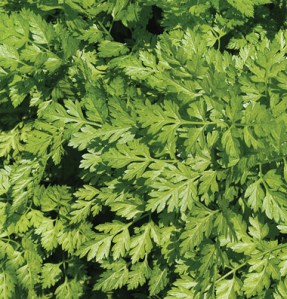
Chervil (Anthriscus cerefolium)

Chervil (Anthriscus cerefolium) is a wonderful herb, but unless you grow it yourself, you’re unlikely to every taste it.  It’s too delicate to be found in the grocery store in the little plastic boxes or in bunches.  I’ve not see it at the farmers’ market as a cut herb either.

As the plant is delicate, the flavor is too:  hints of anise/tarragon and parsley but subtle–which is not something you’d say about French tarragon.

Chervil seed is easy to germinate but the plant is difficult to transplant as it has a taproot. It likes rich, moist soil that is well drained, and would like to be in partial shade. You can sow outside several weeks before the last frost.  It is another herb that like cooler weather, but it may be prolonged by providing some shade, e.g. planting it under other plants. Like cilantro, it is a fast-growing annual that will flower quickly.  If you cut off the flowers you can prolong the foliage to some extent, but the old leaves will change color (from the lovely greet to yellow and purple) and become tough and lose flavor.  If it becomes one of your must-have herbs, you can sow successively (as with cilantro) throughout the growing season.

To harvest, cut sprigs about two inches above the ground, taking the older leaves from the outside of the plant, but be sure to leave the new center leaves as this is where the new growth is occurring.  As with most other herbs, you should not harvest more than one-third of the plant at a time since it needs the leaves for photosynthesis.

In cooking, use it where you want delicate flavors e.g. with mild fish or seafood.  It would do well with young poultry that has more delicate flavor than the older bird.  Chervil would be good with young vegetables–e.g. baby carrots, or fresh baby peas.   The leaves are mild enough to add to salads, and to use as a garnish in place of parsley.  It could be used with many of the same foods as tarragon, only where you’d like a more delicate touch–e.g. with eggs. It’s so mild that you will want to use lots of it–quite in contrast to tarragon.

I am not a fan of dried chervil–it seems to lose a lot of flavor and come across somewhat hay-like, even when I’m sure I’ve obtained it from a supplier with good turnover of their dried herbs.  So for me, it’s one of the signs of spring, right along with the new peas.

♦♦♦

Image from Mountain Valley Growers

Winter savory (Satureja montana)

Savory is not going to be found in the grocery store shelves either.  Two savories, summer (Satureja hortensis) and winter savory (Satureja montana) have very distinctly different growth and appearance.

Summer savory is an annual about 12 to 18 inches tall that tends to be rather sparse, lanky looking with grayish green leaves that will last only until frost.  Winter savory is a perennial, evergreen or semi-evergreen, shrub with a bushy habit, usually not taller than about 12 inches.  It’s leaves are glossy, dark green and closely spaced.

While both have are spicy, rather than sweet flavor (like tarragon or chervil), the winter savory is spicier and hotter than the summer, but they can generally be used interchangeably, though the milder summer savory is best with fresh summer veggies.  I think that the savories are most commonly associated with northern European cooking than with American cooking.

Both winter and summer savory are sometimes known as the “bean herb” as they are particularly used with dishes made with dried beans;  the somewhat milder summer savory is great with fresh beans as well (fava, lima, or green beans).  Other uses include with cabbage, Brussels sprouts, and with summer squash, and roasted potatoes.  It’s potent enough to use in marinades for beef, lamb, as well as chicken and pork.

The summer savory is easily started from seed.  Summer savory is not fond of being transplanted (if starting indoors use peat pots so that you do not have to disturb its roots).  It does will is average soil that is well drained, but well watered.   It will want plenty of sun and does need to be well fertilized.  Blooms will appear between the leaves on the upper portion of the plant.  At that point you should cut the plant back by about one-third in order to prolong its culinary use by encouraging more foliage.

Winter savory can tolerate poorer soil than the summer, but it also must be well drained. It also wants plenty of sun.  It is hardy to about zone 5,  if the roots are not wet during the cold weather.  Wet roots in the winter may well mean no savory in the spring–really true of most perennial herbs!    After or as it blooms (I prefer not to let my herbs bloom), it should also be cut back to encourage it to be bushy and increase foliage, which is what you want for cooking.

Both are harvested by cutting springs from the plant–remember not to cut more than one-third of the plant at a time so that it can keep growing and producing.  If you need to store savory,  wrap in a slightly damp paper towel and place in a zipper-lock back.  Summer savory should hold for about a week, and winter for about two weeks.

USDA hardiness zones

I’ve talked about growing your own herbs, and I’m sure I’ve mentioned that certain perennials are hardy in some zones and not in others.  If you are unfamiliar with these, here is a link  from the National Gardening Association which will answer some questions about hardiness zones, and will let you check out your zone.  Remember that drainage can affect hardiness, and it will make a difference if the plants are in pots, rather than in the ground.

It’s not only cold that affects your plants:  It’s thought that plants begin to suffer physiological damage at temperatures above 86 ° F.  From the American Horticultural Society, here is a link to a downloadable heat zone map; online this map may be viewed at the Southern Gardening website.  This gives the average number of days when the temperature is above 86 ° F

In using either of these (cold hardiness or heat zones) you have to consider where your plants are being grown–in the ground, in pots, the soil drainage, and water availability, among other things.

Addendum to aguas frescas

Browsing my favorite blogs, I found this recipe for watermelon aqua fresca with lime that  those of  you who are addicted to watermelon in hot weather might enjoy.  The combination of watermelon and lime is good!

Smoked salmon salad

It was  just hot enough this evening that I didn’t really want to cook–not all that hungry, but wanted something easy and light.  Rummaging in the pantry, I found that I had Chicken of the Sea wild-caught, smoked Pacific (Alaskan) salmon in the pouches, so I made a salad to have with some good crisp flatbread and fruit (melon and cherries) on the side.

Quantities are approximations–precise measurement is certainly not necessary to make something like this–use your judgement.

Ingredients: 

  • approximately 1/3 to 1/2 cup sweet onion, diced
  • approximately 1/3 to 1/2 cup cucumber (seeded if needed), diced
  • two packages (6 ounces) smoked salmon slightly broken up into chunks
  • lemon juice to taste
  • lemon zest to taste (about 1/8 to 1/4 teaspoon
  • drizzle of extra-virgin olive oil sufficient to moisten
  • fresh-ground black pepper to taste
  • salt to taste  (taste before adding any
Assembly:  combine all ingredients and mix gently.  Taste and adjust seasoning.
Variations:
  • replace extra-virgin olive oil with a dollop of sour cream and add chopped fresh dill
  • if you have leftover grilled or griddled salmon steak or fillet this is even better
  • if you are not using smoked salmon, a dash of chipotle chile powder gives a bit of smoky taste and zip
  • add minced green or red chile pepper (jalapeño, poblano or serrano) to taste.
There are all sorts of possible variations here…fix it to suit yourself.
A son goût!  

King klip

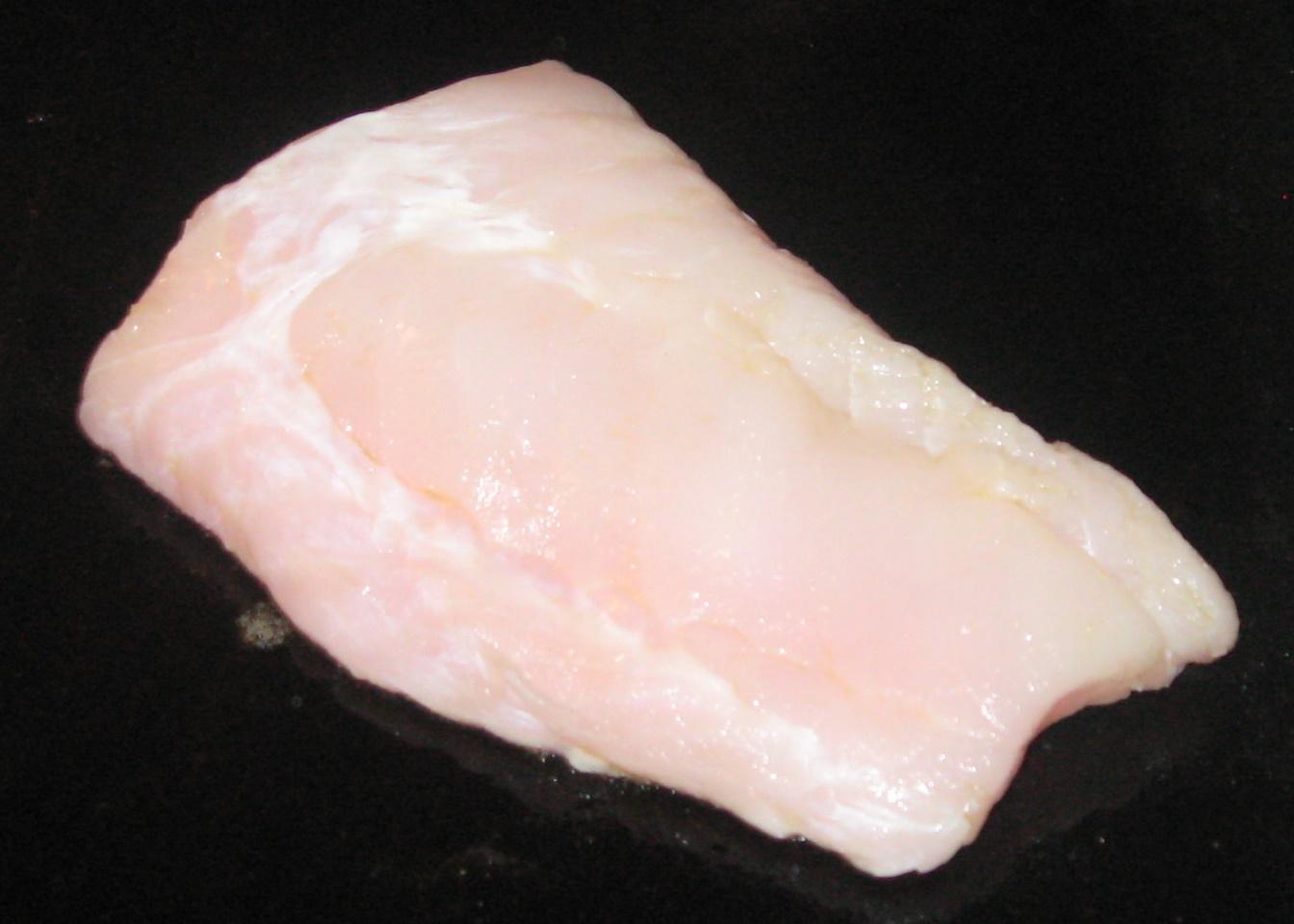
I went to Harris Teeter (affectionately known as the Teeter or HT) this morning looking for something to cook for  dinner (or supper if you prefer).  I was scoping out the fish contemplating salmon, tuna, or one of the standbys when  saw something that I was not familiar with, but look great.  The sign said it was  King klip.  My cooking curiosity being what it is, I had to bring some home with me, particularly as it  was inexpensive.

The fishmonger told me it was sort of like grouper and would do well grilled.  The heat being what it was this afternoon (my thermometer in the shade said 97 ° F ), I thought that grilling was out of the question so I opted for the cast-iron griddle –my standby.

I portioned my fish (I was a little overzealous when I said how much to cut so I have King klip filet portionedanother portion to try cooking a different way tomorrow), patted it dry, and rubbed itwith a tiny bit of olive oil.   Then I started wondering what I was going to have with this lovely fish…looking around the kitchen I saw the kaboka squash that I’d brought home from the Compare market the other day and decided that was going to be part of dinner tonight.  (I now have to figure out what to do with the rest of this thing as well, since I used only about a quarter of it.)  I attacked it with my chef’s knife, halved it, seeded half, and then took off several slices to use this evening.

I decided that I needed some green stuff with this as well, so I make a trip to a neighbor’s garden(yes, she had previously offered)  for some of  the last of the snow peas–it’s really the last–the heat has gotten to them for sure.

I decided that I’d steam sauté the squash, extravagantly with a bit of butter since the rest of the meal would be “lean”.  I used a paring knife to remove the skin and cut it into chunks so it would cook fairly quickly.

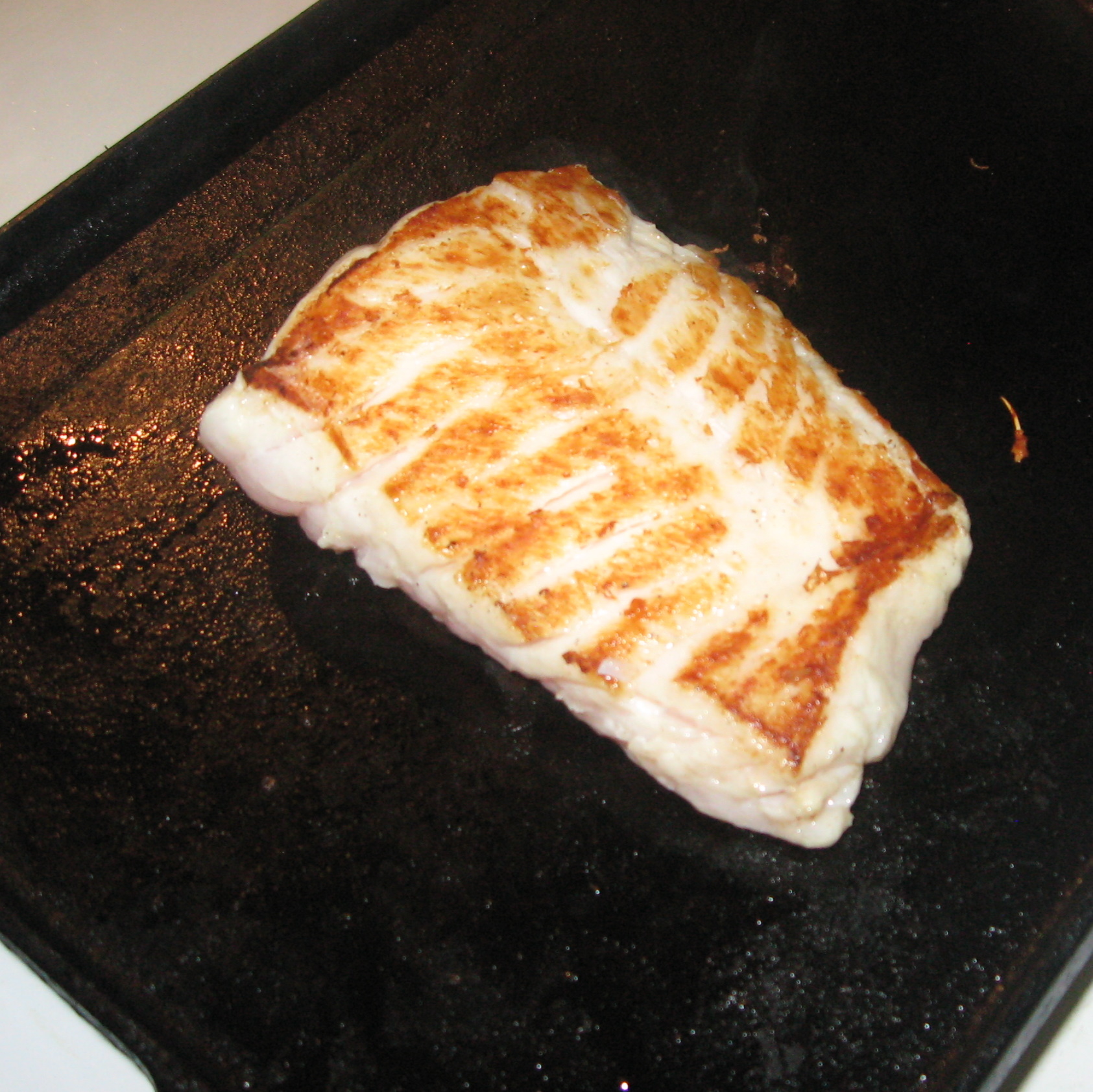
I topped and tailed my snow peas and since they were feeling the heat I put them into some cold water until I was ready to cook them.  I started the  squash in my small sauté pan with a bit of butter and about a tablespoon of water, covered tightly.  It was time to heat up the griddle.  Once it was hot, I rubbed just a light coat of oil onto the surface and put my filet on to start cooking.

Meanwhile, a quick check on the squash–not quite ready to let the water evaporate yet, but close.  Back to the fish–not quite ready to turn yet–still resisted my sliding the spatula under the edge, so it needed a bit more browning to “release” by itself.   It was smelling really good by now.  About the time it was ready to turn, the squash should be read to be uncovered to finish cooking while the water evaporated, and then to start sautéing to finish.

   The fish released and turned easily on the griddle.  I removed the lid from the squash and let the water evaporate from the pan; turned the heat down to hold while the fish was finishing.  I could see the opaque line moving toward the middle.

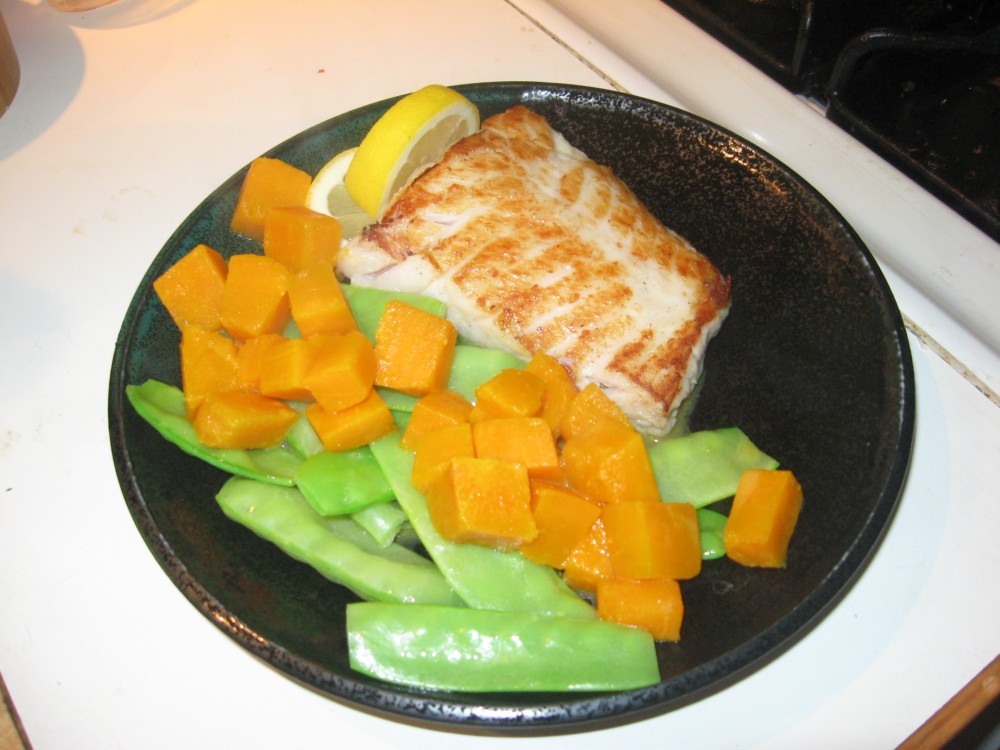
I put the snow peas into the pan on top of the squash and put the lid back on so that they would get just a bit of steaming .  By the time this thick filet was opaque to the center, the squash and peas were ready to eat as well.

I warmed my plate under hot water and dried it, and put my dinner on it!  Simple, and really pretty healthy–I did put just a small pat of butter on top of the fish to finish it off with the lemon.  That was about 30 to 40 minutes start to finish.  Since this was my first time with this fish, I wanted to cook it as simply as possible to get to know its basic taste.  It was a very mild fish, but it held together well during the grilling.  It’s going in my “standby” category with tilapia for a good all-purpose white fish.  (It’s line-caught, by the way; I was pleased to see that HT signs indicated how all of the fish in the case had been caught)!   It was a simple, but good, quick, healthy meal!

I think that I’ll try baking the other half of that filet in foil with some veggies.  As for the rest of that kaboka, I have a neighbor  who I’m sure will be able to make use of at least part of the other half.  (If you’re doing single-serving cooking, it’s always good to find out what your neighbors like to eat–so you can share when you get really big things like winter squash or watermelons.)  I’ll share, and still have a bit more of the squash for me.  The second portion of fish will probably be a hobo pack with some fresh tomatoes and herbs–maybe tarragon. The rest of the kaboka squash is likely going to get a “classic” treatment:  baked with some butter and brown sugar.

One of the good principles of single-serving cooking is to share the big stuff.  Most of my single (or cooking for two) neighbors always seem really please to be able to get a portion of something like the kaboka–especially if you give cooking instructions if it’s unfamiliar to them.)

A must-try dessert

Since I’ve gotten Trillian installed I get all these quick updates from Twitter and Facebook zipping across my desktop. This one, given that it’s berry season,  looked like something I should pass on.

I’m not usually “into” cakes particularly, but I do have a weakness for good pound cake, especially with fresh berries, figs, and good ice cream.  (Good pound cake means one that does not shy away from the good stuff like butter.)

It’s from David Lebovitz. If this recipe is anywhere near as tasty as the recipes in The Perfect Scoop, it will be a real keeper! Take a look at this Bay-leaf-infused Pound Cake!

Pork stock

Not an instance of absolutely great planning, but here I am as the thermometer hits the 90s making pork stock.  Well…I never said that I was the greatest planner in the world–strawberry ice cream and stock-making in the kitchen all at one time.  My favorite meat supplier (Meadow Lane Farm, Louisburg NC)  had great meaty pork neck-bones at the market this past Saturday so I had to bring some home–so despite the heat it’s stock-making time.

These are very meaty bones, so I’ll have some meat to use after the stock is finished.  Since there is so much meat on these bones, and I want to use it, I’m not doing the quick stock–but rather the stove-top method (now you’re sure I’m not great at planning, right?).  But when you have the opportunity to get pork neck-bones, you take it.  Meadow Lane farms is doing more pork (as well as beef) so next time I can plan to do this is cold weather.  (I’m glad I’ll have more access to pork…love that “other white meat”.)

Basic Stove-top Pork (or Meat) Stock

Ingredients: 

  • about 4 pounds meaty pork neck bones
  • 2 medium onions, chunked up
  • 2 medium carrots, chunked
  • 3 bay leaves (dried ones)
  • about 2-3 teaspoons salt
Preparation:
  • Rinse the bones well.  If you feel that there is any old, or “off” odor, or they’re very bloody, blanch quickly in one change of water.
  • Add aromatics–onions, carrots, and bay leaves
  • Add water to cover.
  • Bring to a boil quickly, and then reduce to keep a bare simmer, and leave for about  2 or 3 hours.  Test after about 2 hours–when the meat is fork-tender and “fallin’ off the bone” (a country expression that means really tender), remove from heat.
  • Strain to remove bones/meat and aromatics.
  • Cool stock quickly in an ice bath, stirring frequently to help cool evenly;  then freeze or refrigerate. (Do not put the hot stock in the freezer or refrigerator as it will (1) warm up the refrigerator and affect everything in it, and (2) it does not cool evenly and quickly so that you could have bacterial growth.)
  • When the bones are cool enough to handle, remove the meat and save for another use.
I want a neutral white stock, so I’m not roasting bones.  The meat from making this stock may be a bit less flavorful than had it not been used to make stock, but it will still be good to use for  eating.  I don’t add celery to my stock unless I’m making stock for a specific recipe that needs it.  Carrots and onions, and bay leaves provide some sweetness and depth.  Because I may want to use the stock in a recipe calling for reducing it, I don’t add much salt; I do add a little, because I think that helps develop flavor of the stock as it cooks.   (Salt is for more than just making things taste salty!)  The meat and the stock will both likely need to have additional salt added to taste, but now I have stock that I can use in a reduction sauce if I wish. 

There was a bit of cursing in the kitchen as I removed the meat from the bones because I tried to do it before they had cooled quite enough, but for my efforts (sweaty through they were) I have bit over a gallon of pork stock that is cooling in the refrigerator to be de-fatted.

I have about a pound of very tender, succulent pork to use for another purpose, maybe a chili verde since the garden is rife with green chili peppers.  The meat recovered after making stock is not as flavorful as it would be had I cooked it primarily to use  just the meat, but it’s certainly great for a dish that is supplemented with herbs and spices like that.  I could also use it in hot and sour soup, or posole.

My active cooking time was about 45 minutes from setting the stockpot on the stove to washing the stock pot.  That includes the time to remove the meat from the neck bones!  Although not the ideal time of the year to make stock–it’s well worth the effort.  (Have to have some priorities–right?)  In the winter, I’d have put the pot in the oven for the cooking time, but I thought that, perhaps, the stove-top (very low simmer) would be a bit cooler way to do this. (No, I’m NOT planning to check that out any time soon!)