Griddled dinner, addendum

End of the work week for me; I’m home from teaching my last class (ended at 4 o’clock).  I made a stop at the local Harris Teeter store to try to find some “Opal” apples without success, and came home with only some milk and chocolate  (Chuao with chile pepper and some other spices).

I think that I probably set a record for the least time to get a meal for myself (and a good one, at that)–short of just dipping into the peanut butter jar.  Of course, it helps to start with great ingredients that really don’t need much done to them.

I got some beautiful wild-caught Alaskan salmon yesterday, so that was dinner this
evening, from the griddle.  The filet was beautiful–skin on,  not a single bone that I had to pluck out with tweezers, and it was cut to just the size that I needed for a single serving.  It was griddle-ready.

I heated the griddle so that I had a good “spit” when I flicked a drop of water on it.  I rubbed a bit of olive oil on both sides, sprinkled a little salt, put the salmon on the griddle skin-side up to start.  At the same time I tossed a handful of partially cooked haricots verts on with it.  It took about five minutes for it to brown nicely.  I flipped it over, skin-side down,  turned the heat down on that end of the griddle, and finished cooking it until there was just a nice darker streak  visible on the ends and took it off the griddle to rest for a few minutes, flipped the beans, and topped the salmon with some sorrel butter.  Great meal in about 15 minutes, start to sit-down.   Definitely minimal ingredients, but not minimal flavor–and it was a healthy dinner too. (Keiko preferred it without the sorrel butter, though.)

I wish there had been enough sorrel to make a sauce, but as it’s just coming up, I could not pick many leaves; what I could pick were minced and mixed with room-temperature butter (unsalted) to be plopped on top of the salmon.  The sorrel butter added a little richness, with some tartness that went well with the salmon.  Fast, easy, and a great way to cook for one person.

Evolution of comfort food.

A few days ago it was gray, rainy, chilly and no matter what there thermostat said, I could not feel warm.   Peering into the refrigerator, I could not find anything that I wanted to eat and I did not want to cook.  Comfort food was in order, something basic: grilled cheese and tomato soup.

That got me thinking about why grilled cheese and tomato soup was so appealing.  I realized that it was likely because that was comfort food when I was a child–home from school with a cold, or sometimes, just a treat.

I did fix myself a grilled cheese sandwich and tomato soup, and it was wonderful–just what I needed.  Munching away, I started considering, even though this was grilled cheese and tomato soup (our of a can), how different it was from what I had as a child.

Growing up on a farm in the country we were pretty self-sufficient: raised and butchered our own meat, curing our own ham and bacon, canning vegetables, raising chickens for our own eggs, and milking cows so that we had our own butter, milk and cream.  I grew up with home-made bread, cakes, pies as a routine thing.   From that vantage point, “store-boughten” was a treat.

One of those treats was a grilled cheese sandwich made with American cheese and something like Wonder bread–so it all squished down flat under the bacon press.  Heaven was to have that accompanied by a can of Campbell’s cream of tomato soup–yes, the condensed stuff.

Given the home-cured country ham, bacon, and good meats (beef, pork, and maybe even lamb, with some rabbit and maybe venison) a treat was a bologna sandwich!  Extra special if fried.  Probably almost anything that came out of a tin can that required a can opener, and did not come out of a Ball/Mason jar would have been considered a real treat.

The things that came out of the Ball/Mason jars were luscious halves of peaches, whole tomatoes,  pears, apple butter…and I did not appreciate them then–they were just food, nothing special.  Well, how things do change.

Now, even though I admit to really liking mortadella, and having just had a grilled cheese sandwich with cream of tomato soup for comfort food–my idea of quality of comfort food has changed a lot.

My grilled cheese sandwich was made with excellent imported, firm, nutty Swiss cheese, with bread sliced from a whole loaf of Italian bread.   That bread was lightly brushed with extra-virgin olive oil, almost like was done in my childhood, put onto a cast iron griddle and carefully browned on both sides.  Lovely, crunchy on the outside, melted cheese oozing with every bit, and delicious.

My tomato soup, admittedly, did come from a can but what a difference from condensed soup.  It was Progresso chunky tomato with basil, not cream of tomato, but really pretty good for soup out of a can.  I did, however, want cream of tomato soup.  I put half the soup into the refrigerator to be used another time, and after heating the other half in the microwave, I added two teaspoons of heavy cream, and some fresh (frozen) basil to it.

I was quite happy with my comfort food–but I did have to reflect on how my taste has evolved.  The original American-cheese, Wonder-bread sandwich never even occurred to me; no did Campbell’s condensed cream of tomato soup–yet my choice was cream of tomato soup and a grilled cheese sandwich, but such a difference now.

This made me think of other differences then and now.  When I first left the farm and went to the city, I was amazed at “city” or deli ham…thought I liked  that better than “country ham”.  Living alone and cooking for one, I even used mac ‘n’ cheese from a box–very different from what I had grown up with.  I was so thankful to be away from the farm, to not have to milk cows, churn butter, and make cheese.  Now, I seem to  have come back to where I started–I want to grow things, buy from the farmers’ market, and will search out those things that I took so much for granted as a child.

House cleaning–a digression.

My apologies for the rather large hiatus between posts.  End of the year got a little hectic and some things just kind of got put off–among them cleaning and writing.

While taking a break from working on my ASI indexing examination, tax preparation, and course-preparation for the up-coming term,  and contemplating the need to get out the vacuum cleaner, it occurred to me that if you’re cooking for one, you are most likely cleaning for one, too.  Now house-cleaning is not one of my preferred activities–I’d rather be watching birds (Project Feeder Watch count), or cooking, or reading one of my favorite British or Alaska mysteries, or just having quality time with the cat.

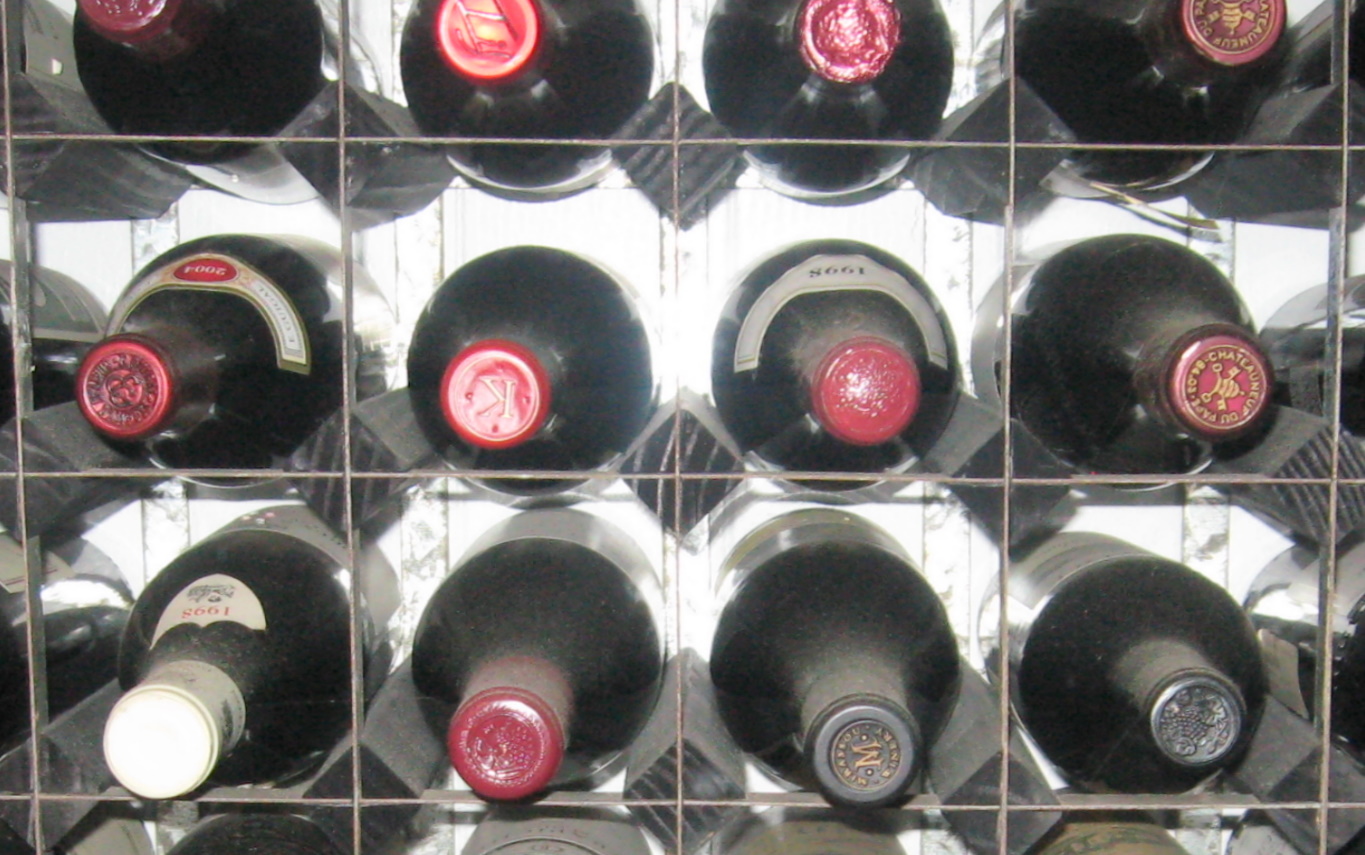
I think that solo dwellers who need to do single-serving cooking, probably also have some issues with cleaning.  I’m a renter, which means that I don’t have lots of space, so my wine collection shares my living-room with me and with the cat.  Now dusty wine bottles may be perfectly suited to the wine cellar in a fine old family manor  in the latest British mystery, but they don’t do a lot for decor in my living room.

Predictably, I have to dust them–and   that is certainly a house-cleaning activity.  As much as I love wine, I don’t love keeping the bottles somewhat dust-free.  To add to the issue, I’m allergic to house dust so stirring the stuff up makes my eyes itch, and my face break out–a sure sign that serious cleaning must happen.  Needless to say, I’m looking for an “easy” way to address this problem, as well as the blades of the ceiling fans and other high places that are generally out of my reach without a ladder.

The vacuum cleaner was not the solution.  As you can see, each bottle has its own little cubby-hole, and in order to use the vacuum cleaner, I’d have to lift each bottle out individually, or remove all from one row so that I could vacuum the next row….et cetera.  Not a viable solution to someone who does not have the support staff of  Martha Stewart, and who does not have a frank OCD. I’ve used torn-up T-shirts for dust clothes–maybe rags is a more suitable term–but again, each bottle had to come out individually, and I’d rough up the corners of the labels.

I’ve pondered the cleaning products in the supermarket aisle  often, and not given in to the lure of the latest product because I have to wonder what chemicals are added to get all this super-duper dust attraction or magnetism.  My better sense tells me that I’d likely be helping the environment and my budget if I did not use some of these products, but  stuck with  things like white vinegar and the like that my grandmother used.  Then a little voice says “but your grandmother was not dusting wine bottles, was not working outside the home….well, you can work through that rationalization for yourself.

I succumbed to trying a Swiffer Duster.  It took seeing the one with the handle that extends, meaning that I could reach all the window tops, the ceiling fan blades and not have to tote out the stepladder.  I discovered that this nice fluffy thing did a great job at getting down the cobwebs, and dusting the ceiling fans, lamp shades, picture frames, and even the fake sunflowers in that huge vase sitting on the floor.  Here was a product that made my cleaning easier (not that I’m always “swiffering” around the house–don’t get me wrong).

The dusters did not turn me into someone who would rather clean than do all the other things mentioned above.  It did make cleaning easier.  I might not have kept buying the dusters, but I discovered that the duster was just the right width to slip into each little wine-bottle cubbyhole and at least remove a lot of dust without having to do a bottle-by-bottle dusting, and the fluffy duster did not catch on the wine labels!  Now  I don’t procrastinate so long between dustings.   I still wonder about what chemicals are used, and consider that while I’m using  the dusters, but I’m in love with the fluffy little blue thingy that fits onto that extend-able handle.  So the barrier was broken–a new cleaning product entered my house.  I find I’m much more likely to pick up that duster and use it than I was to even contemplate dusting each bottle the other way.

Well, sharing my domicile with a cat is another “problem”–the beast (an affectionately used term) sheds.  So there is cat hair in the corners.  Yes–you say that the vacuum cleaner takes care of that.  Very true–but I have to get it out and use it.  I’m willing to do that about every ten days, but what about in between those times? The cat does not shed on my schedule.

Well, I discovered the Swiffer Sweeper (while contemplating the price of a new traditional dust mop).  Does a great job on cat hair, dust bunnies and other household things on the floor.  It also goes under the bottom row of wine bottles without jostling them around!  So, despite my thoughts about the chemicals, et cetera, I have “dust mop” and  dusters in the house.  It is much easier to toss that little square of stuff with all the dust attached, rather than having to wash the  traditional dust mop every once in a while. It’s one of the “perks” of an allergy to house dust that you have to clean the cleaning equipment every so often.

So, I’ve given in to the lure of easy cleaning and chemical assistance with something as mundane as dusting–what next? Enough with the cleaning–time to get back to cooking for myself and the cat!

Pot roast with brown gravy

You’ll notice that I said “gravy”–this is too much of a comfort food to use “sauce” because what you’re getting is plain, down-home gravy that needs bread or potatoes to complement it.

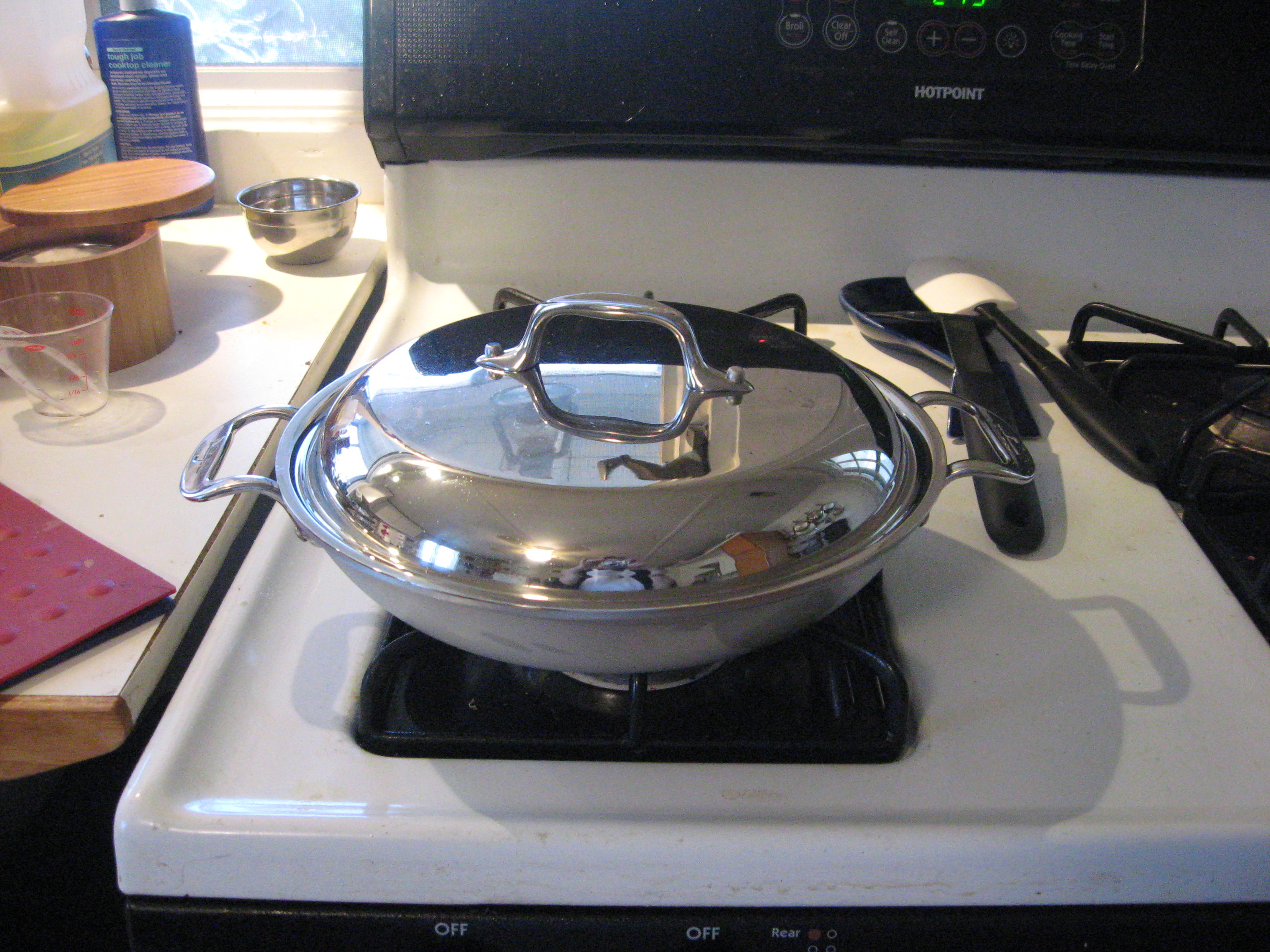
After I got my Christmas present (See The Petit Brasier) I had to give it an immediate test run.  What better to test than a favorite braised dish:  pot roast.  This was nothing fancy at all.  You’ll note that I’m not even saying it had a sauce–I really did mean good, old-fashioned, down-home, satisfying brown gravy, lots of onions, and good tender beef.

Even though I say I dislike leftovers, there are some exceptions and pot roast is one of the exceptions.  Sometimes I get the great big chuck roast and make a lot of it and put it in the freezer in single-serving packages, right with the chili, the stock, and some soups so that I can have an “instant” meal–the microwave is great for defrosting and individual portion.  I don’t always want to have to pack and freeze leftovers, so with the small braiser, and a cooperative butcher or meat department at the supermarket, I can make a small pot roast that’s good for two, or maybe three meals since there are some very easy ways to kind of spiff it up for the reruns.

This is really not a recipe–it’s a happening–quantities are approximate as the amount of oil you need will vary with the size of you pan, the amount of mushrooms and onions you are going to sauté–just use what you need.  (Improvise! Wing it!  Just do it–it will work.)

Ingredients

  • 1-1/2 to 1-3/4 pound piece of chuck roast
  • 4 or 5 small onions (or 3 medium to large ones) sliced moderately thinly
  • 2 teaspoons flour, plus flour for dredging the beef
  • about 3 tablespoons olive oil (divided as needed for  sautéing mushrooms and onions.
  • 8 ounces of mushrooms, sliced (more if you really like mushrooms)
  • 1 to 1-1/2 cups of water or stock
  • salt and fresh-ground black pepper to taste
  • about 8-10 medium garlic cloves.

Preparation

  1. Pat the pot roast dry with paper towels and dredge in a flour seasoned with salt and pepper.  Let it stand while you cook the onions and mushrooms.
  2. Slice the mushrooms and sauté in a little of the olive oil until they release their liquid and brown.  When brown and liquid has evaporated, remove to a bowl.
  3. Add a bit more olive oil, and sauté the sliced onions until they start to brown and caramelize.  When partly browned, remove to a bowl with the mushrooms.
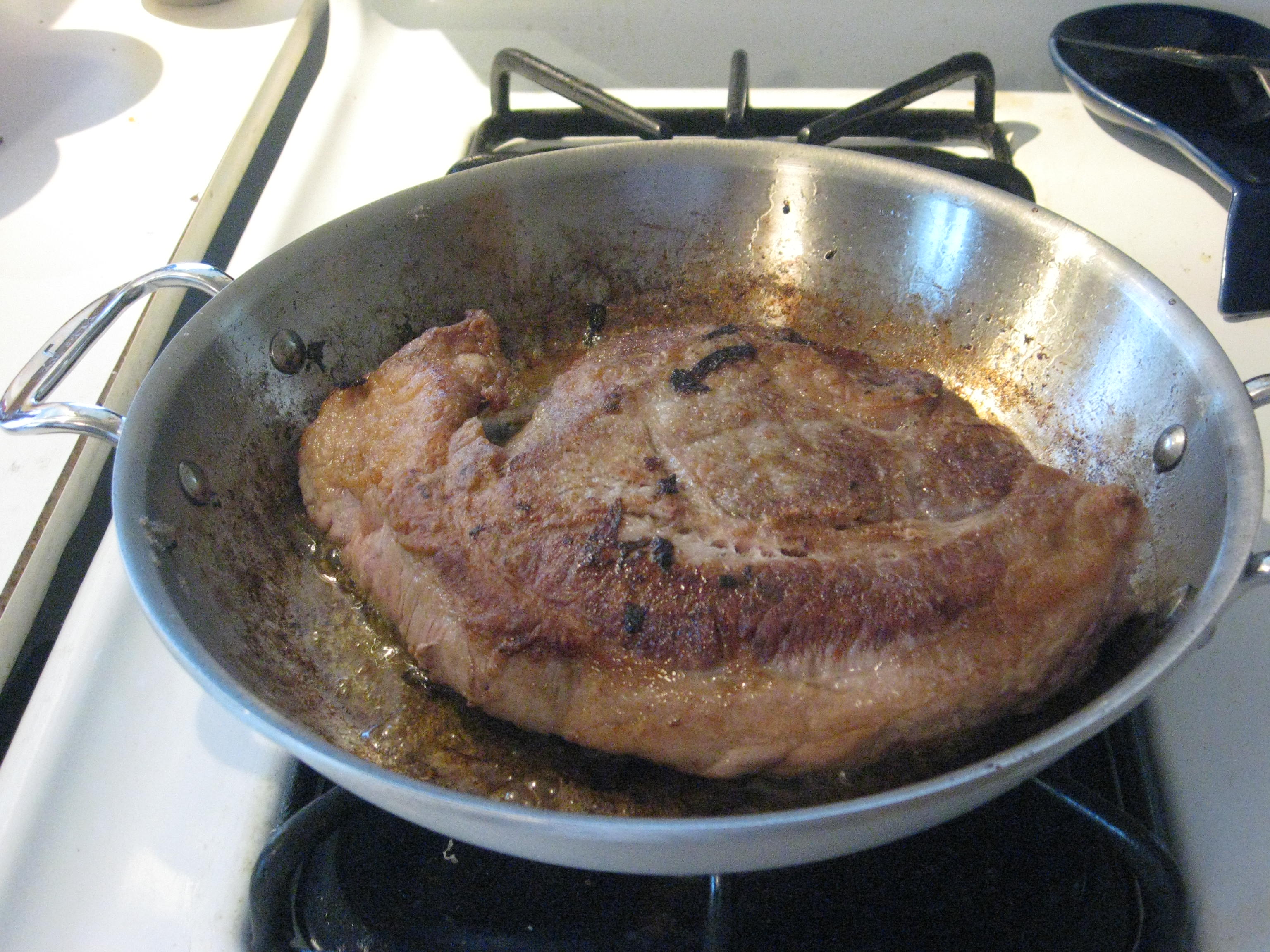
  4. Add the additional olive oil, as needed, and brown the beef well on both sides. Put it to the side for final assembly.
  5. Take the rest of the olive oil, and the 2 teaspoons of flour, and brown the flour in the oil until it turns a nice golden brown and smells toasty.  Turn the heat down, add the stock or water to the browned flour.
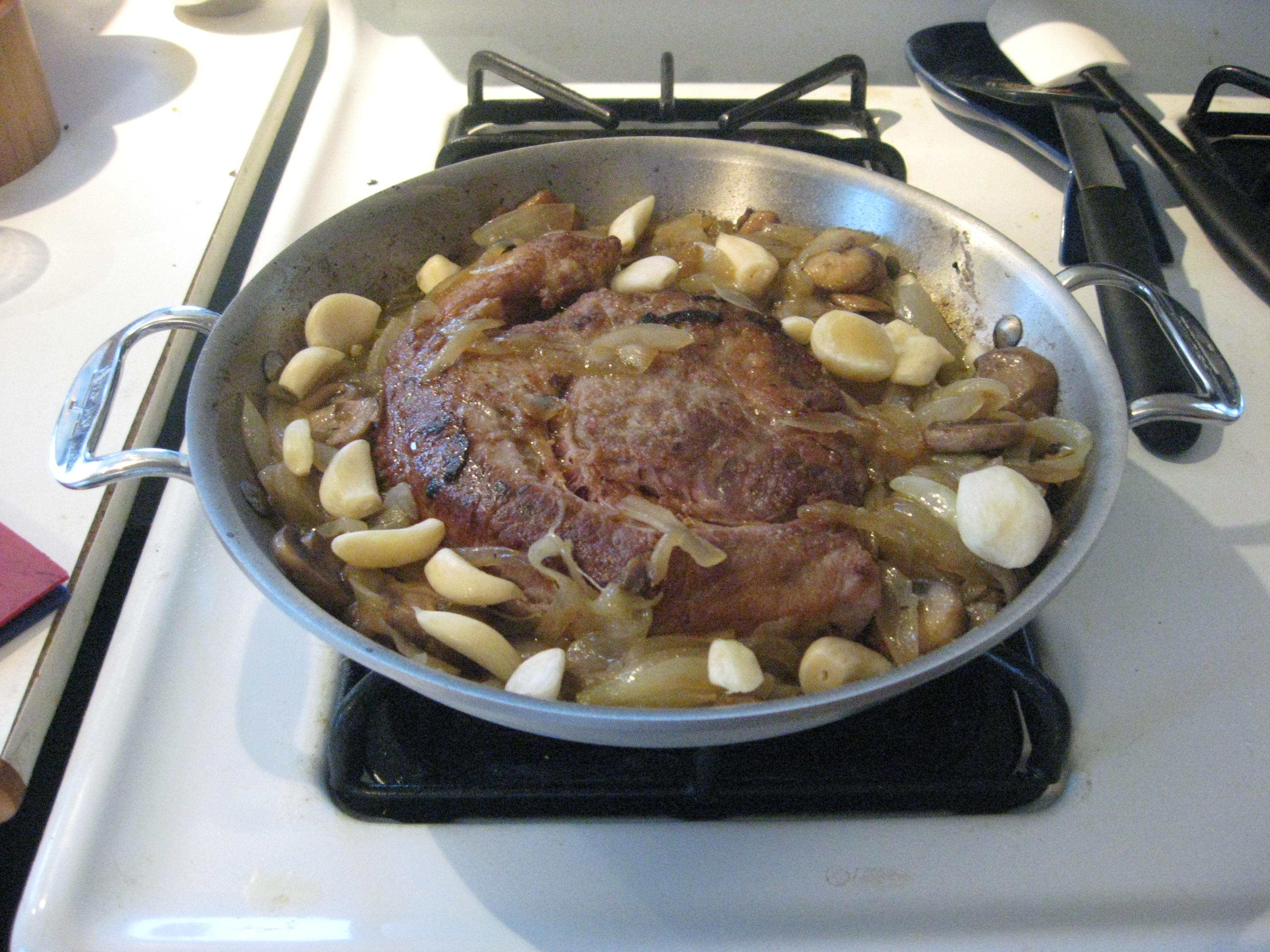
  6. Add the sautéd onions and mushrooms, and return the browned roast to the pan, with the onion/mushroom mixture around the sides, sprinkle the garlic cloves over the top.
  7. Bring to a simmer on the stove top, cover and place in a 295-300 ° F oven and cook until fork tender–about 2-3 hours (unattended).  Check periodically to see if you need to add more liquid.  You need just enough to make nice thick gravy, and the onions are going to cook down to help thicken the gravy.

For that first meal, all you really need is a salad, maybe a baked potato….or some noodles.For the second serving, stir a tiny dollop of sour cream into the portion of brown gravy for this serving to add some tang and be a bit “stroganoff-ish”, add some steam-sautéd (See Cooking Vegetables Quickly) carrots, or spinach as a side.   What about the third?  As you reheat, add some tomato paste, or some tomato sauce to the last bit for a different taste.

It’s pure unadulterated comfort food.  Even if it’s not a single serving, it’s an appropriate quantity for small-time cooking, but it sure has big-time taste.  It’s great what having the right size pan does for cooking for one.

A son goût!

Making stock quickly.

Despite occasionally using the microwave to make stock or broth quickly or in hot weather, I’m a fan of the long, slow, stove-top or oven method so that I can luxuriate in the wonderful smells when it’s cold and/or rainy outside.  It’s such a comforting activity and, though it takes time, it does not require a lot of close attention.  However, there are times when I need stock or broth and I need it quickly.  I gave the basic recipe for chicken broth in an earlier post (See The Microwave in my Kitchen), but I want to show you it can be used for other stock, not chicken.

Cooking some chicken give enough good strong broth for a bowl or two of soup.  There are times when I need more than that because I’ve run out of what I had stashed in the freezer.  That’s likely to happen in the winter when I’m a real soup-hound.

I was happy to find a quick method that does produce good stock–using the microwave.  This might also be a reasonable solution for those of you who don’t have the chest freezer on the back porch or a good-size freezer with the fridge.

I own only one microwave cookbook:  Barbara Kafka’s Microwave Gourmet. She was a reluctant convert to the microwave–as well as a traditionally trained chef.  I read her introduction to the book while standing in the Regulator Bookshop; her initial reluctance to hop on the microwave bandwagon made me thing that this might be a different kind of microwave cookbook; I was right.  I still do not cook a lot of things in the microwave, but I have found some very useful things in this book.  I like the fact that she gives single-serving amounts for some of the recipes–as well as doubling some.

Getting bones for making stock is getting harder, with so much meat coming into the store already cut and boned,  but if you can find a butcher shop, it’s well worth exploring the possibility of having them save bones for you.  You should check your farmers’ market as you might be able to get “stewing” hens there, or if there is a vendor selling beef, they might have soup bones (necks, tails, etc.) and that is a real delight.  I’ve found “marrow bones” in the freezer case at the supermarket, but they were so clean that they really did not make good stock (the marrow was excellent spread on toast, though).  For chicken broth, you can always buy a whole bird, and take off the breast and leg/thigh meat and use the rest of the carcass for making broth.

I want to give you an adaptation of her stock/broth recipe (p.314):

Meat Broths

  • 2 pounds meat (chicken, duck, veal, beef marrow, or other beef or lamb bones cut into small pieces–maybe by the butcher)
  • 4 cups water
  1. Place the bones and water in a 2-quart microwave-safe container.  (Personally, I have a large 2-quart Pyrex measuring “cup” that I use for this; it has pouring spout and a handle which I like when working with this much liquid.)  Cook at 100% for 30 minutes, or 40 minutes for a broth that will jell.
  2. Remove from the microwave oven and let stand until it stops bubbling. Strain the broth through a fine sieve.  If you want it clear, you need to do the clarifying procedure, which I’m not including here.  You can find that in her book (p.314).
  3. Cool and refrigerate, tightly covered (See Storage Containers) if not using immediately. (Usually don’t store it–my reason for making it in the microwave was either that it was sweltering summer weather, or I needed it NOW!)

If you have “soup bones” that include lots of meat, as do the ones that I get at the Durham Farmers’ market, then you have a hearty meal that’s beyond just soup. The beef can taken off the bones and added to some of the broth with vegetables for a really hearty meal of serious comfort food.  That’s a bonus.

That’s it!  As is mentioned in another post, I have not  done a side-by-side taste test of the broth make the traditional (long, slow way) with that made this quick way,  I am pleased with the results of  this method.  I will freely admit to keeping canned broth and stock on my pantry shelf, but these are usually a last resort, or to be used when the broth will be a background flavor as in chili con carne–not when it up front really good soup like a winter favorite, beef-barley-mushroom soup.

If you want a “brown” broth, you can always roast the bones in the oven before putting them into the microwave to cook.  The recipe in the book gives lots of variations that are useful, including adjustments for more meat, adding vegetables, clarifying, and making fish broth as well.  If you’re a microwave user, you might find this a great book to have on your shelf, or you might want to check it out of the library and see what else is in it.  There is a large “dictionary” in which she lists lots of different ingredients and gives cooking times, or sometimes recommends not cooking that in the microwave.  I do refer to the dictionary frequently.  If you are a novice with the microwave (think it’s for popping popcorn, or heating water) she does a good review of the types and the shapes of containers that work best for cooking in the microwave and the information on cooking times is useful.

Storage containers

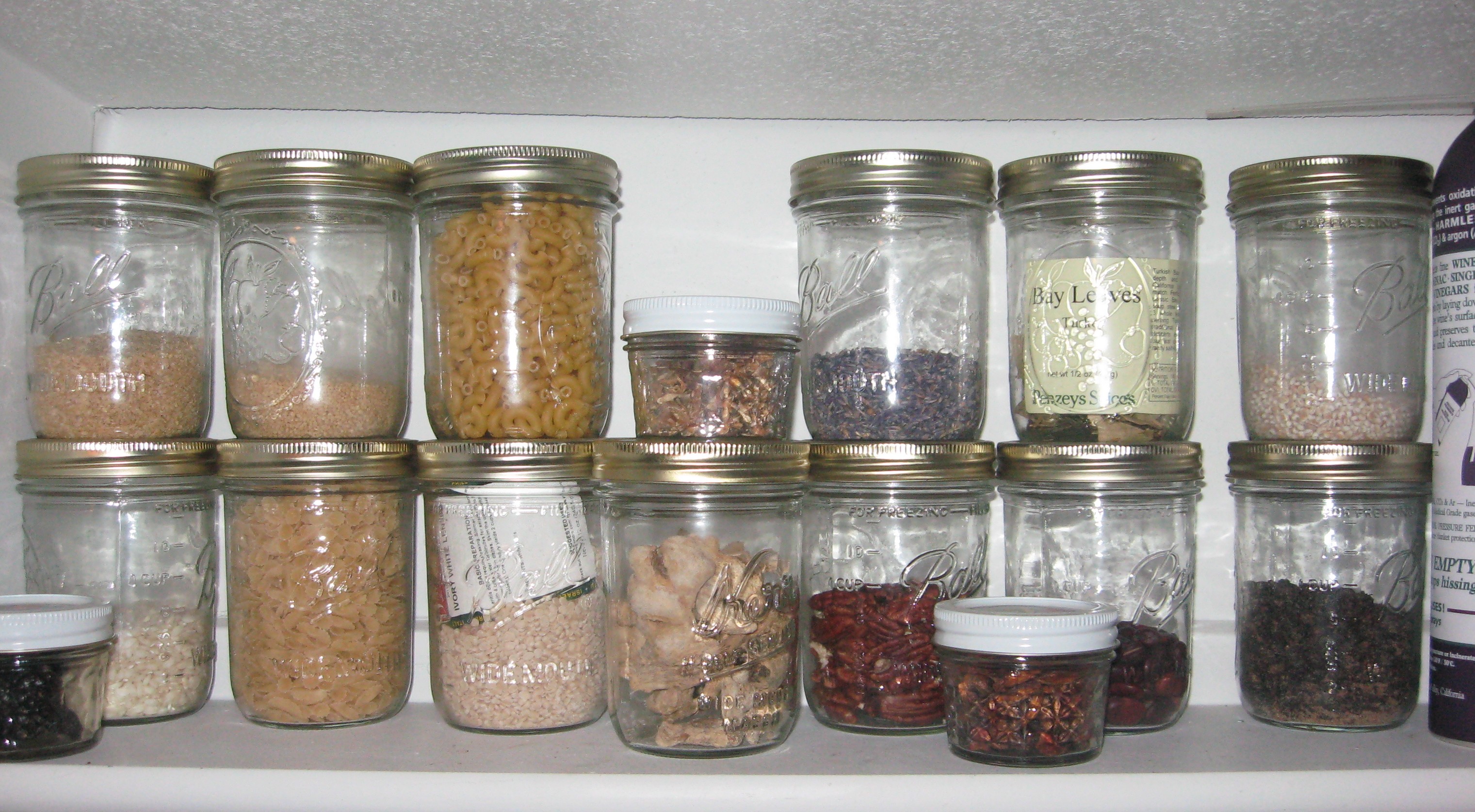
One of the perennial problems with liking to improvise, and wanting to have a well-stocked pantry is that one person uses things more slowly than you would cooking for a family of four.  I think that it’s important to store supplies carefully in closed containers rather than bags or boxes which can let some interesting beasties into your staple supplies.  For years, I carefully cleaned and saved glass jars and their lids.  Great solution?  Well–until the lid loses its seal.

Then what do you do?  My solution was to buy some Mason  canning jars (Ball or Kerr) with wide mouths, in the pint and quart sizes.  They are inexpensive, and lids are  no longer a problem.  The same lids fit all the jars, so I’m not standing around with a jar full of something and trying to find a lid to fit.  The rings last, and last–a bit like the Energizer bunny–and you can replace the seals as needed!  I think that my kitchen shelves even look rather nice…but then I kind of like a homey look.

If your pantry space is cramped,  the wide-mouth jars stack well!  Another advantage of the wide-mouth jars is that a 1/4-cup dry measuring cup will fit through the mouth of the jar easily–so you can dip and measure from the easily. Got to store that 10-pounds of rice that was such a great price?  Well the same lids will fit the half-gallon jars.

With some minimal additional equipment you can even put food by in these same jars–just be sure that you have new lids  if you’re going to use them for long-term preserving of foods.

An awesome lentil soup!

Being both a cookbook/food addict and a Kindle addict, it’s probably no big surprise that I’d have to have a cookbook on my Kindle.  My first one was the Cook’s Illustrated, special Kindle edition (only for Kindle, I believe) which is a great book to have available.  But you can’t expect a cookbook addict to stop at one can you?  Certainly not!

The second one that I downloaded was Kitchen Express. Having the instant gratification of looking, trying a sample, and viola, there it is,  just naturally leads to an I-must-cook-something-out-of-it-now frenzy in the kitchen.  Now I have to say that I love the way that book is organized (aside from the thrill of being able to search using the Kindle).

The weather probably contributed to my choice of a first recipe to try–rainy, but certainly not cold–but the kind of weather to make you want something like comfort food.  I’ve always liked lentils–the cook quickly, freeze well, and all sorts of things.  Given the rain, I searched for lentils and found a recipe for which I had all the ingredients except one: a lemon!  I looked at the description of the recipe, and decided that I had to have a lemon.  Not wanting to go to the grocery store in the rain, I called my closest neighbor to see if she had a lemon I could borrow.  Luck was with me–she had several.

Now having all the ingredients, I made lentil soup (and returned the lemon in a large bowl of soup). Both of us have subsequently done a lot of improvisation around this basic recipe, so I’d like to share it with you, and hope it will inspire you to do some variations.  Here is the recipe reproduced from Mark Bittman’s Kitchen Express. *

Lemony Red Lentil Soup with Cilantro

Red lentils cook very quickly, but allow more time if you substitute and other type.

Cook a copped onion in olive oil in a saucepan until soft; add one cup of red lentils and four cups of chicken broth and bring to a boil; continue simmering until the lentils are soft.  Puree a handful of cilantro with a few tablespoons of olive oil and a pinch of salt; set aside. If you like, puree half the lentils until almost smooth; return them to the pan. Add about two tablespoons of lemon juice or more to taste.  Stir in the cilantro puree, adjust the seasonings, and serve with crusty bread or a mound of rice in the center.”

I’ve done lots of variations on this one: used lime instead of lemon, added some rice, pureed it or not; there are so many ways to improvise with a recipe like this.  I’ve had the same basic soup with garbonzo beans.  There’s something about the combination of the citrus and the cilantro that just makes this kind of sparkle.  I like to add a bit of the citrus zest to brighten this even more that just the juice.  The pureed cilantro keeps very well in the fridge if the surface is covered with oil (and it’s a great addition to chili con carne to add some fresh contrast).

Well, it’s a few months later, and now we have cold weather, real serious soup weather!  I just finished making another half recipe of this with the chicken broth from cooking some chicken thighs.  Now that it’s colder I wanted to “hearty” the soup up a bit, so I used some French (green) DePuy lentils (which I prefer to red, even though they take a bit longer to cook) and added the chicken meat from one of the thighs that I cooked in the microwave to get both meat and broth.

The only complication that I’ve found with this recipe for one is that bunches of cilantro from the grocery store are huge.  As much as I like cilantro I can never use it all.  In the summer I plant successive pots of cilantro so that there is always some to pick.  In the winter, it’s a different story: want to make this but don’t have cilantro.  I’ve found a great stand-in for the fresh cilantro in the frozen foods department at the grocery store: Dorot Chopped Cilantro (www.dorotfoods.com).  It’s frozen, fresh cilantro in cubes equivalent to 1 teaspoon each.  Nothing is quite like the fresh, but I’ve been rather pleased with this as a stand-in, so it has become a freezer staple for my kitchen.

I’ve just finished a supper of a first course of steam-sautéed vegetables–a medley of carrots, broccoli, and red bell pepper, followed by a hearty bowl of the lentil soup with the chicken meat added.   Since I made a half recipe, I’ll have enough for another bowl in a day or two.  I’ll add another splash of lemon and a bit of cilantro to perk it up, and perhaps have it with (as the recipe suggested) a mound of rice–another satisfying, healthy, and easy meal.

This recipe lends itself so easily to improvisation.  Try it–you’ll find something to please your palate.

A son goût!

* I’ve been searching on how to cite a Kindle reference properly since I don’t have the hard copy.  According to Amazon discussions, the font size does NOT affect the location: so here that is: 1187-98.  Since I’ve given you the exact recipe title, I’m sure you’ll have no difficulty locating it in the book.


Cooking vegetables quickly

No matter how much you like to cook, sometimes you just want to prepare veggies quickly, but still want them to taste good.  One of my favorite ways to quick-cook vegetables is a technique that I learned from How to Cook without a Book by Pam Anderson, who really stresses improvisation and good food.

One of her techniques that I’ve found useful for vegetables is the “steam/sautéed” method.  It’s a very simple technique, using both “wet” and “dry” cooking in a single pan, without boiling or blanching and draining.  You can facilitate speed by how you cut the vegetables–smaller pieces cook more quickly than larger chunks.  This book is an excellent resource to help you learn to improvise and adjust quantities for single servings, doing away with leftovers. Recipes are simple, and presented in a manner that makes them very easy to adjust serving sizes, giving the necessary ingredients and there are variations given so that you get the feel of improvising.

To cook vegetables this way, you need vegetable, some fat, and flavorings.  The recipes in the book are presented starting with one pound of vegetables, but are easily down-sized to a single serving.  The basic ratio of these recipes is (p. 204):

  • 1/3 cup water
  • 1 tablespoon fat
  • 1/2 teaspoon salt
  • 1 pound prepared vegetable
  • optional aromatics (1/2 small onion, sliced thin, or 2 medium garlic cloves, minced)
  • optional spices (dried or fresh herbs and or flavorings)
  1. Bring the water, fat, salt, and vegetable, along with the optional aromatics, spices, dried herbs and/or other flavorings to a boil in a Dutch oven or a large deep skillet. Cover and steam over medium-high heat until the vegetable is brightly colored and must tender, 5 to 10 minutes, depending on the vegetable size.
  2. Remove the lid and continue to cook until the liquid evaporates, 1-2 minutes longer, adding optional fresh herbs and/or other flavoring at this point. Sauté to intensify flavors, 1-2 minutes longer.  Adjust seasonings, including pepper to taste and serve.

The cooking instructions are simple. I’ll give you an example of a recipe from this book, and of the technique (above):

Steam/Sautéed Carrots with Cumin (p.209)

  • 1 pound carrots, peeled and cut into 1/2-inch coins
  • 1 tablespoon butter
  • 1/2 teaspoon ground cumin
  • 1 tablespoon minced fresh parsley or cilantro leaves

Follow the Steam/Sautéed Vegetables recipe (p. 204), adding the cumin with the carrots and the parsley once the carrots start to sauté.

One pound of carrots is approximately 5-6 medium or 4 large, so it’s easy to adjust the proportions here for two medium carrots.  For me, 1 large carrot is about the right amount for a serving of vegetable.  The amounts of fat, spices, and water are easily adjusted (see Measurement Conversions), and they do not have to be exact–you can add a bit more water if the vegetable is not quite tender enough, and a bit extra will evaporate once the pan is uncovered.  You’ll adjust the seasonings to taste, as well.

You will need to consider whether your vegetable is “soft” (vegetables which normally give off water as they cook) may not need the steaming before the sauté step), but  vegetables that do not give off moisture as they cook, like the carrots, green beans, cabbage or broccoli, do need this step.  The amount of water will vary with the density of the vegetable–you will learn to judge that, always remembering that you can add more water a tablespoon or so at a time as needed.

Dried herbs and spices (except black pepper) should be added with the vegetable in order to have the flavors develop.  Because fresh herbs can lose volatile oils with heat exposure, these need to be added at the end so that the freshness is retained.  With this technique is easy to prepare vegetables for small-time cooking, keeping the big-time taste.

Cannellini & Italian sausage supper

One Italian sausage provides seasoning and a bit of meat for two meals.  The starting point gives enough for two servings.  When I’m using the Italian sausage for two separate meals like this, I usually buy sweet instead of hot, since I can readily add the heat I’d like with crushed red pepper flakes at the time I’m preparing the meal.

  • 1 medium onion, halved lengthwise and thinly sliced
  • 1 sweet Italian sausage, meat removed from the casing and crumbled
  • 4 cloves garlic, minced
  • 1 tablespoon olive oil
  • 2 cups cooked, drained white beans (cannellini or great northern) or 15-ounce can rinsed and drained
  • 2 tablespoon water

In a 12 inch skillet with a tight-fitting cover, add the olive oil; when the skillet is heated add the sliced onion, and cook until it is beginning to brown. Add the sausage and brown.  Add minced garlic and cook about 2 minutes.  Add the rinsed beans, and cook covered about 5 minutes.

Remove half the bean/onion/sausage mixture to be used for a second meal.  Cool and refrigerate.

Meal 1:

  • Half the bean/onion/sausage mixture
  • about 15 grape/cherry tomatoes, halved
  • 1/4 cup antipasto salad mix (pitted olives, peppers, carrots) from the salad bar, chopped finely.
  • several sprinkles of crushed red pepper flakes
  • 2-3 teaspoons chopped fresh sweet marjoram or Turkish/Greek oregano, or 1/2 teaspoon dried herbs.
  • a single-serving size handful of haricots verts
  • 1 teaspoon water
  • salt and fresh-ground black pepper to taste (the antipasto salad is salty so taste before you add additional salt.

Add the herbs, the chopped antipasto salad, crushed red pepper flakes and mix well.  Over medium low heat, add the tomatoes, lay the haricots verts on top of the cannellini beans, add the water, cover tightly and continue to cook until  the haricots verts are tender.  Serve with shavings of Pecorino Romano over the canellinni beans, and the haricots verts on the side, drizzled with a few drops of extra-virgin olive oil.

Meal 2:

  • the reserved cannellini bean/onion/sausage mixture
  • about 15 grape/cherry tomatoes, halved
  • 3 generous handfuls baby spinach
  • 1 tablespoon water
  • salt and fresh-ground black pepper to taste

Place the cannellini bean/onion/sausage in sauté pan, add the water, halved tomatoes, and cover.  Heat gently for about 5 minutes (until starts to steam).  Add the spinach, cover, and allow spinach to wilt.  Toss to combine with the bean mixture.

I had this with some steam-sautéed carrots as an additional vegetable.  Add a glass of good friendly red wine and its a very satisfying meal that’s easy and economical.

Healthier eating: More fruits, grains, and vegetables, please.

A couple of recent events and activities have made me give some serious thought to what I eat:  books I’ve been reading about the impact of food on environment, and the current obesity epidemic, and the fact that my doctor has said that I DO  need to lose weight, a lot of weight–at least I think that 25 or 30 pounds is a lot.  Obviously I have to find a way to do it as pleasurably as possible since I readily admit to being a hedonist.

All this has led me to look at what I have been eating–not that it’s exactly unhealthy or junk food, by any means; but it would seem that the weight loss is likely to be abetted by adding more fruits, vegetables and whole grains.  So, I’m going to try to do better what I’m sort of do already.

One of the things that I’m going to try to do is eat more salads.  Now I’ve already complained about the waste when I clean out the refrigerator and find all the slimy veggies that did not make it into the salads. This is going to be interesting–I truly dislike having to throw out food, especially after reading some statistics on the amount of energy that goes into producing the food that gets thrown away.  The challenge is going to be keeping the salads interesting enough that I will actually eat them every day.  If I can achieve that, I’ll likely not be throwing away so many veggies.

Another decision that I’ve reached (after reading the label on the salad dressing bottle) is that I have to re-think salad dressings.  I don’t like the list of ingredients on “low-fat” or “no-fat”, or really, any mass-produced dressing.

My first solution to that was with my salad this evening; I started with mesclun, added some fresh herb leaves (from my deck) which made the taste very complex.  Then I added veggies that I had brought home–ones that I think (hope) will find multiple uses: celery, cucumbers, cherry/grape tomatoes, onions as salad material and as snacks.  I had some black table grapes in the fridge, so I threw some of those into my single-serving salad bowl.  Now to dress my salad.

It’s easy to make a vinaigrette dressing, but being in a hurry and lazy this evening, I opted for the simplest thing that I could think of:  extra-virgin olive oil and an acid.  I did not want anything as tart as wine vinegar, so I added a squeeze of lemon juice.  With the sweetness of the grapes, spiciness of the radishes, and the fresh herbs it was great–and so simple, and so healthy.  In retrospect, I suspect that some nuts would have added some texture and different flavor to the salad too, but I did not think about that at the time.  (After all that extra-virgin olive oil provides some of those monounsaturated fatty acids (MUFAs) that are supposed to be so good for us, and according to some studies–more on that later–and even help in losing belly fat!  Pleasant thought that something that tasted that good could actually be good for me!  I’m sure that I’ll be trying out other citrus juices in combination with the oil for my dressing!  I’m sure that I’ll also get around to actually emulsifying the oil and the acid to make a good vinaigrette too, eventually.

Next project: getting more whole grains into my diet. Accompanying me home from the grocery store this evening in anticipation of  that first goal was a multi-grain cereal.   I’m going to make a serious effort to eat breakfast as I’m told that is helpful in losing weight too.  My problem with that is that I do not actually like food early in the morning.  I love hot cereals like steel-cut oats, multi-grain cereals; just not at the time I need to eat them before I go to work–and it’s not the cooking time that makes me not like them.  I can figure out lots of ways to have long-cooking cereal without spending time cooking it in the morning.  It’s more basic–I don’t like early-morning food.  I can’t take it to work with me to eat at my desk later, because “work” is delivering a lecture, so I’ll have to find some other way to do this–without getting up too much earlier!

The last, but not least, goal of this project is reducing my (already pretty low) meat consumption.  I’ve posted references to some of the books that I’ve been reading lately on the bibliography page.  The information on energy consumption related to meat (term used loosely to include poultry) production is–not sure what adjectives to use to describe some of that data–thought-provoking to say the least.  I’m reducing consumption, not giving up meat totally, nor am I giving up milk, eggs, cheese, or other animal products.  As much as I like meat this is going to be an interesting time for me.

I always liked grains and pulses (beans, lentils, peas and such) so that’s part should not be too difficult (famous last words?).  I expect I’ll be using  some new  grains and  pulses now, so it will be a learning experience.  I’ll be finding out how to cook and use these in small quantities, or single-serving amounts.  I was pleased to see that my supermarket had teff, spelt, and quinoa available as will as the more usual bulghur, kasha and brown rice of different varieties.

If I can get add some regular exercise, as well as eating food early in the morning, I might actually get to like this regimen, and succeed in doing what I need to do, and keep the weight off as well.

Now…let me go peruse a cookbook or two in search of recipe ideas that I can adapt for a single-serving.