Caramelized apple pie

What a lovely dessert–and not difficult, really. I’m not wild about just apple pie, but the caramelization and the wine combination. I just had to share this one even though you don’t see many desserts posted here.

s_marchiori's avatarthewinelifestyle

Dear readers,

Today I tought about the caramelized apple pie recipe, really tasty and quite simple to prepare: your weekend will be much sweeter!

Let’s go step by step to prepare the recipe and you will see it will be less difficult than expected.

Ingredients (12 slices):

2 egg yolks
2 entire eggs
200 gr of flour (7 oz)
200 gr of sugar (7 oz)
50 gr of melted butter for the mixture (1.8 oz)
60 gr butter to melt in the pan for the “caramelized” process (2.1 oz)
80 gr of sugar to caramelize the apples (2.8 oz)
Juice of half a lemon
250 gr of thinly sliced ​​apples (moisten with a few drops of lemon juice to prevent them discoloring) (8.8 oz)

Preparation

Beat and mix the two egg yolks in a bowl, the two whole eggs and 200 grams of sugar.
Melt the 50 gr of butter for a minute…

View original post 398 more words

For chocolate lovers….

I just have to share this post from Spoon, Fork, Bacon for Double Chocolate Pound Cake!  Pound cakes are my favorite in almost any flavor, but then add chocolate, and I’m likely to eat way more of this than I should. I’ve not made it yet, but it’s on for the weekend.

Oat flour bread

While we’re experiencing some really serious winter weather for this part of the country, I couldn’t think of anything I would like better than the aroma and taste of some warm bread.

loaf of bread

oat-flour bread

I got out the Artisan Bread in Five Minutes a Day and made bread.  Because we’re having the possibility of power outages and wanted something that would be easy for sandwiches so I made the “Oat Flour Bread” from that book. (I’ve modified that recipe for a more artisan-like bread using barley or oat flour, too).

Here is the recipe for the sandwich-style oat flour bread (summarized from Artisan Bread in Five Minutes a Day).  See the links above for summary of basic method.

Oat Four Bread (pp.104-105)

Ingredients

  • 3-1/4 cups of lukewarm water
  • 1-1/2 tablespoons granulated yeast
  • 1-1/2 tablespoons salt (kosher)
  • 1 cup oat (or barley) flour
  • 5-1/2 cups unbleached all-purpose flour (I always use King Arthur)
  • Neutral tasting fat for oiling pan. P

Preparation

This makes three 1-1/2-pound loaves.

  1. Mix liquid, yeast, and salt in bowl.
  2. Add flours.
  3. Cover (but not airtight) and let rise to double volume.
  4. The dough can be used immediately or stored in the refrigerator for up to ten days (actually up to 14 days) just pulling off what you want to bake right then.
  5. Lightly oil a 9x5x3-inch loaf pan.
  6. Take a cantaloupe-size piece of dough and lightly flour surface and shape it into a ball or oval and drop into the pan.
  7. When ready to bake, preheat oven to 400 degrees Fahrenheit.
  8. Let rest/rise for about 1 hour 40 minutes for refrigerated dough, or about 40 minutes for freshly made dough, until it has about doubled in size.
  9. Bake for 45 minutes or until nicely browned.
  10. If possible, let cool before cutting–that very seldom happens in my house unless I bake an extra loaf.
  11. If you want it really crusty then follow the procedure with a pan of water in the oven (links above).

<><><>

If you like bread but the time for baking doesn’t seem to fit into your schedule, then this technique is worth exploring. Since there is no kneading, and it takes 15 minutes to mix (and clean up) it makes it possible.  I like it for cooking for one since I can easily make a small loaf more often.

I’ve made the pumpernickel (with and without seeds), rye, basic white, brioche, olive oil, and have been pleased with all of them.  I don’t think that the flavor is quite as yeasty as a bread that goes through the traditional method of kneading and several proofings, but it’s as good or better (and much cheaper) than the usual grocery store bread–anything you’ll get short of going to a real artisan bakery.  Once you get started with it, you can modify to your taste, too.  The same authors also have a similar book for healthy and whole grain breads (bibliography).

Weighing and measuring

I just realized that the measurements for the coffee walnut cake are metric. I do either metric or US/English–but if you don’t work by weight, or have problems with the conversions, here is a link to a good converter on The Gourmet Sleuth.

1130800v2If you find you enjoy baking,
scales are a real time-saver–in terms of ease of measurement, fewer bowls to wash, and conversions. Press a button and you can do metric or pounds/ounces measurements. If you’re not using weight and need conversion, e.g. grams to ounces, The Gourmet Sleuth site has a calculator to do that for you.

These will handle up to 11 pounds, and will zero/tare at the push of a button so it’s possible to one ingredient after another into a single bowl–like the mixer bowl! The display also pulls out so that it’s easy to read even if you are using a large bowl.

My scale simple lives on the counter since I use it so often. Many times since I’m doing single-serving cooking I do ratios, as in How to Cook without a Book and by weight is much easier and faster than by volume–even for water!

Cake is in the oven…

…and I’m waiting, none too patiently for it to be done–it smells heavenly: buttery, coffee-y, nutty, with a little caramel-molasses-like overtone from the brown sugar.

(It’s a very easy cake to put together–you don’t even really need to use a mixer–but since it was sitting there on the counter, I did use it.)

The recipe from Promenade Plantings called for walnuts.  I have to confess to not liking English walnuts–even when good and fresh they have a bitter overtone that I don’t like, so I substituted pecans in the recipe since I really like them.

The house is smelling SO good–it smells like it needs some good dark chocolate–hmmmm, coffee, chocolate, and nuts.  If it tastes like my nose tells me it will, I may try it with some chocolate bits in it too. I can already tell that waiting for it too cool is going to be some sort of ordeal!

_<>_<>_

Finally, it’s cool enough–just couldn’t stand it any longer. All the time I’ve been smelling it, I’ve resisted making some ganache–so far successfully, but the longer I smell that cake….

OMG, is that every good! Tastes every bit as good as I though it would–and as it smelled. It doesn’t scream coffee at you either–I suspect that even non-coffee drinkers would like this.

I’m enjoying it with a big glass of cold milk right now, but I definitely want to try it with coffee–probably with my breakfast coffee in the morning. This could be habit-forming!

A cake I want to bake

You can tell from the posts here that I don’t do a lot of desserts. I usually satisfy my sweet tooth with fruit (dried or fresh) or dark chocolate. Sometimes something like the brioche filled with chocolate ganache. I will admit to really liking so-called “pound cake” or pâte à quatre-quarts; otherwise, I pretty much leave cakes and pies, and the like alone; but then there are some like the bay-infused pound cake (which is fantastic by the way), or the lavender-lemon cake….you get the general idea.

Browsing about on one of the blogs that I follow (Promenade Plantings), I found a recipe for a coffee and walnut cake that looks like one that I might really like, so I though I’d pass this link on to all of you who don’t want gobs of terribly sweet icing or gooey glazes.

This image is from Promenade Plantings. If you think that looks delicious a click here will take you to the recipe for a cake that makes me want to bake–and make some espresso and sit and visit with friends and neighbors.

Coffee and Walnut Cake (13)

from Promenade Plantings: Coffee walnut cake

Get Cooked…

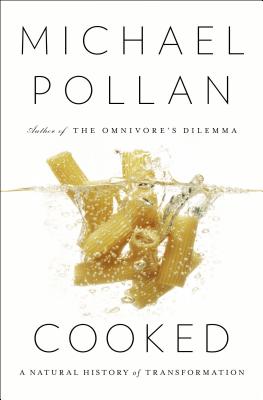
ISBN 9781594204210Obviously I’m a fan of food science and curious about the history of food and cooking in any culture. Michael Pollen’s Cooked: A Natural History of Transformation is a good read; a fascinating review of cooking origins, history, and consequences of both cooking and not cooking.

As usual, Pollen’s style makes this book easy reading, but raises interesting questions about the role of cooking in the development of Homo sapiens.

The book follows Pollen as he attempts to master four cooking techniques: fire, air, water, and earth and describes the place of the cook in relation to nature and culture.

He raises questions about what cooking is, what cooking does for us, and the place we have let processed food assume in our modern culture. It’s an interesting synthesis of history, food science, and archeological discoveries. The implications of NOT cooking, allowing the food processing industry to assume the role of the cook, are something we all need to consider.

This is not a recipe book but it certainly increases understanding of food preparation—cooking—using heat (barbecue), air (baking), water (braising), and earth (fermentation).

The links will take you to an independent book shop were you can order it in various editions—but I get nothing—it’s not affiliate marketing of anything like that.

Flamusse aux Pommes (Burgundian Apple Flan)

Looks awesome! Burgundian food and wine are some of my favorites!

StefanGourmet's avatarStefan's Gourmet Blog

For the Burgundian evening there also had to be a traditional dessert from Burgundy. I decided to prepare flamusse, an apple flan that is similar to clafoutis (made with cherries). This is a very an quick simple cake/dessert to make, but really tasty. The important thing is to use only a bit of batter and not to beat too much air into it, otherwise the flan will rise too much and although it will still taste good, it will look quite messy.

View original post 248 more words

Cooking monkfish

TGIEOT—yes, that’s a bit more than TGIF!  It’s end-of-term.  The Spring term was the school term from hell, starting right at the end of Fall term!  Over the winter break I had unexpected course preparation to do for two online classes—switching from Blackboard to Sakai—for content management.  Top that off with an ongoing indexing project, and it’s—well, let’s just say it left very little time for cleaning, cooking, or writing!  Then, add to that a hard-drive failure for my computer….but it’s over now.

I’ve taken some time to work on revising the on-deck herb garden since I had plants that needed to go into their home pots, and a couple of days to do nothing but have quality time with the cat.  All that has left me yearning for some relaxation time and some really good food—cooked by me.

My day was absolutely made when I got my email delivery of the “Fresh Catch” specials from my local Harris Teeter this morning: they had monkfish! In terms of favorite fish, that’s right up there with Chilean sea bass for me.  Needless to say, I scarfed down my morning coffee and headed right off to HT.
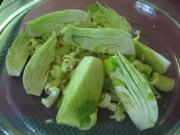
fennel, leeks and garlic ready to roast

fennel, leeks and garlic

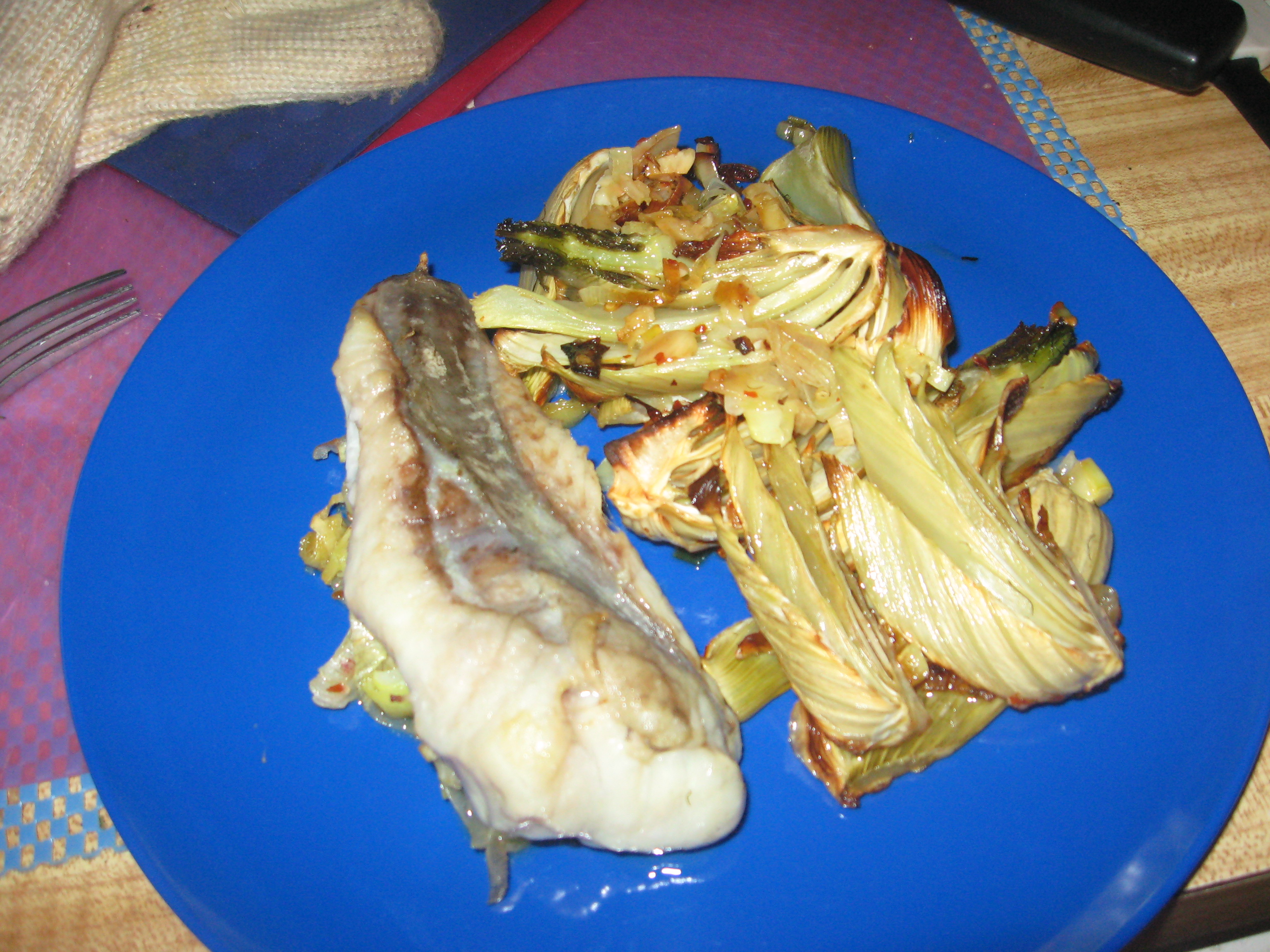
Supper this evening was roasted monkfish, with roasted fennel with leeks, garlic, and a dash of red pepper flakes, with a nice un-oaked chardonnay.  The fennel was an in-store, spur of the moment thing since it looked so gorgeous.

Even though it is warm this afternoon, I opted to cook in the oven because I wanted roasted fennel as well. I’ve done monkfish in hobo-pack style before but I thought I’d try roasting it this time and see if I couldn’t have a one-pot dinner.
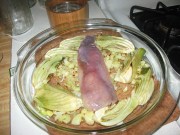
monkfish

monkfish

I’d seen a post by Edward Schneider in Mark Bittman’s NY Times column (Diner’s Journal) about roasting monkfish, and the differences in monkfish on both sides of the Atlantic. After reading that I salted my monkfish for about an hour, and then roasted it.  I did manage to make a one-pan meal out of it. Since I had to allow about 40 minutes for the fennel to roast, I started that first.  After about 15 minutes, I laid the monkfish on top of the leeks, pushing the fennel wedges to the side, and popped it back into the oven for about 15 minutes.  I used very simple seasoning on the fish—olive oil and salt before going into the oven, and nothing for than fresh-ground black pepper and a pat of unsalted butter after it came out of the oven. So very simple—so very good, and even healthy.

(The only thing I wish I had done differently would have been to add some sweet red (or orange or yellow) bell pepper with the fennel. A glass of un-oaked chardonnay complemented the meal very nicely.)
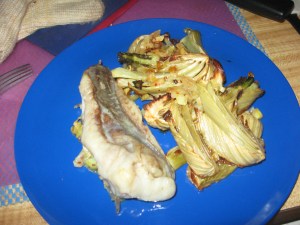

IMG_7553

Baked cod fillet with vegetables

The “leftover” cod to which I alluded in a previous post was the result of beginning-of-term course preparation frenzy (always happens no matter how well I think that I’ve planned).  It was an OMG-I’m-starving-what-have-I-got-in-the-fridge, what-can-I-put-into-the-oven-so-I-don’t-have-to-watch-it, panic situation.

cod filet in a baking dish

cod & vegetables ready for oven

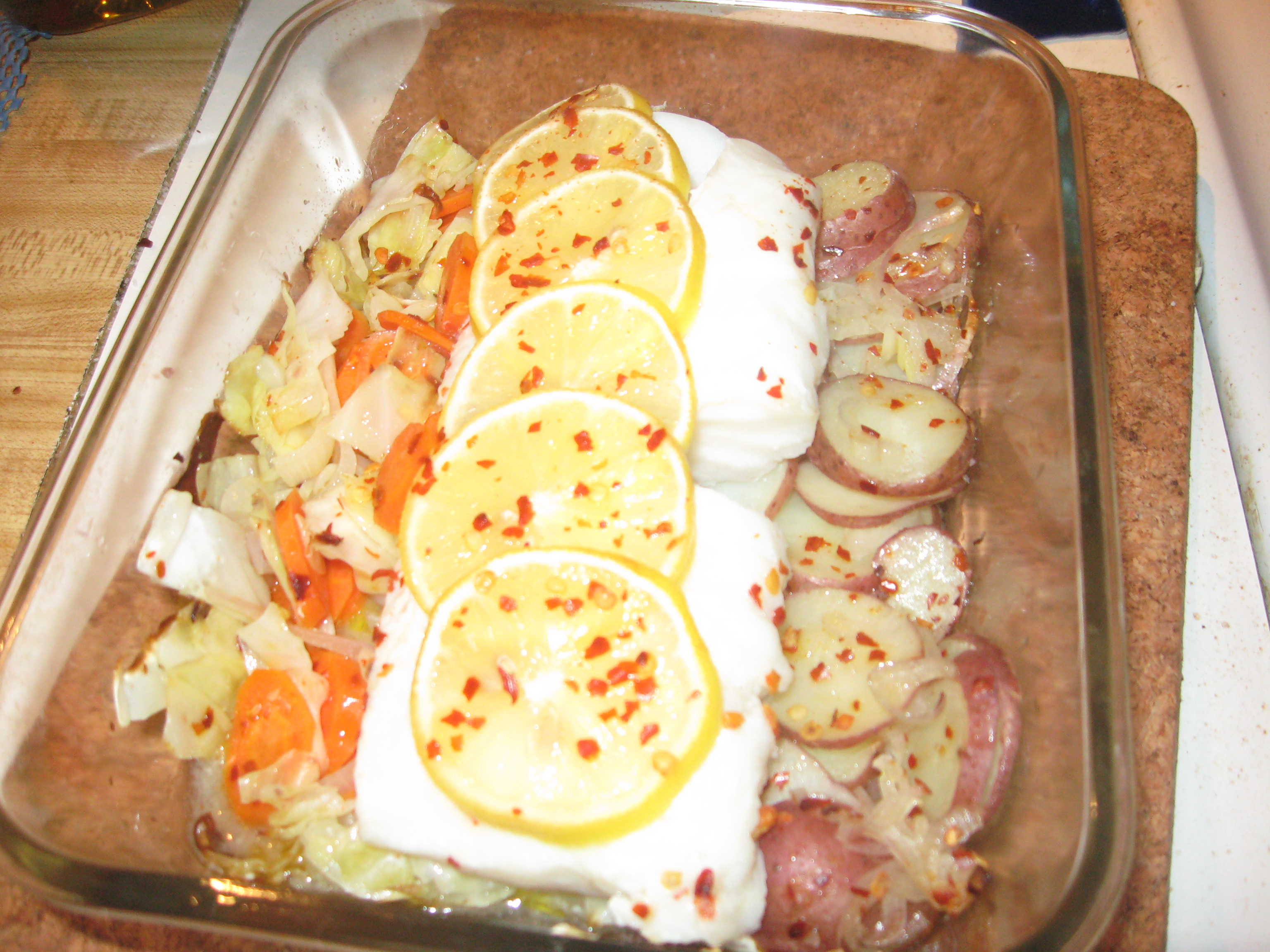
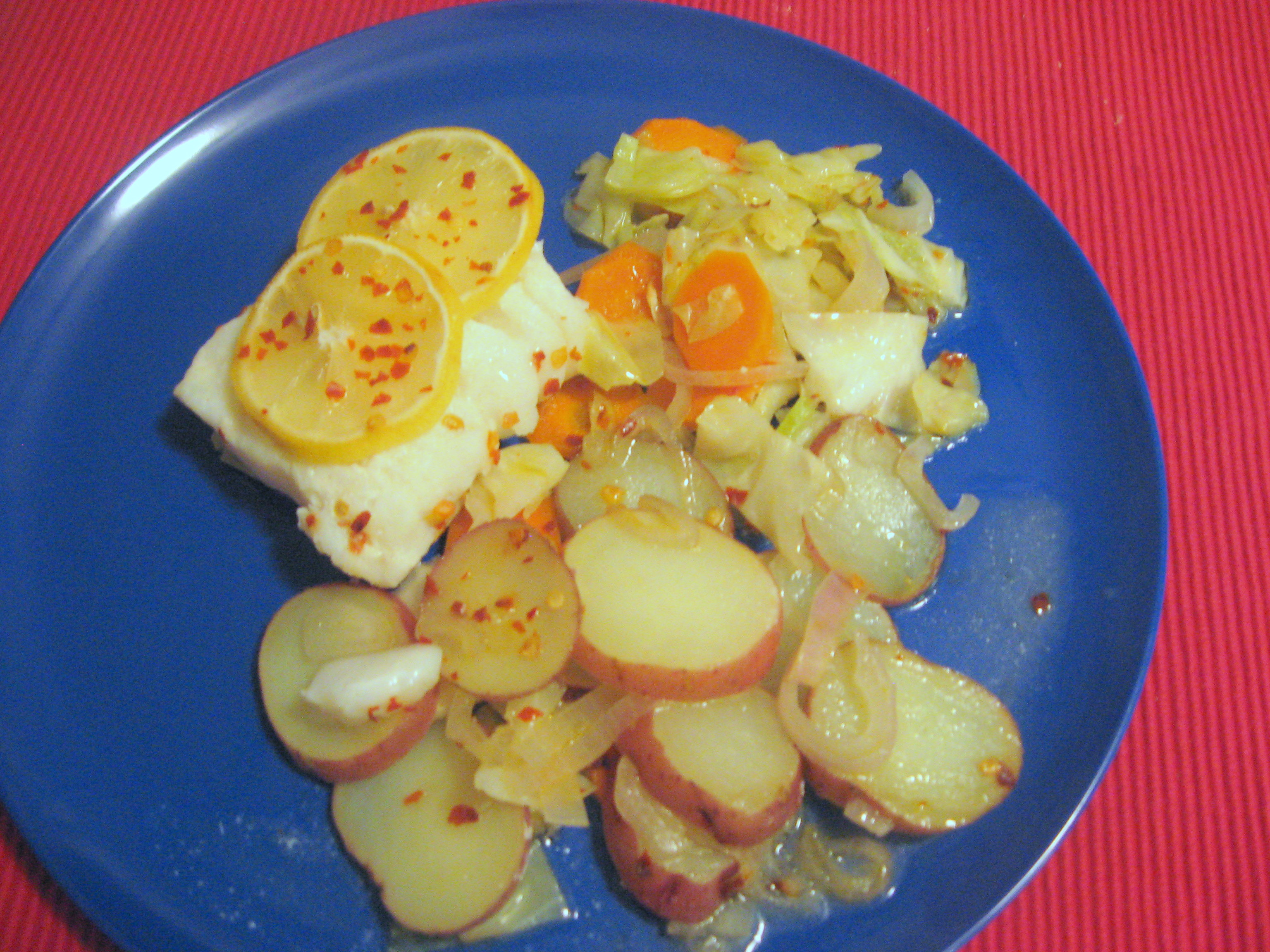
I had the cod fillet, but I was really pressed for time.  After madly rummaging in the vegetable crisper, and came up with cabbage, carrots, potatoes, lemons, and onions.  The cabbage got cut into bite-size pieces, the carrots and potatoes sliced into about 3 mm (1/8-inch) pieces.  I tossed the cabbage and very thinly sliced onions with some extra-virgin olive oil and a pinch of salt.  I gave the carrots and the potatoes the same treatment, threw in one of the few herb mixes that I keep on hand–herbes de Provence (my go-to in panic mode), some red pepper flakes put the fillet on top, plopped some lemon slices in, covered it, and stuck it in the partially preheated 325°F oven for about 45 minutes since it was a very thick cod fillet–and set a timer! (Since there were lemon slices, and the cabbage was still damp from rinsing, the cover for this baking dish fit very well, and I knew there would be a bit of liquid from the fish, I didn’t add any water.)

plated cod fillet with cabbage, carrots and potatoes

one-dish meal

When the timer went off I went back to see what I had–the thinly sliced carrots and small red potatoes were tender, the cabbage was tender but still slightly crisp, and the fish flaked nicely–success on the fly!  If you don’t like a little crunch with your cabbage, you might remove the heavier ribs.

Good results for minimal effort, and a really healthy meal.  The lemon and extra-virgin olive oil complemented all the veggies and the fish.  The red chili pepper flakes spiced things up just a little.  Yes, pretty simple, but tasty.  Good food doesn’t have to be complicated if you have good things to start with.