Panzanella (Bread Salad)

lots of tomatoes laid out on table

tomatoes, tomatoes…

Tomatoes, tomatoes and more tomatoes! So many ways to eat tomatoes…caprese salad, good old-fashioned tomato sandwiches–good white bread, mayonnaise, and juicy tomatoes; a sandwich that has to be eaten over the kitchen sink.   Then there is the BLT!  All good, but what else can you do with the summer abundance of tomatoes? Obviously  you can freeze some, or make sauce to freeze for winter use,  but one of my summer favorites is panzanella, or bread salad.  Since stale bread is a fact of life, even when you bake your own pretty much “on demand”, here is one of my favorite ways to use it up and to enjoy summer tomatoes.

This is a summary and adaptation of  my “go-to” recipe from Marcella Hazan’s Essentials of Classic Italian Cooking (pp. 554-555):

Ingredients

  • 1/2 garlic clove, peeled
  • 2-3 flat anchovy fillets, chopped fine
  • 1 tablespoon capers, soaked and rinsed
  • 1/4 yellow bell pepper, ribs and seeds removed
  • 1/4 cup extra-virgin olive oil
  • 1 tablespoon good red wine vinegar
  • 2 cups firm bread (cut into 1/2-inch squared), trimmed of crust and toasted
  • 3 fresh, ripe, firm tomatoes
  • 1 cup cucumber cut into 1/4-inch dice
  • 1/2 medium sweet onion, diced
  • fresh-ground black pepper and salt to taste

Preparation

  • Mash the garlic, anchovies, and capers to a paste.
  • Toss  the pepper, garlic, anchovy, olive oil, and vinegar together in a bowl.
  • Put the toasted bread (and any crumbs) in a small bowl.
  • Purée one tomato in food mill; add to bread an allow it to steep for 15 minutes or longer.
  • Skin and seed the other 2 tomatoes and cut into 1/2-inch pieces (picking out some of the seeds if there are too many).
  • Add the cut tomatoes and the bread squares to the bowl with pepper, garlic, anchovy, oil and vinegar mix, and  add the cucumber and the onion; toss thoroughly.

While the recipe calls for peeling the tomatoes, I don’t usually do this unless the skins are very tough–I’ve no objection to the extra fiber, and some objection to the extra work that peeling them takes.  I don’t pick out seeds either–I think that the “jelly” surrounding the seeds adds extra flavor and an acidity that is lost by removing them–however, if you want a more refined version, by all means peel and remove seeds. (If you keep the “jelly” and seeds, it increases the tartness of the tomatoes, so you might want to decrease the wine vinegar–just taste it and season accordingly.) You can add fresh herbs of your choice–basil, marjoram, oregano, Syrian oregano (zaatar)–whatever strikes your fancy!

If this cookbook is not in your library, there is also a recipe for a simpler version of panzanella at Epicurious.com.

If you’d like to make this a meal in itself, add some good quality canned tuna or your homemade tuna confit to it. Cucumbers and onions are certainly optional.  Some fresh mozzarella would work here too.

The basic recipe above makes four to six servings, but it’s very easy to cut this down to make a single-serving quantity–just eyeball it!

I decided that this had potential for a bacon, lettuce and tomato salad so I did some modification: omitted the anchovies, capers, and the pepper.  I prepared the bread and the tomatoes as for the panzanella, and substituted balsamic (or rice wine) vinegar.  I kept the cucumber for it’s crunch and freshness and the sweet onion, even though they are not part of the BLT.  I added crumbled crisp bacon, and had this over romaine lettuce.

Since I did this improvisation  (it just wasn’t something that I needed a recipe for), I’ve googled “BLT salad” and found lots of variations on that theme, especially with the dressing.  Since I’m one who does like mayonnaise with my BLT, I’ve looked for dressings using it, but haven’t found anything I like better than the basic oil and vinegar, though I may be adventurous and try a creamy dressing with mayonnaise, thinned with buttermilk in the future.

A son goût!  
Red, white, and blue roasted potatoes

Happy Fourth of July to all!

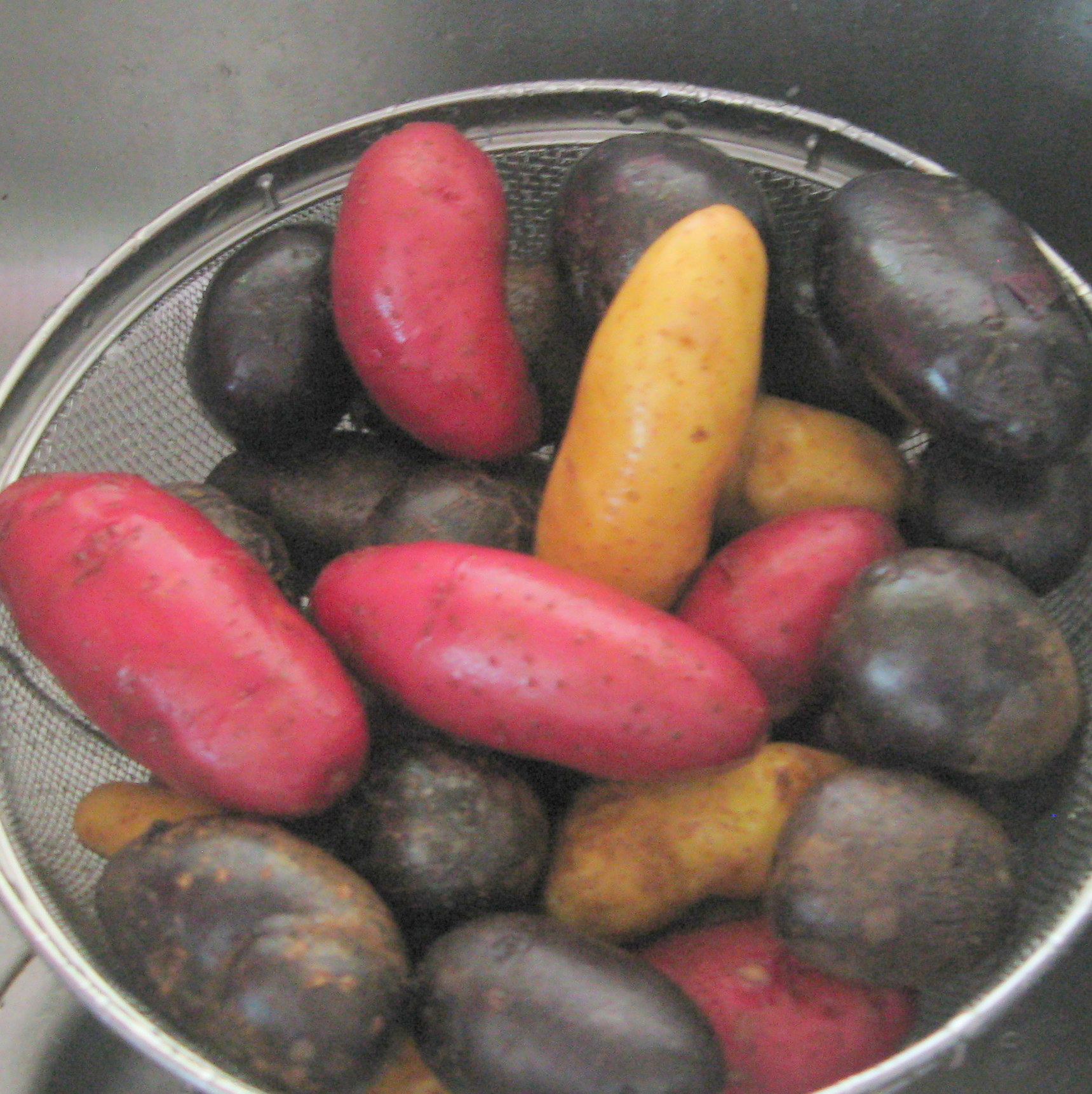
mixed color potatoes in colander

I really was planning to do something special today–more smoked lamb and goat shanks–but I admit to turning to a total wuss, wimping out…as I looked at the weather forecast for the week.  Even though those are easy, it still requires some minding of the grill, and I just could not face it.  I resolved to have a quiet, cool Fourth of July–just me and the cat–indoors with the air conditioning…and I woke up this morning wishing I’d not been such a wuss.

Saved by friends!  An impromptu invitation to join them for grilled chicken this evening.  So–I’m having my quiet Fourth, but with friends and neighbors.

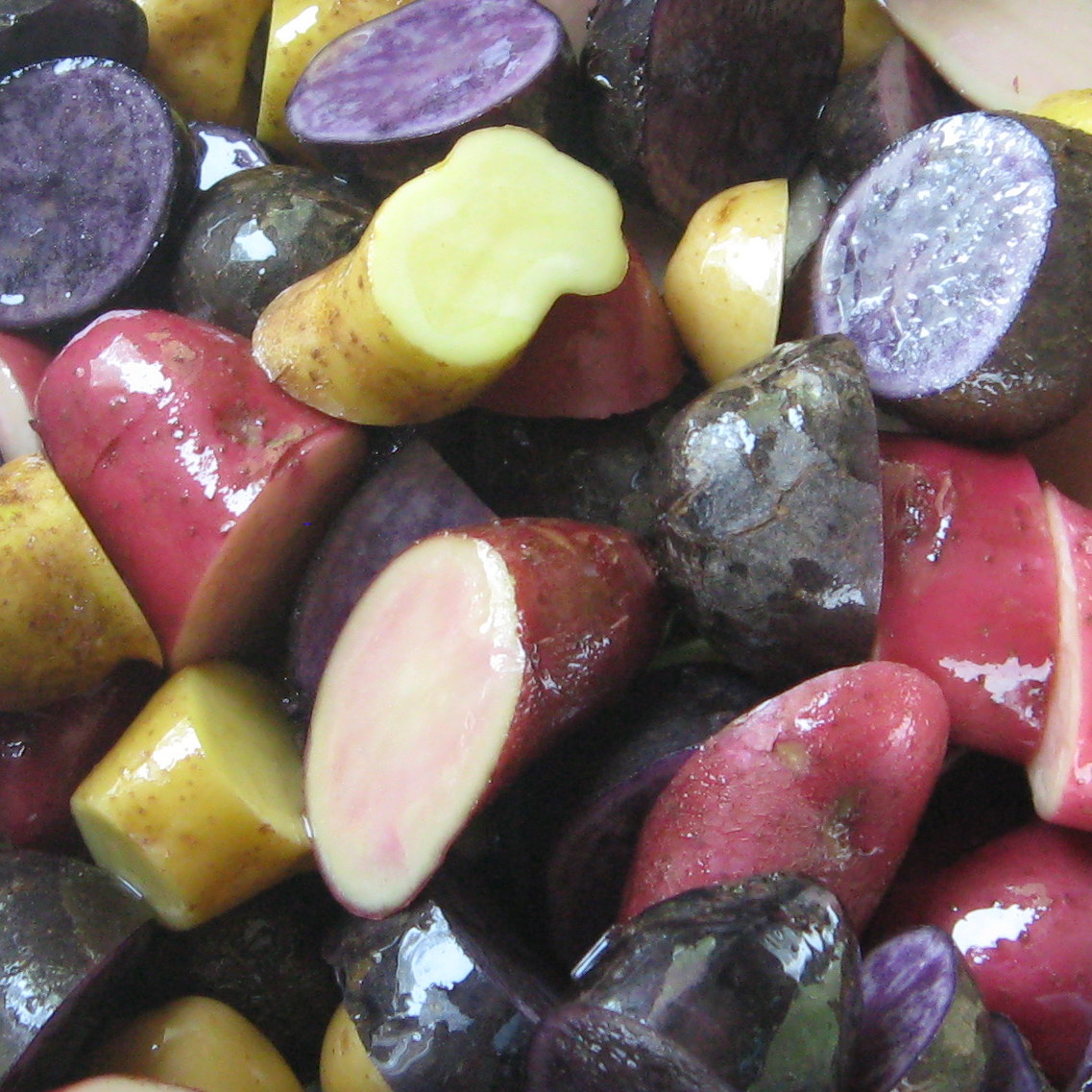
close-up of cut purple, pink/red, and yellow potatoes

Not to go empty-handed, I am making some patriotic roasted potatoes–red, white, and blue–Red Thumb, Russian Banana (okay, bit of fudging here), and Purple Majesty potatoes (new ones from the farm).  Since it’s HOT (my thermometer is reading 98°F now), I’ve decided that those roasted potatoes are going to turn into something that can be eaten at “room temperature”, that will be light and refreshing, and compliment the chicken.

I’m taking  newly dug tri-colored potatoes and scrubbing their delicate skins carefully, cutting as needed to have them equal sizes so that they cook at the same rate, tossing them with a little olive oil; then into a preheated pan and into a 350° F oven until they are tender.

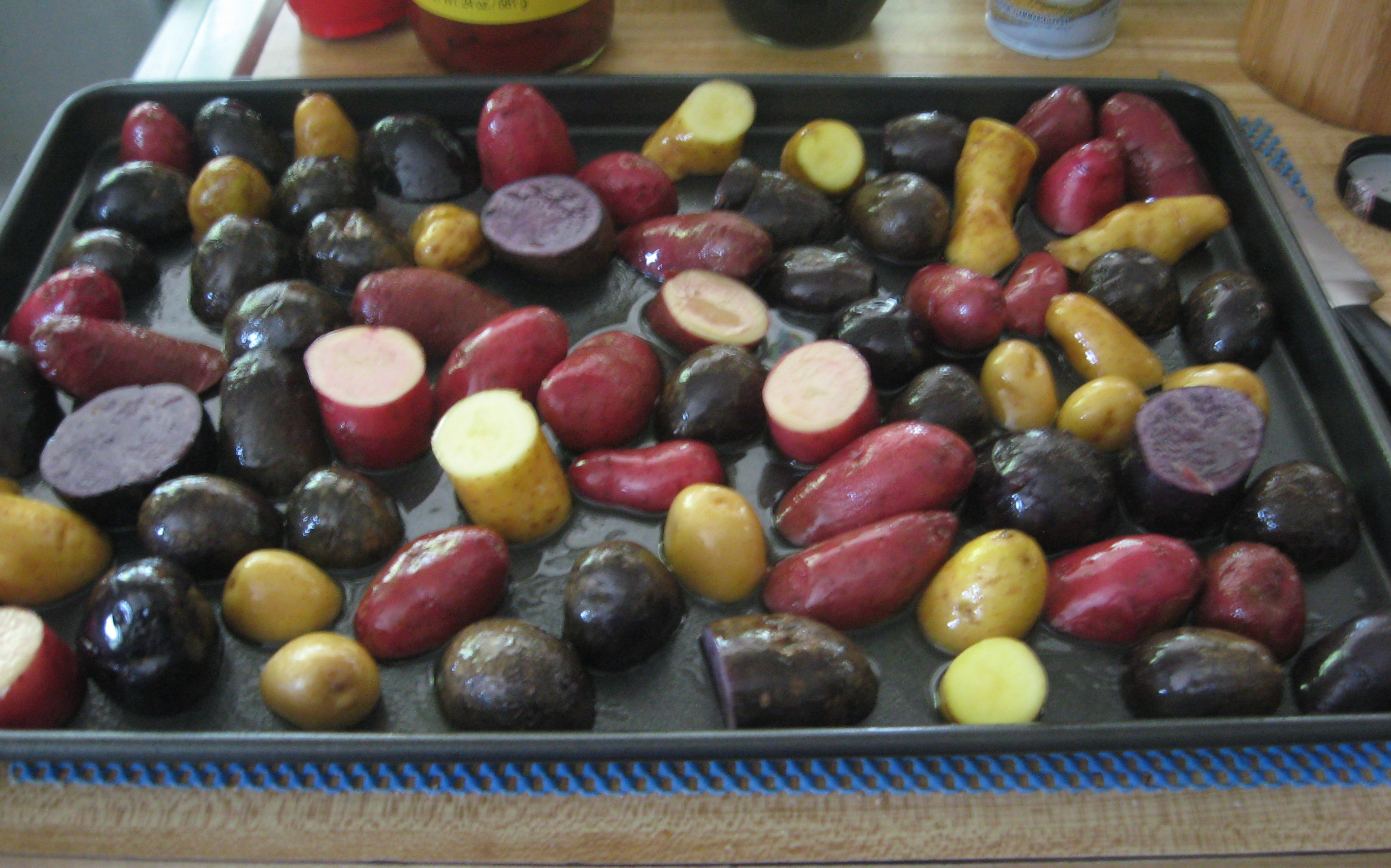
cut and oiled potatoes on baking sheet

I’ve done what America’s Test Kitchen recommends and placed cut sides in contact with the baking sheet so that at least some of the potatoes will brown to give roasted flavor. Now for some complimentary and contrasting flavors to finish these. Since all these do taste a bit different, and for me one of the fun things about this is to be able to taste the individual potatoes and to compare them–think about comparing wines–I want light seasoning–nothing to overwhelm the potatoes themselves. The only seasoning at this point is kosher salt.

Since it’s hot outside (my thermometer is now reading 99.7°F ), I’m thinking light and cool flavors.  I don’t want “potato salad”–so vinegar is out, but I do need something “bright”–and light, and something cool.  Time to check out the herbs on the deck, and the crisper drawer.

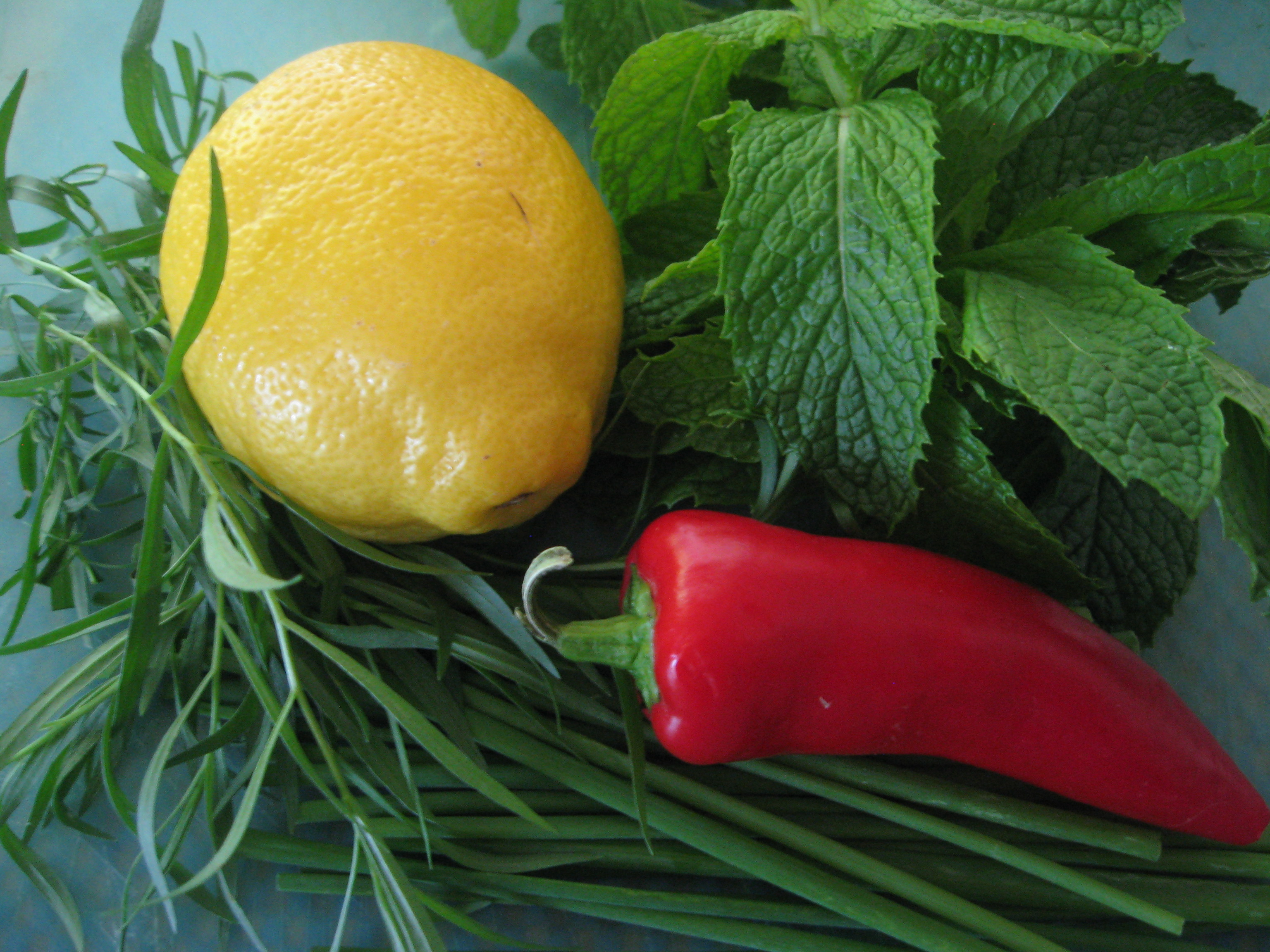
lemon, tarragon, chives, mint, and chili peppers.

Chicken makes me think tarragon.  Cool makes me thing mint–hmm.  Let me smush a couple of leaves together and see how that smells.  Tarragon–warm, mint–cool.  Need some brightness to set off the earthiness of the potatoes–lemon zest, and maybe just a bit of lemon juice over the potatoes while they are still warm.  Seems a good start–but not quite there yet.  Needs a little “spice”–some very finely minced red chili pepper might just do it.

After the potatoes had been in the oven for 30 minutes, I used the tip of a paring knife to check doneness–not quite; and, not quite brown enough.  (I probably should have used the heavier half-pan baking sheet instead of this one–drat.) I kicked the oven temperature to 450°F for another 15 minutes and checked again.  Perfect!  Brown potatoes–so out of the oven, ready for the first seasoning.

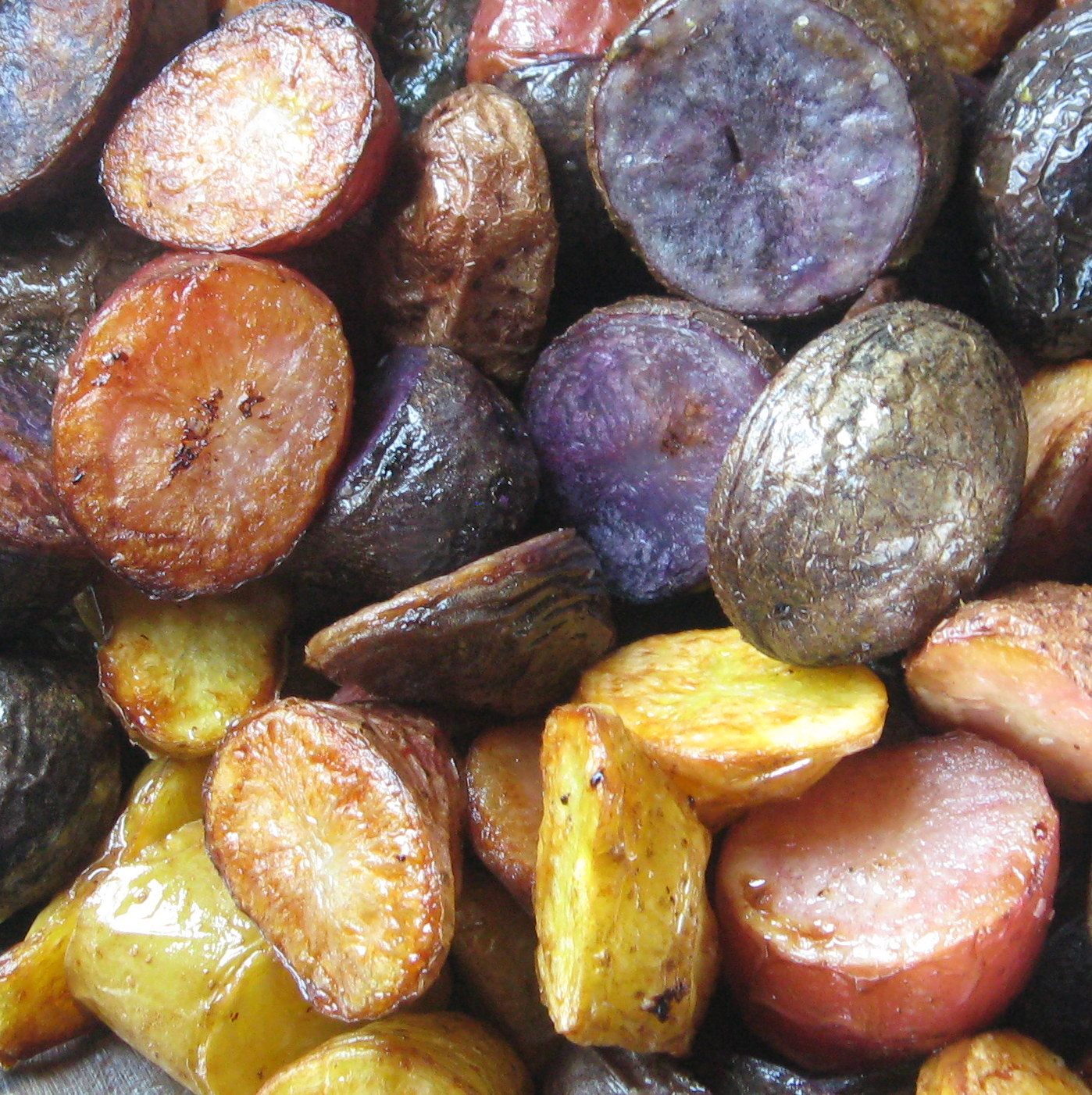
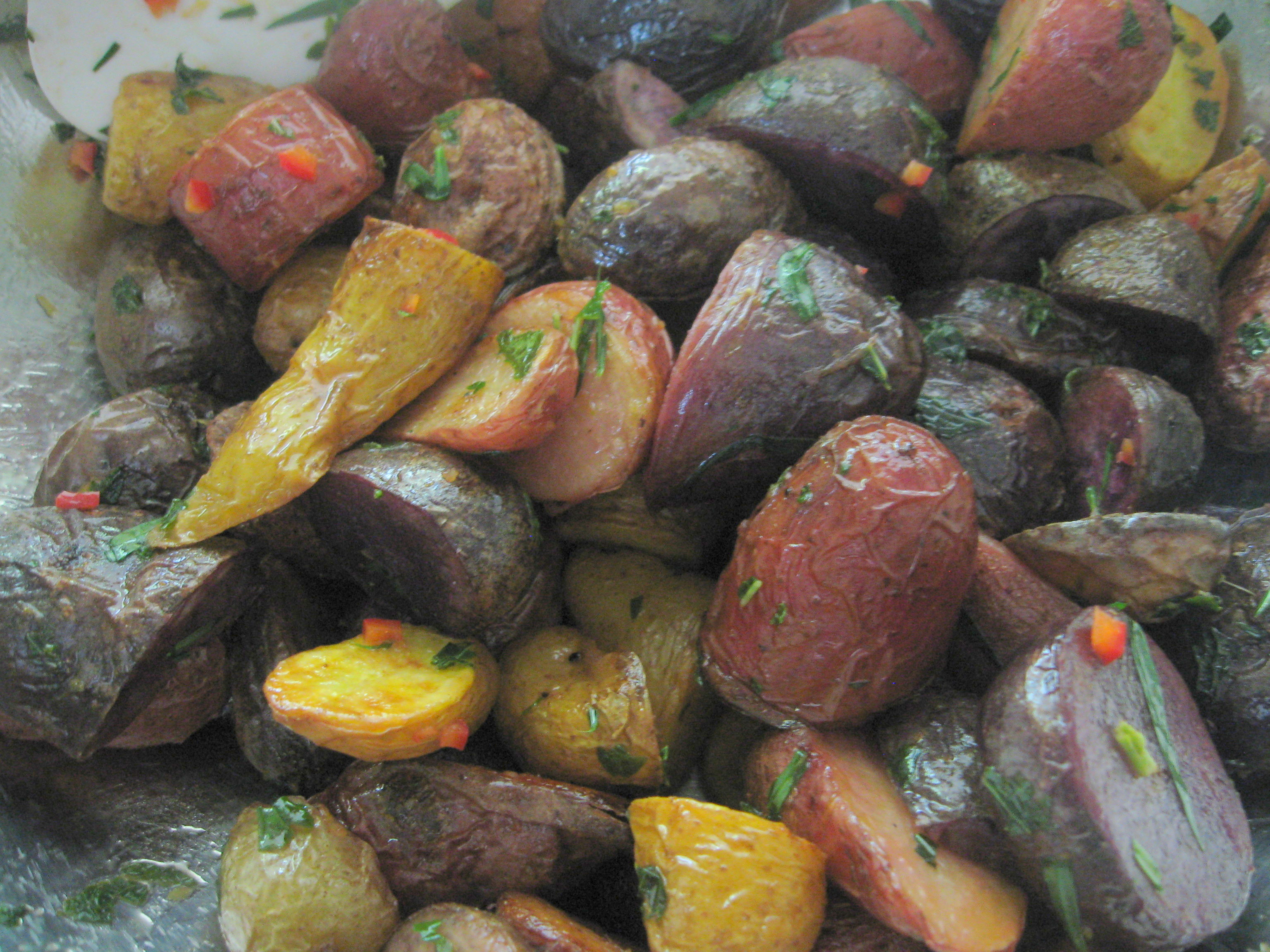
roasted potatoes--browned edges of the red, yellow and purple  ones.While still hot, I tossed them with the zest of one lemon and most of the juice of the lemon–nice bright flavor to contrast with the brown and earthy potatoes.  After cooling a bit, I tossed in about a tablespoon each pretty finely chopped French tarragon and mint. That got the first taste of cool mint, followed by the warm flavor of French tarragon.  So far so good.

I let them stand for a bit and tasted again–the lemon flavor is there but not overwhelming–the juice has added just a bit of tartness, but not enough to taste like a “potato salad”. Now, I’m debating chives and chili pepper.  I taste the chili pepper–it’s not screaming hot–and I think that just an occasional bit of heat as you eat the potatoes would be nice.  I seeded and removed the ribs, and finely minced about 1/5 of the pepper and tossed that with the potatoes. (Still debating about the chives–I really don’t want them to taste like ersatz baked potatoes.)

seasoned IMG_6935After standing for a bit longer, I tasted again, and decided that chives are not what is needed here–I probably should just leave them alone!

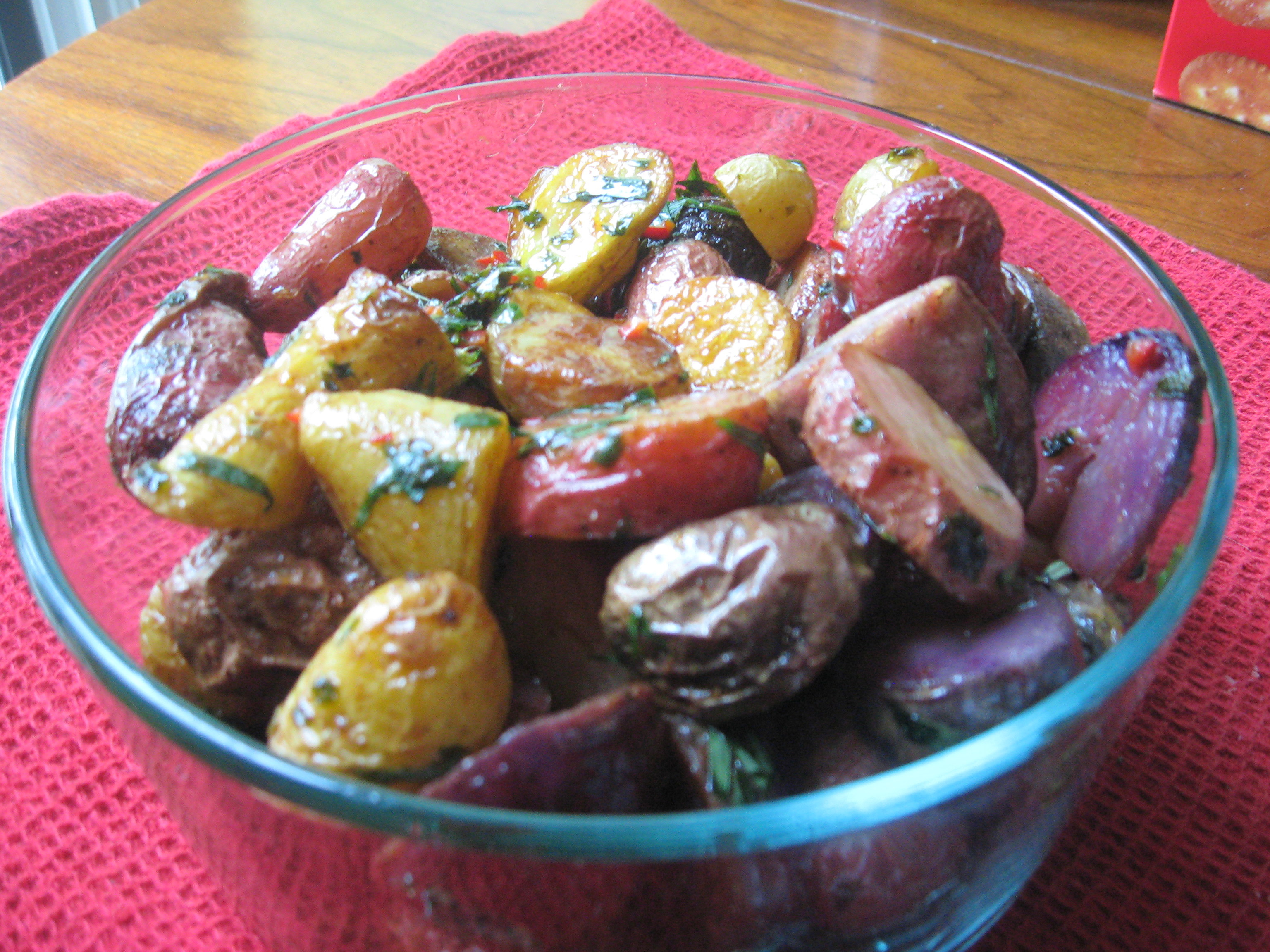
So the final seasonings are the zest of one lemon, lemon juice, mint, tarragon, and just a touch of  red Serrano chili pepper, and a very light sprinkle of a good fruity, extra-virgin olive oil.  I hope that after standing a bit more (not to be refrigerated before we eat the at ambient temperature–or maybe a little less–thermometer now at 100.6°F ) there will be flavors of warm and cool herbs, the brightness of lemon (juice and zest), and an occasional burst of heat from the chili pepper.

Using the baking sheet so that the potatoes are spread out and don’t steam, and preheated does really help get browned roasted potatoes.  If they are too crowded, they will only “steam” and not brown–not really roasted.  The browning is, after all, the whole purpose of turning on the oven!

It’s not smoked lamb shanks, but it’s going to be a pleasant evening with friends–and I do think that something similar will return to go with those lamb shanks when they happen later–when the temperature does not turn me into a total wimp!

…and yes, I’ve done that final taste–yum!  No chives though.

roasted potatoes, with herbs and chili peppers in serving dish.

Leftovers? Possibly–it is a big dish of potatoes for three, but leftovers here are desirable.  Tomorrow they can become a roasted potato salad–perhaps with just a splash of balsamic vinegar, adding some fresh tomato, and cucumber, and, perhaps, some celery, radishes, crisp sweet onion or some freshly snipped chives.

Happy Fourth of July!  A son goût!  

Beet (and other) Röstis

One of the things that we often want in cooking for one (just as in cooking for four or six) is fast and easy, and a technique that can be applied to a number of dishes. I’ve mentioned steam-sauté as a great way to cook vegetables quickly–but here are some other ideas for quick cooking.

Beets image from Swallowtail Garden seeds

beets

Beets can normally take quite some time to cook since they are dense and hard.  One of the ways to speed up cooking is by grating or shredding a dense vegetable–think about hash browns!  You can use a similar technique with beets (or carrots, parsnips, cabbage)–cut them into small pieces so that they will cook more quickly.  Here is an example adapted from Marion Morash’s Victory Garden Cookbook: 

Grated Sautéed  Beets

Ingredients

  • 4 medium beets
  • 4 tablespoons butter, or olive oil
  • Fresh lemon juice
  • Salt and fresh-ground black pepper
  • Chopped fresh dill weed or parsley

Preparation

  • Wash, peel, and coarsely grate beets (If small and tender, peeling is not necessary)
  • Melt butter in a covered frying pan.
  • Add beets, and stir to cover with butter or oil.
  • Cover and cook for about 10 minutes, until just tender.  (You could add a bit of water or stock–like steam-sauté technique if needed to keep from burning.)
  • Season with lemon, salt and pepper and serve.

Although this will serve four, it’s easy to cut this down to a single-serving size–there’s really nothing to measure or adjust–it’s easy to eyeball the amount of butter and quantity of beets needed.  What could be simpler!

If you want to get just a bit fancier with your veggies, you could make röstis.  This gives you different flavor and texture for very little extra effort.

 You’ve probably heard of rösti–maybe just as “potato pancakes”.  A potato rösti at its simplest is just grated (shredded) potato, mixed with a little flour to help hold the potatoes together (and maybe some Parmigiano-Reggiano), which is sautéed  in a little butter until tender, brown, and crispy.  It’s simple, quick, and yummy–and even better, it’s easily made for one or two people as it’s really not a fussy recipe:  small for a side dish, or a bit larger for a main course.

Here is a basic potato rösti recipe from Mark Bittman’s Food Matters cookbook Kindle location 1464).  This recipe makes four substantial servings, or 12 snack size röstis. Röstis are typically shaped into a cake, but can also be baked in muffin tins or on a cookie sheet

Potato-Parmesan Rösti

Ingredients

  • 1/4 cup olive oil, plus extra for greasing pan and your hands.
  • 1-1/2 pounds waxy potatoes (new potatoes, or red potatoes)
  • 1 onion
  • 1 tablespoon coarsely chopped fresh rosemary or thyme
  • 1/2 cup grated Parmesan cheese
  • 1 tablespoon whole wheat flour
  • salt and fresh-ground black pepper

Preparation

  • Heat oven to 350° F and grease nonstick muffin tins or backing sheet.
  • Grate the potatoes and onion (food processor, or by hand).
  • Squeeze dry with paper towels.
  • Put in bowl, add Parmesan, flour, and oil (if baking–omit if sautéing).
  • Sprinkle with salt and pepper.
  • Divide between muffin tins and press down, or press into cakes.
  • Bake or sauté until crisp and golden–about 30 minutes.
  • Let cool for 10 minutes before removing from pan.
  • Serve warm or at room temperature.

Obviously, this technique will work well with other vegetables–such as beets, carrots, squash, cabbage.  You can see that this is easily cut down for a single serving: you’ll want about one-fourth this amount:  1 tablespoon oil, 6 ounces potato, 1/4 onion, a healthy pinch of rosemary, 2 tablespoons Parmesan, and a scant teaspoon of flour for one large cake, and the cooking time should be about the same since the recipe calls for dividing into cakes. Making these in single serving sizes, I opt to sauté them rather than bake them.  I omit the oil from the mixture and add a little to the skillet.

This technique can be used with lots of other vegetables–one of the advantages being that the shredded vegetables will cook more quickly than whole veggies.

Another recipe from Mark Bittman is for beet rösti from his column in the New York Times:

Beet rösti

Ingredients

  • 2 pounds beets (3 very large or 4 to 6 medium)
  • 2 teaspoons coarsely chopped fresh rosemary
  • Salt and freshly ground pepper to taste
  • 1/2 cup flour
  • 2 tablespoons butter
  • Minced parsley or a few rosemary leaves for garnish.

Preparation

  • Trim and peel beets as you would potatoes.
  •  Grate them in food processor or by hand (For a single serving, I’d use a box grater.)
  • Begin preheating 12-inch nonstick skillet over medium heat.
  •  Toss grated beets in bowl with rosemary, salt and pepper.
  • Add about half the flour; toss well, add rest of flour, and toss again.
  •  Put butter in skillet; heat until it begins to turn nut-brown.
  • Scrape beet mixture into skillet, and press with spatula to form a round.
  • With medium to medium-high heat–the pancake should gently sizzle–cook, shaking pan occasionally, until bottom of cake is nicely crisp, 8 to 10 minutes.
  • Slide cake onto a plate, top with another plate, invert the two plates, and return cake to pan.
  • Keep cooking, adjusting heat if necessary, until other side is browned, another 10 minutes or so.
  •  Garnish, cut into wedges, and serve hot or at room temperature.

 This can be readily adapted to other vegetables–carrots, parsnips, rutabagas, turnips–which have about the same texture and density as beets. Once you’re familiar with the technique, you can use vegetables with different textures:  summer squash–just squeeze them thoroughly to remove moisture, and remember that they will cook more quickly than beets.

Umami in the slow cooker…

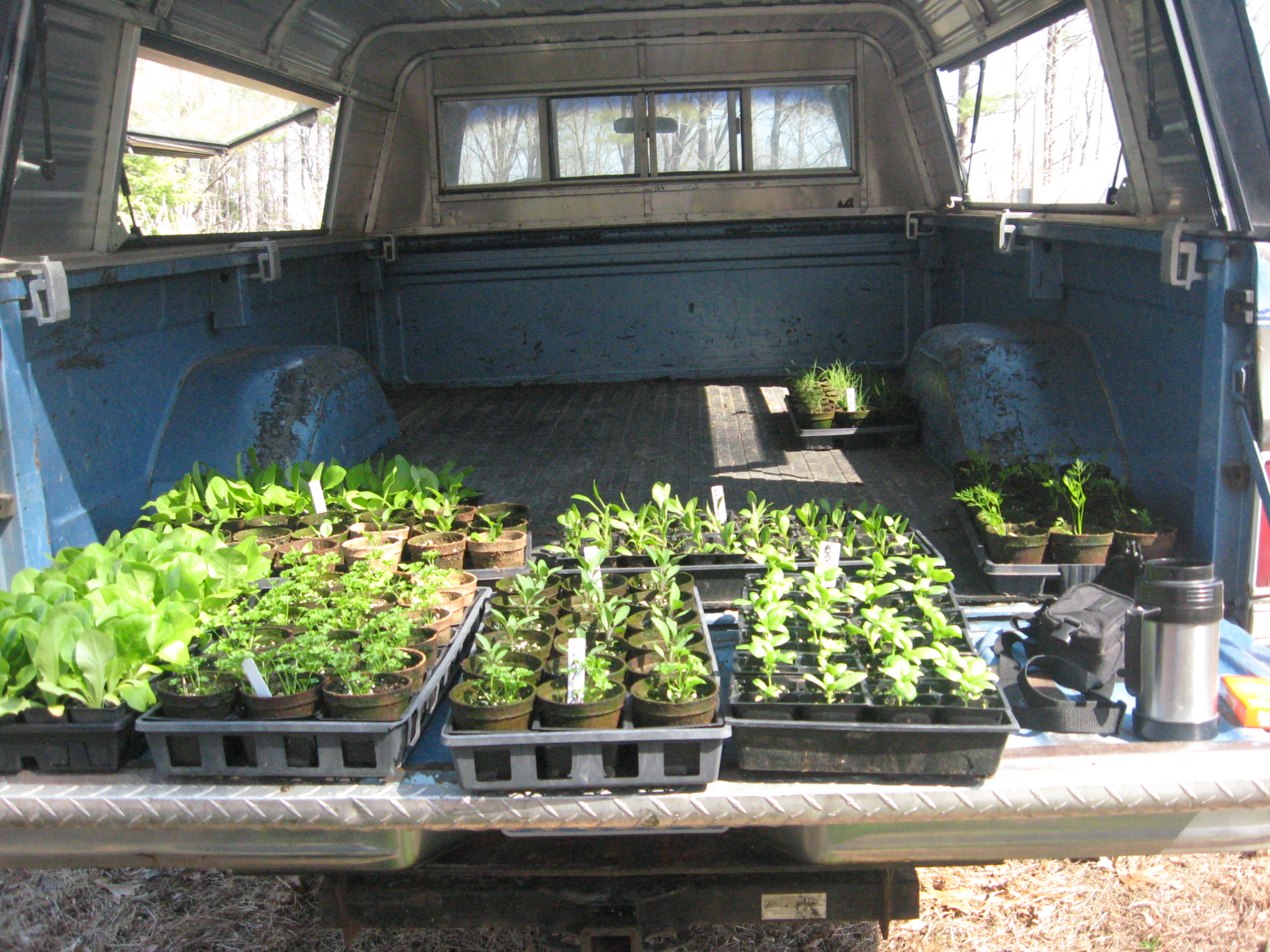
flats of plants on tailgate of truck to be loaded for the farmers' market.

for market

Obviously I’ve not been giving a lot of thought to cooking  things lately–it’s been end-of-term grading, indexing and proofreading, or getting  ready for the farmers’ market, or actually being at the farmers’ market, with more energy going to planting things, both for later harvest and for selling at the market than into cooking.

One of the down sides of working the farmers’ market is that I’m one of those people who wake up like a compact fluorescent bulb–pretty dim at first–so getting to the farmers’ market on time on Saturdays involves getting up before the birds just to give me time to be awake and functional. Even Fridays demand early rising, especially as the weather gets hotter–flowers to cut early in the morning and produce to be harvested before the heat of the day sets in and thing wilt…and just to avoid being out in the worst of the heat.

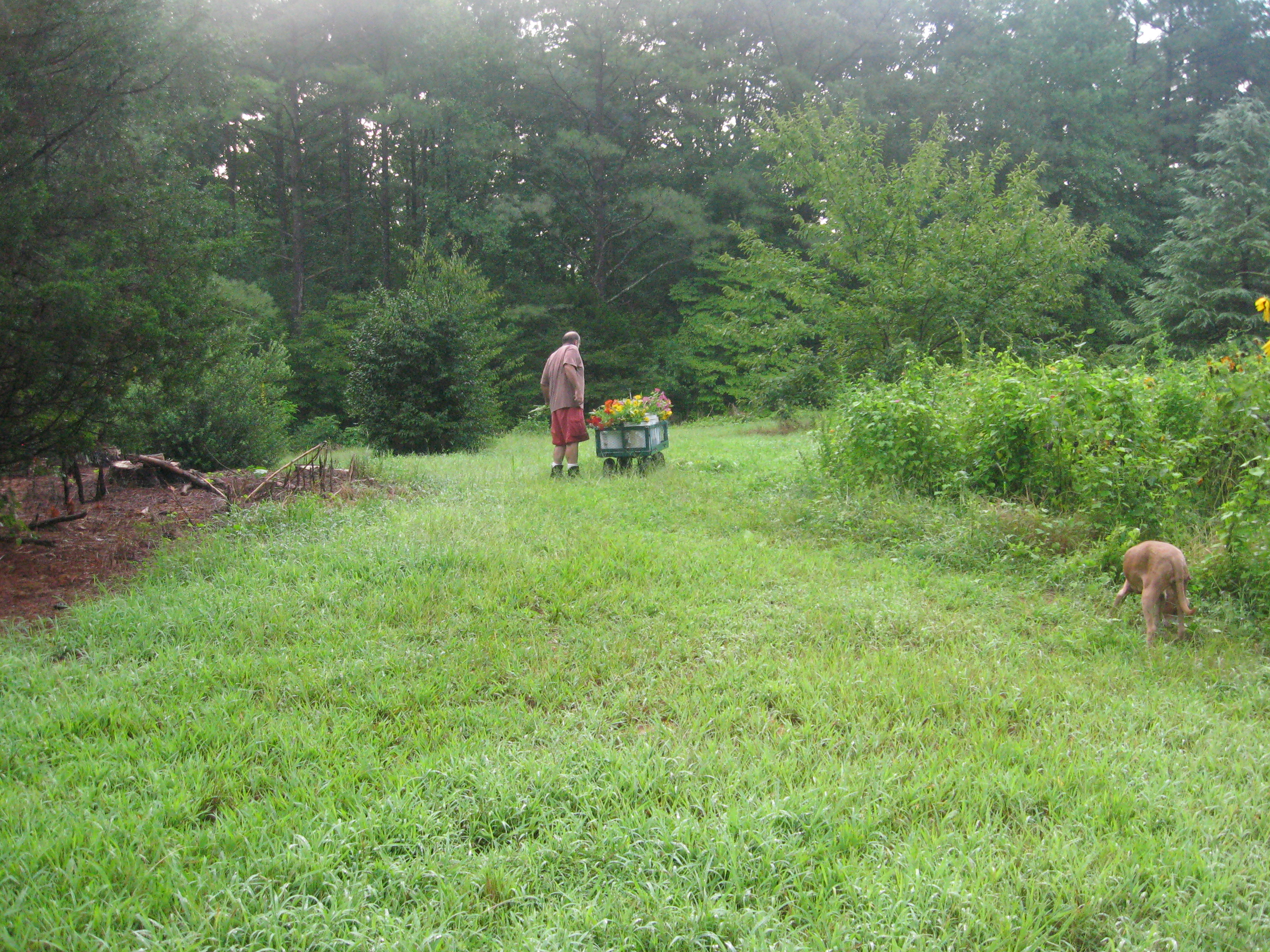
wagon of flowers in buckets

cutting flowers

I’m getting into the swing of that now but it still takes time for my lights to come on, though less painful now.  That early rising on Friday and Saturday makes me into a really lazy slob on Sunday.  Now that the Spring term is over, I’m not meeting classes during the week so I’m enjoying the summer hiatus from lecturing, but still working at freelance indexing so the absolute laziness has to be confined to Sundays and Mondays through Thursdays are still busy.

All this means that for Friday, Saturday, and Sunday cooking is likely to be focused on one-dish meals, and dishes that are good (or even better) when reheated.  Sometimes Saturday meal is not even something reheated–it’s my treat-yourself day–OnlyBurger for after-market meal before I devote the rest of the day to quality time with the cat!  (This past Saturday the treat was a Texan (burger with braised brisket on it) and a peach ice cream sandwich (handmade at OnlyBurger) after the market.  The evening meal was Carolina Moon cheese and strawberries–both from the farmers’ market.)

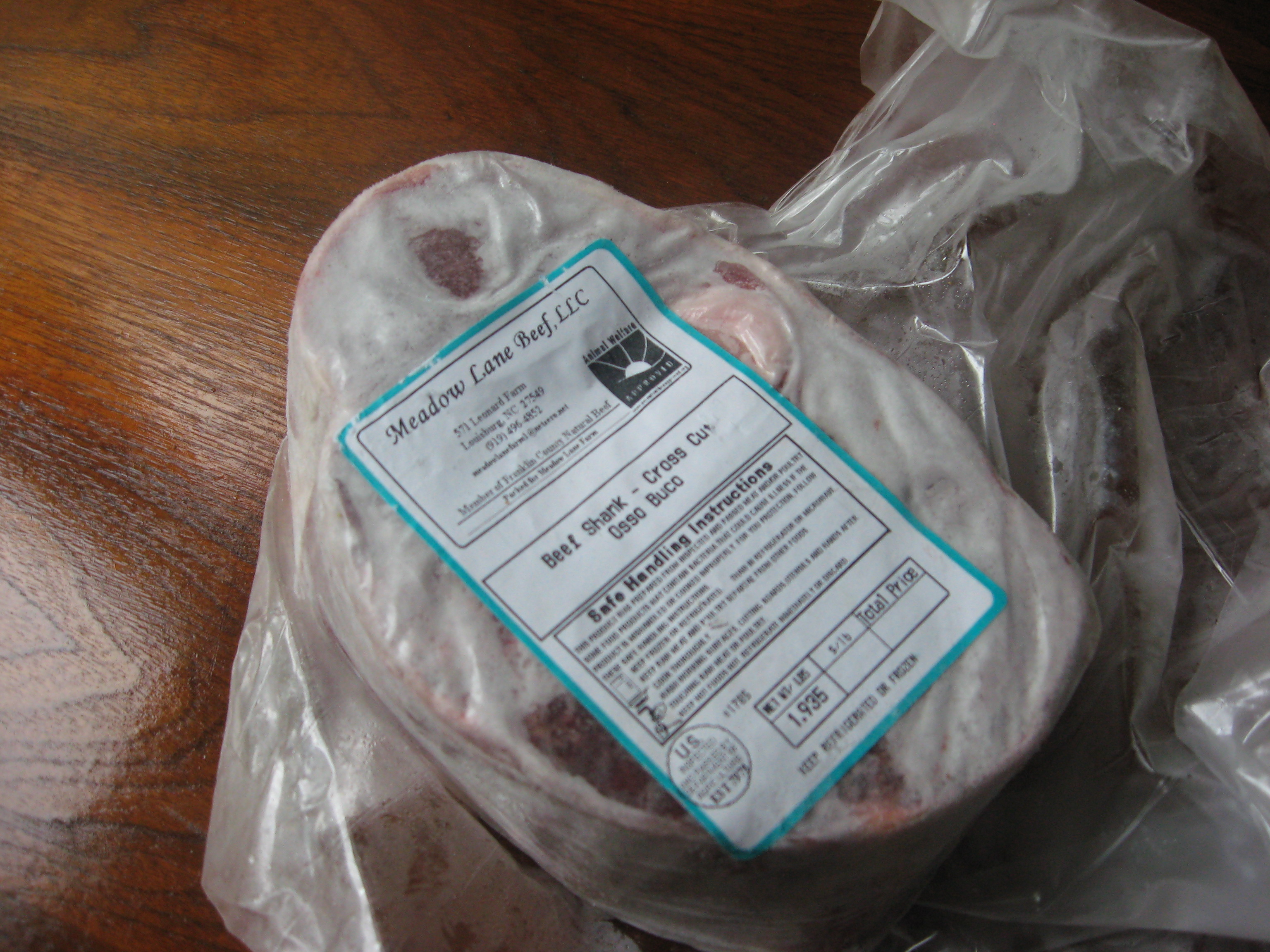
packaged cross-cut beef shank

beef shank

This weekend schedule means that I try to do some planning and cooking on Thursday to have reheatable food on Friday and Sunday.

This weekend’s meals are going to feature an absolutely lovely cross-cut beef shank from Meadow Lane Farms (also from the Durham farmers’ market)  in an easy dish that can cook mostly unattended: osso bucco, but with beef shank rather than veal shank. (The osso bucco really just means “bone with a hole” or marrow bone.)

It’s a dish that’s easily adapted for one person–there’s nothing fussy about it–no need to be exact or tedious in measuring ingredients, and to make even more “unattended”, it will go into the slow cooker (also serving as rice cooker and steamer) while I’m out working on the farm.

Krups rice cooker/slow cooker and steamer

Krups rice cooker

I have to admit that I’ve not been a fan of the slow cooker until recently, at least for anything much more than cooking dried beans, or poaching a beef tongue. The flavors and textures just aren’t the same as when the slow cooking was done in the oven where some evaporation, browning and concentration takes place even in a covered dutch oven.

My attitude about slow cookers has changed since I found the Cook’s Illustrated Slow Cooker Revolution (See Bibliography) and learned some techniques for making food out of the slow cooker more flavorful.  I’m not ready to quit slow-cooking in the oven despite that, but in hot weather I’ll certainly use the slow cooker more often with some of the “tricks” I learned from that cookbook.

What I missed most in slow-cooker dishes was that savoriness that comes from browning (Maillard reaction)  when you slow-cook in a traditional oven or brown/sear on the stove-top.  In the slow  cooker, you can make this absence less noticeable by adding ingredients that contribute “umami“.

Some of the most useful things I learned from that Slow Cooker Revolution are ways to use the microwave oven to facilitate the slow cooker, and using some “unusual” ingredients  in recipes–not esoteric ingredients, just pantry staples that boost  the umami flavor:

  • precooking aromatics like onions in the microwave so that they don’t stay crispy-crunchy in the slow cooker,
  • using tomato paste (for umami) by browning it with the aromatics either in a skillet or in the microwave before adding it to the slow cooker,
  • using dried mushrooms to boost flavor (again, umami),
  • using foil packets in the slow cooker to keep some ingredients from over cooking.
  • using soy sauce or fish sauce to add more of that umami that many slow-cooker dishes don’t get without the evaporation and browning as in the traditional oven.
  • using the microwave to precook some ingredients to get rid of excess moisture that would otherwise dilute the dish in the slow cooker.

These are all easy to do–they really don’t add significant extra prep time or effort, and do really make a difference in the flavor.  I expect an easy, flavorful meal (or two) from the braised beef shank that is going to emerge from my slow cooker on Friday evening, thanks to some added umami!

About lentils

lentils in Mason/Ball jar on pantry shelf.

lentils

Lentils (Lens culinaris), closely related to beans and peas, are dried after harvesting; you’ll find them on the shelves of your supermarket, gourmet stores, and online. They have been a staple food in many areas for over 8000 years, likely originating while in Turkey.  They are a staple food for many south Asian cultures, Middle Eastern, and Mediterranean countries.  The Latin word for lentils, lens, was used in the 17th century to describe eye glasses because of the similarity in shape

Like other legumes, lentils are low in fat and high in protein and fiber, but they have the added advantage of cooking quickly.  Lentils have a mild, often earthy flavor, which lets them pair well as side dishes, in salads, and soups.  Lentils have traditionally been used as a meat substitute.  Like other pulses, when paired with grains they offer excellent quality protein in our diet.

Before cooking, always rinse lentils and pick out stones and other debris–usually they are quite free of debris, but it’s always good to check them before cooking.  Unlike dried beans and peas, there’s no need to soak them. Lentils cook more slowly if they’re combined with salt or acidic ingredients, so add these last.  Bigger or older lentils take longer to cook.  Store dried lentils for up to a year in a cool, dry place. Substitutes: dal OR split peas OR black-eyed peas  More varieties are appearing even on the supermarket shelves, but specialty sources offer a wide variety with which to experiment.

The quick cooking and nutritious nature of lentils make them an obvious choice for winter soups. They are also good cooked and chilled for salads or mixed with bread crumbs to stuff vegetables. Blend lentils with middle eastern couscous and use as a bed for seafood and poultry.  Use them instead of beans  for summer salads with fresh tomatoes and other veggies.

Here is a little information about the various kinds of lentils.  More synonyms and alternative names can be found in the Cook’s Thesaurus.

  • Brown Lentils:  The average grocery store lentil is the brown lentil. You’ll likely find these on the shelves with the dried beans.  They tend to get mushy if overcooked.  If you want them to be firm, add oil to the cooking water and cook the lentils just a short while, say 15 minutes.
  • Black beluga lentils are a very popular legume in South Asia, they are used to make a beautiful black lentil soup. Some of the names that they my go by are Beluga lentil = black beluga lentil = beluga black lentil = petite beluga lentil. When they’re cooked, especially in salads with a tiny bit of oil, they glisten so that akes them look like beluga caviar.
  • Petite crimson lentils are “crimson” in color, which is a deep orange-red. These lentils tend to lose their shape when they are cooked and are an excellent choice for thickening soup.
  • Petite golden lentils are a small firm, golden lentil that is rounder in shape than many other  lentils; one of the reasons that this lentils holds its shape so well when cooked.  They have a soft texture.
  • Ivory white lentils are a creamy white colored small lentil that is really a peeled black lentils, known in India as urid dal.
  • French green lentils: (also called French green lentils, du Puy lentils,  lentilles du Puy, lentilles vertes du Puy.)  By many chefs, these are considered the “best”, most delicate lentils.  They have the typical earthy flavor, but also  are a bit “peppery”. These hold their shape well better than many other lentils,  but take longer to cook, but still do not need presoaking. While I love all lentils, and typically have several kinds in the pantry, these are the ones that I would not want to be without!)
  • Red lentils are the common seen in the supermarket.  It’s a lovely salmon pink in the dried form, but it turns golden when cooked.  These lentils cook faster than others.  They’re best in  purées or soups.
  • Spanish pardina lentils (also known as Spanish brown lentils or Continental lentils) are smaller the brown or red lentil–about the same size as a petite green or black lentil.  They have a particularly nutty flavor, and they hold their plump, round shape when cooked. This makes them a particular favorite with e for use in summer vegetable/lentil salads.
  • Dal is the Indian term for peas, beans, or lentils that have been split and often skinned, but the name is sometimes used for all lentils, peas, or beans, or to cooked dishes made with them. Split lentils don’t hold their shape well, so they’re often cooked into soups or purées.

Most of these can be interchanged in recipes as long as you take into account how quickly they cook and the final textures–some are softer than others. Generally the split ones tend to lose shape faster, so don’t do well for salads, or side dishes where you want them to keep their shape, but will be fine in soups–especially if you’d like your soup to be a little thicker.  Any of these would work in the lentil soup recipe that I gave earlier–though I usually use the lentils du Puy even for that.

Aside from using them instead of beans in summer salads, I think that lentils make an awesome side dish to go with grilled salmon–there’s something about the earthy flavor that combines SO well.  If you have “leftover” grilled salmon, try using it with some lentils to make a cool, but hearty summer salad with some tomatoes and cucumber to it.  Combined with a grain, this can be a very nutritious vegetarian dish–or not.

Here is a link to a lentil salad that makes me drool on my keyboard just looking at the recipe:  Warm Salad of Lentils with Duck Fat from the Hudson Valley.  Love’s description of the lentilles du Puy is marvelous.  (Each time I cook duck, I carefully keep some of the fat, sealed and refrigerated to use for things like this.)  Add some greens, and this is a one-dish meal that’s in my group of comfort foods.  Lentils will also work in the sausage, beans and greens one-dish meal.

Lots of uses, quick-cooking, nutritious, tasty, inexpensive…what more could you want?  Try some!

Pumpernickel with seeds

sunrising through trees

morning through the kitchen window

I’m sitting here this evening, writing and waiting for the first loaves of the pumpernickel from the Healthy Bread in Five Minutes a Day (p. 115) to come out of the oven.  I’ve peeked in and they look good and smell wonderful!

(Why does it seem that it takes so much longer for bread to bake once it smells so good that your practically drooling on the keyboard? I just know that one of these loaves is not going to get to cool as it should even though I know cutting it immediately will not help–that’s one of the reasons I like baking two smaller loaves–I can treat myself, and still have good bread for sandwiches.)

Waiting, and not very patiently….

Just because of the way that I use bread, I’ve baked these in the perforated Italian bread pan.  The crust is probably not quite what it would be directly on the baking stone, but it quite good and I have the longer, slightly skinnier loaf, and it’s easier if I want to bake a second loaf to share with friends.

This healthy bread has whole wheat flour, rye flour, and flaxseed meal in it…and I did put in the caraway seeds this time too.  I did tamper with the recipe that was given in Healthy Bread in Five Minutes a Day.  I really do make an effort NOT to play with the recipe until after I’ve made it as given once, but I did not make it this time.

Since I had white whole wheat flour which gives a milder flavor instead of regular whole wheat, my dough wasn’t very dark, and it just lacked something in the kind of “bitter” smell that I’ve liked about that last batch of pumpernickel.  The “missing ingredient was the unsweetened cocoa powder, so I got carried away and put in cocoa powder.

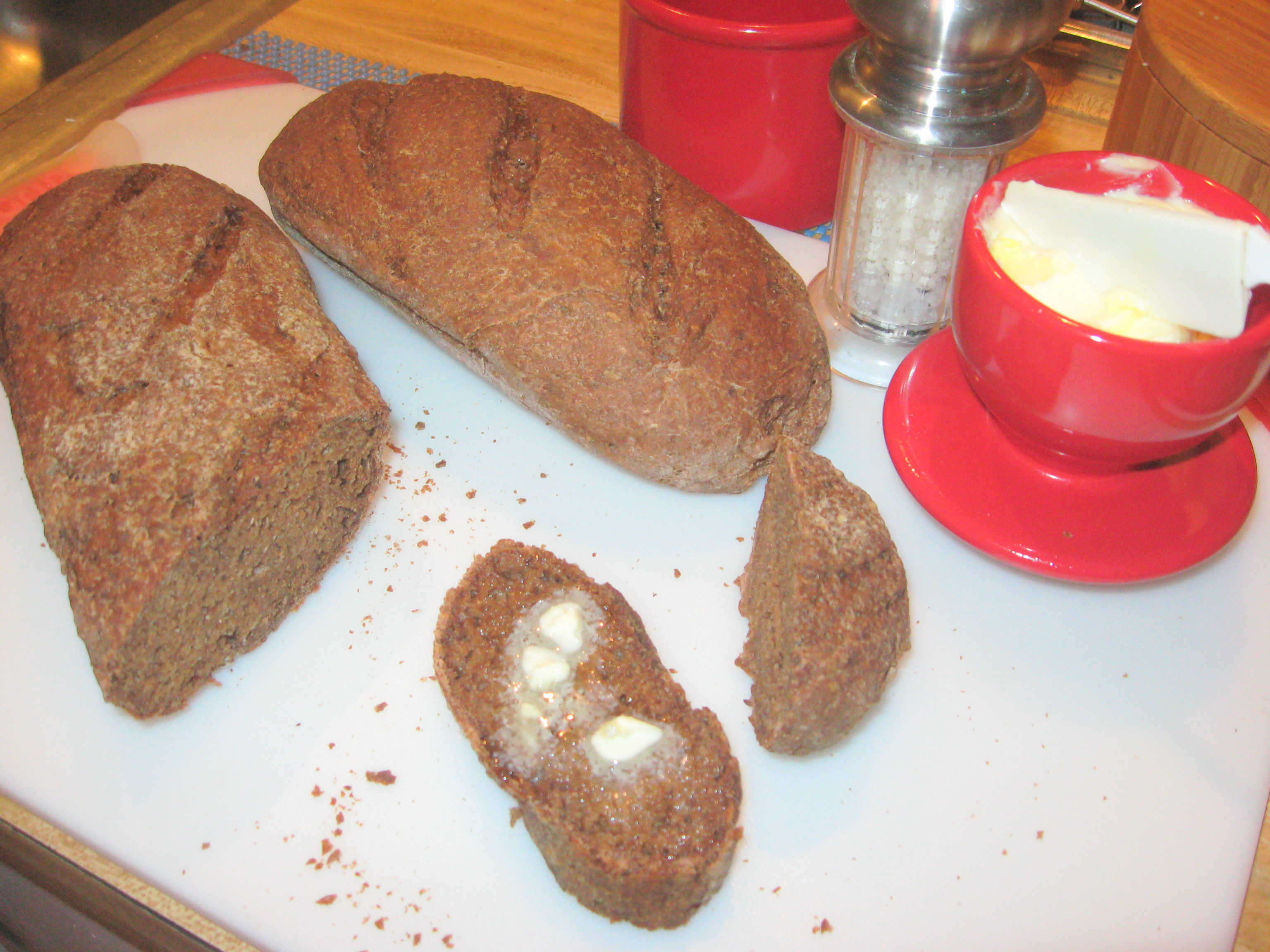
One loaf of pumpernickel bread on cutting board with butter-bellIt’s out of the oven now, and cooled just enough so I can ravage one of the loaves–I’m cutting the one that didn’t rise quite as well, but it’s a keeper.  As you would expect with more whole grain flour, it’s more dense than the first batch, but a good crumb–which I’m sure would have been better had I not cut it so soon.  The flavor is great–the cocoa powder did the trick to take up for the white whole wheat flour, and I think that the flaxseed meal is really undetectable.  The amount of caraway seed called for in this recipe was only 2 tablespoon for four loaves–so it stays as a kind of “dark” background flavor.

This will get made again–with the modifications.  I think that I can work with this (without caraway) to try to get the Russian black bread recipe (the Smitten Kitchen) adapted for the no-knead technique. (It’s not just that it’s no-knead–I have a KitchenAid® mixer.  The real attraction is that I can have this dough in the fridge for a long time–10 to 14 days–and have freshly baked bread quickly and often, too.)

I’m now enjoying my warm (actually, hot) freshly baked bread with some unsalted butter and a light sprinkle of sea salt since the butter has no salt.  I do have some radishes in the fridge to have a radish sandwich tomorrow after the bread has really cooled!  That will be time to break out the bubbly!

one whole loaf and one cut loaf with slice of bread with butter.

…A son goût!  

Under-appreciated veggies: Brussels sprouts

bagged Brussels sprouts at Harris Teeter supermarket

Brussels sprouts

Obviously I’m writing this because I have Brussels sprouts in hand now!  They are a favorite winter veggie in my kitchen but I think they are sometimes under-appreciated and under-used by those of us doing single-serving cooking, possibly because the come in packages that contain too many.  Some of these may be underused because we’ve had them prepared in ways that did not really let them make their best impression.  I thought I’d address some of these, especially the cool weather crops–starting with one that seems to be a love-it-or-hate-it vegetable: Brussels sprouts.  Until I started cooking for myself, I was in the hate-it camp.  Most of the Brussels sprouts that I had were over-cooked, mushy, and bitter; in a word, nasty!

Fortunately, I’ve discovered ways to make Brussels sprouts a desirable vegetable because they have some excellent qualities: they are  inexpensive and readily available in the wintertime.  They are nutritious–I’ll not give you all the details here, but you can find all that sort of information from the Nutrient Database Laboratory.  They are versatile–you can use them as a substitute for cabbage in some recipes, and (a concern if you’re cooking for one), they store well in the fridge.

First, storage:  Brussels sprouts often come prepackaged in a mesh bag that’s about a pound or so.  That’s a lot of Brussels sprouts if you’re cooking for one and had to use them all at one time.  Fortunately that’s not the case–they’re small, separate units so you are not trying to preserve a cut vegetable (always more difficult)–big bonus for those cooking for one.  I store mine with a paper towel that has been dampened and then squeezed mostly dry, in a partly open zipper-lock bag in the vegetable drawer.   I’ve seen suggestions (The Victory Garden Cookbook–see bibliography) that the flavor gets stronger with storage.  I’ve not found that to be a problem, but that may be because I do keep my fridge really cold, and the damp paper towel helps even out moisture. However, if you do find that you don’t like the taste after they’ve been stored for a few days, the other option of something to do with the rest of the bag would be to blanch and freeze part of them.  Blanching is simple:  bring a large pot of water to a boil, salt it heavily (after it’s come to a boil), and put in the Brussels sprouts for about 2 minutes; then “shock” in an ice bath, drain, and freeze.  (The purpose of the blanching is to stop enzyme action, and it keeps the color bright and green.)

Now for cooking them. Personally I’m not a fan of boiling veggies as a method of cooking them (other than blanching before freezing)–there are so many nutrients that are water soluble!  So my preference is for some cooking method that does not involve putting them into huge quantities of water to cook completely.  So that leaves steaming, stir-frying, roasting, and  microwaving.  The best way to avoid having “nasty” sprouts is NOT to overcook them.

I’ve added them to soups, used them instead of cabbage with braised pork, and added them to one-dish meals like roasted potatoes with sausages, and lots of other things.  They lend themselves well to improvisation and substitution.

Recipes for steaming, blanching, roasting and microwaving can be found in a number of cookbooks so I’ll not post here, except for the recipe that I just made to go along with my baked sweet potato.

For more information on how to cook and specific recipes, I suggest you might want to check The Victory Garden Cookbook by Marian Morash (see bibliography).  As I was sitting here at the computer writing this, my e-mail notification popped up and said it had received a notification of a new post from domestic diva M.D., a blog that I think is worth following for anyone who cooks.  I was surprised to see that the subject was  roasted Brussels sprouts.  

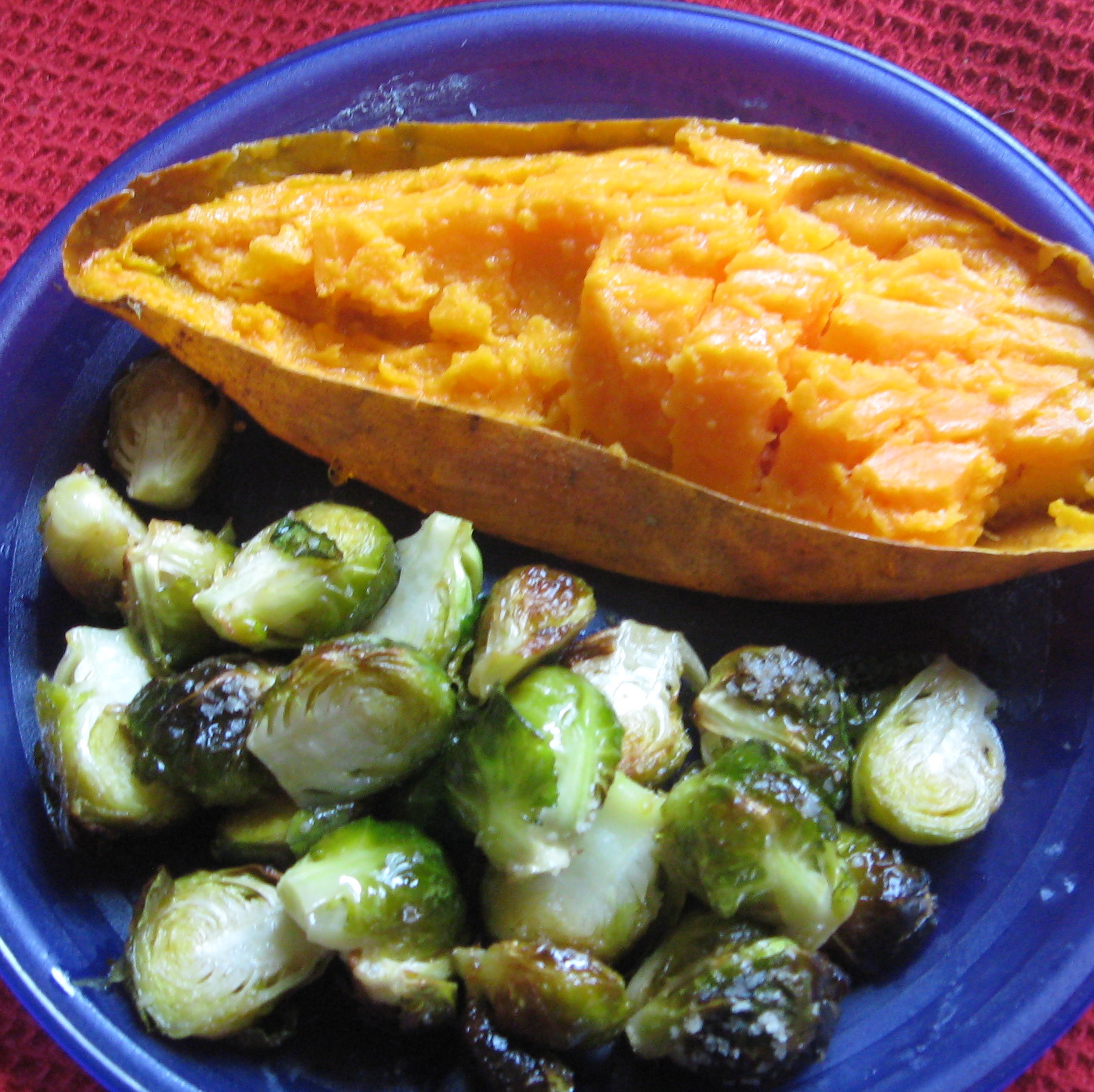
Since it was about lunch time, I was preheating the oven to bake a sweet potato (a very large sweet potato so that I’ll have some for another use as well).  I read the recipe and grabbed the last of the Brussels sprouts from the fridge.  I didn’t have the full amount, but this is a recipe that does not depend on the quantity–which is great for us solo cooks.  Since I was baking my potato in a 350 ° F oven, I did alter the cooking time just a bit–I popped the Brussels sprouts prepared as in the recipe into the oven for about 45 minutes right along side my sweet plate with half  a baked sweet potato and roasted Brussels sproutspotato, and there was my colorful, nutritious lunch!  This is the kind of improvisation that can make cooking for one easy–many recipes aren’t dependent on how many you have or how many you want to cook and eat right now.

You should check out this recipe.  I’d not used garlic powder with them before, but it was yummy and much easier to use than minced garlic.  One of the comments on this post suggested adding Parmesan cheese–I did not try that because I’m out of Parmigano-Reggiano (horrors!), but it sounds  like something that would taste great!

Oops–Pumpernickel bread without the caraway seeds

What better to do while we had our brief taste (so far) of winter than to bake some bread–the oven adding warmth to the kitchen and the smell of rising and baking bread adding some warmth for the soul as well.

My encounters with pumpernickel bread have been with deli sandwiches–and I cannot recall ever having had pumpernickel without the caraway seeds.  Rationally, I knew that a large part of what I tasted as “pumpernickel” was the caraway which, although I like it, is a pretty strong, defining flavor.

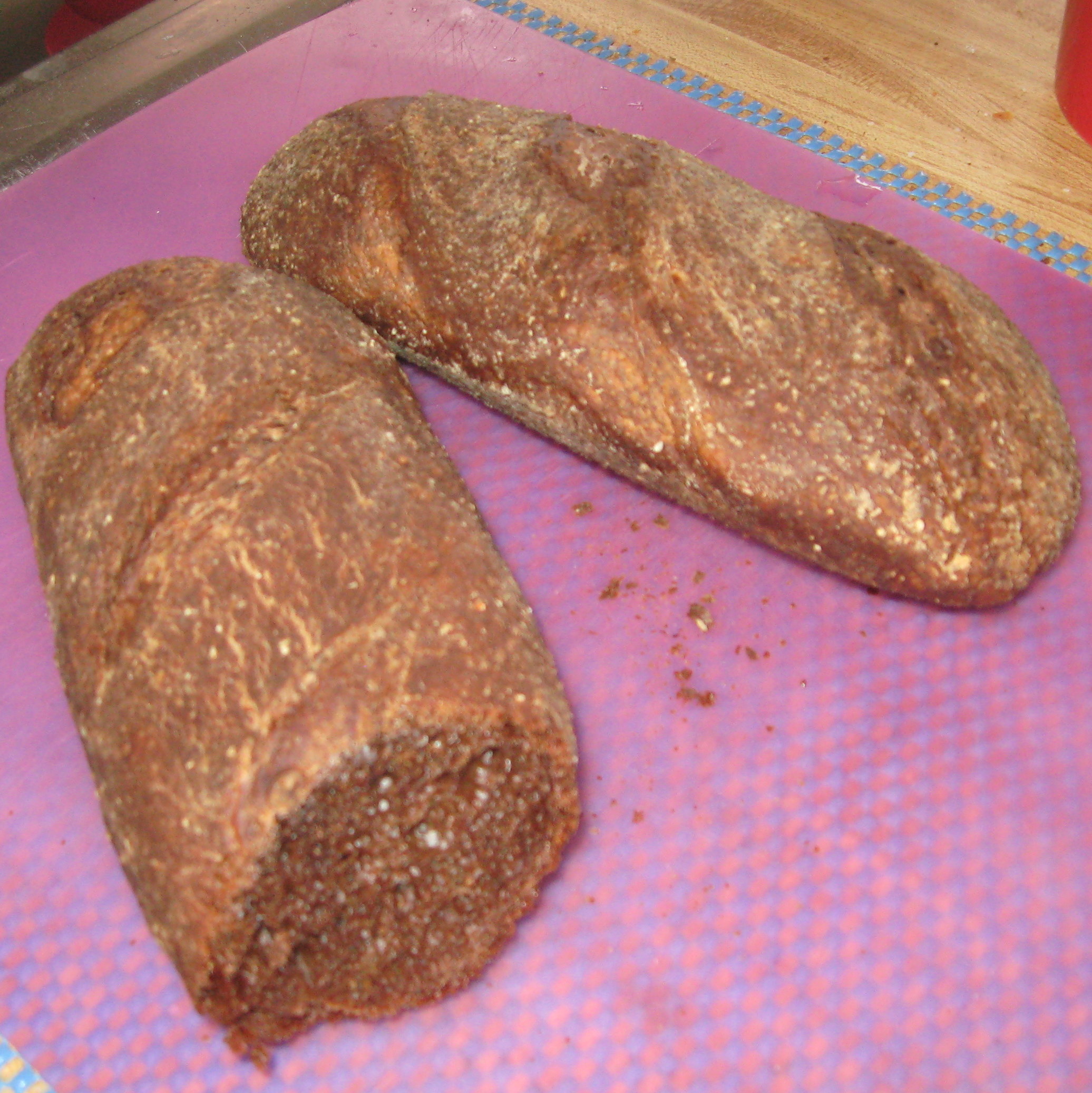
Loaves of pumpernickel

freshly baked

I’ve never had freshly baked pumpernickel bread so that seemed like a good thing to do.  I have always associated pumpernickel and rye breads with caraway seeds, so I wasn’t surprised to see caraway seeds in the list of ingredients.  Since I’ve been so pleased with the results of the “no knead” technique, I went to the recipe from Artisan Bread in Five Minutes a Day (p. 67) for my pumpernickel bread. I knew that I had all the unusual ingredients necessary for the recipe since I’ve been planning to try it for some time now and just hadn’t gotten around to it.  I had the unsweetened cocoa powder, caramel coloring, espresso powder, molasses, and caraway seeds.

After my bread had risen nicely I slashed the top, popped it into the oven and generated some steam by spraying water into the oven several times for the first couple minutes, and sat back to await the aroma of baking bread.  Wonderful!  About the time that I really began to smell it was when I realized that I had not sprinkled it with the caraway seeds–but, too late now.

It’s a very happy “oops” from my point of view.  When I tasted the warm bread  with some unsalted butter and a sprinkling of sea salt, it was an absolutely wonderful surprise–without the caraway seeds I was tasting this wonderful dark, slightly sweetish, slightly bitter (pleasantly, mind you) bread.  I loved it.  I’ve been making sandwiches with it for the last several days.  I’ll be making more of it without adding the seeds.

But I couldn’t get away from the fact that I’d never tasted it without caraway seeds before.  I started looking at recipes for pumpernickel bread in all my cookbooks, and online as well.  I wasn’t really surprised when I found that almost all of them included caraway seeds as part of the recipe.  I looked at the recipe for pumpernickel bread in Healthy Bread in Five Minutes a Day (“Bavarian-Style Whole Grain Pumpernickel Bread”, p. 115) and found that caraway seeds were called for in that recipe too.

Further searching lead me to a recipe for the “traditional” Westphalian pumpernickel–the unleavened version, and to other dark/black breads like peasant  black bread, Russian black bread.  Some had caraway seeds, some had fennel or anise seeds, and some had none.  While I used supermarket medium  rye flour rather than darker rye or pumpernickel flour (rye with bran left in), this sample has left me wanting to sample other “black” breads for which I found recipes while browsing through Bernard Clayton’s New Complete Book of Breads–like onion rye, sour cream rye, Russian black bread….

My online browsing lead me to the Smitten Kitchen for a recipe for black bread that sounds so intriguing–reading the list of ingredients trying to imagine the overall taste of this bread.  I’m so “addicted” to the no-knead technique, but I may have to give this one a try just to get a gestalt for the taste–and then maybe I can have a no-knead version.  This recipe calls for seeds–caraway, and fennel, as well as shallots, cider vinegar,  molasses and the chocolate/cocoa of the recipe that I just made.

I think that my next attempt at pumpernickel will be the recipe from Healthy Bread in Five Minutes a Day since that is a whole-grain bread, quite possibly without the seeds!  That may well be one to try to modify it to approximate the Russian black bread recipe from the Smitten Kitchen.

Though I want to try other recipes with other ingredients, I will certainly make pumpernickel again, both with and without the seeds.  I have visions of a wonderful hors d’oeuvre of crispy French radishes, unsalted butter, a sprinkle of sea salt, on unseeded pumpernickel or black bread of some sort, with a glass of champagne!

It’s good that I’ve remedied my cultural deprivation and discovered black breads to bake at home…Still have enough dough for 2 more loaves in the fridge.

Oat flour bread

Freshly baked oat flour bread

oat flour bread fresh from the oven

Bread is one of my favorite things–from the yeasty smell while it’s doing that last rise before going into the oven, while it’s baking, or just out of the oven while I’m waiting for it to cool a bit–to the crusty crunch of biting into a slice  fresh from the oven.

I’m addicted to having fresh bread when I want it, using the no-knead approach from Artisan Bread in Five Minutes a Day.   I’ve had great luck with every recipe that I’ve tried from this book–from the basic white bread to the brioche, including pita bread, rye bread, and now the oat flour sandwich loaf.

The stated intent of the oat flour recipe was to sneak more fiber and whole grain into the kids diet.  Since I don’t have to worry about the kid’s diet, only my own, I decided that I wanted more oat flavor and a different consistency–more like free-form boule or a loaf baked in an Italian pan.

I started with the “Oat Flour Bread” (pp.104-105) recipe in Artisan Bread in Five Minutes a Day” ,  then added the information gleaned from reading Healthy Bread in Five Minutes a Day on gluten requirements and characteristics of flours, I’ve been working on modifying the recipe to meet my particular desires:  first, more oat flavor, and second, a dough that can be baked free-form, or in an Italian perforated pan rather than a loaf pan.
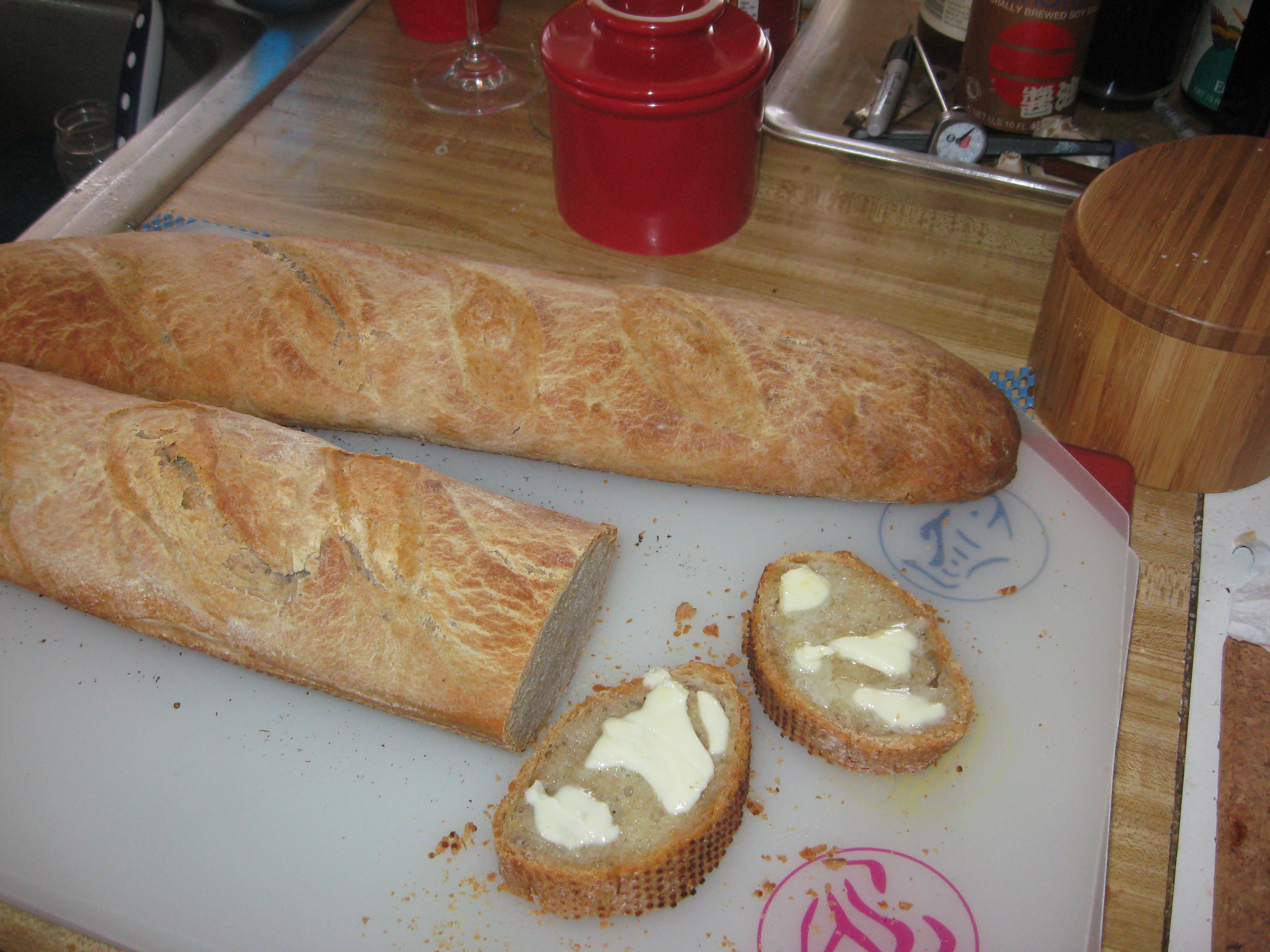
Oat flour bread dough for free-form loaf

Ingredients (3 one-pound loaves)

  • 3-1/4 cups lukewarm water
  • 2-1/2 cups oat flour (275 grams)
  • 1-1/2 tablespoons vital gluten (about 1-2 teaspoons per cup of whole grain flour)
  • 4 cups unbleached, all-purpose flour (King Arthur is my preference)
  • 1-1/2 tablespoon salt
  • 1-1/2 tablespoon granulated yeast

Preparation

  • Measure out and whisk together the dry ingredients (except for salt and yeast). When you’re adding vital gluten you need to be sure it’s well mixed with the flour before you add liquid or it can form lumps.
  • Combine lukewarm water, salt and yeast in the mixing bowl and gradually add the dry ingredients.  If you’re using a stand mixer, use the paddle instead of the dough hook.
  • Place in a covered, but not air-tight container, and allow to rise until doubled in volume; then refrigerate.
  • Pull of the amount of dough needed and shape as directed, and bake in an oven preheated to 400 ° F for about 45 minutes to 1 hour.
◊♦◊
perforated italian loaf pan

Italian loaf pan (perforated

I like to bake my bread in an Italian loaf  pan (bigger than a baguette pan), since it’s just the right diameter to slice the bread on a diagonal and have a good size for a small sandwich. For me this is an effort at mindful eating and  portion control–rather than “dieting”.   This would do well in a baguette pan for good crusty bread if you don’t want to use it for sandwiches.  The Italian pan gives with some of the good parts of a baguette when it’s fresh out of the oven, but the flexibility to have sandwiches later as well.

loaves fresh from the oven, one cut, one whole

yum!

Braise-roasted sausages, potatoes, and Brussels sprouts

Another dreary, rainy, winter day…not particularly cold, but as usual on a day like this I’m in need of comfort food.  In trying to keep one of my New Year’s resolutions to be sure and use what’s in my freezer, I was rummaging through the freezer to see what was there.  Interesting package of four plump sausages.  Only problem, I don’t know what they are–except that they are labeled “hot”.   But I’m sure they are due to be used–probably a sample that I got at one of the farmers’ markets this summer.  So we’re going to cook those this evening.  (I usually try to be careful to label things that get put into the freezer–I suspect that these were frozen when I brought them home, so I just tossed them into the freezer and…now I don’t know for sure what I’ve got.  But–they look like the should turn into a luscious meal once cooked.

Looking through the vegetable drawer in the fridge I found Brussels sprouts, potatoes (yes, I do keep my potatoes in the fridge because they aren’t in there long enough to change taste or texture.)

Onions, garlic, chili peppers, potatoes, sausages…and sprouts.  I’m being lazy today so I want easy food, but flavorful and satisfying.  Since there are four sausages I think that I should just do about 4 serving of this dish: one for another day this week, and maybe one for the “ready-to-eat” part of the freezer, along with the soup and the chilli.

I took four medium size Yukon Gold potatoes scrubbed but not peeled, cut into 1-1/2-inch chunks, mixed with about 6 or 8 garlic cloves, one medium onion chopped into 1-inch chunks, about 15 trimmed Brussels sprouts, all sprinkled with a three-finger pinch of salt.  On top of that go the four sausages, skins pierced so that they won’t explode, and some herbs. (Being in truly lazy mode, I used herbs de Provence since that’s got a variety of herbs so likely something will connect with the sausage seasoning.

I added about 1/4 cup of water, covered the baking dish tightly, and popped it into a 350 ° F oven.  I’ll check it in about 45 minutes.  When the potatoes are close to being done,  the cover comes off and  it finish cooking uncovered.  Add one green salad, or maybe just the sprouts, and there’s comfort food, and lazy comfort food at that!