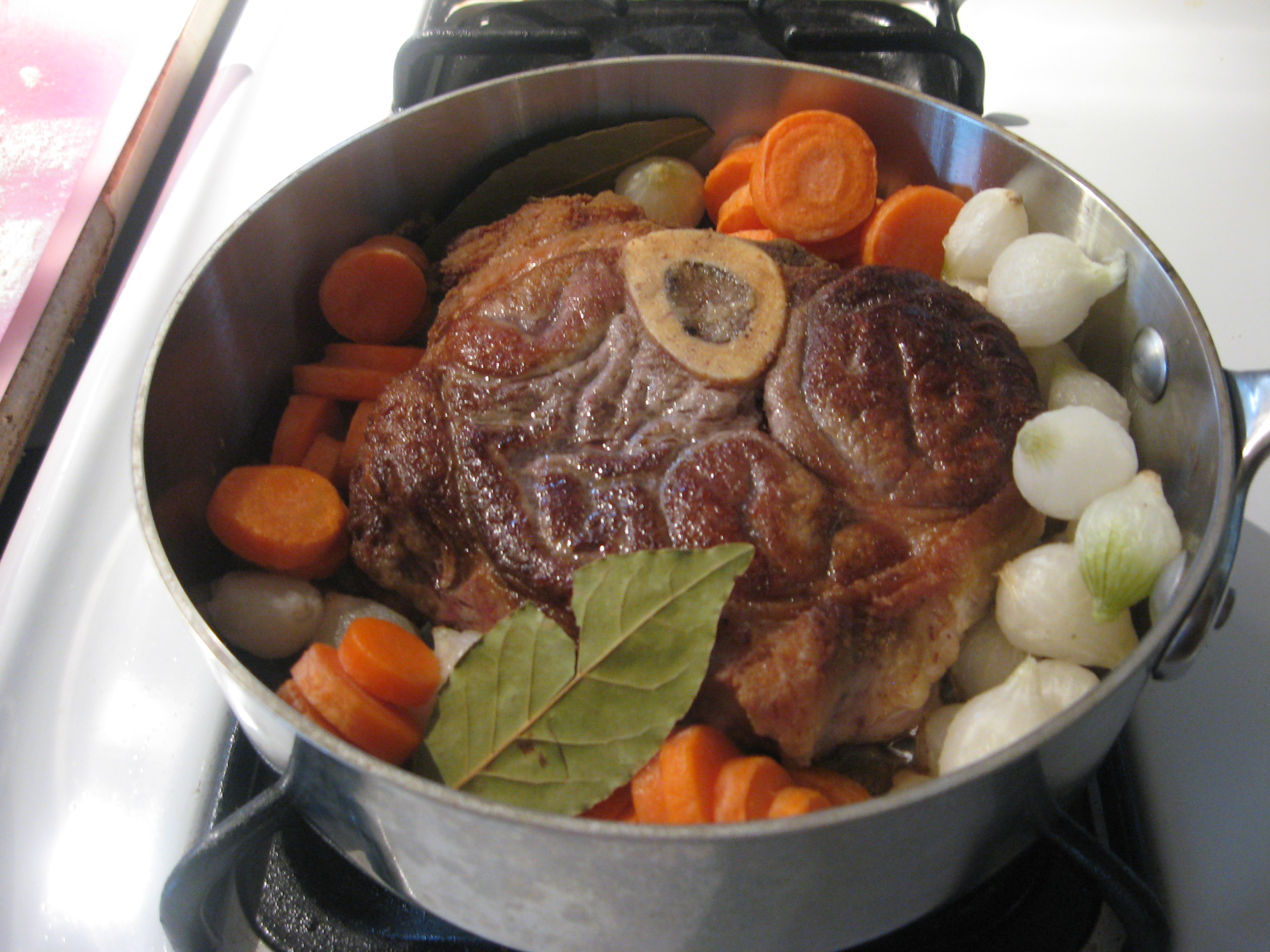
Prime beef!

I did eat well over the Christmas-New Year holidays. Most of my fancy stuff was sale “finds” (pheasant and duck breasts), but I did have one splurge. The holiday season brings out USDA prime beef (without having to special order it) so I took advantage of that and treated myself to a steak. I guess you could call it a steak, but it was almost a young roast.

I’m enough of a carnivore that I like my meat rare to medium rare, it was cut thick enough that I could get a decent sear on the outside and still be rare inside. I cooked this marvellous hunk of beef in a combination of oven and stove-top as directed by Cook’s Illustrated. My first meal was a steak and potatoes meal (with the leftover cabbage and rutabaga from my Christmas dinner.

Obviously, there were some serious leftovers from a chunk of beef that big. Mostly I just enjoyed the leftover steak by making “roast” beef sandwiches of various sorts. After all, that’s a treat you don’t often get when you’re doing single-serving cooking.

In the process of eating up all that leftover beef I had lots of splendid sandwiches. But I did come up with one spectacular one. I love bleu cheese, and I think it’s excellent with beef. It’s not unusual for me to top a steak with gorgonzola dolce or even just Danish bleu.

Rummaging in the fridge, I realized that there was just enough beef to make one last sandwich–and it was time to use it or lose it. There was also a slice of Boar’s Head MarBleu cheese. MarBleu has (as you might guess) something to do with bleu cheese: it’s Monterey Jack with bleu marbeling. It’s got the bleu cheese tang, but not so strong that it is overwhelming, and it can be sliced (delicious grilled cheese sandwiches, too). A beef and bleu sandwich was just what I needed, but the real pièce de résistance was what I used for a condiment on this sandwich.

In the process of putting the finishing touches on my Christmas Eve and Christmas day dinner, I went to Bull City Olive Oil to get some balsamic vinegars to use with the duck breasts. While trying to decide what to do with leftover duck and pheasant, I made another trip to Bull City Olive Oil looking for inspiration. In a shop that allows tasting, I’m constitutionally unable to NOT taste. One of the oils that I tasted was a chipotle infused oil. That was just the thing to help me get rid of the leftover duck breast (later on that).

That bottle was sitting on the counter while I was making my beef and bleu sandwich. I passed on the mayonnaise, the butter, and the mustard that I had been considering. Instead, I drizzled some of the chipotle oil on my bread, stack on my thinly sliced beef, and the MarBleu cheese. Great combination–just a bit spicy, just a bit smokey. (I had the green stuff on the side as a salad.)

Ò¿Ó

(No pictures of that beautiful steak–they disppeared somewhere betwixt the smart phone and Google photo so all I have are the gustatory and olfactory memories.)


Lamb Stew (Alentejo-style)

My bargain shopping got me a butterflied leg of lamb that was on special. Rather than roast it whole, I decided our chilly, grey, damp weather needed stew.

I cut the lamb leg into 3 cm cubes; I decided that I wanted some variety in my stews so since I had two pounds of lamb so all I needed to do was halve the recipes.Since I’ve not done much Iberian cookery I got out The Food of Spain & Portugal: The Complete Iberian Cuisine by Elizabeth Lambert Ortiz (page 152).  

pimenton-de-la-veraThere are a lot of lamb stew recipes in this book. I finally made a decision based on seasonings that sounded interesting: garlic, parsley, pimenton de la vera (smoked), cayenne, and cloves. (The recipe only said “paprika”–which I’m sure would work fine, but I particularly like the smokiness of the pimenton de la vera, but I used the amount called for.)

.

.

Carneiro à Alentejana

Ingredients

  • 4 cloves garlic, crushed
  • 1 tablespoon finely chopped parsley
  • salt and freshly ground pepper
  • 900 g (2 pounds), lean, boneless lamb, cut into 3.5 cm/1-1/2 inch pieces
  • 6 tablespoons olive oil or lard
  • 2 medium onions, finely chopped
  • 1 tablespoon paprika
  • 1/8 teaspoon cayenne
  • 1/8 teaspoon ground cloves
  • 175 mL/ 3/4 cup dry white wine

Preparation

  • Mix garlic, parsley, salt, and pepper. Add the lamb to the garlic mixture and marinate about 2 hours. (I left mine overnight)
  • In a large skillet, heat the oil or lard and brown the lamb pieces all over.
  • Transfer lamb to a flameproof casserole.
  • In the remaining oil and sauté the onion until soft and add to the casserole.
  • Add paprika, cayenne, cloves to the casserole. (I like to “bloom” dry spices in oil before adding liquid so I added the paprika while sautéing the onions)
  • Bring to a simmer on the stovetop.
  • Cover and put in a moderate oven (180ºC/350ºF) and cook until the lamb is tender (about 1-1/2 hours).

The author recommends serving with a light red wine (red Vinho Verde or Dão, and notes that in Portugal meats are usually served with both potatoes and rice.

õ¿õ

I halved the recipe above and used the other pound of lamb to make my favorite lamb and cabbage stew (Fårikål) with the other half. I considered being very energy conscious and making both at the same time; however, my hedonism won and I made them on different days because I love to luxuriate in the aromas of cooking–that’s part of the anticipation and enjoyment of cooking and eating. I just didn’t think I would get to enjoy them in the same way if I were to cook both at the same time. I would have missed some of the pleasure of cooking had I done that. The smell (especially of the pimenton de la vera) was particularly appetizing.

The combination of the pimenton, cayenne, and clove was wonderful. I don’t often use the “sweeter” spices with meats but that little dash of clove has made me wonder why I haven’t used them more with meat. I need to broaden my perspective on the “appropriate” spices to use with meats.

The balance of the seasoning in this recipe (I didn’t change anything) was wonderful–just enough cayenne to give a little “burn” as you eat your way through a serving, but not every getting to the point where you felt as if you had blisters on your taste buds–and the clove didn’t smack you in the face either. All in all a very well-balanced seasoning. I’ll probably try this with lamb shoulder chops–even without cutting them up.

Oh, wine? Well since there was a bottle of my “house wine” already open, I used that–it’s one of the things I like about that wine: it’s very versatile. Rice? Potatoes? Nope–garbanzo beans.

There is one modification I think I’ll make next time–I’ll add more onions they were luscious after cooking with the lamb and seemed just right with the pimenton.

Supper for a chilly evening….

If it were not that my outdoor thermometer is reading 46ºF I’d be calling it a snow day–grey, chilly, misty, damp, dreary. It seems like a day for “oven food”. While the oven is on, the heat won’t be coming on as much. Food and warmth in one.

I’ve hit the time when cleaning out the refrigerator becomes a necessity–not that I had anything about to grow legs and crawl out, just things that should be used, and it’s also time to rotate stuff from the freezer, too. So a browse through the fridge, the freezer and from the counters is making a meal–a one-pot meal. I did have go to the grocery store because this kind of weather calls for potatoes–and I had only a baking potato in the house–and those just don’t do for braises. So, leaving the Romertopf to soak while I   went to do cat care for a friend and got some potatoes and then started to see what would b_shank_crop_20161204_153707happen for supper–it’s a no-recipe event this evening.

I scrabbled around in the freezer and came up with a very large beef shank (with marrow in the bone), the refrigerator gave up some under-cooked collard greens ( I attempted to cook them in the slow-cooker–not recommended if they are older greens). The counter yielded some cherry tomatoes that were getting wrinkly, and there were some sliced shiitake mushrooms loitering in the fridge.

Even though it’s the weekend, it’s a working day for me so I’m doing lazy cooking. All of b-shank-covered_20161204_153715the above-mentioned items went into the soaked Romertopf–with bite-size Yukon gold potatoes added. I did my lazy herb seasoning (herbs de Provence), lots of garlic cloves, and then those cherry tomatoes that had wrinkles. Add a couple bay leaves, salt and water, and put it into a cold oven set for 350ºF–a kitchen happening. Had I soaked the larger Romertopf, I would have added some rutabaga and carrots too–but those looked as if they could linger for just a bit longer in the fridge. Now–to work!

ò¿ó

Today has been one of those frustrating days when I’ve had difficulty really concentrating–even though I didn’t have to attend to cooking supper. For all the true productivity I might as well have been in the kitchen cooking. Even without any attention, about three hours later, I’ve a really tasty meal–quite suitable for the weather tonight.

20161204_200628It may not be styled and truly photogenic, but the beef shank was very tender–but very beefy–it’s one of the things that is great about some of the less popular cuts of the cow.  The smoky, earthiness of the shiitake mushrooms, the mellow flavor of the roasted garlic made a great contrast to the bitterness of the collard greens (these took a lot of cooking to get them really tender). The healthy dose of bay and herbs de Provence really added a lot of flavor. I did finish my plate with a drizzle of herbs de Provence infused olive oil (Bull City Olive Oil). To accompany this casual meal I had a glass of 1999 Domaine Cros Minervois wine. Just the ticket to go with the very “beefy” beef and the collard greens!


A great supper for a rainy, damp, chilly evening. A successful kitchen happening without the vestige of a recipe in sight.

A son gôut!

shank_plate_20161204_200706

Õ¿Õ

.


Another lamb and garbanzo bean stew

Yesterday was the day for a trip to the supermarket–as usual dictated not by coupons but by me being low enough on milk that I was not going to be able to make enough caffè latte to get me awake and doing what I needed to do today. As usual, I didn’t go with preconceived notions of what I might bring home to cook.

I got my milk and eggs–just not possible to be out of eggs, but I was–and did my usual troll past the butcher counter. I found a manager’s special that was simply too good to pass up: lamb stew meat at a great price. Since my agenda today was mostly minor chores I thought I’d have time to cook, so I came home with lamb stew meat and actually remembered to soak (in brine) the garbanzo beans last night. You’re probably thinking so what?

Well, it’s fall and that makes me want to cook hearty stuff and lamb stew just seemed to be a really good idea: economical, tasty, some to go in the freezer for quick meals, and some to eat now. Unfortunately, the weather is not really cooperating–my thermometer is showing 82ºF right now–but at least it’s cooler in the evenings now so stew is not completely amiss. Still, so what?  Right?

Well, as I started my morning caffeination by browsing Facebook I was informed that I had memories from two years ago. Now I’m still not convinced the FB really cares about my memories, but the top item on the list was my post about making–yep!–lamb and garbanzo bean stew in the oven. Well, same today: it’s unseasonably warm again, but not too humid, and it’s sunny and breezy today so it’s oven rather than slow-cooker version this time. Since I did forget to soak the Romertopf  ahead of time, I just pulled out the Dutch oven instead.

I did look for recipes last night but didn’t really find anything inspiring, so today’s lamb stew was a “kitchen happening”–let’s just see what turns out. That two-year-ago lamb stew was an oven version of a slow cooker recipe. This year, given the weather I decided that I’d (again) do oven braising. (The slow-cooker version was good, but no way as good as the one done in the oven.)  I haven’t looked back to see what went with that version–all I really remember is that I used canned beans that time.

Oven-braised lamb and garbanzo stew (2016)

Ingredients

(I’m not giving much in the way of measurements here since this was a “kitchen happening”)

  • Lamb stew meat (about 3 pounds with some bones included)
  • Garbanzo beans (brined over-night)
  • Lots of onions (cheated and used frozen chopped ones)
  • Bay leaves–2 large
  • Salt about 1-1/2 teaspoons, give or take–will taste later
  • French thyme (dried)
  • Marjoram (dried)
  • Garlic powder (Oops–not a single head of garlic in the house!)
  • One 14-ounce can of diced tomatoes–drat, out of fire-roasted ones.
  • Smoked Spanish paprika
  • Olive oil as needed for browning lamb

Preparation

  • Brown stew meat (bones included; they will make good stock as the beans and lamb cook ).The bones are big enough to get out easily when the stew is done. Add to Dutch oven.
  • Saute onions until just golden, and add to Dutch oven with meat, beans, and tomatoes
  • Deglaze skillet with water and add to braising pot
  • Add  salt, herbs, and spices.
  • Bring to a simmer on the stove-top
  • Place in a 185ºF oven  and cook until beans and meat are tender–about 3 hours.

Ò¿Ó

Here I was, again, making this lovely stew in unseasonably warm weather but still cool enough to use the oven rather than the slow-cooker. Cooking my own garbanzo beans was well worth the thought and bit of effort that it took to soak them. Brining them seems to make them cook much more quickly. Leaving the bones in with the meat really gave a lot of lamb flavor–worth the effort of taking them out after the meat was done.

I love this combination of lamb and garbanzo beans–it seems that I’ve used different seasonings almost every time this “happens” in my kitchen, but it’s good every time! No recipe needed just season as you like…a son gôut!


Pork confit


Cool weather inspires cooking! Something warm and cozy–confit as a “pantry” staple for a starting point for multiple dishes. With the weather a bit up in the air I decided to make something that would give me lots of possibilities even if Matthew decides to visit.

Confit was originally made as a method of preserving meat–often duck or goose, but it’s a method that can be applied to other meats, fish, and seafood–e.g. tuna which I love for summer salads and cold meals but it’s a great starting place for cool-weather meals too. The traditional method is to poach meat in fat (oil) at low temperatures which yields meat that is intense in flavor, and absolutely luscious in texture. If you’re wondering, it’s NOT greasy! The Science of Cooking addresses many of the questions often asked about confit.

With cool weather here I decided to opt for my favorite meat–pork–and to try a slightly different method of achieving the end results. This inspiration sprang from finding country-style spare ribs on special at my local Harris Teeter market. Since the weather wasn’t quite cool enough for me to want to have the oven on for hours, I decided to use the my multi-function pot in slow-cooking mode to make pork confit.

packaged pork from the meat counter in the supermarket

Since country-style spare ribs have a lot of fat on them I decided that I didn’t need to submerge them in oil–the fat would render from them as they cooked in the slow-cooker. From experiments when I was trying to do monk fish sous vide, I knew that the slow-cooker mode would keep the temperature at 185ºF. Most confit recipes suggest temperatures between about 190ºF and 200ºF. I thought 185ºF would be workable (especially since the confit will be refrigerated after cooking) but will be covered with the rendered pork fat.

I took my country-style spare ribs and salted them liberally over night–e.g. “dry brine”, then rinsed, and patted them dry. Because of the fattiness of this cut, I added only a couple s tablespoons of olive oil in the bottom of the cooker and packed in the meat. I didn’t add seasoning other than the previous salting so I have a flavorful (but kind of “blank” canvas) to build other dishes. I set the cooker for eight hours and went on to do other things–like hive inspections.

The liquid which (intensely flavored broth/gelatin) was separated from the fat that was rendered and will ultimately make its way into soup or as “au jus” with the confit. The meat is now tucked away in the fridge sealed in the fat. Since this was originally a method of preserving meat, now with the addition of refrigeration, there is a long shelf-life if you separate the broth/gelatin liquid from the fat and then “seal” the meat in the fat. Old method, but useful in modern cooking.

This cooking method works with any meat–a favorite in this household is confit made with chicken (especially leg quarters or thighs). I think that this fall as “turkey” season rolls around I will try to find thighs to cook this way. It might improve my attitude toward turkey given the flavor and texture changes that result from the confit process.

The result? Absolutely as good as if I had done it in the oven though requiring less added fat than I would have added for that method.  Enough fat rendered to submerge the meat about three-quarters of the way up the sides. Even without additional seasonings the meat is luscious immediately after cooking–pure unadulterated pork flavor.

What’s on the menu for supper? Well, I’m thinking cabbage steak (done under the broiler) with pork confit that has been quickly reheated and browned (also under the broiler) but with the tahini sauce replaced with the juice from the confit process.

Ô¿Ô

Krups rice cooker IMG_3796

.


Pot roast made for one

beef shankEven though we are getting warmer weather now, there are still some grey, chilly (but not really cold) days here–the kind of day where you want to smell fresh-baked bread or something warm and filling cooking in the kitchen. Even though pot roast is something that reheats well, and freezes well when you make it, I don’t always want a huge batch so I was thinking about alternatives to the usual chuck roast.

Today it’s somewhere between ersatz osso buco and pot roast. I love pot roast, but starting with a huge (for single-serving cooking, at least) chuck roast is just a bit much when you don’t want to stock the freezer for future meals.

I decided that a cut of beef shank would make a great alternative to the chuck roast; just have it cut a bit thicker, and the marrow bone is another benefit.  Since I had this cow shank, I obviously thought of osso buco, though it’s true that  real thing is would be made with veal shanks. Veal shanks (and lamb shanks) are actually too pricey for my budget most of the time–I watch closely for managers’ specials in the butcher case.

browned beef shank I treated the beef shank just as I would a big chuck roast–I dredged it in flour and browned it in a mix of butter and olive oil.  (Smells luscious while it’s browning . The flavor and smell of butter–yum.)  While that was in progress, I got my veggies ready (meaning I got frozen carrots and onions out of the freezer),

(Note that this is in a pan of the appropriate size–not too big, not too small. There’s no plastic so this can go into the oven for a nice low and slow cooking, covered with its tight-fitting lid.

Once the shank was nicely browned, there not really much to do except tuck some carrots, onions, and bay leaves around IMG_8056the edges, a pinch of salt,  add some dry white wine, and some beef stock–just poured it in until it was about 1/3 of the way up the side of the meat. That’s the reason it’s important to have an appropriate size pot–too large and you have to add too much liquid.  We’re not wanting to make soup here.

Cover with a tight-fitting lid; use foil if necessary  to make sure of a tight seal.  Cook in  a low to medium oven (275 to 300 °F) for about 2 hours or until the meat pierces easily with a fork, and enjoy–without having  too much left over! (A dollop of gremolata would be good with this.)

Always Hungry? Another improvisation

Pork is one of my favorite meats, and it is not on the list of approved protein sources, although I assume it is in the category of “game and other meats” so I’m improvising a Phase 1 meal with a pork chop this evening. After reading a recipe from The Kitchn for 20160322_163300“Sweet and Spicy Braised Cabbage” my mouth was set for pork. The sweet part is going to prevent me from having that to go with my pork chop this evening (save this one for Phase 2 or 3).

I thought about taking  the lazy way out for vegetables and carbohydrate–use some of the mixed greens and borlotti beans that I had with my tuna steak, with  an addition of a little extra seasoning for the second time around, but that just did not tingle my taste buds today. So, sautéed kale this evening. I have a large bag of kale that I’m first going to sauté  simply with olive oil and then add seasonings to what I’m going to have with the pork chop–leaving the “extra” for later use to season differently  for later use. (I do quite often to avoid wasting food because I’m a picky eater who doesn’t want the same thing over and over.)

Supper this evening was part of this pork chop cooked on my cast iron griddle as described for pork neck steak–smoking hot griddle, first two minutes on each side, then turned at minute intervals until it reached an internal temperature of 130 degrees to allow for continued cooking while resting. Kale sautéed with black-eyed peas, and a side of sautéed apple (not good enough to eat out of hand, but fine when cooked). The sautéed apple replaced dessert with this meal. The contrasts of the slight bitterness of the kale, the earthiness of the black-eyed peas, and the sweetness of the apple with the pork did make my taste buds sit up and take notice.

20160322_171559

Ò¿Ó

This slideshow requires JavaScript.

Braised lamb shanks

Continuing my freezer clean-out, I discovered two lovely lamb shanks that I must admit, I had forgotten were in there.  The weather that we’re having now just begs for comfort food, so I decided to make braised lamb shanks and the shanks beg for white beans to accompany them.

Starting with a recipe for braised lamb shanks and white beans that I knew worked well I still perused recipes from some other reputable sources (Williams-Sonoma, Food and Wine, and The New York Times). My lazy side came to the front and I decided that I wanted to do this all in one pot–so I went with the New York Times recipe–except I used thyme instead of rosemary and scaled the recipe for two lamb shanks.

Then I decided to follow a favorite principle of mine in cooking: never do on the stovetop what you can do in the oven (extremely hot weather will modify this). After bringing the pot to a simmer on the stovetop, I popped the pot into a 275°F oven for a few hours–low and slow since this is supper for tomorrow, likely with a grilled (well, broiled given the weather) cabbage wedge for a side.

Even for two shanks, this comes out to be a lot of food, so I’m looking forward to putting some into the freezer for another rainy day meal when I’m feeling indolent.

Gremolata

A simple, quick way to add some kick and freshness to lots of dishes: gremolata.  It’s an Italian classic served with osso buco, but can be used with almost any grilled, roasted, or even boiled meats, fish, or with vegetables. It’s especially delightful in the winter when food is a bit heavier and lacks that spring and summer freshness. Great taste, and it is so simple and quick.

It’s one of those things you don’t really need a recipe for. It’s just lemon zest, parsley, and garlic. Here is a nice post from The Kitchn that should give you all the information you need to whip up this condiment.

Once you’ve got this basic condiment down, you’ll find lots of uses for it, and here are some variations for different dishes.

So many variations!

A son goût.

Snow day. . .

Well, not really a snow day (I wish!), but an ice and wind day, the second in a row here. It’s a grey day with a few snowflakes fluttering around. It’s not so far been a productive day. I’ve been wandering from room to room, fighting the urge to take a lesson from the cat. Neither did he go with me to make morning coffee nor did he get out of bed when I started rattling around in the kitchen. He simply got under the duvet instead of on top.

Cat looking into refrigeratorSo I’ve resisted the lure of book and duvet to try to accomplish something, even if not useful or productive, just something I can say that I did. The motif today seems to be opening, peering inside, and closing doors, figuratively and literally, including internet browsing–opening a site and then just passing on to another. I’ve peered into the cabinet where all the plastic storage containers live and close the door tightly and firmly, then opened the internet door (Google search) on organizational ideas for empty containers.
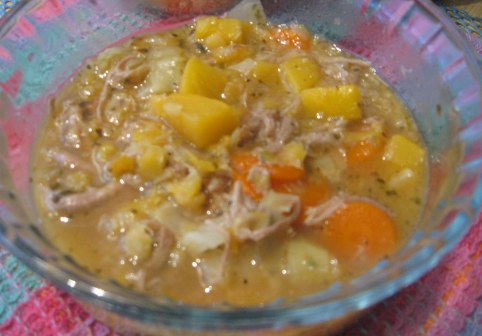
Peering into the refrigerator led to the conclusion that I didn’t want to eat anything that was already in there. The threat of power outage led me to follow a link on what foods were safe after a power outage, but that didn’t catch my interest either (no new information, and no power outage here yet). My list of blogs that I follow l did provide something that held my attention: posts on one taste at a time caught my interest–food waste and eating mindfully. After reading (and reblogging those) my meandering led me back to the kitchen with thoughts of something warm and cozy to eat this afternoon.

This recurring theme eventually led to the freezer compartment of the refrigerator which has been needing organization and sorting for a while. Gazing at a container of stock finally got my interest. What better way to start sorting and organizing that to make something from what I found in the freezer that was approaching its end-of-life-even-if-frozen state.  Thus: mostly freezer soup happened–with additions from the crisper drawer.

Ingredients

  • pulled pork (from a large pork butt, slow-roasted in the Schlemmertopf)
  • two packages of stock (one pork, one chicken)
  • the last package of sofrito (a staple, but needing to be used and replaced)
  • carrots (the last of a bag that had been vacuum packed for later use)
  • 1/2 small rutabaga, diced
  • two handsful of cabbage, in bite-size pieces (a crisper staple)
  • about 1 cup yellow split peas
  • about two teaspoons Hatch red chili powder
  • a dash of dried oregano
  • (a retained bay leaf from the pulled pork)

Preparation

  • thaw and sauté the sofrito to brown lightly (frozen with olive oil)
  • add chili powder and oregano to bloom in olive oil
  • add frozen stock
  • add pork
  • add rutabaga, cabbage, and split peas
  • simmer until rutabaga and split peas are tender (about 40 minutes)

Supper is on! IMG_8880

As is typical of all soup making, there is more than I’m going to eat, but some will go back into the freezer for a quick meal on another grey day–carefully labeled, and dated.

Ò¿Ó

.