Trying to keep the New Year’s resolutions…

I’m really trying to keep my New Year’s resolutions, though sometimes I think that I should simply resolve each year to try to do better on keeping LAST year’s resolutions.  But it’s a new year, new start, so here goes!

I’ve just gotten back from the grocery store–with only one thing that wasn’t planned–That was a veggie that I’ve never seen in this Harris Teeter before–a Boniato (Cuban sweet potato). While I gripe loudly and constantly about how crowded the grocery store always is on Sundays, it’s what seems to work for me–so I gripe and still shop on Sundays–unless I ran out of milk on Saturday!

The grocery shopping took a bit longer than usual, but I went with the idea of doing some meal planning on the hoof.  (I like to shop by what looks good and what’s on special, so meal planning at home doesn’t necessarily work for me.) I went with a set number of meals in mind–and the meat (at least vaguely) in mind, then walked around looking to see what was on special, and what looked good–in other words,  produce and meat.

Knowing that we can expect some cooler weather over the next week did influence my shopping, and so did the fact that I’m still knee deep in course prep for the medical terminology courses that I’m teaching.  I need cool-weather dishes that I can pop into the oven (Römertopf is out on the counter–and I can scarcely believe that I’ve not posted about cooking something in them before this.)

The result of my meal planning on the fly was this and I’m going to keep you posted on how well I succeed with this–hoping for some peer-pressure here:

  • It’s really too-warm-for-the-season weather here today, so I’m having something light (and “leftover”)–cod re-warmed with the tomato sauce that I brought home from the Italian restaurant, and cauliflower and black olive gratin (had all the ingredients in the fridge except the cauliflower.  I purchased enough for one good-size serving from the salad bar–cheaper than a whole head of cauliflower when I know part will likely go to waste.)
  • Lamb (shoulder chops to be cut up) braised with veggies–in the Römertopf–with an under-appreciated vegetable–turnips.  Personally I love them raw too, and like the sweetness that they add to soups, so they get used a lot.  Doesn’t hurt that they store so well either.
  • Chicken thighs to roast (most likely Römertopf  again) with some root vegetables (have carrots, turnips, parsnips, and some cabbage).  There will be at least two meals from the chicken thighs.
  • Since I have some lovely ham stock (courtesy of a friend sharing ham and the ham bone with me) I’m going to make some bean and kale soup for one warm cozy supper.
  • While I was perusing the New York Times Health section and stumbled onto a recipe for a turnip gratin that is a possible for a side dish with some of the chicken.
  • Then last, but not least, is a fresh black pepper and onion sausage that most likely headed into the Römertopf with some potatoes, to be accompanied by some cabbage that’s been quickly microwaved with a bit of extra-virgin olive oil.

After my meal planning, I’ve got a couple servings of meat (chicken thighs and pepper-onions sausages) that are flexible and should lend themselves to other things if my appetite doesn’t fit my plans.  The sausages could always end up in another “one-pot” dish.  There are also some salad makings in the fridge, and some fruit (Fuyu persimmons, apples, and oranges) for dessert.

One of the things that I like about recipes like those for the cauliflower-black olive gratin and the turnip gratin, is that even though they say “serves 6” they are SO easy to cut down to size for single-serving cooking.

So that’s my plan for this week–regular cooking that is healthy, and doesn’t promote waste from things that just don’t get used.  There are some lunches to be made during the week since most of my courses are online this term–meaning I’m home to fix brunch or lunch for myself.  Maybe that Boniato will fit there.

I’ll be posting more about these meals, but, please, wish me luck with the New Year’s resolution!  Now, off to the kitchen to do the cauliflower-black olive gratin to go with my cod in tomato sauce!

Chilli and Nutmeg Dark Chocolate Bark

I have to try this–I’ve had dark chocolate with nutmeg and love it…and dark chocolate and chili and love that (but then I’m a serious chocoholic anyway).

frugalfeeding's avatarFrugalFeeding

chilli dark chocolate bark

When one really takes time to delve into all things festive it quickly becomes clear that it is unlikely that there will ever be an end to Christmastime culinary possibility. In fact, it turns out that it’s dreadfully difficult to keep one’s blog up-to-date with all that is being produced. The weather is the entity most at fault here, but what can one do? It’s difficult to castigate the weather – it makes a mockery of us all.

Following on from my recent monologue regarding presents and the meaning of Christmas, a little gifting advice may be necessary. For those of you that weren’t aware, chocolate is always a safe bet – is there anyone who doesn’t covet one form of chocolate or another? It is in this spirit that I bring you my recipe for chilli and nutmeg dark chocolate bark; it is both frugal and spectacularly delicious. Perhaps…

View original post 450 more words

Cucumber mango salad

Photograph of 7 mangoes in case with PLU stickers

mangoes

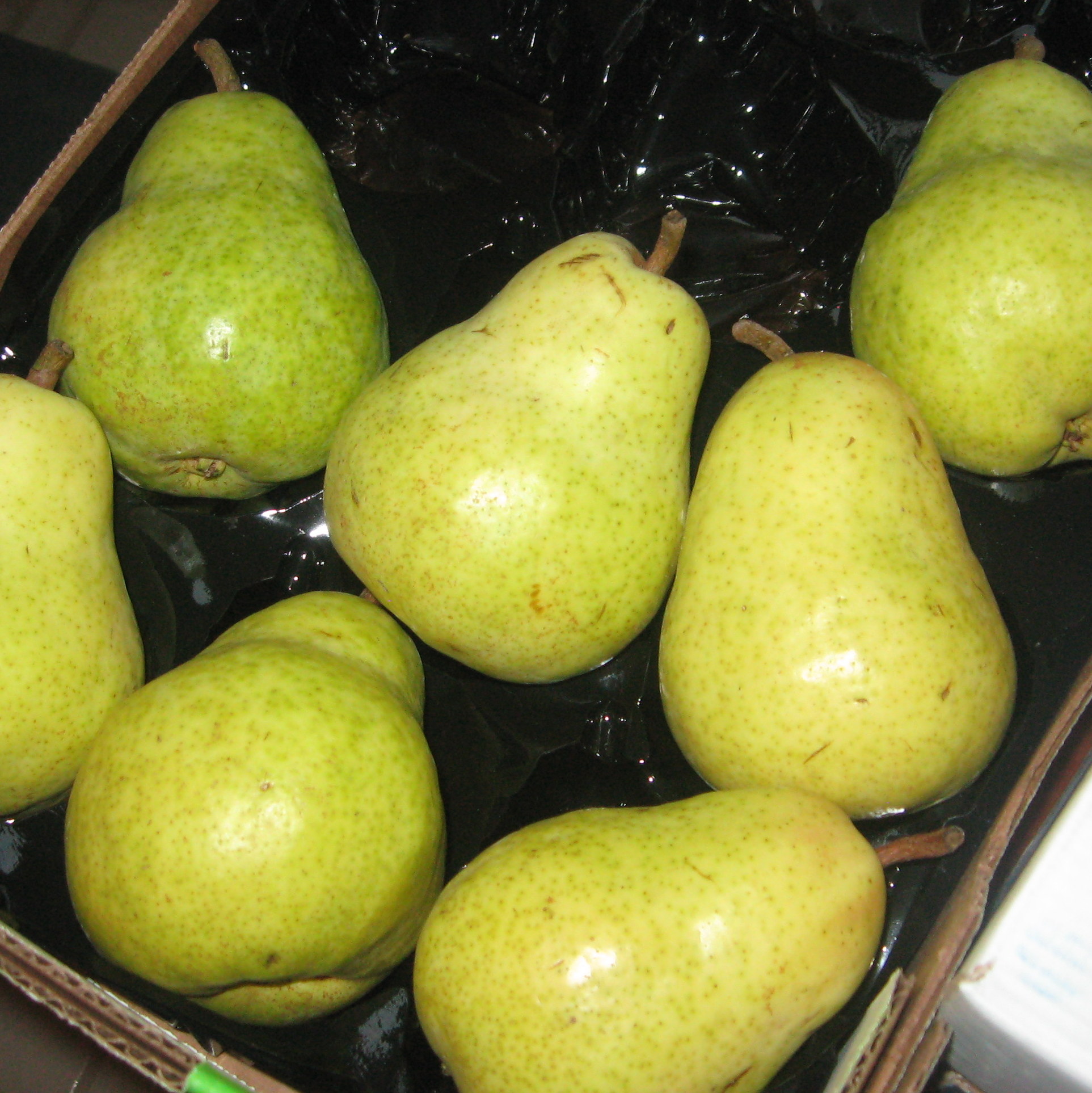
Yesterday I had a minor food crisis–fruit overload.  I went to Costco (for cat food and laundry detergent) but while walking past the huge stacks of produce I smelled first peaches, and then pears–and then there were the mangoes. The difficult decision was pears or peaches, and/or mangoes.  The pears won over peaches though the peaches smelled as good as the pears, but the price was such that I brought both mangoes and pears home with me. Both were much more reasonably priced than in the supermarket. So it was a no-brainer–I eat all the pears and mangoes that I want and share some with friends and I’m still ahead on the cost. (The pears were absolutely luscious–every bit as good as they actually smelled!)

bartlett pears in case (from costco)

Bartlett pears

That quantity of fruit does have you looking for some things to do other than just eat it out-of-hand.  I had some mangoes that needed to be used; I had eaten lots and shared some, but I needed to eat some more! (Not that eating big, juicy, ripe mangoes is really any hardship.) Saved by inspiration that struck when I started smelling my supper cooking.

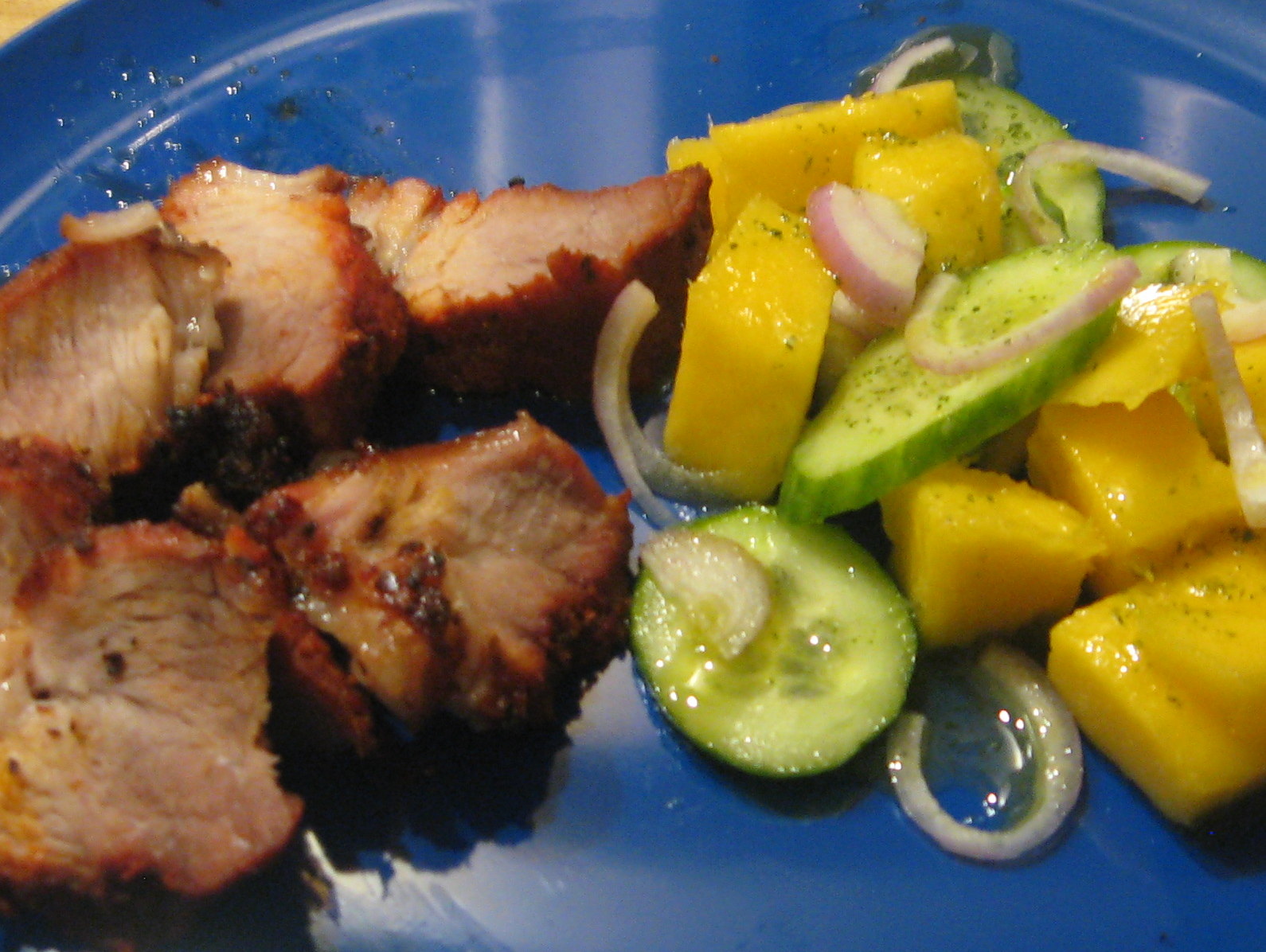
I was roasting some pork (on which I’d used a dry adobo seasoning rub given to me by a friend as a birthday present)–just a single big meaty spare rib for supper. This was one that was extra from making the chili con carne--simply would not fit in the pot so it became a small pork roast for one with just a tad left over.

I couldn’t think what to have with it until I smelled the roasting pork with the spicy adobo seasoning, something said “sweet and cool”–I thought of mangoes and cucumbers (which were sitting right there in the refrigerator just waiting to be used).

Not being particularly inspired about what to do with these two things, I headed for my laptop and Google!  As I was entering the “cucumber and ma….” the instant search which I’ve enabled popped up “cucumber and mango salad”.  That sounded just right with spicy roast pork.

I perused a number of recipe sites and blogs and found several interesting ones for cucumber and mango salads (and somehow I thought I was being very original when I visualized that combination):

  • from Daily Bites blog mango and cucumber, lime, ginger, honey (or coconut nectar–something new to explore), and optional cilantro.
  • from Eating Well which added avocado, brown sugar, rice vinegar, canola oil, and fish sauce as well as red pepper flakes.
  • from Herbivoracious  using Thai sweet chili sauce, rice vinegar, mint and cilantro leaves, and toasted sesame seeds.
  • from My Recipes  the simplest of all–cucumber, mango, lime juice and ground red pepper.
  • from Rookie Cookie with the addition of jacima, red bell pepper, honey, rice vinegar, and chile powder.
  • from The Full Plate Blog those basics but with champagne vinegar in the dressing, and suggestions for optional pea shoots (yum!), and slivered almonds, with romaine lettuce.

Those certainly gave a place to start for concocting for what I needed that night’s supper.  Then I found recipes with suggestions for adding grilled shrimp…seems like these need to be explored  much more carefully next time I’m that flush with mangoes.

rosy-cheeked bartlet pear and mango on blue/purple print towel.

pear and mango

Since my adobo rub had given me quite a spicy seasoning for the pork, I decided that I did not want to add chile powder, or even ginger–anything at all spicy to the salad–I wanted something cool and contrasting with the spicy meat.

I opted for the bare basics: cucumbers (the little baby ones), mango, shallot (no red onion in the house),  and since I didn’t have fresh mint (I’ve now killed my second plant), I used frozen cilantro (from Dorot) in the dressing which was just a simple vinaigrette made with olive oil and sherry vinegar (drat–no lime or champagne vinegar) and I didn’t think that rice wine vinegar would stand up to the adobo seasoning of the pork).

Even one mango and cucumber gave me some extra, so I dressed only what I was going to eat right then.  (What was left became another salad, with very thinly sliced pork right in with the fruit, and I added some of those luscious Bartlett pears to it as well–threw that over some mixed greens and it made an awesome lunch. I dressed with a fig-infused white balsamic vinaigrette since I added the pear.

The combination of mango, or other sweet fruit, and cucumber is definitely one that I’ll be playing with in the future–probably with chicken, shrimp  or maybe even crab, or scallops to “bulk it up” a bit for a complete meal.

(I know, it’s not a beautiful plate, but I was too hungry to go outside in the dark to find garnish–I almost didn’t even take a picture.)

A son goût!

pork, cucumber-mango salad

supper

Chilli con carne redux update

I’ve finished the “fast” version of the chilli con carne that I posted about in Chilli Con Carne Redux!  I’ll concede that it’s only sort of faster in terms of the active prep time–it still needs to cook long and slowly, but it is a success.  I don’t think that I can tell the difference (tasted side-by-side with the more laborious version from the freezer) and friends have given it the nod of approval.  So here are the changes and additions to the original chilli con carne that I posted.

  • After the bacon browned, 3 tablespoons of tomato paste was added while the onions were sautéed, and this was browned–again to enhance the umami, not to add tomato flavor.
  •  None of the meat (pork or beef) was browned before adding liquids.
  •  Added bay leaves to increase the earthiness (used five large for this 6 pounds of meat).
  •  Added Mexican oregano–about 2 rounded teaspoons. (You really do want Mexican oregano for this–much different flavor than Turkish or Greek (Mediterranean) oregano–after all it is an unrelated plant, but worth having in the kitchen if you like chili.)
  •  Sun-dried tomatoes (about 1/2 cup chopped) were added for more umami even though this was NOT made in a slow cooker, I was not aiming for tomato-flavored chili.
  • During the cooking time I tasted some in a bowl with a little fish sauce added (yep, I did get up the nerve to try this) and it tasted wonderful; so I added about 4 or 5 tablespoons of fish sauce.  (I suspect that if you don’t have fish sauce a couple of anchovy filets thrown in would have the same effect.)
  • The final thickening was one with a brown roux made with masa harina.  For the fat in this roux I reserved about 1/4 cup of the fat from the de-fatting step.  I heated this and made sure that all liquid was evaporate, then added about 6 tablespoons of masa harina and cooked it until it was a medium brown and toasty smelling.
  • Because of my work schedule, this was cooked in a lower oven (about 195° F) for about 10 hours.

After another run on this I’ll have to post a revised recipe for the “fast” and easier version, but if you feel so inclined you can work with these changes–after all chili con carne is one of those things that really doesn’t need a recipe to be followed strictly.

Chilli con carne redux….

I love my chilli con carne–but it’s very a very time-consuming kitchen project so after considering umami in the slow cooker I though I’d try a few shortcuts, with some umami boosts.

I usually buy a big chuck roast and cut it up myself, but I found that my local Harris Teeter had stew mean which was chuck roast already cut up, so I bought a big package of that.  Some time saved there.  I did have to cut the pork, but I bought  spare ribs so that all I had to do was cut them into chunks–another bit of time saved.

One thing that takes a lot of time is browning that much meat, so I thought I try bypassing that step since I still plan to cook it in the conventional oven very slooooowly, letting evaporation and concentration happen so there should get a little browning as the liquid reduces.

I toasted all the spices (cumin and coriander) and the chilli peppers that went into the pot and added a little tomato paste that had been browned.  I know that fish sauce (nam pla) and soy sauce are supposed to boost umami, but I just couldn’t put either of them into the pot.  If this doesn’t work, I guess I’ll try that next time.

The pot of chilli con carne is ready to go into the oven as soon as the oat bread comes out.  So some hours from how, I’ll know if this worked or not….

Umami in the slow cooker…

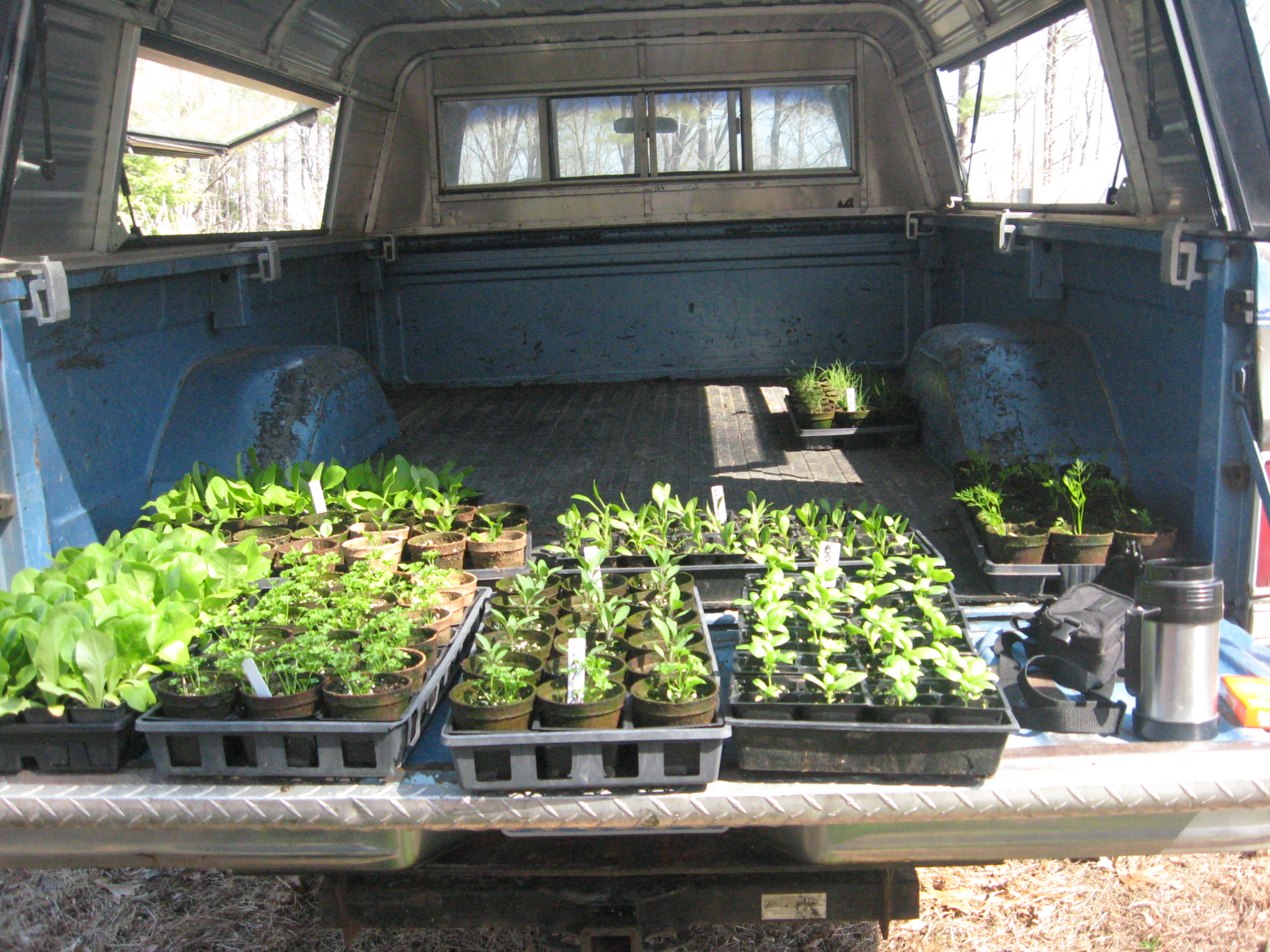
flats of plants on tailgate of truck to be loaded for the farmers' market.

for market

Obviously I’ve not been giving a lot of thought to cooking  things lately–it’s been end-of-term grading, indexing and proofreading, or getting  ready for the farmers’ market, or actually being at the farmers’ market, with more energy going to planting things, both for later harvest and for selling at the market than into cooking.

One of the down sides of working the farmers’ market is that I’m one of those people who wake up like a compact fluorescent bulb–pretty dim at first–so getting to the farmers’ market on time on Saturdays involves getting up before the birds just to give me time to be awake and functional. Even Fridays demand early rising, especially as the weather gets hotter–flowers to cut early in the morning and produce to be harvested before the heat of the day sets in and thing wilt…and just to avoid being out in the worst of the heat.

wagon of flowers in buckets

cutting flowers

I’m getting into the swing of that now but it still takes time for my lights to come on, though less painful now.  That early rising on Friday and Saturday makes me into a really lazy slob on Sunday.  Now that the Spring term is over, I’m not meeting classes during the week so I’m enjoying the summer hiatus from lecturing, but still working at freelance indexing so the absolute laziness has to be confined to Sundays and Mondays through Thursdays are still busy.

All this means that for Friday, Saturday, and Sunday cooking is likely to be focused on one-dish meals, and dishes that are good (or even better) when reheated.  Sometimes Saturday meal is not even something reheated–it’s my treat-yourself day–OnlyBurger for after-market meal before I devote the rest of the day to quality time with the cat!  (This past Saturday the treat was a Texan (burger with braised brisket on it) and a peach ice cream sandwich (handmade at OnlyBurger) after the market.  The evening meal was Carolina Moon cheese and strawberries–both from the farmers’ market.)

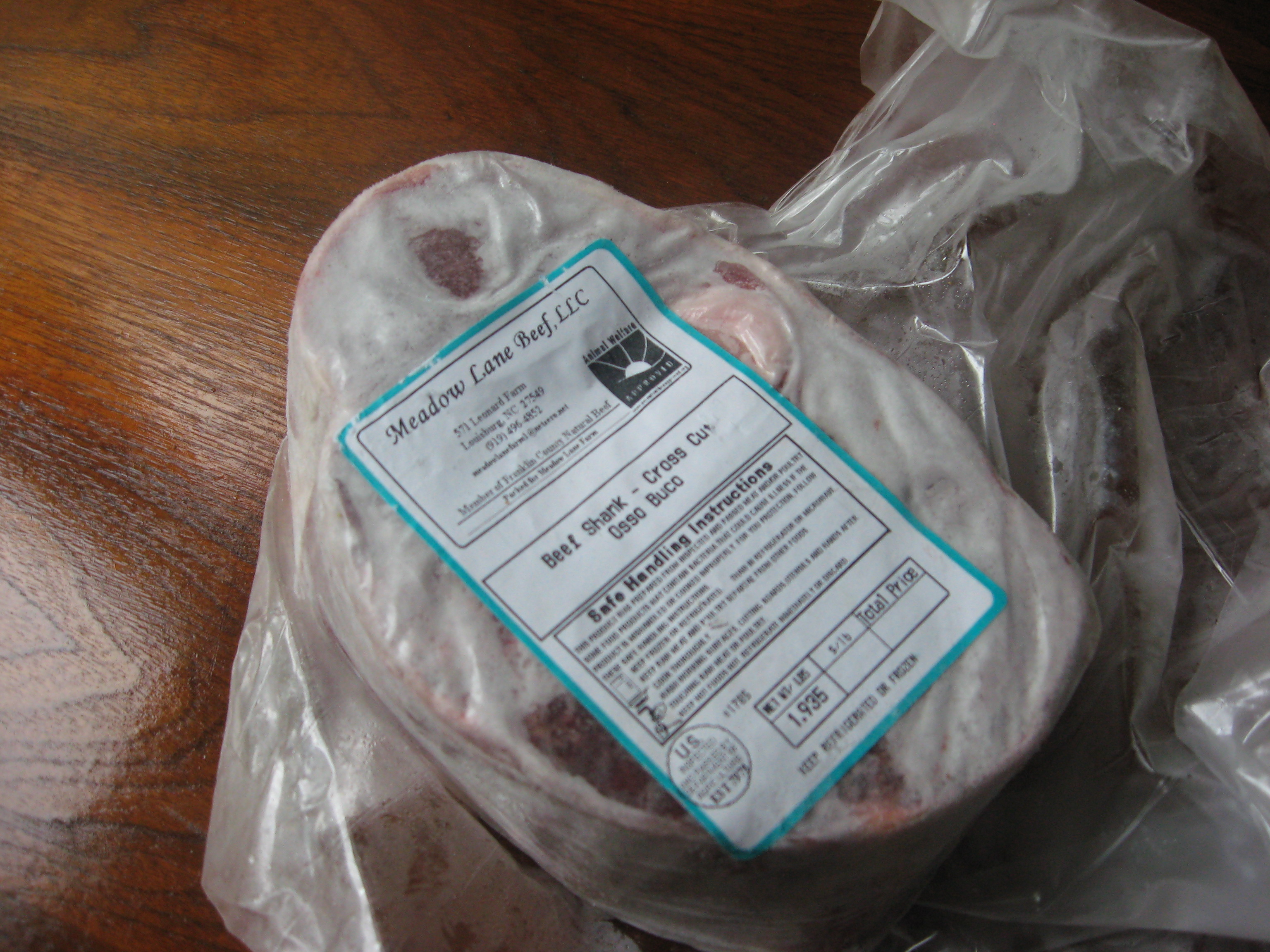
packaged cross-cut beef shank

beef shank

This weekend schedule means that I try to do some planning and cooking on Thursday to have reheatable food on Friday and Sunday.

This weekend’s meals are going to feature an absolutely lovely cross-cut beef shank from Meadow Lane Farms (also from the Durham farmers’ market)  in an easy dish that can cook mostly unattended: osso bucco, but with beef shank rather than veal shank. (The osso bucco really just means “bone with a hole” or marrow bone.)

It’s a dish that’s easily adapted for one person–there’s nothing fussy about it–no need to be exact or tedious in measuring ingredients, and to make even more “unattended”, it will go into the slow cooker (also serving as rice cooker and steamer) while I’m out working on the farm.

Krups rice cooker/slow cooker and steamer

Krups rice cooker

I have to admit that I’ve not been a fan of the slow cooker until recently, at least for anything much more than cooking dried beans, or poaching a beef tongue. The flavors and textures just aren’t the same as when the slow cooking was done in the oven where some evaporation, browning and concentration takes place even in a covered dutch oven.

My attitude about slow cookers has changed since I found the Cook’s Illustrated Slow Cooker Revolution (See Bibliography) and learned some techniques for making food out of the slow cooker more flavorful.  I’m not ready to quit slow-cooking in the oven despite that, but in hot weather I’ll certainly use the slow cooker more often with some of the “tricks” I learned from that cookbook.

What I missed most in slow-cooker dishes was that savoriness that comes from browning (Maillard reaction)  when you slow-cook in a traditional oven or brown/sear on the stove-top.  In the slow  cooker, you can make this absence less noticeable by adding ingredients that contribute “umami“.

Some of the most useful things I learned from that Slow Cooker Revolution are ways to use the microwave oven to facilitate the slow cooker, and using some “unusual” ingredients  in recipes–not esoteric ingredients, just pantry staples that boost  the umami flavor:

  • precooking aromatics like onions in the microwave so that they don’t stay crispy-crunchy in the slow cooker,
  • using tomato paste (for umami) by browning it with the aromatics either in a skillet or in the microwave before adding it to the slow cooker,
  • using dried mushrooms to boost flavor (again, umami),
  • using foil packets in the slow cooker to keep some ingredients from over cooking.
  • using soy sauce or fish sauce to add more of that umami that many slow-cooker dishes don’t get without the evaporation and browning as in the traditional oven.
  • using the microwave to precook some ingredients to get rid of excess moisture that would otherwise dilute the dish in the slow cooker.

These are all easy to do–they really don’t add significant extra prep time or effort, and do really make a difference in the flavor.  I expect an easy, flavorful meal (or two) from the braised beef shank that is going to emerge from my slow cooker on Friday evening, thanks to some added umami!

Braise-roasted sausages, potatoes, and Brussels sprouts

Another dreary, rainy, winter day…not particularly cold, but as usual on a day like this I’m in need of comfort food.  In trying to keep one of my New Year’s resolutions to be sure and use what’s in my freezer, I was rummaging through the freezer to see what was there.  Interesting package of four plump sausages.  Only problem, I don’t know what they are–except that they are labeled “hot”.   But I’m sure they are due to be used–probably a sample that I got at one of the farmers’ markets this summer.  So we’re going to cook those this evening.  (I usually try to be careful to label things that get put into the freezer–I suspect that these were frozen when I brought them home, so I just tossed them into the freezer and…now I don’t know for sure what I’ve got.  But–they look like the should turn into a luscious meal once cooked.

Looking through the vegetable drawer in the fridge I found Brussels sprouts, potatoes (yes, I do keep my potatoes in the fridge because they aren’t in there long enough to change taste or texture.)

Onions, garlic, chili peppers, potatoes, sausages…and sprouts.  I’m being lazy today so I want easy food, but flavorful and satisfying.  Since there are four sausages I think that I should just do about 4 serving of this dish: one for another day this week, and maybe one for the “ready-to-eat” part of the freezer, along with the soup and the chilli.

I took four medium size Yukon Gold potatoes scrubbed but not peeled, cut into 1-1/2-inch chunks, mixed with about 6 or 8 garlic cloves, one medium onion chopped into 1-inch chunks, about 15 trimmed Brussels sprouts, all sprinkled with a three-finger pinch of salt.  On top of that go the four sausages, skins pierced so that they won’t explode, and some herbs. (Being in truly lazy mode, I used herbs de Provence since that’s got a variety of herbs so likely something will connect with the sausage seasoning.

I added about 1/4 cup of water, covered the baking dish tightly, and popped it into a 350 ° F oven.  I’ll check it in about 45 minutes.  When the potatoes are close to being done,  the cover comes off and  it finish cooking uncovered.  Add one green salad, or maybe just the sprouts, and there’s comfort food, and lazy comfort food at that!

Braised pork and cabbage (Caribbean seasoning)

I’m of the opinion that cabbage is a much under-appreciated vegetable!  It’s good for so many things besides the traditional “coleslaw”.  One of my favorite things is to use it in braises.  Here is one of my favorites:  Braised pork and cabbage.  Again, it’s versatile, freezer-friendly, and the quantities are flexible.

Heads of savoy cabbage

Savoy cabbage

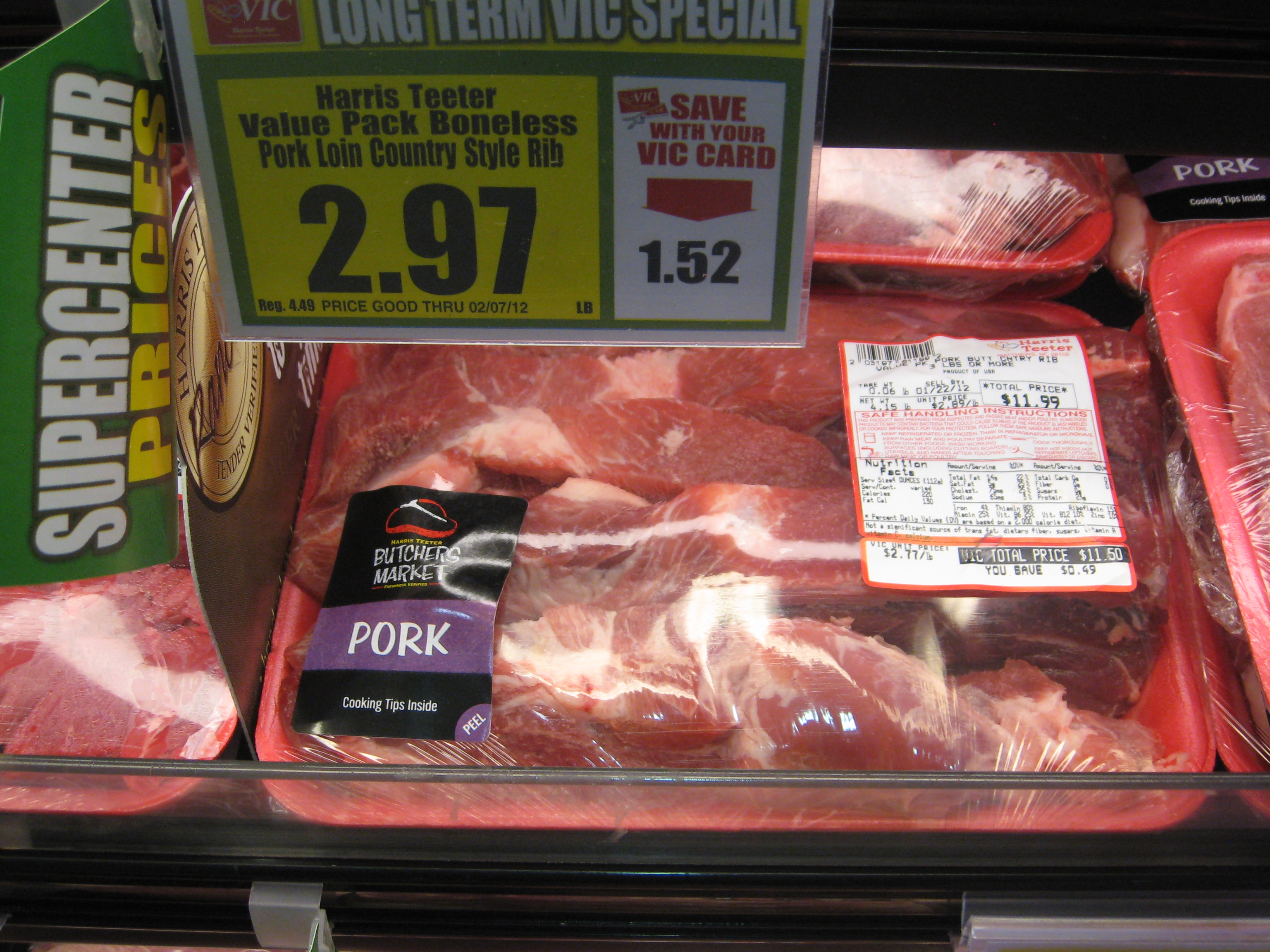
A particular favorite is from Jacques Pepin’s Cuisine Economique.  I’ll give you the basic recipe here ingredients as given in that recipe and summary of the preparation.  If you’re interested in ways to take economical cuts of meat and make them into something really good, this is a book worth looking at (See Bibliography).  The recipe is here not to give you quantities, but to suggest seasoning.  While this recipe suggests a larger cut of pork, I usually get the boneless country ribs to use for this–they are really more like pork butt than are loin chops.

Braised Pork and Cabbage (p. 247)

Ingredients

  • 2 teaspoons salt
  • 2 teaspoons dried oregano
  • 1/2 teaspoon allspice powder
  • 1 teaspoon cumin powder
  • 1/4 teaspoon cayenne pepper
  • a 4-pound pork roast (loin tip, shoulder, or pork butt)
  • 1 tablespoon virgin olive oil
  • 1 large or 2 medium-size heads Savoy cabbage (about 2-1/2 pounds), leaves cut into 2-inch pieces and core cut into 1/2-inch pieces
  • 2 large onions (about 1 pound), peeled and sliced
  • 1 tablespoon of sugar
  • 1/2 cup cider vinegar
  • 1 tablespoon dark soy sauce
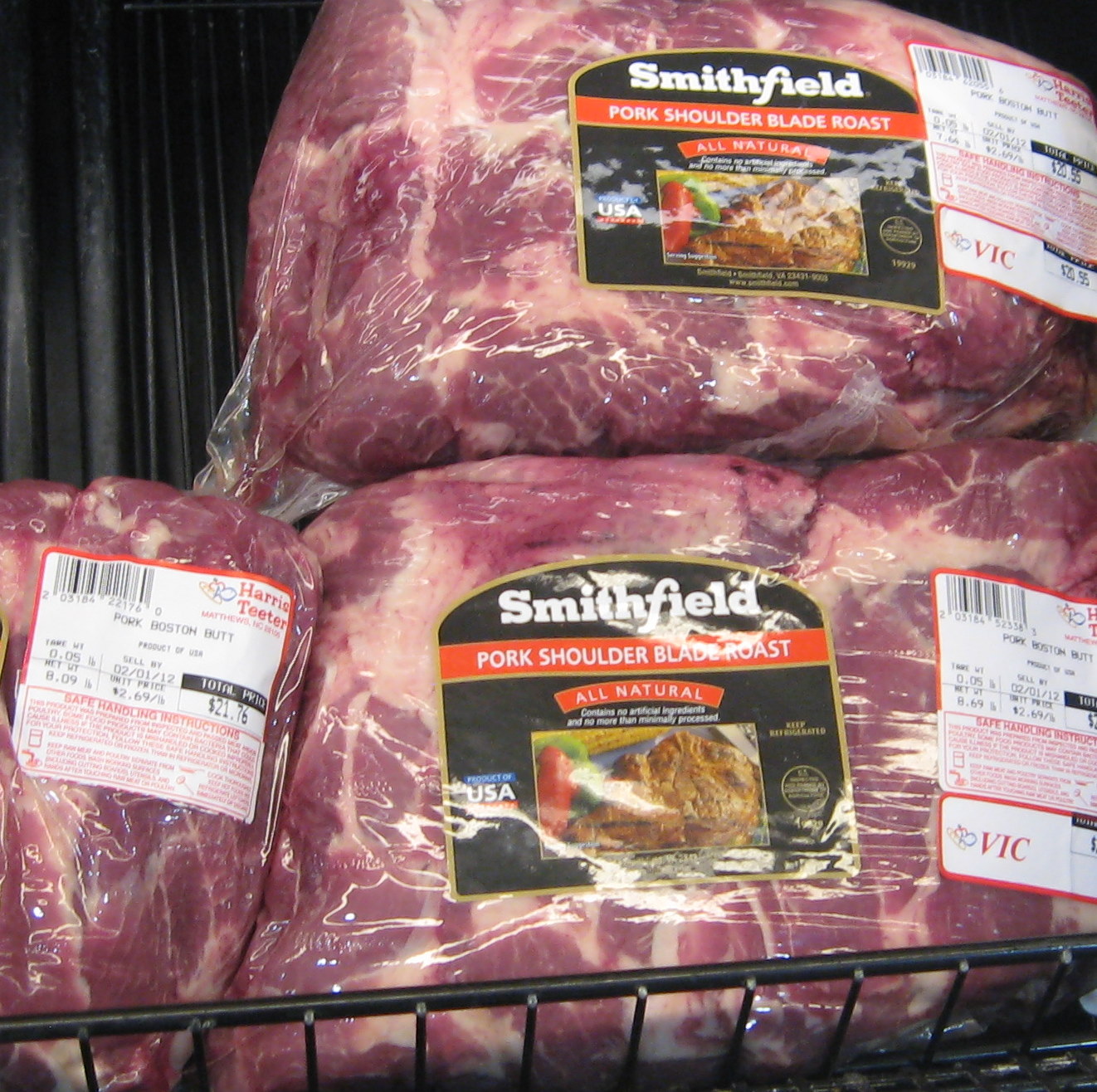
packaged pork boston butt

boston butt shoulder roast

Preparation

  • Mix the salt, oregano, cumin, allspice, cayenne, and rub the mixture all over the meat.  (See Notes.)
  • Heat the olive oil in a heavy pot.  When hot, brown the meat over medium-to-high heat for about 30 minutes (See Notes) until well browned on all sides.
  • Cover tightly and place in a preheated 325 ° F oven and cook for 45 minutes to a hour.
  • Remove the meat and transfer to a platter.
  • Combine the cabbage, onions, sugar, vinegar, and soy sauce in the pot.
  • Put the meat on top of the cabbage, cover, and return to the oven for about 2 hours until the roast has released juice and is fork tender.
  • Slice the meat and serve with the cabbage and juices from the pot.

Notes:

  • The cooking times will vary to some degree with the type of meat you use–shoulder, butt and ribs have enough fat and connective tissues to need long slow cooking. A supermarket loin roast, which I would not use, can easily become dry with long cooking unless brined.   I do not usually make this with a roast, but with big, meaty,  country-style spare-ribs, with about  1 to 1-1/2 pounds.  Even using about a quarter of the meat, your cooking time will still be longer than a quarter of these times–you just need to check the doneness)

    country ribs

    butt country ribs

  • You’ll probably want to use the quantities given for the rub ingredients–and I like to put these on the meat for at least several hours (if not a day before) browning it.  There is a lot of surface area to cover with the ribs.
  • This is also a freezer-friendly dish–I love to have a single-serving sized portion to pull out when I need comfort food on a cold day or I’m just in a hurry for food.
  • I like to serve steamed potatoes with it–or add one of those single servings to a  single-serving amount of rice as it cooks (in the rice cooker) for a complete meal.
  • A Riesling or Gewürztraminer wine is excellent with this dish.

Veal chop

Today I absolutely HAD to go to the grocery store to retrieve some “paper products”…just no way to put it off any longer.  Procrastination was definitely not an option.  So, after giving my lecture this morning, I had a bowl of oatmeal (I try not to go to the grocery store when I’m hungry), and headed out to the store for one item.

Well, while I don’t like shopping for some things, I do find it hard to go through the grocery store without meandering around through the produce, fish, seafood, and meat counters, and occasionally (especially around the holidays when they have chocolate cherry bread) the bakery.

Today my meandering took me past the meat counter.  I usually do check what might be on special–especially when I’ve not decided on that night’s supper–I might well find something that’s not usually in the budget marked down because, while it’s still fine, it’s sell-by date is approaching.   Today is wasn’t a “need to move it” but a “manager’s special”.

I found a lovely veal rib chop (bone in and thick) as a store special (read cheap for veal).  My oatmeal just was not enough to allow me to pass that up–so I came home with a veal chop–since chops of any kind are always wonderful for single-serving cooking.  Now, what to do with this chop?

veal rib chop with whole fresh sage leavesAs comfortable as I am with improvising, I do sometimes want a recipe.  I know that some where in all my cookbooks there is a recipe for “sage-sage scented veal chops” that I just want to look at.  How do I find that recipe?  Off to Eat Your Books. (I know I’ve mentioned it before, but Eat Your Books is wonderful if you’ve got cookbooks and want to find recipes–and they are now indexing magazines and blogs as well as books.)

The recipe is from Every Night Italian (p. 127) by Giuliano Hazan was the inspiration for this (but could not remember who or where to find it).  Thank you, www.EatYourBooks.com!  This is so simple that you really don’t need a recipe.

Sage-scented Grilled Veal Chops

Ingredients

  • one veal chop (at least 1 inch thick, and I prefer about 1-1/2-inch thickness)
  • fresh sage leaves cut into strips or chopped
  • olive oil

Preparation

  • Cut the sage leaves into strips (chiffonade)
  • Pat the sage, with the olive oil, all over the chop
  • Let stand (at room temperature) until your grill is ready–about 30 to 40 minutes.
  • See Ready to Cook (below) for cooking method

Ò¿Ó

I’ve followed these directions, but I’m a sage lover and I want a bit more sage flavor (even with mild veal) than I get with that standing time, so I’ve tried to find ways to bump up the sage.

I’ve tried processing the sage leaves with some olive oil into a nice green slurry and rubbing that on the chop.  That works well in you have only a short time to get your sage flavor into the chop–but don’t leave that one more than about an hour or you’ll totally over-sage your chop.  Sage is potent even as a fresh herb, some varieties more than others.  I would not cook a chop this way if I did not have fresh sage.

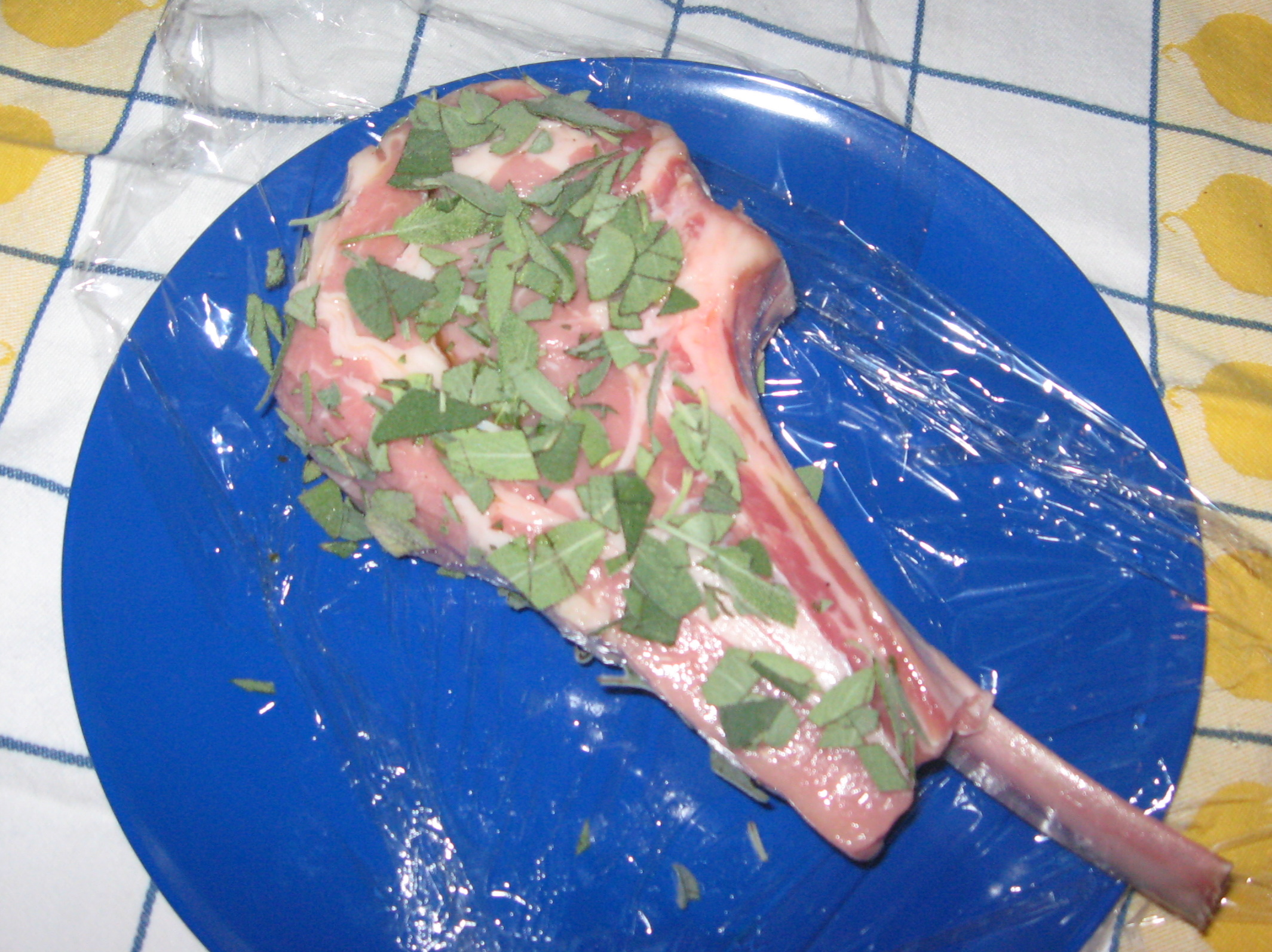
veal chop covered with coarsely chopped sage leaves

I’ve gotten the flavor that I want by very coarsely chopping the sage or even just thoroughly bruising the leaves and patting them over my chop, wrapping it in plastic film, and letting it sit in the refrigerator at least over night, or up to one day, and then cooking it.
So here’s my chop, rubbed with olive oil covered with the sage leaves, ready to go into the refrigerator until I’m ready to cook in tomorrow evening. Depending on the weather, it will be ready to  charcoal grill it, or griddle it, or even pan-sear it.

Ready to cook…..

When you’re ready to cook the chop, wipe off the sage leaves. The high heat doesn’t improve the flavor of sage, and can actually burn them, so I like to remove them.  You’ll want to salt and pepper the chop as you start to cook it.  You want to cook the chop to an internal temperature of 130 ° F (medium rare–for my taste) or a bit longer for medium.

  • If you’re cooking on a gas or charcoal grill, you will want to have  two-levels of heat–high to start brown the chop, and a lower temperature to finish the cooking since it’s a thick chop.
  • If you are pan-searing you’ll need about 2 tablespoon of oil.  Heat the oil over medium-high heat until it starts to smoke, and put your seasoned chop in the pan.  Let it cook without moving it for 4 to 5 minutes when it should be browned on one side. Using tongs, flip the chop and reduce the heat to medium and continue cooking until  it’s at 130 ° F (or desired doneness).
  • For griddling, I use a cast-iron griddle that fits over two burners–so I can kind of have  “two-level” heat with the two burners at different levels. Again, let the chop cook for about 5 minutes without moving it.  Once I’ve turned the chop and moved the chop to the somewhat cooler end, I can put veggies on to cook while the chop finishes.   (If you’re working on a grill-pan, then adjust the heat as you would for the pan searing, but with the heavy cast iron it does take a bit for the heat to adjust.
So quick and easy!

Õ¿Ô

I ended griddling my chop because it was a damp, rainy day–it was still wonderful.  Added a few steamed fingerling potatoes and some sautéed  broccoli raab (with garlic and red pepper flakes). It was a fine  meal.

(I’m sure I won’t  do this again until there’s another special as it’s a splurge even then, but worth every penny!)

A son goût!

Bean and ham soup

The arrival of cooler weather means that it’s time to start restocking the freezer with hearty winter comfort foods.  Some of the mac ‘n’ beef now resides in the freezer.  Another favorite that needs to be stashed in the freezer along with the chili con carne is some ham and bean soup.

Mix of 15 kinds of beans

a 15-bean mix

For my bean soup, I start with a one-pound bag of soup mix of fifteen different beans and lentils.  The first step is to discard the seasoning packet that comes in the bag with the beans.

The dried beans need to be soaked so it does require a little planning.  Use a brine of 3 tablespoons of table salt or equivalent amount of kosher salt (see Conversions page) in one gallon of water and soak over night at room temperature.

The next important ingredient is some country ham (a hock is good or a slice will do too)–not the “city” or deli ham.  If you’re lucky you’ll find real country (dry, salt cured) ham in your supermarket (not in the refrigerated meat section, but somewhere in the meat department), or maybe even in your local hardware store (right next to the new-crop pinto beans there in the bushel basket).

American country ham is dry, salt cured–like Italian prosciutto or Spanish Serrano ham.  (Deli or “city ham” is wet cured in brine and is a different matter.  You can use it for ham soup, but it’s a different flavor and complexity when you use country ham.)

Because the country ham is SO salty, it needs to soak in water (or milk) to remove some salt.  If your ham is a thick chunk like a hock,  it  needs to soak at least 24 hours, with the water changed about every six to eight hours, to remove salt.  For a thick slice of country ham, or even “biscuit” slices, an overnight or 8-hour soak would be adequate with a couple changes of water.

The “hock” is the small end of the hind leg that has been cured.  It will have some skin, bone and fat on it.  Don’t remove the skin, bone or fat…it has connective tissue that will “melt” with the slow cooking and give the soup a nice silky texture.

When you’re ready to start the soup, sauté  chopped onions, celery, and carrots in a bit of olive oil until they start to brown.  This caramelization adds an extra layer of flavor to your soup.  I like to add lots of whole garlic cloves for the last few minutes of the sauté. You can slice or mince the garlic if you want, but whole cloves will give mellow background flavor after they’ve cooked with the beans and almost fall apart.

Two cautions when making this soup:

  • First, you do not want to add acid ingredients (like tomatoes) to your soup until the beans are tender.
  • Even though the ham was soaked, it’s still going to be saltier than “city” or deli ham, so don’t add salt until you’ve tasted the cooked beans.

Drain the soaking water from the beans.  Put the beans and ham hock  into a Dutch oven with the aromatics (onions, carrots, celery) and herbs (a couple large bay leaves and about a tablespoon of classic herbes de Provence) and enough liquid (water or part chicken broth) to cover the beans by a couple inches.  Bring to a simmer on the stove top.  Once simmering, cover the pot with a tight-fitting lid put it on the middle rack of a 295 ° F  to 300 ° F oven.  It can simmer unattended for about an hour  to an hour and a half later when you should check to see how tender the beans are.

When the beans are almost tender, remove the pot from the oven. Take out the ham hock and remove the skin, fat and bones.  Chop the meat into bite-sized pieces and return it to the pot.

Now that the beans are tender, you can add acid ingredients to your soup.  I like to add two 14.5-ounce cans diced fire-roasted tomatoes, or just diced or crushed tomatoes–what ever strikes your fancy.  Either return the soup to the oven  for another 30 to 40 minutes, or simmer on the stove top to allow flavors of the soup and the  tomatoes to meld.

You now have some serious bean soup.  Just before serving I like to add a few drops of sherry vinegar to brighten the flavor. Some minced parsley would make a great garnish, adding some bright, fresh notes to this hearty, earthy soup.

This does make a lot of soup so some is destined for the freezer for that really cold, damp winter day when you need comfort food.

A son goût!