Vacuum pack it!

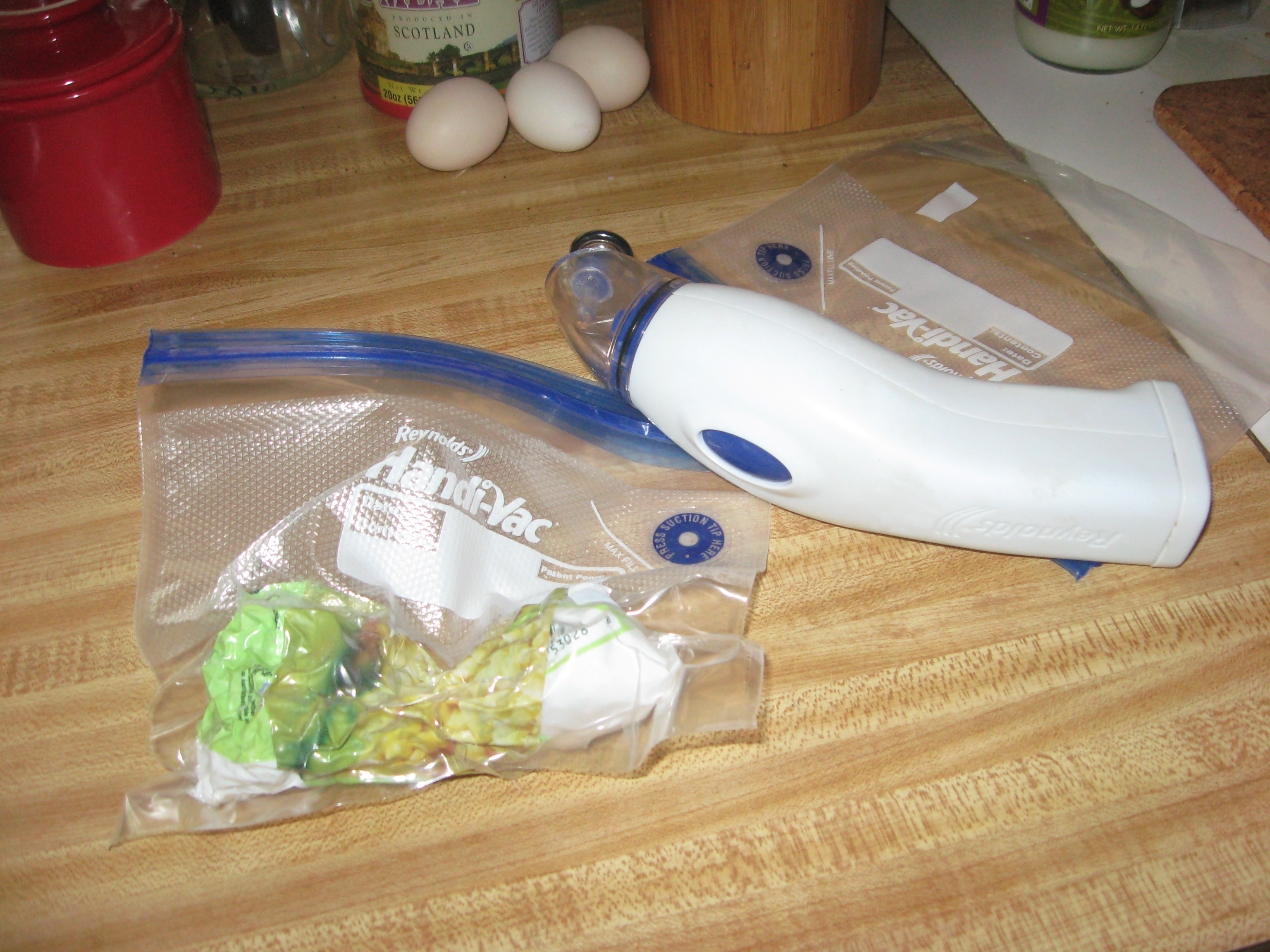
Reynolds Handi-Vac and bagWe all know about “freezer burn” that can happen when you put opened bags of stuff back into the freezer.  I’ve found something that ameliorates that. We’ve all observed that products that are vacuum-packed hold much better than those that are not. So–when I put opened bags vegetables back into the freezer, I use a clever gadget from Reynolds®.  Lest you cringe thinking expense–I’m not talking about the “big” vacuum sealing system.  I’m talking about the little hand-held pump and bags with a valve on them.

This is the Reynolds® Handi-Vac® system (reported to be discontinued, but still available from eBay and Amazon). It operates on AA batteries. For storing opened frozen products, I put the original bag, folded and air squeezed out into the vacuum bag, and vacuum! This is not as “hard” a vacuum as achieved with the counter-top vacuum sealing products, but it hides in a drawer and is inexpensive–no lost counter space which can be important.
vacuum sealed cornIt does help extend the freezer-life of opened packages of frozen products. If it’s something I use a lot of (e.g the petits pois, or “baby” peas that only come frozen–we’re ignoring canned), then I may buy the family size package and portion and vacuum those in serving size.  For the most part, I leave the veggies in the original bag–this way I can reuse the vacuum bags. For meats or seafood, I generally don’t reuse the bags. I just don’t feel I can be sure that they are sufficiently clean.

Here is a partial bag of frozen corn (another thing I like to buy in bigger packages). I confess that I’ve not done any scientific studies here, but using this seems to have decreased the number of times I dump a partial bag because of the freezer burn.

I’ve also discovered that using this really helps with the celery dilemma common to single-serving cooking: wash and cut celery into length that fit into these bags (you can also get bigger bags), wrap in a damp paper towel, and vacuum seal. It’s’ amazing how long it lasts that way. When you wish to freeze servings of big-batch cooking you can use these if there is not much liquid, but it can be tricky. What I usually do for those is to put the food into a “light” storage zipper-lock bag, squeezing out most of the air, and then into one of these.  Again, I can reuse the bags; they seem to stand up to reuse quite well.
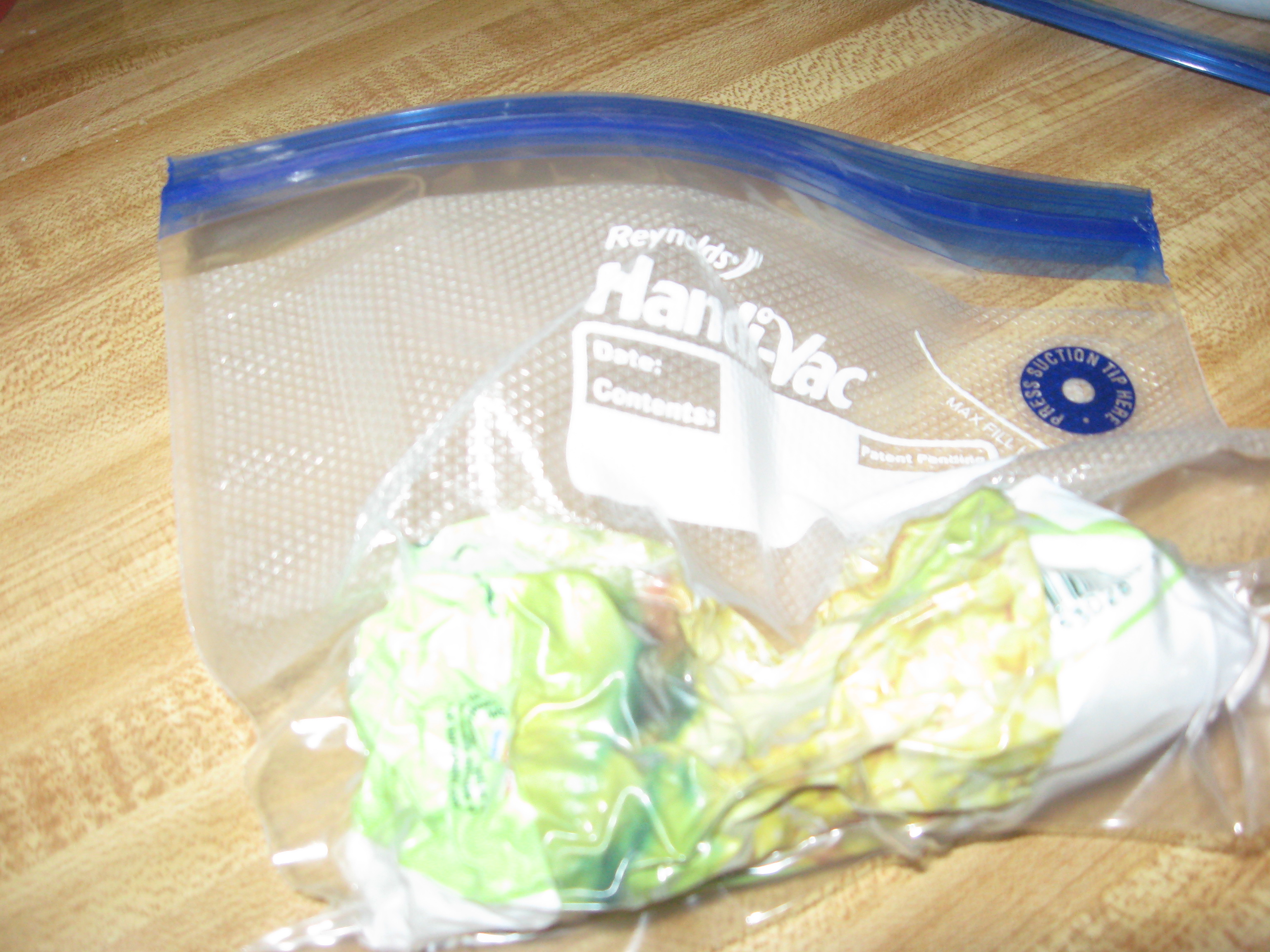
corn in vacuum sealed bagMy only experience has been with the Reynolds® Handi-Vac® though I’ve noted that Ziploc® and FoodSsaver® both now have hand-held systems (as well as the counter-top). Just from trawling the internet, I can’t tell if the Handi-Vac can be used with the Ziploc® or the FoodSsaver® bags; there’s contradictory information (what a big surprise).  Of note, the Ziploc® pump is manual rather than battery operated, and I would suspect that it will create a less strong vacuum than battery-operated pumps.

There’s an advertisement for an adapter for the Handi-Vac® pump to be used on Ziploc® bags. It’s called the “ReynLock Adapter™”; I’m NOT including a link because of the contradictory information I’ve found, and the price of the gizmo, and I’ve not used it so I don’t know anything other than the advertisement. (See My Opinion page, please).

Updates when I have more information because I will be looking for another product to do this.  Maybe I’ll be lucky and the Ziploc® bags will work!

Too much convenience?

Mueller's Pot-Sized PastaI was striding purposefully down the aisle of my local Harris Teeter when a package caught my eye–and brought me to a screeching halt–pot-sized spaghetti? This is something that you buy?  You don’t just take the regular spaghetti and break it, assuming that you’re not going to just put it into the water slowly, letting it soften until it’s all in the water?

Pot-sized angel hair?

Pot-sized thin spaghetti?

Pot-sized linguine?  Really? I was amazed, or maybe stupefied, or maybe the only thing that really covers my reaction was what I understand the British expression–gobsmacked–to mean!  Are we so far from “home cooking” that we can’t even deal with pasta unless it’s pot-sized. As you can tell this catapulted me right onto my soapbox, or maybe even onto my high horse (which every you prefer). Has having pot-sized pasta brought down the price of my plain spaghetti that’s too long to fit in the pot unless I stand there and lower it slowly into the water? Not being a marketer, or an economist, merely a consumer, I really doubt that  it has. (Besides, I think this would be too short to twirl effectively to wrap it around my fork.) Not something I’m likely to buy (even though I do sometimes buy other Mueller’s pastas.

jar of mixed rice and grainsI went past the pasta display because I was on my way to something of a convenience nature for me: one of the packages of grain mixes. Those don’t leave me gaping.  They are very useful for single-serving cooking.  My latest is an HT Traders mix of basmati brown rice, red rice, with barley and rye berries. That’s my idea of convenience–I don’t have to buy the standard package of each of those grains: that would be about 1-3/4 pounds of basmati rice, and who knows how much red rice and rye berries. I most likely would not use that mix if I had to buy each of those separately–unless I could buy each from bulk supplies.

That kind of convenience I can get my mind around. I do have packages of barley, oats, but even the dried things don’t have unlimited shelf-life. They don’t  spoil–in other words they are not perishable. If you store them carefully in glass jars with good seals, they should not get buggy, but keep them long enough and they won’t hydrate as well, taking longer to cook. For some dried goods like beans, you may get to the point where they will never soften appropriately.

Of course, there’s also the issue of storage space–for those of us without the luxury of a large pantry with miles of shelf space, but who do like variety this is a great alternative. It has another benefit: it’s compatible with the rice cooker.  I’m happy to more of the “esoteric” grains show up in my local supermarket–they are cheaper than if I were to go to a specialty shop, not to mention just closer to home.

mixed grains

Moroccan-Style Quinoa with Chickpeas and Kale redux

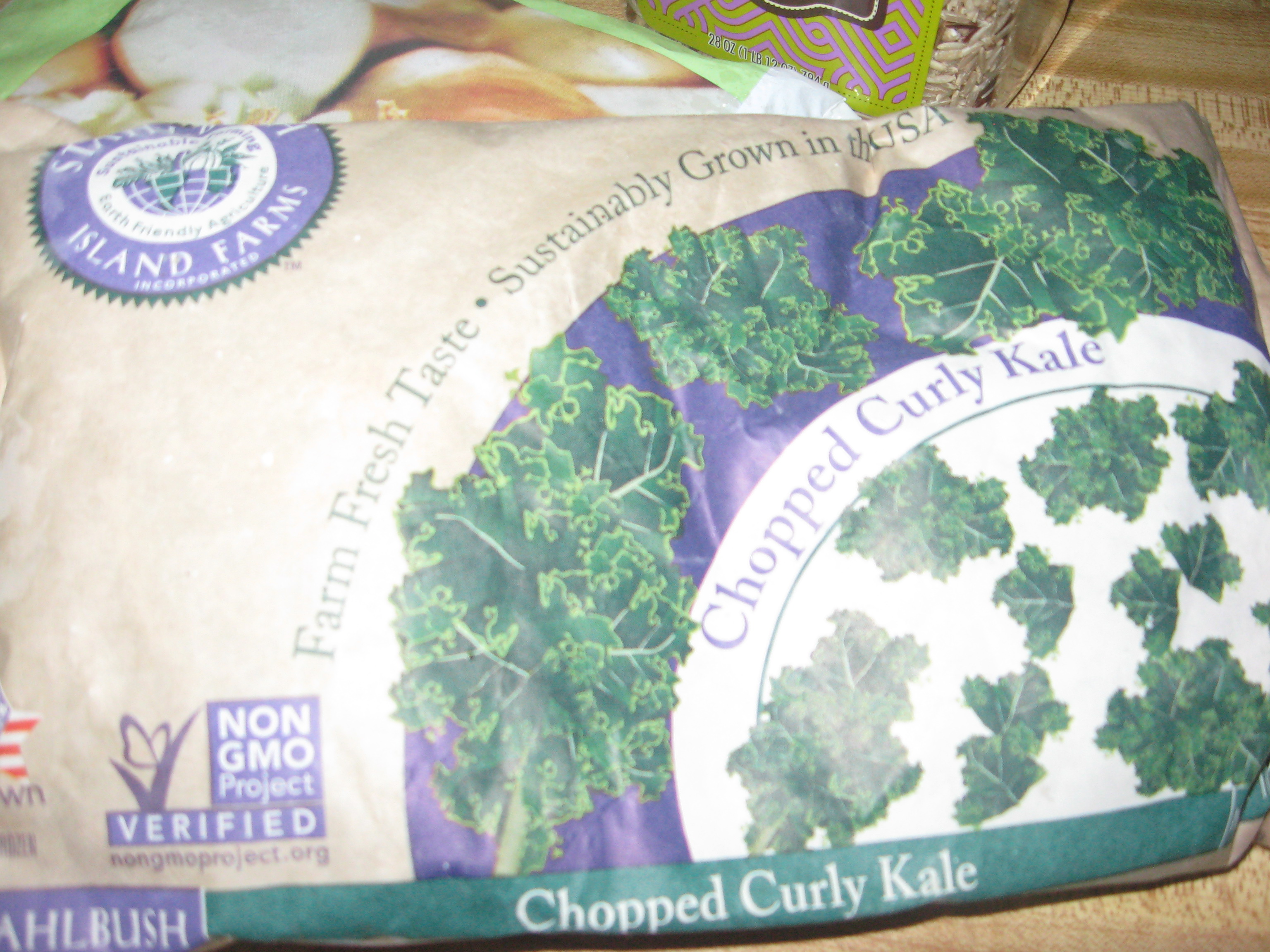
Frozen kaleIn my post about trying a recipe from an America’s Test Kitchen (ATK) I expressed my dissatisfaction with the balance between the kale and the rest of the ingredients.  I think I may have stumbled on a partial solution.

I’m admitting that in single-serving cooking I use frozen vegetables. One reason is that I can put the “leftovers” back into the freezer and not be pressured to use the rest of it right away–I’ll also admit to being a picky eater, par excellence as you’ve probably figured out.  Note my comments on meal planning.

Another is the nutritional value and quality of GOOD frozen products–we’re not talking “heat-‘n’-eat” here.  We’re talking fruits, vegetables, perhaps fish, etc. I don’t mean that I don’t buy fresh from local suppliers, but probably frozen is better than not bringing home fresh kale because it’s packaged (even at the Farmers’ Market) in a huge bunch that just doesn’t work for me.  (Cat just doesn’t eat enough vegetables for that to work, just like he doesn’t help with dust-bunny control).

I made this again, adjusting the seasoning–mostly just adding more of what was called for–but using the frozen kale from Stahlbush Island Farms and it was not overwhelmed by the kale. (Their website says it’s curly kale, but it must be younger leaves that what I had before.)  There will definitely be more of their kale in my freezer and I’ll make this again with these adjustments.


Lamb leg steak–continued

lamb leg steak on plate with ratatouilleThat lamb leg steak that I cooked a couple days ago was a big steak–weighing in just a bit under a pound. That’s a lot of meat–couldn’t possibly eat all that at one time.  As vehement as I’ve been about not liking, or dealing well with leftovers,  that does not apply here.  I don’t really consider the part of this steak that I didn’t eat then as undesirable. I couldn’t have that luscious steak without some left for other uses–not when it needs to be at least an inch thick to cook well. You’re wondering what happens to the rest of this steak?

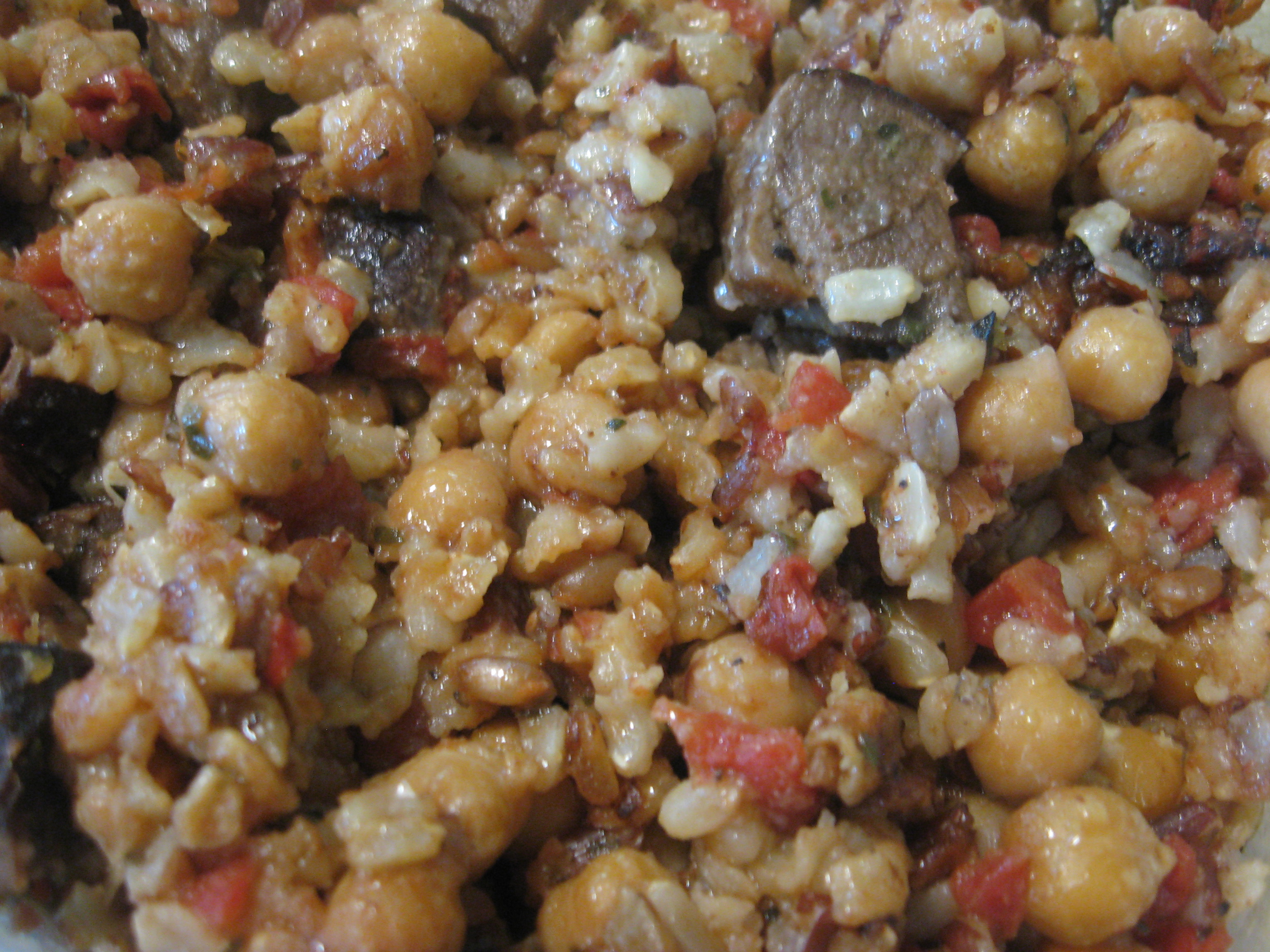
Often the remains of a beef steak or a pork chop goes into a sandwich–since roast beef, lamb, or pork is not on the single-serving menu. Other times it does some metamorphic changes.  The remainder of this steak went into the rice cooker with a convenience mix of grains,  some garbanzo beans to give me some additional meals that were not meat-centric.

Ingredients

  • about 1/2 pound of cooked lamb steak, cut into 1/2-inch pieces
  • one 15-ounce can garbanzo beans with liquid
  • one 10 ounce can of diced tomatoes with jalapeños with liquid
  • 1 cup of brown basmati rice, red rice, barley, and rye berry mixture (uncooked)
  • 1 tablespoon olive oil
  • 2 bay leaves
  • 2 teaspoons dried Turkish oregano
  • 1/2 to 1 teaspoon garlic powder
  • 1 to 1-1/2 teaspoon onion powder
  • 1 cup water (to bring total liquid to amount required for grains)

Preparation

  • Add all ingredients to rice/multi-cooker, stir well.
  • Set on rice cooking mode.
  • When cycle finishes, check grain for doneness.  If needed add more water in 1/2 cup increments until grains are done.

Ò¿Ó

Since the lamb steak had been well-browned on the griddle, it provided good rich flavor for the grains and the garbanzo beans.  Some of this was an extra meal (with a side of ratatouille), and the rest was packed (with the Handi-Vac®) for the freezer for later (especially cooler weather) meals.

mixed grains with tomatoes and lamb

angel hair pasta with raw tomato sauce

I’ve always like angel hair pasta with a very light, fresh sauce. Since it’s tomato season, at least for a bit yet, I wanted to share this one–The recipes (and commentary) from this blog (Smitten Kitchen) are always good–and this is SO easy.  I’ve found that angel hair pasta cooks so well in the microwave pasta cooker which means no hot steamy, boiling pot in the  kitchen in this hot weather.

Enjoy!

angel hair pasta with raw tomato sauce from the Smitten Kitchen.

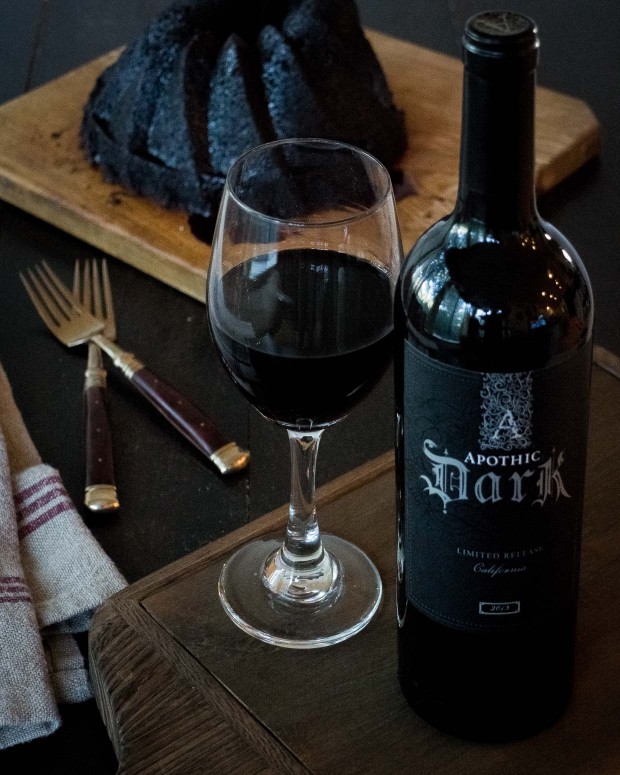
Recipe: Apothic Dark Red Wine Cake

I like this wine–just for drinking, and can imagine that this will be awesome.

winebyari's avatarWine by Ari

Apothic-Cake-2-3-620x775


I came across this amazing recipe for Apothic Dark Red Wine Cake from Chasing Delicious.

Apothic Dark Red Wine Cake

Ingredients

  • 6 ounces flour
  • 2 ounces cocoa powder
  • 1 teaspoon baking soda
  • ½ teaspoon salt
  • 8 ounces unsalted butter, at room temperature
  • 14 ounces vanilla sugar (or granulated sugar)
  • 2 eggs
  • 1 teaspoon vanilla extract
  • 1⅓ cup sweet red wine (try Apothic Dark)
  • 1 cup cinnamon red wine sauce, recipe below

Instructions

  1. Preheat an oven to 350°F.
  2. Butter and flour or grease a bundt pan. Set aside.
  3. Mix together the flour, cocoa powder, baking soda and salt in a large bowl. Set aside.
  4. Beat the sugar and vanilla together until light and fluffy, about 5 minutes.
  5. Add the eggs, 1 at a time, and then the vanilla, mixing well after each addition.
  6. Add half of the dry mixture and mix in well. Pour in the wine and mix…

View original post 207 more words

Roast NY Strip Loin

This is a great way to do strip. If you’re cooking for one, you can use a strip steak cut about 2-2-1/2-inches thick. It gives some “leftovers” for a roast beef sandwich. It’s one way to cook roast beef for a single-serving meal with not too many leftovers.

Russ's avatarThe Domestic Man

The NY strip loin, sometimes called loin roast or top loin, is a cut taken from the top of the cow’s short loin. The short loin is located near the spine, past the ribs but before the tenderloin and round. This is a crowded area of the cow in terms of butchery, as the porterhouse and tenderloin also come from this section. In fact, this strip loin is basically an uncut series of NY strip steaks. Confused yet? Don’t worry, you don’t need to know how to break down a cow in order to cook up this delicious specimen.

We’re going to roast this loin in a method similar to my most popular post, this Perfect Eye of Round. We’ll blast the roast at 500F to create a nice crust, then reduce heat to 250F until it’s medium-rare.

Not one to leave a job half done, I also roasted…

View original post 108 more words

Homemade Chipotles in Adobo Sauce

I just have to pass this along–chipotle peppers are something I use rather often. I think this will beat the tinned ones from the supermarket.

StefanGourmet's avatarStefan's Gourmet Blog

DSC07025
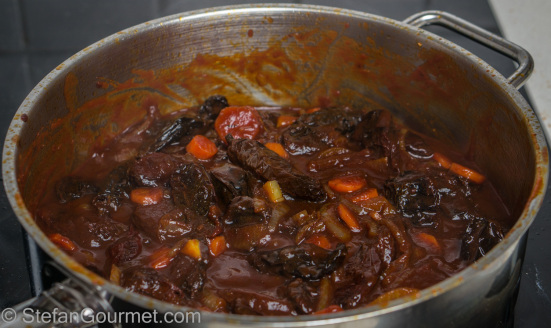
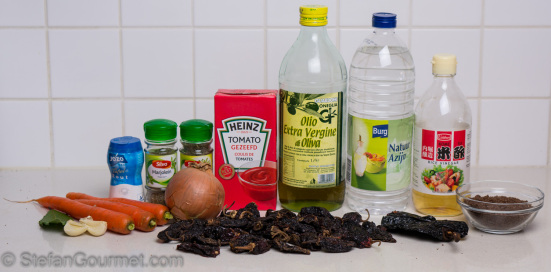
My favorite kind of chiles are chipotles because of their smokiness. Chipotles in adobo sauce, a sauce made from tomatoes and ancho chiles, are a great condiment. I love them for instance with chicken, mushrooms and cream. Chipotles in adobo sauce are available in cans, but since I like to make everything from scratch, I wanted to try making my own chipotles in adobo. I used a recipe by Pati’s Mexican table. It wasn’t hard at all, and the result was amazing. Chipotles in adobo from a can are great, but these homemade chipotles in adobo sauce have a more complex and well-rounded flavor. I will definitely make them again. I made a few adjustments, most importantly not using fresh tomatoes because they are out of season (and even if they were in season, tomatoes here are not that great). Here’s my version.

Ingredients

DSC06983
For about 850 ml (3…

View original post 349 more words

Perfect homemade pasta every time

A simple recipe for homemade pasta. If you don’t have a kitchen scale, you really should get one. They are not really expensive and make a lot of cooking so simple.

homecookexplorer's avatarhomecookexplorer

This is going to be my shortest blog ever.

But it will show how you can make perfect homemade pasta each and every time.

Here is the trick. I’ll assume you have a pasta maker already.

Start by weighing your eggs (not your flour). 1 egg per person eating your wonderful ooh! and aahhh! homemade pasta.

Next divide the weight of the eggs by .6. This will be the weight of flour to use.

So if you are making pasta for 4 and your eggs weigh out to 215g, then 215/.6 = 358 which would be how much flour to add. The more precise you can be, the better will be your result.

This quite precise ratio will give you the precise amount of hydration to your dough so that when you put it through your pasta roller, it will be perfect. No extra flour needed, no extra water, no…

View original post 67 more words

Those little “goodfellas”: Brussels Sprouts and Hot Sausage Tortiglioni…

I haven’t made this yet–but I love sausage and I like Brussels sprouts. Since I do a lot of cabbage and greens with sausage, I want to try this, so I’ll just share it.

Francesca's avatarFlora's Table

Brussel sprout and hot sausage tortiglioni

2 Servings

Brussels sprouts are not very popular in my country and they certainly weren’t on my family’s table. I don’t think I can recollect one time that I ate them in my house or anywhere else in Italy.

Things started changing a couple of years ago when I decided to host my first Thanksgiving’s dinner. During my “due diligence” period, in my quest for dishes traditionally served in the US for that holiday, I found out that Brussels sprouts were a must as a side dish, stir-fried or roasted, preferably with bacon or pancetta and even with raisins.

Little by little my acquaintance with these little guys turned into a beautiful friendship and now I’m totally in love with them for several different reasons.

Brussel sprout and hot sausage tortiglioni

First, their appearance – because no matter what they say, appearances still count! 🙂 Their vibrant green has the magical power to put me in a…

View original post 483 more words