Smoky, spicy red lentil soup (Always Hungry?)

Lemony Red Lentil Soup with Cilantro

This is one of those “recipes” that really isn’t. Kitchen Express doesn’t give you a list of ingredients–it gives you a paragraph description of what to do–a happening. I don’t always have red lentils, so I’ve made this with De Puy lentils; it simply takes a little longer to cook. This is the “light, bright” lentil soup that I make in warm or hot weather.

The soup below started as the Red Lentil Soup (pages 283-284) in Always Hungry?  However, true to form for me, it evolved–still keeping the spirit of the meal plan. So here’s my version of a seemed to be rather a bland lentil soup when previewed on the page. It evolved on a dreary, rainy, chilly day in May that felt more like regression to March. It’s only mildly spicy and garlicky–you could increase the chipotle powder or add a dash of cayenne.

Serves 4 with big bowls, or 6 with small bowls. Add some meat (lamb would be good) and it’s a meal in a bowl.

Smoky, Spicy Red Lentil Soup

Ingredients

  • 2 tablespoons olive oil (for cooking)
  • Chopped onion–about 1 to 1-1/2 cups
  • 2 medium carrots, diced
  • 2 ribs celery, diced
  • one 14-ounce can of diced tomatoes [fire-roasted are really good in this.]
  • 32 ounces chicken stock
  • 1 cup red lentils
  • 2 or 3 large cloves of garlic minced or pressed (or more according to taste)
  • 1-1/2 teaspoons of herbs de Provence
  • 1 to 1-1/2 tablespoons of pimentón (smoked Spanish paprika)
  • 1 teaspoon chipotle chile powder
  • 1/2 teaspoon red pepper flakes (hot)
  • salt and black pepper to taste
  • one 8-ounce package of frozen chopped kale
  • extra virgin olive oil for drizzling as a tasty garnish

Preparation

  • Heat the cooking olive oil in a good-sized pan and sauté the onions until beginning to brown.
  • Add the carrots and celery and sauté until starting to brown.
  • Add the pimentón, chipotle chilli powder, red pepper flakes, and garlic; sauté until fragrant.
  • Add the chicken stock, tomatoes, and 2 cups water.
  • Add the herbes de Provence
  • Bring to a simmer and cook until the lentils are almost tender. [I moved it to the oven to finish cooking so I could work without worrying about checking it.]
  • Stir in the chopped kale and continue cooking until the lentils are tender.
  • Serve it up and drizzle with a bit of aromatic extra-virgin olive oil.
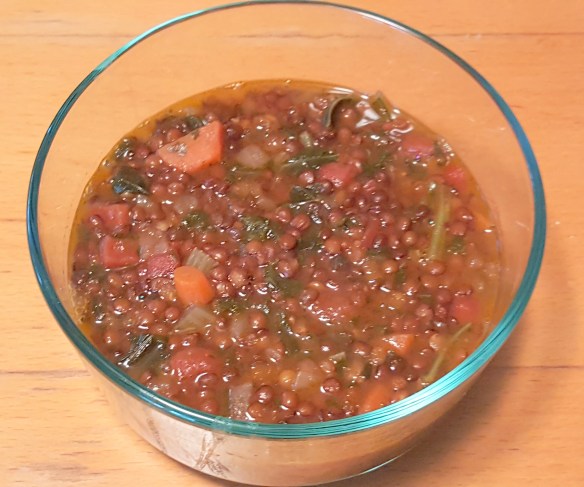
clear glass bowl with lentil soup

Labneh

I finally got around to making some yoghurt cheese or labneh! I don’t know why it has taken me this long to do something that simple–it’s practically effortless. After reading David Lebovitz’s post on Labneh I finally did it. Now that the weather is getting warmer I’ll be looking for lighter things to eat with fresh vegetables.

After googling “labneh recipes”, I had a plethora from which to choose. Variations include some calling for full-fat plain yoghurt, some for Greek, one for adding lemon juice, and others for herbs. All called for some salt.

Greek yoghurt cheese

Labneh

For my first trial, I used full-fat plain that was lingering in the fridge since I’ve found that I really prefer skyr (even to Greek yoghurt). I added a healthy pinch of salt, then set the yoghurt to drain for 15 hours.

Tasting the labneh I discovered that it wasn’t quite as tangy as I had hoped–I’ll try adding lemon juice next time.

I suspect that this is going to become a “fixture” in my fridge instead of the usual cream cheese. I am a fan of radishes so adding those and other vegetables to labneh sounds like a great summer treat, and I’ve many other interesting recipes for using it. Some found its way into my omelette with sautéed kale as an improvised breakfast with the Always Hungry? meal plan inside the omelette, rather than as a topping, or have berries without the skyr  or yoghurt.

It’s such fun to discover new foods!

omelette with labneh and kale

Always Hungry? Cabbage Casserole

white cabbage cropped IMG_6018One of the recipes from Always Hungry?  that I wanted to try was the Cabbage Casserole (pages 236-237) since I feel that cabbage is an underappreciated vegetable that should be (at least) a winter staple. I suspect that when many people hear cabbage mentioned as an edible thing, they think “coleslaw”, or the St. Patrick’s Day corned beef and cabbage, or, perhaps, stuffed cabbage.

The other advantages to me were that it was an “all phases” dish, and I didn’t see anything that would make it impossible to freeze for later use. So, the Cabbage Casserole happened today. When I’m trying a new recipe, I like to make it as directed, except for seasonings that I thought needed adjustment for my taste. As usual, I found one thing that I felt could be modified without changing the results, but would make the recipe easier.

The directions call for blanching the cabbage in boiling water. I assumed (yes, I do know what “assume” does to you and me) that the blanching was to soften the cabbage a bit so that the texture wouldn’t be crunchy in the finished dish–just as you soften the leaves when making stuffed cabbage with whole leaves. Instead of blanching, I put the cabbage, with a splash–maybe a tablespoon–of water into the microwave until it had softened–about 5 minutes, then proceeded with the layering of the meat mixture, the cabbage, and the apple-tomato mixture as instructed in the recipe. Then, into the oven.

Ò¿Ó

cabbage casserole and serving on blue plate

cabbage casserole

The casserole is out of the oven, and I’ve enjoyed a serving. It’s another keeper. I’m surprised and pleased. The seasoning as in the recipe is good as is, though for my taste, I may add a little more garlic next time. The amount of cinnamon is perfect.  It’s another keeper even though it’s associated with a weight-loss program. The final result has a bit more liquid than I hoped, even though I baked it uncovered a little longer than the recipe called for. The recipe did not call for draining the tomatoes, but I’ll do that next time.

The microwave was apparently a good substitute for the blanching: the cabbage is tender, and not at all crunchy. I’ll happily eat this again, looking forward to having a glass of a hearty red wine to accompany it.

cabbage casserole up close

.

Always Hungry? Meal Plan

Since I seem to be unable to stick to a recipe, am a picky eater, and have a lot of difficulty with breakfast, I’ve downloaded the Simplified Meal Plan from Always Hungry? website, and very carefully read the requirements for the “Building a Phase 1 Meal” (pages 151-152).  Since I was having a lazy day I did some adaptation on the “Herb-Roasted Chicken Thighs” since chicken thighs often show up on my house menus. I decided to make this a one-pot meal.

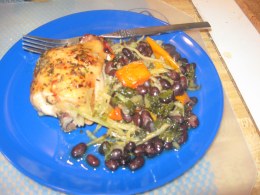
roasted chicken thigh, greens, black beansAfter seeing a post on slow roasted kale on Stefan’s Gourmet Blog, I decided I could make a one-dish meal that met those Phase 1 requirements. Using a bag of salad greens (broccoli, Brussels sprouts, kale, and some others) I put enough into the clay cooker to give me the amount of cooked greens that I needed for two meals (two of the thighs were for other uses). Since I’m such a fan of greens and beans, I added enough black beans for two servings. Since bell peppers are on the okay list, I added red and orange mini bell sweet peppers to the mix.  Finally, I topped that huge pile of greens with the chicken thighs sprinkled with salt, red pepper flakes, and oregano. The soaked clay cooker went into a cold 400 °F oven for a little over one hour and out came a meal that had the protein, vegetables, and the carbohydrates (the beans). All I had to add was dessert. (Yes, this meal plan includes dessert–in this case a cup of fruit and 1/2 ounce of dark chocolate.)

One of these thighs is going to find its way into chicken salad with grapes and pecans (substitution for walnuts) for one of the prescribed lunches and another into the freezer to pull out when I need a quick dinner ready with the vegetable, meat, carbohydrate quantities already worked out.

Snow day. . .

Well, not really a snow day (I wish!), but an ice and wind day, the second in a row here. It’s a grey day with a few snowflakes fluttering around. It’s not so far been a productive day. I’ve been wandering from room to room, fighting the urge to take a lesson from the cat. Neither did he go with me to make morning coffee nor did he get out of bed when I started rattling around in the kitchen. He simply got under the duvet instead of on top.

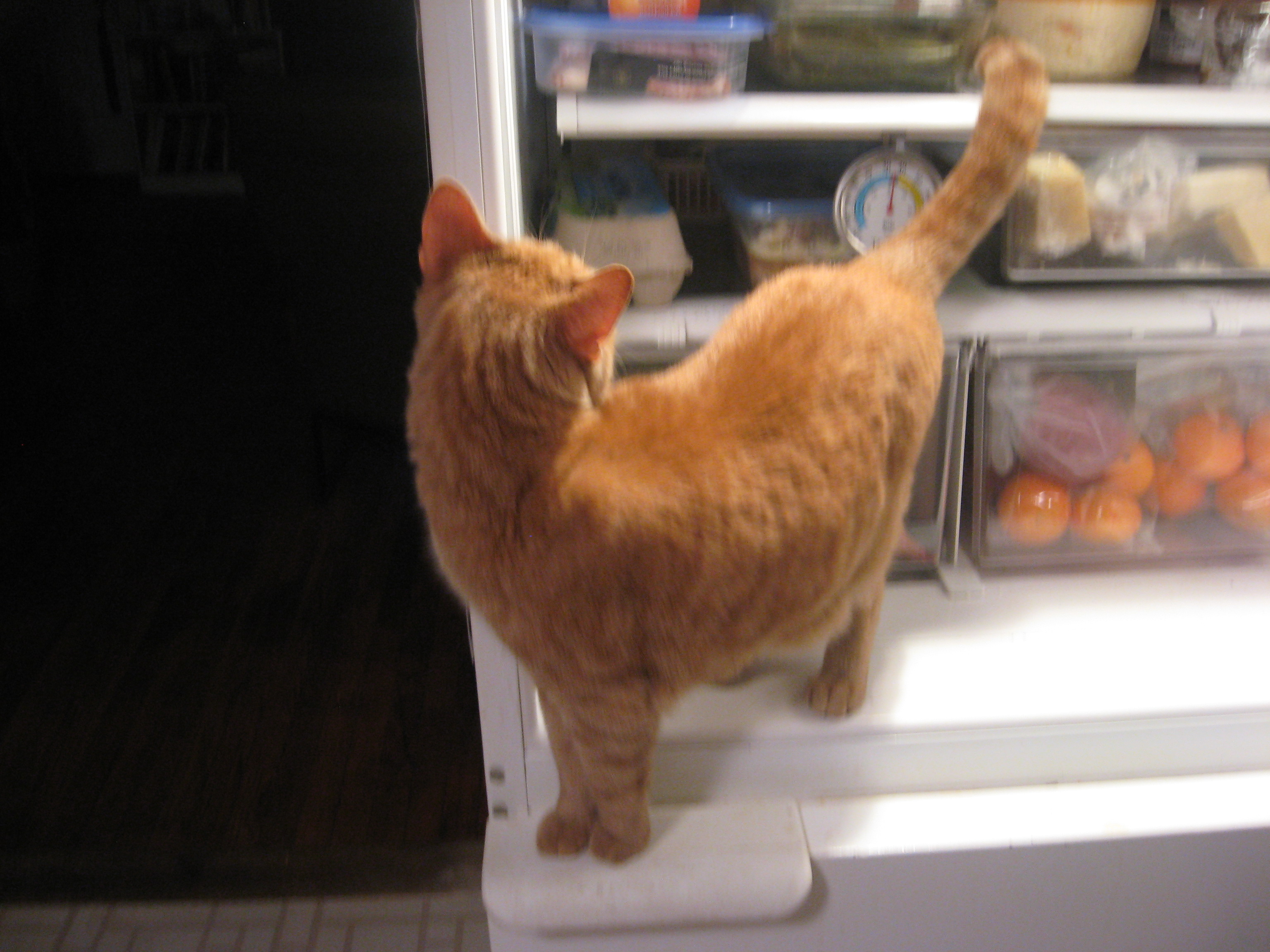
Cat looking into refrigeratorSo I’ve resisted the lure of book and duvet to try to accomplish something, even if not useful or productive, just something I can say that I did. The motif today seems to be opening, peering inside, and closing doors, figuratively and literally, including internet browsing–opening a site and then just passing on to another. I’ve peered into the cabinet where all the plastic storage containers live and close the door tightly and firmly, then opened the internet door (Google search) on organizational ideas for empty containers.
Peering into the refrigerator led to the conclusion that I didn’t want to eat anything that was already in there. The threat of power outage led me to follow a link on what foods were safe after a power outage, but that didn’t catch my interest either (no new information, and no power outage here yet). My list of blogs that I follow l did provide something that held my attention: posts on one taste at a time caught my interest–food waste and eating mindfully. After reading (and reblogging those) my meandering led me back to the kitchen with thoughts of something warm and cozy to eat this afternoon.

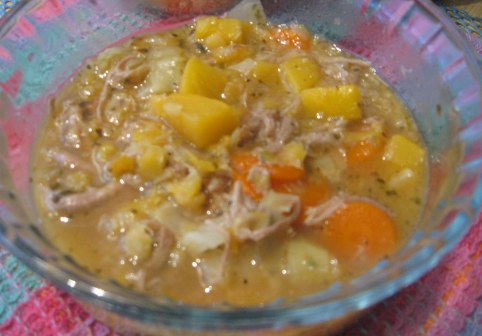
This recurring theme eventually led to the freezer compartment of the refrigerator which has been needing organization and sorting for a while. Gazing at a container of stock finally got my interest. What better way to start sorting and organizing that to make something from what I found in the freezer that was approaching its end-of-life-even-if-frozen state.  Thus: mostly freezer soup happened–with additions from the crisper drawer.

Ingredients

  • pulled pork (from a large pork butt, slow-roasted in the Schlemmertopf)
  • two packages of stock (one pork, one chicken)
  • the last package of sofrito (a staple, but needing to be used and replaced)
  • carrots (the last of a bag that had been vacuum packed for later use)
  • 1/2 small rutabaga, diced
  • two handsful of cabbage, in bite-size pieces (a crisper staple)
  • about 1 cup yellow split peas
  • about two teaspoons Hatch red chili powder
  • a dash of dried oregano
  • (a retained bay leaf from the pulled pork)

Preparation

  • thaw and sauté the sofrito to brown lightly (frozen with olive oil)
  • add chili powder and oregano to bloom in olive oil
  • add frozen stock
  • add pork
  • add rutabaga, cabbage, and split peas
  • simmer until rutabaga and split peas are tender (about 40 minutes)

Supper is on! IMG_8880

As is typical of all soup making, there is more than I’m going to eat, but some will go back into the freezer for a quick meal on another grey day–carefully labeled, and dated.

Ò¿Ó

.

Jabberwock

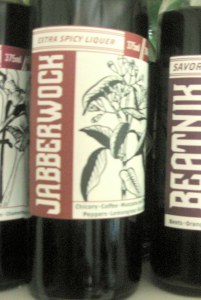
Jabberwok liqueurI love the names of the liqueurs from the Brothers Vilgalys. Jabberwock conjures up some interesting images for me–something dark, smoky,  and exciting, and maybe just a tad bit scary.
I can’t say which of these liqueurs I like best–they are all so different, so I  have them all, but this one is close to the top of the list–partly because I love strong, black coffee and I like the spice of chilies.

The ingredient list for this one includes coffee, chicory, lemongrass, eucalyptus, manzano & chipotle peppers. Just like the other liqueurs from Brothers Vilgalys the flavors just unfold as you sip. There is definitely some heat–it’s going to make your mouth feel warm. With the first sip there is the “brightness” of the lemongrass and the eucalyptus, then the heat starts to build, but the heat doesn’t hide the “dark” coffee and chickory. The lemongrass and the eucalyptus come through in the nose. There’s a long, warm finish where the smokiness of the chipotles lingers, even as the heat fades. Another winner!

(It’s a fantastic addition to hot drinking chocolate–the coffee and the chickory enhancing the chocolate flavor and the chilies adding some spice.)

Hot Cocoa

It’s been a chilly, damp, drippy Monday–the kind of day that takes an inordinate amount of caffeine to achieve a minimally functional state. The day’s to-do list included taking the cat to the vet. Of course it was raining  when I toted Frankie out to the car, and it was raining when we came out of the veterinarian’s office. Frankie was lucky–he was in the carrier and dry (not that he was at all appreciative of that).  Now we’re back indoors.  It’s still chilly, damp, drippy Monday–but now dark.  It’s time for a warm beverage that must have chocolate in some form in it–but there must be lots of if.  That means hot coca!

The hot chocolate is sipping chocolate–thick, rich, creamy–for when you feel truly decadent and in need of something sensuous as well as chocolate. There are times when chocolate is required–after a long walk in the snow, or after you’ve finished all the errands that made you go out on a cold, damp, grey, and miserable day. Those are the times when I want hot cocoa–a lighter beverage that comes in a BIG mug (and maybe even whipped cream) to warm me up. It has to be lighter than drinking chocolate because I want to drink more just because. I don’t want the stuff from the grocery store shelves that is supposedly “hot cocoa” but is usually too sweet and lacking in cocoa/chocolate flavor (e.g. Swiss Miss or Nestle’s).

Some chocolatiers have cocoa or drinking-chocolate prepared mixes that are very good–Chuao chocolate Spicy Mayan (expensive and really drinking chocolate), Starbucks, Ghiradelli, to mention a few of the up-scale ones. Even with these, I feel that the cocoa flavor is a bit lacking–I end up using more than suggested on the package,  and they are often sweeter than I like–I’m paying for lots of sugar and powdered milk. For a review of a hot cocoa mixes see Serious Eats.

Scharffen Berger does have sweetened cocoa powder–though more flexible, you’re paying for sugar (that you can get at the grocers inexpensively and you probably already have it in the kitchen).  So, how do I get my great big, steaming, warming mug of hot cocoa?

I’ll start with a premium cocoa: Valrhona is a favorite, Ghiradelli but  you can use the cocoa powder of your choice. The basic recipe for hot cocoa for one is from Epicurious. (On particularly miserable days, I recommend doubling the recipe even if it is just for one.)

Simple Hot Cocoa for One

Ingredients

  • 2 tablespoons unsweetened cocoa powder
  • 1 to 2 tablespoons sugar (depending on how sweet you like it
  • Pinch of salt
  • 1 cup milk or any combination of milk, half-and-half, or cream
  • 1/4 teaspoon vanilla extract

Preparation

  • Whisk together the cocoa, sugar, salt, and about 2 tablespoons milk in a small saucepan over medium-low heat until cocoa and sugar are dissolved.
  • Whisk in the rest of the milk and heat it over medium heat, whisking occasionally, until it is hot.
  • Stir in the vanilla and serve.
  • If you like it frothy, blend it in the blender
  • This recipe multiplies easily. When you get up to a quart of milk, use 1/4 teaspoon salt

For a bit more oomph, you can use both chocolate and cocoa together–and if you don’t want to do more that heat milk to get you cocoa and chocolate fix, here is a recipe for The Best Hot Chocolate Mix from Cook’s Illustrated, November/December 2014, page 23 that makes enough mix for 12 one-cup servings. Frankly, I get less than 12 since I usually use a big mug.

The Best Hot Chocolate Mix

Ingredients

  • 1 cup (7 ounces) sugar
  • 6 ounces unsweetened chocolate, chopped fine
  • 1 cup (3 ounces) unsweetened cocoa powder
  • 1/2 cup (1-1/2 ounces) nonfat dry milk powder
  • 5 teaspoons cornstarch
  • 1 teaspoon vanilla extract
  • 3/4 teaspoon kosher salt

Preparation

  • Process all the ingredients in food processor until ground to powder (30 to 60 seconds, or as needed)
  • Store in airtight container at room temperature for up to 2 months.

Making hot chocolate

For 1 serving:

  • Heat one cup milk (whole, 2%, or 1% low fat) over medium heat until steaming and bubbles appear around the edge of the pan.
  • Add 1/4 cup (4 tablespoons) hot chocolate mix
  • Continue to heat, whisking constantly, until simmering (another 2-3 minutes)
  • Pour into a heated mug and serve

Ò¿Ó

Hot chocolate or hot coca sometimes begs to be dressed up with some additions like Krupnikas or perhaps Jabberwok. If you’re going to add a sweetened liquor like Krupnikas, you may not want to use a mix (as above) that contains sugar. You can only tell by tasting.

Other liqueurs that to dress up hot chocolate or cocoa beverages:

Ò¿Ó

It’s always fun to dress up your hot cocoa–but for me, forget the marshmallows (unless they are homemade), and the whipped cream (unnecessary when you use at least part half-and-half), but adding some spices or other flavors can be fun. Sometimes I make hot chocolate with favorite chocolate bars:  Chuao Spicy Mayan bars, and I sometimes use that to make hot chocolate. My local Harris Teeter has a “house” dark chocolate with orange that makes a great cup of hot chocolate, and the pear and dark chocolate is a way to get a boost if your bar doesn’t include the liqueurs.

Ò¿Ó

Kitchen disaster. . .

. . . but a happy, tasty ending.

Cat looking into refrigeratorI’m feeling a cold draft–very cold draft–around my ankles!

I know I’m not dreaming though it’s the middle of the night or somewhere in the wee hours of the morning–I’ve come to the kitchen (without turning on the light) to get a drink of water. . . .

Cold draft? Really, really cold draft–on my ankles.

Reality gradually seeps into consciousness:  I’m standing in front of the refrigerator–which has a bottom freezer, which I have stuffed pretty full.. . .

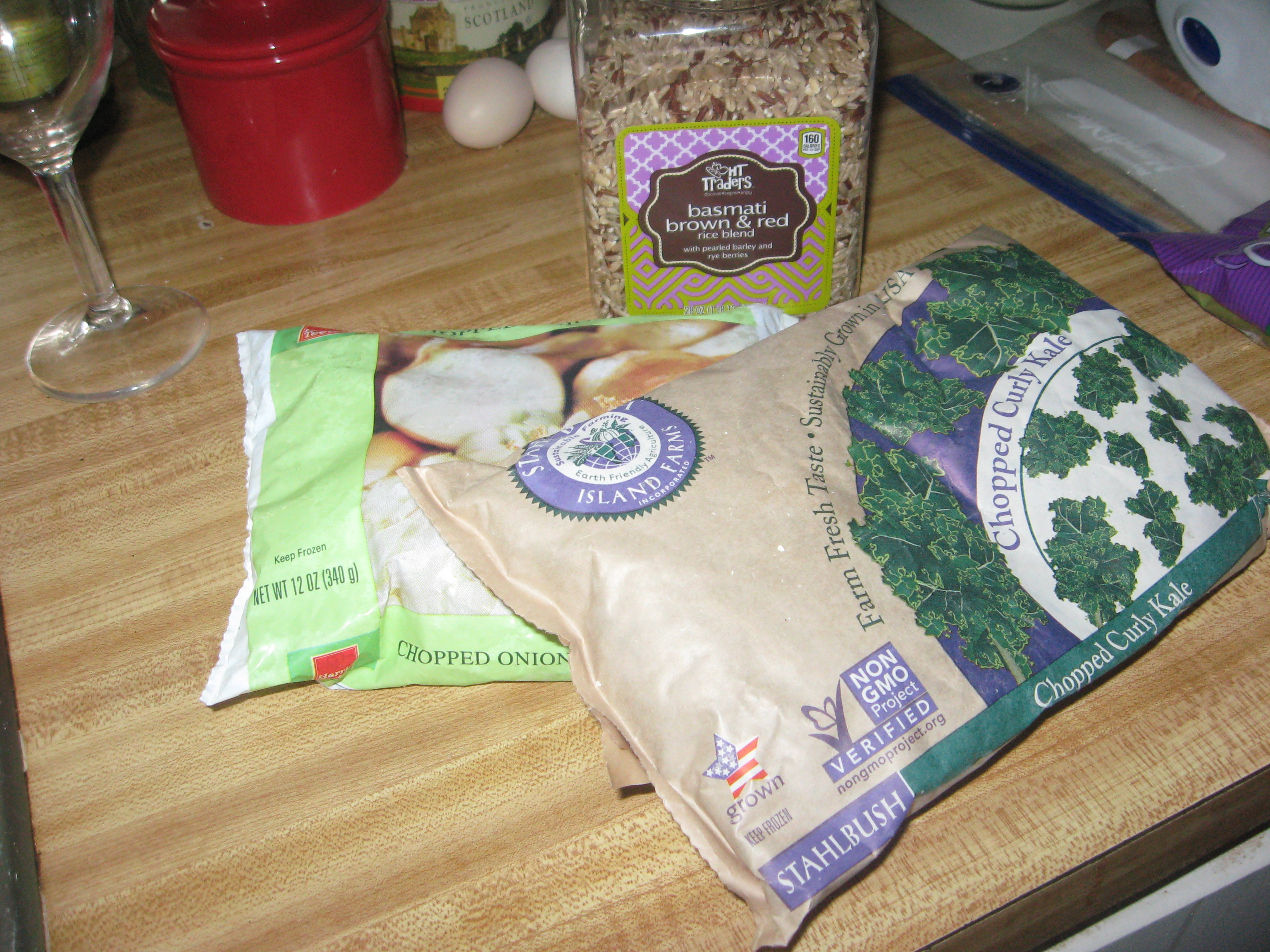
Light on. Obviously I’ve stuffed the freezer a little too full or something has fallen out of place. The freezer door is very slightly ajar. Even in my rather sleep-befuddled state, brain clicked on. Several epithets which should not be printed. Open freezer door and palpate the front packages: kale, butternut frozen onions, kalesquash, chopped onions. Soft, but not obviously completely thawed, but destined to turn into a huge clump of re-frozen vegetables.The only meat even close was a game hen which was still hard as a rock.

I closed the freezer door and checked that it shut completely, and tightly. Back to bed, knowing that I would have to do something with those veggies in the morning. (The ice cream was far enough back and in a corner that it was still hard or I guess I’d have been compelled to eat it right then and there–hmmmmm, should I go do a careful check on the ice cream?)

Morning after: I’ve got work that that to be done NOW so spending a bunch of time in the kitchen or skulking through cookbooks isn’t on my agenda. It’s time for some improvisation: take chopped onions, chopped kale and cubed butternut squash. . . .add some bratwursts that are in the fridge. Add a portion of mixed grains (brown basmati rice, red rice, barley, rye berries) and one multipurpose rice cooker.

I’m sure you’re not surprised that I’d resort to the rice cooker, given all the other things I have it to cook. Once you understand the physics of its function, it’s really easy to make it do what you want. So here we go again with the rice cooker.

Ò¿Ó

Kale, butternut squash with bratwurst

Cook’s note: first this is not a recipe–it’s an improvisational happening. Secondly, it’s recommended that you deliberately thaw the vegetables in the refrigerator or on the counter instead of the method described here if you wish to have them unfrozen. You can put frozen vegetables in the rice cooker without thawing unless you have a great big blob of frozen stuff. You can adjust the proportions of kale, onions, and squash as desired.

Ingredients

  • one standard-sized package chopped kale, thawed
  • one standard-sized package chopped onions, thawed
  • one standard-sized package butternut squash, cubed
  • 4 fresh bratwursts
  • 1 tablespoon olive oil
  • 1/2 teaspoon salt
  • 2-1/2 cups water (or amount called for in the cooking instructions of your grain)
  • dash of red pepper flakes
  • 1/4 to 1/2 teaspoon of oregano or herb of choice

Preparation

  • add olive oil to rice cooker bowl
  • add thawed onions and let sauté briefly
  • push the onions to the sides of the rice cooker
  • lay fresh sausages in a single layer and then redistribute the onions evenly over the bottom and partly over the sausages; they will brown lightly on the side in contact with the bottom of the rice cooker bowl
  • add 1 cup of grains
  • add kale and distribute evenly over grain and sausages
  • add red pepper flakes and herbs
  • add scant 2 cups of water; your rice cooker may need more or less, adjust as needed
  • close rice cooker and leave until it switches to “warm” function
  • stir contents (grains should be a bit underdone)
  • add remaining water
  • add butternut squash on top of greens, grain, and sausages
  • close rice cooker and leave until it switches to “warm” function a second time
  • check doneness of grain; if needed add a bit more water and wait again
  • when grains are cooked as you like them, serve!

Ò¿Ó

Despite the ridiculous circumstances that gave rise to this recipe, it was very tasty, and I’m sure some version of it will be made again. The combination of kale with the butternut squash was delightful. The combination of grains gives some interesting texture and flavor to the dish.

A son goût!

cat on kitchen counter