Dandelion greens

I finished my teaching week this afternoon and found myself in need of an attitude adjustment.  It’s been a busy, hectic week but I still can’t figure out what I supposedly accomplished in all that business.  Still laundry to do and other household chores….

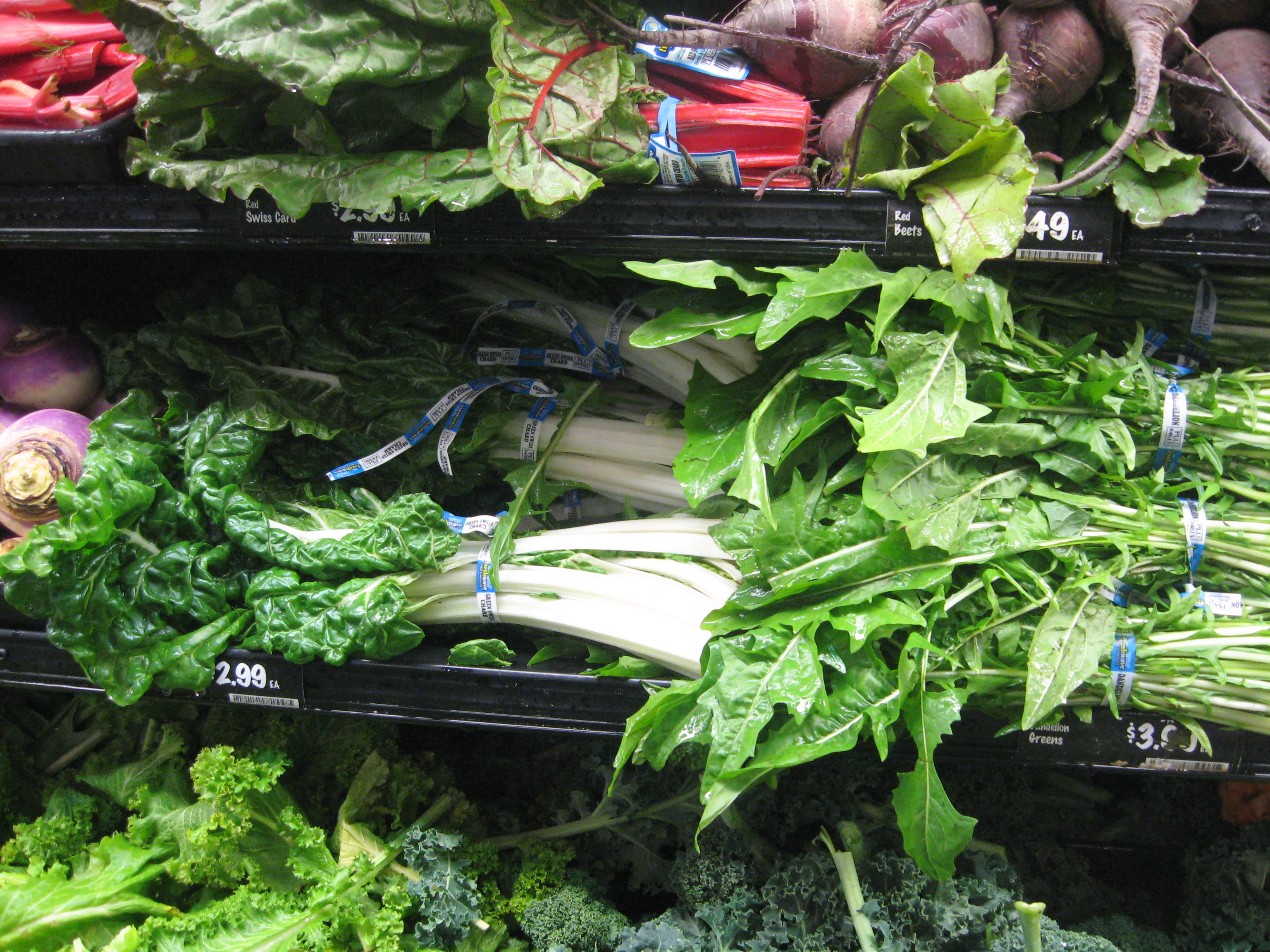
dandelion greens bunched in the Harris Teeter produce department

dandelion greens

In prowling through the grocery store (my local Harris Teeter) the other day I found absolutely lovely dandelion greens.  I haven’t had dandelion greens very often since I was a kid growing up on the farm.  Then they were a springtime treat–the young tender ones in a wilted salad with bacon dressing.  I thought that I’d try them in a one-dish meal based on a recipe from Jacques Pepin’s Shortcut Cook–quick, easy, and in the comfort-food category.  I decided that a good complement to the bitterness of the dandelion greens would be Siciliansausage which Harris Teeter makes in the meat department.  It’s a bit like Italian, but spicier and with much less fennel.

fresh store-made sausages

freshly made sausages

Remove sausage from casing, brown; add chopped onion and continue with the browning, then add a couple of garlic cloves, minced.  Add the chopped dandelion greens, stems about 10 minutes before the leafier parts (still wet from washing), cover and simmer. Depending on the spiciness of the sausage you might want some red pepper flakes. This particular sausage is strongly enough flavored that I did not add anything else.  When the greens are almost cooked, add some cooked pinto beans (in this case I’m resorting to canned ones). For a change from beans, add some diced potatoes to cook with the sausage and the greens.

Finish with a tiny drizzle of good fruity extra-virgin olive oil and it’s good to go, add some of my homemade oat bread, and ripe and fragrant Bartlett pears.

It’s certainly easy, reasonably quick–it takes about 15 to 20 minutes for the greens to cook, but it sure does contribute to attitude adjustment!  (Sorry, no pictures–it’s not photogenic.)  It’s good for single-serving cooking since I can buy the sausages individually, and if I’m using mustard, kale, I can buy those loose in the amount needed I don’t have leftovers.  If there is more than I’m going to use at once, I’ll take out some of the sausage and greens to be used later, perhaps as an omelette filling.

A son goût! 

Indigo Rose Tomatoes

When you’re just getting thoroughly tired of winter–about late November or  very early January–the seed catalogs start to appear in the mail box.  You spend hours happily looking through them and anticipating planting seed.  There are all those gorgeous pictures and the descriptions.  For me this is especially a problem with tomatoes.  So, every year I end up wanting something new–in addition to those heirlooms that I always want (Black Krim, Cherokee Purple). Last year my new addition was a Japanese Black Trifle.  It’s now become one of the regulars, and is close to replacing the Black Krim because it tastes wonderful and produces more tomatoes.

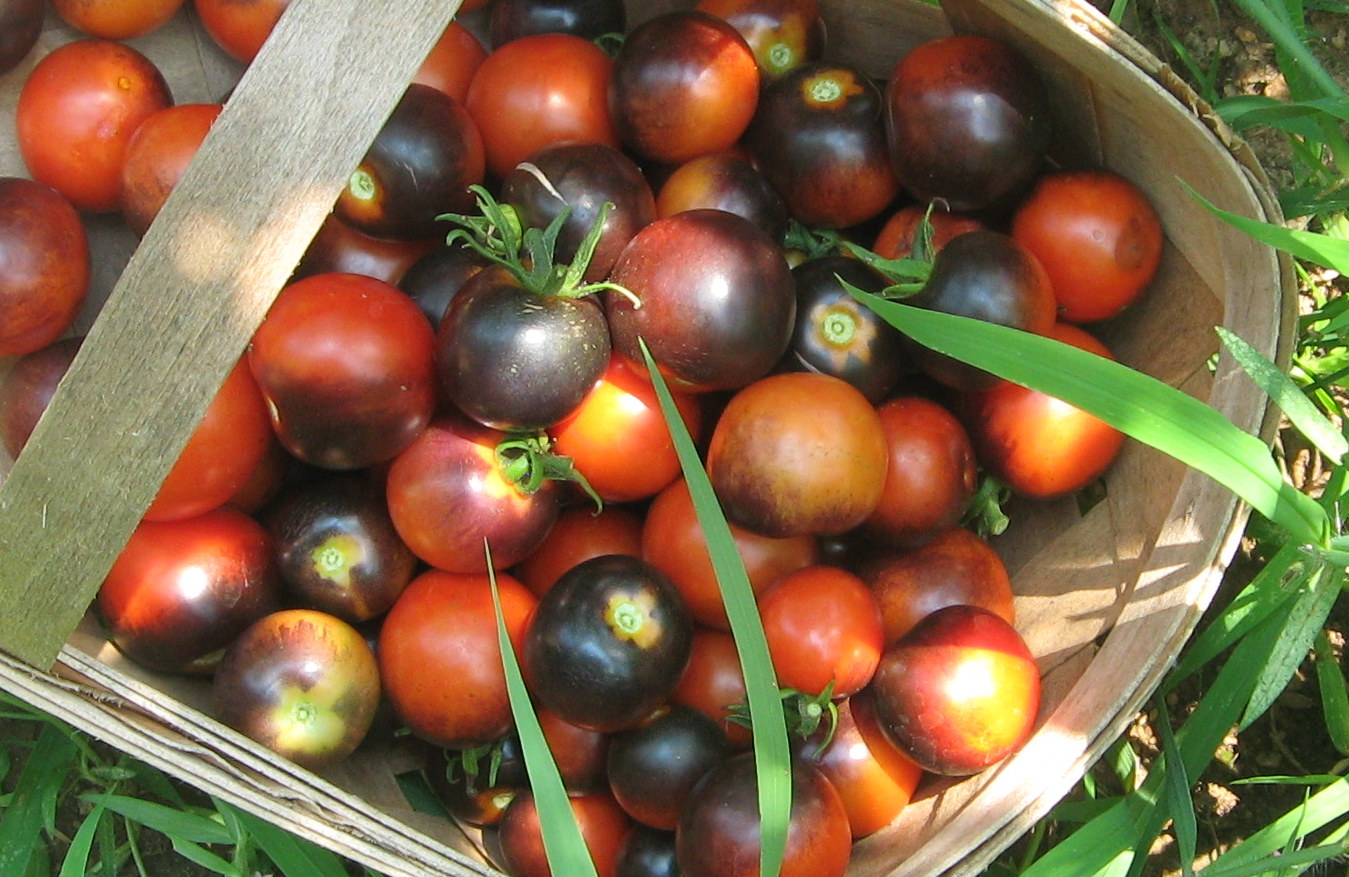
This past winter the tomato that aroused my curiosity most was an Indigo Rose, described in Johnny’s Select Seeds as a cocktail sized tomato, dark purple because of the anthocyanins (anti-oxidants) which develop in areas of the skin exposed to direct sunlight. To further titillate, it was described as ” good flavor with ‘plummy’ overtones. Developed by Jim Myers at Oregon State University using traditional plant breeding techniques. Moderately vigorous. Compact indeterminate. Organically grown.”  Now, who could possibly resist that in the midst of grey skies and cold rain?  Yes, I ordered some seeds.

Sprays of unripe Indigo Rose Tomatoes on the vine

unripe Indigo Rose tomatoes

Now we are harvesting them from the garden and fields–the acid test, so to speak.  I’ll concede that they are moderately vigorous, compact indeterminate, and very striking when you see them in the garden even when unripe the purple anthocyanin pigment is really obvious.

As they ripen to red (thus, the “Rose”, I guess) they really are lovely–impressive to be perfectly honest about it.

The very first ones that I tasted left me somewhat ambivalent about the taste–maybe I  tried them before that were appropriately ripe, or maybe I just like a different style of tomatoes–anyhow, there were different opinions.

Ripe Indigo Rose tomatoes

ripe Indigo Rose on the vine

Now that I’ve tasted some that I’m sure are really ripe, and tried them in several different ways, other than just eaten out of hand, I’m more interested in exploring different things to do with them.

I have to say that they are not going to make it on to my bacon, lettuce, and tomato sandwich–not nearly tart enough to stand up to the really good dry cured kind of bacon that I like to put on my BLTs.  (I would put a Black Krim, or a Japanese Black Trifele, or a Brandy Boy on my BLT, though.) But–there are lots of tomatoes that I really like for different uses that don’t make it onto the BLT either–so no strike against the Indigo Rose for that reason.

My impression eating them out of hand is that they are a very low acid tomato.  Usually I prefer higher acid tomatoes–a balance of tomato-tart and tomato-sweet.  So this is not going to be my choice of tomato for my sloppy, eat-over-the-sink-with-mayo tomato sandwich (which needs to be on white bread, too, by the way!) either.

But–one of my other summer favorites is insalata Caprese.  One of the fun things to do when making this salad is to have different kinds of tomatoes–lots of visual appeal–like Green or Red Zebras, some pink, some purple–whatever!  I tried these with the fresh mozzarella and extra-virgin olive oil, and just a tiny drizzle of a good balsamic vinegar.  The sweet-tartness of the balsamic really showed the sweet tomato flavor of the Indigo Rose tomatoes.  I did not (I know Indigo rose tomatoes in basket after pickingit’s heresy, but I did not) put basil on this salad–I used Syrian oregano, and it was a lovely salad.

For more taste and visual contrast I might combine these with an orange or yellow (also lower acid) tomato, but not with high acid tomatoes–I think that would just make the Indigo Rose ones taste bland–but that’s the next experiment!  A reason to go tomato shopping at the Wake Forest Farmers’ market tomorrow.

Another way that I’d like to try them is slowly oven-roasted to concentrate the flavors–I think that will really bring out the sweet, plummy flavor–again another experiment.  They are a good size to use in green salads, but I’d want a pretty mellow vinaigrette with them–maybe just extra-virgin olive oil and balsamic vinegar.

Choicest summer fruit–figs!

figs on tree

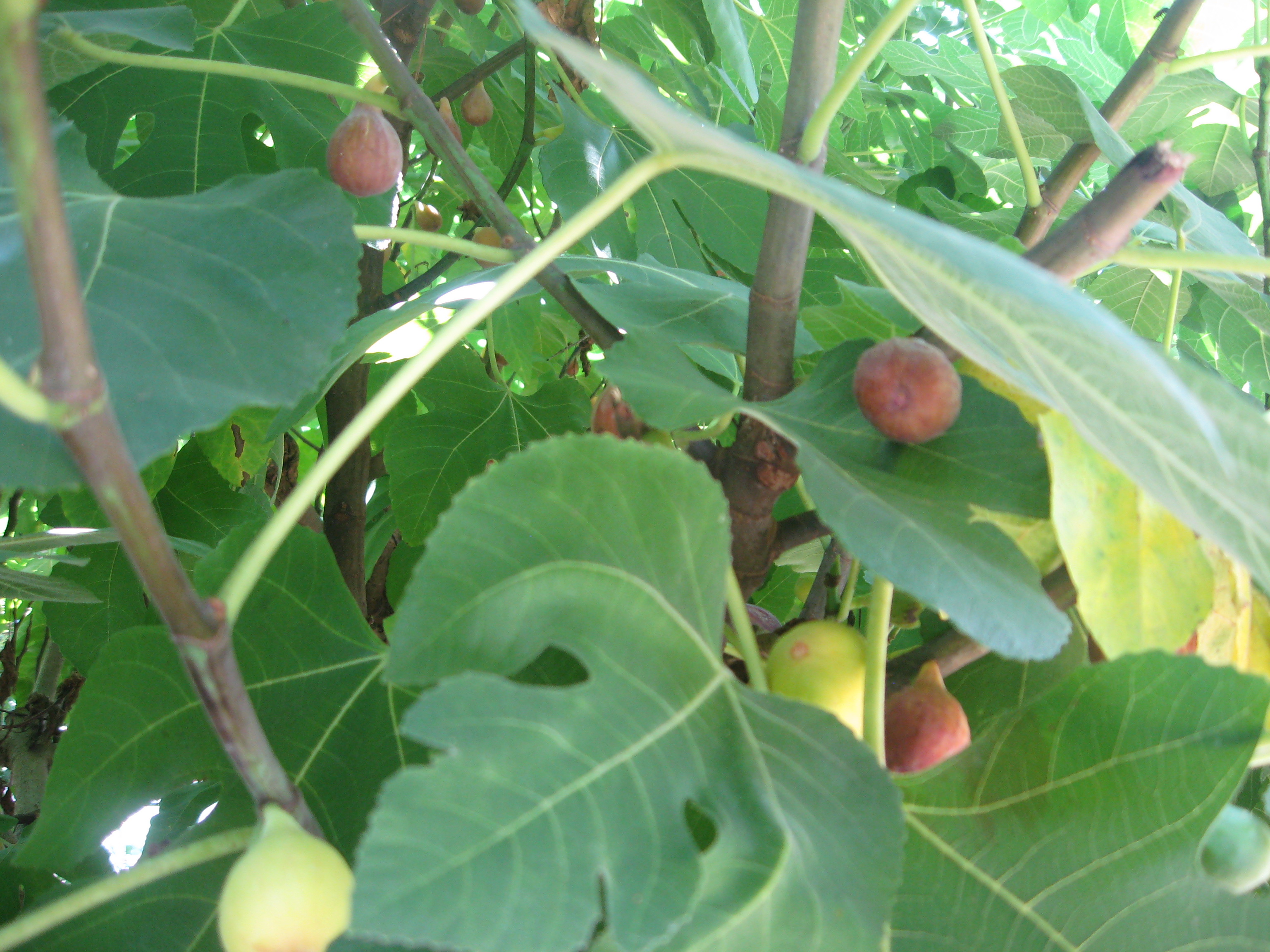
ripe and unripe figs on tree

One of the high points of summer for me is when figs are ripe–eat them fresh, ripe from the tree early in the morning while they are still cool from nighttime, or in the heat of the afternoon when they are fragrant and warm from the afternoon sunshine.  Absolutely luscious!  They never even make it into the house.  Should the crop be so plentiful that they do make it into the house, then get out the prosciutto–fresh figs are even better than melon with that lovely ham! Or, some good cheese–goat cheese, or Gorgonzola, or other  blue, or a sheep’s milk cheese like Etorki or aged Manchego They are never better than when you can pick them truly tree-ripened.

Too many times, figs are sold unripe, mostly because they are very perishable and delicate when at peak ripeness.  Another reason figs are frequently picked before peak ripeness is the competition: birds, squirrels, bees, wasps, and ants–all those critters have an eye for the perfectly ripe fig!  If you want to eat them ripe from the tree you have to be willing to share because unfortunately, figs do not ripen after they are picked–pick a green fig and you’ll always have a tasteless fruit that will leave you wondering why anyone would want to eat them, much less get excited about them.

It’s really hard to describe the taste of a fresh, ripe fig–it’s certainly much different  from dried ones, and a world away from Fig Newtons.  I think that a ripe, fresh fig has some peach and berry flavors–it will vary somewhat with the variety of fig, but still—it’s not likely to be what you’d expect from eating dried ones.

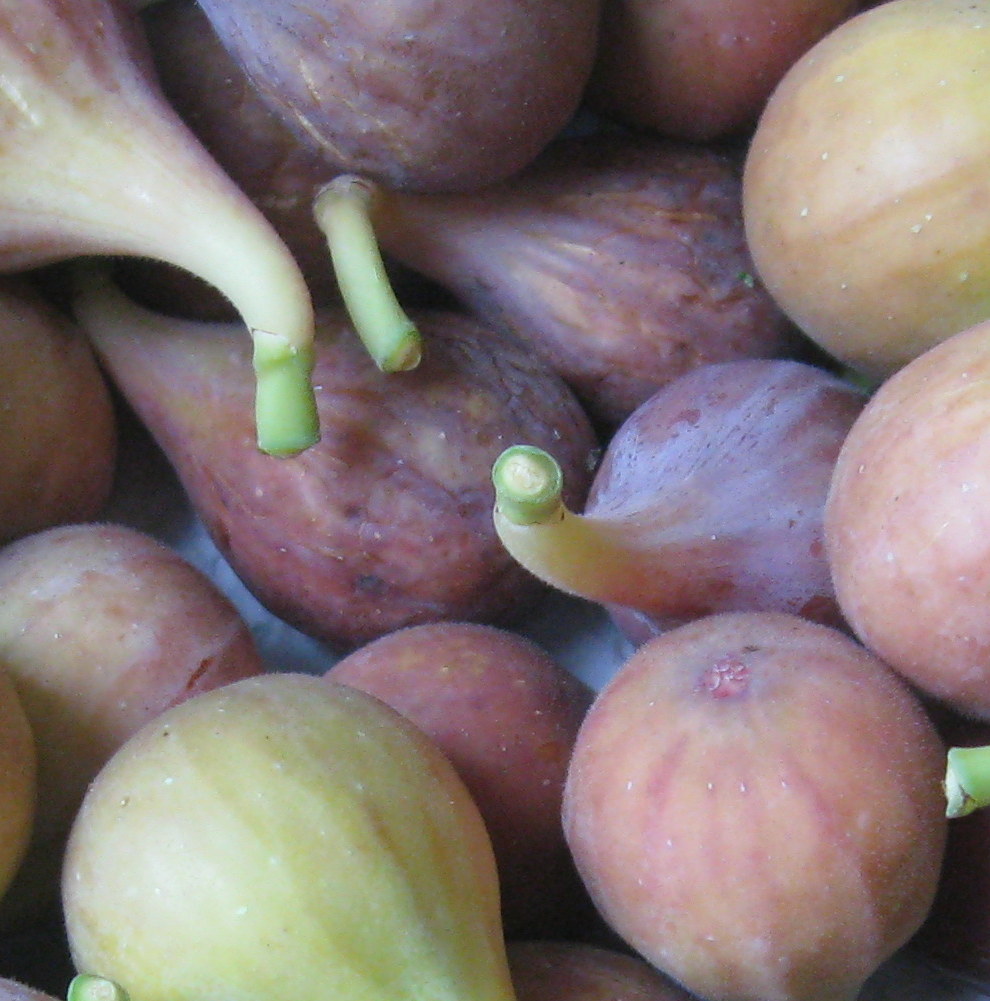
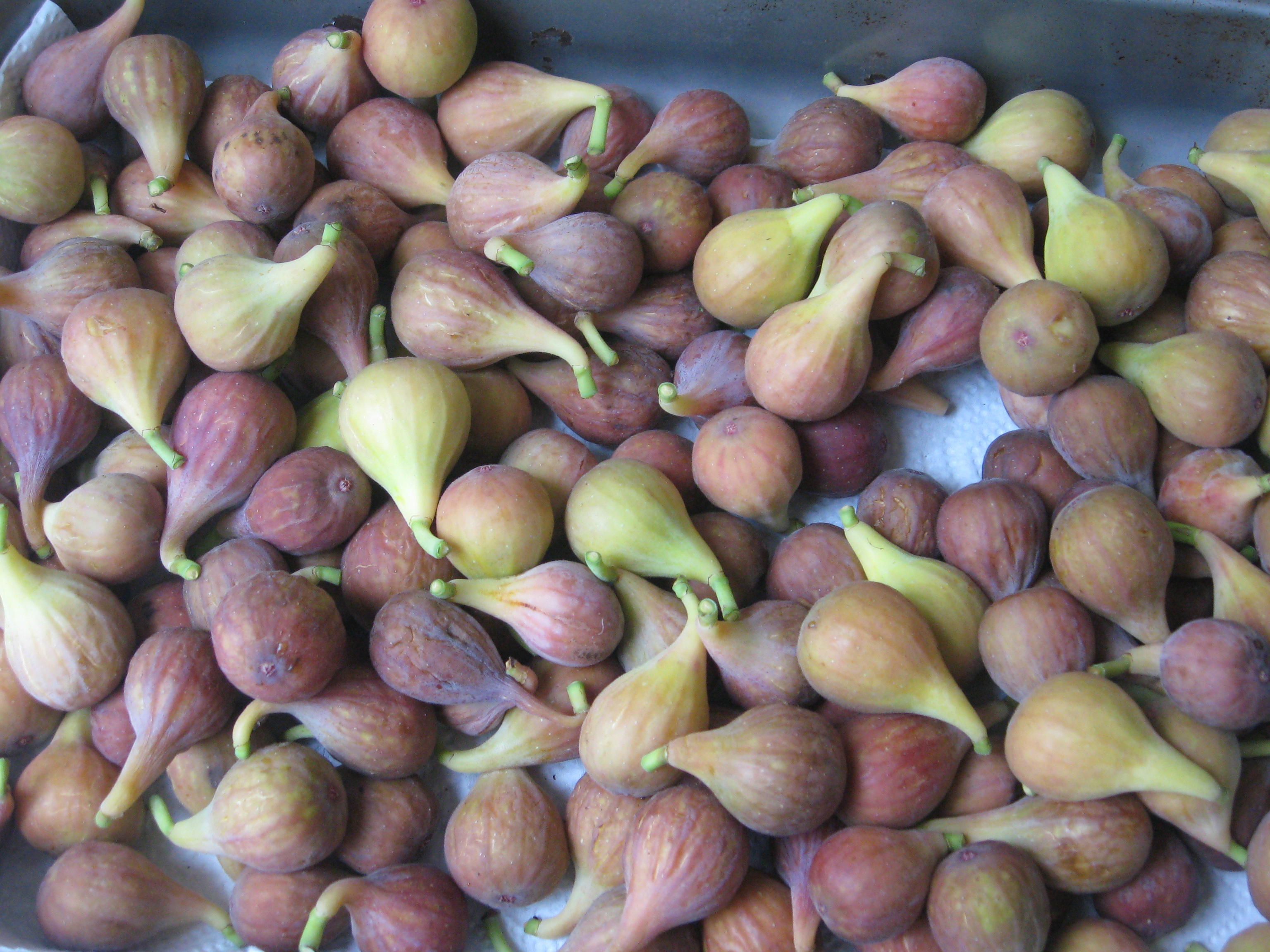
So how do you tell if a fig is ripe? They should be soft–but please be gentle when you press on them. Really, you can tell if they are going to be soft by looking at the color (you do need to know the color of the variety when ripe). The Brown Turkey figs first turn yellowish-green–they will likely be just starting to soften then, but still do not have much flavor yet.  As they ripen more they begin to turn a lovely rosy brown–but wait!  They’re not ready to eat yet.

Figs hang in a drooping way from the tree (you can see how the stem ends are curved in the photograph above).  When ripe they should separate easily from the tree when you lift them up against that curve. If they don’t they are not ripe!

For best flavor, they should begin to show some tiny surface fissures in the skin (not deep cracks) almost like crazing on pottery glaze, and the small round area at the blossom end should have started to  open or to show a split. On some figs you may actually see a drop of clear liquid there.

To find ripe figs if you don’t have your own tree, you need to head to the farmers’ market. The common fig here is the Brown Turkey which is in season approximately from July to September. I’ve just harvested several pounds of figs–but the tree still has lots of small green figs that should ripen in a second flush in a few weeks.

Should you have an excess of fresh figs, you should use some with duck–the recipe is complicated, but the result is unforgettable–worth the effort.  What else can you do with fresh figs?  Fig ice cream, poach some and serve with pound cake or vanilla ice cream, fresh fruit tart….but best of all, just eat them unadorned.

If you find you have some that are not quite what you’d like to eat out-of-hand, then you can make a lovely dessert by poaching them in Campari.  This is a recipe that I found in Jacques Pepin’s The Shortcut Cook (page 248) for which I’ll give you the basics here:

Poached Fresh Figs with Campari

Ingredients

  • 1 cup fruity white wine
  • 1/4 cup sugar
  • 1/4 cup lime juice
  • about 20 small, ripe figs
  • 2 teaspoons cornstarch dissolved in 2 tablespoons water
  • 2 tablespoons Campari

Preparation

  • Combine wine, sugar and lime juice and bring to a boil.
  • Add figs, cover, and simmer for about 4 to 5 minutes. Figs should be tender when tested with the tip of a knife, but should not burst open.
  • Transfer to a bowl with slotted spoon.
  • Reduce the liquid in the saucepan to 1 cup if there is more than this.
  • Add cornstarch slurry and bring to a boil to thicken.
  • Cool sauce to room temperature then stir in the Campari and pour over figs.

These are delightful served over pound cake with a dollop of sour cream or crème fraîche, or spooned over good vanilla ice cream.  (I like to add just a hint of cardamom to this poaching liquid.)

brown turkey figs picked ripe

ripe Brown Turkey figs

Red, white, and blue roasted potatoes

Happy Fourth of July to all!
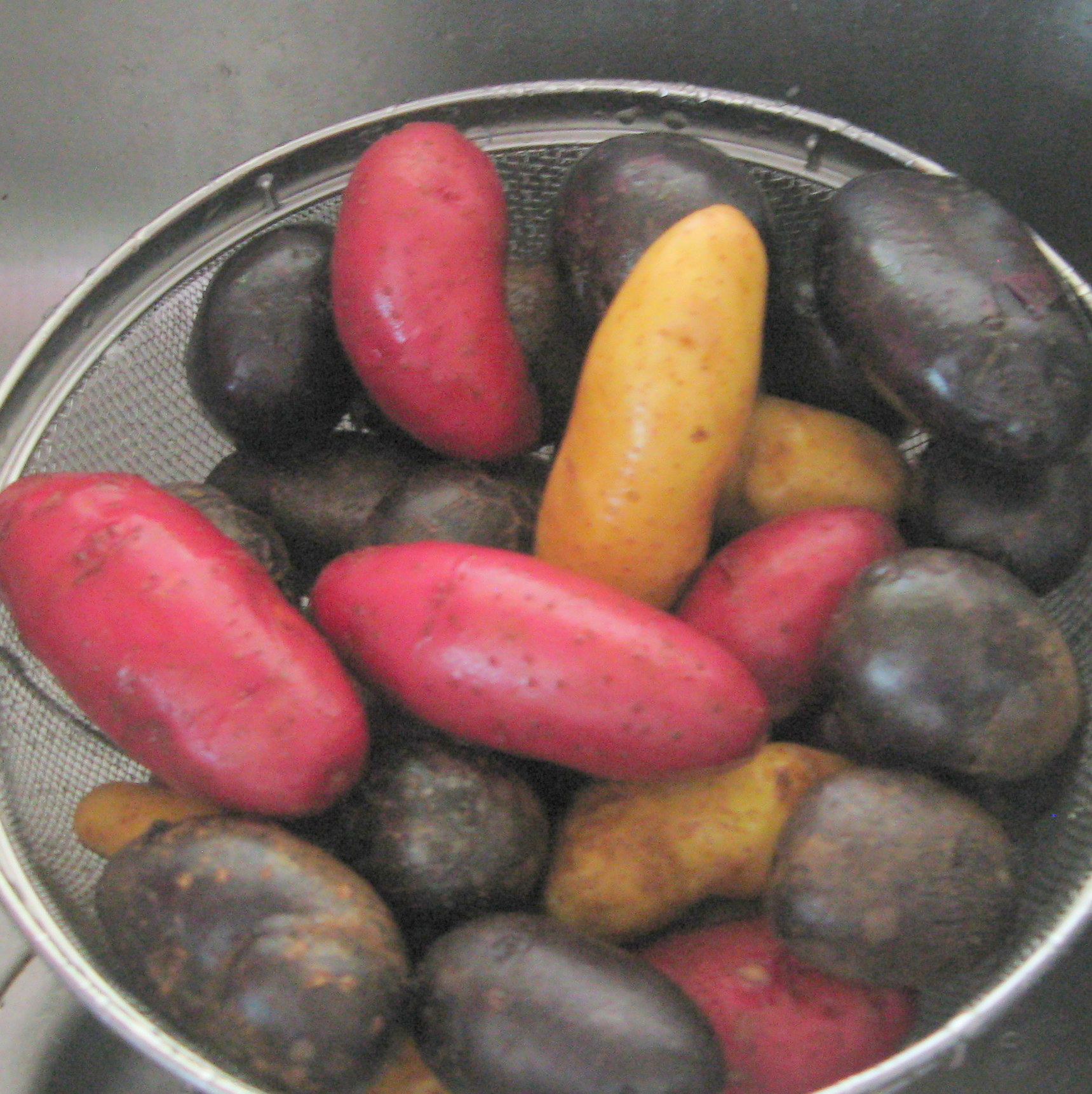
mixed color potatoes in colander

I really was planning to do something special today–more smoked lamb and goat shanks–but I admit to turning to a total wuss, wimping out…as I looked at the weather forecast for the week.  Even though those are easy, it still requires some minding of the grill, and I just could not face it.  I resolved to have a quiet, cool Fourth of July–just me and the cat–indoors with the air conditioning…and I woke up this morning wishing I’d not been such a wuss.

Saved by friends!  An impromptu invitation to join them for grilled chicken this evening.  So–I’m having my quiet Fourth, but with friends and neighbors.
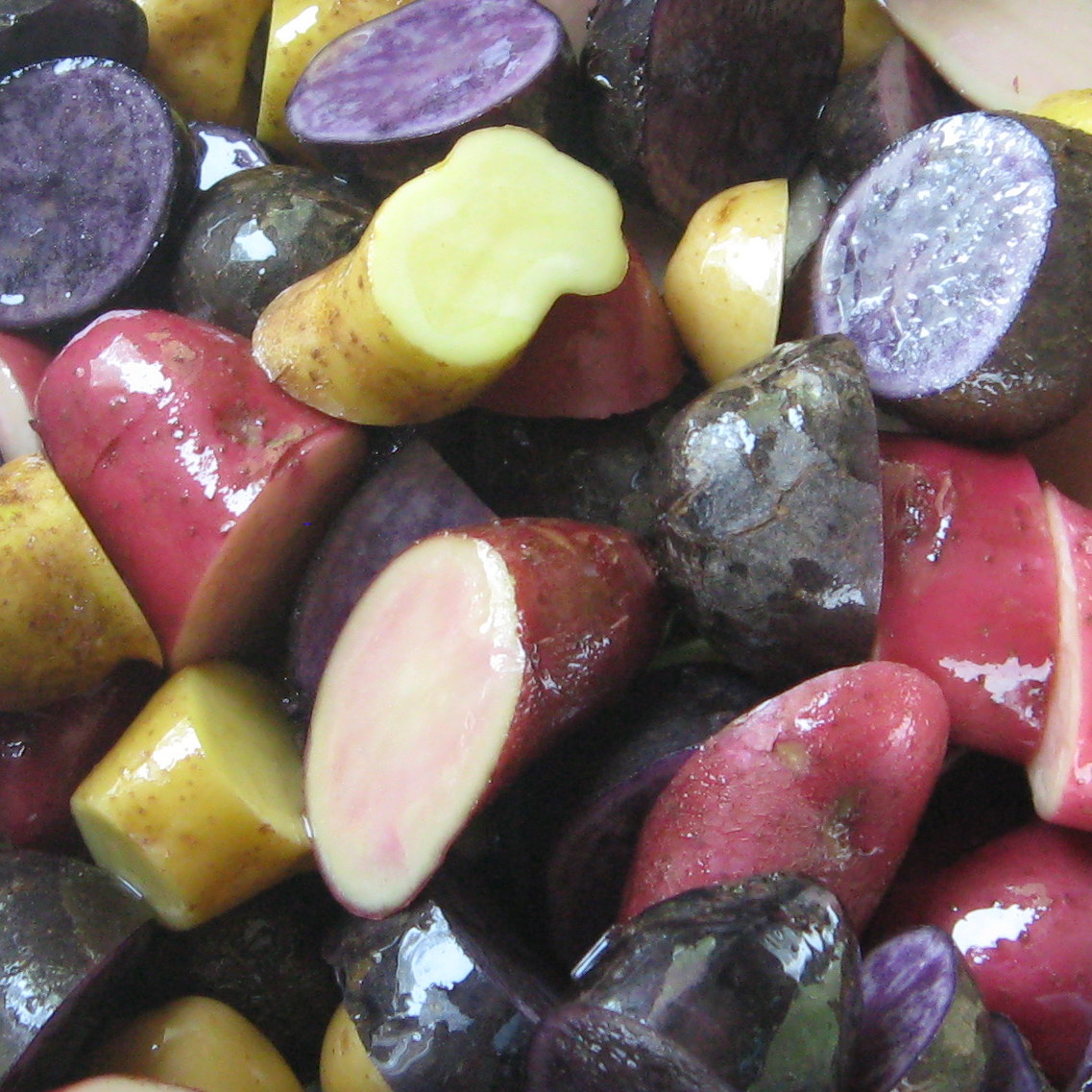
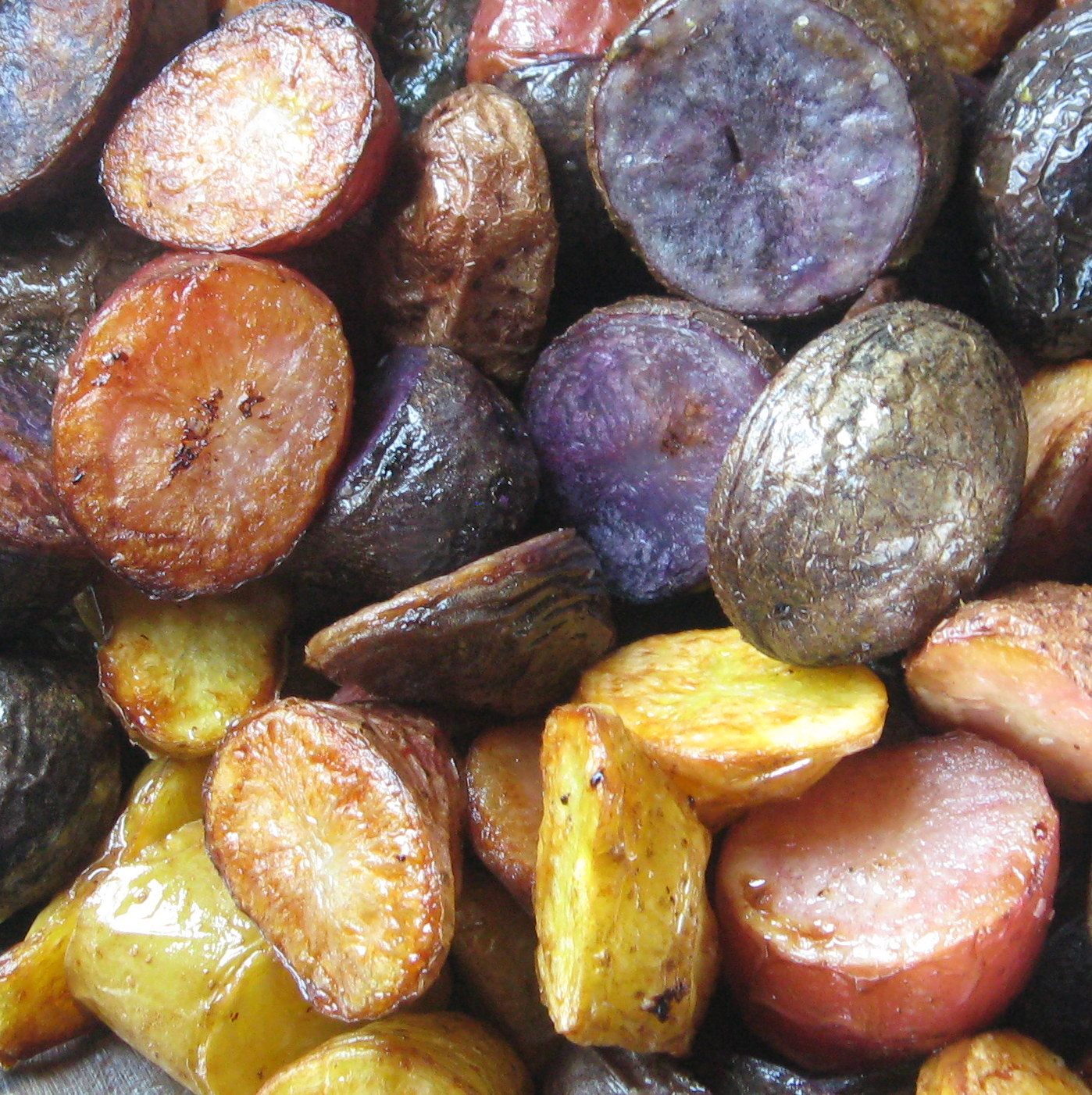
close-up of cut purple, pink/red, and yellow potatoes

Not to go empty-handed, I am making some patriotic roasted potatoes–red, white, and blue–Red Thumb, Russian Banana (okay, bit of fudging here), and Purple Majesty potatoes (new ones from the farm).  Since it’s HOT (my thermometer is reading 98°F now), I’ve decided that those roasted potatoes are going to turn into something that can be eaten at “room temperature”, that will be light and refreshing, and compliment the chicken.

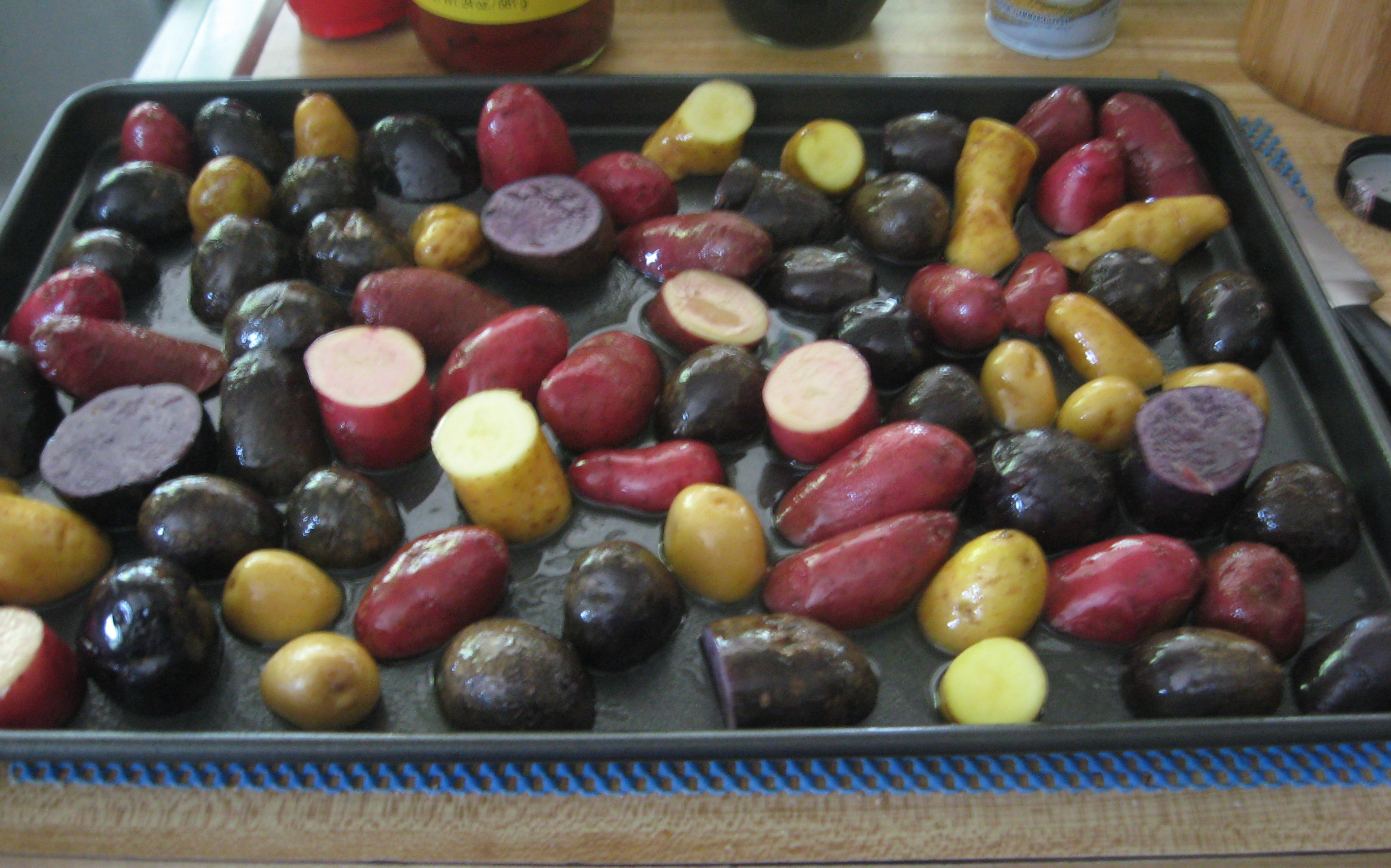
I’m taking  newly dug tri-colored potatoes and scrubbing their delicate skins carefully, cutting as needed to have them equal sizes so that they cook at the same rate, tossing them with a little olive oil; then into a preheated pan and into a 350° F oven until they are tender.
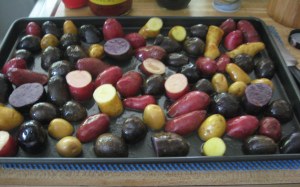
cut and oiled potatoes on baking sheet

I’ve done what America’s Test Kitchen recommends and placed cut sides in contact with the baking sheet so that at least some of the potatoes will brown to give roasted flavor. Now for some complimentary and contrasting flavors to finish these. Since all these do taste a bit different, and for me one of the fun things about this is to be able to taste the individual potatoes and to compare them–think about comparing wines–I want light seasoning–nothing to overwhelm the potatoes themselves. The only seasoning at this point is kosher salt.

Since it’s hot outside (my thermometer is now reading 99.7°F ), I’m thinking light and cool flavors.  I don’t want “potato salad”–so vinegar is out, but I do need something “bright”–and light, and something cool.  Time to check out the herbs on the deck, and the crisper drawer.
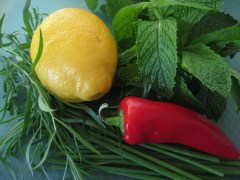
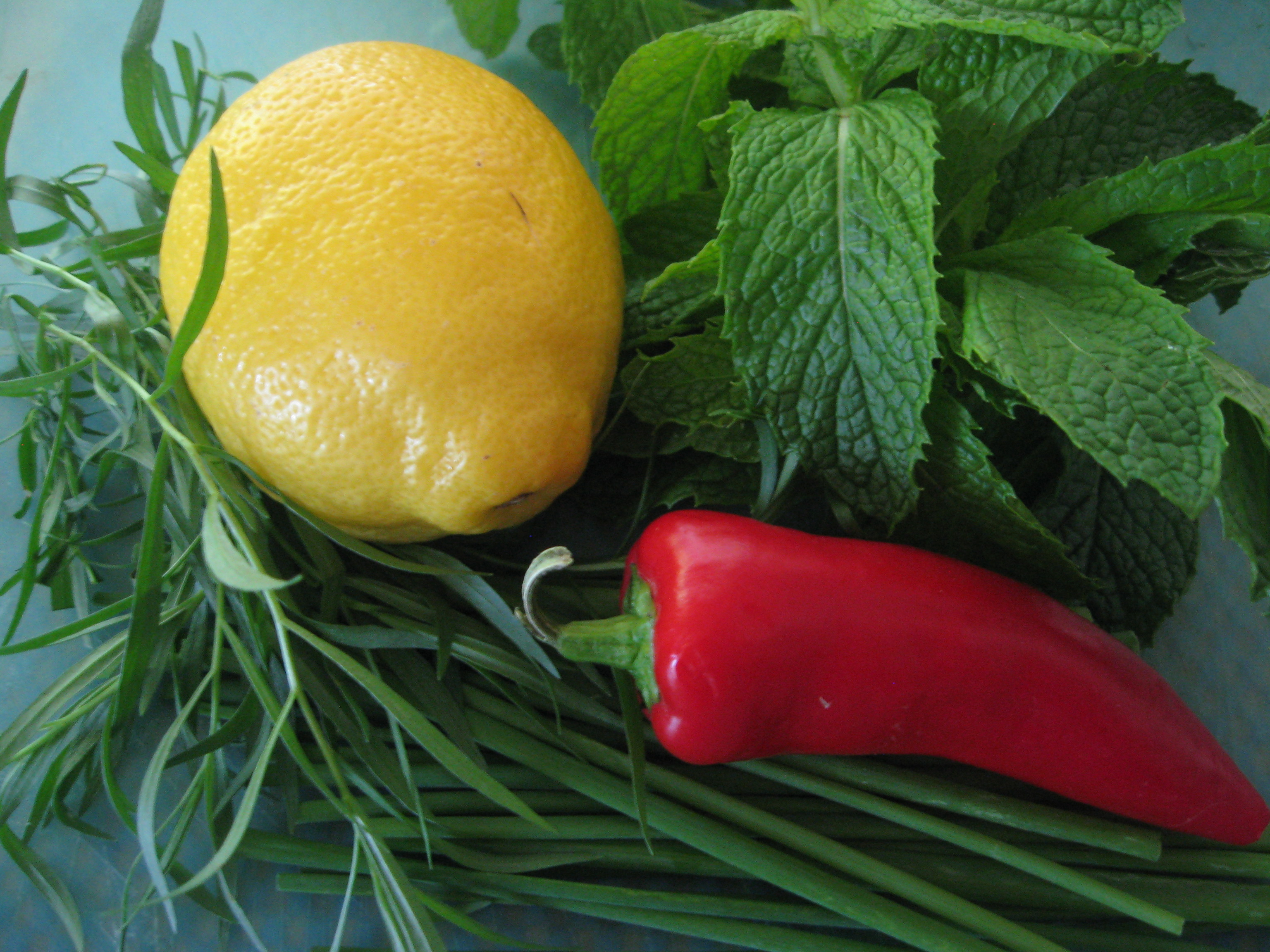
lemon, tarragon, chives, mint, and chili peppers.

Chicken makes me think tarragon.  Cool makes me thing mint–hmm.  Let me smush a couple of leaves together and see how that smells.  Tarragon–warm, mint–cool.  Need some brightness to set off the earthiness of the potatoes–lemon zest, and maybe just a bit of lemon juice over the potatoes while they are still warm.  Seems a good start–but not quite there yet.  Needs a little “spice”–some very finely minced red chili pepper might just do it.

After the potatoes had been in the oven for 30 minutes, I used the tip of a paring knife to check doneness–not quite; and, not quite brown enough.  (I probably should have used the heavier half-pan baking sheet instead of this one–drat.) I kicked the oven temperature to 450°F for another 15 minutes and checked again.  Perfect!  Brown potatoes–so out of the oven, ready for the first seasoning.
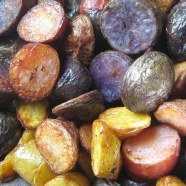
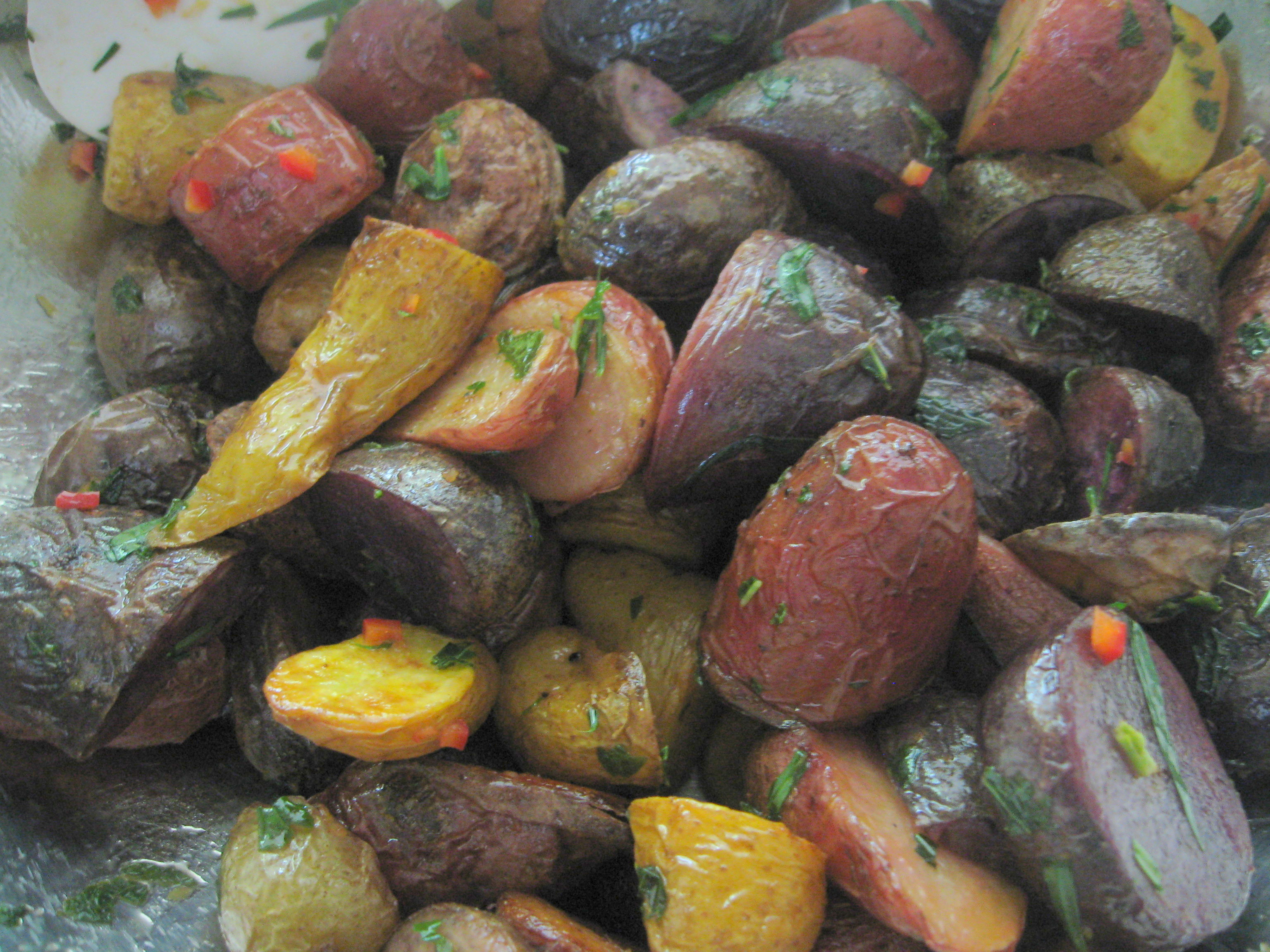
roasted potatoes--browned edges of the red, yellow and purple  ones.While still hot, I tossed them with the zest of one lemon and most of the juice of the lemon–nice bright flavor to contrast with the brown and earthy potatoes.  After cooling a bit, I tossed in about a tablespoon each pretty finely chopped French tarragon and mint. That got the first taste of cool mint, followed by the warm flavor of French tarragon.  So far so good.

I let them stand for a bit and tasted again–the lemon flavor is there but not overwhelming–the juice has added just a bit of tartness, but not enough to taste like a “potato salad”. Now, I’m debating chives and chili pepper.  I taste the chili pepper–it’s not screaming hot–and I think that just an occasional bit of heat as you eat the potatoes would be nice.  I seeded and removed the ribs, and finely minced about 1/5 of the pepper and tossed that with the potatoes. (Still debating about the chives–I really don’t want them to taste like ersatz baked potatoes.)
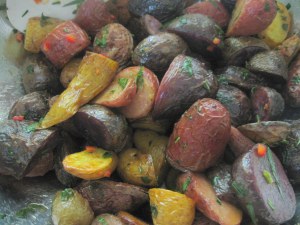
seasoned IMG_6935After standing for a bit longer, I tasted again, and decided that chives are not what is needed here–I probably should just leave them alone!

So the final seasonings are the zest of one lemon, lemon juice, mint, tarragon, and just a touch of  red Serrano chili pepper, and a very light sprinkle of a good fruity, extra-virgin olive oil.  I hope that after standing a bit more (not to be refrigerated before we eat the at ambient temperature–or maybe a little less–thermometer now at 100.6°F ) there will be flavors of warm and cool herbs, the brightness of lemon (juice and zest), and an occasional burst of heat from the chili pepper.

Using the baking sheet so that the potatoes are spread out and don’t steam, and preheated does really help get browned roasted potatoes.  If they are too crowded, they will only “steam” and not brown–not really roasted.  The browning is, after all, the whole purpose of turning on the oven!

It’s not smoked lamb shanks, but it’s going to be a pleasant evening with friends–and I do think that something similar will return to go with those lamb shanks when they happen later–when the temperature does not turn me into a total wimp!

…and yes, I’ve done that final taste–yum!  No chives though.
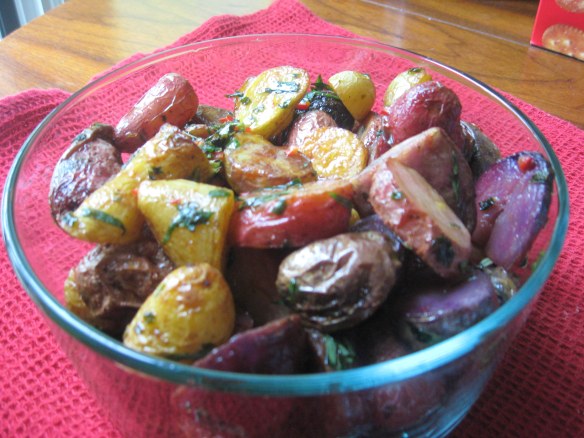
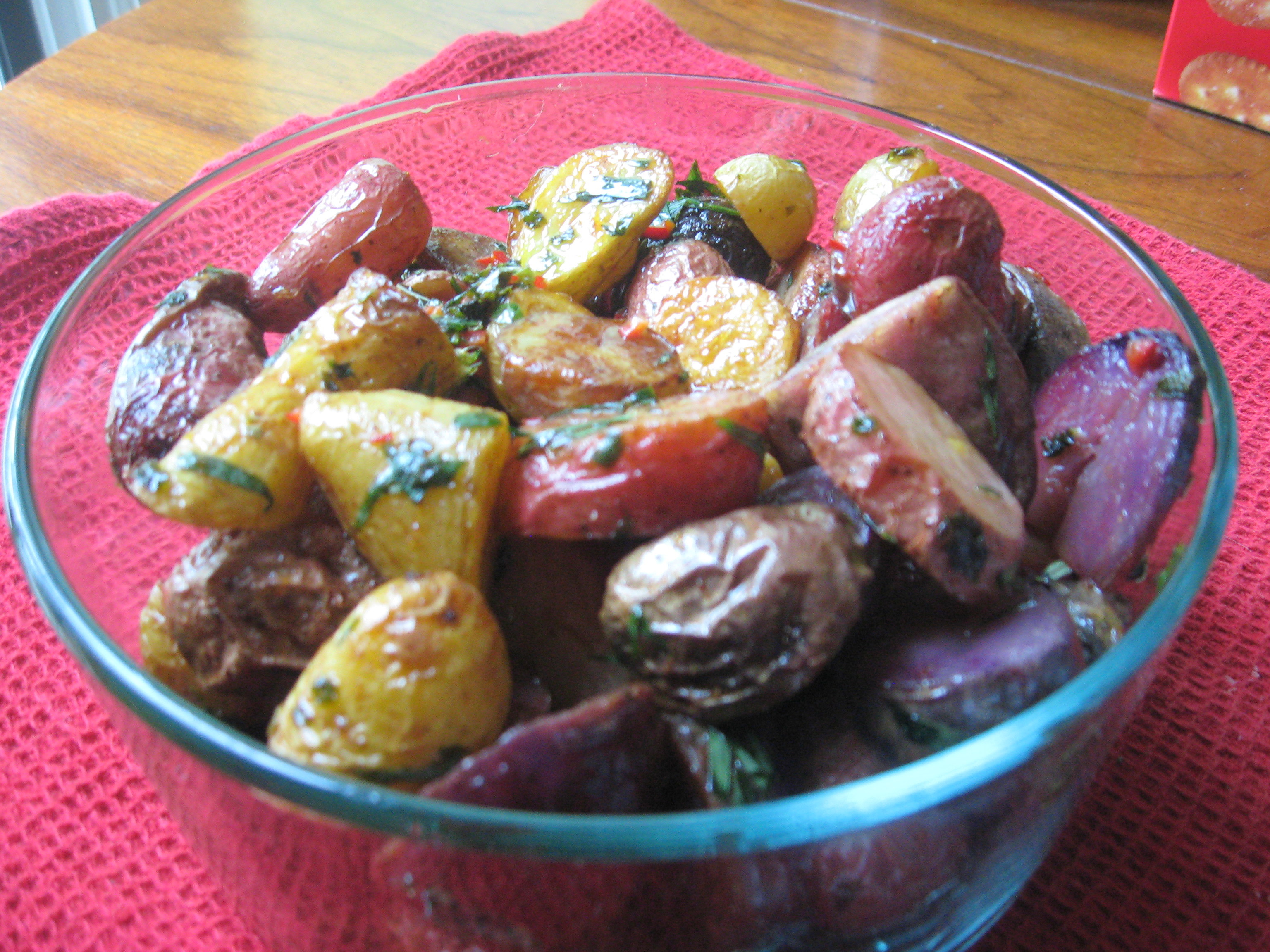
roasted potatoes, with herbs and chili peppers in serving dish.

Leftovers? Possibly–it is a big dish of potatoes for three, but leftovers here are desirable.  Tomorrow they can become a roasted potato salad–perhaps with just a splash of balsamic vinegar, adding some fresh tomato, and cucumber, and, perhaps, some celery, radishes, crisp sweet onion or some freshly snipped chives.

Happy Fourth of July!  A son goût!  

Haricots verts with herb-infused oil

Taverna filet beans

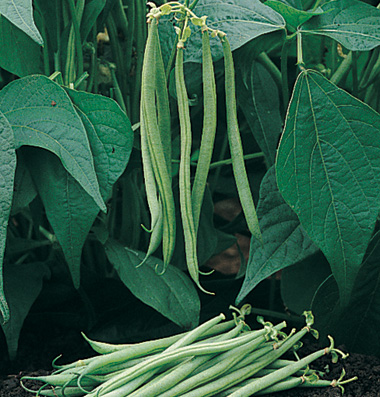
haricots verts (Taverna)

Yes, it is French for green beans–and they are Phaseolus vulgaris, but they are special green beans–not like Kentucky Wonder, or some of the other rather common beans.  To find them in the seed catalogue you need to look for “filet” beans.  They are bush beans, but the pods are small and slender (when harvested appropriately). Not having a large garden, I don’t grow my entire supply of green beans–the usual pole beans or bush beans like Kentucky Wonder–I buy some from the farmers’ market and I even use frozen ones in the wintertime.

These little beans are something that does get space in my garden or in a container on my deck–with successive plantings throughout the summer so that I can dash out and pick a single-serving batch when I want them.

My favorite way to cook them is to steam them very briefly (about 5 minutes) until just tender, shock  them in ice water so that they stay brilliant green, and  toss them with some extra-virgin olive oil infused with fresh herbs, and served at room temperature.  A favorite of mine for those hot summer days when you’re being fussy about what you eat.

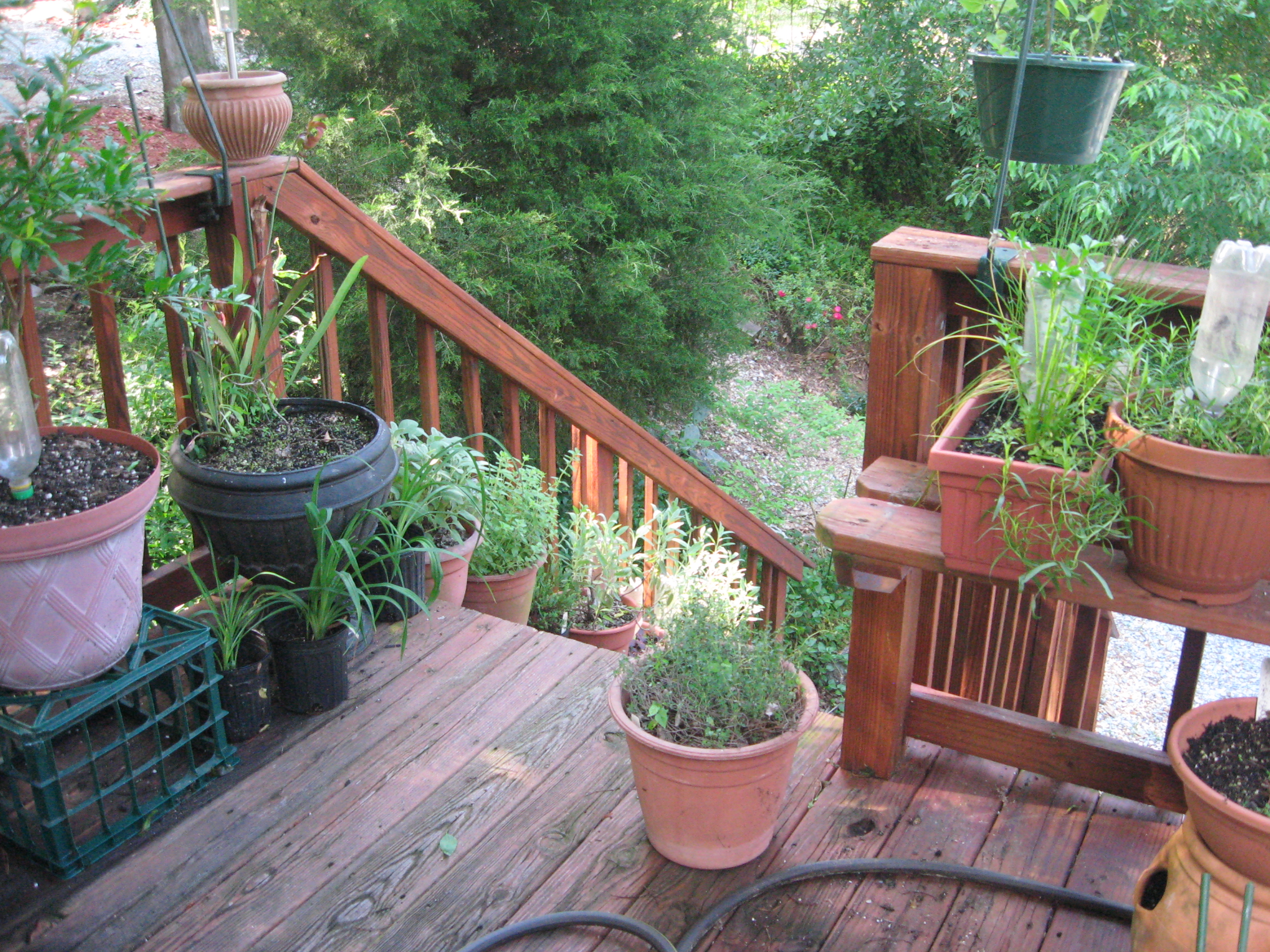
containers of herbs on deck and stairway

herbs

Since I do grow a lot of herbs on my deck with containers arranged on the stairway, and since I prefer not to let them bloom since that affects the flavor of the herb, I keep them cut back to prevent blooming–or grow varieties that do not bloom as readily as the common culinary herbs.  I find that I often need to give the marjoram and the oregano a “butch” cut.  This does not involve a neat trim–it’s taking the hedge shears with the long blades and lopping off the tips.  That leaves me with a handful of fresh herbs to share with my neighbors, or to use to make herb-infused oils to have on hand, and to use during the wintertime.

It’s simple to make herb-infused oils.  For immediate use, you can simply blanch the herbs, then “shock” in ice water, squeeze dry, and purée with enough oil to make a slurry, then add more oil.  Let stand, refrigerated, for 24 hours and strain through coffee filter.  These can keep for about a week, refrigerated.

For longer storage, I prefer to heat the herbs in oil to about 185 to 195° F and then strain.  At that temperature, you should be safe from any bacterial growth.  The last batch of oil that I prepared, I washed, blanched and dried the herbs; then chopped them and popped them into my very small slow cooker overnight, and then strained them.  This oil is probably not as bright green as it would be had I not heated it for that long, but the aroma is really great.

My favorites with the haricots verts is either sweet marjoram, or Syrian oregano (also sometimes known as zaatar).  Both of these herbs seem to intensify the sweetness and the “bean-ness” of the haricots.

Most herbs lend themselves well to making flavored oils:  sage, oregano, thyme–whatever is your favorite–try different ones with the beans, and vary it according to the flavors of other dishes served at the same time.

A son goût!  
Umami in the slow cooker…

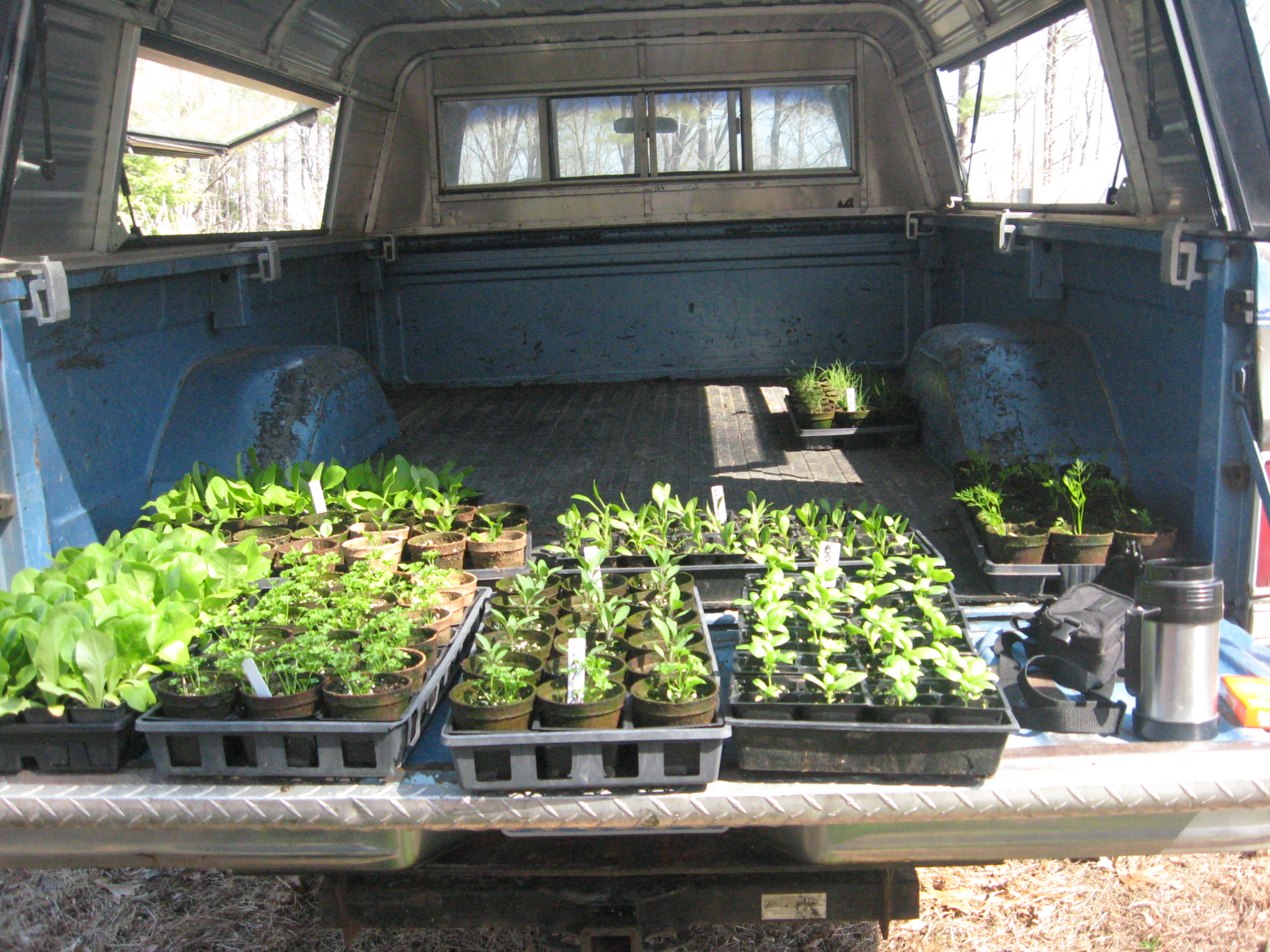
flats of plants on tailgate of truck to be loaded for the farmers' market.

for market

Obviously I’ve not been giving a lot of thought to cooking  things lately–it’s been end-of-term grading, indexing and proofreading, or getting  ready for the farmers’ market, or actually being at the farmers’ market, with more energy going to planting things, both for later harvest and for selling at the market than into cooking.

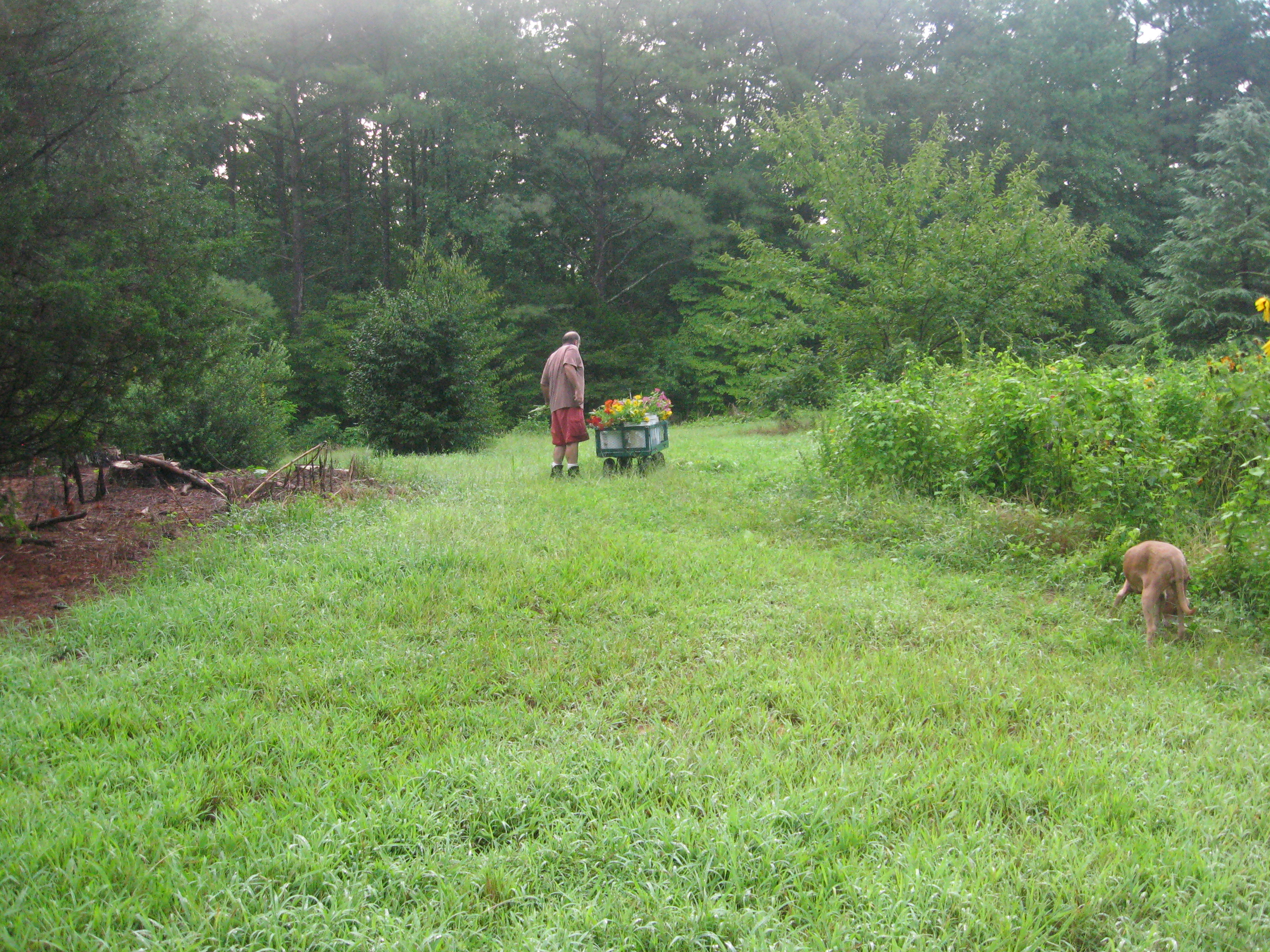
One of the down sides of working the farmers’ market is that I’m one of those people who wake up like a compact fluorescent bulb–pretty dim at first–so getting to the farmers’ market on time on Saturdays involves getting up before the birds just to give me time to be awake and functional. Even Fridays demand early rising, especially as the weather gets hotter–flowers to cut early in the morning and produce to be harvested before the heat of the day sets in and thing wilt…and just to avoid being out in the worst of the heat.

wagon of flowers in buckets

cutting flowers

I’m getting into the swing of that now but it still takes time for my lights to come on, though less painful now.  That early rising on Friday and Saturday makes me into a really lazy slob on Sunday.  Now that the Spring term is over, I’m not meeting classes during the week so I’m enjoying the summer hiatus from lecturing, but still working at freelance indexing so the absolute laziness has to be confined to Sundays and Mondays through Thursdays are still busy.

All this means that for Friday, Saturday, and Sunday cooking is likely to be focused on one-dish meals, and dishes that are good (or even better) when reheated.  Sometimes Saturday meal is not even something reheated–it’s my treat-yourself day–OnlyBurger for after-market meal before I devote the rest of the day to quality time with the cat!  (This past Saturday the treat was a Texan (burger with braised brisket on it) and a peach ice cream sandwich (handmade at OnlyBurger) after the market.  The evening meal was Carolina Moon cheese and strawberries–both from the farmers’ market.)

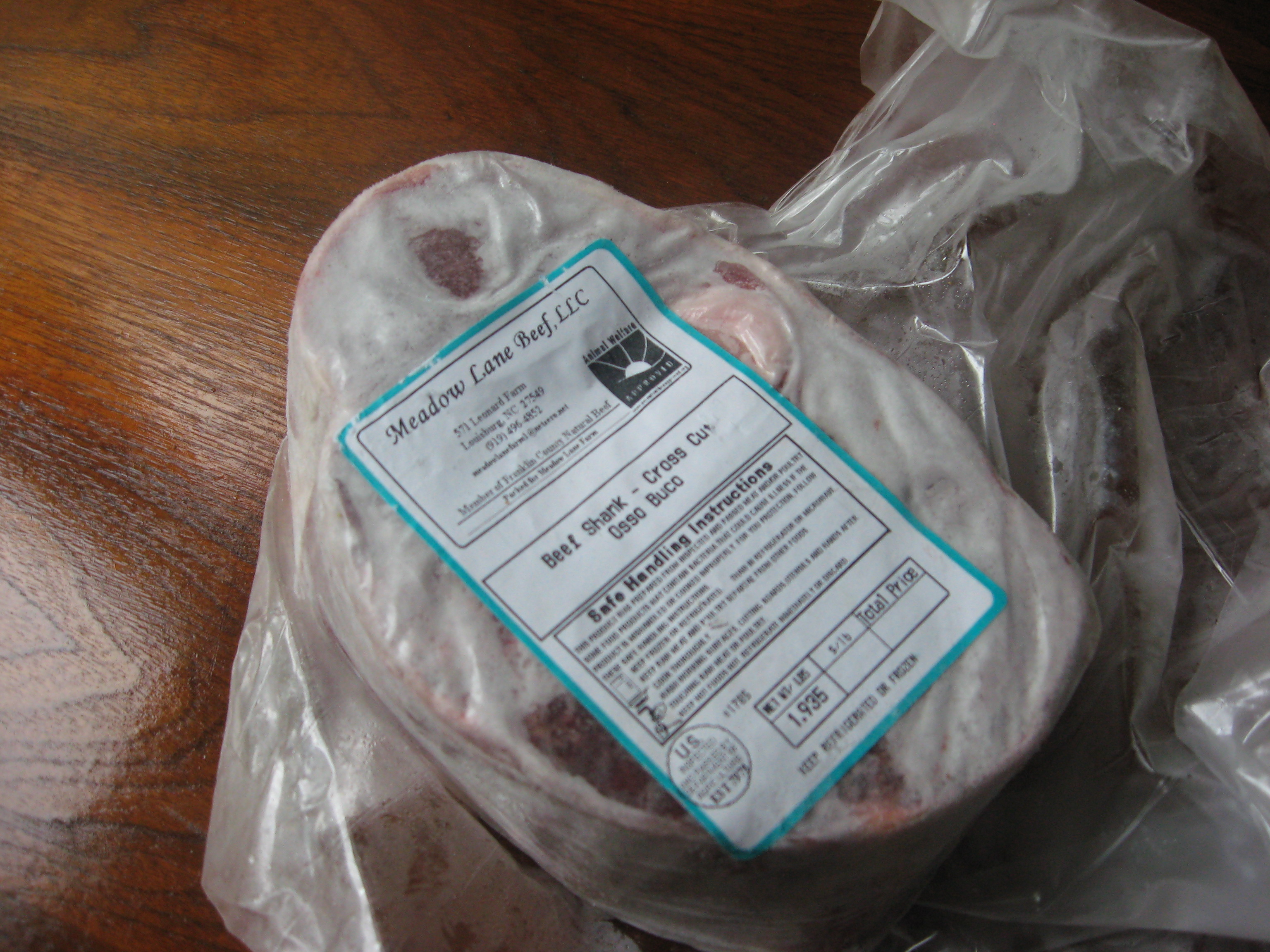
packaged cross-cut beef shank

beef shank

This weekend schedule means that I try to do some planning and cooking on Thursday to have reheatable food on Friday and Sunday.

This weekend’s meals are going to feature an absolutely lovely cross-cut beef shank from Meadow Lane Farms (also from the Durham farmers’ market)  in an easy dish that can cook mostly unattended: osso bucco, but with beef shank rather than veal shank. (The osso bucco really just means “bone with a hole” or marrow bone.)

It’s a dish that’s easily adapted for one person–there’s nothing fussy about it–no need to be exact or tedious in measuring ingredients, and to make even more “unattended”, it will go into the slow cooker (also serving as rice cooker and steamer) while I’m out working on the farm.

Krups rice cooker/slow cooker and steamer

Krups rice cooker

I have to admit that I’ve not been a fan of the slow cooker until recently, at least for anything much more than cooking dried beans, or poaching a beef tongue. The flavors and textures just aren’t the same as when the slow cooking was done in the oven where some evaporation, browning and concentration takes place even in a covered dutch oven.

My attitude about slow cookers has changed since I found the Cook’s Illustrated Slow Cooker Revolution (See Bibliography) and learned some techniques for making food out of the slow cooker more flavorful.  I’m not ready to quit slow-cooking in the oven despite that, but in hot weather I’ll certainly use the slow cooker more often with some of the “tricks” I learned from that cookbook.

What I missed most in slow-cooker dishes was that savoriness that comes from browning (Maillard reaction)  when you slow-cook in a traditional oven or brown/sear on the stove-top.  In the slow  cooker, you can make this absence less noticeable by adding ingredients that contribute “umami“.

Some of the most useful things I learned from that Slow Cooker Revolution are ways to use the microwave oven to facilitate the slow cooker, and using some “unusual” ingredients  in recipes–not esoteric ingredients, just pantry staples that boost  the umami flavor:

  • precooking aromatics like onions in the microwave so that they don’t stay crispy-crunchy in the slow cooker,
  • using tomato paste (for umami) by browning it with the aromatics either in a skillet or in the microwave before adding it to the slow cooker,
  • using dried mushrooms to boost flavor (again, umami),
  • using foil packets in the slow cooker to keep some ingredients from over cooking.
  • using soy sauce or fish sauce to add more of that umami that many slow-cooker dishes don’t get without the evaporation and browning as in the traditional oven.
  • using the microwave to precook some ingredients to get rid of excess moisture that would otherwise dilute the dish in the slow cooker.

These are all easy to do–they really don’t add significant extra prep time or effort, and do really make a difference in the flavor.  I expect an easy, flavorful meal (or two) from the braised beef shank that is going to emerge from my slow cooker on Friday evening, thanks to some added umami!

A one-dish meal.

A lot of us eventually reach the point when we realize we are getting a bit rotund (or worse) and start thinking about watching (or losing) weight, or maybe just being more conscious about nutrition.  With several of those things in mind (or should I really say on my mind) I did some web browsing.

I found a website that I’d like to share with you:  A Slice of Nutrition.  I found this through another blog that I follow, My Imperfect Kitchen, that had a post by Avital Greenbaum as a guest blogger–Chicken, Zucchini, and Quinoa. 

One dish meals are very appealing to me–at least some of the time, because I can be lazy, have a good meal and not have to wash lots of pots and pans.  (No, Frankie refuses to do that!)  I’ve had quinoa in breakfast cereals, and things like that but after reading how healthy it is, I decided I need to try it in a main dish and this looked like a great place to start.

Garlic scapes lying next to a basket of strawberries

garlic scapes

I do have to admit that, as well as being constitutionally unable to make a small pot of soup, I seem to be unable to leave a recipe alone when I’m making it.  I did almost follow this one.  Instead of garlic powder, I had fresh, green garlic scapes from the farmers’ market.  Those went it, and I added some mushrooms; otherwise, I left it alone.  This one-dish meal is now in the oven (despite the heat) getting ready for my supper.

Since my veggies are included with the dish, I think that all I’ll need to add is some of those luscious ripe strawberries as dessert!


Baking dish with chicken and quinoa

Chicken, zucchini & quinoa

This is a keeper–only a few minutes prep, and it’s unattended cooking with tasty results. The quinoa is very light–good in hot weather.  I think that it might make some very tasty “salads” with lentils for satisfying summer meals when the weather is sweltering and I want a light meal.

Braise-roasted sausages, potatoes, and Brussels sprouts

Another dreary, rainy, winter day…not particularly cold, but as usual on a day like this I’m in need of comfort food.  In trying to keep one of my New Year’s resolutions to be sure and use what’s in my freezer, I was rummaging through the freezer to see what was there.  Interesting package of four plump sausages.  Only problem, I don’t know what they are–except that they are labeled “hot”.   But I’m sure they are due to be used–probably a sample that I got at one of the farmers’ markets this summer.  So we’re going to cook those this evening.  (I usually try to be careful to label things that get put into the freezer–I suspect that these were frozen when I brought them home, so I just tossed them into the freezer and…now I don’t know for sure what I’ve got.  But–they look like the should turn into a luscious meal once cooked.

Looking through the vegetable drawer in the fridge I found Brussels sprouts, potatoes (yes, I do keep my potatoes in the fridge because they aren’t in there long enough to change taste or texture.)

Onions, garlic, chili peppers, potatoes, sausages…and sprouts.  I’m being lazy today so I want easy food, but flavorful and satisfying.  Since there are four sausages I think that I should just do about 4 serving of this dish: one for another day this week, and maybe one for the “ready-to-eat” part of the freezer, along with the soup and the chilli.

I took four medium size Yukon Gold potatoes scrubbed but not peeled, cut into 1-1/2-inch chunks, mixed with about 6 or 8 garlic cloves, one medium onion chopped into 1-inch chunks, about 15 trimmed Brussels sprouts, all sprinkled with a three-finger pinch of salt.  On top of that go the four sausages, skins pierced so that they won’t explode, and some herbs. (Being in truly lazy mode, I used herbs de Provence since that’s got a variety of herbs so likely something will connect with the sausage seasoning.

I added about 1/4 cup of water, covered the baking dish tightly, and popped it into a 350 ° F oven.  I’ll check it in about 45 minutes.  When the potatoes are close to being done,  the cover comes off and  it finish cooking uncovered.  Add one green salad, or maybe just the sprouts, and there’s comfort food, and lazy comfort food at that!

Cool-weather one-dish meals

links of hot Italian sausage

hot Italian sausage

Come cool (or cold weather) I’m ready  for hearty, warming food (healthy and simple is fine too).  One of my favorites because it  will reheat well if there are leftovers, it’s easily modified if there are second runs,  there’s nothing fixed about the quantity, and there are SO many variations with seasonal ingredients is a recipe from Jacques Pepin’s The Short-cut Cook for a stew of sausage, greens and beans.  It can be made from ingredients found in your supermarket (Harris Teeter, in my case).

This serves six, but it’s easily halved and it’s freezer-friendly for later use.  I’m reproducing and adapting the basic recipe here for you:

loose mustard greens (Harris Teeter Fresh Market)

mustard greens

Sausage Stew with Mustard Greens and Beans (p. 178)

Ingredients

  • 1-1/4 pounds of hot Italian sausage
  • 2 onions (about 8 ounces total) peeled and quartered.
  • 2 cans (1 pound each) red kidney beans
  • 1 small jalapeño pepper, minced (optional)
  • 1 teaspoon ground cumin
  • 1 package (10 ounces) frozen chopped mustard greens

Preparation

  • Divide the sausage meat and form into balls with your hands (dampened).
  • In  a heavy pot, over medium-to-low heat, cook the meatballs for about so minutes covered, turning about every 5 minutes, until they begin to brown.
  • Add the onions and cook for 10 minutes.
  • Add the beans (with their liquid), the jalapeño pepper, the cumin.
  • Bring to a boil and cook gently for about 10 minutes.
  • add the mustard greens, allowing them to thaw in the hot liquid for a few minutes and then break them up.
  • Cover and cook for about 10 minutes longer (or for a total of 50 minutes)
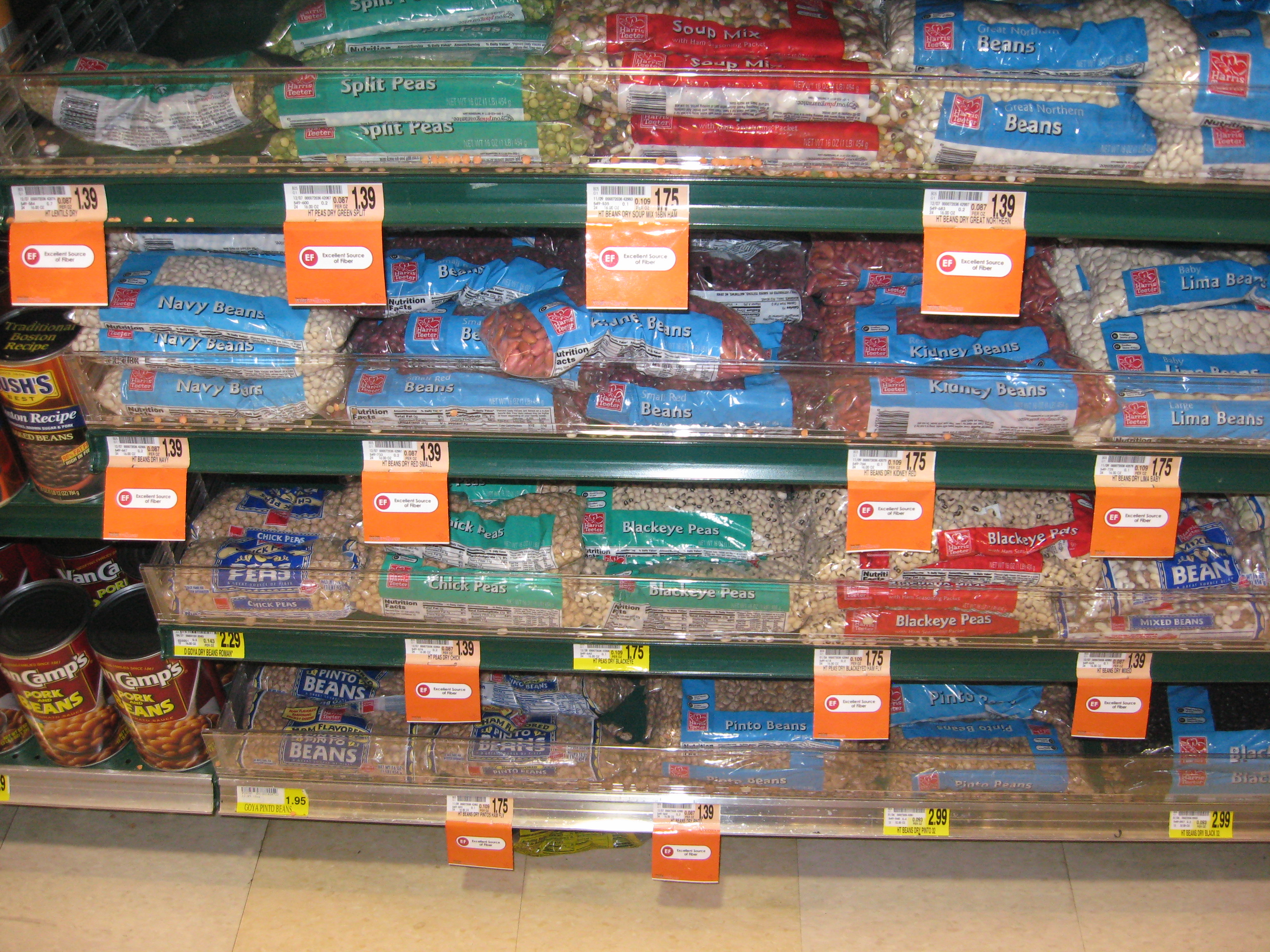
dried beans

dried beans

Now, how many variations are there on this basic recipe?  Well, go look at the canned beans or the dried beans…there are so many possibilities.  Even though this recipe calls for the liquid from the canned beans, I really don’t like the taste so I drain and rinse the beans and substitute an equal amount of water or chicken stock instead…but do whatever works for you.  If you’ve cooked your own dried beans, then by all means use the liquid from the beans.

produce displace of winter greens

winter greens

Now go check out the frozen greens in the supermarket–or the fresh ones in the produce department. (I don’t like spinach in this since it’s so tender that  it cooks to slime–but kale, collards, mustard, even cabbage will work–any of the “tough” greens that need longer cooking).

You want more variations?  Okay go to the meat department and check out the varieties of sausage that are available–polish sausages, bratwurst, and if you’re lucky, you’ll find store-made fresh sausages: bangers, lamb sausages, chicken sausages, bratwurst, et cetera.  So there are lots of variations with some minor changes in seasoning.  I know that If I ask, I can find out what seasoning is in the sausages, and adjust the seasoning of my one-dish meal accordingly.  When you want to make a single-serving, you can buy just one or two sausages.

sausages in display case in meat department of Harris Teeter

sausages

If you like this sort of thing, here a link to The Kitchn where you’ll find a great sounding recipe for beans and greens with a slightly different touch.  These are such versatile ingredients–and just add a bit of rice or pasta and you’ve got a whole meal, with or without the meat.

Comfort food: baked potatoes

It’s another chilly day here, but at least the rain has stopped and the sun is out off and on now, but the thermometer is still reading only 51 ° F .  Despite the chill, a neighbor and I ventured out to go to the wine tasting at the Wine Authorities.  as well as the usual great wines, there was cheese from the Reliable Cheese Company (with samples).  The Tomme de Savoie was very tempting, but when I saw the raclette, I passed on the Tomme since it’s only for me (and the cat). I got the raclette instead so that I could  make one of my favorite special comfort foods:  baked potato with raclette cheese melted over it.

Just plain baked potatoes are one of my favorite comfort foods!  I don’t mean anything fancy like “twice-baked” potatoes  (love those too)—just a really good baked potato that has seen neither the inside of a microwave oven, nor the inside of a foil package.

Russet (baking potato)

a baking potato

When you select your potato for baking, you want one that is as evenly shaped as possible, in addition to being a good potato in general.  (See potatoes.)

Here are three basic recipes for baked potatoes (adapted from Cook’s Illustrated).  Easy…and worth the time.  Cheaper than eating out too–you’d have to go to a really expensive restaurant to get as good a baked potato as any of these recipes will give you.

Basic oven-baked potato

This method will give you a baked potato with a really great  skin to munch on along with that lovely interior.

  • Preheat oven to 350 ° F
  • Scrub a russet potato thoroughly and dry well.
  • Place potato in the middle rack of the oven and bake for 1 hour and 15 minutes.
  • Remove and open immediately (to let steam escape) and serve.

Salt-baked potato

This method can give the potato a flavor boost, especially if you include herbs and/or garlic in the covered dish while the potato is baking.  It will give you the fluffiest inside and a tender but lightly crisped skin on the top.

  • Preheat oven to 450 ° F
  • Scrub a russet potato thoroughly and dry well.
  • In a small baking dish, place a layer of kosher salt about 1/2-inch thick (about 1 cup for this particular dish).
  • Place the potato on the salt, broad side down.
  • Cover with foil or place in a covered baking dish and bake in the middle position of oven for 1 hour and 15 minutes
  • Remove foil, brush the potato with 1 teaspoon olive oil and return to the oven until tender when pierced with the tip of a paring knife.
  • Remove, brush off excess salt, open immediately, and serve.

Oven-baked sweet potato

This is for the orange-fleshed, wetter varieties.  If you have a white sweet potato (yum) it has much drier flesh, and I typically treat it as a russet potato.

  •  Scrub thoroughly. Prick lightly with a fork in three places, or multiple times with the tip of a paring knife.
  • Preheat oven to 400 ° F
  • Rub the potato with olive oil and place on a foil-covered pan, on the middle rack of the oven.
  • Bake 40 to 50 minutes until it’s tender when pierced with the tip of a knife.
  • Open immediately, season to taste, and serve.
«◊♦◊»
Wedge of raclette cheese

Raclette cheese

When you want to be a little extra special with even the most comfy of foods–just add more comfort food.  One of my favorite extra comfy foods is baked potato with cheese; and my all time favorite for baked potato with cheese is baked potato with raclette.  Never mind the butter, sour cream and all that stuff (admittedly wonderful), but in this case it’s totally unnecessary.

Raclette is a semi-hard cow’s milk cheese that is mellow, nutty and earthy.  A dish by that name is typically served with the cheese melted over potatoes (usually

black cat looking at potato

Is it mine?

boiled) and gherkins (pickles made from specially grown small cucumbers). While what I’m having here is not traditional raclette, it is a real treat.  (All cooking and recipes are tested and approved (or not) by Keiko, the cat.)

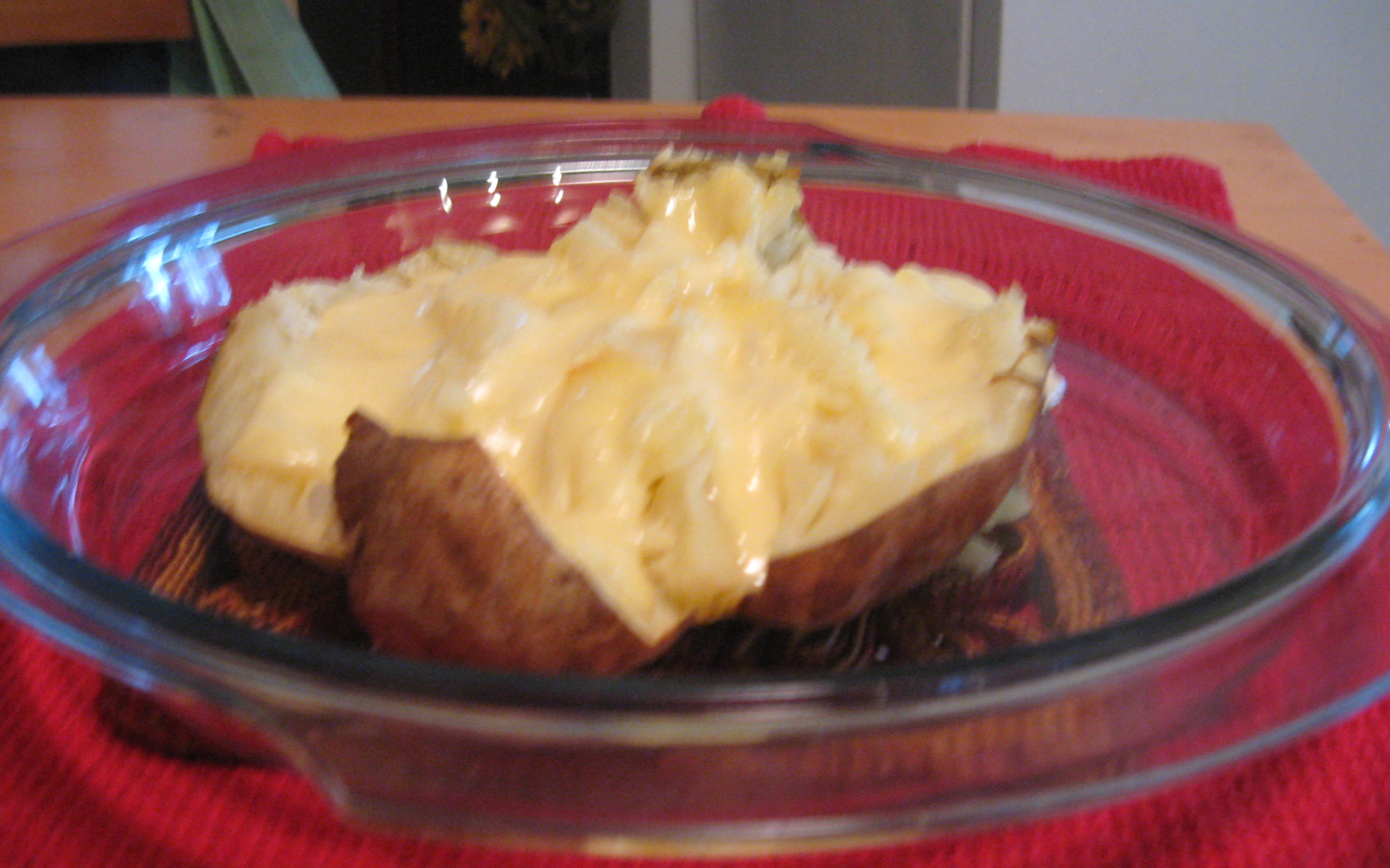
I made a salt-baked potato and finished it as directed in the recipe, and after opening it, laid slices of raclette over the top, and put it back into the oven to let the cheese melt (not under the broiler).

baked potato topped with raclette cheese

Comfort food for supper

The  main course was just that big baked potato and cheese, with a glass of champagne (no cornichons though)!  I had really intended to have a first course of roasted baby carrots and baby zucchini with vinaigrette dressing….but that was not just BIG potato–it was a HUGE potato, so it was my evening to have just that–I had fruits and veggies for breakfast and lunch anyway.)

 −«◊»–