Pesto variations

I get the impression that lots of people think “pesto” means what we consider “traditional” basil, pine nuts, garlic, parmesan.and/or pecorino romano blended in olive oil. The name really refers to the method of preparation–pounding or crushing using mortar and pestle.

With the convenience of a blender or food processor you don’t have to do the laborious pounding so this is an easy, no-cook sauce–right up there with gremolata  or persillade to at zip and zing to summer (or winter) dishes. It’s also a way to preserve some summer bounty into the winter when you want to resurrect a bit of summer–when you have an excess of summer herbs, make it, and freeze it.

As hot summer weather looms, pesto of various sorts is great for use in lighter meals–pasta, bean or legume salads, and with summer vegetables. Bon Appetit just posted recipes for different kinds of pesto–with recipes: 22 Pesto Recipes for When You Want Greens *and* Cheese might just provide some inspiration for summer meals.

Go ahead, get wild an crazy with variations on the traditional basil pesto!

A son gôut!

Beef and barley stew redux

The snow happened, and melted quite rapidly but with the temperature only reaching into the mid 40s, it’s still a good day for beef and barley stew. Just from browning the meat and the vegetables (including the garlic, tomato paste, and the Vegemite), it already smells like comfort food. I did opt to be lazy and finish cooking the stew in the oven (275ºF).

Now I’ve experienced the jar of Vegemite (Marmite wasn’t available at my local supermarket) although I’ve not gotten to the point of trying it spread on toast. I like the aroma from the jar–but that really didn’t come as any surprise because I already knew I liked the aroma of yeast-y thing: certain champagnes, bread dough….

The prep for this is really easy–most of the time spent browning the meat and vegetables but the hands-on work is still minimal, especially since I bought boneless short ribs, so chunking them up was quick and easy. To my dismay, I did find that I hadn’t any whole canned tomatoes–only diced, so diced was what I used.  I did “cheat” and use frozen chopped onions (probably my favorite “convenience” thing except for mirepoix (homemade and put in the freezer), and the kale will be from a bag as well. For now,  it’s time to wait, and anticipate!

Since I’m cooking this for only one person–and this half recipe should be two quite generous servings, I’m going to add the kale (frozen) to only what I’m going to eat today. Whether I decide to freeze half or simply reheat in a couple days, I’ll add the kale to that serving then so it not overcooked. That’s one of the advantages of frozen stuff when it comes to cooking for one.
20170312_161745

…Ò¿Ó…

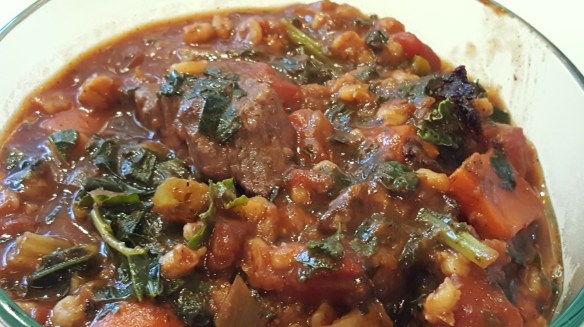
…and finally, it’s time to eat! This is the first time for tomatoes in beef and barley stew, but I like it as an alternative to the more stripped down version that I usually do (read beef and barley with seasonings)–but I think I’ll try adapting mine by adding the extra umami sources and the kale but omitting the tomatoes. Beef and barley stew, for me, is a bit like lentil soup: you can never have too many variations.

I’ve not used short ribs often for stews, but in cooking for one when I don’t want to volume that I’d get with chuck, I think I’ll me using them more often–even though they are not really cheap, the have the advantage of being available in quantities suitable for single-serving, or two-serving, cooking.  Another adaptation that I’ll make is to increase the proportion of barley (and, obviously, the liquid) in my efforts to shift toward using less meat.

I suspect it would taste really good even without the Vegemite, but that jar of yeasty stuff is going to hang out with the fish sauce, anchovies, and soy sauce because it certainly is tasty with it.

This was a yummy meal for a chilly day!
20170312_164807

…Ò¿Ó…

.

Duck breast salad

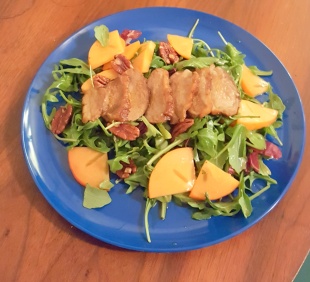
For my Christmas Eve supper I fixed pan-seared duck breast–there were two in the package and that meant leftovers. I could have had a second meal had I not been a bit greedy and 20170107_182359eaten part of the second one. So leftovers–just enough for a salad.

A very simple salad made with arugula and radicchio for the greens (just a bit of bitterness to counter the fat of the duck),  Fuyu persimmon, pecans, and the thinly sliced duck breast.

For the dressing, I decided that the leftover sauce that was used for the cabbage and rutabaga side dish for Christmas dinner could make a second appearance–with a little help from an infused oil from Bull City Olive Oil. (Yes, I’ve gotten into infused oils since I discovered some quality ones.) The sauce was lime juice, lime zest, and buckwheat honey but I needed something more–I tasted it with plain (but very good olive oil). That gave me an excuse to go back and do some more tasting and shopping. I tasted several infused oils and decided that the chipotle infused oil would add just the right bit of spark to the leftover sauce.

I made a vinaigrette using about 2:1 proportions of oil and sauce, tossed the greens, persimmon, and some pecans with it; making a perfect bed for the sliced duck breast that was quickly warmed in a skillet. The finishing touch was just a bit more chipotle oil–just a few drops–on the sliced duck breast.

Yum! A great light supper from recycled leftovers, although I’d be more than happy to serve a freshly cooked duck breast this way as well.

Ò¿Ó


Lamb Stew (Alentejo-style)

My bargain shopping got me a butterflied leg of lamb that was on special. Rather than roast it whole, I decided our chilly, grey, damp weather needed stew.

I cut the lamb leg into 3 cm cubes; I decided that I wanted some variety in my stews so since I had two pounds of lamb so all I needed to do was halve the recipes.Since I’ve not done much Iberian cookery I got out The Food of Spain & Portugal: The Complete Iberian Cuisine by Elizabeth Lambert Ortiz (page 152).  

pimenton-de-la-veraThere are a lot of lamb stew recipes in this book. I finally made a decision based on seasonings that sounded interesting: garlic, parsley, pimenton de la vera (smoked), cayenne, and cloves. (The recipe only said “paprika”–which I’m sure would work fine, but I particularly like the smokiness of the pimenton de la vera, but I used the amount called for.)

.

.

Carneiro à Alentejana

Ingredients

  • 4 cloves garlic, crushed
  • 1 tablespoon finely chopped parsley
  • salt and freshly ground pepper
  • 900 g (2 pounds), lean, boneless lamb, cut into 3.5 cm/1-1/2 inch pieces
  • 6 tablespoons olive oil or lard
  • 2 medium onions, finely chopped
  • 1 tablespoon paprika
  • 1/8 teaspoon cayenne
  • 1/8 teaspoon ground cloves
  • 175 mL/ 3/4 cup dry white wine

Preparation

  • Mix garlic, parsley, salt, and pepper. Add the lamb to the garlic mixture and marinate about 2 hours. (I left mine overnight)
  • In a large skillet, heat the oil or lard and brown the lamb pieces all over.
  • Transfer lamb to a flameproof casserole.
  • In the remaining oil and sauté the onion until soft and add to the casserole.
  • Add paprika, cayenne, cloves to the casserole. (I like to “bloom” dry spices in oil before adding liquid so I added the paprika while sautéing the onions)
  • Bring to a simmer on the stovetop.
  • Cover and put in a moderate oven (180ºC/350ºF) and cook until the lamb is tender (about 1-1/2 hours).

The author recommends serving with a light red wine (red Vinho Verde or Dão, and notes that in Portugal meats are usually served with both potatoes and rice.

õ¿õ

I halved the recipe above and used the other pound of lamb to make my favorite lamb and cabbage stew (Fårikål) with the other half. I considered being very energy conscious and making both at the same time; however, my hedonism won and I made them on different days because I love to luxuriate in the aromas of cooking–that’s part of the anticipation and enjoyment of cooking and eating. I just didn’t think I would get to enjoy them in the same way if I were to cook both at the same time. I would have missed some of the pleasure of cooking had I done that. The smell (especially of the pimenton de la vera) was particularly appetizing.

The combination of the pimenton, cayenne, and clove was wonderful. I don’t often use the “sweeter” spices with meats but that little dash of clove has made me wonder why I haven’t used them more with meat. I need to broaden my perspective on the “appropriate” spices to use with meats.

The balance of the seasoning in this recipe (I didn’t change anything) was wonderful–just enough cayenne to give a little “burn” as you eat your way through a serving, but not every getting to the point where you felt as if you had blisters on your taste buds–and the clove didn’t smack you in the face either. All in all a very well-balanced seasoning. I’ll probably try this with lamb shoulder chops–even without cutting them up.

Oh, wine? Well since there was a bottle of my “house wine” already open, I used that–it’s one of the things I like about that wine: it’s very versatile. Rice? Potatoes? Nope–garbanzo beans.

There is one modification I think I’ll make next time–I’ll add more onions they were luscious after cooking with the lamb and seemed just right with the pimenton.

Chile (or chilli or chili) paste for the pantry

I was perusing the list of favorite blogs that I follow on WordPress. When I got to the Chef Mimi blog I found an idea (and a recipe) that I just have to share.

I always have dried chilli peppers around the house, but they mostly just get used when I’m making chilli con carne because they take time and usually some unplanned effort to use.  I’d not thought of making paste out of them! A wonderful thing to have on hand. This will take you to the recipe for Ancho Chile Paste. No matter how you name those peppers they are great to have in the kitchen–and this makes them easier to use.

(I’m not going to give up my ancho chile powder from Penzeys Spices, though.)

A little food history

I do enjoy Facebook! Because my friends have such diverse interests, I get to read articles that I might never have encountered were it not for perusing Facebook posts. In this case, I’ve been overwhelmed with work (love that) which cuts into my skulking about the internet looking for fun stuff.

Here’s a link to an article from NPR on the Eastern and Western use of spices that I just read (no it’s not new–only new to me) and enjoyed.

Gremolata

A simple, quick way to add some kick and freshness to lots of dishes: gremolata.  It’s an Italian classic served with osso buco, but can be used with almost any grilled, roasted, or even boiled meats, fish, or with vegetables. It’s especially delightful in the winter when food is a bit heavier and lacks that spring and summer freshness. Great taste, and it is so simple and quick.

It’s one of those things you don’t really need a recipe for. It’s just lemon zest, parsley, and garlic. Here is a nice post from The Kitchn that should give you all the information you need to whip up this condiment.

Once you’ve got this basic condiment down, you’ll find lots of uses for it, and here are some variations for different dishes.

So many variations!

A son goût.

Holiday time again….

Like it or not the holiday season approaches. I’ve one Christmas gift to order yet, but then I’m through. I thought I’d pass on a few suggestions for gifts for those of you who still have a cooking person on your list to shop for:

  • Volrath French carbon steel skillet: probably my most-used, it has the advantages of cast iron, without the weight.
  • Romertopf clay cooker: a go-to especially for one-dish meals in cold weather.
  • Home espresso machine: Can’t start the morning without my jolt of caffeine either straight espresso or café latte.
  • Clever Coffee Dripper: If I’m not wanting quite the jolt of espresso this gets something more like French press, with the benefit of a filter to eliminate the sediment.
  • Kunh Rincon garlic press: If garlic is a cooking necessity, a garlic press can be a time-saver, or it can be a total nuisance when you have to clean it, so you don’t use it. This is a good one, recommended by Cook’s Illustrated after testing lots of them.*
  • Max Burton Portable Induction cook unit: Live where it’s hot and humid in the summer? You just hate to turn on the stove? Induction cooking is much cooler–though it does require cookware that is either stainless steel or iron.  If a magnet won’t stick on your cookware, then you need the Hob Heat Diffuser that will allow you to use other cookware with the induction unit.
  • Pressure cooker: The Fissler FSSFIS5859 Vitaquick Pressure Cooker was the winner of the Cook’s Illustrated testing* and is pricey.  The runner-up was the Fagor Duo line, less pricey, highly recommended and noted as “best buy”. (This is the one I’ve used.) This cooker does work with induction cook units–a real plus in hot, humid weather when you still want those dried beans cooked.
  • Fasta Pasta Microwave pasta cooker: This is a real gem to have in the kitchen! So much easier than boiling that big pot of water–again great in hot, humid weather, but once you start using it, you’re hooked. Again this is a kitchen “gadget” that was tested by Cook’s Illustrated.*
  • If the cook you’re shopping for is just getting a kitchen set up, there’s always some of the essentials for good cooking: Penzeys herbs and spices, either basic, for bakers or for the cook starting to branch out, a do-it-yourself box of specialty herbs and spices.  If you have someone on your list who has to watch sodium intake, there are lots of salt-free blends. If you buying for a cook pressed for time, seasoning blends can be real time-savers–in my kitchen I don’t want to be without herbes de Provence for that time when I’m just too rushed to think blending my own.
  • For relaxation and enjoyment,  either alone or with company, a selection off teas to have on a leisurely morning, or relaxing afternoon break.  Harney & Sons Master Tea Blenders have a fantastic selection–black, green, herbal, flavored, and all the accessories necessary to make a special occasion. Teas can be ordered individually, or there are collections ready made.  If you’re unsure what tea would please your “giftee” most, then send a selection of samples–for a modest $2 you can send enough to brew a decent pot of many teas. Some very expensive ones–e.g. Black King which rings up at $240.00/pound–the sample may run $5. What a great way to let someone explore fine teas–treat yourself.
  • Like a liqueur to sip while relaxing? If you’re in North Carolina, there are some lovely liqueurs made in Durham by the Brothers Vilgalys: Krupnikas, a spice honey liqueur would be a real treat, or look at the unusual liqueurs they make: Beatmik, Beebop, Zaphod, and Jabberwok.  All are great in cocktails, for just sipping straight, added to hot chocolate or hot cocoa.  If you’re not in North Carolina you may still be able to get these delightful liqueurs through other distributors.

Wishing you and your favorite cook very happy holidays–lots of good food, friends, conversations, as well as wines and spirits!

__________________________________________________________

*Cook’s Illustrated equipment testing is done without manufacturers knowledge until after publication, and products tested are chosen for consumer benefit. They do not accept requests for testing from manufacturers.

.

Ò¿Ó

.

Thyme and Black Pepper Crackers

These sound just incredible–and easy!

Chelsea's avatar"blackberry-eating in late September"

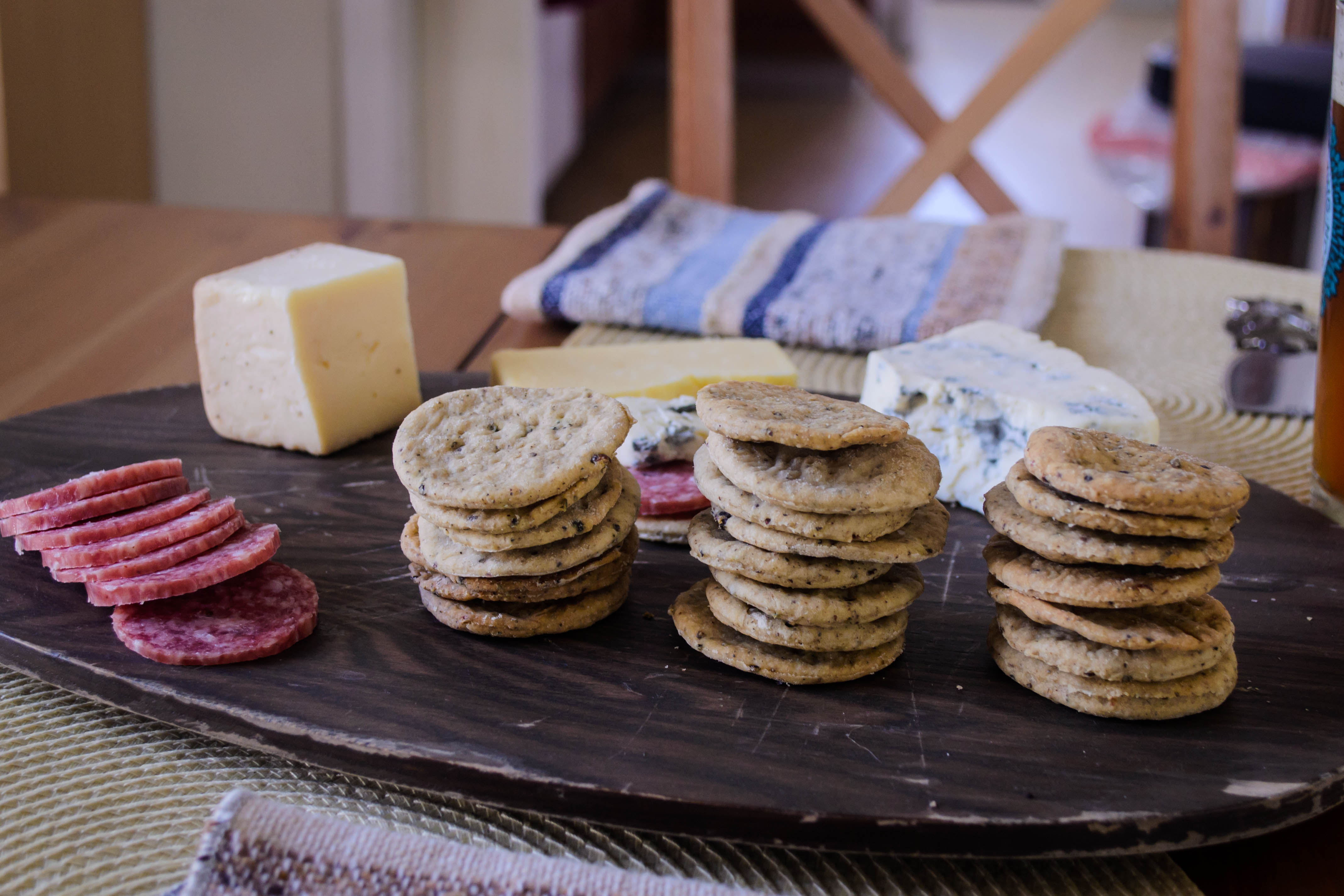
2015 Blog September-0498Over the past few years, N. and I have made it our business to conclude the week with a happy hour – we load some cheeses and crackers on a plate, sometimes some sliced cured meat, sometimes a few dried figs – and pour something cold and alcoholic into a frosty glass. Through this process, I’ve learned that N. loves black pepper. We bought a wedge of cheese crusted in black pepper once as an experiment, and I think since then it has been on every shopping list, every week, for about the last two years. More recently, we started picking up variety packs of crackers – the crushed wheat rounds, the chalky water crackers, the rectangles spiked with vegetable bits – and in one variety-pack, a black pepper water cracker. This sleeve always, always disappears first. N. doubles up on the pepper – peppered cheese on peppered cracker. And…

View original post 1,021 more words

Spice is a state of mind: cabbage thoran

Good information for all of us who cook using spices.

Aneela Mirchandani's avatarThe Odd Pantry

Cabbage thoran Cabbage thoran

Sometimes spice is just a state of mind. Plants don’t come with Dymo-printed labels that say ‘Spice use recommended’.

Now you might think I’m making an issue out of nothing. Obviously, plants that produce a strong appetizing smell can be used as spices, and others not, right? No mind tricks necessary.

But consider what happens during the process of blooming spices, otherwise known as tempering, or tadka. A sequence of spices are thrown into hot oil. They may be seeds — like cumin or black mustard, dry leaves like the bay, or even bits of bark — like cinnamon.

If the temperature is too low, nothing particular happens, while if the temperature is too high, the spice burns. But if the temperature is just right, two things happen. One, the outer surface of the spice browns. This browning, known as the Maillard reaction, is the perfect state of cooked food…

View original post 396 more words