
Cooking vegetables quickly

No matter how much you like to cook, sometimes you just want to prepare veggies quickly, but still want them to taste good.  One of my favorite ways to quick-cook vegetables is a technique that I learned from How to Cook without a Book by Pam Anderson, who really stresses improvisation and good food.

One of her techniques that I’ve found useful for vegetables is the “steam/sautéed” method.  It’s a very simple technique, using both “wet” and “dry” cooking in a single pan, without boiling or blanching and draining.  You can facilitate speed by how you cut the vegetables–smaller pieces cook more quickly than larger chunks.  This book is an excellent resource to help you learn to improvise and adjust quantities for single servings, doing away with leftovers. Recipes are simple, and presented in a manner that makes them very easy to adjust serving sizes, giving the necessary ingredients and there are variations given so that you get the feel of improvising.

To cook vegetables this way, you need vegetable, some fat, and flavorings.  The recipes in the book are presented starting with one pound of vegetables, but are easily down-sized to a single serving.  The basic ratio of these recipes is (p. 204):

  • 1/3 cup water
  • 1 tablespoon fat
  • 1/2 teaspoon salt
  • 1 pound prepared vegetable
  • optional aromatics (1/2 small onion, sliced thin, or 2 medium garlic cloves, minced)
  • optional spices (dried or fresh herbs and or flavorings)
  1. Bring the water, fat, salt, and vegetable, along with the optional aromatics, spices, dried herbs and/or other flavorings to a boil in a Dutch oven or a large deep skillet. Cover and steam over medium-high heat until the vegetable is brightly colored and must tender, 5 to 10 minutes, depending on the vegetable size.
  2. Remove the lid and continue to cook until the liquid evaporates, 1-2 minutes longer, adding optional fresh herbs and/or other flavoring at this point. Sauté to intensify flavors, 1-2 minutes longer.  Adjust seasonings, including pepper to taste and serve.

The cooking instructions are simple. I’ll give you an example of a recipe from this book, and of the technique (above):

Steam/Sautéed Carrots with Cumin (p.209)

  • 1 pound carrots, peeled and cut into 1/2-inch coins
  • 1 tablespoon butter
  • 1/2 teaspoon ground cumin
  • 1 tablespoon minced fresh parsley or cilantro leaves

Follow the Steam/Sautéed Vegetables recipe (p. 204), adding the cumin with the carrots and the parsley once the carrots start to sauté.

One pound of carrots is approximately 5-6 medium or 4 large, so it’s easy to adjust the proportions here for two medium carrots.  For me, 1 large carrot is about the right amount for a serving of vegetable.  The amounts of fat, spices, and water are easily adjusted (see Measurement Conversions), and they do not have to be exact–you can add a bit more water if the vegetable is not quite tender enough, and a bit extra will evaporate once the pan is uncovered.  You’ll adjust the seasonings to taste, as well.

You will need to consider whether your vegetable is “soft” (vegetables which normally give off water as they cook) may not need the steaming before the sauté step), but  vegetables that do not give off moisture as they cook, like the carrots, green beans, cabbage or broccoli, do need this step.  The amount of water will vary with the density of the vegetable–you will learn to judge that, always remembering that you can add more water a tablespoon or so at a time as needed.

Dried herbs and spices (except black pepper) should be added with the vegetable in order to have the flavors develop.  Because fresh herbs can lose volatile oils with heat exposure, these need to be added at the end so that the freshness is retained.  With this technique is easy to prepare vegetables for small-time cooking, keeping the big-time taste.

Cannellini & Italian sausage supper

One Italian sausage provides seasoning and a bit of meat for two meals.  The starting point gives enough for two servings.  When I’m using the Italian sausage for two separate meals like this, I usually buy sweet instead of hot, since I can readily add the heat I’d like with crushed red pepper flakes at the time I’m preparing the meal.

  • 1 medium onion, halved lengthwise and thinly sliced
  • 1 sweet Italian sausage, meat removed from the casing and crumbled
  • 4 cloves garlic, minced
  • 1 tablespoon olive oil
  • 2 cups cooked, drained white beans (cannellini or great northern) or 15-ounce can rinsed and drained
  • 2 tablespoon water

In a 12 inch skillet with a tight-fitting cover, add the olive oil; when the skillet is heated add the sliced onion, and cook until it is beginning to brown. Add the sausage and brown.  Add minced garlic and cook about 2 minutes.  Add the rinsed beans, and cook covered about 5 minutes.

Remove half the bean/onion/sausage mixture to be used for a second meal.  Cool and refrigerate.

Meal 1:

  • Half the bean/onion/sausage mixture
  • about 15 grape/cherry tomatoes, halved
  • 1/4 cup antipasto salad mix (pitted olives, peppers, carrots) from the salad bar, chopped finely.
  • several sprinkles of crushed red pepper flakes
  • 2-3 teaspoons chopped fresh sweet marjoram or Turkish/Greek oregano, or 1/2 teaspoon dried herbs.
  • a single-serving size handful of haricots verts
  • 1 teaspoon water
  • salt and fresh-ground black pepper to taste (the antipasto salad is salty so taste before you add additional salt.

Add the herbs, the chopped antipasto salad, crushed red pepper flakes and mix well.  Over medium low heat, add the tomatoes, lay the haricots verts on top of the cannellini beans, add the water, cover tightly and continue to cook until  the haricots verts are tender.  Serve with shavings of Pecorino Romano over the canellinni beans, and the haricots verts on the side, drizzled with a few drops of extra-virgin olive oil.

Meal 2:

  • the reserved cannellini bean/onion/sausage mixture
  • about 15 grape/cherry tomatoes, halved
  • 3 generous handfuls baby spinach
  • 1 tablespoon water
  • salt and fresh-ground black pepper to taste

Place the cannellini bean/onion/sausage in sauté pan, add the water, halved tomatoes, and cover.  Heat gently for about 5 minutes (until starts to steam).  Add the spinach, cover, and allow spinach to wilt.  Toss to combine with the bean mixture.

I had this with some steam-sautéed carrots as an additional vegetable.  Add a glass of good friendly red wine and its a very satisfying meal that’s easy and economical.

Healthier eating: More fruits, grains, and vegetables, please.

A couple of recent events and activities have made me give some serious thought to what I eat:  books I’ve been reading about the impact of food on environment, and the current obesity epidemic, and the fact that my doctor has said that I DO  need to lose weight, a lot of weight–at least I think that 25 or 30 pounds is a lot.  Obviously I have to find a way to do it as pleasurably as possible since I readily admit to being a hedonist.

All this has led me to look at what I have been eating–not that it’s exactly unhealthy or junk food, by any means; but it would seem that the weight loss is likely to be abetted by adding more fruits, vegetables and whole grains.  So, I’m going to try to do better what I’m sort of do already.

One of the things that I’m going to try to do is eat more salads.  Now I’ve already complained about the waste when I clean out the refrigerator and find all the slimy veggies that did not make it into the salads. This is going to be interesting–I truly dislike having to throw out food, especially after reading some statistics on the amount of energy that goes into producing the food that gets thrown away.  The challenge is going to be keeping the salads interesting enough that I will actually eat them every day.  If I can achieve that, I’ll likely not be throwing away so many veggies.

Another decision that I’ve reached (after reading the label on the salad dressing bottle) is that I have to re-think salad dressings.  I don’t like the list of ingredients on “low-fat” or “no-fat”, or really, any mass-produced dressing.

My first solution to that was with my salad this evening; I started with mesclun, added some fresh herb leaves (from my deck) which made the taste very complex.  Then I added veggies that I had brought home–ones that I think (hope) will find multiple uses: celery, cucumbers, cherry/grape tomatoes, onions as salad material and as snacks.  I had some black table grapes in the fridge, so I threw some of those into my single-serving salad bowl.  Now to dress my salad.

It’s easy to make a vinaigrette dressing, but being in a hurry and lazy this evening, I opted for the simplest thing that I could think of:  extra-virgin olive oil and an acid.  I did not want anything as tart as wine vinegar, so I added a squeeze of lemon juice.  With the sweetness of the grapes, spiciness of the radishes, and the fresh herbs it was great–and so simple, and so healthy.  In retrospect, I suspect that some nuts would have added some texture and different flavor to the salad too, but I did not think about that at the time.  (After all that extra-virgin olive oil provides some of those monounsaturated fatty acids (MUFAs) that are supposed to be so good for us, and according to some studies–more on that later–and even help in losing belly fat!  Pleasant thought that something that tasted that good could actually be good for me!  I’m sure that I’ll be trying out other citrus juices in combination with the oil for my dressing!  I’m sure that I’ll also get around to actually emulsifying the oil and the acid to make a good vinaigrette too, eventually.

Next project: getting more whole grains into my diet. Accompanying me home from the grocery store this evening in anticipation of  that first goal was a multi-grain cereal.   I’m going to make a serious effort to eat breakfast as I’m told that is helpful in losing weight too.  My problem with that is that I do not actually like food early in the morning.  I love hot cereals like steel-cut oats, multi-grain cereals; just not at the time I need to eat them before I go to work–and it’s not the cooking time that makes me not like them.  I can figure out lots of ways to have long-cooking cereal without spending time cooking it in the morning.  It’s more basic–I don’t like early-morning food.  I can’t take it to work with me to eat at my desk later, because “work” is delivering a lecture, so I’ll have to find some other way to do this–without getting up too much earlier!

The last, but not least, goal of this project is reducing my (already pretty low) meat consumption.  I’ve posted references to some of the books that I’ve been reading lately on the bibliography page.  The information on energy consumption related to meat (term used loosely to include poultry) production is–not sure what adjectives to use to describe some of that data–thought-provoking to say the least.  I’m reducing consumption, not giving up meat totally, nor am I giving up milk, eggs, cheese, or other animal products.  As much as I like meat this is going to be an interesting time for me.

I always liked grains and pulses (beans, lentils, peas and such) so that’s part should not be too difficult (famous last words?).  I expect I’ll be using  some new  grains and  pulses now, so it will be a learning experience.  I’ll be finding out how to cook and use these in small quantities, or single-serving amounts.  I was pleased to see that my supermarket had teff, spelt, and quinoa available as will as the more usual bulghur, kasha and brown rice of different varieties.

If I can get add some regular exercise, as well as eating food early in the morning, I might actually get to like this regimen, and succeed in doing what I need to do, and keep the weight off as well.

Now…let me go peruse a cookbook or two in search of recipe ideas that I can adapt for a single-serving.

That fourth chicken thigh…

As I mentioned in my previous post regarding what to do with a package of four chicken thighs when you are cooking for one (and the cat) and don’t do leftovers, chicken soup was in the making with some leftovers (rice, garbanzo beans) as a start.

The broth from cooking those four chicken thighs was so intense that I was able to add a bit of water to it, so I have two servings of chicken soup.  (Soup being a leftover that I tolerate better than other leftovers.)  To keep the time invested to a minimum, I did use a convenience product:  frozen soup mix vegetables .   I do use those for winter use since it lets me have a lot of variety without purchasing all the individual vegetables;  I can throw a handful or so into something for quick soup.  As you can see there was okra, peas, corn , celery, potatoes, green beans, and onion.Not having any canned tomatoes open, I used some of the grape cherry tomatoes, halved and tossed into the mix.

I boned the chicken thigh and added it to the broth and veggies, popped the whole thing into the microwave for six minutes to cook the veggies.  The broth from cooking the thighs had been seasoned only with a bit  of salt to allow for maximum flexibility in what I could do with the meat, so it was a tad bland. I supplemented the previous seasoning with a dash of herbes de Provence, and some crushed red pepper flakes to add a bit of zing.  Made and great bowl of soup

chicken soupGiven lots of veggies, the rice, and beans, and the very flavorful broth, the fourth chicken thigh provided reasonable portion f meat for the two servings of soup.  When we consider that most of us eat much more meat than we  need nutritionally, I was very pleased with the flavor of this quick meal.   All I added was a green salad with cucumbers, radishes, grape tomatoes, black grapes, fresh herb leaves, with a drizzle of extra-virgin olive oil and a squeeze of lemon juice.   With the addition of a glass of red wine (from a box) it was a very satisfying meal.  I have no idea of a calorie count–but I do think it was a healthy meal, particularly for evening when I know I’m going to be very sedentary.

Admittedly, there is a snack for later in the evening: some black grapes, grape tomatoes, and a few nuts, maybe pistachio, or Brazil nuts, or hazel nuts, or a mixture (only a tablespoon or two, though).

Lots of flexibility in terms of what you can do when you’re making a small quantity.   I suspect that the remaining serving, which will be used in a day or two, will get some additional “perking” before it becomes a meal, but I know I’m starting with a good base of tasty broth and a bit of meat.  In looking over what’s likely to be available , I suspect that I’ll add a bit of cabbage, and maybe some chile pepper to that last batch–but who knows.

Even though I bought the more expensive, free-range, organic chicken I think it was economical:  essentially five meals from that one package of chicken.  The extra flavor from the chicken paid off.

A son goût!

A sweet treat

Holiday time is coming up so I want to introduce you to something special that you can do, even for one:  brioche filled with chocolate ganache.  While it’s baking, you home will smell like a bit of heaven.  I’m going to share with you a recipe that I will abridge and paraphrase from Artisan Bread in Five Minutes a Day by Jeff Hertzberg and Zoë Francois to demonstrate the range of recipes available in their books, and how adaptable they are to cooking for one. The full recipe (well worth having) is found on page 189 of the book. It’s a recipe that is easily doubled or halved.

Brioche (unfilled)

Ingredients: Makes four 1-pound loaves.

  • 1-1/2 cups lukewarm water
  • 1-1/2 tablespoons granulated yeast
  • 1-1/2 tablespoons (kosher) salt
  • 8 eggs lightly beaten
  • 1/2 cup honey
  • 1-1/2 cups (3 sticks) unsalted butter, melted
  • additional butter for greasing the pan
  • 7-1/2 cups unbleached all-purpose flour
  • egg wash (1 egg beaten with 1 tablespoon of water)

Assembling the dough:

  1. Mix the yeast, salt, eggs, honey, and melted butter with the water in a 5-quart bowl (or lidded, but not air-tight) food-grade container. (You will store the dough in the refrigerator in this.)
  2. Mix in the flour without kneading, using a wooden spoon. You may need to use wet hands to fully incorporate the last bit of flour.  The dough is loose but will become firm when chilled.  You should not try to work with it until it has chilled for 24 hours.  There may be lumps in the dough, but they will (mine did though I was uneasy about this on the first batch).
  3. Cover (not airtight) and allow to rest at room temperature until the dough rises and collapses or at least flattens on top.  This takes about 2 hours.
  4. Refrigerate in the container; it can be used over the next 5 days; for longer, you should portion and freeze the dough.

Baking the brioche:

  1. Grease a 9 x 4 x 3-inch nonstick loaf pan.
  2. Dust the surface of the dough with flour and cut off a 1-pound (grapefruit-size) piece of dough.  Dust this piece with more flour and quickly shape (see link to videos demonstrating this in my post “Smell the fresh bread”.)
  3. Elongate into an oval and place in the prepared pan and allow it to rest for 1 hour and 20 minutes, covered lightly with a cloth or plastic wrap if it is dry in your home.
  4. About 5 to 10 minutes before baking time preheat the oven to 350 ° F.  If you are using a stone in the oven then you will need to preheat the oven for about 20 minutes.
  5. Using a pastry brush, brush the top of the loaf with the egg wash.
  6. Place the bread near the center of the oven and bake for 35-40 minutes.  It should be a lovely medium golden brown.  It does not form a hard crust because of the fat in the dough.
  7. Allow to cool before slicing and eating.  (I can tell you this part is really hard!)

Brioche

Brioche Filled with Chocolate Ganache (page 195)

This calls for good quality chocolate.  I have always used Valrhona chocolate for this.  It’s worth the splurge to have very good chocolate–after all, you are not likely to be eating this every day.

Note:  This dough can become very soft in hot weather or in a very warm room.  To keep the dough cool while rolling it out, fill two or three zipper lock bags with water and lay them flat in the freezer until frozen solid; use these under an upside-down lipped baking sheet to roll out the dough.  This will keep it cool and easier to work with, but you still need to work quickly.

Ingredients:

  • A 1-pound portion of the brioche dough above.
  • 1/4 pound bittersweet chocolate (Valrhona or equivalent)finely chopped.
  • 2 tablespoons unsalted butter (plus more for greasing the pan)
  • 4 teaspoons unsweetened cocoa powder (Valrhona or equivalent here too).
  • 1 tablespoon of rum or Chambord (optional).
  • 5 tablespoons corn syrup
  • 1 egg white, lightly beaten with 1 tablespoon water
  • Granulated sugar for sprinkling on top.

Making the ganache:

  1. Melt the chocolate in a double boiler or in the microwave until smooth; be careful not to burn it.
  2. Remove the chocolate from the heat and stir in the butter thoroughly.
  3. Stir in the cocoa powder into the rum or liqueur if using.  Otherwise, stir in the corn syrup and mix until smooth.
  4. Add to the chocolate.

Assembling the brioche:

  1. Lightly butter a nonstick 9 x 4 x 3-inch pan.  Take a 1-pound piece of dough as described above, and shape it into a ball, as above.
  2. Using a rolling-pin, roll out the dough into a 1/4-inch thick rectangle; dust with flour as needed.
  3. Spread 1/2 cup of ganache evenly over the dough, keeping a 1-inch border all around the edge.
  4. Starting at the short end, roll up the dough, sealing the bare edges.  Tuck loose ends underneath and place in the prepared pan.
  5. Allow it to rest for 1 hour and 40 minutes.

Baking the brioche:

  1. Preheat the oven to 350 ° F at least 5-10 minutes.
  2. Using a pastry brush, apply the egg white wash to the top of the loaf.  Sprinkle lightly with granulated sugar.
  3. Bake for about 45 minutes, or until golden brown and the sugar on top has caramelized.  (The loaf will likely split in places during baking and some of the ganache will show through, but it just looks so good with the chocolate peeking out!)
  4. Remove it from the pan and let the brioche cool slightly.
  5. Drizzle the rest of the ganache (1/4 cup) over the top crust.  Cool completely and slice.  (This really does need to cool completely before slicing–don’t be tempted to cut it while warm.

There you have it–a serious treat.  It’s very easy to make smaller filled brioches in small “mini” pans, but I’ve found you need to roll out the brioche dough more thinly for the “mini” loaves–otherwise the filling and the brioche are out of balance.  Of course this will take a smaller amount of ganache per loaf.  I have to confess to making more of the smaller loaves, and NOT drizzling the ganache on top, but just letting the sugar and the ganache peeking out from inside  be the finish on the top.

Now you want to know, what else can you do with this dough?  There are recipes in the book for filled breads, pastry, rolls, and other treats that you can make so easily.   You can vary the filling–I’ve done it with good ginger preserves, and orange marmalade too.  Lots of room to please your palate.

The basic brioche is wonderful toasted, makes a great grilled ham and  cheese sandwich (croque monsieur, if you wish, to be in keeping with the brioche).

Think what a great gift a loaf of plain brioche or the filled brioche would make.  Though I don’t make it often (diet!) I like to have friends in for a mid-morning slice of the filled brioche and hot chocolate to give us a wonderful chocolate fix!

Remember that you can halve the recipe easily so it’s very adaptable for almost single-serving cooking, but there really is some big-time taste here.  If you appreciate  breads, this book gives recipes for a huge variety that are all easy to portion  as appropriate for one person.

Fresh-baked bread

The smell of fresh-baked bread is one of the best that I know (along with bacon and fresh-ground brewing coffee).  I cannot think of anything much more pleasurable than hot, fresh bread with butter and maybe some exquisite (unprocessed) raw honey.  I’ve found that even when cooking for one on a busy schedule it not impossible to bring that wonderful taste and aroma into my kitchen with a minimal investment of time.

Buying bread from the bakery is fine, but for me, I keep ending up with stale bread.  I can make bread crumbs for later use, but that fills my freezer with more bread crumbs that I’ll ever need.  I could freeze part of the bakery loaf, but even though that helps, it’s still not the same as fresh bread from the oven.  I’ve baked bread the usual way: proofing, letting it rise, punching it down, letting it rise…successfully.  I put small loaves in the freezer, and as long as I remembered to pull them out to defrost in the fridge over night, I could have fresh bread with minimal effort and in quantities appropriate for one person.  That was fine when I was a telecommuter; I could use my breaks to knead the bread, and take the few minutes necessary to pop it into the oven.  I had my small loaves; but, I had to remember to defrost it. When I was no longer a telecommuter, that did not work quite so well, so when I heard about the dough being kept in the refrigerator, I had to try it.

Deli-style rye breadThe no-knead, wet-dough technique described in Artisan Bread in Five Minutes a Day by Jeff Hertzberg and Zoe Francois lends itself admirably to cooking for one.  I was skeptical when I first heard about this, but since I love good, fresh bread, I bought the book and gave it a try.  It has made fresh bread for one an easy thing to do.  When I’m in need of an attitude adjustment, nothing does it better than to go into the kitchen and with minimal effort have my home smelling of fresh bread.  The main attraction of this method for me was that the dough could be kept in the refrigerator for about two weeks (less for dough enriched with eggs).  I can reach in and grab a handful of dough, form a small loaf, let it rise (shorter time for small loaf), and bake.  The hands-on time is minimal.  The results are wonderful.

To give you a sample, here is an adaptation of the Master Recipe a free-form boule from Artisan bread in Five Minutes a Day.  For measuring the flour, just dip and then level your measuring cup with a spatula (scoop and sweep)–no sifting required.  You can bake this on a cookie sheet, but if you really get into this, you will probably want to get a baking stone, but even baking on a cookie sheet, you have some good bread.  Be sure to use dry-ingredient measuring cups for the flour. I assuming that you likely don’t have a stand mixer or  a large food processor, so I’m given the hand mixing instructions here.  I think that the only “tricky” part is shaping the loaf; not having the pictures in the book, here is a link to a video which will show you the mixing and shaping technique.

Ingredients for dough to make four 1-pound loaves:

  • 3 cups lukewarm water
  • 1-1/2 tablespoons granulated yeast
  • 1-1/2 tablespoons kosher salt or other coarse salt
  • 6-1/2 cups unsifted, unbleached, all-purpose white flour
  • cornmeal for your cookie sheet or parchment paper

Add yeast and salt to the lukewarm water in a 5-quart bowl or lidded (not airtight) container.  Mix in the flour all at once with a wooden spoon.  If the mixing becomes too difficult with the spoon, use your hands (wet) to work in the flour, but do not knead the dough.  Now, allow to rise at room temperature (covered) for about 2 hours until the dough as doubled, or starts to collapse (flattens on top).  Refrigerate the dough overnight since it’s easier to shape the loaves with cold dough.

When you’re ready to bake, prepare you cookie sheet, or parchment paper with a light sprinkling of flour or cornmeal.  Now, sprinkle a bit of flour on the surface of the dough and pick up a handful (about grapefruit-size for a one-pound loaf). Sprinkle with flour and shape, as if you were pulling a blanket from the top down around it to the bottom side.  Don’t knead–this shaping should take only about a minute.

Place the loaf on cornmeal on the cookie sheet or on parchment paper, and let it rest for about 40 minutes for the one-pound loaf.

Preheat you oven to 450 ° F  with the rack in the middle of the oven.

After the bread rests for 40 minutes, dust the top of the loaf with flour.  Using a serrated knife, slash a 1/4-inch deep cross on top so that you control how the crust breaks open when it expands in the oven.

The crust will be best if you use steam in the oven; you can do this by using the broiler pan on the lower rack, and pouring in a cup of hot tap water when you put the loaf in to bake.  Baking will take about 30 minutes, or until the crust is brown.

Store the remainder of the dough in the refrigerator until you’re ready to make another loaf.

I started with the master recipe, and have now worked my way through a number of others: deli-style rye, brioche, chocolate bread (yum), brioche filled with chocolate ganache, the Portuguese broa (a corn bread–great for the Thanksgiving holidays), olive oil dough, and others.  Every recipe has worked as it should.  It’s great to be able to make myself a crusty baguette one day, and a boule, or sandwich loaf the next time–all from the same batch of dough.  Since I use some bread for sandwiches, I frequently bake mine in an Italian bread pan which lets me have an oval loaf , larger than a baguette, that works well for the kind of sandwiches I make.  This pan is perforated so you get a better crust than using a non-perforated pan.  The pan is nonstick, but with the wet dough you will still need to us a cooking spray to prevent sticking, and the dough will ooze into the perforations sightly, but it can usually be removed easily.

The container that I use to hold my dough is a Rubbermaid that I got from the grocery store.  It has a good lid, and is not airtight.  If you are hand mixing you could , just mix in this container.  The corners are slightly rounded, but I find it’s difficult to get all the dry flour mixed around the edges, so I usually mix in a bowl and transfer the dough into this container.  If the lid on the container fits very tightly, you will need to leave it loose of because of the gases that are formed during the fermentation.

Of course, I was excited when the second book, Healthy Bread in Five Minutes a Day appeared.  I’ve just gotten the Kindle version of that one, and  anxious to try some of the recipes there.  I’ve been interested to see comments about this technique on other blogs.  An adaptation of the master recipe for whole grain bread can be found on the Former Chef blog, along with some helpful photographs that should make you want to run to the kitchen and bake.   I intend to take this evening to peruse this book and see what gems I can find.  To be on the safe side, I’ll start with the master recipe to see how the dough handles.  Based on my previous experience with these recipes I’m expecting great things.

More recipes and baking tips can be found in Zoe Francois’s blog, Zoe Bakes. New recipes and tips are available at Artisan Bread in Five website as well.

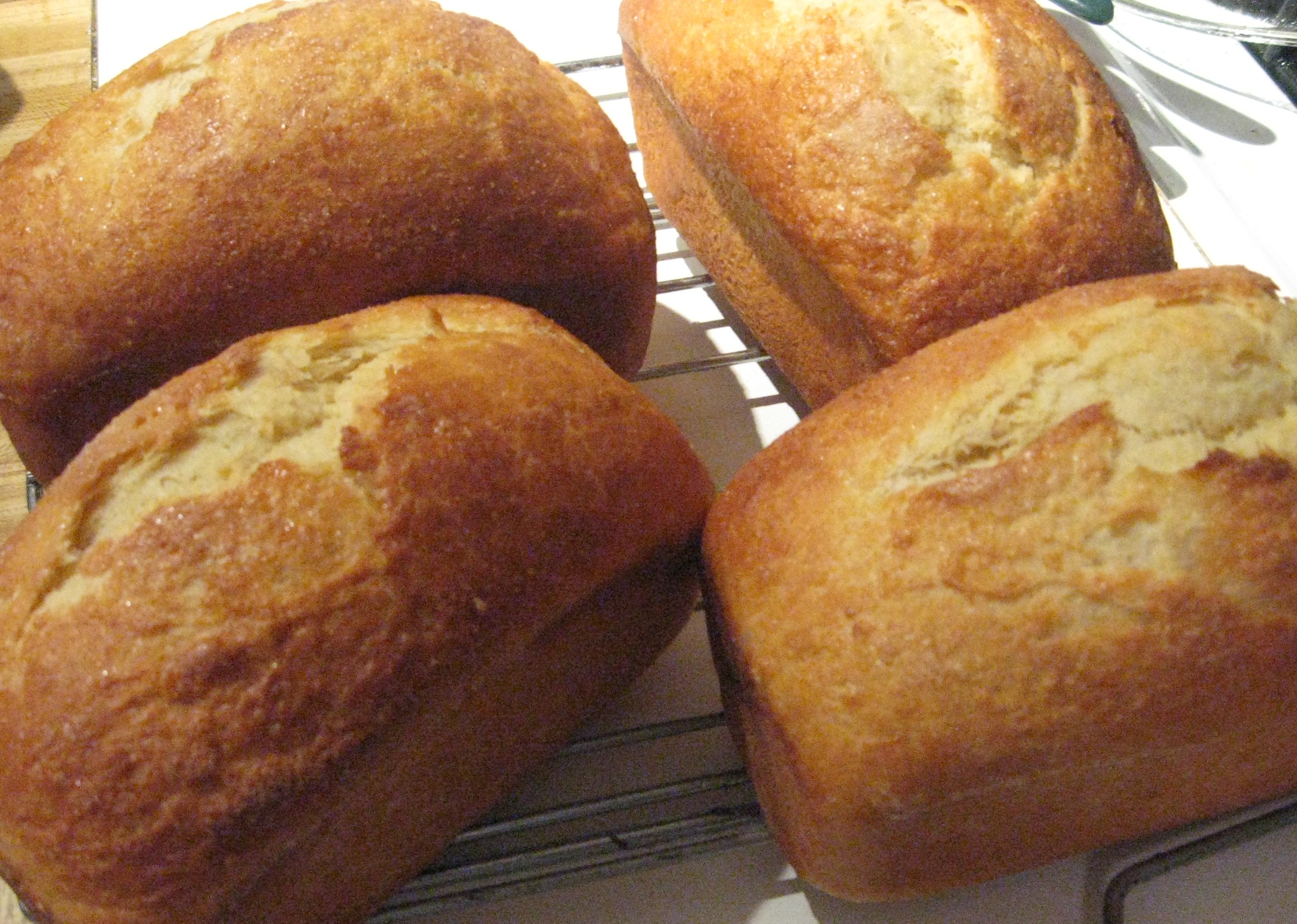
I’m hooked on having fresh bread in such an easy way.  The loaves in the photograph are brioche just out of the oven.  If you really need an attitude adjustment, the smell of the brioche (especially when filled with chocolate ganache) will definitely do it!  More about brioche coming  soon.  Happy baking!

Cookware for small-time cooking

One of the important things in cooking for one is to have the right size pan for the quantity you are cooking.  Small-time cooking with big-time flavor doesn’t happen when you have  one chop in as 12-inch skillet!  This may mean that you don’t buy that prepackaged set that is more appropriate in size for a family of four, but buy smaller pans as your needs are likely to be different.  Cook’s Illustrated has a great article on “à la carte” selection of cookware.  When cooking for one, you won’t need the sizes, but pans with the same functionality will give you a lot of flexibility and room for you cooking to evolve.   To  stretch you dollars, you want to look for multifunctional cookware.  If you are really going to enjoy cooking for one, you do need the best pans that you can afford and it is better to have a few good ones than many not-so-good ones, or even good ones in the wrong sizes.  It’s worth saving for good pans (or you drop all sorts of hints to friends and relatives, if not to give you the pans you want, at least to give you the means to purchase them).

At the time I needed to make the decision about cookware, I was fortunate to be working in a gourmet food store with an excellent kitchen ware department, and I was able to have hands-on experience with top-line cookware (All-Clad, Calphalon, Le Creuset, Emile Henry, and others).  I was able take advantage of employee discounts so I started with All-Clad cookware.  I cook for one (and a cat) most of the time;  but do like to have friends come for meals when I cook something special (like roast goose and stuffing) that is not just for one.  I bought standard starter set of All-Clad stainless steel cookware that had nothing huge in it, but did cover even making stock (for one).  That set consisted of a 10-inch fry pan, a 2-quart saucepan, a 6-quart sauté pan, a 6-quart stockpot, and a  4-quart casserole with lid.  I got a bonus of an 8-inch nonstick fry pan with the set.  That was so many years ago–but I’m still hooked on the All-Clad cookware.

Over the years, I’ve added various other pieces to fit my cooking needs–from the steamer insert, and double-boiler insert (with rounded bottom corners that make it easy to stir with a whisk) that fit the 8-inch saucepans or the casserole, a smaller sauté pan (2-quart), a larger, tall stockpot with pasta/colander insert.  Even cooking for one, I use all these–the smaller ones more frequently than the larger.  I’ve been using this cookware now for more years that I am going to admit to publicly–but it has performed well, so that I’ve never questioned where to go for additional pieces.

The latest piece that I have added is the 1-quart open saucier pan.  I added that because I frequently do reductions of stock or sauces and make custards over direct heat–which means that the rounded bottom edges of this pan don’t let custards stick and curdle in the squared off corners as they would in a sauce pan.  I had to make a decision on whether to add a Windsor pan or the saucier–difficult because the both have their uses, but I opted for the saucier.  (I was given a saucier pan as a gift–from another manufacturer–and it is languishing in the back of a cabinet somewhere because it did not heat evenly, and it was easy to see why just by the heft of the two pans.

My very first high-end cookware was a great set of Le Creuset, enameled cast iron (a gift).  Looked great, cooked great–I really liked it, but it was heavy.  After I had used All-Clad, so much easier to lift, and found out how well it did, I decided that I’d rather have the advantage of lighter weight, easier care, and great performance.  I passed on my Le Creuset saucepans and fry-pans to a friend, and got the All-Clad.  I confess that I kept the Le Creuset dutch oven for a number of years even though I always reached for the equivalent All-Clad since it was so much easier for me to lift into and out of the oven when filled with stew or stock.  When I was convinced that the All-Clad performed as well as that, that particular piece also went to join its mates with the same friend.

So where do you start if you’re going  to purchase cookware?  I’d start with Cook’s Illustrated website (unless you’re a subscriber to the Cook’s Illustrated magazine) since they do some pretty stringent and objective tests of cookware (Note that there is no advertising in the magazine).  Then, I would go to a brick-and-mortar store that carries different brands, e.g. All-Clad, Calphalon, Le Creuset, and look, lift and see how the pieces look and feel.  I think that it’s important, just like I advised with knives, that you actually handle the different pieces and brands.  But, don’t commit to buying yet!    Think about it, sleep on it.  It’s not quite like buying a car, but it is an investment.  After you’ve thought about it, I’d go online to Cooking.com. They have customer reviews which are helpful to read; look at the pieces you think would make sense for you, check prices and compare.

Think about your favorite foods–what you’d like to cook for yourself.  I like to do soups and stews in the winter, but don’t always want huge quantities, so the small covered casserole (4-quart) which can function like a small stockpot,  or dutch oven (oven or  stove-top) is a necessity for me.  It’s the workhorse in my kitchen.  Another that I reach for a lot is the small sauté pan–just the right size for one or two chops.

There are other things to consider in your choice of cookware:  What is the manufacturer’s recommendation about putting it in the dishwasher?  Can the pans (with lids) go from stove-top to oven cooking?  This last is the much more important consideration (at least for me) since in order to cook with minimal attention I use the oven a lot for finishing stews, making stocks–anything that requires long, slow cooking.

Dishwasher safe if less important when cooking for one. The All-Clad stainless steel is dishwasher safe, but other finishes are not.  Stainless steel is my preference for appearance–and for the fact that it can be used with induction cooking.  Copper clad is beautiful–if you don’t mind the maintenance–I ogle a friend’s copper All-Clad enviously, but know that mine would never look like that!   For other information you can go to the manufacturer’s FAQs.

As you cook more, it’s likely you’ll want to add other pots and pans.  I’ve got a couple of All-Clad pans on my wish list:  Right at the top of my wish list is the petit braisier. I have (as a gift) a Calphalon 12-inch “everyday” pan.  It performs very well, but it’s too big for many of the things that I cook as single servings.  It can function is so many ways–skillet, brasier, omelet pan, and the short handles make it ideal for things that go from stove-top to oven. Another on my wish list is the round dutch oven for one.  I  use my pans directly from oven/stove-top to table–and not because I’m cooking only for myself (and the cat).  I think that the rounded bottom corners and the domed lid would be great–and besides, aesthetics do count, too; it’s a great looking pan.

I’d love a domed lid to fit my sauté pan (if possible), rather than buying another pan.  The flat lids that I have fit so well and have handles that can go in the oven, but every once in a while, that domed lid would be great since it give you a bit of extra capacity. Then there is the French brasier…another to the wish list!  There are times when the stainless steel rack would be wonderful….

You might be wondering why I’ve not mentioned nonstick cookware.  I do have two nonstick pans–which are very infrequently used.  For dishes that may go stove-top to broiler, I’d be concerned about the temperature effect on the nonstick coating.  For frying, I often want to use high heat, so for me, nonstick is out.  The two places where it is useful are an omelet pan and a pan in which you sauté delicate fish.  Generally, I think that if you have good cookware that distributes  heat well, you warm the pan before adding oil, and let your oil heat before you put anything in, any pan is nonstick!  Nonstick cookware has the disadvantage of not forming fond as well–which can keep pan sauces from being as flavorful as when it develops well.  If you like to do quick sautés and make pan sauces, then you might not want nonstick; however, you cookware needs to fit you style of achieving big-time taste with small-time cooking.  To help you make that decision, I’d recommend the Cook’s Illustrated article on nonstick cookware.

Shop carefully, compare prices.  It’s possible to find even some of the high-end cookware at special prices, so check prices.  Have to love the Internet.  Just to give you an example, I did price comparisons for that petit braisier that tops my wish list:  I found it ranging from $99.99 to $179.95.  The lowest price (excluding shipping–don’t forget that) was from Cooking.com (and that was with free shipping and a coupon code given)! I think I just found the Christmas present that Keiko, the cat, is going to give me!

Take four chicken thighs…

If you are going to cook for one, you need to get away from recipes that specify exact quantities–it’s a step toward learning to improvise as you cook.  I’d urge you to take a look at Kitchen Express by Mark Bittman–you don’t have to buy it, thought it’s a great book to have; go to the library and check it out. (It’s also available for Kindle, too)  Other simple, and simply good recipes can be found at The New York Times, and at Mark Bittman.com.  You will find recipes that are easy to do for one because they are “quantity-less” in the sense of the typical recipes.  They don’t call him “minimalist” without a reason–a very few ingredients can make some wonderful eating.

Now for those four chicken thighs, cooked as described in “The Microwave in my Kitchen”, here’s what has been done with some, and what is intended for that fourth one:

1.  Chicken salad for a sandwich, quickly made by adding some minced red onion, a bit of cutting celery (See Herbs page) leaves and stems, salt, fresh-ground black pepper, a squeeze of lime juice (or lemon juice), and a drizzle of extra-virgin olive oil.

2.  A warm meal of chicken with  part of a can of chickpeas left from a previous use.  Sautéed a handful of onion in olive oil until softened, added a big clove of garlic, the chicken cut into bite-sized pieces, added some halved grape tomatoes, about a tablespoon of chopped sun-dried tomatoes, a dash of Syrian oregano (still growing on my deck); finish with salt and fresh-ground black pepper to taste.   Add a  single-serving salad of mixed greens and had a quick, satisfying meal.

3.   The third piece went to make some quick chicken hash for Sunday breakfast as follows:  In a 12-inch nonstick skillet sauté a handful of diced onion  in olive oil until just starting to brown.  Add two minced garlic cloves (I like lots of garlic),  and cook for two or three minutes.   Meanwhile, open a can of diced potatoes (I told you this was quick–obviously you can start with raw potatoes and sauté them until tender) and brown them lightly. Rinse and drain the potatoes, add to the skillet and sauté until they start to brown.

Remove half the potato mixture–this is destined for another use.  Remove the meat from the chicken thigh if it was bone-in and dice the meat.  Add this to the potato mixture in the skillet, along with some (about 1/2 teaspoon) fresh thyme (again still growing on my deck) and continue to sauté.  When the potatoes and chicken are slightly browned, remove to a plate and keep warm.  Cook one egg (or two if you are really hungry) to medium, and serve over the chicken hash.

The portion of potatoes that you removed from the skillet can be used in different ways: the are likely to become a kind of quick version of a Spanish tortilla by just  warming and adding a couple of eggs and serving with a salad or vegetable.

4.  With the broth obtained from cooking the thighs in the microwave, I plan make a meaty chicken soup using that fourth chicken thigh, using that bit of  rice left  from another meal.  I’ll add more veggies, perhaps a bay leaf, and some of my “lazy” favorite (and only) herb mix, herbs de Provence. I’ll see when the time comes–since I don’t do leftovers, I probably shouldn’t do predictions either.

There will be a follow-up on that fourth piece of chicken to let you know where my improvisation lead me.  I’ll give you another example, using a recipe from Kitchen Express for a lentil soup that just blew my mind (See An Awesome Lentil Soup).  It was such an unexpected combination of flavors, and it is one that I keep using to improvise with other ingredients, as well as coming back to the original.  It’s a recipe where I could also make use of the last piece of chicken.

The microwave in my kitchen

I guess I’m not really fond of many small appliances or kitchen gadgets.  There seem to be a lot that just take up drawer space or counter space and don’t work that well.   In many ways the microwave has mostly been just a “gadget” in my kitchen.  Most of the microwave recipes that I found were just not that good: edible, but that’s about it. Many of the early cookbooks that I looked at seemed to suggest that anything could be cooked well in the microwave.  Admittedly, I’ve not looked at a lot of newer ones because they seemed so uncritical about what does or does not cook well in the microwave.  So for me it was for melting chocolate, making popcorn, heating a cup of water….

I’ve revised my opinion slightly after finding the Microwave Gourmet cookbook by Barbara Kafka.  This author is a traditionally trained chef, and approached the microwave in a very skeptical frame of mind, and that has produced a useful microwave cookbook.  There is no hesitation in saying what NOT to cook in the microwave.

One of the really useful features of this book  is a dictionary where you can look things you might want to know about cooking in the microwave, and find times, suggested container sizes in which to cook it.  I’ve use this more than almost any other part of the book, except possibly the information on how to arrange foods in containers in order to have them cook properly.

I’ve tried the microwave risotto, and it’s not bad for times when you don’t want to spend the time standing by the stove stirring for 25 minutes or so.  (I’m anxious to compare the results of this with the Cook’s Illustrated simplified risotto.)

The most-used recipe in that book for me is the one for quick chicken broth or stock.  I’m mostly a stove-top or oven stock maker, but this is great when you don’t have canned stock or want some really good broth for soup.  Here is the recipe:

Use bones (carcass from the roast chicken, or necks, backs, wings, or giblets (except liver).  You can collect these in the freezer until you have enough, or if you’re lucky, you can buy backs cheaply and make this whenever you need to.

  • 2 pounds chicken
  • 4 cups water

For 4 cups, place the bones and water in a 2-quart dish and cover tightly with microwave plastic wrap.  Cook at 100% for 30 minutes.  (Cook 40 minutes for broth that will jell.)

For 2 cups, use 1 pound bones, and 2 cups water.  Cook for 20 minutes.

This cookbook has directions for making  the classic stocks and broths in the microwave–including vegetable and fish/seafood broths.  Although I’m sure I will not give up the stove-top or oven long, slow preparation of stock I think that I’ll turn to the microwave more frequently, especially in hot weather.  I’ve not done a side-by-side tasting of each method, but this is certainly better than canned!

I’ve also cooked chicken in the microwave according to instructions in this book and been pleased with the results.  I use chicken thighs instead of breasts, but instructions/times can be found in the Dictionary section of this cookbook.  An unexpected benefit of cooking the chicken this way  is some very good strong broth; just enough to make one good  serving of chicken soup.  To me the texture of the chicken is a bit different when done in the microwave– more chewy, but not tough, or disagreeable at all (I actually like that “chew”).  I expect that I’ll be using the microwave more often to cook chicken now.

“Convenience” foods for cooking for one

Time frequently seems to be of the essence when cooking–for one or for many.  There are some things that I discovered that save me lots of time–and that means that I’m much more likely to cook a meal, rather than do carry-in, or reach for the peanut butter jar!

When you see “convenience” food, I dare say your first thought is processed, open-heat-and-eat food.  That’s not what I’m talking about here.  I’m thinking of things you prepare yourself with choice ingredients, and freeze, or otherwise “put by” for later uses that can shave time off of recipes.

How many recipes do you have that start with  a “flavor base” like  sofrito (Spanish), soffrito (Italian), mirepoix or mirepois (French)?    Lots, probably.  How many times have you passed on that recipe because you don’t have those, you did not want to spend the time mincing, dicing, or you pulled that bag of celery out of the crisper, and–yuck–it’s no longer fit to use!   Cooking for one, I find celery a particularly frustrating ingredient.  I like celery–but it always seems to go bad in the crisper.

Many flavor bases to start soups, stews, et cetera begin with carrots, celery, onion, diced or minced and sautéed  in olive oil (or maybe butter).  True it’s only a few minutes work to do this–if you have the ingredients.  My solution to this has been to take celery, carrots, onions, and use the food processor to chop a large batch of this useful mixture, sauté in a mild olive oil with just a touch of salt, and then pack it into small containers in lots of a couple tablespoons (or freeze in ice-cube trays and transfer to zipper-lock bag), and put it in the freezer so that when I need it, I have the basic prepared carrots, celery and onions, to which I can add garlic and herbs as needed for a particular recipe, and I’m off to a running start.

I do keep canned beans around as a “convenience” food, but I much prefer to cook my own dried legumes (pulses).  Since that is a time consuming thing, I have found a way to make those into “convenience” ingredients:  cook a large batch until almost fully cooked, and then freeze with some of the liquid in small quantities–a cup or so, whatever you would most likely use.  I’ve found that they hold well in the freezer, and can finish cooking quickly, so that you have the advantage of home-cooked quality, without the time investment.  I’ve done this with lentils (my favorites being the French LePuy) of all sorts.  True, lentils cook quickly and do not require soaking, but I can still save time with these.   I particularly like to do this “precook” with beans since that means that I can have lots of variety and have the convenience of canned, with specialty beans that are very tasty.

Grains can also be done this way too.  That left-over serving of rice that I’m sure I’m not going to use this week gets labeled, dated, and put into the freezer for a quick serving when I don’t want to take the time of cook rice from scratch.

Risotto is another favorite main dish for me–right in my category of comfort food with mac ‘n’ cheese, and tomato soup; I don’t find cooking it to be difficult–in fact it’s rather relaxing, but time consuming.  I’ve tried some of the “quick” recipes (see Risotto post) and have not been too dissatisfied with them, but I’ve also found that I can make a big batch of risotto to the point where it’s ready for the addition of the Parmigiano-Reggiano, and then freeze it is serving-size batches.   It will thaw quickly, and lets me have risotto fairly frequently.   It’s easy to add vegetables or seafood or other quick-cooking things as you finish this preparation.

Another “convenience” ingredient is homemade broth or stock.  While I will admit to keeping canned/boxed broth/stock on hand, I much prefer to have the real homemade thing, and that is not hard to do:  make a large batch on a cold rainy day when it’s good to be indoors; freeze it in small quantities for future use.   I’ve found a very quick way to make chicken broth too.  More about that later.

All these little conveniences can add up to much better small-time cooking with big-time flavor even when cooking just for one.