Braised pork and cabbage (Caribbean seasoning)

I’m of the opinion that cabbage is a much under-appreciated vegetable!  It’s good for so many things besides the traditional “coleslaw”.  One of my favorite things is to use it in braises.  Here is one of my favorites:  Braised pork and cabbage.  Again, it’s versatile, freezer-friendly, and the quantities are flexible.

Heads of savoy cabbage

Savoy cabbage

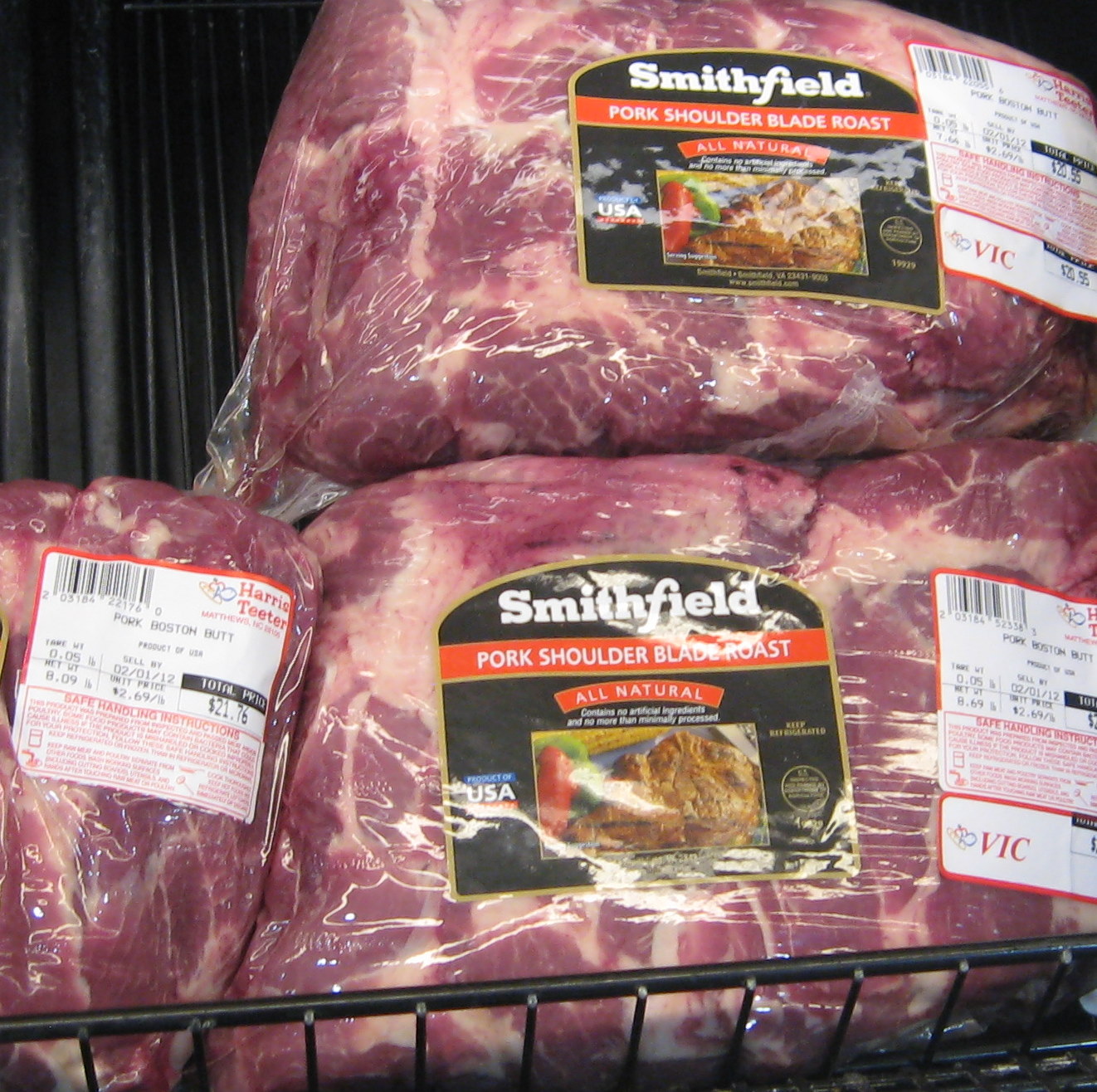
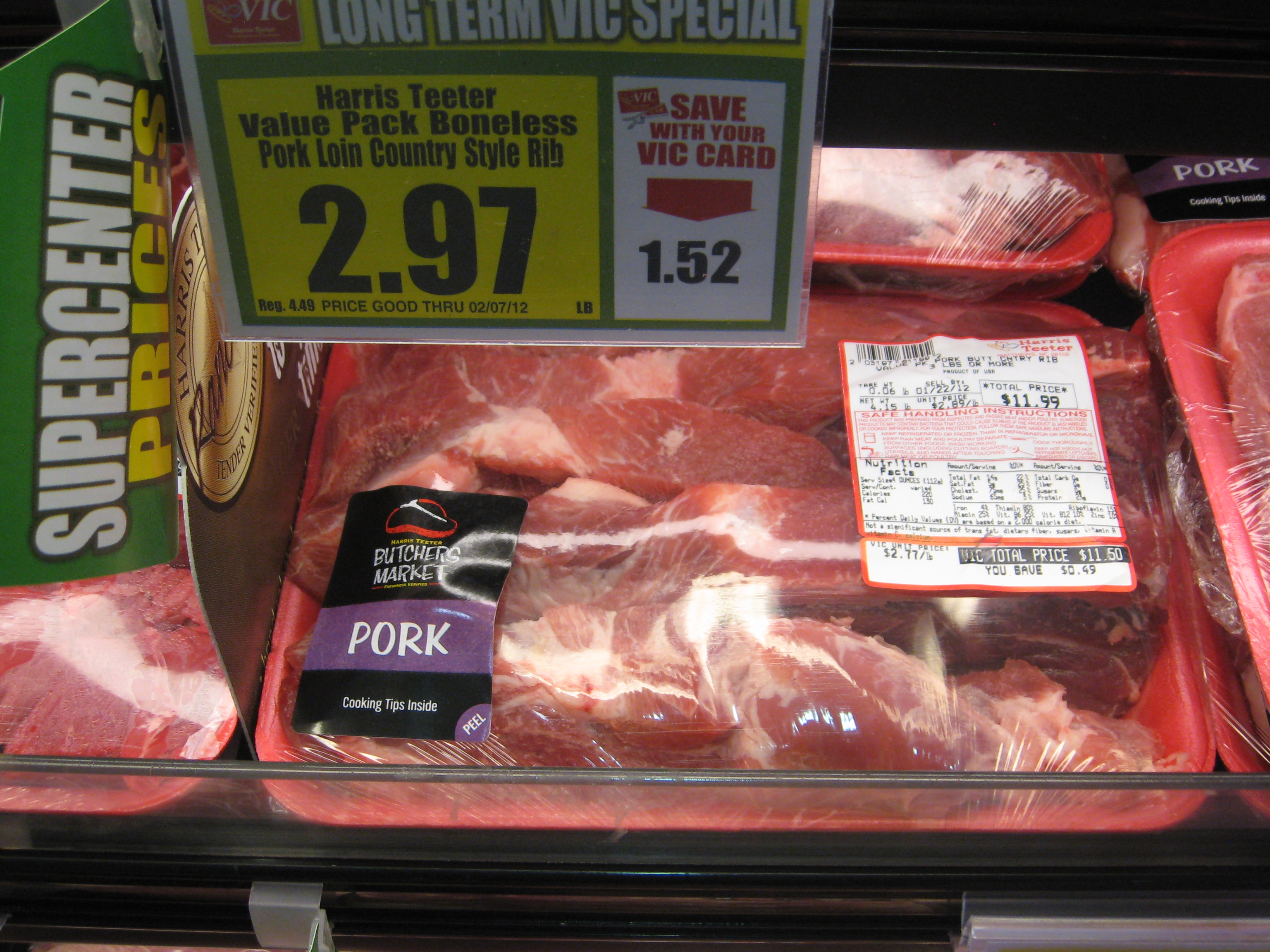
A particular favorite is from Jacques Pepin’s Cuisine Economique.  I’ll give you the basic recipe here ingredients as given in that recipe and summary of the preparation.  If you’re interested in ways to take economical cuts of meat and make them into something really good, this is a book worth looking at (See Bibliography).  The recipe is here not to give you quantities, but to suggest seasoning.  While this recipe suggests a larger cut of pork, I usually get the boneless country ribs to use for this–they are really more like pork butt than are loin chops.

Braised Pork and Cabbage (p. 247)

Ingredients

  • 2 teaspoons salt
  • 2 teaspoons dried oregano
  • 1/2 teaspoon allspice powder
  • 1 teaspoon cumin powder
  • 1/4 teaspoon cayenne pepper
  • a 4-pound pork roast (loin tip, shoulder, or pork butt)
  • 1 tablespoon virgin olive oil
  • 1 large or 2 medium-size heads Savoy cabbage (about 2-1/2 pounds), leaves cut into 2-inch pieces and core cut into 1/2-inch pieces
  • 2 large onions (about 1 pound), peeled and sliced
  • 1 tablespoon of sugar
  • 1/2 cup cider vinegar
  • 1 tablespoon dark soy sauce
packaged pork boston butt

boston butt shoulder roast

Preparation

  • Mix the salt, oregano, cumin, allspice, cayenne, and rub the mixture all over the meat.  (See Notes.)
  • Heat the olive oil in a heavy pot.  When hot, brown the meat over medium-to-high heat for about 30 minutes (See Notes) until well browned on all sides.
  • Cover tightly and place in a preheated 325 ° F oven and cook for 45 minutes to a hour.
  • Remove the meat and transfer to a platter.
  • Combine the cabbage, onions, sugar, vinegar, and soy sauce in the pot.
  • Put the meat on top of the cabbage, cover, and return to the oven for about 2 hours until the roast has released juice and is fork tender.
  • Slice the meat and serve with the cabbage and juices from the pot.

Notes:

  • The cooking times will vary to some degree with the type of meat you use–shoulder, butt and ribs have enough fat and connective tissues to need long slow cooking. A supermarket loin roast, which I would not use, can easily become dry with long cooking unless brined.   I do not usually make this with a roast, but with big, meaty,  country-style spare-ribs, with about  1 to 1-1/2 pounds.  Even using about a quarter of the meat, your cooking time will still be longer than a quarter of these times–you just need to check the doneness)
    country ribs

    butt country ribs

  • You’ll probably want to use the quantities given for the rub ingredients–and I like to put these on the meat for at least several hours (if not a day before) browning it.  There is a lot of surface area to cover with the ribs.
  • This is also a freezer-friendly dish–I love to have a single-serving sized portion to pull out when I need comfort food on a cold day or I’m just in a hurry for food.
  • I like to serve steamed potatoes with it–or add one of those single servings to a  single-serving amount of rice as it cooks (in the rice cooker) for a complete meal.
  • A Riesling or Gewürztraminer wine is excellent with this dish.
Another use for Ball/Mason jars…..

This was just on my Facebook news feed from Savory Simple.  I have never found a travel mug that cleaned up easily…and they are not cheap!  Since I use wide-mouth canning jars for so much of my storage, I have them around in various sizes.   Definitely have to have one of these gadgets!

Oyster-corn chowder

I’m an oyster lover!  One of the few Christmas traditions that I do keep is Christmas eve with Handel’s Messiah, and oysters in some form.  I got this tradition from my grandmother–Christmas was oyster time.  My uncle would drive to the coast and bring home a bushel of oysters on Christmas eve day.  We had oyster stew (more like poached oysters the way my grandmother made it) on Christmas eve, and fried oysters on Christmas day.  I don’t do the fried oysters, but I’ve staunchly held onto the tradition of having oyster “stew” of some sort on Christmas eve with friends who also love oysters.

I’m always looking for recipes for oyster chowder, or the like, so that I can try something new while oysters are in season.

This year’s oyster chowder is one of my absolute favorites from Jacques Pepin Celebrates (pp.19-21).  I’m so taken with this recipe that I wanted to share it with any of you out there who love oysters.  I think that you’ll also like the little cornbreads with it.

Oyster-and-corn chowder with small cornbreads 

Small cornbreads (8 individual servings)

Ingredients

  • 2 tablespoons unsalted butter
  • 1/2 cup sliced leek (or shallots)
  • 1/3 cup all-purpose flour
  • 1/2 cup cornmeal
  • 1/2 teaspoon salt
  • 1 teaspoon sugar
  • 1 teaspoon double-acting baking powder
  • 1 large egg
  • 3 tablespoons milk

(To make preparation easier, you can combine all the dry ingredients ahead of time so that all you have to do is add the wet, mix, and spoon into muffin tins. )

Preparation

  • Preheat the oven to 425 ° F
  • Using 1/2 tablespoon of the butter, butter your muffin tins or pans.
  • Melt the remaining butter in a small skillet and sauté the leeks or shallots over medium heat about 90 seconds, and cool.
  • Mix the dry ingredients in a bowl
  • Add the wet ingredients:  egg, milk, and finally the sautéed leeks or shallots and stir well.
  • Divide among your pans.
  • Bake for 10 to 12 minutes until set and nicely browned.

Chowder

Ingredients

  • 3 dozen oysters, shucked with liquid retained
  • 3 cups corn kernels
  • 3 tablespoons unsalted butter
  • 1 medium leek, trimmed, quartered, and thinly sliced
  • 1 medium onion, peeled and chopped
  • 3 or 4 large garlic cloves, peeled, crushed and finely chopped
  • 3 cups milk
  • 1 cup heavy cream
  • 1 teaspoon salt (more or less depending on the saltiness of the oysters)
  • 1/2 teaspoon fresh-ground black pepper
  • 1 tablespoon minced chives

Preparation

  • Check the oysters, removing any shells, and return to the liquid
  • Heat the butter in a heavy pan, and add onion and leeks.
  • Sauté over medium heat for 3 or 4 minutes, or until translucent, but NOT browned
  • Add garlic, stir for 20 or 30 seconds until it smells fragrant.
  • Add milk and cream.
  • Bring to a boil. (You can quit here, cool, and hold in refrigerator until you’re ready to make the chowder.)
  • Bring back to a strong boil (if you’ve prepared this in advance).
  • Add corn (in winter, substitute frozen for fresh–I think that it’s better than supermarket corn-on-the-cob.  I particularly like the white shoe-peg kernels. For frozen, I rinse in a strainer under cold water and drain well to at least partially thaw it.)
  • Turn the heat down to medium to medium low–you do not want to boil this again now.
  • Add oysters and the oyster liquid.
  • Heat until the temperature reaches about 170 or 180 ° F  at the most.
  • If you’re not using a thermometer your want the edges of the oysters to just begin to curl.  Don’t boil it–the oysters will turn tough and harshly flavored.
  • Should any scum come to the surface, skim it away.
  • Add the chives, mix well, and serve with the cornbreads.

(This recipe is easily cut down or doubled, but I usually make the whole amount and just have it as the main course, with a salad (bitter greens, mesclun, and fruit and shaved Parmigiano-Reggiano to follow).  I like champagne with this–as awesome treat for a special evening.

Variations:

  • Add some chipotle chili power or ancho chili powder to taste.
  • Add minced red bell pepper, and/or poblano for a red and green touch.  I would  not add green bell pepper to this as their flavor is too bitter/green  to complement the oysters.
  • Add minced ripe jalapeños or Serrano to give just a hint of heat.  This is not a chowder that you want to have much heat.  It should be gentle on the tongue!
  • Substitute shallots for the leeks.

A son goût!

Veal chop

Today I absolutely HAD to go to the grocery store to retrieve some “paper products”…just no way to put it off any longer.  Procrastination was definitely not an option.  So, after giving my lecture this morning, I had a bowl of oatmeal (I try not to go to the grocery store when I’m hungry), and headed out to the store for one item.

Well, while I don’t like shopping for some things, I do find it hard to go through the grocery store without meandering around through the produce, fish, seafood, and meat counters, and occasionally (especially around the holidays when they have chocolate cherry bread) the bakery.

Today my meandering took me past the meat counter.  I usually do check what might be on special–especially when I’ve not decided on that night’s supper–I might well find something that’s not usually in the budget marked down because, while it’s still fine, it’s sell-by date is approaching.   Today is wasn’t a “need to move it” but a “manager’s special”.

I found a lovely veal rib chop (bone in and thick) as a store special (read cheap for veal).  My oatmeal just was not enough to allow me to pass that up–so I came home with a veal chop–since chops of any kind are always wonderful for single-serving cooking.  Now, what to do with this chop?

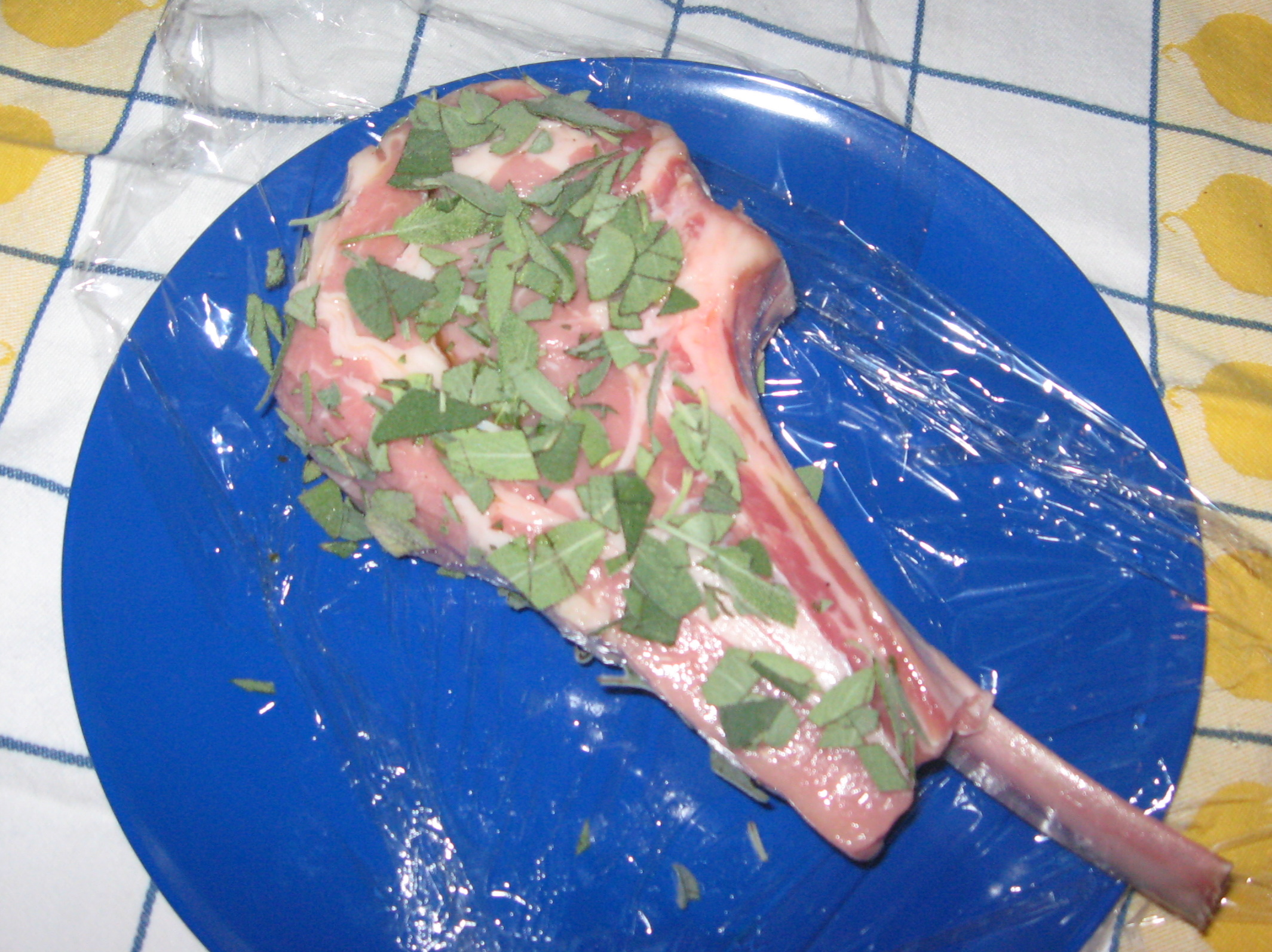
veal rib chop with whole fresh sage leavesAs comfortable as I am with improvising, I do sometimes want a recipe.  I know that some where in all my cookbooks there is a recipe for “sage-sage scented veal chops” that I just want to look at.  How do I find that recipe?  Off to Eat Your Books. (I know I’ve mentioned it before, but Eat Your Books is wonderful if you’ve got cookbooks and want to find recipes–and they are now indexing magazines and blogs as well as books.)

The recipe is from Every Night Italian (p. 127) by Giuliano Hazan was the inspiration for this (but could not remember who or where to find it).  Thank you, www.EatYourBooks.com!  This is so simple that you really don’t need a recipe.

Sage-scented Grilled Veal Chops

Ingredients

  • one veal chop (at least 1 inch thick, and I prefer about 1-1/2-inch thickness)
  • fresh sage leaves cut into strips or chopped
  • olive oil

Preparation

  • Cut the sage leaves into strips (chiffonade)
  • Pat the sage, with the olive oil, all over the chop
  • Let stand (at room temperature) until your grill is ready–about 30 to 40 minutes.
  • See Ready to Cook (below) for cooking method

Ò¿Ó

I’ve followed these directions, but I’m a sage lover and I want a bit more sage flavor (even with mild veal) than I get with that standing time, so I’ve tried to find ways to bump up the sage.

I’ve tried processing the sage leaves with some olive oil into a nice green slurry and rubbing that on the chop.  That works well in you have only a short time to get your sage flavor into the chop–but don’t leave that one more than about an hour or you’ll totally over-sage your chop.  Sage is potent even as a fresh herb, some varieties more than others.  I would not cook a chop this way if I did not have fresh sage.

veal chop covered with coarsely chopped sage leaves

I’ve gotten the flavor that I want by very coarsely chopping the sage or even just thoroughly bruising the leaves and patting them over my chop, wrapping it in plastic film, and letting it sit in the refrigerator at least over night, or up to one day, and then cooking it.
So here’s my chop, rubbed with olive oil covered with the sage leaves, ready to go into the refrigerator until I’m ready to cook in tomorrow evening. Depending on the weather, it will be ready to  charcoal grill it, or griddle it, or even pan-sear it.

Ready to cook…..

When you’re ready to cook the chop, wipe off the sage leaves. The high heat doesn’t improve the flavor of sage, and can actually burn them, so I like to remove them.  You’ll want to salt and pepper the chop as you start to cook it.  You want to cook the chop to an internal temperature of 130 ° F (medium rare–for my taste) or a bit longer for medium.

  • If you’re cooking on a gas or charcoal grill, you will want to have  two-levels of heat–high to start brown the chop, and a lower temperature to finish the cooking since it’s a thick chop.
  • If you are pan-searing you’ll need about 2 tablespoon of oil.  Heat the oil over medium-high heat until it starts to smoke, and put your seasoned chop in the pan.  Let it cook without moving it for 4 to 5 minutes when it should be browned on one side. Using tongs, flip the chop and reduce the heat to medium and continue cooking until  it’s at 130 ° F (or desired doneness).
  • For griddling, I use a cast-iron griddle that fits over two burners–so I can kind of have  “two-level” heat with the two burners at different levels. Again, let the chop cook for about 5 minutes without moving it.  Once I’ve turned the chop and moved the chop to the somewhat cooler end, I can put veggies on to cook while the chop finishes.   (If you’re working on a grill-pan, then adjust the heat as you would for the pan searing, but with the heavy cast iron it does take a bit for the heat to adjust.
So quick and easy!

Õ¿Ô

I ended griddling my chop because it was a damp, rainy day–it was still wonderful.  Added a few steamed fingerling potatoes and some sautéed  broccoli raab (with garlic and red pepper flakes). It was a fine  meal.

(I’m sure I won’t  do this again until there’s another special as it’s a splurge even then, but worth every penny!)

A son goût!

Cornish hen braised in milk

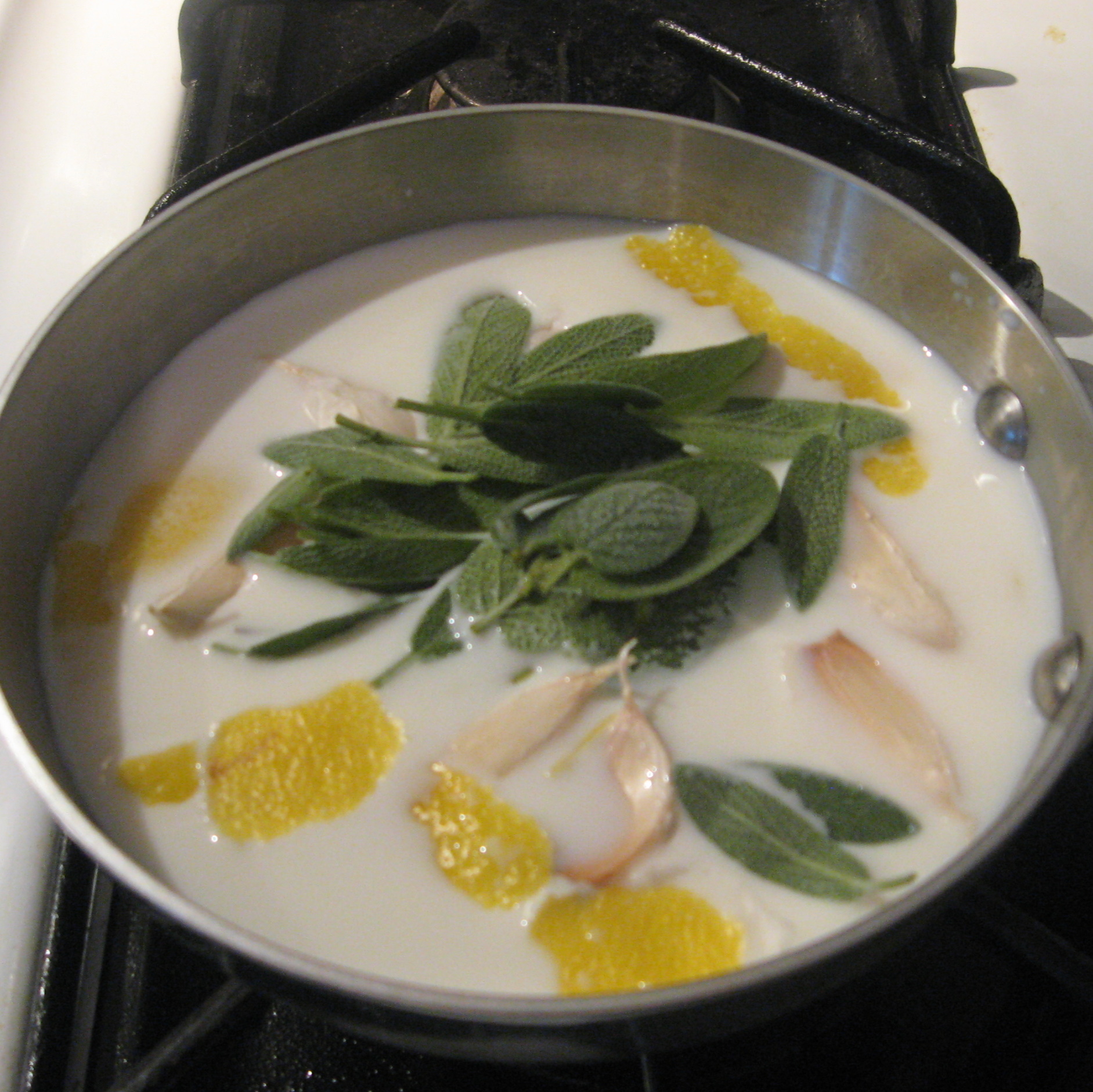
sage, cinnamon, garlic and lemon

I had an earlier post about braising chicken in milk, when I tried the recipe using chicken pieces since that gave me something more like a single serving.  Flavor was great, but I thought that for something a bit scaled down, but more in keeping with the original recipe, I would try this with a Cornish  hen and see how that worked. One of the advantages of these little birds is that they are more in keeping with  Jamie Oliver’s recipe, rather than the chicken parts that I tried originally. This might be a way to keep with the spirit of the original recipe, but scale it down to something closer to single-serving size.  While this is a recipe that might do well on second runs, I really don’t want as much as whole chicken would make.

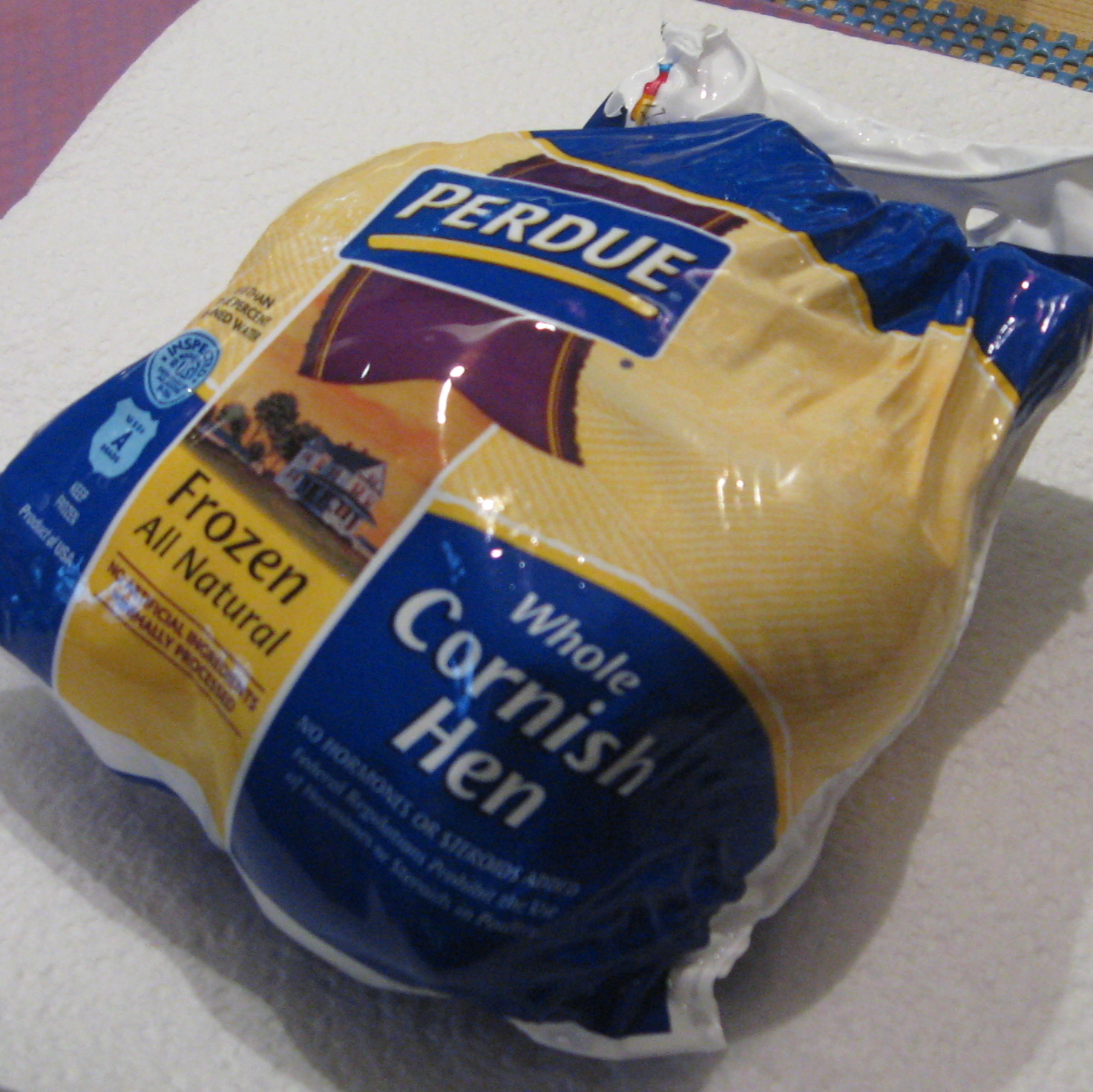
Well, the weather has turned to fall with blowing leaves, and chilly temperatures so this seems an excellent time to try this again…and my grocery shopping provided me with a lovely price on a pair of (frozen) Cornish hens–about 1 to 1-1/4 pounds each.

A Cornish hen–either male or female regardless of calling it a “hen”–is a special breed of chicken (in the USA sometimes also called a poussin, though that is really French for a very young, small chicken that is usually about a pound in weight).  Since my supermarket does not offer poussins, but does have the Cornish hen (which is a young, hybrid chicken–of Rock Cornish with some other breed–not over 2 pounds by USDA specifications) that’s what I’ll use; I was fortunate enough to find some hens that were just about a pound or a pound and a quarter each.

While browsing some of my favorite blogs, I found a discussion of Jamie Oliver’s recipe–where an oversight  of lid on instead of off for part of the time was compared to the bird braised in an open pot.  This made me think of the French chicken in a pot that I had cook recently–one of the things that was  impressive about that was how the flavors seemed to permeate the meat itself.  I decided to try this with the  lid on for part of the time just for that reason.  (I do have two Cornish hens–so maybe I need to do the same here–one each way!

One of the things I discovered when doing the chicken parts was that just because you are using 1 pound of chicken instead of 4 pounds, you might not want to just take a quarter of the seasoning ingredients–the flavor was good, but perhaps a bit on the wimpy side; so I have to find a way to optimize that when cutting the recipe to single-serving size.  I decided that this time, I will make up the seasonings and milk as if I were doing the large chicken (in the 2 cups of milk).  I thought I’d simmer the seasonings in the milk and taste to see what that was like, cool it and add what seemed appropriate for the size of my bird and my pot.

The petit brasier was a no go–too big around–so I used my 4-quart All-Clad pot as being the closest thing to a “small” dutch oven.  The whole stick of butter was obviously not necessary so I used just enough (about 2 tablespoons) with the olive oil (about 2 tablespoons as well) to brown the hen.  (One thing I did discover is that the skin on a Cornish hen is much more fragile and has much less fat under it than does a more mature chicken.)  Just the smell of the hen browning in the butter and the olive oil is fabulous!

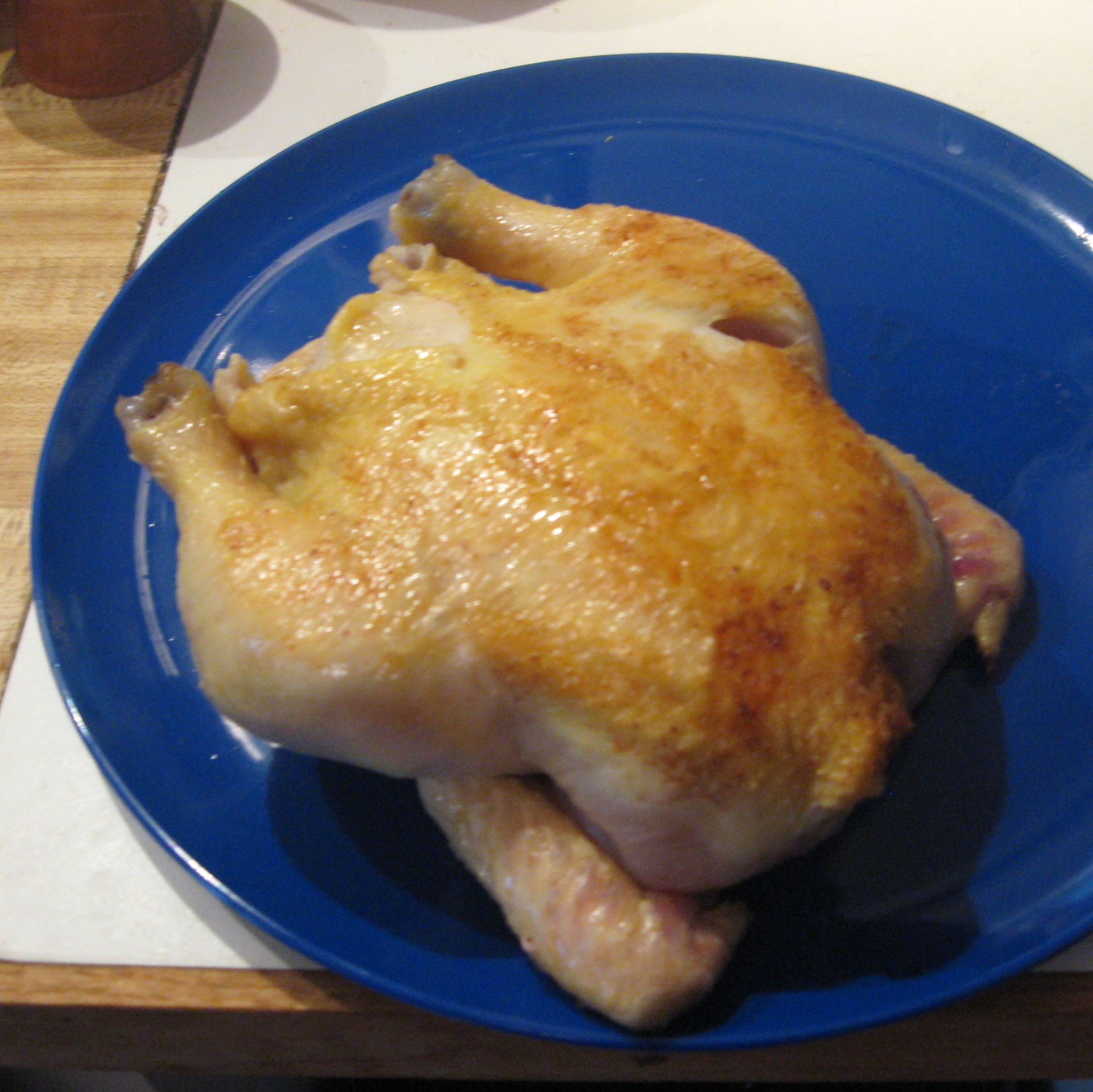
browned bird on plate

There was not much fat in the cavity either so I returned about half of the butter/olive oil mixture to the pot with the chicken.  Giblets were mostly not included–just the neck, but I browned that and included it in the braising pot for  extra flavor.

So here’s my bird, browned, and ready to go back into the pot to braise with the seasoned milk.  (Next time I’m doing a Cornish hen or poussin, I think that I’ll try using just half the milk with half to three-quarters of seasonings even though these birds are only about a quarter the weight of the chicken called for in the original recipe.)

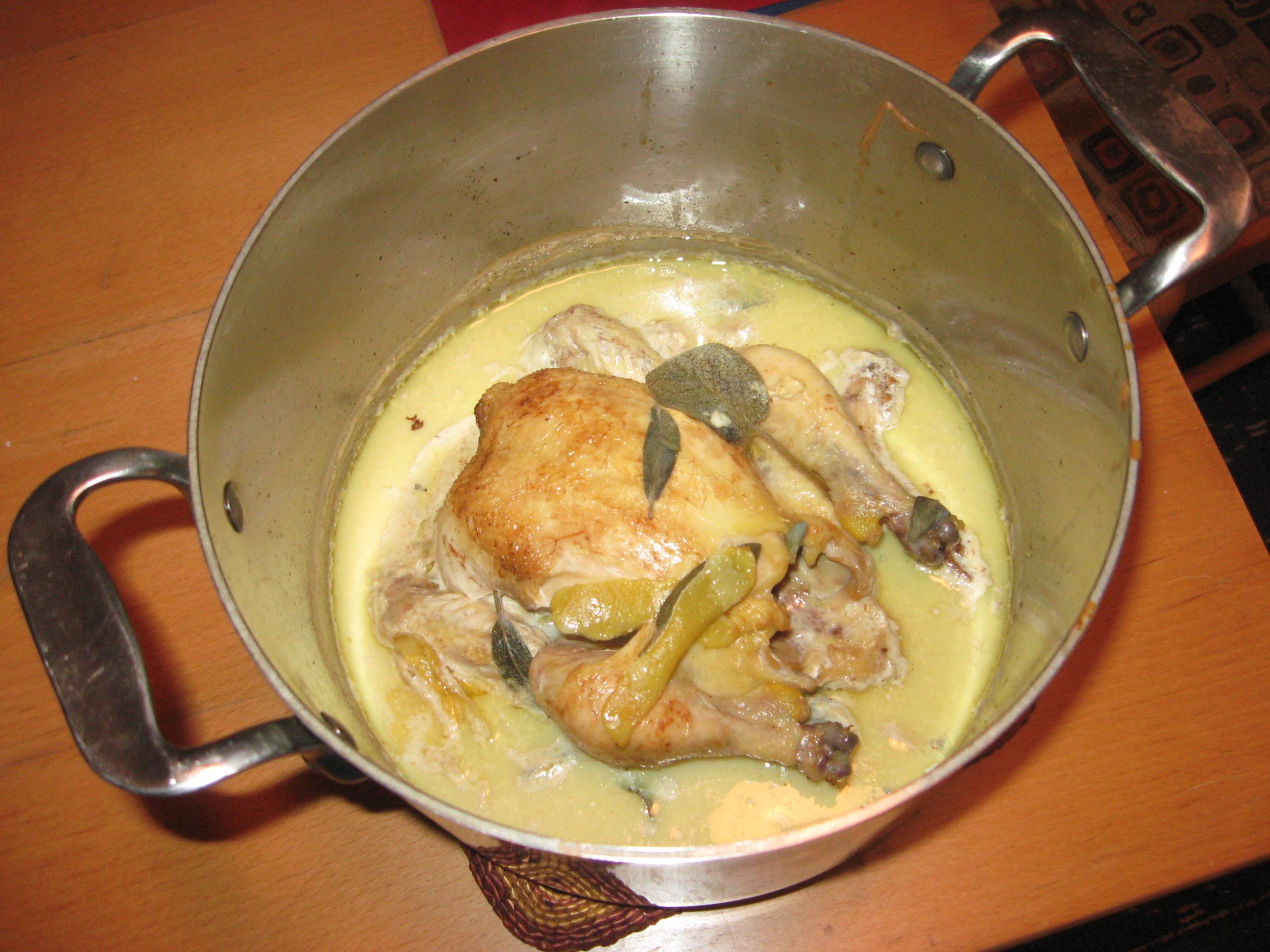
browned bird in the pot with milk and seasonings

After steeping the other seasonings in the warm milk, and then letting it cool a bit, I tasted it–very lemony and sage-y, but not much garlic or cinnamon yet; (that came out later in the braising process).  I divided the milk and the other seasonings in about half since that looked like about the right amount of liquid (the eyeball test!!).  It took about 1 cup of milk (and I added half the solids) so the rest went into the freezer for a repeat, or perhaps just to braise some chicken thighs or poach some breasts. ( I did put the cinnamon into the braising pot with this bird).

braised Cornish hen

Since it was a smaller bird and the braising liquid was already warm, I reduced the oven temperature to 325 ° F since I wanted enough braising time to let the flavors actually get into the meat (as it did in the French chicken in a pot).  I decided to go with lid-on for about 30 or 35 minutes and see how it looked then, and finish the braising with the lid off so that the liquids reduced more.

bird in pot after 30 minutes in the oven with lid off

lid off for about 30 minutes

After another 30 minutes in the oven with the lid off, the sauce has reduced some and it looks falling-off-the-bone tender.

Somewhere along the way, all those unlikely, highly individual, and potent seasonings have turned into a complex, earthy  taste and aroma.

I’m ready to eat!

Admittedly this does not look like it’s going to be a dish that lends itself to elegant presentation, but it’s certainly a keeper for comfort food.  Braised in a container that could go directly to the table it would make a nice casual presentation as the skin does brown more after the lid comes off.

•♦•«»•♦•

The  pot  that I used was just a bit deeper than I might have liked, but better too deep than too wide since that would need too much liquid to reduce by the time the hen was done.  Unfortunately, the bird was just a bit too tall to fit into my small chef’s pan–but this was close enough.  The sauce does look “curdled” but tastes wonderful!  Just the thing for a damp, drizzly, autumn or winter evening!

chocolate mug with sage-lemons IMG_4796The original recipe for a whole chicken would be great for causal company–this is definitely a keeper!   I had this with basmati rice, roasted baby carrots and baby zucchini.  Sautéed  spinach, or maybe broccoli raab would be good too.  I think that the slight bitterness of the broccoli raab would be a great contrast to the way that these seasonings meld into a very earthy background to the chicken.

A son goût!

French chicken in a pot

I’ve been wanting to try this method of cooking a chicken for a long time, but just haven’t wanted to pay the price of a free-range chicken this big.  While marketing the other day I found on marked down so I thought it was finally time to try this out.

The basic recipe is from Cook’s Illustrated (Published January 1, 2008. )  Since this was the first time that I’ve cooked a chicken by this method, I wanted to follow the recipe rather closely before I try  changes, so all that I altered was the herbs and vegetables:  I used shallots instead of onions and garlic, and  sage instead of the rosemary).  The chicken is browned and in the oven now.

♥♦♥

Later, after the chicken is out of the pot…It’s definitely a keeper recipe.  I’m amazed at how well the seasonings penetrated the bird.  With it sealed up in the pot you don’t get to smell it as you would open roasting, but when you open the pot, it’s a real blast of wonderful smells.

We had this with roasted potatoes and haricots verts, and baked figs for dessert…a simple, but delicious meal.  We had this with Paul Lehrner cuvée Claus 2007 which is 85% Zweifelt and 15% Blaufränkisch.  Wonderful!

Next step is to try this with a game hen or petit poussin to adapt this for single-serving cooking.

Tuna salad

Not that there’s anything wrong with traditional American tuna salad, but there are lots of other things to do with  tuna.  I like tuna, but I don’t want “tuna salad” in the traditional sense every time, so I’ve come up with lots of variations.  Some of the best are made with the “leftovers” from grilling a lovely big tuna steak or with my homemade tuna confit.

My “salad” might have onion and celery (if present in the refrigerator) but it’s certainly not a requirement; no mayonnaise either (though I do like the stuff).   Home from work, not going back out to the grocery store; it’s warm enough that I don’t want anything hot for lunch.  What have I got to work with from the pantry and the refrigerator?

If you think about the basic American tuna salad, it has very few ingredients:  usually mayonnaise, celery, onions, and maybe hard-boiled egg, or sometimes pickle relish.

Personally I find the usual supermarket canned tuna to be unappetizing–dry and crumbly if it’s water-packed white albacore, sometimes mushy  and fishy lacking in any real texture,  so I understand why it’s often hidden in the mayonnaise, but there are now  reasonably priced alternatives available.  If I don’t have homemade confit, I’ll be using a single-cooked canned tuna that more nearly approximates the quality of European canned tuna.

Starting with good quality  tuna, unless you want to go all the way and make salad à la niçoise you really don’t need many ingredients.  You don’t really want to overwhelm the tuna (since we are using good tuna here) so the components you need are:

  • some contrasting texture and flavor ingredients
  • just a bit of oil
  • a little acid to brighten it up.
  • fresh-ground black pepper
  • some fresh herbs for extra flavor

Starting with a six-ounce can of tuna, here are some possible things to do:

  • For something light, refreshing  and crunchy for a sweltering day, I like to use diced cucumber, scallions, red onion or sweet onion like Vidalia (depending on what’s in the fridge), fresh-ground black pepper, salt (if the tuna has no added salt), about a teaspoon of very fruity extra-virgin olive oil, a squeeze of lemon juice, and some finely chopped spearmint.
  • For something really quick, I’ve  added some  fresh onion, sweet bell pepper,  diced chile peppers for texture and some salsa  from a jar.  Chipotle salsa can give you a warmer, smoky taste.
  • If you want a heartier salad, add to your tuna some drained, rinsed white beans (great northern or cannellini are my favorites), tomatoes, chopped onion, green or black olives, some extra-virgin olive oil or aïoli (easy to make a quick version if you have decent mayonnaise in the fridge) and some fresh oregano.
  • If you have some pesto in the fridge, try chopped onion (almost always use this), diced tomato, capers, or olives. If there’s pasta around, that can be added too.
  • I usually have a jar of a fruit salsa in the fridge as well and that makes a good start.  Add sweet onion like Vidalia or Walla Walla, more fruit such as peaches or mango, some ripe bell peppers.
  • Black beans, diced tomatoes, onions, chile pepper, ripe bell pepper (I’m just not fond of green bell peppers so I don’t use them), celery, and even some corn and a vinaigrette with a light touch of chilli powder added.
  • For an oriental take on the tuna salad,  a bit of sesame oil (the kind from roasted sesame seeds) with some ginger, green onions, a little garlic if you like, with cucumbers, celery.
  • That extra serving of roasted vegetables–even potatoes–with cherry tomatoes, and a splash of vinaigrette, maybe some fresh thyme.

Obviously, a many of these suggestions would work equally well with chicken if you have that instead, or don’t like tuna.  It’s easy to improvise a quick salad if you start with a serving of meat. The possibilities are really almost endless–just follow your own taste.

A son goût! 

Tuna confit…

Steaks and chops lend themselves beautifully to cooking for one.  One of my favorites is tuna steak, griddled or grilled–served with a side of spinach risotto  and a salad it’s a very quick, easy meal.  If there is leftover from the tuna steak, it can be used in tuna salad.  But sometimes I want to tuna salad when I don’t have leftover tuna steak.  What to do then?

I dislike the “average” can to tuna that is fishy, mushy, and buy the “solid white albacore” which is likely packed in water, but still dry since it’s cooked twice in the processing (Cook’s Illustrated, July/August 2011). I love the expensive, olive-oil packed European tuna–but my budget doesn’t permit it so I’m always looking for alternatives.

One of the things that I like about Cook’s Illustrated is the comparison of products readily available in the American supermarket–that is, after all, where I do most of my shopping. Those products are reviewed without knowledge of the manufacturer, and are not supplied by the manufacturer–so I do tend to give them some credence.

American Tuna image of canIn the July/August issue, there is a comparison of major brands of canned tuna and some newcomers on the market.  The two newcomer brands were Wild Planet Wild Albacore Tuna and American Tuna Pole Caught Wild Albacore. Both these were single-cooked products and had much less liquid and more tuna.  True there were a bit more expensive but not nearly so prohibitive as the European canned products.  There are a variety of different products available from both companies (salmon, sardines). In both cases, products are available with no salt added, or with sea salt add–such a simple ingredient list on the tuna:  albacore tuna (and maybe sea salt)–nothing else.

Image of Wild Planet albacore canSince I like tuna and use it both as a salad ingredient and as a staple in my “emergency” food supply, I wanted to check this out.  I went in search of some of both.  I found the Wild Planet albacore tuna and tried it in a simple non-mayonnaise tuna salad.  I was impressed–I’ll definitely be buying this for my tuna.  I have yet to find American Tuna, but given the review in Cook’s Illustrated, I suspect that I’ll like that one too.  I found the Wild Planet tuna at Whole Foods.  Though Kroger was listed on the retail list, the one closest to me did not have it on the shelf.  The American Tuna products are listed as being available at Whole Foods but apparently have not reached out local Whole Foods yet.  I’ll be watching.

I’ve tasted (and love) the expensive “gourmet” European tuna, but it’s not in my budget, so these products at a more reasonable price are welcome.

There is another alternative for good tuna which will approach the European canned tuna, though not really for the “emergency” food supply since that needs to be canned.  That is to make your own tuna confit.

Confit was originally a way of preserving meats–pork, goose, and duck–by cooking them very gently in their own fat, straining the fat and using it to seal the meat away from air for storage.  It produces meats that are markedly different in texture from those cooked in other ways–smooth, velvety are the adjectives that come to mind, at least in reference to duck and chicken.

I’m lucky to live close to a Harris Teeter which has high-grade tuna.  Every once in a while they will have it on a managers special, or will have smaller pieces left from cutting the tuna steaks which are sold at a reasonable price as “tuna medallions”.  Every time I see those (or steaks) on sale I get some and make my own tuna confit.  So for you tuna lovers, here is a master recipe from Fine Cooking 46, pp. 68-69, January 6, 2004.  I usually halve the recipe since I’m a solo cook.

Tuna Confit

Ingredients

3 cups good-quality olive oil (but not best); more if needed to cover the tuna during cooking
1 medium yellow onion, cut in 1/2-inch slices
2 sprigs fresh rosemary
6 sprigs fresh thyme
1 bay leaf
1 tsp. black peppercorns, coarsely cracked
Zest of 1 lemon, pared in strips
3 Tbs. coarse salt
2 lb. top-quality fresh tuna (yellowfin or ahi), cut into 1-inch-thick steaks

Preparation

  • Combine the oil, onion, herbs, peppercorns, lemon zest, and salt in a deep sauté pan or Dutch oven.  Heat to between 140° and 150°F, stirring occasionally and cook for 20 minutes to infuse the flavors of the aromatics into the oil and to pasteurize it for a long shelf life. Taste the oil; it should be slightly salty. Leave to cool and infuse for about 30 minutes; the oil will be warm.
  • Put the pan back over medium-low heat and slip the tuna into the barely warm oil. (Add as many pieces as will fit in one layer. The tuna must be covered by the oil; add more if needed.) Slowly bring the oil to 150°F again. Turn off the heat, take the pot off the heat, and let the tuna cook slowly in the warm oil. After a minute or two, test for doneness by breaking into the flake of the tuna. The fish should be cooked to medium rare-slightly pink inside and still tender to the touch. If the tuna isn’t quite done, return it to the oil for another minute. Repeat with any remaining pieces of tuna.
  • Transfer the tuna to a storage dish (I prefer glass or crockery, but an airtight plastic container will  do fine) and let it cool. Let the oil cool separately and then strain the oil over the fish, discarding the aromatics. If the tuna isn’t completely covered in  oil, add more fresh olive oil to the storage dish. If not using right away, cover the container tightly and refrigerate. The tuna will keep, covered in oil and refrigerated, for up to 2 weeks.

Nutrition information (per ounce of tuna)

  • Calories (kcal): 60
  • Fat (g): 3
    • Fat Calories (kcal) 30
    • Saturated Fat (g) 0.5
    • Monounsaturated Fat (g) 2
    • Polyunsaturated Fat (g) 0.5
  • Protein (g)  7
  • Carbohydrates (g) 0
  • Sodium (mg) 85
  • Cholesterol (mg) 15
  • Fiber (g) 0
♦♦♦

It’s easy to make this with much less than a pound of tuna–I occasionally do it with a single tuna steak in the summer when I’m really eating lots of salads and want to have them be a meal.

I use the confit to make tuna salad–but usually without mayonnaise–this is not dry so it’s not necessary to have the mayo to make it edible.  I generally pat it dry and use just a drizzle of extra-virgin olive oil with herbs, and some scallions, or cucumbers, or really splurge and do a salad à la niçoise.

Whole wheat pita bread

Baba ghanoush with olive oil and parsleyNow that you have baba ghanoush, you need something to dip in it.  Crudities are always good—and healthy, especially in the summer when there are grape tomatoes, cucumbers, celery, or even blanched green beans.  The traditional thing to have with baba ghanoush, however, is pita bread.  I’m sure that you can find pita at your market but it’s very easy to make and tastes so good freshly baked.

I’ve posted about the no-knead bread dough that can be kept in the refrigerator for about two weeks.  You can use that same dough to make flat breads (pita included), crackers, pizza crust, and the like as well.  It’s just a matter of how you treat the dough.

The same authors who did Artisan Bread in Five Minutes a Day now have another book out:  Healthy Bread in Five Minutes a Day.  This no-knead method is SO easy, and works so well for single-serving cooking that I had to try this one too.

The master recipe in this is for a whole-wheat bread.  That basic dough can be used for pita bread as well.   That master recipe can be found on one of my favorite food-related blogs, Former Chef–so I’ll not reproduce it here.   I’ve made this recipe using white whole wheat flour.  I’ll admit that I’m partial to King Arthur flours; it’s available in my supermarket–so that is what I’ve used.

Pita bread

just out of the oven…

To make pita bread you don’t need to let the dough rise before baking so it’s very quick.  Just develop the gluten cloak  in the usual way. Since I wanted to do smaller pitas, I used about 75 to 100 grams of dough for each portion, “cloaking” each small portion and flattening it, rolling it out to about 1/8 inch thickness.

Since I did four at a time, I baked them on parchment paper on a baking sheet rather than directly on the stone.  With the 450 to 500 ° F oven it takes only about

Remove from the oven and wrap in a towel on a cooling rack.  They may “deflate”,

but the “pocket” is still there.   Pitas made from whole-grain flours may not puff as much as if made from unbleached all-purpose  white flour.

Since these are not crusty, you can store in a plastic bag.

Eggplant….

Eggplant is a lovely vegetable from the blooms to the fruit.  What’s not to love about this glossy purple vegetable, especially from an artistic point of view?  Beautiful color, highlights and shadows….

From a cook’s standpoint, at the farmers’ market I hear lots of “What do I do with eggplant?” questions. This seems to be another vegetable that needs to be looked up in a vegetable cookbook to get some basic information.   I’d recommend checking out The Victory Garden Cookbook at the library if you don’t want to own it.  The author is Marian Morash.

I’m going to try to condense some information from various sources here to give you a bit better idea about what eggplant is and what you can do with eggplant.

For any of you who might want to think about growing your own next summer, keep in mind that it’s a hot-weather plant.  The nighttime temperatures need to be about 55 ° F before you put the plants out in the garden; otherwise they just kind of sit there and never do anything–even after the temperatures warm up.  So don’t rush it–wait until it’s warm enough.  Then you’ll have a plant that is very productive (if you keep harvesting the fruits).  Come peak season, you’ll find eggplant a bit like zucchini…you will have an abundant (maybe even excessive) supply of this lovely stuff. Maybe you neighbors would like some…especially if you can tell them some things to do with it when you give it to them.

It’s a widely used vegetable in Middle East and Mediterranean cultures.  It seems to be less familiar to the average American cook shopping at the farmers’ market.  So here is some basic information on yields (from The Victory Garden Cookbook, page 102-103):

  • one pound of cubed, peeled eggplant is about 4 cups.
  • for 1 cup of cooked, cubed eggplant you’ll need about 6 cups of raw, cubed eggplant.
  • for 2 cups of puréed eggplant, you’ll need about 6 cups of raw, cubed eggplant
  • for 4 servings, you’ll need about 1-1/2 pounds of eggplant.

Now for choosing your eggplant:  If you’re harvesting your own, size is not a good indicator of maturity–big is not necessarily better.  Older eggplants can become bitter, with many seeds, and skins will be tough.   First, look for glossy skin.  Then lightly press on the fruit.  If it’s hard, the eggplant is not ready.  If the flesh presses down, and bounces back–it’s ready.  Flesh of a too-old eggplant will press down very easily and will keep the depression from your pressure.   Eggplants that you buy should have the “cap” and part of the stem on them.

Eggplants are easily bruised so handle with care–when checking for maturity be gentle.

Eggplants also are not “fond” of refrigeration; best storage temperature is about 50 ° F.  Stored colder than that, the eggplant will rapidly develop soft brown spots (rotting) and will become bitter.   Plan to cook your eggplant as soon as possible after purchase or harvest and store in a plastic bag with a damp paper towel, at room temperature.

One of the down sides of cooking eggplant is that it’s a bit like a sponge–it can absorb large quantities of oil–which most of us don’t want in our diet because of the calories (at least).  A properly harvested eggplant does not need salting in order to remove bitterness.  Salting and draining, however, removes moisture from the eggplant.

Traditional salting uses about 1-1/2 to 2 teaspoons salt per pound of eggplant.  Let stand for 30 to 60 minutes.  Then press between paper towels to get more moisture out and compress the eggplant so that it’s not so porous or “spongy”.

You can also get help from the microwave:  add the salt 1/2 teaspoon per pound, place on paper towels sprayed with nonstick spray, and cook on high power for about 10 minutes until it feels dry and is slightly shriveled.  Press to compress the eggplant so that it’s dense, and doesn’t absorb oil.  Proceed with sautéing, and it will not absorb  nearly so much oil; you should be able to sauté a pound of eggplant with about 1 tablespoon of oil.  (I love this method–I have been able to sauté a pound of eggplant in less than a tablespoon of oil.)  See post on Caponata!  This will work with sliced eggplant as well as cubed.  I’d recommend doing this instead of the traditional salting, but the pressure compressing the eggplant is important.

There are other things to do with eggplant than make eggplant parmesan but that seems to be a dish that everyone has heard of.  Even if you’re going to make eggplant parmesan, I recommend using one of the procedures for removing moisture and compressing this vegetable.

If you’re going to broil or grill (a favorite of mine) you won’t need to do the salting or compressing–just brush the slices, of halves of the oriental-type eggplant with olive oil, sprinkle on some salt and pepper and grill/griddle/broil until tender.

There’s a wonderful Middle Eastern dip to make using eggplant too: baba ghanoush (many alternative spellings which I’m not going to include here).   This usually starts with a whole globe eggplant baked or grilled whole before being mashed with extra-virgin olive oil and seasonings.

Another popular eggplant dish which you may encounter in restaurants is Iman Bayidi–eggplant sautéed  and braised with onions, garlic, and tomatoes.  Ratatouille is a popular Provençal dish which uses eggplants.

Baking or sautéing is often a preliminary step in eggplant dishes, but you can serve it just like that with a squeeze of lemon juice, or one of many toppings.

When you’re searching for eggplant recipes, try looking at Mediterranean (Italian, Greek, southern France), Chinese, Japanese, Middle Eastern  cuisines as this vegetable is frequently used in these.    Just some thoughts on where to go to find things to do with eggplant now that you know how to buy it and some of the basic techniques for cooking it.