Lamb leg steak–continued

lamb leg steak on plate with ratatouilleThat lamb leg steak that I cooked a couple days ago was a big steak–weighing in just a bit under a pound. That’s a lot of meat–couldn’t possibly eat all that at one time.  As vehement as I’ve been about not liking, or dealing well with leftovers,  that does not apply here.  I don’t really consider the part of this steak that I didn’t eat then as undesirable. I couldn’t have that luscious steak without some left for other uses–not when it needs to be at least an inch thick to cook well. You’re wondering what happens to the rest of this steak?
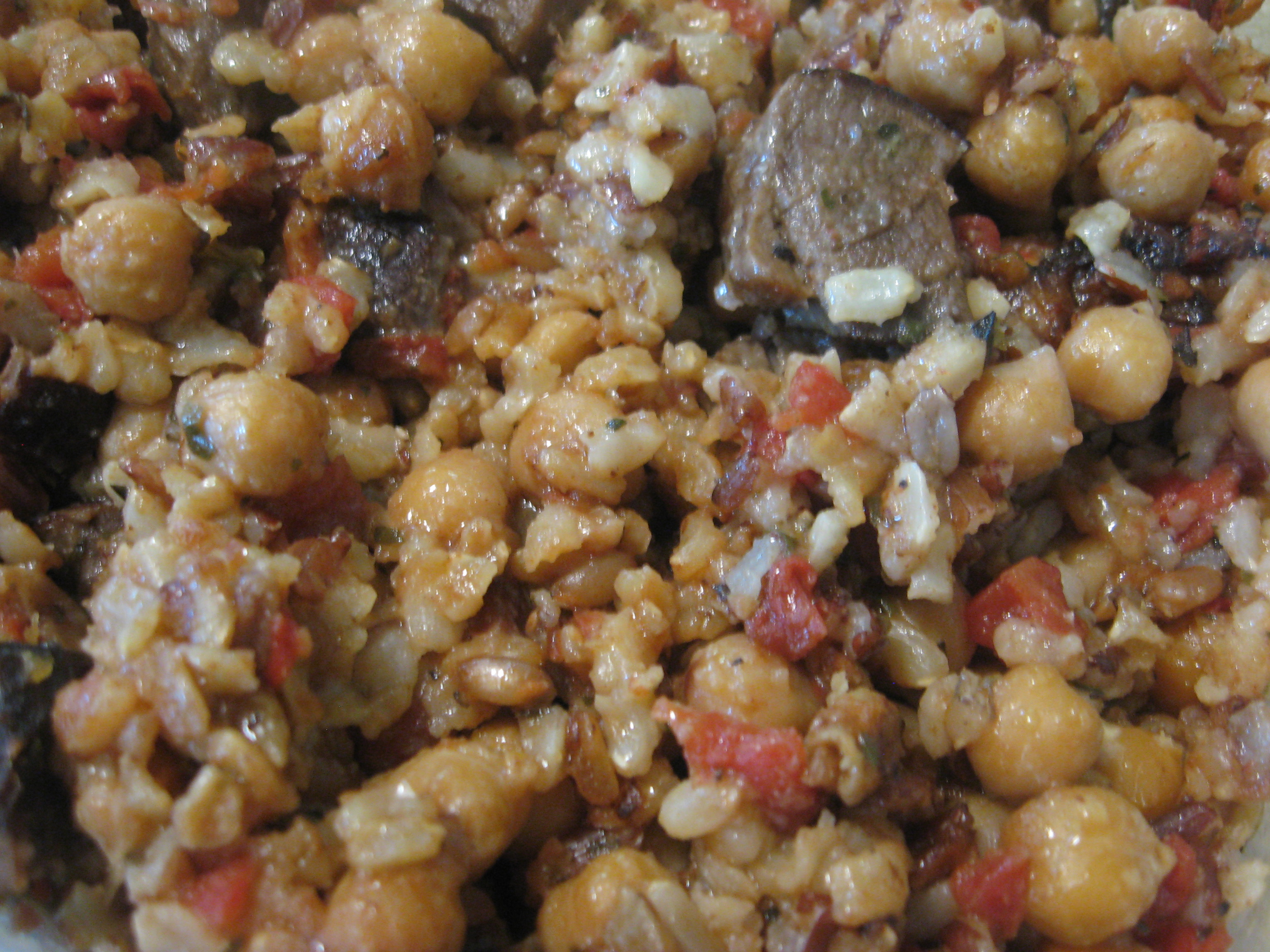
Often the remains of a beef steak or a pork chop goes into a sandwich–since roast beef, lamb, or pork is not on the single-serving menu. Other times it does some metamorphic changes.  The remainder of this steak went into the rice cooker with a convenience mix of grains,  some garbanzo beans to give me some additional meals that were not meat-centric.

Ingredients

  • about 1/2 pound of cooked lamb steak, cut into 1/2-inch pieces
  • one 15-ounce can garbanzo beans with liquid
  • one 10 ounce can of diced tomatoes with jalapeños with liquid
  • 1 cup of brown basmati rice, red rice, barley, and rye berry mixture (uncooked)
  • 1 tablespoon olive oil
  • 2 bay leaves
  • 2 teaspoons dried Turkish oregano
  • 1/2 to 1 teaspoon garlic powder
  • 1 to 1-1/2 teaspoon onion powder
  • 1 cup water (to bring total liquid to amount required for grains)

Preparation

  • Add all ingredients to rice/multi-cooker, stir well.
  • Set on rice cooking mode.
  • When cycle finishes, check grain for doneness.  If needed add more water in 1/2 cup increments until grains are done.

Ò¿Ó

Since the lamb steak had been well-browned on the griddle, it provided good rich flavor for the grains and the garbanzo beans.  Some of this was an extra meal (with a side of ratatouille), and the rest was packed (with the Handi-Vac®) for the freezer for later (especially cooler weather) meals.

mixed grains with tomatoes and lamb

Trying a new recipe….

As much as I’ve talked about improvisation in the kitchen when you’re doing single-serving cooking, I do occasionally like to have a recipe, at least for starters.  Trying to cut a recipe serving six or eight to one-person size is really frustrating.  The major ingredients are not that hard to do–it’s the seasonings that are hardest.  You’ve a much smaller quantity so you do need to cut them, but usually NOT by the same proportions as the main ingredients, so I was excited to see that the editors at America’s Test Kitchen had come out with Cooking for Two 2013, in addition to the Cooking for Two 2011.

In perusing  these (Kindle editions), I though the recipes looked like a good starting place for single-serving cooking: many looked as if the second serving would freeze well, and that’s a bonus. (If you’ve read much at all here, you’ll know I don’t “do” leftovers, nor do I do the cook-one-thing-and-eat-it-all-week scene.) For me, having one serving to eat now, and one in the freezer is good. Other recipes looked as if I could prepare a single chop or chicken breast, with the full recipe, freeze that, and then just add the meat later after thawing the base.

One of the appealing things about the recipes in these books is that they are not terribly involved–like weeknight suppers, and not all-weekend cooking marathons–and shouldn’r leave you with a sink overflowing with dishes, pots and pans.  Definitely worth a try since I’ve always had good results with recipes from Cook’s Illustrated and Cook’s Country.

When making a recipe for the first time, I do follow it–otherwise how would I know how I need to change it?  For my first exploration from the 2013 Cooking for Two I picked a dish that I though sounded tasty and fun, and that the second serving could be put in the freezer: “Moroccan-Style Quinoa with Chickpeas and Kale”.  I like quinoa, I like chickpeas, and kale so this seemed a good one to try.  I honestly did follow the recipe.  Really I did, despite some temptations to tweak the seasonings…like put in extra garlic–that sort of thing.

I’m going (since I’ve given you the attribution above) to reproduce the recipe here with a little adaptation (because I don’t want to key in the entire thing).  It was easy to follow, and –very little cleanup afterwards–all good points.

Moroccan-Style Quinoa with Chickpeas and Kale

  • 2 tablespoons olive oil
  • 1 small onion, chopped fine
  • 1 carrot, peeled and cut into 1/4-inch pieces
  • 2 garlic cloves, minced
  • 1/4 teaspoon ground coriander
  • 1/8 teaspoon red pepper flakes
  • 1/2 cup quinoa, rinsed (if not prewashed)
  • 1-1/2 cups vegetable broth
  • 3/4 can of chickpeas, rinsed
  • 2 tablespoons golden raisins
  • salt and pepper
  • 6 ounces kale, stemmed and chopped into 1-inch pieces
  • 2 tablespoons pine nuts, toasted
  • 1/4 teaspoon lemon zest plus 1 teaspoon juice
  • 2 tablespoons crumbled feta cheese
  1. Heat 1 tablespoon oil in medium saucepan over medium heat until shimmering. Add onions, carrot and cook until onion softens. Stir in garlic,  coriander, pepper flakes and cook until fragrant. Add quinoa and cook stirring often until lightly toasted.
  2. Stir in broth, chickpeas, raisins, 1/8 teaspoon salt.  Place kale (still wet from washing) on top and bring to a simmer.  Cover, reduce heat to low, and simmer until quinoa to  is transparent and tender (18 to 20) minutes.
  3. Off heat, add the remaining 1 tablespoon oil, pine nuts, lemon zest and juice. Sprinkle with feta, season as needed with salt and pepper to taste.  Serve.

-<>^<>-

I’m likely to make this again, because it did go together easily, and cleaning up afterward was easy; but there will have to be some serious modification! The quinoa and chickpeas part of it is okay–except for being  very bland–and I really, honestly did follow the quantities given in the recipe so I’d know. Well, now I do!

I’m not really familiar with Moroccan style seasonings, but I don’t think that this was it.  Even with the added lemon zest and juice, garlic, red pepper flakes, raisins, and coriander, it’s definitely not even approaching complexity. It’s missing something.

Then there was the kale. The recipe didn’t say anything about what kind of kale.  When I went to the  market, I did look for Toscano (Lancinato, Nero) or Russian red kale, but I could find only the curly, redbor kale; I picked out the smallest, youngest looking leaves in the bin. But it still wasn’t what this dish needed–at least for me. The kale completely overwhelmed the flavor of the rest of the dish–I had kale-flavored quinoa and chickpeas.  For me it  just did not fit with the quinoa and chickpeas.

I liked the idea of a one-dish meal (since it’s something I’ve posted about here a number of times), but I’ll not do it with that particular kale again.  I think I’m more likely to do spinach, or maybe arugula, though I might try it with Toscano or Lancinato kale, hoping that would be a bit milder.  (No pictures either–even with the smaller leaves, the kale was a rather icky green by the time it was tender.)

My other frustration with the recipe–supposedly for two–was that the servings were huge–I  have at least two more  servings sitting in the fridge now, even after having had a very reasonable portion for supper. Another piece of information for when I try another of the “for-two” recipes.

I know that when writing recipes public consumption, you do have to be moderate with seasonings, but this was downright bland, not something that I expect from recipes from this source–I’ll be looking out for that with other recipes. I guess I was expecting to taste and think that I’d need more garlic, or maybe more red pepper flakes next time, but I wasn’t expecting what I got from this.

You think I sound frustrated?

You’re right–because I have come to expect better from the recipes from American’s Test Kitchen–and now I have two more servings to try to make more palatable. I’ll try to add more seasoning when I reheat, but I don’t want the quinoa to be total mush.

I will do the quinoa and chickpeas combo again, but likely replacing the vegetable broth with at least part chicken broth, definitely increasing the coriander, red pepper, lemon juice and zest, and figuring out some other spices to add for more complexity–while trying to still keep it simple. (That’s my rationalization for going in search of a Moroccan cookbook now.)

Bottom line for me, it’s a starter–now to see where I can go with it. But, I’ll be trying another recipe from the book….but I’ll definitely feel free to make adjustments right from the start on a few things.

Posole

There is one good thing about having to hike out to the dumpster with the trash, especially when you’re cooking something.  If you stay in the kitchen too long you olfactory sense habituates to the aromas.  Take out the trash and you get a great new olfactory preview when you get walk back into the kitchen–especially if you spend a bit of time chatting with the neighbor who is also taking out the trash.

This cold weather has me cooking stew-y sorts of things.  A friend sent me a care package from New Mexico recently: blue and white corn with a recipe for making posole (or pozole, if you’d rather). Today was the day, since I was organized enough to remember to soak the dried corn overnight.  By the time I had sauteed everything, browned the pork, onions, garlic, added the oregano (had to do Turkish rather than Mexican until I do another Penzeys order), and the chilli pods I wasn’t fully appreciating the aroma of the cooking. I popped the covered dutch oven into the oven and took– out the trash.

When I opened the door and walked into the living room, I was definitely getting a fresh sensation: the browned pork, the oregano, the chillis–this smells like warmth and comfort on a cold day!

White Corn Posole

This is the recipe that came with the package of Los Chileros de Neuva Mexico package of white corn posole. I more or less followed the recipe–

Ingredients

  • 6-8 chile pods
  • 2 pounds cubed pork (or beef)
  • 3 cloves garlic minced
  • 1/2 teaspoon Mexican oregano
  • 1 teaspoon of salt.

Preparation & assembly

  • Soak the posole (12 ounces) in water to cover overnight.
  • Boil the posole in salted water for about 2 hours.
  • Add meat, chilli pods, oregano and garlic.
  • Cover and simmer for another hour or until the posole is tender, stirring occasionally.

<>\/<>

My first deviation from the recipe was to brown the pork (in a little bacon fat) before adding the liquid and the other ingredients. My second deviation was to use 4 chilli pods (ancho and guajillo) and then about 2 teaspoons of Hatch chilli powder.  I had tasted before adding the chilli powder–and it’s wasn’t spicy enough. I’ll see what it’s like when I reheat it. My other deviation was to add way more garlic.

I’d looked at other recipes for posole online, and found lots of recipes calling for other ingredients–cumin, coriander, and even tomatoes. I decided to start with this simple, rather a straightforward one for my first try at posole.

I really think that Mexican oregano is a must–the Turkish just isn’t quite right here–it’s sweeter than the Mexican to my taste and would fit better with the corn flavor. I’m likely to add some cumin and coriander next time around as well. I may add onions (caramelized) as well. It’s a recipe in evolution now. I think a little more “brown” in the flavor would be good, as well as some smoke from either chipotle peppers or from pimentón–but definitely Mexican oregano next time. I used water here and not pork stock, but I think that pork stock would be tastier–especially if the bones/meat were browned before making the stock.

Even though this is a simple soup/stew, a bowl of this is very satisfying on a cold day when you need warmth and a full tummy!

My friend also sent blue corn–which I’ve only had in tortilla chips, so it will be interesting to see how that compares to the white. I do suppose you could make this with canned hominy, but this seems to have more corn flavor that I remember from canned hominy. I’m going to enjoy trying out different seasonings here.

Roast pheasant for dinner

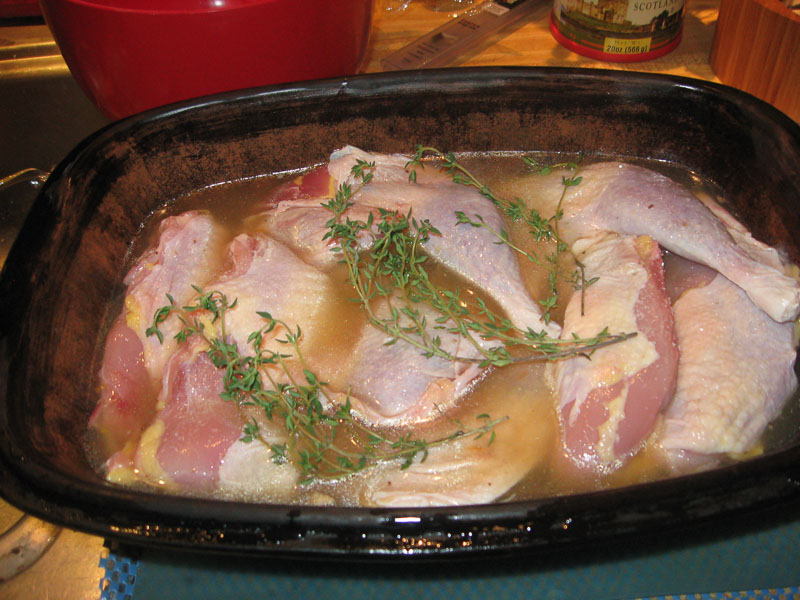
Two Whole Pheasants- Pheasant MeatOn a recent troll of the after-holiday, year-end goodies at my local Harris Teeter, which includes the free-standing freezer in the meat department (as well as the carts at the front of the store), I found pheasants on sale so I decided we (neighbors and friends) needed to have pheasant–especially since at least one had not tasted pheasant.

This is a first for me–I’ve never cooked farm-raised pheasant before; I’ve always cooked the wild birds that we got by hunting. Those we always braised since they could be old and tough.  I went to the McFarlane website Pheasant for Dinner to see what information I could find. I guess these are not likely to be either old  or tough, so I thought about roasting–then I decided that cooked in my Romertopf might be best since pheasants–even farm raised don’t have a lot of fat on them.  I decided that brown basmati rice would cook at the same time under the cut up birds; kind of self-seasoning with the pheasant juices–and whatever else I decided on.

Pheasant dinnerSince this was my first crack at farm-raised birds, I decided to seek expert consultation–from Mike Thomas in the meat department at Harris Teeter, thinking it likely that he’d be able to tell me more about the birds and how they would cook.  He agreed that the Romertopf should be a good way–so that decision was made.

As for seasoning, I was still debating. I wanted tangerines, but couldn’t find them. Tangelos? Well, maybe.  The meat of the tangelos was not very tasty, so I  got Mandarin oranges as well, but use only the tangelos as the mandarin oranges were too sweet.

I originally planned to do fingerling potatoes in the Romertopf with the birds, but I couldn’t get my head around orange and potato together, so I changed to brown basmati rice instead since it could also cook right with the birds in the Romertopf.

My next decision was whole or cut up. I finally decided that cut up would be best–so that I could use the carcasses to make some stock for cooking the rice. So get out the knives! I found a good demonstration on cutting up a pheasant at the McFarlane website–as I thought it’s like disjointing a chicken.  Since it’s not something I do all that often when doing single-serving cooking, it did take a bit, but I got them cut up.  I left bones in–even in the breasts since I think there is a lot of flavor in meat on the bone.

Pheasant dinner-2

into the oven

The backs, wings, necks, and other miscellaneous pieces, with carrot, onion, and bay leaves went into the stockpot (after browning). Simmered and skimmed I had a good start on the rice.

I minced two medium onions, four large cloves of garlic, and sautéed these with the rice before adding it to the soaked Romertopf with the rinsed basmati rice (two cups) with stock.  I added the zest of two tangelos to the rice. I pulled the meat from the stock bones and the giblets, chopped them finely, and added those to the rice–kind of a “dirty” rice here. That plus the 4 cups of stock went into the soaked Romertopf with the pheasant pieces on top, and into a cold oven, as usual with the Romertopf.

For a sauce, I modeled it after the one used for duck with fresh figs; I reduced the remaining pheasant stock and the juice of one tangelo slowly to about 1-1/2 cups–it’s not intended to be thick–more “au jus”. It needed a bit of sweetness despite the tangelo juice. After tasting both thyme honey and leatherwood honey, I opted for the leatherwood, since there was thyme with the bird and the leatherwood added a “dark” contrast to the tangelo and the meatiness of the stock.

(It looked great when I opened the Romertopf, but I was too intent on eating to stop and take pictures.)

My friends brought some awesome roasted Brussels sprouts (with bacon and garlic) to accompany the pheasant–a good meal, with good company!

<>^<>

I used the ratio suggested for the brown basmati rice, but it was just a bit soupy. Next time I’ll use 1 part rice to 1.5 water. Otherwise I was pretty happy with the results–we certainly made a dent it the rice and the pheasant.

The farm-raised pheasants are more chicken-like than wild-pheasant-like–a little disappointing if you are used to the wild ones. I’d cook them again–if I find them on sale, but I’d really rather have the wild ones, though I certainly wouldn’t have been roasting them.

Not knowing the flavor of the farm-raised birds made choosing a wine a bit difficult. We drank a 2012 Ravenswood “Besieged” with it, and it worked well. This limited release is a blend containing 35% Carignane, 20% Petite Sirah, 18% Zinfandel, 13% Mourvedre, 9% Alicante Bouschet, and 5% Barbera. (This was a wine that I stumbled upon while doing my shopping one Saturday at the local Harris Teeter. I’m a definite Alicante Bouschet fan and this blend was very mellow, and fruity so I did something that I don’t do often–I bought a half case of it–and I think I’m going to wish I had more of it.

A new take on a Southern tradition…

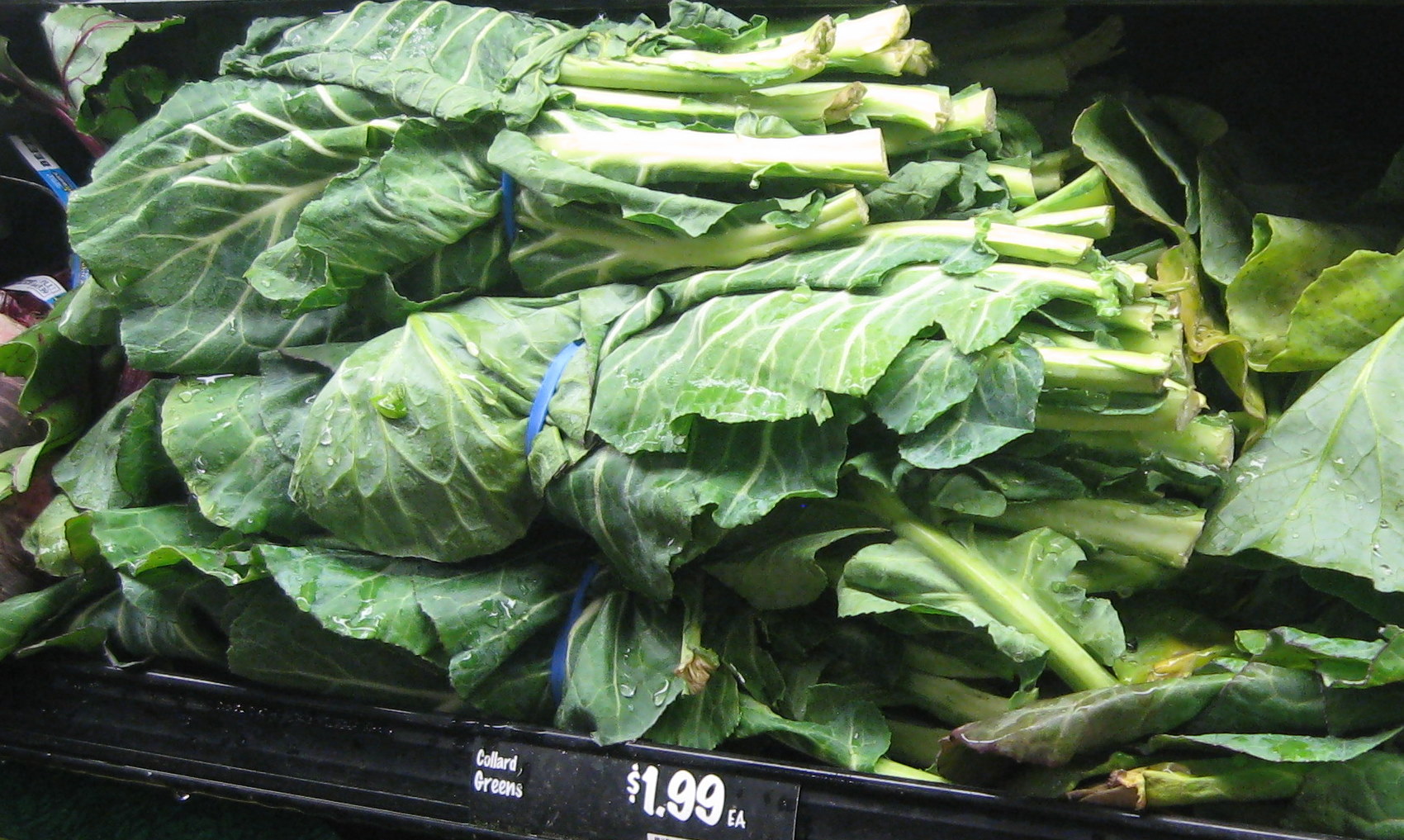
Produce display of bunched collard greens

collard greens

I’m not a native to the “real” South, so I was intrigued to learn about the custom of having collard greens and black-eyed peas as a mandatory part of New Year’s day dinner.  I like greens–so not big thing about the collard greens.  I like pulses, legumes, and all those things too.  Again, no big deal.  Unfortunately, I may be a less finicky eater than some of my friends and acquaintances.

On several occasions I’ve been the delegated to prepare those dishes for New Year’s day meals.  So–dinner for eight or so, I prepare collard greens and black-eyed peas in a traditional Southern style–well, talk about leftovers–everyone had the mandatory dishes–about a teaspoon of each!   Next year, I lucked out again–make collards and black-eyed peas. I made a much smaller quantity of each, but still had mega-leftovers.  Enough of that!

Next time I was delegated to bring collard greens and black-eyed peas to a New Year’s Day gathering, I decided that something had to be done to make those palatable to the kind of guests at the meal–true we’re all foodies, but some of us more than others.  I decided that the problem was not collards and black-eyed peas per se, but rather that they just did not fit with lovely roast duck with a nice fruit sauce.  I decided that I needed to present them differently.

Personally, I’d happily make a one-dish casserole of the collard greens, some sausages, and the black-eyed peas–a variation on one of my favorite recipes from Jacques Pepin’s The Short-cut Cook That still did not fit with New Year’s Day festivities.

My next though was that all these people (in fact, most people  I know) really like risotto.  After perusing a number of recipes, it seemed that as long as you could add most anything to basic risotto, as long as you did the appropriate pre-cooking.

I decided that it was time for collard greens and black-eyed peas to make a début as risotto ingredients.  Thankfully, the frozen vegetable case at my local supermarket came to the rescue: frozen collard greens (chopped), and frozen black-eye peas!  Happiness.

I started the basic risotto recipe with onions, white wine, olive oil, and sautéed  the rice.  I used home-made chicken stock for the liquid.  Frozen collard greens are already blanched, chopped, so all I did was to thaw them,  give them a bit more in the way of a rough chop, and since they are rather “tough” greens, steam-sautéed  them (without adding any more liquid) until close to being done.

The black-eyed peas seemed a bit more problematic since I knew that those can turn to mush easily as they’re fragile; I cooked those separately until almost done (according to the directions on the package).

When the risotto was close to being done, I added the collard greens and the black -eyed peas, and then finished the risotto with the Parmigano-Reggiano as usual.

Taking into account my earlier “luck” with collards and black-eyed peas, I made less than I though eight or so people would eat.  Wrong again–needed more–these foodies wanted seconds!

A son goût!  

Quinoa pudding

I’m happily not intolerant/or sensitive to lactose or gluten, but this summer pudding looks like a must-try to me, since I really like quinoa!

foodrefashionista's avatarThe Food ReFashionista

Sweet, cool, soothing, filling, and easy to make—this is a pudding that’s just right for hot summer days.  This dish is also a new version of a versatile favourite. (Earlier warm pudding versions used dried cranberries and puréed pumpkin or squash.)

I keep finding myself coming back to this pudding recipe whenever a possible ingredient makes itself  known: in this case, aging bananas crying out to be puréed.   But bananas are calorie-expensive, my rational mind argued.  But they’d be delicious in this pudding, my stomach-inclined mind replied.  Think of something! 

That something was to tweak the original recipe by using liquid egg substitute instead of whole eggs and almond milk instead of soy milk.  That didn’t make a significant change in taste but it did lower the Weight Watcher points and, hence, calories.  My stomach-inclined mind immediately thought of adding chocolate or coconut, but I ignored it as best I could!

Printer-friendly…

View original post 181 more words

A one-dish meal.

A lot of us eventually reach the point when we realize we are getting a bit rotund (or worse) and start thinking about watching (or losing) weight, or maybe just being more conscious about nutrition.  With several of those things in mind (or should I really say on my mind) I did some web browsing.

I found a website that I’d like to share with you:  A Slice of Nutrition.  I found this through another blog that I follow, My Imperfect Kitchen, that had a post by Avital Greenbaum as a guest blogger–Chicken, Zucchini, and Quinoa. 

One dish meals are very appealing to me–at least some of the time, because I can be lazy, have a good meal and not have to wash lots of pots and pans.  (No, Frankie refuses to do that!)  I’ve had quinoa in breakfast cereals, and things like that but after reading how healthy it is, I decided I need to try it in a main dish and this looked like a great place to start.

Garlic scapes lying next to a basket of strawberries

garlic scapes

I do have to admit that, as well as being constitutionally unable to make a small pot of soup, I seem to be unable to leave a recipe alone when I’m making it.  I did almost follow this one.  Instead of garlic powder, I had fresh, green garlic scapes from the farmers’ market.  Those went it, and I added some mushrooms; otherwise, I left it alone.  This one-dish meal is now in the oven (despite the heat) getting ready for my supper.

Since my veggies are included with the dish, I think that all I’ll need to add is some of those luscious ripe strawberries as dessert!


Baking dish with chicken and quinoa

Chicken, zucchini & quinoa

This is a keeper–only a few minutes prep, and it’s unattended cooking with tasty results. The quinoa is very light–good in hot weather.  I think that it might make some very tasty “salads” with lentils for satisfying summer meals when the weather is sweltering and I want a light meal.

About lentils

lentils in Mason/Ball jar on pantry shelf.

lentils

Lentils (Lens culinaris), closely related to beans and peas, are dried after harvesting; you’ll find them on the shelves of your supermarket, gourmet stores, and online. They have been a staple food in many areas for over 8000 years, likely originating while in Turkey.  They are a staple food for many south Asian cultures, Middle Eastern, and Mediterranean countries.  The Latin word for lentils, lens, was used in the 17th century to describe eye glasses because of the similarity in shape

Like other legumes, lentils are low in fat and high in protein and fiber, but they have the added advantage of cooking quickly.  Lentils have a mild, often earthy flavor, which lets them pair well as side dishes, in salads, and soups.  Lentils have traditionally been used as a meat substitute.  Like other pulses, when paired with grains they offer excellent quality protein in our diet.

Before cooking, always rinse lentils and pick out stones and other debris–usually they are quite free of debris, but it’s always good to check them before cooking.  Unlike dried beans and peas, there’s no need to soak them. Lentils cook more slowly if they’re combined with salt or acidic ingredients, so add these last.  Bigger or older lentils take longer to cook.  Store dried lentils for up to a year in a cool, dry place. Substitutes: dal OR split peas OR black-eyed peas  More varieties are appearing even on the supermarket shelves, but specialty sources offer a wide variety with which to experiment.

The quick cooking and nutritious nature of lentils make them an obvious choice for winter soups. They are also good cooked and chilled for salads or mixed with bread crumbs to stuff vegetables. Blend lentils with middle eastern couscous and use as a bed for seafood and poultry.  Use them instead of beans  for summer salads with fresh tomatoes and other veggies.

Here is a little information about the various kinds of lentils.  More synonyms and alternative names can be found in the Cook’s Thesaurus.

  • Brown Lentils:  The average grocery store lentil is the brown lentil. You’ll likely find these on the shelves with the dried beans.  They tend to get mushy if overcooked.  If you want them to be firm, add oil to the cooking water and cook the lentils just a short while, say 15 minutes.
  • Black beluga lentils are a very popular legume in South Asia, they are used to make a beautiful black lentil soup. Some of the names that they my go by are Beluga lentil = black beluga lentil = beluga black lentil = petite beluga lentil. When they’re cooked, especially in salads with a tiny bit of oil, they glisten so that akes them look like beluga caviar.
  • Petite crimson lentils are “crimson” in color, which is a deep orange-red. These lentils tend to lose their shape when they are cooked and are an excellent choice for thickening soup.
  • Petite golden lentils are a small firm, golden lentil that is rounder in shape than many other  lentils; one of the reasons that this lentils holds its shape so well when cooked.  They have a soft texture.
  • Ivory white lentils are a creamy white colored small lentil that is really a peeled black lentils, known in India as urid dal.
  • French green lentils: (also called French green lentils, du Puy lentils,  lentilles du Puy, lentilles vertes du Puy.)  By many chefs, these are considered the “best”, most delicate lentils.  They have the typical earthy flavor, but also  are a bit “peppery”. These hold their shape well better than many other lentils,  but take longer to cook, but still do not need presoaking. While I love all lentils, and typically have several kinds in the pantry, these are the ones that I would not want to be without!)
  • Red lentils are the common seen in the supermarket.  It’s a lovely salmon pink in the dried form, but it turns golden when cooked.  These lentils cook faster than others.  They’re best in  purées or soups.
  • Spanish pardina lentils (also known as Spanish brown lentils or Continental lentils) are smaller the brown or red lentil–about the same size as a petite green or black lentil.  They have a particularly nutty flavor, and they hold their plump, round shape when cooked. This makes them a particular favorite with e for use in summer vegetable/lentil salads.
  • Dal is the Indian term for peas, beans, or lentils that have been split and often skinned, but the name is sometimes used for all lentils, peas, or beans, or to cooked dishes made with them. Split lentils don’t hold their shape well, so they’re often cooked into soups or purées.

Most of these can be interchanged in recipes as long as you take into account how quickly they cook and the final textures–some are softer than others. Generally the split ones tend to lose shape faster, so don’t do well for salads, or side dishes where you want them to keep their shape, but will be fine in soups–especially if you’d like your soup to be a little thicker.  Any of these would work in the lentil soup recipe that I gave earlier–though I usually use the lentils du Puy even for that.

Aside from using them instead of beans in summer salads, I think that lentils make an awesome side dish to go with grilled salmon–there’s something about the earthy flavor that combines SO well.  If you have “leftover” grilled salmon, try using it with some lentils to make a cool, but hearty summer salad with some tomatoes and cucumber to it.  Combined with a grain, this can be a very nutritious vegetarian dish–or not.

Here is a link to a lentil salad that makes me drool on my keyboard just looking at the recipe:  Warm Salad of Lentils with Duck Fat from the Hudson Valley.  Love’s description of the lentilles du Puy is marvelous.  (Each time I cook duck, I carefully keep some of the fat, sealed and refrigerated to use for things like this.)  Add some greens, and this is a one-dish meal that’s in my group of comfort foods.  Lentils will also work in the sausage, beans and greens one-dish meal.

Lots of uses, quick-cooking, nutritious, tasty, inexpensive…what more could you want?  Try some!

Mind your peas and beans….

Main Entry: leg·ume    Pronunciation Guide
Function: noun
Inflected Form(s): plural legumes \-ümz, -m\
Etymology: French légume, from Middle French, from Latin legumen, from legere to gather — more at LEGEND
1 a : the fruit or seed of a leguminous plant (as peas or beans) used for food b : a vegetable used for food — used chiefly in menus
2 : a leguminous plant; especially : one grown as a forage or green-manure crop (as clover, alfalfa)
3 : a dry dehiscent one-celled fruit developed from a simple superior ovary and usually dehiscing into two valves with the seeds attached to the ventral suture : POD — compare FRUIT 1d, LOMENT; see FRUIT illustration

“legume.” Webster’s Third New International Dictionary, Unabridged. Merriam-Webster, 2002. http://unabridged.merriam-webster.com (17 Jul. 2011).

-♦♦♦-

I brought up the subject of purple-hulled peas since they are seasonal.  Unless you are a native Southerner you likely don’t know about this vegetable.  I’m not–and it took me a lot of research to find out what I wanted to know about peas and beans, which is which, and what is what.

At the risk of being a bit didactic, let’s start with legumes, which are ancient foods–good sources of protein, carbohydrates and fiber.  We should all eat more of them!  A list of legumes would include  beans, peas, soybeans, peanuts and lentils.

For now, lets just talk about peas (Pisum sativum).  When I say peas, you probably think of “garden” peas–those lovely bright green vegetables that are harbingers of spring.  There are English peas (shelled as the pod is inedible) and the edible-pod peas (snow peas, sugar snap peas or mange-tout).  There are also “field peas”–which are really the form of  pea  that is grown to be dried (on the vine) and would include yellow and green split peas.

Beans include broad beans (Vicia faba) and the common or horticultural bean (Phaseolus vulgaris)–also in pods–again legumes.  When I say “bean”, you likely think of those green things meant when we say “green beans”, “snap beans” or “string” beans.   Then you might think of dried beans.  But did you think of “shell” beans?  Bet you didn’t–unless you’re a Southerner or unless you grew up on a farm where you grew your own food.

Those are all life stages of beans–first comes the pod which we eat as the “green bean”, This is an immature form–picked very young these can be haricots verts; a bit more mature and they are string or snap beans.  The shell bean is the mature, but not dried, bean.  If you leave the pod on the plant to dry in the field, then you have dried beans–black beans, navy beans, pinto beans, et cetera.  For more detailed information on many varieties of Phaseolus vulgaris see The Versatile Grain and the Elegant Bean (bibliography).

Then there are lima beans: Phaseolus limensis (large lima beans frequently Fordhook, Phaseolus lunatus which are small lima beans (also called sieva beans, baby lima beans among other names) which are believed to have first been domesticated in the new world.

So, what are crowder peas, purple-hull peas, black-eyed peas, pigeon peas? Those are subspecies of cowpeas (Vigna unguiculata) sometimes called cowpea beans.   They do look more like beans than like peas, but pods are not edible as are the common (or horticultural) beans.   So these are really neither the common bean nor the peas we know as garden peas.  They are their “own thing”.

So who cares?  I just wanted to know–think of how you can make conversation at the next cocktail party!  The really important thing is that the legumes (lentils will come later) are an important source of protein, carbohydrates, and fiber for animals and we should use more of the as people food.

So, back to the questions that really started this:  how do you cook purple-hull peas?  You’re not going to find out by looking up purple-hull peas in the index of a cookbook.  Look for recipes for black-eyed peas or for fresh shell/shelled beans and you should be able to substitute you shelled purple-hull or black-eyed peas in those recipes.   I’d strongly recommend looking at a vegetable cookbook like The Victory Garden Cookbook.  (The information here has been gleaned from multiple sources, but is mainly from this cookbook).

Some guidelines for buying:  you can likely expect about 50% loss when you shell them–so if you have bought a pound of these in the shell, you will end up with about 1/2 pound shelled.

If you’re not going to cook them immediately after shelling, refrigerate in a zipper-lock bag with a very slightly damp paper towel to keep moisture even–it will soak up condensation or add a bit of moisture if needed.  I wouldn’t keep more than a week…the sooner you cook any vegetable after harvest the better.

  • You can blanch/boil/braisethem:  cover with water, add seaonings if desired, and simmer until tender or partially cook with minimal seasonings andthen finish with additional seasonings or ingredients with another cooking method.  For small beans/peas like these it may take no longer than 5 to 10 minutes to be tender, but they do keep their shape well even with longer cooking times. The braising is really just cooking in water at a gentle simmer, using a minimal amount of water so you’ll need to keep an eye on them to see that they don’t dry out/burn/scorch.
  • you can steam them:  cooking time will be about the same as for blanching–about 5-10 minutes. (Theoretically, you can cook them in the microwave, but I’ve not ever been satisfied with how they turn out if cooked in the microwave, so I’m leaving that out.)

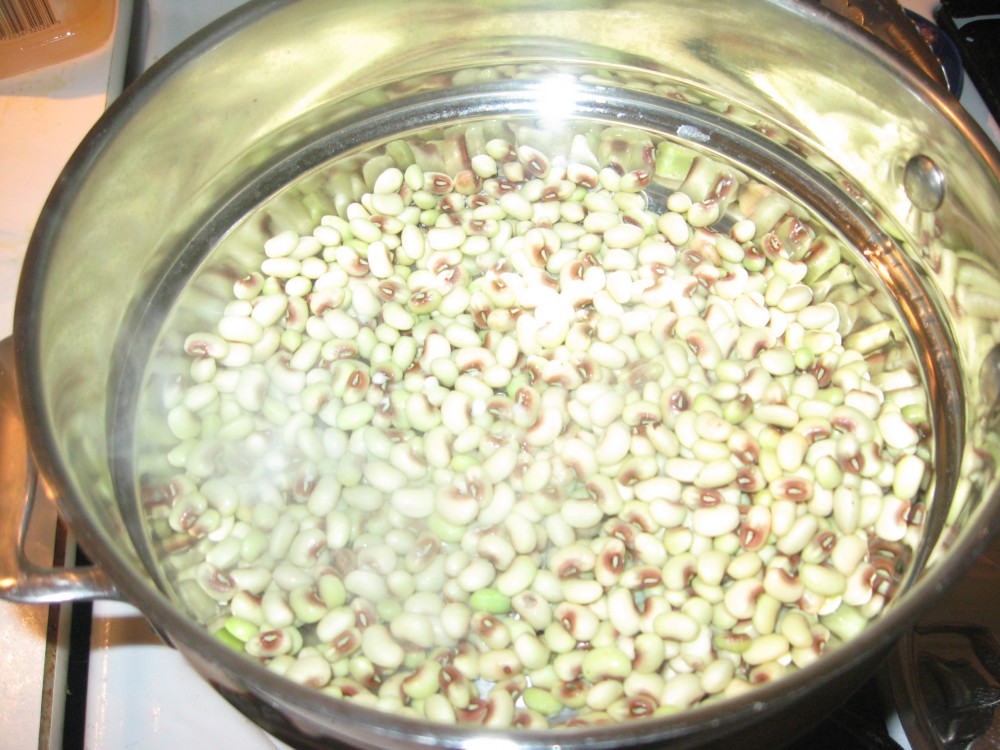
purple-hull peas in steamer

Once they are cooked, you can add some “finishing touches”.  If you cook them without much seasoning, you may be able to use them in a number of different ways.

  • after boiling or blanching, add some butter, salt and pepper to taste, and maybe a squeeze of lemon juice.
  • you can add cream and reduce it to a thicker sauce.
  • bake with a Béchamel/velouté sauce, topped with cheese, until bubbly.
  • add olive oil and herbs…e.g. savory which is sometimes known as the “bean” herb, dill, or sage, or other favorite.  Let stand for a bit to allow herbs and oil to meld with the beans.
  • you can add them to cooked snap/string/green beans, or other green veggies.
  • use cold or at room temperature with tomatoes to make a “bean salad”….
  • you can add them to rice.  Remember that the combination of legumes and grains does provide good quality, complete proteins.
  • then there’s “hoppin’ john”–Here’s a link to Emeril Legasse’s recipe.  If you’re a Southerner, you probably have a variation of this.  I’m not–but this one looks pretty good to me.

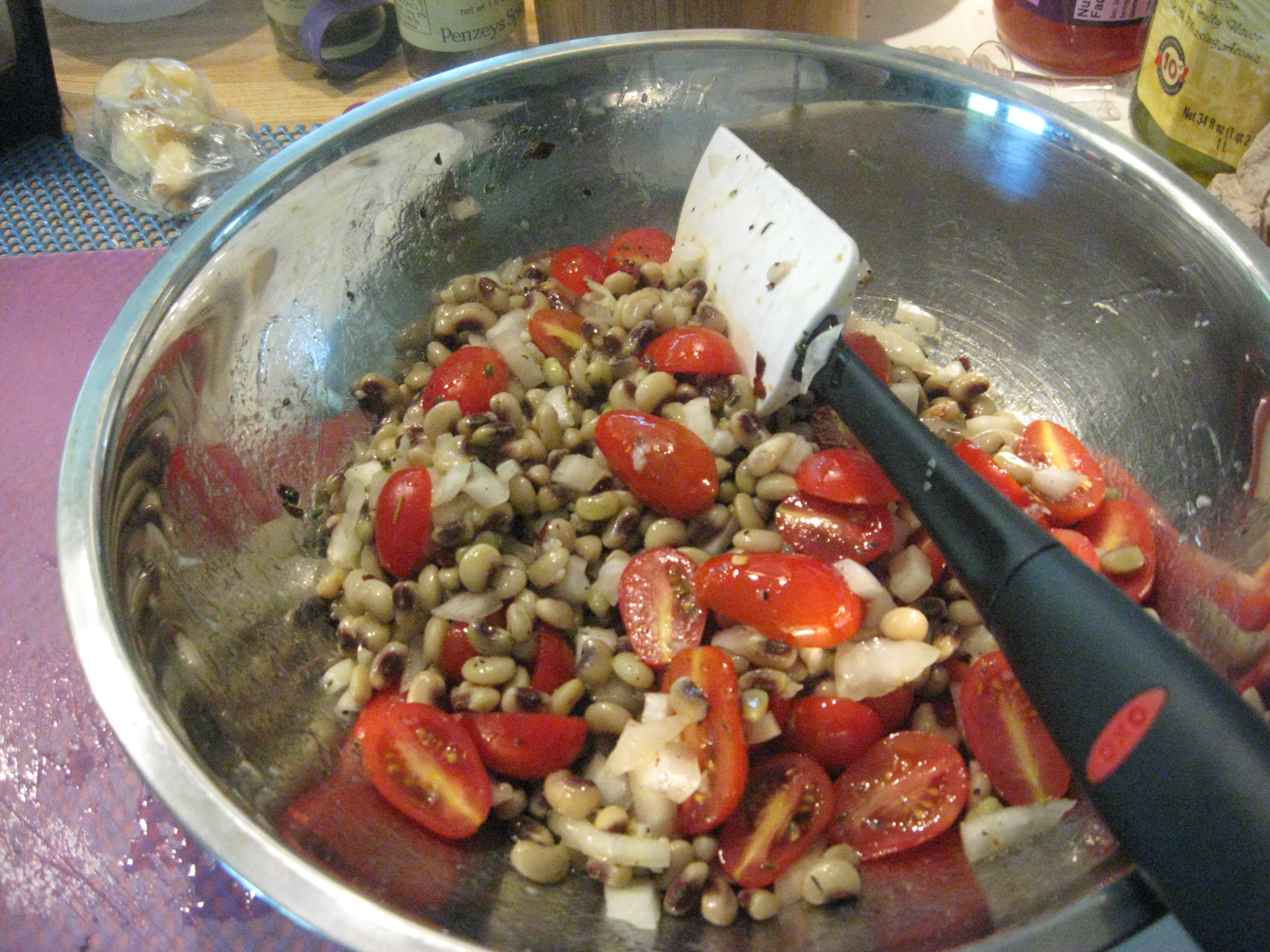
They are versatile–and underappreciated veggies.  My personal favorite for hot summer weather is to use them at room temperature for a “salad”.  Here’s a rough guide to making this dish.

  • steam beans/peas until tender–about 5-15 minutes.
  • While the beans/peas are steaming, dice some sweet onion, halve or quarter
  • some cherry tomatoes, or dice large tomatoes, and place in a bowl.
  • take enough extra-virgin olive oil to lightly coat the veggies and the beans (about 1 tablespoon per pound of beans) to a small skillet over very low heat and add crushed or very finely minced garlic and herbs of choice (savory, oregano, mint, ….) and allow to infuse for about 10 to 15 minutes; you don’t want the garlic to brown–so keep the heat very low–you just want the oil infused well with the flavors of the seasoning.  Or  heat the oil with the herbs and crushed garlic in a microwave safe container on low for about 4 to 5 minutes and let stand until cooled to infuse.
  • combine ingredients and add salt and fresh-ground black pepper to taste.
  • add a squeeze of lemon or a dash of vinegar (rice wine or sherry) to brighten it up and contrast with the earthiness of the beans/peas.
  • toss with the extra-virgin olive oil, herbs and garlic.  (I’ve used about 1 to 1-1/2
  • tablespoon of very finely minced winter savory here.)
Some other additions or variations that are possible would include:
  • if you have “leftover” rice in the fridge or freezer, you could add that to the mix to make this a light meal that has complete proteins.
  • sprinkle with crumbled feta cheese; be careful how much salt you add if you’re going to use feta cheese with this.
  • add chunks of good quality tuna (canned) or from “leftover” tuna steak (this would be worth planning to have some extra grilled tuna steak around).
Now you say you have some lingering in the fridge and you’re tired of eating it? Well, try putting it into some rice as you’re cooking it–the purple-hulled peas usually hold shape well, and the tomatoes and onions will cook with the rice.  Now use it as a side dish with grilled/griddled meat; you might want to add additional herbs to this.

Risotto–even for one

Risotto is a favorite food–sometimes it’s comfort food and sometimes it’s a treat for a special occasion.  I am addicted to that luscious, sensual, creamy texture.  Depending on the additions it’s an all-season dish–veggies or shellfish in warm weather, or sausage and meat for cold-weather, stick-to-the-ribs comfort food.

There was a time when risotto was a special-occasion, dinner-with-friends dish for me. I’d invite friends for a meal and make risotto.   One day while making spinach risotto to go with pan-seared tuna, supervised by the cat, stirring and adding liquid, stirring…and thinking…I decided that there must be a way to have risotto in single-serving quantities.  Thinking of restaurants, I was sure that there was some “trick” that would allow finishing off one serving at a time;  I needed to figure out what that was.

I’ve tried the recipe given by Barbara Kafka in Microwave Gourmet (p.  114)  and that’s good for quick risotto but, to me, not quite as luxurious as the long slow kind.  The advantage there is that she does give quantities for serving one or two.  I kept going back to restaurant line cooking, and wondering how I would do risotto in that situation–I certainly would not be making it totally “to order”–I’d be finishing it off as ordered.  As much as I like risotto, it seemed worthwhile to try to find a way to have it more often.

I was using one of the recipes from Marcella Hazan’s Essentials of Classic Italian Cooking (pp. 242-245) as usual–still stirring, thinking, and stirring….   Maybe I could take some of the risotto out while slightly undercooked, before adding the cheese and butter and any final ingredients and freeze it for later use. (Can you see the light bulb appear above my head with this though?)

Judging that there was  more than enough for two of us in the batch that I was working on, I grabbed a small container and took out a single serving (fairly large single-serving), sealed it carefully so that there was no air space, and put it in the freezer.

A couple of weeks later, I pulled it out of the freezer and let it thaw in the refrigerator.  Now to see if I had something edible.  I’d taken it out of the original batch when I though I had about ten minutes of cooking time left.  Now, back into a pan, add some broth, and more stirring.  It took a bit of effort to get it mixed with the liquid as it was stiff, but after that it seemed to be a good consistency.   As soon as the rice had that bit of “bite” –tender outside, but still firm at the center, I added the parmigiano-reggiano, and a bit of butter and it was ready to eat.

I have not done a side-by-side tasting with this method and the microwave risotto or with risotto freshly made with the classic technique, but I felt that this was a bit creamier than the microwave method, and it took about the same amount of time.

Rice for risotto needs to do two things:  to have soluble starch to dissolve in the liquid to give the creamy texture of risotto, and to have enough insoluble starch to have that “tooth” or “bite” at the center of the grain that makes risotto such a sensual (and sensuous) delight.  I’ve most often used Arborio rice for risotto, and that’s what I used for this, and for the microwave trial, and from the same batch of rice.   Two other varieties of rice used for risotto are Vialone Nano, and Carnaroli.   These three varieties offer a bit of difference in the consistency of the risotto due to differences in the kinds of starch that predominate.   The Vialone Nano has enough e “bite” while having enough soluble starch to have the creamy texture of risotto, albeit looser, and maybe a bit less creamy.  The Carnaroli  has an even firmer “bite” with the creaminess, with the Arborio being sort of in between, and the most readily available (and the least expensive) of the three.  I have not tried this technique with either the Vialone Nano or with the Carnaroli–maybe that’s a future experiment, but with the Arborio I was pleased with the result.

There are so many variations that make risotto a meal in itself:  you can add meat, vegetables, fish, or shellfish easily as you finish the thawed risotto and vary the seasoning easily.   Quick-cooking vegetables could be added as you start the finishing step; harder vegetables can be sautéed  or partially cooked before you add the risotto to finish it.

One surprisingly good addition to risotto (from Marcella Hazan’s recipes) is celery!  I’m always looking for things to do with the celery that’s left after I use the one or two ribs called for in recipes; when I saw her recipe for “Risotto with Celery” I just had to try that variation on risotto. Her recipe (p. 249 in Essentials of Classic Italian Cooking) calls for 2 cups finely diced celery for six serving of risotto.  It’s added in two different stages (if you’re making risotto in the classic way):  half at the beginning  when the rice is added, and the remainder  when the rice is about half-cooked  so there is some texture variation.  This is a great side for grilled meat or fish.  I really liked it to accompany a grilled lamb shoulder chop.   (I’m starting to feel that celery may be an under-appreciated vegetable and not just an aromatic seasoning.)

For finishing liquid, if the original batch of risotto was made using broth, you could finish it with water, though I find I usually have some broth in the refrigerator.   I’ll concede that you may not have the melding of flavors that you would have were the veggies or meats cooked with the risotto for the entire cooking time, but the result is good enough when you consider the shorter time, and the fact that you can have this in single-serving quantities.

Another lovely “comfort” food with Arborio rice that is a favorite of mine is “Boiled Rice with Parmesan, Mozzarella, and Basil” (again from Marcella Hazan’s Essentials of Classic Italian Cooking (pp. 258-259).  Here is a summary of the recipe:

Boiled Rice with Parmesan, Mozzarella, and Basil

Servings: 4, but halving the recipe works well.

Ingredients:

  • 4 tablespoons or butter
  • 6 ounces of mozzarella (fresh)
  • 1-1/2 cups Arborio rice
  • 2/3 cup freshly grated parmigiano-reggiano cheese
  • 4-6 fresh basil leaves (shredded)
  • salt

Preparation:

  1. Cut room-temperature butter into small pieces and cut the mozzarella in  small pieces (grate on the largest holes of a box grater if it’s not too soft–mine usually is too soft). You want small pieces so that the heat of the rice will melt it.
  2. Bring 3 quarts of water to a boil, add 1 tablespoon salt, and bring back to a boil.
  3. Add rice, stir immediately for a few seconds so that it doesn’t stick together. Cover the pan. Keep at a constant, but moderate boil, until the rice is tender but still has the central “bite”.  Stir occasionally while cooking, about 15-20 minutes.
  4. When tender but al dente, drain the rice and add the mozzarella, then the Parmesan cheese, then the butter; stir well after each is added.  Finally, add the shredded basil leaves and stir in and serve immediately.

It’s not risotto, but then you don’t have the constant stirring that goes with classic risotto,  while you do get a great texture given the soluble starch of the Arborio and the cheese melted into the hot rice.

I’ve yet to try the Cook’s Illustrated baked risotto, but that looks like another possible alternative and perhaps adaptable to smaller quantities.  As well as I like rice and risotto, I have a lot of exploring to do to find out what works best for single-serving cooking.

A son goût!