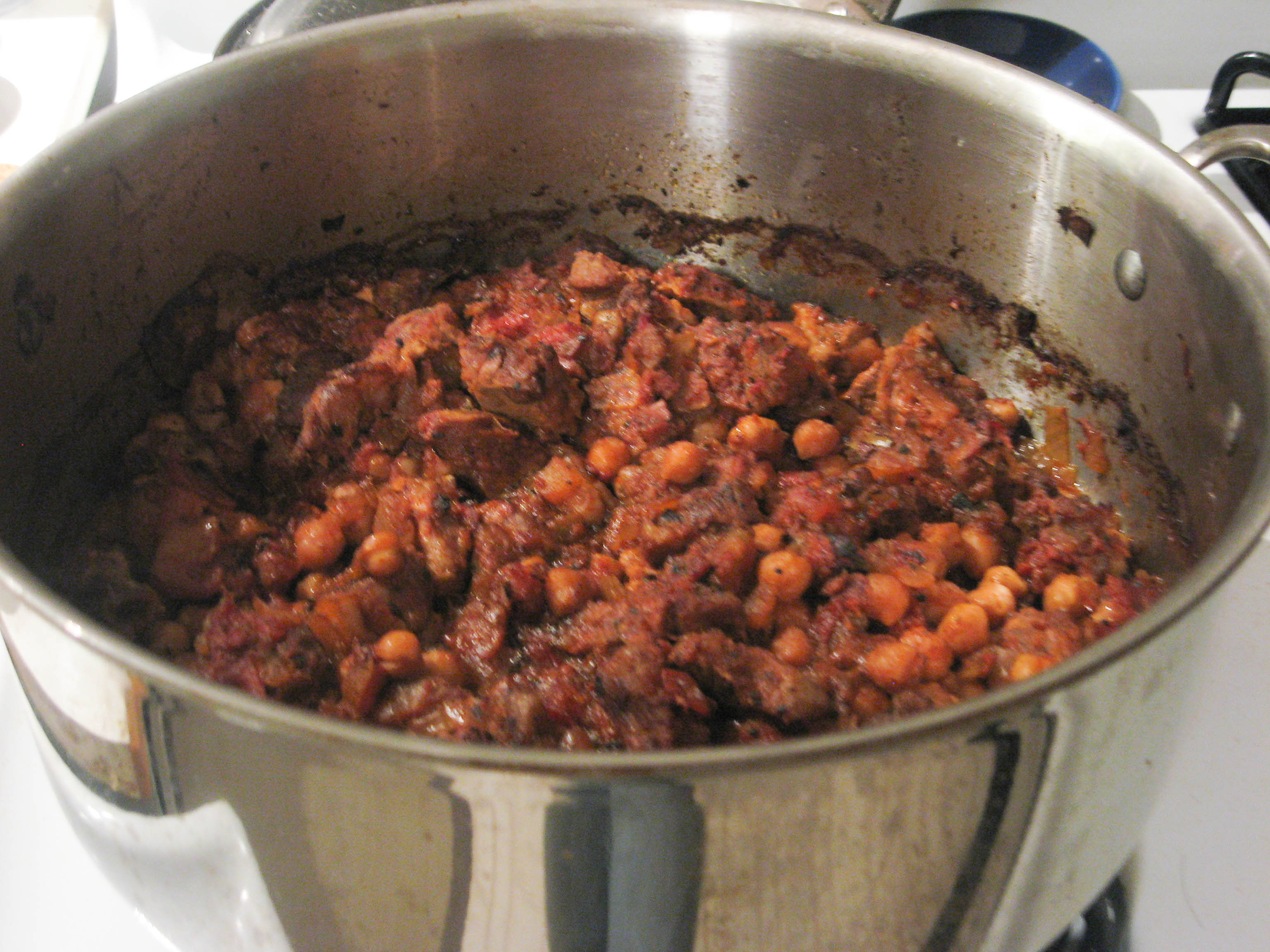
More pork and cabbage

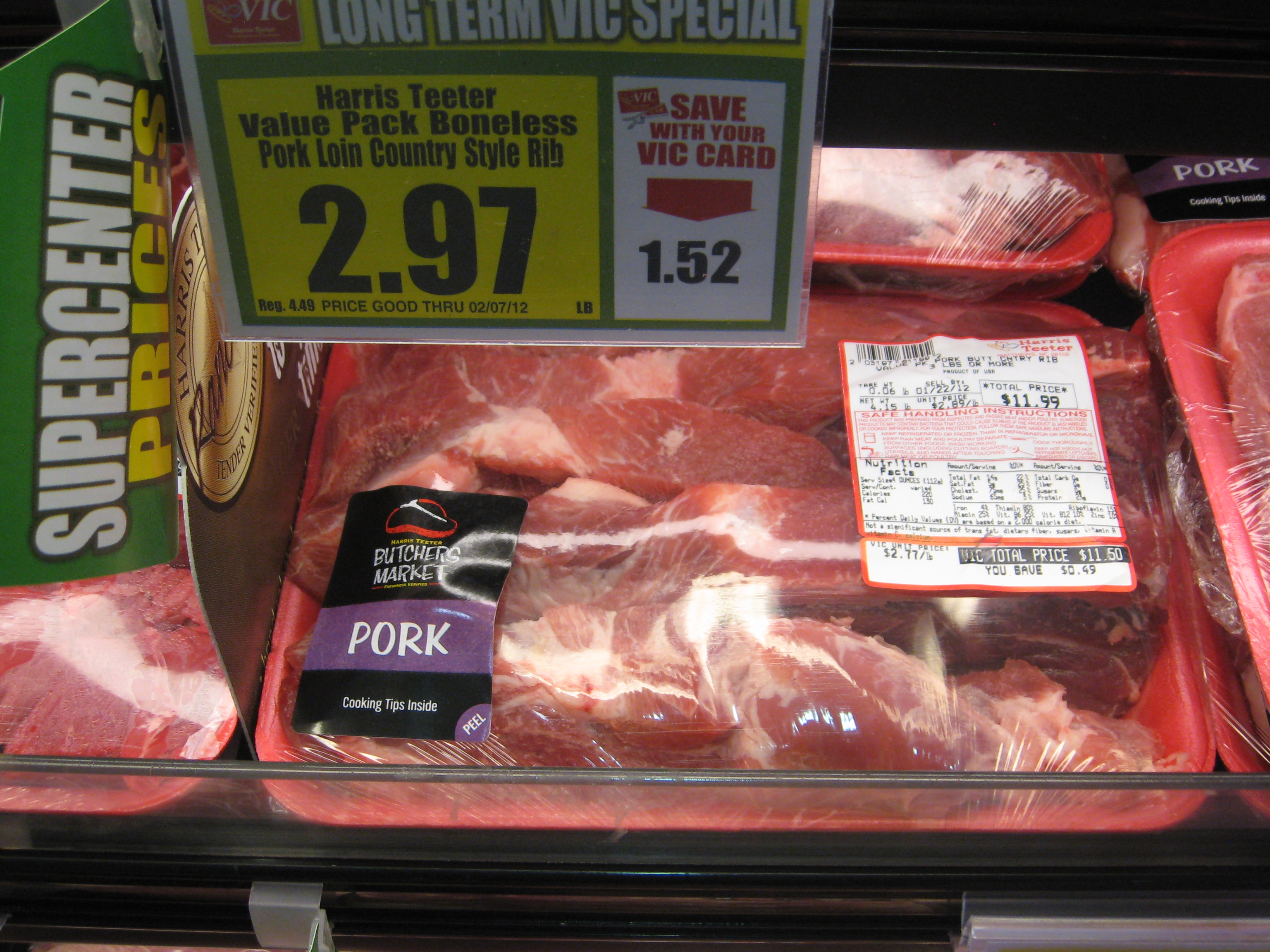
prok butt country ribs IMG_6075

country-style ribs

Yes, more pork and cabbage.

I think pork is a really versatile meat, and cabbage an under-utilized vegetable.  So, more!

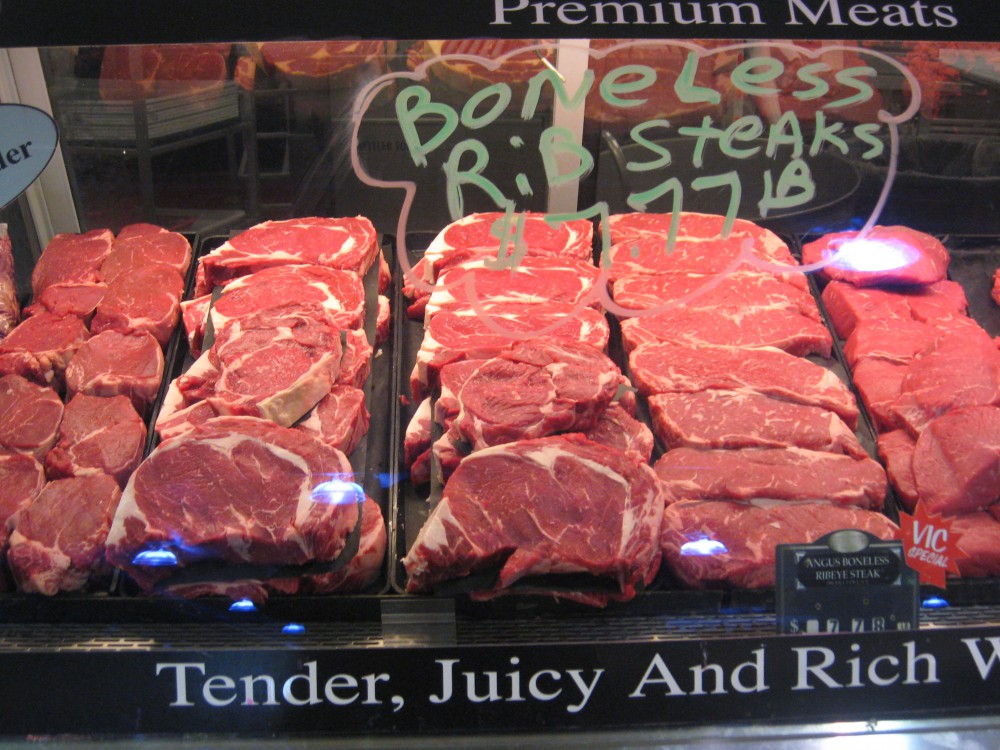
My local Harris Teeter had a special on pork country-style ribs recently–about half the usual price. (Not the price in that picture–less.)  Needless to say,  a big package of country-style ribs came home with me.  The weather has still been cool enough to have braises and stews–cool-weather dishes, so I though I would make braised pork and cabbage since that reheats well, and freezes well.

I was planning to do the Caribbean spiced one from Jacques Pepin’s book, but my plans were altered by the arrival of a manuscript for indexing. After looking at the manuscript, I decided that I needed to get started on that right away to be sure I could meet the deadlines–it’s very dense and intense, and brings out my OCD tendencies–so I opted for a braised pork that I could put together really quickly–in other words, improvisation.
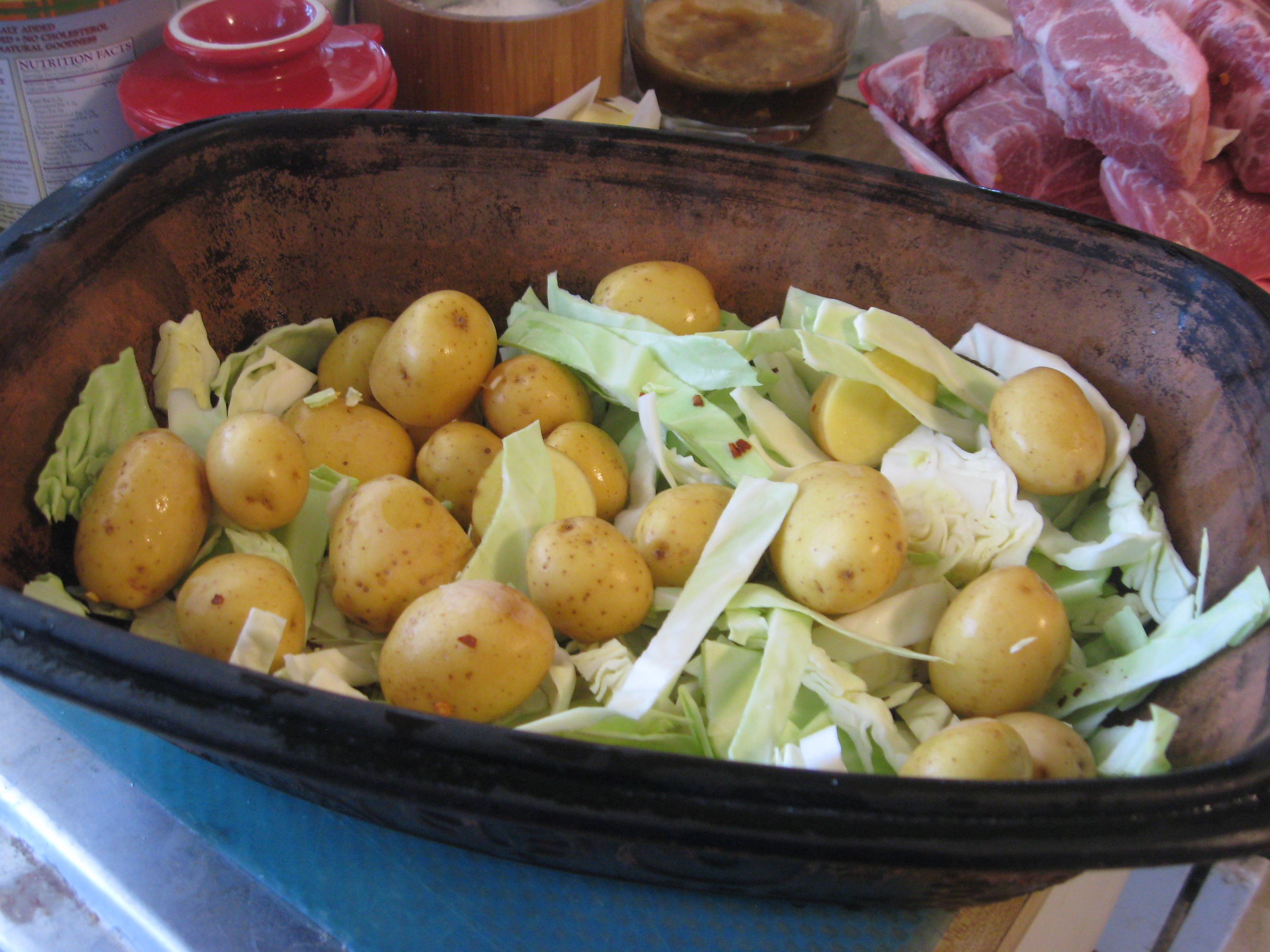
one-pot meal in the making

potatoes and cabbage

I wanted to turn this into a one-pot, one-plate meal, so I put potatoes right in with the pork and cabbage.  I looked at the amount of pork and decided that it needed a whole large head of cabbage. I eye-balled what I thought would be a serving of potatoes with each serving of pork and cabbage, and popped those right in with the cabbage–scrubbed, unpeeled, and cut only if they were large. In this case I used “regular” green cabbage, instead of savoy. I sprinkled some salt over the layers of cabbage and potatoes.

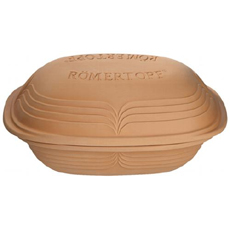
I could have used a Dutch oven, but using a clay cooker let me take a few shortcuts to speed this up–including cooking a bit faster in the oven than had I used the Dutch oven and making it unnecessary to brown the ribs as a separate process before putting them into the pot. The meat will brown on the exposes surfaces while it cooks in the Römertopf since this is more roasting than braising, at least of the meat.
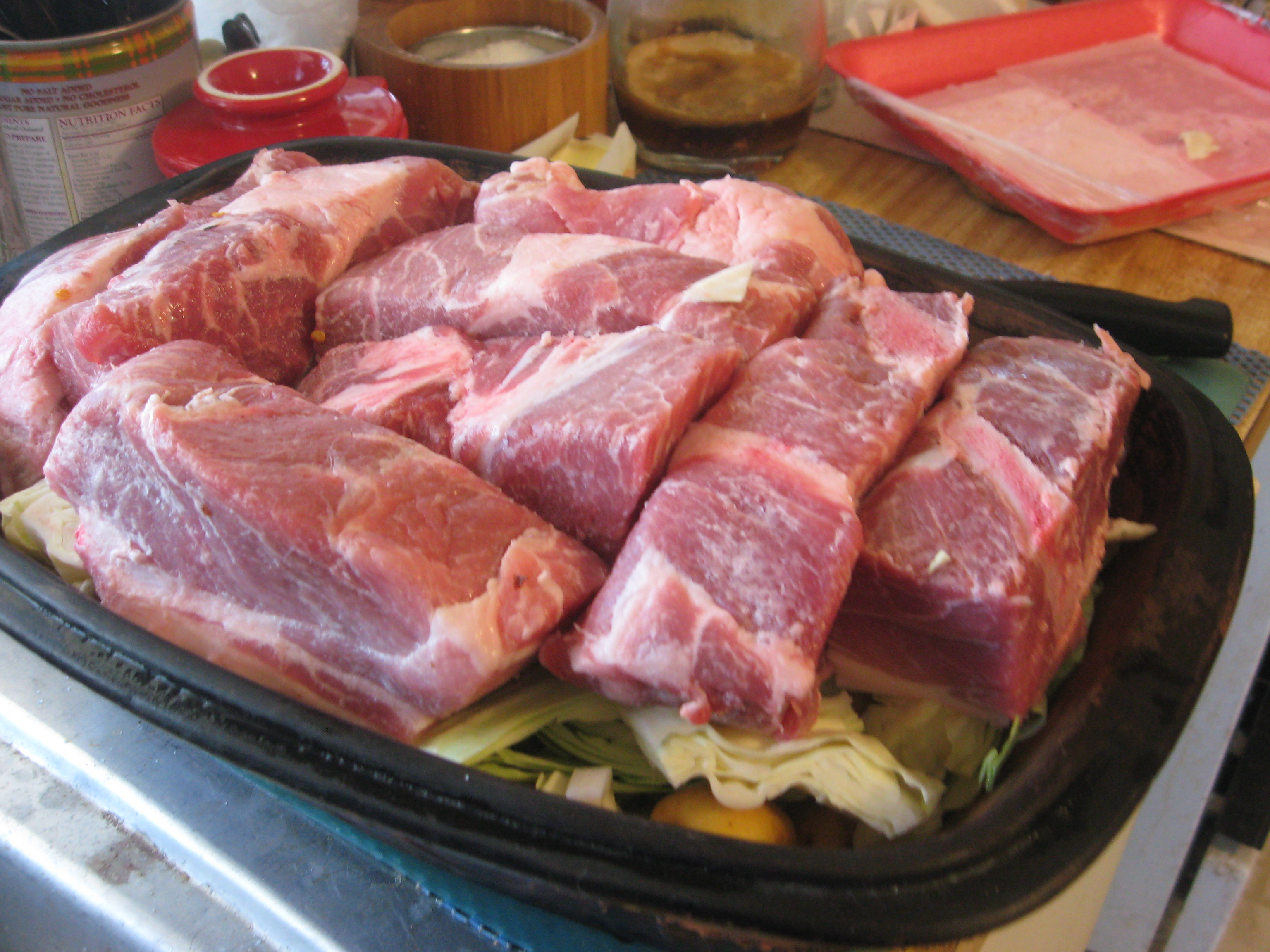
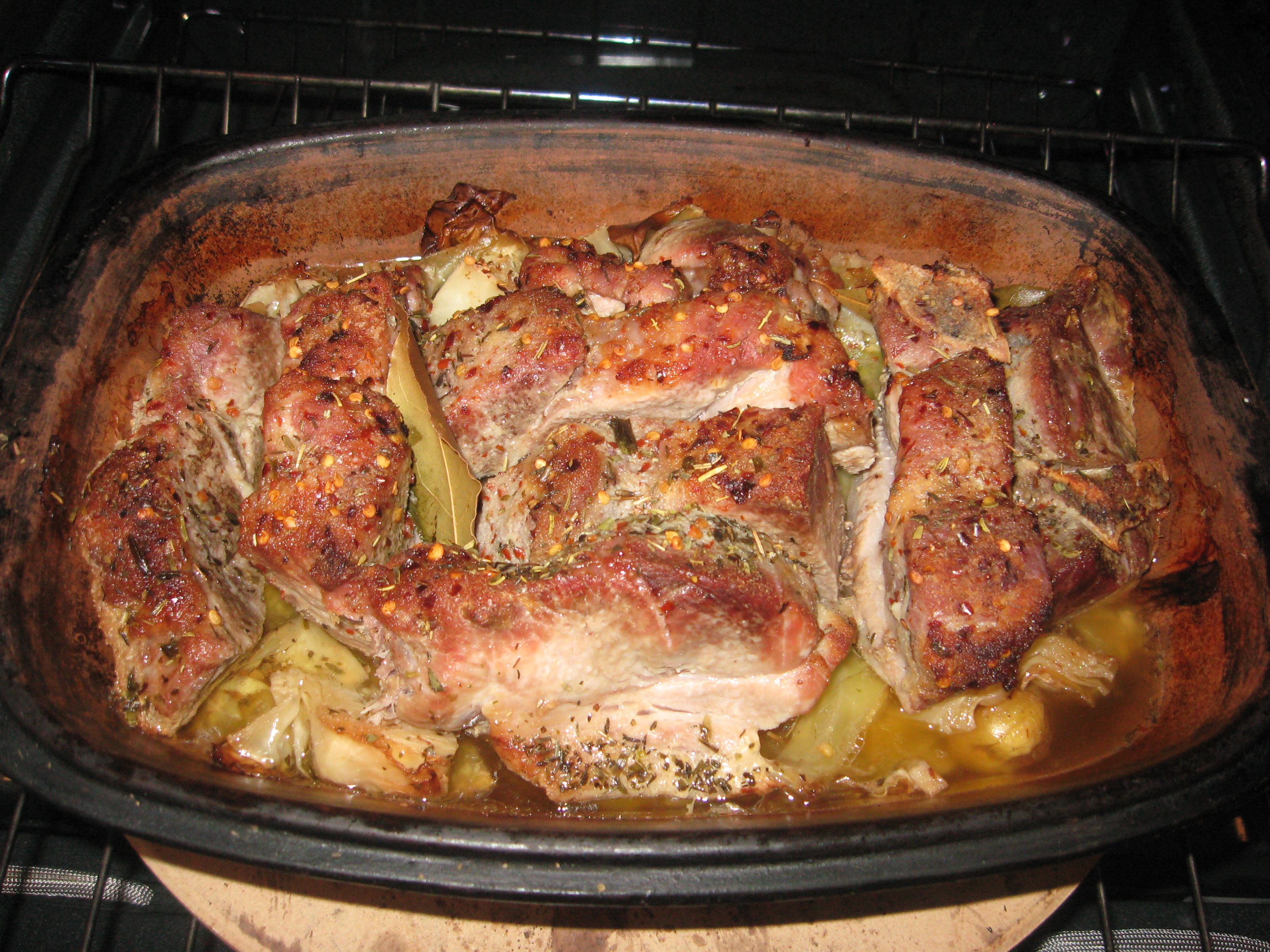
pork added to cabbage and potatoes

ready for seasoning

The Römertopf that I used (pre-soaked) for this was sized for 14 pounds (not that I had THAT much pork), but the quart sizing on these is misleading since it’s the capacity of the bottom (rather shallow).  I had a lot of pork, so I needed the head room here for all that meat. I put the pork over the cabbage and potatoes and seasoned it.

I used by “stand-by, go-to” when lazy seasoning–herbes de Provence because it’s such a great blend of flavors. (I really should have put some caraway seeds in with the Herbes De Provencecabbage, under the pork–that would have blended nicely with the herbes de Provence on the pork). I sprinkled the meat with kosher salt, herbes de Provence, and added some red pepper flakes (hot) for a little extra spice; my supper was now oven-ready.

So there’s not really a recipe here, but to summarize:

Ingredients

  • country-style pork ribs (each strip makes one very good serving)–this was about 6 servings based on the amount of meat
  • one large head of cabbage, depending on what you want the ratio of meat to vegetables (this was about 1:2 meat to cabbage since I wanted large serving of cabbage with the meat).

    IMG_7990

    oven ready Römertopf

  • Yukon Gold potatoes (4 small per serving) but adjust as desired
  • salt (about 1 tablespoon for the entire dish) \*
  • herbes de Provence  or other herbs, about 2 generous teaspoons
  • red pepper flakes, about 1 generous teaspoon, adjust as desired

Preparation

If you’re using a clay baker like the Römertopf or Schlemmertopf, you will need to soak in water for 15 to 30 before putting into the oven. DO NOT preheat oven–clay pots must go into a cold oven.
ready to eat!

ready to eat!

  • Chop cabbage into about 1/2 inch (3.5-4cm) pieces
  • Layer potatoes and cabbage into three layers; sprinkle salt over each layer)
  • Place country-style ribs on top of the cabbage and potatoes and sprinkle with salt and herbes de Provence
  • Cover with the pre-soaked top
  • Do not add liquid–there will be enough released during cooking
  • Place in cold oven, and set to 400°F (200°C)
  • Check after two hours–it’s likely ready to eat.

ÒνÓ

If you don’t have Römertopf or Schlemmertopf, you can do this in a Dutch oven. The recipe for braised pork and cabbage should give you the cooking times, liquid, and oven settings.  Just adjust the size of the pot to be appropriate for the amount of meat and cabbage. (It would have been just as tasty but more colorful had I used Red Bliss potatoes–but Yukon Golds where what was present in the kitchen!

IMG_8002

* A note on salting: I keep kosher salt in a salt pig by the stove so that I can just pinch-and-sprinkle. I estimate that I used about 1 tablespoon for this entire preparation. Just sprinkle salt evenly and lightly and you’ll be fine.

Fårikål (Norwegian lamb and cabbage stew)

Cold, rather dreary day so I’m making some warm, cuddly, comfort food from my most recent cookbook, The Kitchen of Light by Andreas Viestad.

I made the lamb and cabbage stew–well, sort of–I had goat meat in the freezer so I substituted that for lamb.  As I’m writing, I’m smelling it cooking–and practically drooling on my keyboard.

The stew is in the oven in my “small” Dutch oven (did not make the whole recipe). It smells SO good. I’ve been reading posts from a friend on Facebook singing the praises of this stew–reheats well–which means I can make a batch and freeze some.

The seasoning of this stew is bay leaves and black peppercorns–a lot of black peppercorns, cooked with the meat and cabbage.  This surprised me when I read the recipe because I’ve seen sources saying that black peppercorns will be bitter with long cooking, so it’s not usually added until late in cooking, though this is not dry heat, so that may make a big difference. This recipe calls for 1 to 2 tablespoons of black peppercorns.  (From tasting so far, I think I’m going to want to add more black peppercorns.)

Product.DisplayNameReally good, fresh-ground black pepper is one of my favorite spices.  I’ve gotten hooked on the India Special Extra Bold Tellicherry  and that’s what I’m using in this recipe.  Regular Tellicherry or Malabar pepper should also work.

Fårikål (Norwegian lamb and cabbage stew)

This recipe is adapted  from The Kitchen of Light (Andreas Viestad)–It’s easily adapted for single-serving cooking, but also suitable for making the full recipe and reheating/freezing.

Ingredients

  • 6 pounds of bone-in lamb shoulder, trimmed and cut into 1-1/2-inch pieces.
  • 4 pounds of green cabbage, shredded
  • 1 to 2 tablespoons black peppercorns
  • 2 bay leaves
  • 3 tablespoons unsalted butter
  • 1 tablespoon all-purpose flour
  • 4 cups cold water
  • fine sea salt (to taste)

Preparation

  • Layer the meat and cabbage in a large pot
  • Add black peppercorns, bay leaves, butter, and sprinkle in flour
  • Add water
  • Bring to a simmer, covered,
  • Cook about 2 hours over medium-high heat about 2 hours
  • To increase spiciness, add 1 more tablespoon peppercorns and cook an additional 15 minutes
  • Season to taste with salt
plated lamb and cabbage stew

Lamb and cabbage stew (from Wikipedia)

My first adaptation was the use of goat meat since that’s what I had in the freezer–as well as goat brown stock.

The goat meat was excellent, but in the future  I’ll use bone-in lamb shoulder chops, cut into appropriate-sized chunks.  My other adaptation of this recipe was to put it in the oven to cook at 300°F until the meat was very tender. It’s unlikely that I’ll want to make full quantity  of this recipe–more likely half, which will still give more than one meal, and  some to freeze.

This is NOT a pretty dish.  By the time the meat is really tender, the cabbage is NOT going to be pretty and bright green.  There’s more discussion of this dish on My Little Norway.  I like more peppercorns than that recipe uses–I actually added a lot more–and finished my serving with carefully roasted black peppercorns, coarsely crushed.

This has me looking for other recipes using cabbage–which I think is an under-appreciated winter vegetable. Too often I think it’s thought of as “slaw”.  After reading Viestad’s cookbook and North: The New Nordic Cooking of Iceland  by Gunnar Karl Gislason and Jody Eddy,  I want to explore more Scandinavian cooking.  I found lots more recipes on New Scandinavian Cooking, too–and the manifesto of the “New Nordic Cuisine”.

For a beverage with this dish? Well, a porter would be excellent. If I were doing wine, I think I’d look for something really robust–something that has at least some alicante bouchet in it, or maybe a Minervois–I think this calls for some research!

A son goût!


A “roast” beef sandwich

Sandwiches are not just something to be thrown together without thought–definitely NOT two thin slices of baloney and Wonder bread!  They are a special kind  of meal–sometimes comfort food (like grilled cheese sandwiches) and sometimes even need planning when cooking for one person.  I’m always on the lookout for good “recipes”–or maybe inspirations–for sandwiches–particularly roast beef.

As much as I like cooking for one, there are a few drawbacks. One is that  realistically you can’t do real roast beef.  One of the things I miss is a good roast beef sandwich–it’s just not the same when the roast beef comes from the deli–no matter how good the deli.

image from Lemony Thyme

roast beef sandwich

One of the ways to satisfy my craving for roast beef sandwiches is with the planned  “leftovers” from my  thick-cut  steak–intentional leftovers of nice rare, pink, juicy  steak to slice  thinly and make a sandwich.  Then the fun begins–it’s a happening.

  •  Start with good bread (my oat bread , if possible),
  • Add some  flavorful, spicy greens:  radish sprouts or possibly arugula, or endive.
  • Maybe tomato,  if in season.
  • Cheese:  something “bleu”– gorgonzola dolce, Cabrales,  or Danablu–is one of my favorites with beef, though nothing wrong with a good cheddar or Swiss.
  • Maybe some thinly sliced red onion (or Walla Walla, Maui, or Vidalia,   sweet onions, if those just happen to be lying around).
  • Maybe a good “smear” of horseradish or horseradish sauce, instead of onion.
  • Finally,  a thin film of butter, preferably European style cultured (salted or unsalted)!
  • The final touch would be a sprinkle of fleur de sel.

Now choose a beverage–beer, cider, or even a glass of wine. Enjoy.

A good home-cooked steak

Steak is not something that I order when I splurge for a meal in a fine restaurant; it’s too easy to do at home and good for single-serving cooking since it’s portioned when it comes home, and it’s easy to cook.

A good thick-cut, home-cooked steak is one of the things that I don’t mind having left over, since it’s usable as “roast beef” for a yummy sandwich.  (No, the roast beef from the deli simply does not do it.) My favorite way to cook the steak is from Cook’s Illustrated, 01 May 2007–it does take a little time and minimal effort, but it’s well worth it.

steaks in butcher caseMy usual choice of steak is a strip, or New York strip, cut 1-1/2 to 1-3/4 inches thick, with fat cap intact.  If I don’t find one lolling about   in the butcher case (you won’t likely find this in the pre-packaged section)  ask to have it cut the way you want it; my local Harris Teeter will cut to order but generally has thick-cut steaks in the butcher case.

This works fine with rib eye or with filet mignon, as long as it is thick-cut. Personally, I prefer strip or rib-eye to filet. Even with rib eye, it’s still not a substitute for real prime rib roast, but a good “second” so that I plan to have “leftovers”.

Ingredients

  • 1 boneless steak (1 1/2 to 1 3/4 inches thick (about 1 pound), strip or rib eye
  • Kosher salt and fresh ground black pepper
  • 1 tablespoon vegetable oil for searing

Preparation

  1. Adjust oven rack to  mid-position and pre-heat oven to 275 °F .
  2. Pat steaks dry with paper towel and season liberally with salt and freshly ground black pepper.
  3. Place steak on wire rack set in rimmed pan and place in oven.  (Steak does need to be raised rather in contact with pan).
  4. Cook until instant-read thermometer inserted in center of steak registers 90 to 95°F for rare to medium-rare, 20 to 25 minutes  (or 100 to 105°F  for medium, 25 to 30 minutes).
  5. Heat oil in  heavy-bottomed skillet over high heat until smoking.
  6. Place steak in the skillet and sear until well-browned and nicely crusty–about 1-1/2 to 2 minutes, lifting once halfway through to redistribute fat under the steak.
  7. Using tongs, turn steak and cook until well browned on the other side, about 2 to 2-1/2 minutes.
  8. Use tongs to stand steak on the sides and sear on all sides. (This really is worth the effort–and it really does not take long.
  9. Transfer to cooling rack, tent with foil, and let rest for about 10 minutes–this also is really worth the wait.
  10. You can prepare a quick pan sauce while the steak is resting, or simply add a pat of herb butter, horseradish,  or some blue cheese crumbles to the warm steak.

Add some simple sides like salad or baked potato. Now pour yourself a another glass of that luscious  red wine that was  breathing while you were cooking, and enjoy.

A son goût!

Pork butt steaks

One of the frustrations of cooking just for me is that some of the cuts of meat that I like best are typically way too big!  For example, one of my favorites is pork butt (also known as Boston butt).  Note that this does not refer to the location of the cut on the hog–but to the way it was processed and cut in pre-revolutionary and revolutionary times in New England–it’s shoulder that was salted and packed in barrels (called butts).  History aside, it’s good eating no matter what you call it. Enough fat to be succulent, and great for BBQ–friends are always willing to help eat it, but that takes a long time to cook and it’s a LOT of meat, so I generally turn to other cuts.

I use  chops (both loin and shoulder) often. I mean, chops are wonderful–quick, tasty, good size for one, but they are not the only good part of the hog!  I’d rather have cuts other than the ubiquitous loin chops with so little fat that they can be dry if not cooked carefully–such as, a pork neck steak is great (even if hard to find).

Country Spare Ribs

country-style spare ribs

Most often I use country-style spare ribs (from the rib end of the loin), since these can be had in quantities suitable for one person–single-serving plus one for the freezer.  These work well for braised pork and cabbage, and in chilli con carne.

pork butt steak

pork butt steak

While skulking through the supermarket just the other day is was quite surprised to find a package of pork butt steaks lying there in the meat case. No hesitation on my part, they went right into my basket, and home with me, especially since they were on “manager’s special”, but not a problem since I was planning to cook them right away: maybe griddle one, and pop the others into the Romertopf after salting and seasoning with a little chilli powder and coriander.  No water needed to roast these in the Romertopf–but good broth when they come out.   I had one hot meal when they came out of the oven,  packed two more servings with broth for the freezer, and had some for the hot and sour soup.

Some good eating with very little effort on my part–and all very inexpensively!

Posole

There is one good thing about having to hike out to the dumpster with the trash, especially when you’re cooking something.  If you stay in the kitchen too long you olfactory sense habituates to the aromas.  Take out the trash and you get a great new olfactory preview when you get walk back into the kitchen–especially if you spend a bit of time chatting with the neighbor who is also taking out the trash.

This cold weather has me cooking stew-y sorts of things.  A friend sent me a care package from New Mexico recently: blue and white corn with a recipe for making posole (or pozole, if you’d rather). Today was the day, since I was organized enough to remember to soak the dried corn overnight.  By the time I had sauteed everything, browned the pork, onions, garlic, added the oregano (had to do Turkish rather than Mexican until I do another Penzeys order), and the chilli pods I wasn’t fully appreciating the aroma of the cooking. I popped the covered dutch oven into the oven and took– out the trash.

When I opened the door and walked into the living room, I was definitely getting a fresh sensation: the browned pork, the oregano, the chillis–this smells like warmth and comfort on a cold day!

White Corn Posole

This is the recipe that came with the package of Los Chileros de Neuva Mexico package of white corn posole. I more or less followed the recipe–

Ingredients

  • 6-8 chile pods
  • 2 pounds cubed pork (or beef)
  • 3 cloves garlic minced
  • 1/2 teaspoon Mexican oregano
  • 1 teaspoon of salt.

Preparation & assembly

  • Soak the posole (12 ounces) in water to cover overnight.
  • Boil the posole in salted water for about 2 hours.
  • Add meat, chilli pods, oregano and garlic.
  • Cover and simmer for another hour or until the posole is tender, stirring occasionally.

<>\/<>

My first deviation from the recipe was to brown the pork (in a little bacon fat) before adding the liquid and the other ingredients. My second deviation was to use 4 chilli pods (ancho and guajillo) and then about 2 teaspoons of Hatch chilli powder.  I had tasted before adding the chilli powder–and it’s wasn’t spicy enough. I’ll see what it’s like when I reheat it. My other deviation was to add way more garlic.

I’d looked at other recipes for posole online, and found lots of recipes calling for other ingredients–cumin, coriander, and even tomatoes. I decided to start with this simple, rather a straightforward one for my first try at posole.

I really think that Mexican oregano is a must–the Turkish just isn’t quite right here–it’s sweeter than the Mexican to my taste and would fit better with the corn flavor. I’m likely to add some cumin and coriander next time around as well. I may add onions (caramelized) as well. It’s a recipe in evolution now. I think a little more “brown” in the flavor would be good, as well as some smoke from either chipotle peppers or from pimentón–but definitely Mexican oregano next time. I used water here and not pork stock, but I think that pork stock would be tastier–especially if the bones/meat were browned before making the stock.

Even though this is a simple soup/stew, a bowl of this is very satisfying on a cold day when you need warmth and a full tummy!

My friend also sent blue corn–which I’ve only had in tortilla chips, so it will be interesting to see how that compares to the white. I do suppose you could make this with canned hominy, but this seems to have more corn flavor that I remember from canned hominy. I’m going to enjoy trying out different seasonings here.

For real pork lovers

Sometimes I’m a little slow on finding out about new food things in Durham–e.g. Rose’s Meat and Sweet Shop. They’ve been open for about six months and I just recently got there.  I guess I was so slow to find this because I’ve been buried in end-of-term grading, and a couple different indexes, but I’ll certainly be back frequently.

If you’re one of those people who think that pork can’t be eaten if it’s still pink, and if you’re one of those people who carefully cut every last itsy, bitsy, teeny, weeny, tiny bit of fat off you meat, then you might as well stop reading right here because from here on you only comments and thoughts will probably be icky, yuck, and things of that nature; but before you leave, you should certainly check out Rose’s website if you’re in Durham.They have sausages, bacon (dry cured), stock, lard, and offal at various times, depending on when they’ve just  butchered.  (You should definitely peruse the sweets and menu items while you’re there, too–not just the meats.)

It’s not a huge quantity of meat that you’ll see  in the case, but top quality meat, and some unusual cuts that you won’t find in the supermarket.  My “find” on my first visit (in addition to the little chocolate hazelnut tarts and the chocolate wafers) was a pork neck steak–something I’d never seen offered for sale before. Needless to say, my love of pork and my curiosity got the best of me and I brought home neck steak.

When I got my pork neck steak home, I headed for the computer to do a little searching.  I don’t think I’ve seen a recipe for this cut of pork in any of the many cookbooks that I have–even the meat cookbooks.  I guess it’s not a cut that is used frequently.

The first thing I learned was that it’s also called a neck fillet as well.  One of the first places I found information was at Eat to Blog. Donny Tsang’s post on pork neck fillet referenced Jamie Oliver’s method of cooking the cut and had good comments about it. So where else would I go?   Right straight to Jamie Oliver.com for his recipe.

photograph of pork neck fillet from jamieoliver.com

I did as the post on Eat to Blog, leaving out the sage and the lemon because I just wanted to get a feel for the pork itself. It was easy to cook: very, very hot cast iron griddle (which practically lives on my stove) for two minutes on each side, and then turn at one-minute intervals until it has cooked a total of 8 minutes.

The result? Absolutely marvelous! Of course I started with top quality pasture-raised pork that had  enough fat for great flavor and juiciness. With the fat in this cut, it’s very rich.  I did use a squeeze of lemon to brighten and cut a bit of the richness.

Caveats for cooking this on a cast iron griddle or skillet: you’re going to have smoke–but it’s worth it.   I had to take the smoke/CO alarm outside while I cooked this–and I’ll take it out next time, too, because I’ll definitely be cooking this again.  Admittedly it’s not something you are going to eat every day–so I figure I can allow the fat that comes with it. Cutting fat off is not an option because the meat is well-marbled, and fat is interspersed between muscles; besides that, if you’re going to cut off all the fat, you might as well buy a loin chop! We’re after some great flavor here. I think I’ll try the sage next time, but just plain, finished with a little fresh ground black pepper and a sprinkle of Fleur de Sel it was wonderful.

(Ok, I’ll also confess to using lard in some things when I cook–and I so pleased that Rose’s has lard–now I don’t have to scrounge for fat back and render my own.)

NOTE: I’ve unabashedly gotten this photo from Jamie Oliver’s website (caption is a link to his website) but I’ll have to say that mine looked just as good as this one–and the flavor was right up there with the looks.

A son goût!

Oven-braised lamb and garbanzo beans

It’s another grey day–unseasonably warm, but at least not hot, sticky, and terribly humid today–the kind of day when you need to smell something cooking–long, slow, and tantalizing.   I found lamb shoulder chops on special (2-1/2-pound package) at the grocery store, I decided to try the lamb/garbanzo slow-cooker thing in the oven since it’s not too hot (and I’ll use the oven to prepare a second dish for reheating tomorrow (acorn squash stuffed with Sicilian sausage).

Book coverThe slow cooker version of this concoction was really good, but I thought it could be improved by doing it in the oven. Even after reading the Cook’s Illustrated Slow Cooker Revolution (volume 1), I am still not a wild fan of the slow-cooker.  I use it because it does some things well, and is necessary at times to fit cooking into a working schedule.  The Slow Cooker Revolution has improved my slow-cooker results immensely, mostly because I’ve discovered some unusual ingredients that can improve flavor.

My impression was that many of these recipes required more preparation time than I would be able to put into a slow cooker recipe, given that I use it for utter simplicity.  I’m interested in seeing what comes from volume 2 of the Slow Cooker Revolution.  If I have to do a lot of preparation for the recipe, then I might as well not use the slow cooker.  I still find that I like over-braising when possible; however, I do find I’m using the slow cooker even more since I read the first volume of this book. That said, I still prefer oven braising, especially if I’m working at home.

Romertopf clay baker (oval)I had intended to do this in the Romertopf, (one of my favorite things for roasting and baking hearty, peasant-style comfort food in the winter) but by the time I had boned the lamb and added other ingredients, it wouldn’t fit in either of my small ones (great for single-serving cooking), and was not enough to fit in my large Romertopf (for roasting whole chicken, for example)–so it was the Dutch oven for today.

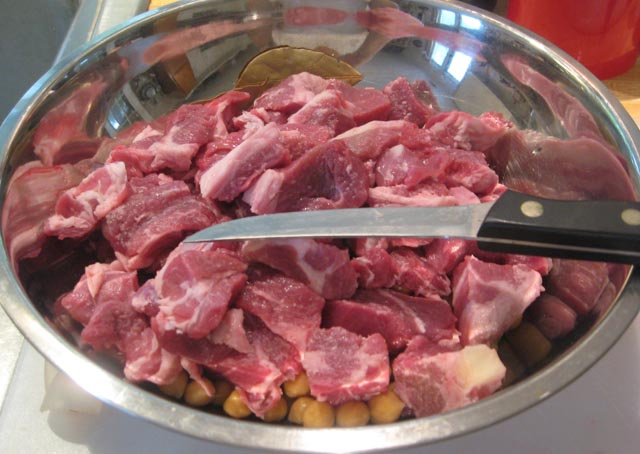
(Shoulder chops are reasonably priced, and the boning doesn’t take long if you use a boning knife rather than trying to do it with a paring knife or chef’s knife.  Those bone went into a saucepan with a tad of salt and some bay leaves to make stock.  After boning out, I had about 2 pounds of lamb, so that’s what I started with.)

Oven-braised lamb and garbanzo beans

lamb from chopsIngredients

  • 2 pounds lamb (from boned shoulder chops)
  • 2 14.5-ounce cans of garbanzo beans, drained and rinsed
  • 3 large onions, chopped
  • 1 14.5-ounce can of fire-roasted, diced tomatoes with juice
  • 2 tablespoons of Hatch chilli powder (used for the slow cooker), but more added after tasting this halfway through cooking
  • 2 teaspoons of salt, or to taste
  • 1 tablespoon fresh Mexican oregano, minced
  • 1 cup water

PreparationIMG_7667

  • Put everything in pot
  • Cover
  • Pop it into the oven, and check for liquid in an hour
  • Go get laundry or whatever, then check liquid again

-<>^<>-

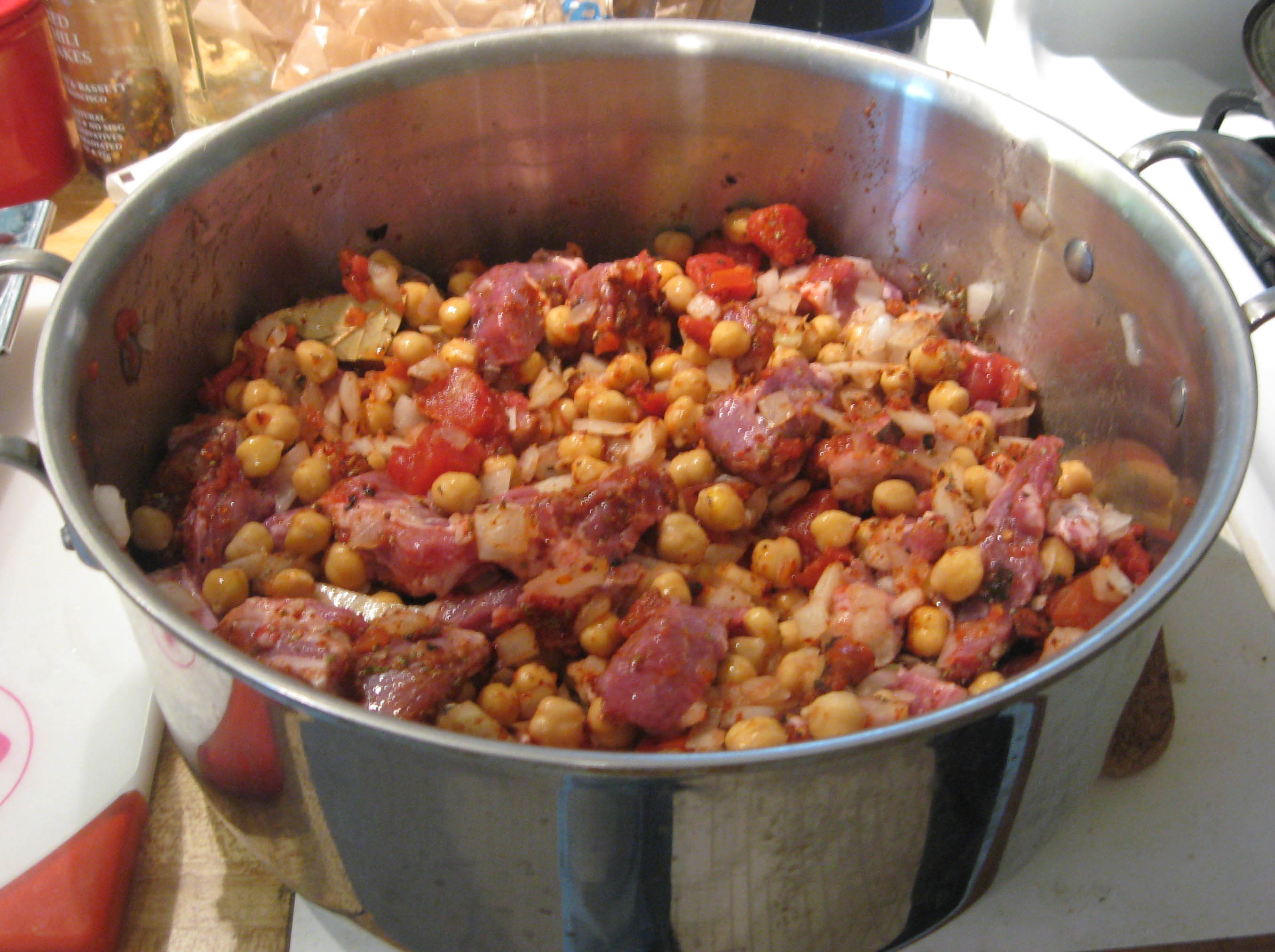
In order to be as much like the slow-cooker, I did not brown the meat or cook the onions separately–just combined everything, covered, and put in a preheated, 300-degree Fahrenheit oven.  I added 1 cup of water to start, and checked in one hour but there was plenty of liquid.

On tasting, I found it needed more than the 2 tablespoons of chili powder so I added about 1 tablespoon more, stirred, covered, and let it continue to cook. There was plenty of liquid, so next time, I’ll not add any water–just rely on the juice from the tomatoes, onions, and meat.

-<>^<>-

The stock made with the bones smelled really good–if more liquid had been needed during baking, I would use some of the stock.  There was some meat from the bones in the stock, but I not enough to spend time picking off, although I’m not compulsive about trying to get every bit off when I bone meat like these chops. Since I started the stock in cold water, the meat that was left was pretty flavorless, but the stock was good.

-<>^<>-

There will be a next time for this–and unless I’m really pushed for time, or can’t leave the oven while I’m out, I’ll opt for the oven method to cook this–a much more complex flavor with the same ingredients, likely attributable to the bit of evaporation that takes place in the oven but not in the closed slow-cooker.

Getting this added flavor lead me to consider the energy used in the various cooking methods–the energy required for cooking is certainly part of the energy required to make that food edible–the energy  of production and transportation, and the cooking is all part of the picture: the footprint of feeding me. We cannot ignore the energy used for cooking when we talk about other energy costs associated with our food so I spent some time browsing to find information on different cooking methods.

In trying to research this issue, I’ve perused many different sources–and the gas/slow cooker comparison is difficult, and I get the feeling that the answer to which is more efficient is an “it depends” situation.

Interestingly, an article on slow cookers versus electric ovens from the University of Connecticut Sustainable Living suggests that there may not be a significant difference in energy use.  SFGate discusses gas versus electric energy use, which gets more complicated, but I’m not sure that there difference is significant enough to make me give up oven braising, even though I’d like to minimize my “carbon footprint” as much as possible. If my slow cooker requires eight or so hours of cooking, and my oven braise requires only two or three hours on low to medium heat, then it may be a toss-up, since the slow cooker doesn’t cycle, and the oven (gas or electric) does.

Oven braising in the wintertime helps warm the house so probably cuts my heating use some, but I’m certainly NOT going to oven braise in the summer and increase the use of air-conditioning.  There is lots of conflicting information out there on the ‘net.  The “best” I found was from the Consumer Energy Center (California Energy Commission)–from that information, I’m not going to give up oven braising for the slow cooker anytime soon, but I’ll still use the slow cooker for some things.

Cover, pressure cooker perfectionOne comparison that I’d really be interested in is slow cooker versus pressure cooker energy use, and taste of the same dish prepared in both. Most data that I found suggested that the slow cooker wins on convenience, and the pressure cooker on energy saving. A taste comparison would certainly be interesting.  I’m almost certain that a pressure cooker can’t replace a good old-fashioned slow braise in the over.

I’ve recently started playing with a pressure cooker–it’s a lot different than what my mother used. The recipes in Pressure Cooker Perfection have been a good starting point. I suspect that I’ll be using a pressure cooker more  in the future, as well as the slow-cooker. Climate, air conditioning, and heating, are all things that will enter into my decisions. I’m also trying out an portable induction unit which is supposed to be ore energy efficient.

So many options for energy efficiency–but what about taste?  I doubt that any other method is going to come out tasting like an oven braise, no matter how many umami-enhancing ingredients you add.

A son goût!

Dutch oven with lamb and garbanzos

very simple, very tasty

A pork and kale braise

It’s been chilly, cloudy, and grey–just the kind of weather for soups, stews, and braises. It’s also time to get the freezer stocked with some quick, easy food as I’ve got indexing projects coming in–some while I’m still teaching this Fall term.  With lots of grading to do as well, I wanted something that would take care of itself while I worked–so out comes the all-purpose “rice” cooker for some slow-cooked food.

I’m a great fan of pork almost any way you fix it so when I found a package of boneless pork ribs–just the ticket for the slow-cooker–while I was doing my grocery shopping on Thursday it obviously went into the cart. Big package, but on special, so it came home with me to make a lazy meal, and some to go into the freezer for quick meals when I’m really busy, or when I need comforting, peasant-style food. Can’t pass up inexpensive on something I really like.

Braised pork and kale from the slow-cooker

Ingredients

  • boneless pork spare ribs, about 2 pounds
  • 1 packaged of frozen, chopped onions
  • chopped kale, one frozen “family” pack
  • 6 large garlic cloves
  • 1 14.5-ounce can of fire-roasted tomatoes
  • 2 tablespoons of Hatch chili powder
  • 2 teaspoons of kosher salt, adjust to taste as needed when cooking is finished

Preparation and cooking

  • cut pork into about 2-inch pieces
  • add half package of kale and onions, mixing
  • layer in pork, sprinkle with salt, chili powder
  • add remaining kale and onions
  • add fire-roasted tomatoes with juice
  • close the lid and set for 8 hours
  • shred pork using two forks (if desired)
  • check seasoning and adjust as necessary.

No, no pictures as  this is NOT a photogenic dish, but it sure is tasty! And there’s certainly nothing like complicated technique involved here.

Great served with a side of spicy black beans, or garbanzo beans, or just a big bowl on its own. This particular time I had a roasted winter squash as a side with it. (Now, to turn the rest of the winter squash into another meal–maybe stuffed with some Sicilian sausage that also went into the grocery cart.)

There was more liquid than I had anticipated when this was finished cooking, so after packing some in zipper-lock bags to go into the freezer (with SOME juice), the extra juice with some kale and some shredded pork is going to turn into soup–details will evolve when it’s used–but that’s an additional meal out of that pack of spare ribs!

Celebrating the autumnal equinox.

I woke up to a lovely fall morning–sunny, breezy, cool–absolutely lovely day, some leisurely time over coffee in the sunny kitchen, and realized that I’ve gradually been shifting into autumn cooking mode–cooking urges that are very different from the hot, humid weather of summer.

I’ve been making meals in the multitasking rice cooker lately: whipped up a great spicy lamb and garbanzo bean stew and another of braised pork and collard greens.  Some of immediate use today, and some of each of those to stash in the freezer for quick meals on a cold winter day when I need serious comfort food.

The lamb and garbanzo “stew” was one that I literally threw together in about 15 minutes while I was finishing an index to send to a client. A good friend who knows how much I like to use chili peppers gave me a wonderful chile powder from Made in New Mexico.  I used lamb shoulder chops, a healthy batch of chile powder, some Mexican oregano,  Goya garbanzo beans, and a can of diced tomatoes. The lamb chops came out of the slow-cooking melt-in-your-mouth tender, with just enough spice to accumulate a bit of burn by the time you’ve eaten a bowl of it, but not enough to rip you taste buds out by the roots.  This chili powder is the best I’ve ever used–I’ll be ordering more of that one.

Another job that just could not be put off any longer was cleaning the gas stove. It is one of my very least favorite things to do so I do tend to procrastinate about it; that does not make the task any easier and I know that but I still procrastinate about it. (I think that a house elf would be a wonderful thing to have around!)

Now the stove has at least had a  lick and a promise as my grandmother would have said. Well, at least the lick, but still needs the promise though that is going to happen today. (Definitely no pictures here!)  So happy that the oven is self-cleaning since it gets lots of use in cool weather for carefree braising while I’m working at home.

Now I’m ready for a plate of braised pork and collard greens!