Always Hungry? NOT!

The Always Hungry? plan is back effect, with a few modifications.  I’ll  admit to my “oops” which was not because I was hungry! I just wasn’t thinking–good food, good company, open mouth, insert food.

My continued  issue is that there’s too much food on the meal plans for what I usually eat and my usual level of activity–I typically don’t “do” snacks”. Perhaps now that the weather is improving, but not yet sweltering, I can get more active.

The other difficulty for me is breakfast. Not only am I not at my peak function first thing in the morning, I just don’t want food.  I love breakfast food–eggs, omelettes, and the like–but just not in the morning. Perhaps as I manage to get off by butt and increase my activity I’ll eat more from the meal plan set out for this program.

For right now, brunch is a concept that fits well with my desire for foods. But, brunch interferes with snacks, so I’m using the snacks as “lunch” and having brunch, or I’m using the Power Shake for Phase 1 as breakfast, and lunch and dinner from the meal plan.

It sounds as if I’m really mucking this around, but I’m being very conscious of the appropriate balance of macronutrients for this phase: protein 25%, carbohydrates 25%, and fat 50%.  Despite my changes and that “slip”, it’s working!

tomato, mozzarella, and garbanzo bean salad, with lemon tahini dressing

tomato, mozzarella, and garbanzo bean salad, with lemon tahini dressing


Always Hungry? Meal Plan

Since I seem to be unable to stick to a recipe, am a picky eater, and have a lot of difficulty with breakfast, I’ve downloaded the Simplified Meal Plan from Always Hungry? website, and very carefully read the requirements for the “Building a Phase 1 Meal” (pages 151-152).  Since I was having a lazy day I did some adaptation on the “Herb-Roasted Chicken Thighs” since chicken thighs often show up on my house menus. I decided to make this a one-pot meal.

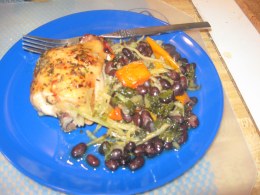
roasted chicken thigh, greens, black beansAfter seeing a post on slow roasted kale on Stefan’s Gourmet Blog, I decided I could make a one-dish meal that met those Phase 1 requirements. Using a bag of salad greens (broccoli, Brussels sprouts, kale, and some others) I put enough into the clay cooker to give me the amount of cooked greens that I needed for two meals (two of the thighs were for other uses). Since I’m such a fan of greens and beans, I added enough black beans for two servings. Since bell peppers are on the okay list, I added red and orange mini bell sweet peppers to the mix.  Finally, I topped that huge pile of greens with the chicken thighs sprinkled with salt, red pepper flakes, and oregano. The soaked clay cooker went into a cold 400 °F oven for a little over one hour and out came a meal that had the protein, vegetables, and the carbohydrates (the beans). All I had to add was dessert. (Yes, this meal plan includes dessert–in this case a cup of fruit and 1/2 ounce of dark chocolate.)

One of these thighs is going to find its way into chicken salad with grapes and pecans (substitution for walnuts) for one of the prescribed lunches and another into the freezer to pull out when I need a quick dinner ready with the vegetable, meat, carbohydrate quantities already worked out.

My fat cells and I

It’s amazing how easy it is to ignore what the scales, the mirror, the doctor, and clothes are telling you–until you get a look as others see you–a video of you going about your normal activity. As you watch, it’s more like watching another person, and you have a sudden OMG-it’s-really-true moment. You suddenly know that the time has come–that repeated New Year’s resolution that you’ve “renewed” umpteen times and not kept must finally be faced. (Hotel bathroom mirrors are almost as revealing–big, usually with door mirrors too so you get an all-around look in really bright light, too.)

You review all the experience that you’ve had with “diets”–the Atkins (worked like a charm but not sustainable because of the ban on fruit, beans, milk, and dairy products except cheese. The New Atkins–for the same reasons. You read the books evaluating low-carbohydrate and low-fat diets, high-protein, Mediterranean diet, and the French Paradox and feel like a real wuss because you’ve not been able to keep to the latest thing you’ve tried. You even check sites that have BMI computations available–everyone gives you the same answer: you’ve moved over from the overweight into the “obese” range. Then there’s the video–wonderful hive inspection but the beekeeper.

9781455533862I bought the latest diet book on the market–the day it was released–Always Hungry?.  I read it, and think about it, and then I saw myself in a video, And the jig is up! You know you’ve deluded yourself when looking in the mirror, looking at photographs, and feeling how your clothes fit.

So reread the book–really read the book (including the recipes and the meal plans). To add motivation, (since the book discusses movement) I’ve dug in the “junk” basket on the bookcase shelf, and in the drawer where stuff accumulates and, finally, found the pedometer. Now I have numbers to show how truly sedentary I truly am! Scary.

Back to this food plan. Refined sugars are a no=no, but that’s not a real problem because your sweet tooth is chocolate dependent. Soft drinks are not in the in this house fridge anyway. But there are pasta and beans on the pantry shelf. From experience I know I  like (maybe even love) complex carbohydrates, aka starches. Those and milk have been the stumbling blocks every time before–but this food plan allows legumes and milk even in the initial phase. There’s one ounce of dark chocolate allowed daily even in Phase 1. This “diet” for weight loss is a plan for moderation. Phases 2 and 3  (essential since you really, truly like food) allows judicious reintroduction of some of the things you most like (baked white potatoes), at least on an occasional basis and still maintain weight loss.

Since some basic sauces are essential for the food plan, I decided to start with some that would need routine weekly preparation and those that I thought I would like particularly well, to give me an idea of how things the recipes are seasoned.

After reviewing the list of permitted foods (again), this book moves to the kitchen. Trying some of the recipes since in the past food plans have always seemed too contrived. Well, the recipe for Blue Cheese Dressing (All Phases) on page 263 seems like a good place to start since it is a favorite. Can’t you eat the lettuce so you can have the blue cheese dressing? Recommended to make a wide-mouth mason jar (have) and immersion blender (have). The prep time estimate was accurate–really fast and easy.. (Since blue cheese is a strong flavor, I prefer more tartness, so I replaced the tablespoon of water with an additional tablespoon of lemon juice.  Tastes splendid so score one for the food plan Bring on the crudities. This sauce is a keeper even if it is on a food plan for weight loss!

So one tasty recipe doesn’t make it acceptable. I like (and make at home often) vinaigrettes and use oil and vinegar dressings. The Lemon Olive Oil Dressing (All Phases), page 269, is straightforward and a good balance of olive oil, lemon juice, salt, and pepper. If you make this in tandem with the blue cheese, you don’t have miscellaneous bits of leftover lemon.

[There’s a bonus to using mason jars–they have gradations on the sides so with just a bit of planning you won’t even have to wash a measuring cup. If you use a kitchen scale, you might not even need measuring spoons. (I’ve noted weights of things like 2 tablespoons of lemon juice with the recipes).]

Next  for testing,  I chose Creamy Dill Sauce (All Phases). This sauce is a bit more complicated than the first two but noted to keep for 1 to 2 weeks in the refrigerator. Again, using a mason jar and scales it was easy to put together.Knowing that I tend to find many recipes under-seasoned, and over-salted, I did use 2 small garlic cloves, substituted 1/4 teaspoon of smoked Spanish paprika for the “dash of paprika” called for in the recipe. I found it a bit lacking in the lemon flavor with only the lemon juice, so I added 1/2 teaspoon of lemon zest. After allowing it to stand for a few hours, I was pleased with the tart dill, lemon, and slightly smoky flavors. (This is easily modifiable without changing the balance of protein/fat–ancho chili or Aleppo pepper could be used.

The final sauce that I made to test was Lemon Tahini (All Phases), page 269. Taking my taste for garlic and tartness into account, I used a large clove of garlic, 2 tablespoons extra lemon juice, and 1 teaspoon of lemon zest.

My clean up after making these sauces (in very close to the prep time given in the book and with a little more experience and organization I’m sure I can decrease that):

  • one chef’s knife
  • one cutting board
  • one set of measuring spoons
  • one spatula for scraping down the side of jars
  • immersion blender
  • microplane grater (for lemon zest)
  • one citrus reamer

I can certainly deal with that. Leftover from this prep, one lemon minus zest (lack of organization on my part–next time I’ll just zest all the lemons before squeezing them)

I didn’t have to buy anything that wasn’t already in my pantry except dill and parsley, but since it’s winter, that’s not a negative thing. I’m certainly not going to have to rearrange my kitchen to accommodate, although the immersion blender will need to live somewhere slightly more accessible.

Sauces, as important as they are, don’t make a meal plan. The recipe for Broiled Fish with Garlic and Lemon (All Phases), page 232, looks like a good way to start testing the main dish recipes. It is simple, and besides, it’s very easy to cook fish, although I don’t use the broiler much–but this recipe works as well as those for the sauces. The serving of cod fillet that I cooked with this recipe was for one–so only about 6 ounces. In order not to overcook the fish, I seared on only one side and then finished under the broiler. . I broiled the fish for 8 minutes (the minimum time suggested in the recipe). Broiling it on the lemon slices with the olive oil and garlic worked: nicely garlicky and great lemon flavor. This is another keeper!

Three things that are called for frequently are mayonnaise and  Ranchero Sauce, page 272. I’m going to opt out of those since I can get a palatable mayonnaise made without sugar (that I usually buy anyway) and I have a favorite salsa that lacks sugar in the ingredient list.My local Harris Teeter grocery has a store brand hummus that is without sugar, so I’ll likely also opt to use that instead of making it at home.(There are resources on the  website  to facilitate the plan.)

Now that I have a feel for the seasoning used in these dishes I think I can use many of the recipes provided with the meal plan without having to alter my pantry much at all. After looking at other recipes, I find several that I am looking forward to trying: Ginger-Carrot Soup (All Phases), Red Lentil Soup (All Phases)Chocolate Sauce (All Phases), and Cabbage Casserole (All Phases). A lot of these recipes lend themselves easily to improvisation with herbs and spices, too–another plus for preventing boredom.

There’s only one “special” thing I have to buy–whey protein for the occasional Phase 1 Power Shake. Because of the stress on the balance of macronutrients emphasized in each phase, I will do that. (The thing sounds good when you consider what else is in it).

After rereading the permitted foods, I’ve decided I can do without pasta if I can have legumes and the prospect of adding some pasta and bread in later Phases 2 and 3. With my physician’s words bouncing around in my brain, and that horrible BMI, I CAN do this. It’s about moderation–and chocolate, whipped cream, and wine (after Phase 1) are allowed. It’s about moderation and balance of the amount and quality of protein, carbohydrate, and fats consumed. It’s also about not having to revamp my pantry or suffer deprivation.

This project has to involve getting off my butt and doing more walking and movement, too! That’s likely to take more effort than eating the right things, given how sedentary my work is. But, needs must!

Ò¿Ó

°

There is a lead-in phase where you get ready–for three of those days I’ll be on the road or at a convention, but once back home, this starts. No more procrastination!  After sampling the sauce recipes and the broiled fish, I certainly feel more positive about the meal plans that I ever have about any other weight-loss meal plan. (The blue cheese sauce added to egg salad is good–lots of room for improvisation with the recipes, still keeping the macronutrient balance.

I’ll admit to one slight frustration with this book: recipes are listed by name under an entry for “recipes”. Cabbage Casserole appears just where you’d expect it. Coleslaw you will find only if you look for “Tangy Coleslaw”. When trying to locate the recipe for the fish, I couldn’t remember the specific name–fortunately, broiled was in the title so it was close to the first of the list.

Though the main focus is not as a cookbook, but on nutrition and weight loss (index very useful for this), just a few simple entries throughout for main ingredients such as “cabbage”, “polenta”, or “shrimp” would be helpful. But, I shouldn’t complain–I know space considerations often dictate what can be included or what must be cut. I’d happily settle for smaller print in the index (even if it meant getting out my reading glasses) to have those extra entries.



Braised lamb shanks

Continuing my freezer clean-out, I discovered two lovely lamb shanks that I must admit, I had forgotten were in there.  The weather that we’re having now just begs for comfort food, so I decided to make braised lamb shanks and the shanks beg for white beans to accompany them.

Starting with a recipe for braised lamb shanks and white beans that I knew worked well I still perused recipes from some other reputable sources (Williams-Sonoma, Food and Wine, and The New York Times). My lazy side came to the front and I decided that I wanted to do this all in one pot–so I went with the New York Times recipe–except I used thyme instead of rosemary and scaled the recipe for two lamb shanks.

Then I decided to follow a favorite principle of mine in cooking: never do on the stovetop what you can do in the oven (extremely hot weather will modify this). After bringing the pot to a simmer on the stovetop, I popped the pot into a 275°F oven for a few hours–low and slow since this is supper for tomorrow, likely with a grilled (well, broiled given the weather) cabbage wedge for a side.

Even for two shanks, this comes out to be a lot of food, so I’m looking forward to putting some into the freezer for another rainy day meal when I’m feeling indolent.

#LovePulses and take the pledge

Another informative post on an underutilized and versatile food source. Even if you don’t wish to take the pledge, please read! Look at the nutrition data. If you cook your own, the preparation  may take planning and time but it’s not labor intensive. Canned beans are an option to help use this food group.

Snow day. . .

Well, not really a snow day (I wish!), but an ice and wind day, the second in a row here. It’s a grey day with a few snowflakes fluttering around. It’s not so far been a productive day. I’ve been wandering from room to room, fighting the urge to take a lesson from the cat. Neither did he go with me to make morning coffee nor did he get out of bed when I started rattling around in the kitchen. He simply got under the duvet instead of on top.

Cat looking into refrigeratorSo I’ve resisted the lure of book and duvet to try to accomplish something, even if not useful or productive, just something I can say that I did. The motif today seems to be opening, peering inside, and closing doors, figuratively and literally, including internet browsing–opening a site and then just passing on to another. I’ve peered into the cabinet where all the plastic storage containers live and close the door tightly and firmly, then opened the internet door (Google search) on organizational ideas for empty containers.
Peering into the refrigerator led to the conclusion that I didn’t want to eat anything that was already in there. The threat of power outage led me to follow a link on what foods were safe after a power outage, but that didn’t catch my interest either (no new information, and no power outage here yet). My list of blogs that I follow l did provide something that held my attention: posts on one taste at a time caught my interest–food waste and eating mindfully. After reading (and reblogging those) my meandering led me back to the kitchen with thoughts of something warm and cozy to eat this afternoon.

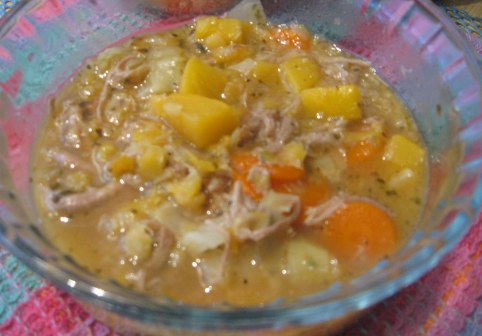
This recurring theme eventually led to the freezer compartment of the refrigerator which has been needing organization and sorting for a while. Gazing at a container of stock finally got my interest. What better way to start sorting and organizing that to make something from what I found in the freezer that was approaching its end-of-life-even-if-frozen state.  Thus: mostly freezer soup happened–with additions from the crisper drawer.

Ingredients

  • pulled pork (from a large pork butt, slow-roasted in the Schlemmertopf)
  • two packages of stock (one pork, one chicken)
  • the last package of sofrito (a staple, but needing to be used and replaced)
  • carrots (the last of a bag that had been vacuum packed for later use)
  • 1/2 small rutabaga, diced
  • two handsful of cabbage, in bite-size pieces (a crisper staple)
  • about 1 cup yellow split peas
  • about two teaspoons Hatch red chili powder
  • a dash of dried oregano
  • (a retained bay leaf from the pulled pork)

Preparation

  • thaw and sauté the sofrito to brown lightly (frozen with olive oil)
  • add chili powder and oregano to bloom in olive oil
  • add frozen stock
  • add pork
  • add rutabaga, cabbage, and split peas
  • simmer until rutabaga and split peas are tender (about 40 minutes)

Supper is on! IMG_8880

As is typical of all soup making, there is more than I’m going to eat, but some will go back into the freezer for a quick meal on another grey day–carefully labeled, and dated.

Ò¿Ó

.

Lamb leg steak–continued

lamb leg steak on plate with ratatouilleThat lamb leg steak that I cooked a couple days ago was a big steak–weighing in just a bit under a pound. That’s a lot of meat–couldn’t possibly eat all that at one time.  As vehement as I’ve been about not liking, or dealing well with leftovers,  that does not apply here.  I don’t really consider the part of this steak that I didn’t eat then as undesirable. I couldn’t have that luscious steak without some left for other uses–not when it needs to be at least an inch thick to cook well. You’re wondering what happens to the rest of this steak?

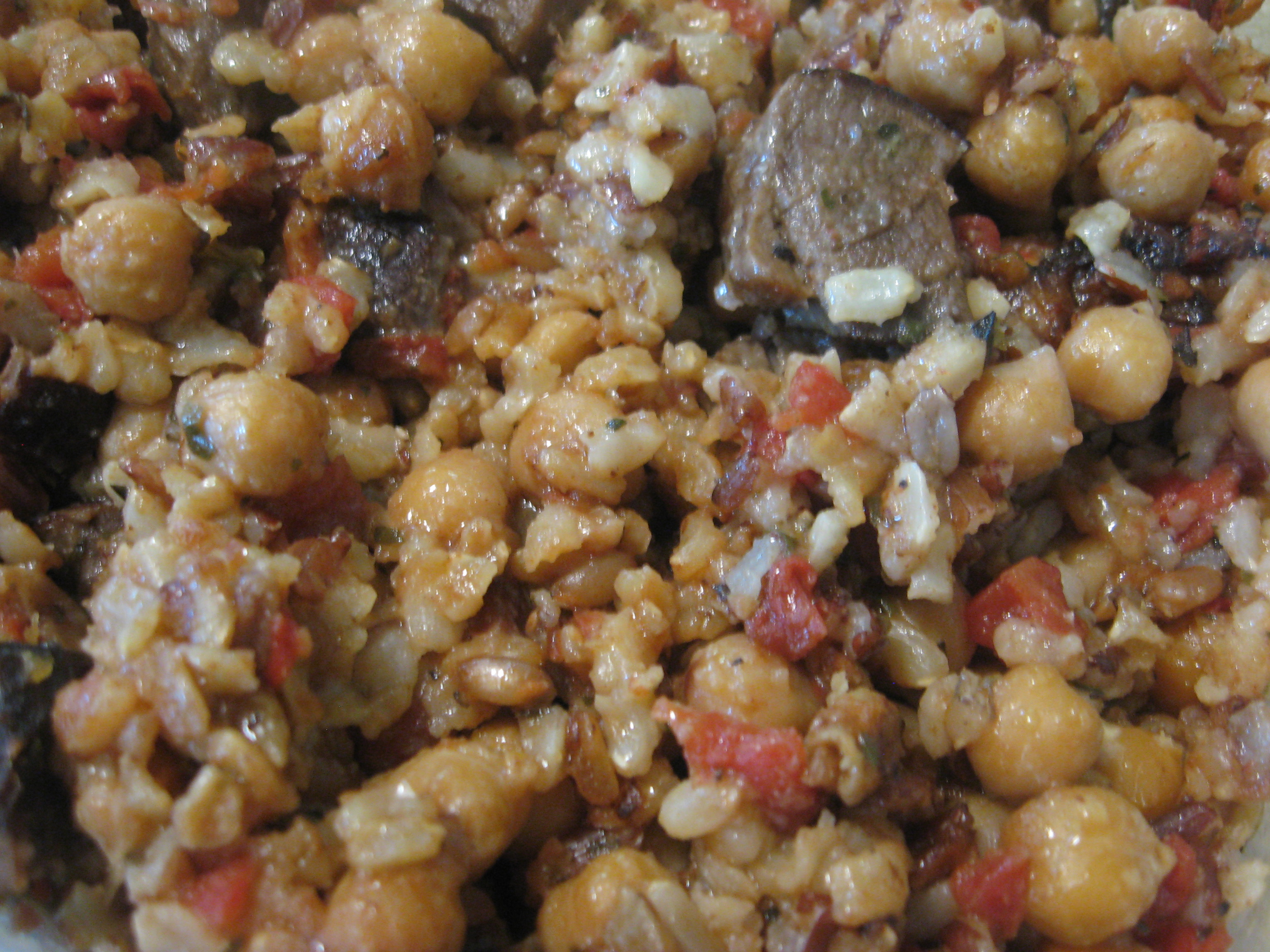
Often the remains of a beef steak or a pork chop goes into a sandwich–since roast beef, lamb, or pork is not on the single-serving menu. Other times it does some metamorphic changes.  The remainder of this steak went into the rice cooker with a convenience mix of grains,  some garbanzo beans to give me some additional meals that were not meat-centric.

Ingredients

  • about 1/2 pound of cooked lamb steak, cut into 1/2-inch pieces
  • one 15-ounce can garbanzo beans with liquid
  • one 10 ounce can of diced tomatoes with jalapeños with liquid
  • 1 cup of brown basmati rice, red rice, barley, and rye berry mixture (uncooked)
  • 1 tablespoon olive oil
  • 2 bay leaves
  • 2 teaspoons dried Turkish oregano
  • 1/2 to 1 teaspoon garlic powder
  • 1 to 1-1/2 teaspoon onion powder
  • 1 cup water (to bring total liquid to amount required for grains)

Preparation

  • Add all ingredients to rice/multi-cooker, stir well.
  • Set on rice cooking mode.
  • When cycle finishes, check grain for doneness.  If needed add more water in 1/2 cup increments until grains are done.

Ò¿Ó

Since the lamb steak had been well-browned on the griddle, it provided good rich flavor for the grains and the garbanzo beans.  Some of this was an extra meal (with a side of ratatouille), and the rest was packed (with the Handi-Vac®) for the freezer for later (especially cooler weather) meals.

mixed grains with tomatoes and lamb

Lentil, cabbage, and bacono salad

I’m on about under-appreciated vegetables this evening. I just reblogged a post on beet soup so now it’s on to cabbage (which I think is also under-appreciated–just relegated to “slaw” which is often just horrible). This is a great modification of this recipe. Thanks!

Al dente adjustment to a Jacques Pépin lentil, cabbage and bacon salad

Oven-braised lamb and garbanzo beans

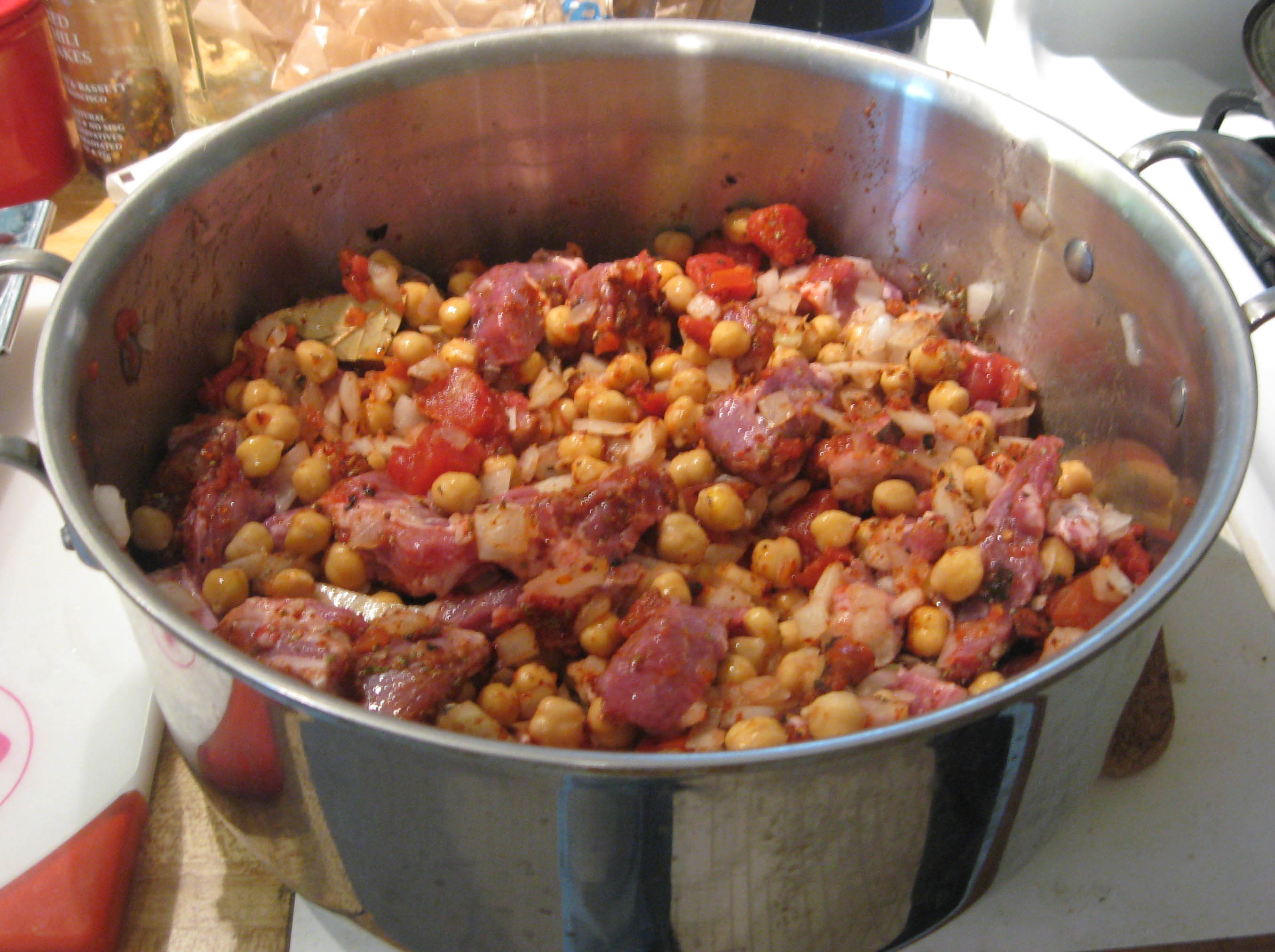
It’s another grey day–unseasonably warm, but at least not hot, sticky, and terribly humid today–the kind of day when you need to smell something cooking–long, slow, and tantalizing.   I found lamb shoulder chops on special (2-1/2-pound package) at the grocery store, I decided to try the lamb/garbanzo slow-cooker thing in the oven since it’s not too hot (and I’ll use the oven to prepare a second dish for reheating tomorrow (acorn squash stuffed with Sicilian sausage).

Book coverThe slow cooker version of this concoction was really good, but I thought it could be improved by doing it in the oven. Even after reading the Cook’s Illustrated Slow Cooker Revolution (volume 1), I am still not a wild fan of the slow-cooker.  I use it because it does some things well, and is necessary at times to fit cooking into a working schedule.  The Slow Cooker Revolution has improved my slow-cooker results immensely, mostly because I’ve discovered some unusual ingredients that can improve flavor.

My impression was that many of these recipes required more preparation time than I would be able to put into a slow cooker recipe, given that I use it for utter simplicity.  I’m interested in seeing what comes from volume 2 of the Slow Cooker Revolution.  If I have to do a lot of preparation for the recipe, then I might as well not use the slow cooker.  I still find that I like over-braising when possible; however, I do find I’m using the slow cooker even more since I read the first volume of this book. That said, I still prefer oven braising, especially if I’m working at home.

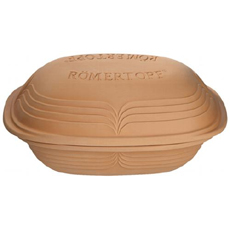
Romertopf clay baker (oval)I had intended to do this in the Romertopf, (one of my favorite things for roasting and baking hearty, peasant-style comfort food in the winter) but by the time I had boned the lamb and added other ingredients, it wouldn’t fit in either of my small ones (great for single-serving cooking), and was not enough to fit in my large Romertopf (for roasting whole chicken, for example)–so it was the Dutch oven for today.

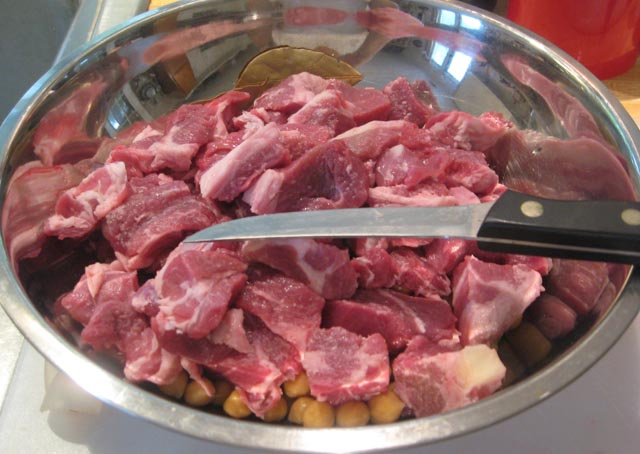
(Shoulder chops are reasonably priced, and the boning doesn’t take long if you use a boning knife rather than trying to do it with a paring knife or chef’s knife.  Those bone went into a saucepan with a tad of salt and some bay leaves to make stock.  After boning out, I had about 2 pounds of lamb, so that’s what I started with.)

Oven-braised lamb and garbanzo beans

lamb from chopsIngredients

  • 2 pounds lamb (from boned shoulder chops)
  • 2 14.5-ounce cans of garbanzo beans, drained and rinsed
  • 3 large onions, chopped
  • 1 14.5-ounce can of fire-roasted, diced tomatoes with juice
  • 2 tablespoons of Hatch chilli powder (used for the slow cooker), but more added after tasting this halfway through cooking
  • 2 teaspoons of salt, or to taste
  • 1 tablespoon fresh Mexican oregano, minced
  • 1 cup water

PreparationIMG_7667

  • Put everything in pot
  • Cover
  • Pop it into the oven, and check for liquid in an hour
  • Go get laundry or whatever, then check liquid again

-<>^<>-

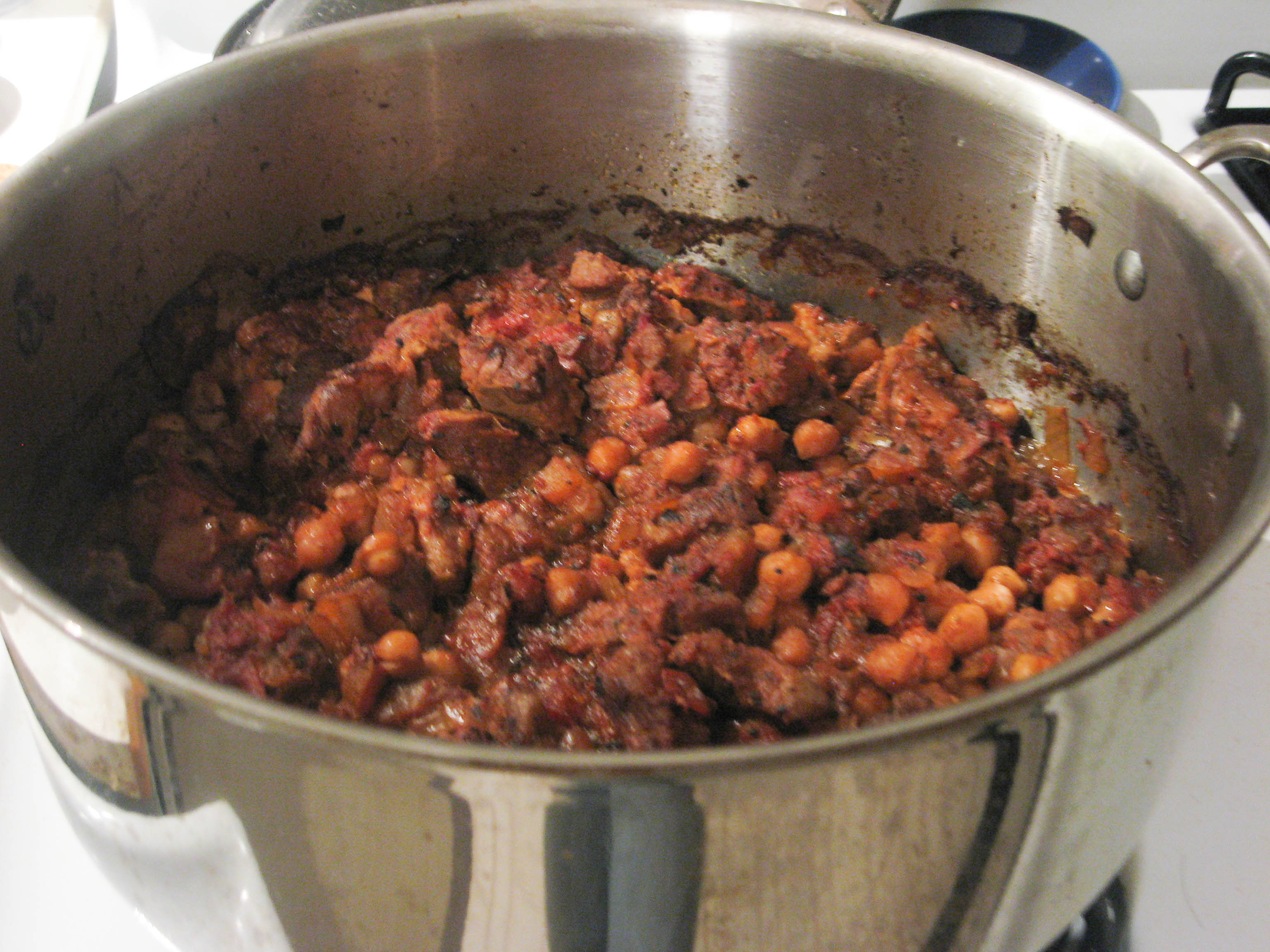
In order to be as much like the slow-cooker, I did not brown the meat or cook the onions separately–just combined everything, covered, and put in a preheated, 300-degree Fahrenheit oven.  I added 1 cup of water to start, and checked in one hour but there was plenty of liquid.

On tasting, I found it needed more than the 2 tablespoons of chili powder so I added about 1 tablespoon more, stirred, covered, and let it continue to cook. There was plenty of liquid, so next time, I’ll not add any water–just rely on the juice from the tomatoes, onions, and meat.

-<>^<>-

The stock made with the bones smelled really good–if more liquid had been needed during baking, I would use some of the stock.  There was some meat from the bones in the stock, but I not enough to spend time picking off, although I’m not compulsive about trying to get every bit off when I bone meat like these chops. Since I started the stock in cold water, the meat that was left was pretty flavorless, but the stock was good.

-<>^<>-

There will be a next time for this–and unless I’m really pushed for time, or can’t leave the oven while I’m out, I’ll opt for the oven method to cook this–a much more complex flavor with the same ingredients, likely attributable to the bit of evaporation that takes place in the oven but not in the closed slow-cooker.

Getting this added flavor lead me to consider the energy used in the various cooking methods–the energy required for cooking is certainly part of the energy required to make that food edible–the energy  of production and transportation, and the cooking is all part of the picture: the footprint of feeding me. We cannot ignore the energy used for cooking when we talk about other energy costs associated with our food so I spent some time browsing to find information on different cooking methods.

In trying to research this issue, I’ve perused many different sources–and the gas/slow cooker comparison is difficult, and I get the feeling that the answer to which is more efficient is an “it depends” situation.

Interestingly, an article on slow cookers versus electric ovens from the University of Connecticut Sustainable Living suggests that there may not be a significant difference in energy use.  SFGate discusses gas versus electric energy use, which gets more complicated, but I’m not sure that there difference is significant enough to make me give up oven braising, even though I’d like to minimize my “carbon footprint” as much as possible. If my slow cooker requires eight or so hours of cooking, and my oven braise requires only two or three hours on low to medium heat, then it may be a toss-up, since the slow cooker doesn’t cycle, and the oven (gas or electric) does.

Oven braising in the wintertime helps warm the house so probably cuts my heating use some, but I’m certainly NOT going to oven braise in the summer and increase the use of air-conditioning.  There is lots of conflicting information out there on the ‘net.  The “best” I found was from the Consumer Energy Center (California Energy Commission)–from that information, I’m not going to give up oven braising for the slow cooker anytime soon, but I’ll still use the slow cooker for some things.

Cover, pressure cooker perfectionOne comparison that I’d really be interested in is slow cooker versus pressure cooker energy use, and taste of the same dish prepared in both. Most data that I found suggested that the slow cooker wins on convenience, and the pressure cooker on energy saving. A taste comparison would certainly be interesting.  I’m almost certain that a pressure cooker can’t replace a good old-fashioned slow braise in the over.

I’ve recently started playing with a pressure cooker–it’s a lot different than what my mother used. The recipes in Pressure Cooker Perfection have been a good starting point. I suspect that I’ll be using a pressure cooker more  in the future, as well as the slow-cooker. Climate, air conditioning, and heating, are all things that will enter into my decisions. I’m also trying out an portable induction unit which is supposed to be ore energy efficient.

So many options for energy efficiency–but what about taste?  I doubt that any other method is going to come out tasting like an oven braise, no matter how many umami-enhancing ingredients you add.

A son goût!

Dutch oven with lamb and garbanzos

very simple, very tasty

Celebrating the autumnal equinox.

I woke up to a lovely fall morning–sunny, breezy, cool–absolutely lovely day, some leisurely time over coffee in the sunny kitchen, and realized that I’ve gradually been shifting into autumn cooking mode–cooking urges that are very different from the hot, humid weather of summer.

I’ve been making meals in the multitasking rice cooker lately: whipped up a great spicy lamb and garbanzo bean stew and another of braised pork and collard greens.  Some of immediate use today, and some of each of those to stash in the freezer for quick meals on a cold winter day when I need serious comfort food.

The lamb and garbanzo “stew” was one that I literally threw together in about 15 minutes while I was finishing an index to send to a client. A good friend who knows how much I like to use chili peppers gave me a wonderful chile powder from Made in New Mexico.  I used lamb shoulder chops, a healthy batch of chile powder, some Mexican oregano,  Goya garbanzo beans, and a can of diced tomatoes. The lamb chops came out of the slow-cooking melt-in-your-mouth tender, with just enough spice to accumulate a bit of burn by the time you’ve eaten a bowl of it, but not enough to rip you taste buds out by the roots.  This chili powder is the best I’ve ever used–I’ll be ordering more of that one.

Another job that just could not be put off any longer was cleaning the gas stove. It is one of my very least favorite things to do so I do tend to procrastinate about it; that does not make the task any easier and I know that but I still procrastinate about it. (I think that a house elf would be a wonderful thing to have around!)

Now the stove has at least had a  lick and a promise as my grandmother would have said. Well, at least the lick, but still needs the promise though that is going to happen today. (Definitely no pictures here!)  So happy that the oven is self-cleaning since it gets lots of use in cool weather for carefree braising while I’m working at home.

Now I’m ready for a plate of braised pork and collard greens!