Holiday gift shopping…2016

That time of year again! I’ve sworn off malls, and almost any shopping until after the holidays. I find I have zero tolerance for the chaos of parking lots and stores. Somehow those places really dampen any holiday excitement that I do manage to have: folks that can’t manage to allow two-lane traffic in a wide lane, bumps in the butt with shopping carts, and the like. Not to mention the choice of music in so many stores. But if you still need to do some holiday shopping….

  • For the cookbook lover who has an incredible library but is constantly cursing about not being able to find a recipe, a membership to Eat Your Books will let them search those books, as well as magazines, and blogs for recipes. (Membership information here.) It is definitely worth the bit of effort it takes to get you books on you searchable bookshelf.
  • Bull City Olive Oil specializes in fine olive oils, vinegars, and other provisions (shipping is available). If you are local (Durham NC) you can taste before buying. I’d not been a particular fan of infused oils until I tasted some there. The combination of herbes de Provence infused oil and lavender infused balsamic vinegar makes an awesome vinaigrette!
  • Cooks always love herbs and spices–if you don’t want to make the decision on what to give Penzeys will provide a great selection from which to choose. Personally  I love the small jars, especially for things you want to try, but may not use in huge quantities. Although I don’t keep many mixes on hand I wouldn’t  want to be without the herbes de Provence–it’s the jar that I reach for when I am rushed or just can’t decide what to use.
  • Spirits are always welcome gifts. My latest “booze” discovery is from The Brothers Vilgalys Spirits. They produce Krupnikas, Jabberwock, Zapod, Beatnik, and Beebop. I know I’ve mentioned these before, but I think they still make an excellent gift.
  • For someone who wants to learn more about cooking, The Science of Good Cooking presents techniques used in the kitchen with some good recipes; eat well while you learn to understand what goes on in the kitchen. In the same understand-what-you’re-doing vein there’s  Cook’s Science Cook’s Illustrated .com, Cook’s Country.com or a subscription to  America’s Test Kitchen membership that can give access to these last three sites.
  • For someone who wants to butter their toast without using cold, hard to spread butter, the Butter Bell crock, or the Emile Henry butter pot, or a plethora of others which work on the principle of using a water seal to keep the butter from air exposure. Caveat: you do have to remember to change the water every couple of days, but it’s a pretty small effort for soft butter. (Unfortunately, I’ll have to mention a solution that doesn’t work although it seems like a nice idea: the Cook’s Innovations Butter Mill. According to reviews some do work–mine didn’t–the fine threads just didn’t catch so the butter moved down to the “grating” surface.)
  • Your toast eater might also appreciate some topping for that buttered toast: varietal honeys from Old Blue Raw Honey–an impressive selection–including poison ivy honey.
  • For the cook who wants to explore using fresh herbs there are seed collections of basic culinary herbs: seed disc collections (complete with pots) from Johnny’s Select Seeds,  or just collections of herb seeds.
  • The potato of the month club from Wood Prairie Family Farm might suit for a “meat and potatoes” person. The variety of potatoes is absolutely amazing–and yes, they do taste different from what we’re used to in the supermarket.
  • For excellent citrus fruits Mixon Fruit Farms can provide luscious fruit shipped right to the door–grapefruit, oranges, lemons, or other. Even the white grapefruit will surprise you.
  • There is always a gift certificate for Kindle books  (or other e-readers) and a Lékué popcorn popper to provide a cozy, relaxing evening. Of all the microwave popcorn poppers I’ve tried this is a hands-down winner.
  • For some exotics like truffle butter, game, kits for making cassoulet, or charcuterie (which you might be invited to share) D’Artagnan can likely provide what you want.
  • Finally, another option for relaxation to go with the book or the Kindle gift certificate, a good cup of tea would add a final touch. Check out what’s available from Harney & Sons provides an incredible variety. One of the things I like so much about getting my tea from them is that for a small charge you can get samples of the teas–enough to brew a pot to really taste the tea. Frankly, I love trying different ones, so I’d be happy with a selection of samples as a gift!

Some other gift suggestions here, here, and here–there may be some redundancy, but some thing appreciated by cooks never change. My redundancy will probably give you an idea of what I’ve had to replace during the year–e.g. Krupnikas!

Disclaimer:  I have neither affiliate connection nor do I receive any consideration from any of the sources suggested above–they’re simply my personal preferences, so you decide. I’m sure that some of the things are available from other sources as well, perhaps less expensively.

Pork confit


Cool weather inspires cooking! Something warm and cozy–confit as a “pantry” staple for a starting point for multiple dishes. With the weather a bit up in the air I decided to make something that would give me lots of possibilities even if Matthew decides to visit.

Confit was originally made as a method of preserving meat–often duck or goose, but it’s a method that can be applied to other meats, fish, and seafood–e.g. tuna which I love for summer salads and cold meals but it’s a great starting place for cool-weather meals too. The traditional method is to poach meat in fat (oil) at low temperatures which yields meat that is intense in flavor, and absolutely luscious in texture. If you’re wondering, it’s NOT greasy! The Science of Cooking addresses many of the questions often asked about confit.

With cool weather here I decided to opt for my favorite meat–pork–and to try a slightly different method of achieving the end results. This inspiration sprang from finding country-style spare ribs on special at my local Harris Teeter market. Since the weather wasn’t quite cool enough for me to want to have the oven on for hours, I decided to use the my multi-function pot in slow-cooking mode to make pork confit.

packaged pork from the meat counter in the supermarket

Since country-style spare ribs have a lot of fat on them I decided that I didn’t need to submerge them in oil–the fat would render from them as they cooked in the slow-cooker. From experiments when I was trying to do monk fish sous vide, I knew that the slow-cooker mode would keep the temperature at 185ºF. Most confit recipes suggest temperatures between about 190ºF and 200ºF. I thought 185ºF would be workable (especially since the confit will be refrigerated after cooking) but will be covered with the rendered pork fat.

I took my country-style spare ribs and salted them liberally over night–e.g. “dry brine”, then rinsed, and patted them dry. Because of the fattiness of this cut, I added only a couple s tablespoons of olive oil in the bottom of the cooker and packed in the meat. I didn’t add seasoning other than the previous salting so I have a flavorful (but kind of “blank” canvas) to build other dishes. I set the cooker for eight hours and went on to do other things–like hive inspections.

The liquid which (intensely flavored broth/gelatin) was separated from the fat that was rendered and will ultimately make its way into soup or as “au jus” with the confit. The meat is now tucked away in the fridge sealed in the fat. Since this was originally a method of preserving meat, now with the addition of refrigeration, there is a long shelf-life if you separate the broth/gelatin liquid from the fat and then “seal” the meat in the fat. Old method, but useful in modern cooking.

This cooking method works with any meat–a favorite in this household is confit made with chicken (especially leg quarters or thighs). I think that this fall as “turkey” season rolls around I will try to find thighs to cook this way. It might improve my attitude toward turkey given the flavor and texture changes that result from the confit process.

The result? Absolutely as good as if I had done it in the oven though requiring less added fat than I would have added for that method.  Enough fat rendered to submerge the meat about three-quarters of the way up the sides. Even without additional seasonings the meat is luscious immediately after cooking–pure unadulterated pork flavor.

What’s on the menu for supper? Well, I’m thinking cabbage steak (done under the broiler) with pork confit that has been quickly reheated and browned (also under the broiler) but with the tahini sauce replaced with the juice from the confit process.

Ô¿Ô

Krups rice cooker IMG_3796

.


Steamed eggs?

Browsing through my email cooking subscriptions, I found an article that made me think of my egg cooker–one of my favorite small kitchen appliances is my egg cooker–yes, it’s a single-use appliance, but it’s worth the bit of space it takes up because it gets used often–to hard cook eggs that I want to have around for snacks and salads, to soft cook in the shell for breakfast, or to poach. It is so much easier than “boiling” in a pot of water; it eliminates cracked eggs, with funny alien looking growths. I can’t screw up the timing. Even in my minimally functional morning state, I can do the simple task of measuring some water in a Maveriick egg cooker IMG_3799specially marked cup to cook my egg. The buzz (truly obnoxious) when the eggs are done takes care of overcooking issues.

This is an inexpensive (under $20 even today and as you can see, well-used, Maverick) egg cooker–no fuzzy logic, nothing complicated. It’s just physics in operation. The eggs are cooked by steaming. There is an on-off switch, but otherwise, absolutely no controls to fuss with–except the cup to measure the water. (The cup also has a piercing gadget built right into the bottom of the cup so you don’t have to look for a thumb tack or push pin. So, you’re wondering why steam cooking eggs is better? A more tender egg white and a smoother yolk that is much appreciated by egg aficionados.

If you don’t have an egg cooker but would like to try steaming your eggs here is a link to an article from Bon Appetite on steaming eggs. You do have to watch the time with this method, but it would let you see the difference with steaming (which may lead to the purchase of an egg cooker); however, I not about to give up some other cooking methods like carefully scrambling in butter, poached in olive oil (video), or in Spanish potato omelette.

(Cook’s note: It would seem that the Maverick egg cooker has gotten more expensive, and a fancy version comes looking like a white hen; perusing Amazon.com for egg cookers, I see that there are still some basic cookers still available in that price range; given how happy with my Dash yoghurt maker, were I looking for a basic, inexpensive egg cooker I’d likely try theirs or the Better Chef.)


Homemade skyr

41ktixxzjwl-_sx425_I finally got a yogurt maker. I didn’t go for the Cuisinart with all the bells and whistles–just opted for the Dash which seems to do the basics.  I didn’t order hot pink, but that’s what I got; I can deal with that–I’m not going to be sitting around contemplating it–so long as it works–and it does do what it’s supposed to. I got the “Greek” because it has a strainer with it and it does bulk yogurt instead of little itty, bitty jars.
Of all the commercial yogurts I’ve tried, the Icelandic Products Skyr is my favorite. I looked at the cultures used in that: Streptococcus thermophilus Icelandicus™ and Lactobacillus bulgaricus bifidobacterium. These are noted as heirloom cultures. Since this is my favorite store-bought yogurt I decided to use that as my starter culture.

Most of the recipes that I found for skyr called for rennet but that’s not listed as in ingredient in the Icelandic Products skyr, so I’m not using it. The ingredients did say skim milk but since I’m still working on the Always Hungry? plan, which calls for whole milk products, I made mine with whole milk.

I used 8 hours 30 minutes for my first batch. The texture after straining was great but for my taste, it needs to be just a bit more tart so I’ll try using 10 hours next time. Perhaps after I get off the Always Hungry? program, I’ll try skim milk and see how that works.

I’ve used the whey that was strained off to thin the consistency of the power shake just a bit instead of pouring it down the drain since I’m adding whey protein powder to the shakes. Though it’s a bit richer tasting than most commercial yogurts, it seems to work fine in all the uses called for in the meal plan.Certainly much cheaper than buying Greek yogurt–and I know exactly what is in it.

20160715_153827

Holiday time again….

Like it or not the holiday season approaches. I’ve one Christmas gift to order yet, but then I’m through. I thought I’d pass on a few suggestions for gifts for those of you who still have a cooking person on your list to shop for:

  • Volrath French carbon steel skillet: probably my most-used, it has the advantages of cast iron, without the weight.
  • Romertopf clay cooker: a go-to especially for one-dish meals in cold weather.
  • Home espresso machine: Can’t start the morning without my jolt of caffeine either straight espresso or café latte.
  • Clever Coffee Dripper: If I’m not wanting quite the jolt of espresso this gets something more like French press, with the benefit of a filter to eliminate the sediment.
  • Kunh Rincon garlic press: If garlic is a cooking necessity, a garlic press can be a time-saver, or it can be a total nuisance when you have to clean it, so you don’t use it. This is a good one, recommended by Cook’s Illustrated after testing lots of them.*
  • Max Burton Portable Induction cook unit: Live where it’s hot and humid in the summer? You just hate to turn on the stove? Induction cooking is much cooler–though it does require cookware that is either stainless steel or iron.  If a magnet won’t stick on your cookware, then you need the Hob Heat Diffuser that will allow you to use other cookware with the induction unit.
  • Pressure cooker: The Fissler FSSFIS5859 Vitaquick Pressure Cooker was the winner of the Cook’s Illustrated testing* and is pricey.  The runner-up was the Fagor Duo line, less pricey, highly recommended and noted as “best buy”. (This is the one I’ve used.) This cooker does work with induction cook units–a real plus in hot, humid weather when you still want those dried beans cooked.
  • Fasta Pasta Microwave pasta cooker: This is a real gem to have in the kitchen! So much easier than boiling that big pot of water–again great in hot, humid weather, but once you start using it, you’re hooked. Again this is a kitchen “gadget” that was tested by Cook’s Illustrated.*
  • If the cook you’re shopping for is just getting a kitchen set up, there’s always some of the essentials for good cooking: Penzeys herbs and spices, either basic, for bakers or for the cook starting to branch out, a do-it-yourself box of specialty herbs and spices.  If you have someone on your list who has to watch sodium intake, there are lots of salt-free blends. If you buying for a cook pressed for time, seasoning blends can be real time-savers–in my kitchen I don’t want to be without herbes de Provence for that time when I’m just too rushed to think blending my own.
  • For relaxation and enjoyment,  either alone or with company, a selection off teas to have on a leisurely morning, or relaxing afternoon break.  Harney & Sons Master Tea Blenders have a fantastic selection–black, green, herbal, flavored, and all the accessories necessary to make a special occasion. Teas can be ordered individually, or there are collections ready made.  If you’re unsure what tea would please your “giftee” most, then send a selection of samples–for a modest $2 you can send enough to brew a decent pot of many teas. Some very expensive ones–e.g. Black King which rings up at $240.00/pound–the sample may run $5. What a great way to let someone explore fine teas–treat yourself.
  • Like a liqueur to sip while relaxing? If you’re in North Carolina, there are some lovely liqueurs made in Durham by the Brothers Vilgalys: Krupnikas, a spice honey liqueur would be a real treat, or look at the unusual liqueurs they make: Beatmik, Beebop, Zaphod, and Jabberwok.  All are great in cocktails, for just sipping straight, added to hot chocolate or hot cocoa.  If you’re not in North Carolina you may still be able to get these delightful liqueurs through other distributors.

Wishing you and your favorite cook very happy holidays–lots of good food, friends, conversations, as well as wines and spirits!

__________________________________________________________

*Cook’s Illustrated equipment testing is done without manufacturers knowledge until after publication, and products tested are chosen for consumer benefit. They do not accept requests for testing from manufacturers.

.

Ò¿Ó

.

Breakfast

Nutritional information—or what passes for it—abounds on the internet and in books that you can check out from the library, or find as you pass through the checkout line at the grocery store, but it’s frustrating. It’s constantly changing. Many—really most of us—don’t have the background in physiology, medicine, or the time to do our own detailed research to assess it. You can read the books, e.g. Good Calories, Bad Calories ( (Taubes, Good Calories, Bad Calories 2007), Why We Get Fat ( (Taubes, Why We Get Fat: And What to Do About It 2010), or The Big Fat Surprise (Teicholz 2015) which are extensively researched and well documented. But it still can be confusing, especially if you want more specific information. There’s the Paleo diet, the Atkins diet, the Mediterranean diet….and even The New Atkins for a New You (Westerman and Phinney 2010). So much information, so much controversy. . .

Then there are the things that our grandmothers told us—eat your veggies, and your fruits—but the one that I remember most is that breakfast is a must-have meal. That seems to be one of the less controversial bits of advice out there. There’s only one problem—breakfast is supposed to happen when you wake up. Now, according to the Merriam-Webster Unabridged Dictionary, wake up, awake or awaken, means to “stop sleeping”. The problem is that for some of us awakening is not the same as achieving a state of functioning (“performing a group of related acts and process” according to the dictionary). We awaken, and the functioning state is bestowed later–sometimes much later and only with an appropriate amount of caffeine.

Every time I have to say whether I’m a “morning person” I face a quandary—I love early mornings—the cool part of the day, with the inspiration of the sunrise. So in that sense, I’m a morning person. Add functionality to that and there is a problem. Until I’ve had my morning cafè latte or espresso function is simply out of the question. Making breakfast requires functioning—albeit minimal. I can manage the kind of functioning required to get the espresso machine to spit out the liquid caffeine portion of my latte. Actual breakfast is another issue.

Another issue for me is that first thing in the morning, even as much as I love breakfast food, I don’t want to eat. Food? Yuck! So I have my two café lattes, and by then I should be at my computer working on the current index—breakfast gets another miss.

Every New Year (and probably again this coming one) my resolutions include eating more healthily. That would include giving my body morning fuel. Every year it goes by the wayside because of non-functioning in the morning. So I’m attuned to things that will get me food with least effort in the morning. I’m willing to admit that cooking eggs seems pretty simple, but diet-wise I doubt the nutritional wisdom of bacon and eggs daily partly from the caloric point of view.

In the winter (especially if the view from the kitchen window reveals a cold, grey, damp, day) a breakfast favorite is oatmeal (don’t DO cold cereals on a taste or nutritional basis). Specifically, I want oatmeal with some tooth to it—which really eliminates the quick stuff. I want the steel-cut, slow-cooking stuff. It’s the slow-cooking part that hurts. So I’m constantly on the lookout for things that might help me keep that New Year’s resolution—and maybe even contribute to more healthy eating (and weight loss.

If you search the web, you can find numerous suggestion on how to cook steel-cut oats—some reducing the cooking time to 30 minutes. Even with that, it’s still not in my range of morning functionality—I won’t enumerate the number of ways is possible to screw up when your functioning is barely above brain-dead.

In my recent perusal of the blogs that I follow I was delighted to see a post entitled How To Make Oatmeal in Jars: One Week of Breakfast in 5 Minutes. First of all, it promised make-ahead, and then you’ve probably gathered that I’m a fan of Ball/Mason jars so I have lots of those around.

The prep is simple (see full post for discussion and details)

  • Combine 1-2/3 cups steel-cut oats with 4 cups water, ¼ teaspoon salt.
  • Bring to boil and cook for 3 minutes.
  • Put it into jars, and when it reaches room temperature, cap and refrigerate.
  • To eat, microwave 2 to 3 minutes, add whatever you wish and eat.

My only change to this is something I’ve done for a long time when I’m cooking oatmeal—substitute milk or oat milk for 3 cups of the water and divide into 7 servings since I just don’t eat that much in the morning. The three-minute boil gives chewy kernels; I actually prefer just a bit less chew, so I boil for 5 minutes.

I like to use 1/2-pint jars for this as they will sit in a coffee mug so I don’t have to handle the hot jar or put it into something else to eat–admittedly I do at times end up taking my breakfast on my “commute” into the office and eating at my desk. (I know–not a good thing to do, but it happens when deadlines are close.) Filled only to about 2/3 there’s still room to add things on top–then this recipe works for about 7 days.

Another alternative to “quicken” up the steel-cut oats is to do an overnight soak at room temperature; Maria Speck, in her book on ancient grains, suggests that this will reduce cooking time to about 7 minutes.  My issues with this are that it requires planning ahead. Once the oats are soaked, they need to be cooked. I am, admittedly, a very temperamental, picky eater: I might wake up not wanting to eat oats for breakfast. By precooking and refrigerating, I do give myself a little leeway to be picky without throwing something out.

On more relaxed mornings, I’ll make other versions of steel-cut oats. A favorite is from Alton Brown via the Food Network. Love the toasting before adding liquid. Adding the milk and buttermilk adds richness and tanginess. His point here about stirring in the dairy does make a difference. I’ll admit to not being the owner of a true Scottish-style spurtle but a Holland-style spoodle to be a bit gentler with my steel-cut oats.

Now, for breakfast. . . a drizzle of some luscious varietal honey like French lavender, tupelo, sourwood, or maybe leatherwood, or thyme, or just wildflower or clover, or orange blossom, or maybe just some butter, or possibly milk, or…it may well depend on what I see from my kitchen window!

Ò¿Ó

Kitchen disaster. . .

. . . but a happy, tasty ending.

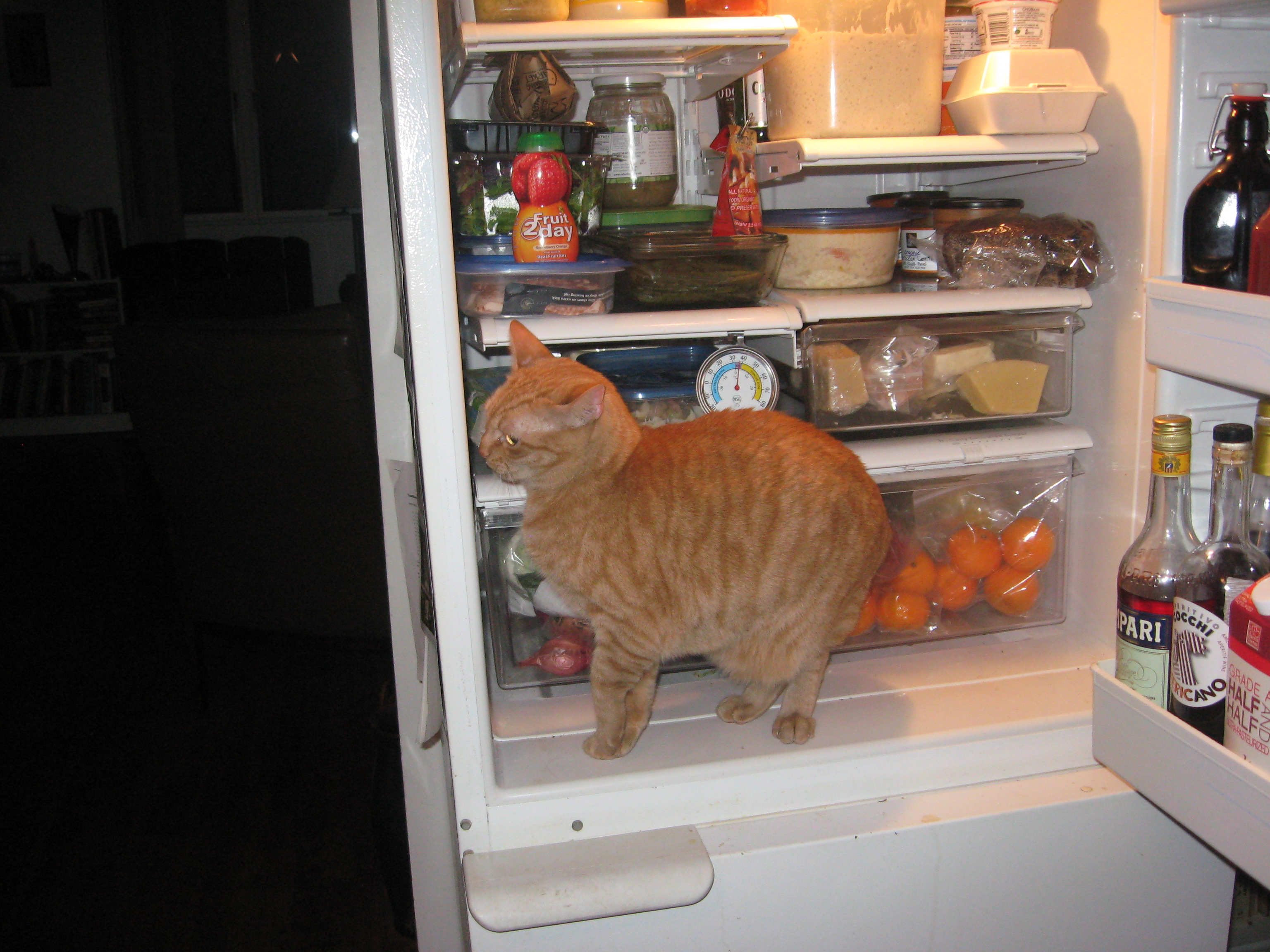
Cat looking into refrigeratorI’m feeling a cold draft–very cold draft–around my ankles!

I know I’m not dreaming though it’s the middle of the night or somewhere in the wee hours of the morning–I’ve come to the kitchen (without turning on the light) to get a drink of water. . . .

Cold draft? Really, really cold draft–on my ankles.

Reality gradually seeps into consciousness:  I’m standing in front of the refrigerator–which has a bottom freezer, which I have stuffed pretty full.. . .

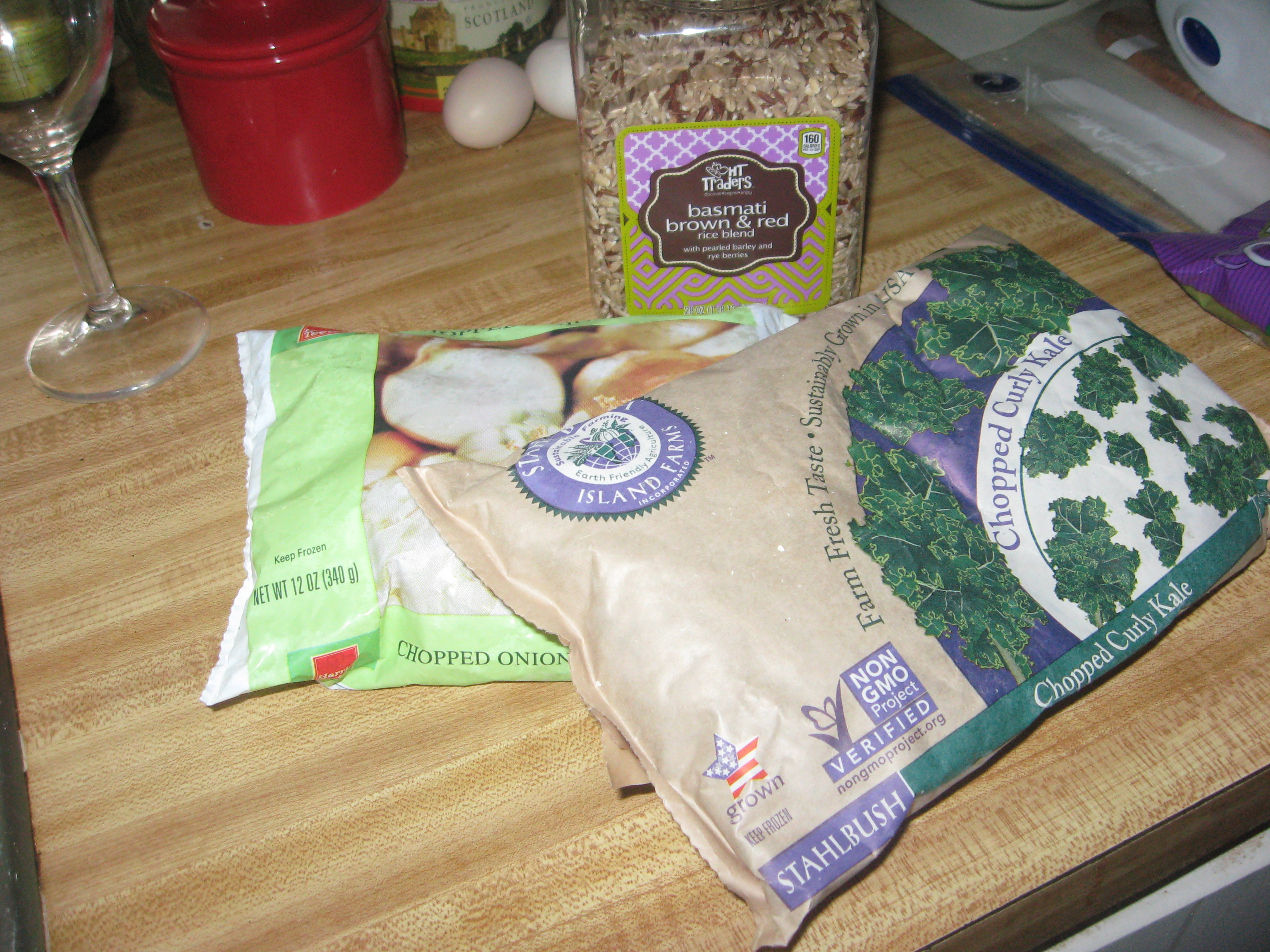
Light on. Obviously I’ve stuffed the freezer a little too full or something has fallen out of place. The freezer door is very slightly ajar. Even in my rather sleep-befuddled state, brain clicked on. Several epithets which should not be printed. Open freezer door and palpate the front packages: kale, butternut frozen onions, kalesquash, chopped onions. Soft, but not obviously completely thawed, but destined to turn into a huge clump of re-frozen vegetables.The only meat even close was a game hen which was still hard as a rock.

I closed the freezer door and checked that it shut completely, and tightly. Back to bed, knowing that I would have to do something with those veggies in the morning. (The ice cream was far enough back and in a corner that it was still hard or I guess I’d have been compelled to eat it right then and there–hmmmmm, should I go do a careful check on the ice cream?)

Morning after: I’ve got work that that to be done NOW so spending a bunch of time in the kitchen or skulking through cookbooks isn’t on my agenda. It’s time for some improvisation: take chopped onions, chopped kale and cubed butternut squash. . . .add some bratwursts that are in the fridge. Add a portion of mixed grains (brown basmati rice, red rice, barley, rye berries) and one multipurpose rice cooker.

I’m sure you’re not surprised that I’d resort to the rice cooker, given all the other things I have it to cook. Once you understand the physics of its function, it’s really easy to make it do what you want. So here we go again with the rice cooker.

Ò¿Ó

Kale, butternut squash with bratwurst

Cook’s note: first this is not a recipe–it’s an improvisational happening. Secondly, it’s recommended that you deliberately thaw the vegetables in the refrigerator or on the counter instead of the method described here if you wish to have them unfrozen. You can put frozen vegetables in the rice cooker without thawing unless you have a great big blob of frozen stuff. You can adjust the proportions of kale, onions, and squash as desired.

Ingredients

  • one standard-sized package chopped kale, thawed
  • one standard-sized package chopped onions, thawed
  • one standard-sized package butternut squash, cubed
  • 4 fresh bratwursts
  • 1 tablespoon olive oil
  • 1/2 teaspoon salt
  • 2-1/2 cups water (or amount called for in the cooking instructions of your grain)
  • dash of red pepper flakes
  • 1/4 to 1/2 teaspoon of oregano or herb of choice

Preparation

  • add olive oil to rice cooker bowl
  • add thawed onions and let sauté briefly
  • push the onions to the sides of the rice cooker
  • lay fresh sausages in a single layer and then redistribute the onions evenly over the bottom and partly over the sausages; they will brown lightly on the side in contact with the bottom of the rice cooker bowl
  • add 1 cup of grains
  • add kale and distribute evenly over grain and sausages
  • add red pepper flakes and herbs
  • add scant 2 cups of water; your rice cooker may need more or less, adjust as needed
  • close rice cooker and leave until it switches to “warm” function
  • stir contents (grains should be a bit underdone)
  • add remaining water
  • add butternut squash on top of greens, grain, and sausages
  • close rice cooker and leave until it switches to “warm” function a second time
  • check doneness of grain; if needed add a bit more water and wait again
  • when grains are cooked as you like them, serve!

Ò¿Ó

Despite the ridiculous circumstances that gave rise to this recipe, it was very tasty, and I’m sure some version of it will be made again. The combination of kale with the butternut squash was delightful. The combination of grains gives some interesting texture and flavor to the dish.

A son goût!

cat on kitchen counter

Leftovers. . . and second servings

One of the banes of refrigerator maintenance is leftovers. I work hard to avoid them, but I’m often defeated in my efforts, especially when eating out. So often restaurant servings are HUGE, and, sucker that I am, I don’t just leave the excess on my plate.  I bring it home, tuck in into the refrigerator, and then likely at some too-far-in-the-future date I get an odoriferous reminder that I now have to do something with the leftovers, which are likely to be found in the back of the refrigerator. They will most likely be unidentifiable now, so they go into the garbage.

cat in refrigerator

lookin’ for leftovers

The obvious first step is to think carefully about bringing home restaurant leftovers: Will it reheat well enough that you really want to eat it?  After all it probably doesn’t make much difference when it gets thrown out–then or a week later. If I decide to tote it home (and I already know that the cat won’t eat it), then I need to label it, and be sure that it doesn’t end up in the back-most corner of the fridge.  I have used masking tape (which comes off easily–often too easily), Sharpies (which can be removed from some things with rubbing alcohol).  I recently found a suggestion to use dry erase crayons (which I didn’t even know existed).  Might be worth a try, but better yet for me would be to be much more judicious in what I put into the fridge as a “leftover”.

“Leftovers” from my own cooking aren’t as much of a problem, but I’m always looking for ways to use the bits and pieces of produce or the last part of that can of beans. I’ve got a handle on the bits and pieces of bags of frozen vegetables and even partially on the celery.  But there are still bits  and pieces….

The Cook’s Illustrated books on cooking for two and Joe Yunan’s book (see bibliography) is the cross-indexing of recipes that use the same ingredient so you have a suggestion for what to do with the other half  of that head of cauliflower.

I’ve found several tools to help reduce waste in single-serving cooking. First from the kitchn is an article titled What to Do With…? 75 Tips for Leftovers and IngredientsThere is a long list of things from produce market, the refrigerator, and the pantry with suggestions of what to do with the extras. For a lot, the suggestions are “freeze it” which does not necessarily solve the problem–just moves it to some point in the future; however, there are some good suggestions.

The flip side of this is throwing away things that could reasonably be used. For some examples, see 10 Foods You Should Never Throw Away. I can agree with the cheese rinds and chicken bones, but here again, I think it’s easy to fall into the trap of just changing where you stash the leftovers. When you’re doing single-serving cooking you do need to consider carefully what you bring home and what you keep.  Also useful might be Top 10 Ways to Use Up Overripe Fruit.

Another article that is useful 15 Foods You Should Freeze in an Ice Cube Tray. There are lots of other things to freeze as “ice” cubes, and the put into zipper-lock bags for freezing.  Having these portioned out can make it easier to use them. One of the things I do with excess celery and carrots is to make mirepoix (soffrito) in a big batch, then freeze it in ice-cube trays. One or two cubes will be what you need for small-time cooking–and it cuts time from preparation, and should reduce waste!

Planning use as in having thought about possibilities for that second serving (no, not meal planning–I don’t do that), and shopping with single-serving cooking in mind should help. One way to manage what gets pushed to the back is to add a triage box to the fridge.  Triage  refers to the process or sorting, or assigning priority to something.  In the fridge it would be an eat-me-first box where you put things that have a short shelf-life, or perishables so that they don’t get pushed to the back of the fridge.


Refrigerator and freezer use

Admittedly we need a stove in the kitchen, but we also need the refrigerator–and it’s probably the appliance that we misuse most often. When I stop and think about the times that I’ve had to clean out the refrigerator because something got “lost” back there and made its presence known in a rather aromatic way, I know I need to work on this problem–yes, I’m writing this because I have to clean out the fridge again. . . .

We don’t usually stop to think about the micro-environments inside. I know that I often just open the door and plop something in without much thought to where it would keep best.

Just recently I found a series of articles on the kitchn on using and maintaining the refrigerator for best performance.  I thought I’d share these–I know that I do misuse mine–and I suspect (hope) I’m not alone.

Of course, then there is the freezer which can be wonderful, or a trap cooking intentions. Again, I’m facing the necessity of cleaning out the freezer after the recent kitchen disaster which was directly attributable to me just opening the freezer door and chucking stuff in–I think I need to stop and think about why I’m putting something in the freezer, and make a huge effort at organization.

This is a list of main articles–within each, there are links to other useful tips for managing the cold spots in the kitchen. Now,  off to the kitchen to attack the fridge!

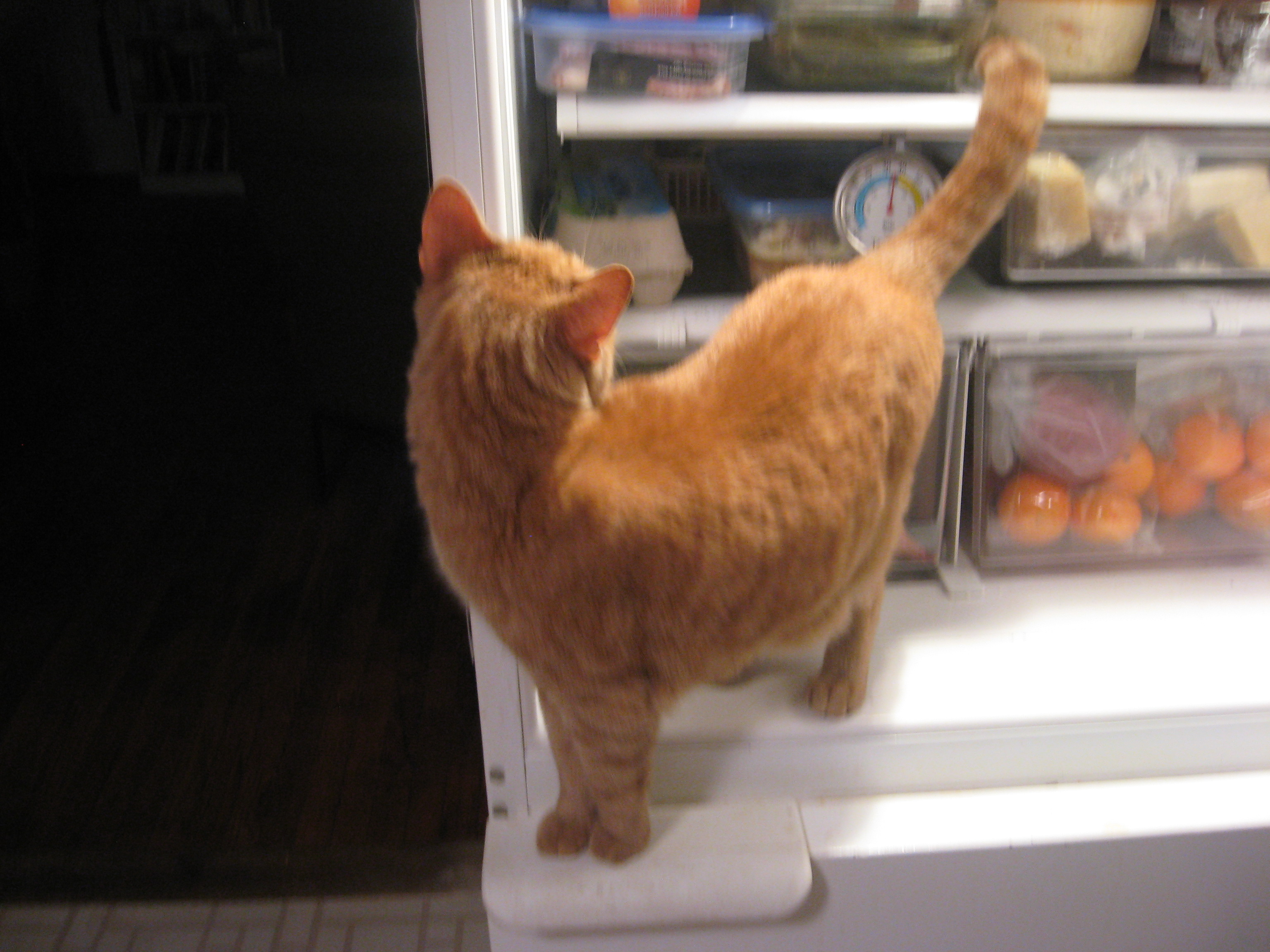
Cat in fridge

Vacuum pack it!

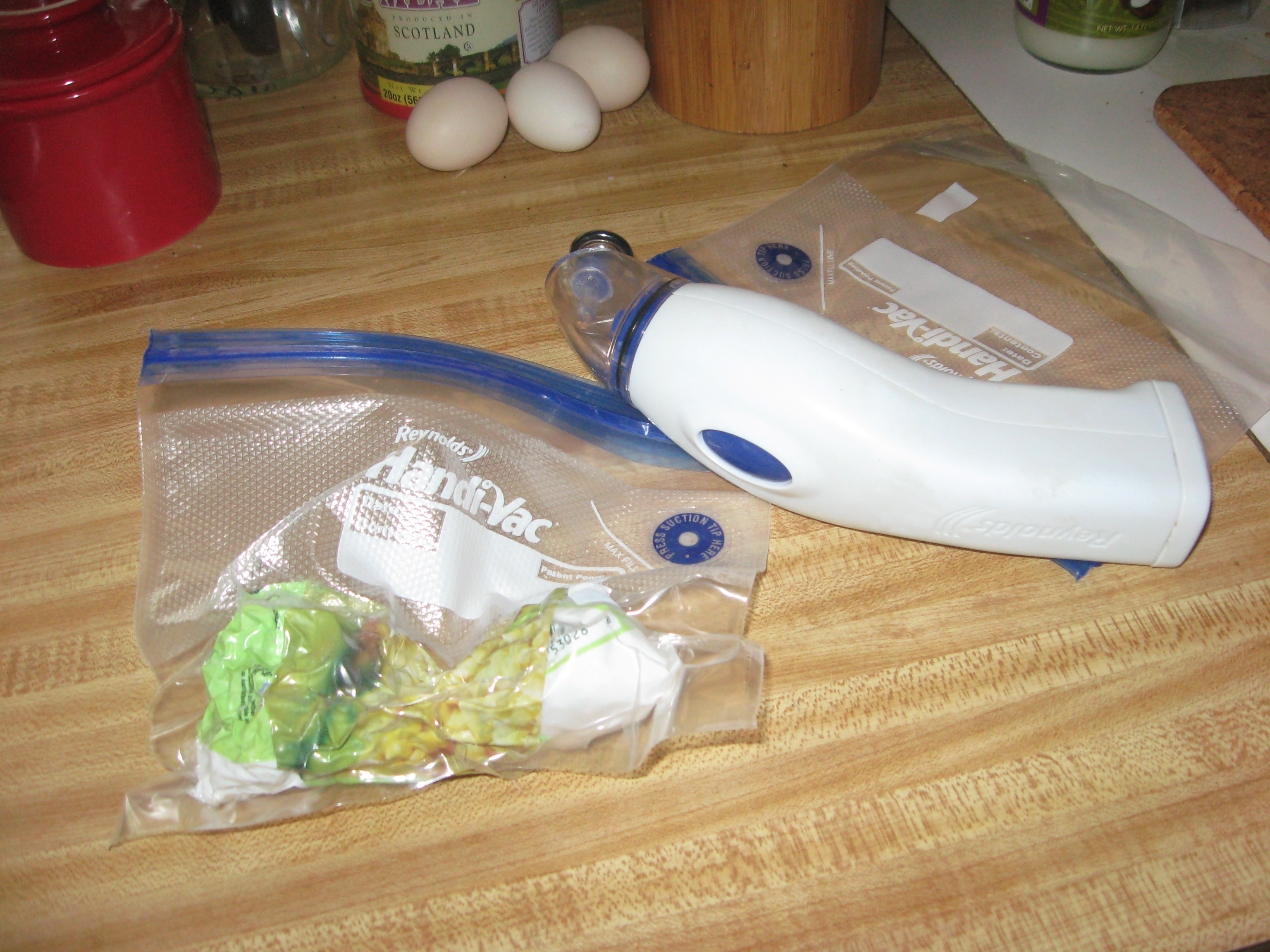
Reynolds Handi-Vac and bagWe all know about “freezer burn” that can happen when you put opened bags of stuff back into the freezer.  I’ve found something that ameliorates that. We’ve all observed that products that are vacuum-packed hold much better than those that are not. So–when I put opened bags vegetables back into the freezer, I use a clever gadget from Reynolds®.  Lest you cringe thinking expense–I’m not talking about the “big” vacuum sealing system.  I’m talking about the little hand-held pump and bags with a valve on them.

This is the Reynolds® Handi-Vac® system (reported to be discontinued, but still available from eBay and Amazon). It operates on AA batteries. For storing opened frozen products, I put the original bag, folded and air squeezed out into the vacuum bag, and vacuum! This is not as “hard” a vacuum as achieved with the counter-top vacuum sealing products, but it hides in a drawer and is inexpensive–no lost counter space which can be important.

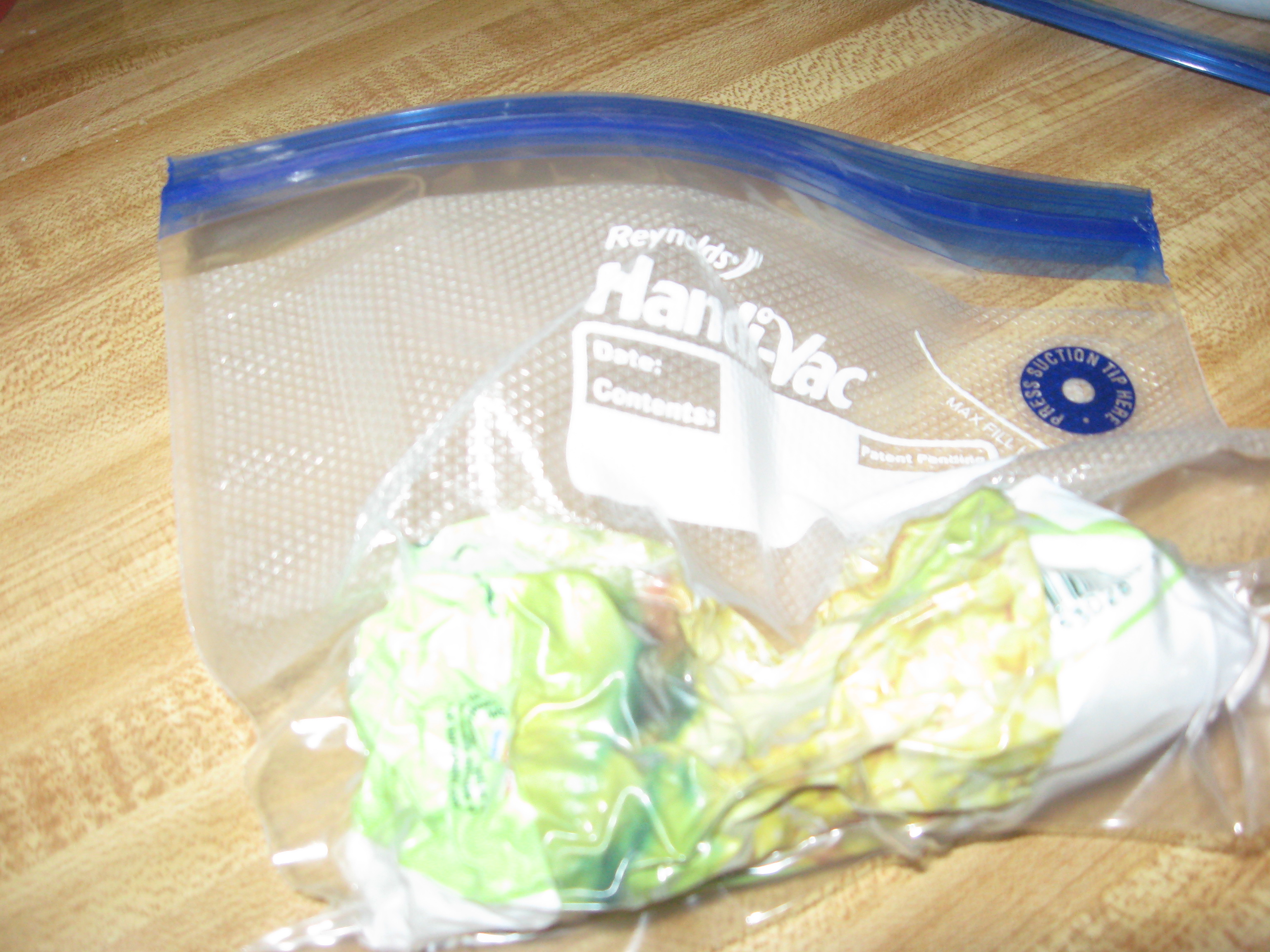
vacuum sealed cornIt does help extend the freezer-life of opened packages of frozen products. If it’s something I use a lot of (e.g the petits pois, or “baby” peas that only come frozen–we’re ignoring canned), then I may buy the family size package and portion and vacuum those in serving size.  For the most part, I leave the veggies in the original bag–this way I can reuse the vacuum bags. For meats or seafood, I generally don’t reuse the bags. I just don’t feel I can be sure that they are sufficiently clean.

Here is a partial bag of frozen corn (another thing I like to buy in bigger packages). I confess that I’ve not done any scientific studies here, but using this seems to have decreased the number of times I dump a partial bag because of the freezer burn.

I’ve also discovered that using this really helps with the celery dilemma common to single-serving cooking: wash and cut celery into length that fit into these bags (you can also get bigger bags), wrap in a damp paper towel, and vacuum seal. It’s’ amazing how long it lasts that way. When you wish to freeze servings of big-batch cooking you can use these if there is not much liquid, but it can be tricky. What I usually do for those is to put the food into a “light” storage zipper-lock bag, squeezing out most of the air, and then into one of these.  Again, I can reuse the bags; they seem to stand up to reuse quite well.

corn in vacuum sealed bagMy only experience has been with the Reynolds® Handi-Vac® though I’ve noted that Ziploc® and FoodSsaver® both now have hand-held systems (as well as the counter-top). Just from trawling the internet, I can’t tell if the Handi-Vac can be used with the Ziploc® or the FoodSsaver® bags; there’s contradictory information (what a big surprise).  Of note, the Ziploc® pump is manual rather than battery operated, and I would suspect that it will create a less strong vacuum than battery-operated pumps.

There’s an advertisement for an adapter for the Handi-Vac® pump to be used on Ziploc® bags. It’s called the “ReynLock Adapter™”; I’m NOT including a link because of the contradictory information I’ve found, and the price of the gizmo, and I’ve not used it so I don’t know anything other than the advertisement. (See My Opinion page, please).

Updates when I have more information because I will be looking for another product to do this.  Maybe I’ll be lucky and the Ziploc® bags will work!