Corned Beef for St. Patrick’s Day

Though it’s too late to get your corned beef this way, you can be prepared for next year! Corned beef is easy, and really good it’s DYI!

StefanGourmet's avatarStefan's Gourmet Blog

DSC07510
Happy St. Patrick’s day! It’s an Irish-American tradition to eat corned beef with cabbage on St. Patrick’s day. I usually don’t celebrate St. Patrick’s day (most people in the Netherlands haven’t even heard of it), but when I came across a recipe for corned beef with cabbage I thought the cooking technique was very interesting. You see, beef brisket is first cured in salt and spices (similar to the first curing of pancetta or gravlax), and then it is cooked. What finally won me over is that the recipe requires saltpeter (potassium nitrate, KNO3 or E252). Ironically, this ingredient is not available in Ireland, and so I bought it for Conor so he could make spiced beef. Although Conor only needed 12 grams, the smallest amount I could order was 2.5 kilograms.

10947257_957045920974339_1991779490484442380_n
I mailed enough of the ‘dangerous substance’ to Ireland for Conor to make spiced beef twice, and…

View original post 711 more words

A “roast” beef sandwich

Sandwiches are not just something to be thrown together without thought–definitely NOT two thin slices of baloney and Wonder bread!  They are a special kind  of meal–sometimes comfort food (like grilled cheese sandwiches) and sometimes even need planning when cooking for one person.  I’m always on the lookout for good “recipes”–or maybe inspirations–for sandwiches–particularly roast beef.

As much as I like cooking for one, there are a few drawbacks. One is that  realistically you can’t do real roast beef.  One of the things I miss is a good roast beef sandwich–it’s just not the same when the roast beef comes from the deli–no matter how good the deli.

image from Lemony Thyme

roast beef sandwich

One of the ways to satisfy my craving for roast beef sandwiches is with the planned  “leftovers” from my  thick-cut  steak–intentional leftovers of nice rare, pink, juicy  steak to slice  thinly and make a sandwich.  Then the fun begins–it’s a happening.

  •  Start with good bread (my oat bread , if possible),
  • Add some  flavorful, spicy greens:  radish sprouts or possibly arugula, or endive.
  • Maybe tomato,  if in season.
  • Cheese:  something “bleu”– gorgonzola dolce, Cabrales,  or Danablu–is one of my favorites with beef, though nothing wrong with a good cheddar or Swiss.
  • Maybe some thinly sliced red onion (or Walla Walla, Maui, or Vidalia,   sweet onions, if those just happen to be lying around).
  • Maybe a good “smear” of horseradish or horseradish sauce, instead of onion.
  • Finally,  a thin film of butter, preferably European style cultured (salted or unsalted)!
  • The final touch would be a sprinkle of fleur de sel.

Now choose a beverage–beer, cider, or even a glass of wine. Enjoy.

A good home-cooked steak

Steak is not something that I order when I splurge for a meal in a fine restaurant; it’s too easy to do at home and good for single-serving cooking since it’s portioned when it comes home, and it’s easy to cook.

A good thick-cut, home-cooked steak is one of the things that I don’t mind having left over, since it’s usable as “roast beef” for a yummy sandwich.  (No, the roast beef from the deli simply does not do it.) My favorite way to cook the steak is from Cook’s Illustrated, 01 May 2007–it does take a little time and minimal effort, but it’s well worth it.

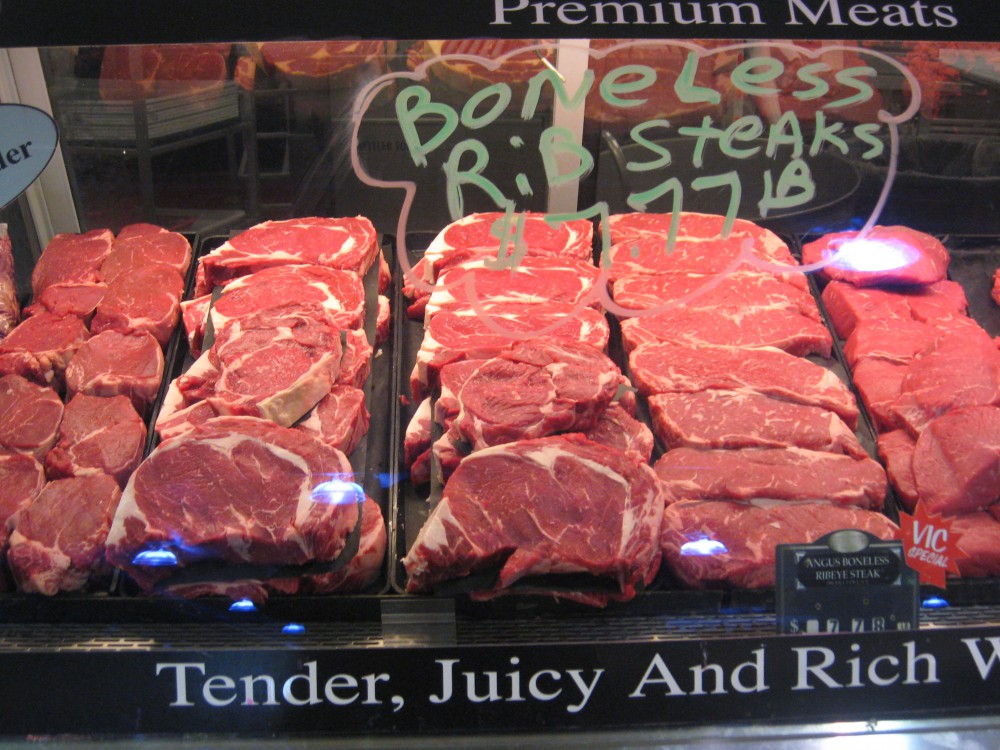
steaks in butcher caseMy usual choice of steak is a strip, or New York strip, cut 1-1/2 to 1-3/4 inches thick, with fat cap intact.  If I don’t find one lolling about   in the butcher case (you won’t likely find this in the pre-packaged section)  ask to have it cut the way you want it; my local Harris Teeter will cut to order but generally has thick-cut steaks in the butcher case.

This works fine with rib eye or with filet mignon, as long as it is thick-cut. Personally, I prefer strip or rib-eye to filet. Even with rib eye, it’s still not a substitute for real prime rib roast, but a good “second” so that I plan to have “leftovers”.

Ingredients

  • 1 boneless steak (1 1/2 to 1 3/4 inches thick (about 1 pound), strip or rib eye
  • Kosher salt and fresh ground black pepper
  • 1 tablespoon vegetable oil for searing

Preparation

  1. Adjust oven rack to  mid-position and pre-heat oven to 275 °F .
  2. Pat steaks dry with paper towel and season liberally with salt and freshly ground black pepper.
  3. Place steak on wire rack set in rimmed pan and place in oven.  (Steak does need to be raised rather in contact with pan).
  4. Cook until instant-read thermometer inserted in center of steak registers 90 to 95°F for rare to medium-rare, 20 to 25 minutes  (or 100 to 105°F  for medium, 25 to 30 minutes).
  5. Heat oil in  heavy-bottomed skillet over high heat until smoking.
  6. Place steak in the skillet and sear until well-browned and nicely crusty–about 1-1/2 to 2 minutes, lifting once halfway through to redistribute fat under the steak.
  7. Using tongs, turn steak and cook until well browned on the other side, about 2 to 2-1/2 minutes.
  8. Use tongs to stand steak on the sides and sear on all sides. (This really is worth the effort–and it really does not take long.
  9. Transfer to cooling rack, tent with foil, and let rest for about 10 minutes–this also is really worth the wait.
  10. You can prepare a quick pan sauce while the steak is resting, or simply add a pat of herb butter, horseradish,  or some blue cheese crumbles to the warm steak.

Add some simple sides like salad or baked potato. Now pour yourself a another glass of that luscious  red wine that was  breathing while you were cooking, and enjoy.

A son goût!

Posole

There is one good thing about having to hike out to the dumpster with the trash, especially when you’re cooking something.  If you stay in the kitchen too long you olfactory sense habituates to the aromas.  Take out the trash and you get a great new olfactory preview when you get walk back into the kitchen–especially if you spend a bit of time chatting with the neighbor who is also taking out the trash.

This cold weather has me cooking stew-y sorts of things.  A friend sent me a care package from New Mexico recently: blue and white corn with a recipe for making posole (or pozole, if you’d rather). Today was the day, since I was organized enough to remember to soak the dried corn overnight.  By the time I had sauteed everything, browned the pork, onions, garlic, added the oregano (had to do Turkish rather than Mexican until I do another Penzeys order), and the chilli pods I wasn’t fully appreciating the aroma of the cooking. I popped the covered dutch oven into the oven and took– out the trash.

When I opened the door and walked into the living room, I was definitely getting a fresh sensation: the browned pork, the oregano, the chillis–this smells like warmth and comfort on a cold day!

White Corn Posole

This is the recipe that came with the package of Los Chileros de Neuva Mexico package of white corn posole. I more or less followed the recipe–

Ingredients

  • 6-8 chile pods
  • 2 pounds cubed pork (or beef)
  • 3 cloves garlic minced
  • 1/2 teaspoon Mexican oregano
  • 1 teaspoon of salt.

Preparation & assembly

  • Soak the posole (12 ounces) in water to cover overnight.
  • Boil the posole in salted water for about 2 hours.
  • Add meat, chilli pods, oregano and garlic.
  • Cover and simmer for another hour or until the posole is tender, stirring occasionally.

<>\/<>

My first deviation from the recipe was to brown the pork (in a little bacon fat) before adding the liquid and the other ingredients. My second deviation was to use 4 chilli pods (ancho and guajillo) and then about 2 teaspoons of Hatch chilli powder.  I had tasted before adding the chilli powder–and it’s wasn’t spicy enough. I’ll see what it’s like when I reheat it. My other deviation was to add way more garlic.

I’d looked at other recipes for posole online, and found lots of recipes calling for other ingredients–cumin, coriander, and even tomatoes. I decided to start with this simple, rather a straightforward one for my first try at posole.

I really think that Mexican oregano is a must–the Turkish just isn’t quite right here–it’s sweeter than the Mexican to my taste and would fit better with the corn flavor. I’m likely to add some cumin and coriander next time around as well. I may add onions (caramelized) as well. It’s a recipe in evolution now. I think a little more “brown” in the flavor would be good, as well as some smoke from either chipotle peppers or from pimentón–but definitely Mexican oregano next time. I used water here and not pork stock, but I think that pork stock would be tastier–especially if the bones/meat were browned before making the stock.

Even though this is a simple soup/stew, a bowl of this is very satisfying on a cold day when you need warmth and a full tummy!

My friend also sent blue corn–which I’ve only had in tortilla chips, so it will be interesting to see how that compares to the white. I do suppose you could make this with canned hominy, but this seems to have more corn flavor that I remember from canned hominy. I’m going to enjoy trying out different seasonings here.

Chilli and Nutmeg Dark Chocolate Bark

I have to try this–I’ve had dark chocolate with nutmeg and love it…and dark chocolate and chili and love that (but then I’m a serious chocoholic anyway).

frugalfeeding's avatarFrugalFeeding

chilli dark chocolate bark

When one really takes time to delve into all things festive it quickly becomes clear that it is unlikely that there will ever be an end to Christmastime culinary possibility. In fact, it turns out that it’s dreadfully difficult to keep one’s blog up-to-date with all that is being produced. The weather is the entity most at fault here, but what can one do? It’s difficult to castigate the weather – it makes a mockery of us all.

Following on from my recent monologue regarding presents and the meaning of Christmas, a little gifting advice may be necessary. For those of you that weren’t aware, chocolate is always a safe bet – is there anyone who doesn’t covet one form of chocolate or another? It is in this spirit that I bring you my recipe for chilli and nutmeg dark chocolate bark; it is both frugal and spectacularly delicious. Perhaps…

View original post 450 more words

Chilli con carne redux update

I’ve finished the “fast” version of the chilli con carne that I posted about in Chilli Con Carne Redux!  I’ll concede that it’s only sort of faster in terms of the active prep time–it still needs to cook long and slowly, but it is a success.  I don’t think that I can tell the difference (tasted side-by-side with the more laborious version from the freezer) and friends have given it the nod of approval.  So here are the changes and additions to the original chilli con carne that I posted.

  • After the bacon browned, 3 tablespoons of tomato paste was added while the onions were sautéed, and this was browned–again to enhance the umami, not to add tomato flavor.
  •  None of the meat (pork or beef) was browned before adding liquids.
  •  Added bay leaves to increase the earthiness (used five large for this 6 pounds of meat).
  •  Added Mexican oregano–about 2 rounded teaspoons. (You really do want Mexican oregano for this–much different flavor than Turkish or Greek (Mediterranean) oregano–after all it is an unrelated plant, but worth having in the kitchen if you like chili.)
  •  Sun-dried tomatoes (about 1/2 cup chopped) were added for more umami even though this was NOT made in a slow cooker, I was not aiming for tomato-flavored chili.
  • During the cooking time I tasted some in a bowl with a little fish sauce added (yep, I did get up the nerve to try this) and it tasted wonderful; so I added about 4 or 5 tablespoons of fish sauce.  (I suspect that if you don’t have fish sauce a couple of anchovy filets thrown in would have the same effect.)
  • The final thickening was one with a brown roux made with masa harina.  For the fat in this roux I reserved about 1/4 cup of the fat from the de-fatting step.  I heated this and made sure that all liquid was evaporate, then added about 6 tablespoons of masa harina and cooked it until it was a medium brown and toasty smelling.
  • Because of my work schedule, this was cooked in a lower oven (about 195° F) for about 10 hours.

After another run on this I’ll have to post a revised recipe for the “fast” and easier version, but if you feel so inclined you can work with these changes–after all chili con carne is one of those things that really doesn’t need a recipe to be followed strictly.

Chilli con carne redux….

I love my chilli con carne–but it’s very a very time-consuming kitchen project so after considering umami in the slow cooker I though I’d try a few shortcuts, with some umami boosts.

I usually buy a big chuck roast and cut it up myself, but I found that my local Harris Teeter had stew mean which was chuck roast already cut up, so I bought a big package of that.  Some time saved there.  I did have to cut the pork, but I bought  spare ribs so that all I had to do was cut them into chunks–another bit of time saved.

One thing that takes a lot of time is browning that much meat, so I thought I try bypassing that step since I still plan to cook it in the conventional oven very slooooowly, letting evaporation and concentration happen so there should get a little browning as the liquid reduces.

I toasted all the spices (cumin and coriander) and the chilli peppers that went into the pot and added a little tomato paste that had been browned.  I know that fish sauce (nam pla) and soy sauce are supposed to boost umami, but I just couldn’t put either of them into the pot.  If this doesn’t work, I guess I’ll try that next time.

The pot of chilli con carne is ready to go into the oven as soon as the oat bread comes out.  So some hours from how, I’ll know if this worked or not….

Umami in the slow cooker…

flats of plants on tailgate of truck to be loaded for the farmers' market.

for market

Obviously I’ve not been giving a lot of thought to cooking  things lately–it’s been end-of-term grading, indexing and proofreading, or getting  ready for the farmers’ market, or actually being at the farmers’ market, with more energy going to planting things, both for later harvest and for selling at the market than into cooking.

One of the down sides of working the farmers’ market is that I’m one of those people who wake up like a compact fluorescent bulb–pretty dim at first–so getting to the farmers’ market on time on Saturdays involves getting up before the birds just to give me time to be awake and functional. Even Fridays demand early rising, especially as the weather gets hotter–flowers to cut early in the morning and produce to be harvested before the heat of the day sets in and thing wilt…and just to avoid being out in the worst of the heat.

wagon of flowers in buckets

cutting flowers

I’m getting into the swing of that now but it still takes time for my lights to come on, though less painful now.  That early rising on Friday and Saturday makes me into a really lazy slob on Sunday.  Now that the Spring term is over, I’m not meeting classes during the week so I’m enjoying the summer hiatus from lecturing, but still working at freelance indexing so the absolute laziness has to be confined to Sundays and Mondays through Thursdays are still busy.

All this means that for Friday, Saturday, and Sunday cooking is likely to be focused on one-dish meals, and dishes that are good (or even better) when reheated.  Sometimes Saturday meal is not even something reheated–it’s my treat-yourself day–OnlyBurger for after-market meal before I devote the rest of the day to quality time with the cat!  (This past Saturday the treat was a Texan (burger with braised brisket on it) and a peach ice cream sandwich (handmade at OnlyBurger) after the market.  The evening meal was Carolina Moon cheese and strawberries–both from the farmers’ market.)

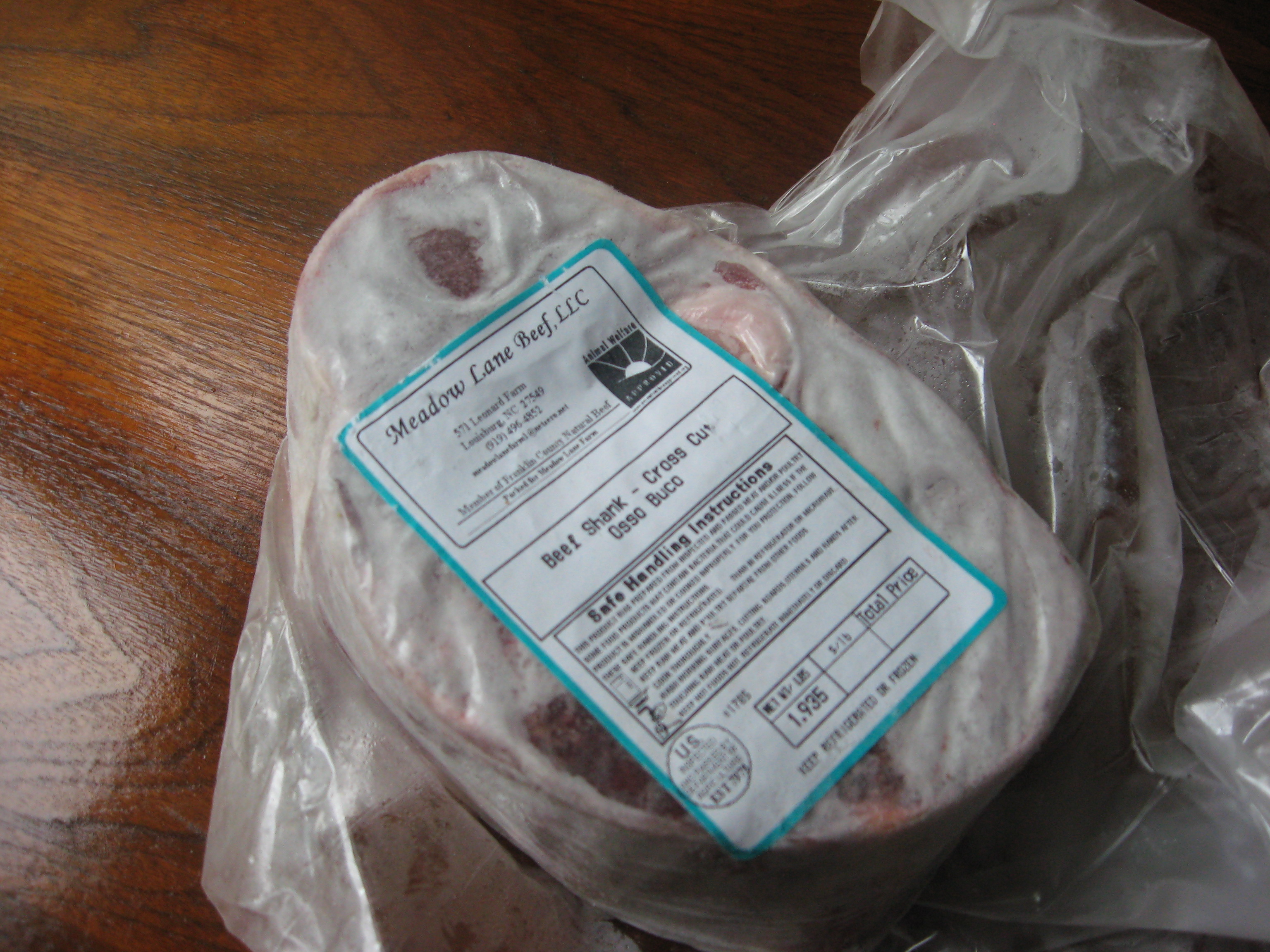
packaged cross-cut beef shank

beef shank

This weekend schedule means that I try to do some planning and cooking on Thursday to have reheatable food on Friday and Sunday.

This weekend’s meals are going to feature an absolutely lovely cross-cut beef shank from Meadow Lane Farms (also from the Durham farmers’ market)  in an easy dish that can cook mostly unattended: osso bucco, but with beef shank rather than veal shank. (The osso bucco really just means “bone with a hole” or marrow bone.)

It’s a dish that’s easily adapted for one person–there’s nothing fussy about it–no need to be exact or tedious in measuring ingredients, and to make even more “unattended”, it will go into the slow cooker (also serving as rice cooker and steamer) while I’m out working on the farm.

Krups rice cooker/slow cooker and steamer

Krups rice cooker

I have to admit that I’ve not been a fan of the slow cooker until recently, at least for anything much more than cooking dried beans, or poaching a beef tongue. The flavors and textures just aren’t the same as when the slow cooking was done in the oven where some evaporation, browning and concentration takes place even in a covered dutch oven.

My attitude about slow cookers has changed since I found the Cook’s Illustrated Slow Cooker Revolution (See Bibliography) and learned some techniques for making food out of the slow cooker more flavorful.  I’m not ready to quit slow-cooking in the oven despite that, but in hot weather I’ll certainly use the slow cooker more often with some of the “tricks” I learned from that cookbook.

What I missed most in slow-cooker dishes was that savoriness that comes from browning (Maillard reaction)  when you slow-cook in a traditional oven or brown/sear on the stove-top.  In the slow  cooker, you can make this absence less noticeable by adding ingredients that contribute “umami“.

Some of the most useful things I learned from that Slow Cooker Revolution are ways to use the microwave oven to facilitate the slow cooker, and using some “unusual” ingredients  in recipes–not esoteric ingredients, just pantry staples that boost  the umami flavor:

  • precooking aromatics like onions in the microwave so that they don’t stay crispy-crunchy in the slow cooker,
  • using tomato paste (for umami) by browning it with the aromatics either in a skillet or in the microwave before adding it to the slow cooker,
  • using dried mushrooms to boost flavor (again, umami),
  • using foil packets in the slow cooker to keep some ingredients from over cooking.
  • using soy sauce or fish sauce to add more of that umami that many slow-cooker dishes don’t get without the evaporation and browning as in the traditional oven.
  • using the microwave to precook some ingredients to get rid of excess moisture that would otherwise dilute the dish in the slow cooker.

These are all easy to do–they really don’t add significant extra prep time or effort, and do really make a difference in the flavor.  I expect an easy, flavorful meal (or two) from the braised beef shank that is going to emerge from my slow cooker on Friday evening, thanks to some added umami!

Offal: beef tongue

Offal:  1 : material that is left as waste or by-product of a process of preparation or manufacture: as a : the stalks and dust from tobacco leaves b : less valuable portions (as the belly, head, and shoulders) of a hide c : the by-products of milling (as of wheat or barley) used especially for stock feed d : the parts of a butchered animal that are removed in dressing, that consist largely of the viscera (as brain, heart, sweetbreads, liver) and the trimmings (as tail, hooves, blood, skin, head meat), and that are used as edible products or as raw material in the manufacture of by-products e : small or inferior or unmarketable fish

(Webster’s Third New International Dictionary, Unabridged. Merriam-Webster, 2002. http://unabridged.merriam-webster.com (20 Jun. 2011).

♦♦♦

I am fortunate to have a wonderful supplierof organ meats, such as tongues, hearts, beef cheeks, and other offal at my local farmers’ market.  While it’s not a regular part of my diet it’s certainly a treat to cook some once in a while.  It can be hard to find recipes for organ meats.

Since I now have a ready supply of offal, I’ve recently discovered two delightful cookbooks dealing with offal.  The Whole Beast:  Nose to Tail Eating and Beyond Nose to Tail:  More Omnivorous Recipes for the Adventurous Cook by Fergus Henderson.  The onset of cool weather makes me want to do more serious cooking so I’ve searched for recipes for beef heart and beef cheeks, which reside in my freezer awaiting cooking.   My own cookbook library provided me with some, but wanting to be a bit more adventurous, I decided to see what other recipes I could find.  It would seem that offal is gaining favor, at least with adventurous cooks, judging from the results of my search for blogs and recipes.

Since I grew up on a farm where we butchered our own meat, I’ve never been squeamish about organ meats, either preparing or eating.  Beef tongue is really pretty tame when it comes to offal.  Some of my old stand-by recipes are found in Mastering the Art of French Cooking (Volume 2) by Julia Child, and in Glorious French Food by James Peterson.  Since I’ve been cooking beef tongue for so long, I don’t always do a fancy preparation–love it cold, sliced for sandwiches in the summer time; for that I break out the slow-cooker and just poach it.  I’m fortunate that the tongues I get from my supplier (Meadow Lane Farms) are extremely clean, I don’t have to do a lot of the cleaning and soaking that many recipes call for.  I sometimes salt, but sometimes I don’t and the results either way are excellent.

I usually poach the tongue with bay leaves, juniper berries, brown mustard seeds, or maybe herbs de Provence:  just pop it into the slow cooker and cover with water for really carefree cooking.  If you don’ t have the slow cooker, it can be simmered on the stove-top, but it does need monitoring so that it does not boil. You could also cook this in a slow oven so that you don’t have to do so much monitoring–bring to a simmer on the stove top and then move to the oven.

The tongue is simmered in the slow cooker for two or three hours, and then I check to see if the outer covering peels easily.  If so, I’ll pull it out of the slow cooker and peel it.  If you’re doing this on the stove-top, or even in the oven, it may be ready to peel in about an hour.  Since I want to use some of it for sandwiches or in a salad, I’ll return the peeled tongue to the slow-cooker for another hour or so, until it’s tender; then let it cool in the cooking liquid and chill it, since it’s easier to slice when cold. The cooked tongue is very tender and beefy in flavor.

A great hot meal can be made if you take thicker slices of the tongue and quickly brown them in butter, and then serve with the brown butter over as a sauce.  Great with asparagus, or haricots verts, and some potatoes.  In the summertime, when the tomatoes are really lush, the cold sliced tongue with a good sweet-tart tomato slice, on bread brushed with a bit of olive oil is wonderful.   As with other beef, horseradish complements it nicely, too.

Health-wise, it’s not something I’d have every week, but I doubt seriously that it is any worse for me than some of the things I might find in the local delicatessen, and I know exactly what is in it.  While it may not sound like something to prepare when you’re cooking for one, it’s so versatile that leftovers are never a problem!

Pot roast with brown gravy

You’ll notice that I said “gravy”–this is too much of a comfort food to use “sauce” because what you’re getting is plain, down-home gravy that needs bread or potatoes to complement it.

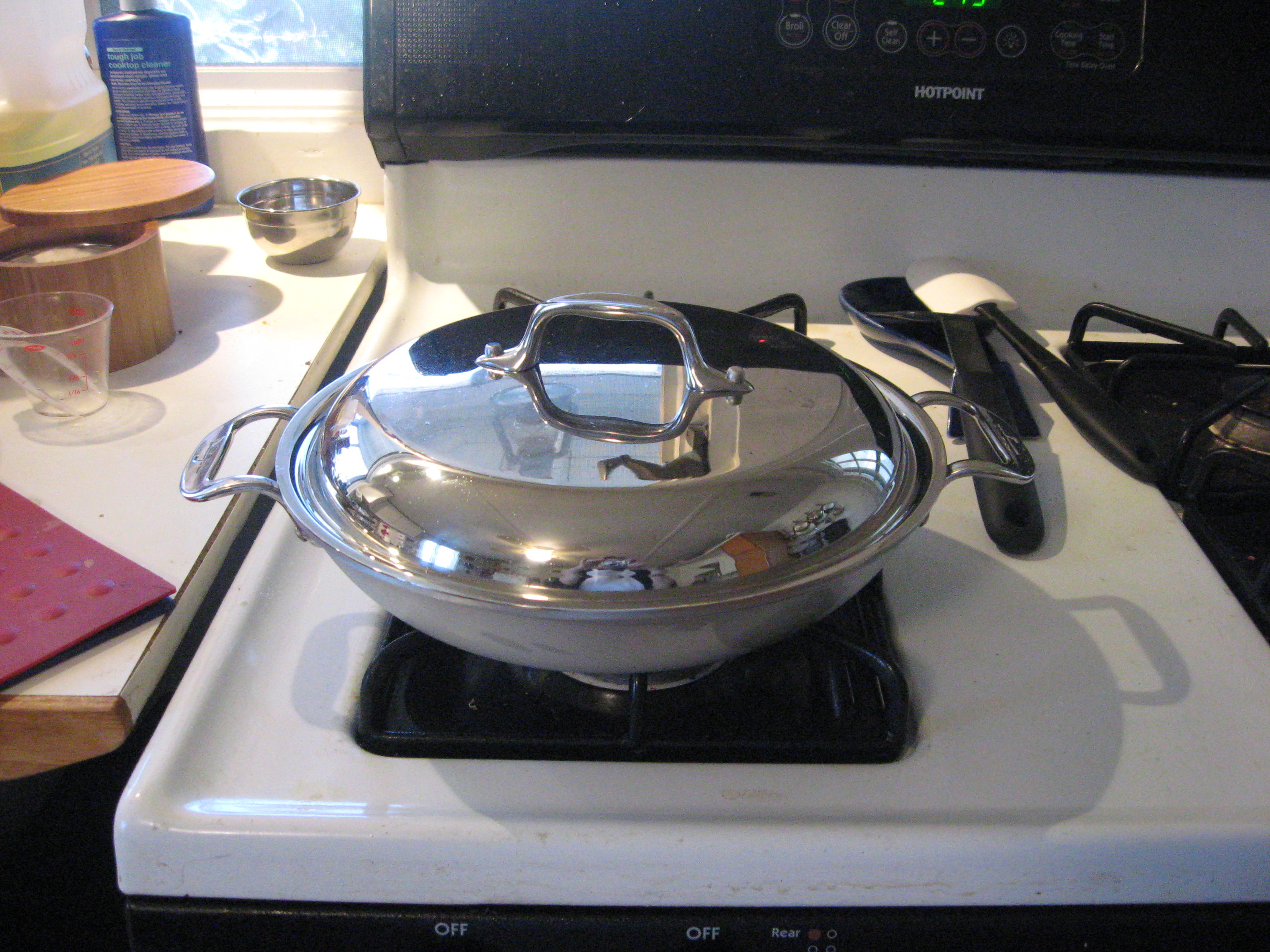
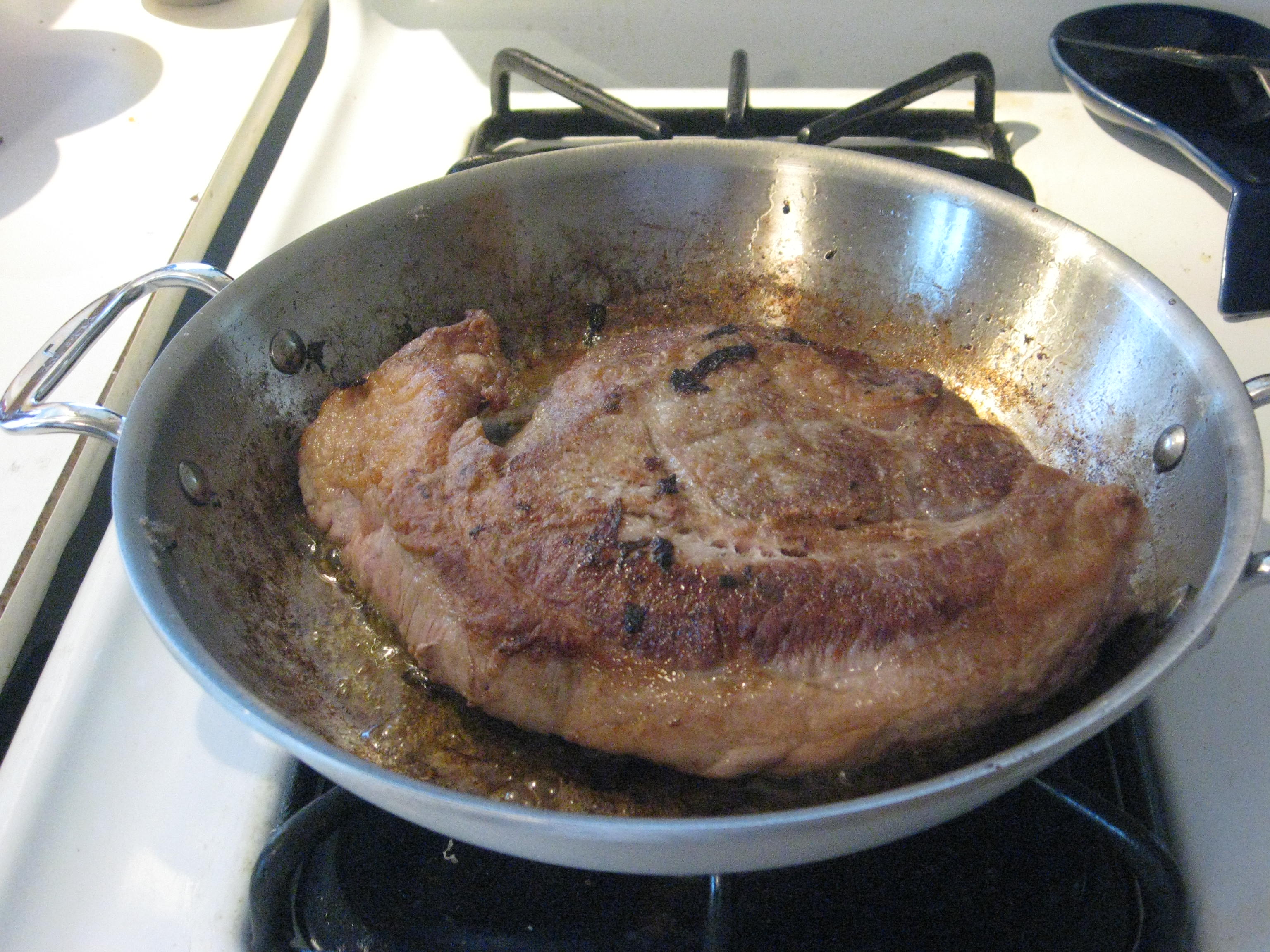
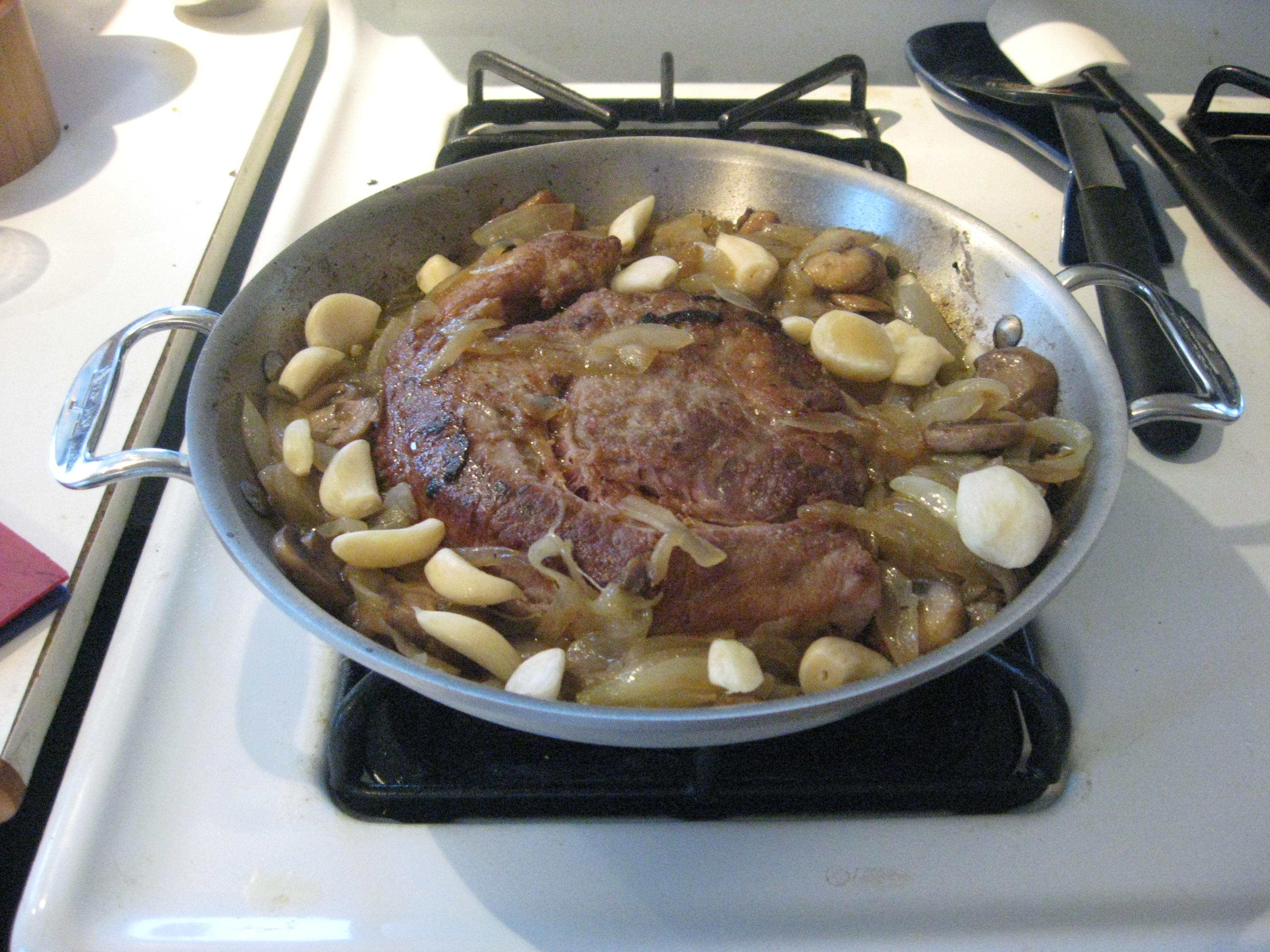
After I got my Christmas present (See The Petit Brasier) I had to give it an immediate test run.  What better to test than a favorite braised dish:  pot roast.  This was nothing fancy at all.  You’ll note that I’m not even saying it had a sauce–I really did mean good, old-fashioned, down-home, satisfying brown gravy, lots of onions, and good tender beef.

Even though I say I dislike leftovers, there are some exceptions and pot roast is one of the exceptions.  Sometimes I get the great big chuck roast and make a lot of it and put it in the freezer in single-serving packages, right with the chili, the stock, and some soups so that I can have an “instant” meal–the microwave is great for defrosting and individual portion.  I don’t always want to have to pack and freeze leftovers, so with the small braiser, and a cooperative butcher or meat department at the supermarket, I can make a small pot roast that’s good for two, or maybe three meals since there are some very easy ways to kind of spiff it up for the reruns.

This is really not a recipe–it’s a happening–quantities are approximate as the amount of oil you need will vary with the size of you pan, the amount of mushrooms and onions you are going to sauté–just use what you need.  (Improvise! Wing it!  Just do it–it will work.)

Ingredients

  • 1-1/2 to 1-3/4 pound piece of chuck roast
  • 4 or 5 small onions (or 3 medium to large ones) sliced moderately thinly
  • 2 teaspoons flour, plus flour for dredging the beef
  • about 3 tablespoons olive oil (divided as needed for  sautéing mushrooms and onions.
  • 8 ounces of mushrooms, sliced (more if you really like mushrooms)
  • 1 to 1-1/2 cups of water or stock
  • salt and fresh-ground black pepper to taste
  • about 8-10 medium garlic cloves.

Preparation

  1. Pat the pot roast dry with paper towels and dredge in a flour seasoned with salt and pepper.  Let it stand while you cook the onions and mushrooms.
  2. Slice the mushrooms and sauté in a little of the olive oil until they release their liquid and brown.  When brown and liquid has evaporated, remove to a bowl.
  3. Add a bit more olive oil, and sauté the sliced onions until they start to brown and caramelize.  When partly browned, remove to a bowl with the mushrooms.
  4. Add the additional olive oil, as needed, and brown the beef well on both sides. Put it to the side for final assembly.
  5. Take the rest of the olive oil, and the 2 teaspoons of flour, and brown the flour in the oil until it turns a nice golden brown and smells toasty.  Turn the heat down, add the stock or water to the browned flour.
  6. Add the sautéd onions and mushrooms, and return the browned roast to the pan, with the onion/mushroom mixture around the sides, sprinkle the garlic cloves over the top.
  7. Bring to a simmer on the stove top, cover and place in a 295-300 ° F oven and cook until fork tender–about 2-3 hours (unattended).  Check periodically to see if you need to add more liquid.  You need just enough to make nice thick gravy, and the onions are going to cook down to help thicken the gravy.

For that first meal, all you really need is a salad, maybe a baked potato….or some noodles.For the second serving, stir a tiny dollop of sour cream into the portion of brown gravy for this serving to add some tang and be a bit “stroganoff-ish”, add some steam-sautéd (See Cooking Vegetables Quickly) carrots, or spinach as a side.   What about the third?  As you reheat, add some tomato paste, or some tomato sauce to the last bit for a different taste.

It’s pure unadulterated comfort food.  Even if it’s not a single serving, it’s an appropriate quantity for small-time cooking, but it sure has big-time taste.  It’s great what having the right size pan does for cooking for one.

A son goût!