Always Hungry? An improvised meal

One of the problems I have with rigorous meal plans is that I refuse to shop for my food according to a menu! Even though I’m shopping in the supermarket, I want the freedom to buy what looks good–not what I need for a menu. When I find lovely ahi tuna for a measly &7.99 per pound, you be I’m having that for a meal. That was what I found on Friday, so I had an ad lib meal constructed from the simplified meal plan (page 152).

My high-quality protein was the tuna–pan seared to medium rare. The carbohydrate and vegetable were spicy mixed greens (a mix of radicchio, shredded broccoli stems, kale, and a few other robust greens) steam-sautéed with borlotti beans, seasoned with just a dab of bacon fat and red pepper flakes. Since tuna is not as oily/fatty as sardines, salmon, or mackerel, I followed the “pour on the fat” instruction by adding with a dollop of the lemon dill sauce.  YUM! Dessert? Raspberries and heavy cream (though these were not on the menu for today  either but I used the quantities suggested in the meal plan elsewhere.

(The dill sauce thins and spreads quickly when it hits something hot–next time it will go on the side!) The tuna steak that I had was close to a half pound, so there will be some for a lettuce wrap or salad tomorrow.

20160319_161611

Ò¿Ó

Always Hungry? Mediterranean Chicken

And the weight loss is back on track, and meals still really tasty. From the Always Hungry? today I picked the Mediterranean Chicken recipe to try. The recipe struck me as  lacking oomph that I needed today, but a meal plan is a meal plan. This was, at least, a one-pot meal, and easy.

Refrigerator tidying was in progress at the same time as I started preparing the chicken. Some of the things that I found lurking in the back of the fridge ended up in the  Mediterranean chicken–though I played with it a bit, the final dish contained all the ingredients called for in the recipe–well, except one. That recipe called for putting green beans in near the end of the cooking time. I didn’t do that. Just didn’t trip my trigger, and since I made the whole four servings I’ll need to reheat and that wouldn’t work well with the green beans. (The haricots verts that I had in the fridge turned into a side that has always been a favorite: room temperature with sweet marjoram infused olive oil, and a sprinkle of Maldon salt–keeping with the spirit of the meal plan.)

The basic recipe is simple: chicken thighs cut into bite-sized pieces, sautéed with onion, then simmered with canned tomatoes with garlic, olives–salt and pepper, of course. The recipe called for kalamata olives–not what I had so I used a mix of green (that had been marinated in garlic and red pepper flakes), and oil-cured black olives to make up the 3/4 cup called for in the recipe. I was surprised that there were no herbs called for here–but I remedied that!

Ingredients

NOTE: The pickled garlic cloves were from tidying the fridge and I thought the bit of tartness would be nice since the tomatoes were very sweet smelling. The garlic cloves and the green olives both had hot red pepper flakes, so I didn’t need to add. If I were doing this without these, I’d likely add about 5 or 6 cloves of garlic sliced thin, a dash of red pepper flakes, and a splash of vinegar–likely white wine.

  • 1 pound of skinless, boneless  chicken thighs, cut into 1-inch pieces
  • 3/4 cup of pitted oil-cured black olives and green olives, halved
  • 1-1/2 cups of chopped onions (I cheated and used frozen ones)
  • a 28-ounce can of whole San Marzano tomatoes, hand-crushed into the pan,  the thick juice added as well
  • 1/2 cup of pickled garlic cloves, sliced
  • one 14-ounce can of garbanzo beans
  • 1/2 teaspoon of dried Turkish oregano
  • 1/4 teaspoon salt (olives were salty)
  • 1/3 teaspoon fresh ground black pepper
  • 3  tablespoons olive oil
  • feta cheese for garnish

Preparation

  • In a large skillet or brasier  heat the olive oil
  • Sauté the onion until translucent, add the sliced garlic a continue to sauté until fragrant
  • Add the chicken, salt, and olives a sauté until the chicken is opaque
  • Add the tomatoes, black pepper, and garbanzo beans
  • Simmer uncovered for about 35 minutes until the sauce thickens nicely
  • Garnish with feta cheese and serve with vegetable or salad

Ò¿Ó

In my tidying of kitchen and fridge, there were a small handful of cherry and grape tomatoes on the counter, so I pitched those in as well. I think that my modifications were in keeping with the spirit of the meal plan–even though the green beans migrated to a side dish. Those were a nice contrast to the dish–and now I can put part of it into the freezer for later use. This nice spicy, garlicky combination of chicken, tomatoes, and garbanzos would have been lovely accompanied by a glass of red wine, but–that will come later; meanwhile, I’m eating healthy, tasty food and losing weight.

Ò¿Ó

.

Always Hungry? NOT!

The Always Hungry? plan is back effect, with a few modifications.  I’ll  admit to my “oops” which was not because I was hungry! I just wasn’t thinking–good food, good company, open mouth, insert food.

My continued  issue is that there’s too much food on the meal plans for what I usually eat and my usual level of activity–I typically don’t “do” snacks”. Perhaps now that the weather is improving, but not yet sweltering, I can get more active.

The other difficulty for me is breakfast. Not only am I not at my peak function first thing in the morning, I just don’t want food.  I love breakfast food–eggs, omelettes, and the like–but just not in the morning. Perhaps as I manage to get off by butt and increase my activity I’ll eat more from the meal plan set out for this program.

For right now, brunch is a concept that fits well with my desire for foods. But, brunch interferes with snacks, so I’m using the snacks as “lunch” and having brunch, or I’m using the Power Shake for Phase 1 as breakfast, and lunch and dinner from the meal plan.

It sounds as if I’m really mucking this around, but I’m being very conscious of the appropriate balance of macronutrients for this phase: protein 25%, carbohydrates 25%, and fat 50%.  Despite my changes and that “slip”, it’s working!

tomato, mozzarella, and garbanzo bean salad, with lemon tahini dressing

tomato, mozzarella, and garbanzo bean salad, with lemon tahini dressing


Always Hungry? Cabbage Casserole

white cabbage cropped IMG_6018One of the recipes from Always Hungry?  that I wanted to try was the Cabbage Casserole (pages 236-237) since I feel that cabbage is an underappreciated vegetable that should be (at least) a winter staple. I suspect that when many people hear cabbage mentioned as an edible thing, they think “coleslaw”, or the St. Patrick’s Day corned beef and cabbage, or, perhaps, stuffed cabbage.

The other advantages to me were that it was an “all phases” dish, and I didn’t see anything that would make it impossible to freeze for later use. So, the Cabbage Casserole happened today. When I’m trying a new recipe, I like to make it as directed, except for seasonings that I thought needed adjustment for my taste. As usual, I found one thing that I felt could be modified without changing the results, but would make the recipe easier.

The directions call for blanching the cabbage in boiling water. I assumed (yes, I do know what “assume” does to you and me) that the blanching was to soften the cabbage a bit so that the texture wouldn’t be crunchy in the finished dish–just as you soften the leaves when making stuffed cabbage with whole leaves. Instead of blanching, I put the cabbage, with a splash–maybe a tablespoon–of water into the microwave until it had softened–about 5 minutes, then proceeded with the layering of the meat mixture, the cabbage, and the apple-tomato mixture as instructed in the recipe. Then, into the oven.

Ò¿Ó

cabbage casserole and serving on blue plate

cabbage casserole

The casserole is out of the oven, and I’ve enjoyed a serving. It’s another keeper. I’m surprised and pleased. The seasoning as in the recipe is good as is, though for my taste, I may add a little more garlic next time. The amount of cinnamon is perfect.  It’s another keeper even though it’s associated with a weight-loss program. The final result has a bit more liquid than I hoped, even though I baked it uncovered a little longer than the recipe called for. The recipe did not call for draining the tomatoes, but I’ll do that next time.

The microwave was apparently a good substitute for the blanching: the cabbage is tender, and not at all crunchy. I’ll happily eat this again, looking forward to having a glass of a hearty red wine to accompany it.

cabbage casserole up close

.

Always Hungry? Oops!

I hate to have to admit this, but I fell off the meal plan, not because I was hungry, but just because I wasn’t thinking.

The Always Hungry? plan cautions you to be strict about following in the first fourteen days. Well, that is serious advice that should be heeded. I tried–really I did, but being away from home at a meeting in Alexandria, VA,  lead to a couple of deviations in the balance. Frist was a snack of cheese and crackers during a break in our meeting. The second was a glass of wine with dinner; the third was eating a small quantity of pasta with the entree I ordered, and finally that sandwich I had when I stopped to eat on my drive home.

The cheese was not the problem–it was the crackers as they are carbohydrates in a form not allowed on this plan. The second big problem was the pasta. This plan is doable in a restaurant, with just a bit of though. My problem was that I wasn’t thinking. I was enjoying good conversation with colleagues and good food.

After out meeting we had a delicious meal at Vaso’s Mediterranean Bistro. The entrée that I ordered had clams, mussels, shrimp, calamari, and scallops in a tomato sauce. There is nothing there that would “undo” the Always Hungry? meal plan–except for the pasta that was buried under all that lovely seafood. Just because it was there, didn’t mean I had to eat it–with the cup of avgolemono and the side salad, the seafood would have been a generous serving. But, I was just enjoying the meal and the company and ate some of the pasta! That alone was probably not a huge issue, except in conjunction with the crackers that I’d eaten with the cheese (St. Andre and Cambazola) earlier, and the added “insult” of the sandwich–yes, with white bread.

The result of these infractions? Well, I had not realized how good I felt for past week until I woke today. Until this morning, I had posted 7 pounds off my weight–now back up to 5 pounds off the weight. That wasn’t the real problem, though–I’m sure most of that was fluid and will go away quickly. It was how I felt–it’s hard to describe, but that week of no starchy things, except for legumes, made a huge difference in energy and well-being. It will be interesting to see how long it will take to recover from this lapse. This interlude has certainly impressed me with the effect of what I eat with how I feel–and not just hunger (or not), or satiety.

Õ¿Õ

.


Always Hungry? Meal Plan

Since I seem to be unable to stick to a recipe, am a picky eater, and have a lot of difficulty with breakfast, I’ve downloaded the Simplified Meal Plan from Always Hungry? website, and very carefully read the requirements for the “Building a Phase 1 Meal” (pages 151-152).  Since I was having a lazy day I did some adaptation on the “Herb-Roasted Chicken Thighs” since chicken thighs often show up on my house menus. I decided to make this a one-pot meal.

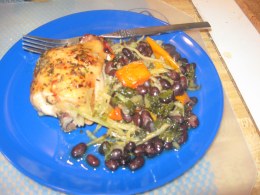
roasted chicken thigh, greens, black beansAfter seeing a post on slow roasted kale on Stefan’s Gourmet Blog, I decided I could make a one-dish meal that met those Phase 1 requirements. Using a bag of salad greens (broccoli, Brussels sprouts, kale, and some others) I put enough into the clay cooker to give me the amount of cooked greens that I needed for two meals (two of the thighs were for other uses). Since I’m such a fan of greens and beans, I added enough black beans for two servings. Since bell peppers are on the okay list, I added red and orange mini bell sweet peppers to the mix.  Finally, I topped that huge pile of greens with the chicken thighs sprinkled with salt, red pepper flakes, and oregano. The soaked clay cooker went into a cold 400 °F oven for a little over one hour and out came a meal that had the protein, vegetables, and the carbohydrates (the beans). All I had to add was dessert. (Yes, this meal plan includes dessert–in this case a cup of fruit and 1/2 ounce of dark chocolate.)

One of these thighs is going to find its way into chicken salad with grapes and pecans (substitution for walnuts) for one of the prescribed lunches and another into the freezer to pull out when I need a quick dinner ready with the vegetable, meat, carbohydrate quantities already worked out.

My fat cells and I

It’s amazing how easy it is to ignore what the scales, the mirror, the doctor, and clothes are telling you–until you get a look as others see you–a video of you going about your normal activity. As you watch, it’s more like watching another person, and you have a sudden OMG-it’s-really-true moment. You suddenly know that the time has come–that repeated New Year’s resolution that you’ve “renewed” umpteen times and not kept must finally be faced. (Hotel bathroom mirrors are almost as revealing–big, usually with door mirrors too so you get an all-around look in really bright light, too.)

You review all the experience that you’ve had with “diets”–the Atkins (worked like a charm but not sustainable because of the ban on fruit, beans, milk, and dairy products except cheese. The New Atkins–for the same reasons. You read the books evaluating low-carbohydrate and low-fat diets, high-protein, Mediterranean diet, and the French Paradox and feel like a real wuss because you’ve not been able to keep to the latest thing you’ve tried. You even check sites that have BMI computations available–everyone gives you the same answer: you’ve moved over from the overweight into the “obese” range. Then there’s the video–wonderful hive inspection but the beekeeper.

9781455533862I bought the latest diet book on the market–the day it was released–Always Hungry?.  I read it, and think about it, and then I saw myself in a video, And the jig is up! You know you’ve deluded yourself when looking in the mirror, looking at photographs, and feeling how your clothes fit.

So reread the book–really read the book (including the recipes and the meal plans). To add motivation, (since the book discusses movement) I’ve dug in the “junk” basket on the bookcase shelf, and in the drawer where stuff accumulates and, finally, found the pedometer. Now I have numbers to show how truly sedentary I truly am! Scary.

Back to this food plan. Refined sugars are a no=no, but that’s not a real problem because your sweet tooth is chocolate dependent. Soft drinks are not in the in this house fridge anyway. But there are pasta and beans on the pantry shelf. From experience I know I  like (maybe even love) complex carbohydrates, aka starches. Those and milk have been the stumbling blocks every time before–but this food plan allows legumes and milk even in the initial phase. There’s one ounce of dark chocolate allowed daily even in Phase 1. This “diet” for weight loss is a plan for moderation. Phases 2 and 3  (essential since you really, truly like food) allows judicious reintroduction of some of the things you most like (baked white potatoes), at least on an occasional basis and still maintain weight loss.

Since some basic sauces are essential for the food plan, I decided to start with some that would need routine weekly preparation and those that I thought I would like particularly well, to give me an idea of how things the recipes are seasoned.

After reviewing the list of permitted foods (again), this book moves to the kitchen. Trying some of the recipes since in the past food plans have always seemed too contrived. Well, the recipe for Blue Cheese Dressing (All Phases) on page 263 seems like a good place to start since it is a favorite. Can’t you eat the lettuce so you can have the blue cheese dressing? Recommended to make a wide-mouth mason jar (have) and immersion blender (have). The prep time estimate was accurate–really fast and easy.. (Since blue cheese is a strong flavor, I prefer more tartness, so I replaced the tablespoon of water with an additional tablespoon of lemon juice.  Tastes splendid so score one for the food plan Bring on the crudities. This sauce is a keeper even if it is on a food plan for weight loss!

So one tasty recipe doesn’t make it acceptable. I like (and make at home often) vinaigrettes and use oil and vinegar dressings. The Lemon Olive Oil Dressing (All Phases), page 269, is straightforward and a good balance of olive oil, lemon juice, salt, and pepper. If you make this in tandem with the blue cheese, you don’t have miscellaneous bits of leftover lemon.

[There’s a bonus to using mason jars–they have gradations on the sides so with just a bit of planning you won’t even have to wash a measuring cup. If you use a kitchen scale, you might not even need measuring spoons. (I’ve noted weights of things like 2 tablespoons of lemon juice with the recipes).]

Next  for testing,  I chose Creamy Dill Sauce (All Phases). This sauce is a bit more complicated than the first two but noted to keep for 1 to 2 weeks in the refrigerator. Again, using a mason jar and scales it was easy to put together.Knowing that I tend to find many recipes under-seasoned, and over-salted, I did use 2 small garlic cloves, substituted 1/4 teaspoon of smoked Spanish paprika for the “dash of paprika” called for in the recipe. I found it a bit lacking in the lemon flavor with only the lemon juice, so I added 1/2 teaspoon of lemon zest. After allowing it to stand for a few hours, I was pleased with the tart dill, lemon, and slightly smoky flavors. (This is easily modifiable without changing the balance of protein/fat–ancho chili or Aleppo pepper could be used.

The final sauce that I made to test was Lemon Tahini (All Phases), page 269. Taking my taste for garlic and tartness into account, I used a large clove of garlic, 2 tablespoons extra lemon juice, and 1 teaspoon of lemon zest.

My clean up after making these sauces (in very close to the prep time given in the book and with a little more experience and organization I’m sure I can decrease that):

  • one chef’s knife
  • one cutting board
  • one set of measuring spoons
  • one spatula for scraping down the side of jars
  • immersion blender
  • microplane grater (for lemon zest)
  • one citrus reamer

I can certainly deal with that. Leftover from this prep, one lemon minus zest (lack of organization on my part–next time I’ll just zest all the lemons before squeezing them)

I didn’t have to buy anything that wasn’t already in my pantry except dill and parsley, but since it’s winter, that’s not a negative thing. I’m certainly not going to have to rearrange my kitchen to accommodate, although the immersion blender will need to live somewhere slightly more accessible.

Sauces, as important as they are, don’t make a meal plan. The recipe for Broiled Fish with Garlic and Lemon (All Phases), page 232, looks like a good way to start testing the main dish recipes. It is simple, and besides, it’s very easy to cook fish, although I don’t use the broiler much–but this recipe works as well as those for the sauces. The serving of cod fillet that I cooked with this recipe was for one–so only about 6 ounces. In order not to overcook the fish, I seared on only one side and then finished under the broiler. . I broiled the fish for 8 minutes (the minimum time suggested in the recipe). Broiling it on the lemon slices with the olive oil and garlic worked: nicely garlicky and great lemon flavor. This is another keeper!

Three things that are called for frequently are mayonnaise and  Ranchero Sauce, page 272. I’m going to opt out of those since I can get a palatable mayonnaise made without sugar (that I usually buy anyway) and I have a favorite salsa that lacks sugar in the ingredient list.My local Harris Teeter grocery has a store brand hummus that is without sugar, so I’ll likely also opt to use that instead of making it at home.(There are resources on the  website  to facilitate the plan.)

Now that I have a feel for the seasoning used in these dishes I think I can use many of the recipes provided with the meal plan without having to alter my pantry much at all. After looking at other recipes, I find several that I am looking forward to trying: Ginger-Carrot Soup (All Phases), Red Lentil Soup (All Phases)Chocolate Sauce (All Phases), and Cabbage Casserole (All Phases). A lot of these recipes lend themselves easily to improvisation with herbs and spices, too–another plus for preventing boredom.

There’s only one “special” thing I have to buy–whey protein for the occasional Phase 1 Power Shake. Because of the stress on the balance of macronutrients emphasized in each phase, I will do that. (The thing sounds good when you consider what else is in it).

After rereading the permitted foods, I’ve decided I can do without pasta if I can have legumes and the prospect of adding some pasta and bread in later Phases 2 and 3. With my physician’s words bouncing around in my brain, and that horrible BMI, I CAN do this. It’s about moderation–and chocolate, whipped cream, and wine (after Phase 1) are allowed. It’s about moderation and balance of the amount and quality of protein, carbohydrate, and fats consumed. It’s also about not having to revamp my pantry or suffer deprivation.

This project has to involve getting off my butt and doing more walking and movement, too! That’s likely to take more effort than eating the right things, given how sedentary my work is. But, needs must!

Ò¿Ó

°

There is a lead-in phase where you get ready–for three of those days I’ll be on the road or at a convention, but once back home, this starts. No more procrastination!  After sampling the sauce recipes and the broiled fish, I certainly feel more positive about the meal plans that I ever have about any other weight-loss meal plan. (The blue cheese sauce added to egg salad is good–lots of room for improvisation with the recipes, still keeping the macronutrient balance.

I’ll admit to one slight frustration with this book: recipes are listed by name under an entry for “recipes”. Cabbage Casserole appears just where you’d expect it. Coleslaw you will find only if you look for “Tangy Coleslaw”. When trying to locate the recipe for the fish, I couldn’t remember the specific name–fortunately, broiled was in the title so it was close to the first of the list.

Though the main focus is not as a cookbook, but on nutrition and weight loss (index very useful for this), just a few simple entries throughout for main ingredients such as “cabbage”, “polenta”, or “shrimp” would be helpful. But, I shouldn’t complain–I know space considerations often dictate what can be included or what must be cut. I’d happily settle for smaller print in the index (even if it meant getting out my reading glasses) to have those extra entries.



#LovePulses and take the pledge

Another informative post on an underutilized and versatile food source. Even if you don’t wish to take the pledge, please read! Look at the nutrition data. If you cook your own, the preparation  may take planning and time but it’s not labor intensive. Canned beans are an option to help use this food group.

Ratatouille (slow-cooker)

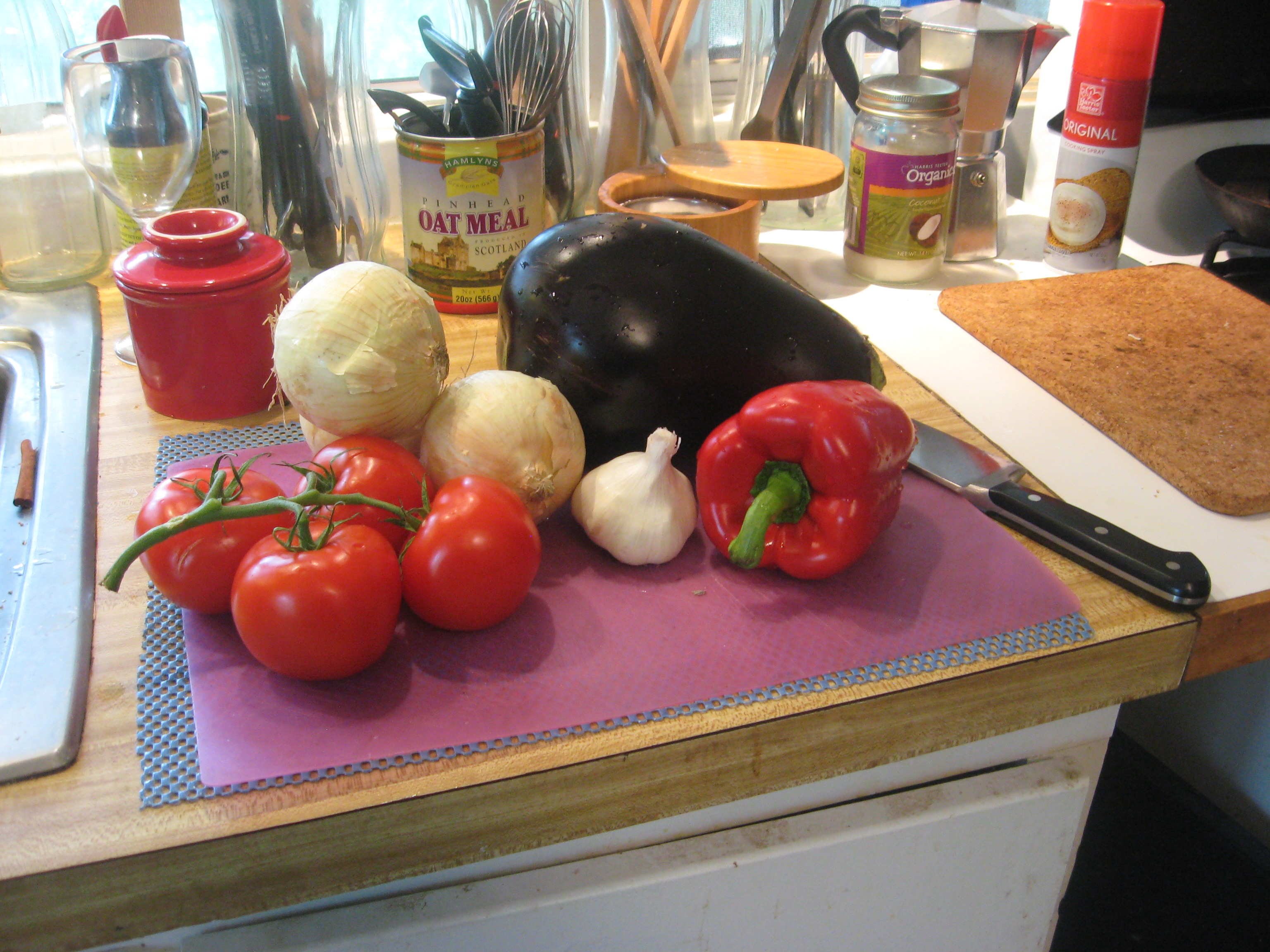
vegetables for ratatouilleDuring the summer abundance of eggplant, squash, and tomatoes  we’re often in the OMG-what-can-I-do-with-these-zucchini mode. Ratatouille and caponata  provide some good eating even when the hot weather has rather killed the appetite. I thought that being able to do this in the slow-cooker instead of stove-top would be an advantage in sweltering weather that is already taxing the A/C without adding more heat.

It’s easy to find ratatouille recipes–a quick search on the internet will provide a plethora.  The question:  are they  “good” recipes”?  I’m not sure I can tell you what (specifically) tells me “good”, “passable”, or “oh yuk”.  Most likely past experience, and reading a lot of food science, and (from America’s Test Kitchen) “why this recipe works”.

Here is a ratatouille recipe given by a friend, from Food.com, reproduced below. I’ve never made ratatouille in a slow cooker so I thought this was worth trying. In reading the recipe, I had only a couple questions, so I decided to make the recipe as directed–well, almost–as much as I can–I’m just a compulsive tinkerer, and constitutionally unable to follow a recipe strictly, but almost.  ratatouille ingredientsLooking at the recipe, I knew I’d want more garlic. Had I not been using part frozen peppers (from a Kitchen Disaster), I would not use green peppers–I prefer ripe (red, yellow, or orange) like them. I’m changing the herbs to thyme and oregano,  rather than basil (for reasons explained below in Cook’s notes).  My other question about this recipe had to do with that quantity of tomato paste. Why?

When I started the prep, I was still undecided about the tomato paste.  My inclination was to leave it out because this is an “all fresh” dish, and (to me) tomato paste tastes canned and cooked. Since this does not call for the tomato paste to be added until later, my obvious solution is to wait and see how it tastes, especially since these are summer tomatoes. If  I were wanting to supplement the “tomato” part of the flavor I would likely add some sun-dried tomatoes, rather than tomato paste–unless there is a dearth of “umami” (which is one of my reservations about slow-cooker dishes).

Slow Cooker Ratatouille (Food.com)

The modifications that I made on this recipe on the first round are shown in parentheses after the ingredient. These were just to meet my seasoning preferences, not for any other reason.  Don’t hold this on “warm”–it just doesn’t do well.

Serves: 6 to 8

Ingredients

  • 1 large eggplant, peeled and cut into 1 inch cubes
  • salt
  • 2 medium onions, chopped
  • 2 cups chopped fresh tomatoes–about 3 medium
  • 1 large green bell pepper, cut into 1/2 inch squares
  • 1 large red bell peppers or 1 large yellow bell pepper, cut into 1/2 inch squares
  • 3 medium zucchini, sliced
  • 3 tablespoons olive oil
  • 3 tablespoons dried basil (substitute 1/2 teaspoon thyme and 1/2 teaspoon Turkish oregano)
  • 2 garlic cloves, crushed through a press (4 garlic cloves)
  • 1/2 teaspoon fresh ground pepper (held until end as I think it gets bitter with long cooking)
  • 1 (6 ounce) cans tomato paste
  • 1 (5 1/2 ounce) cans pitted ripe olives, drained and chopped coarsely (oil cured black olives)
  • 3 tablespoons chopped fresh basil (substitute chopped fresh oregano)

Directions

  1. Sprinkle the eggplant with salt; let stand in a colander 1/2- 1 hour to drain.
  2. Press out excess moisture.
  3. Rinse the eggplant with water and pat dry with paper towels.
  4. Place the eggplant in crock pot.
  5. Add onions, tomatoes, bell peppers, zucchini, olive oil, basil, garlic, pepper and 1/2 tsp salt.
  6. Mix well.
  7. Cover and cook on high setting about 3 hours or until the vegetables are tender but still hold their shape.
  8. Stir in the tomato paste, olives, and the fresh basil.
  9. Serve hot, room temperature or chilled.

Notes:  Being of scientific orientation, I decided to do an experiment–half the recipe is cooked as above; and the other half cooked separately, with modifications after I had tasted the results of the original method. First, I had to cook for an additional hour–I thought my rice cooker/slow cooker ran rather hot, but not according to this.  After tasting I did add the tomato paste as the tomato flavor was not at all pronounced, but I think the tomato paste (unless browned before adding) doesn’t add the depth I want. I needed more salt (which kind of surprised me because I don’t usually need to add much. Oregano and thyme needed to be bumped up as did the garlic. Those minor things were done to the first batch. So far the onions  have stayed crispy and I think I’d prefer them a bit softer so maybe microwave them before putting into the slow cooker (that had to wait because they were already mixed with the other vegetables). This came out with more juice than I’d expected.

Now for the second batch. I’m adding more olives, more garlic (sliced rather than pressed), some red pepper flakes (about 1/8 teaspoon) for a little zing (but not a lot of heat), and sun-dried tomatoes (instead of tomato paste), a bay leaf, and increasing the oregano and thyme. Instead of increasing salt, I’m going to add just a touch of nam pla (fish sauce)–or an anchovy fillet mashed would work. This is not intended to make it at all fishy just more flavorful. This needs to be stirred after an hour so that the bottom veggies don’t mush and the top be a bit undercooked. Check for doneness–don’t just trust the time. I prefer my veggies cooked but with a little “tooth” to them, so in my slow cooker this finishes in about 2 hours. I like this one as there’s no added liquid, except the dash of nam pla and what the veggies give off. Minced fresh oregano added the last 15 minutes of cooking leaves it very fresh tasting.

Bottom line: this is quick and works if you want a very light ratatouille, not complex ratatouille.  I don’t want my ratatouille over whelmed with herbs and garlic, but I’d like to make it a bit more complex, or layered flavor–maybe it needs a little more umami It has the advantage of being very quick to assemble.

Ò¿Ó

As you likely know if you’ve read other posts, I’m somewhat partial to recipes from America’s Test Kitchen.  When the published Slow Cooker Revolution I had to check it out.  I was hoping that those recipes would improve my attitude to (and increase use of ) my slow cooker. There’s no denying it’s convenience, but generally I’ve simply not been happy with the results when compared with oven or stove-top methods.

A comparison of America’s Test Kitchen recipe with the one above is interesting. One of my “complaints” is that their recipes sometimes  seem more complicated–though they do increase flavor.  The recipe below is from the Slow Cooker Revolution (Kindle edition). This is the recipe that inspired me to try the one above.  The cooking instructions are quite extensive so I’m only going to summarize them for purposes of comparison. I’m trying to find a compromise of best flavor and easy preparation.

Slow-cooker ratatouille (America’s Test Kitchen)

Serves: 10 to 12

Ingredients

  • 6 tablespoon extra-virgin olive oil
  • 2 eggplants (2 pounds), cut into 1-inch chunks
  • 3 zucchini (1-1/2 pounds), cut into 1-inch chunks
  • 2 onions, halved and sliced 1/4-inch thick
  • 2 red bell peppers, stemmed, seeded, and cut into 1/2-inch pieces
  • 2 cloves garlic, minced
  • 2 teaspoons minced fresh thyme or 1/2 teaspoon dried
  • 1/4 cup all-purpose flour
  • 1 (28-ounce) can diced tomatoes, drained, juice reserved
  • 1/4 cup chopped fresh basil or parsley
  • Salt and pepper
  • Grated Parmesan cheese, for serving

Preparation

  1. Brown eggplant, half at a time, in olive oil (5 to 7 minutes), and transfer each batch to slow cooker.
  2. Brown zucchini, half at a time, in olive oil, transferring each batch to slow cooker.
  3. Cook onions, bell peppers, garlic, and thyme until softened and lightly browned (8 to 10 minutes), stir in flour and cook for 1 minute. Whisk in reserved tomato juice, scrape up browned  bits, and smooth out lumps, and transfer to slow cooker.
  4. Stir tomatoes into slow cooker, close and cook until vegetables are tender (4 to 6 hours).
  5. Season with salt and pepper as needed.

Notes:  The time it takes to brown the vegetables really is not that long, so it’s worth the extra flavor. It’s a drastic difference, even when you add some umami-hyping ingredients to the Food.com recipe.

The differences here are, notably, the use of flour to thicken, the lack of tomato paste, and the preparation of the eggplant. One of my reasons for trying the recipe from Food.com is the handling of the eggplant, with the idea that salting to remove fluid might eliminate the need for flour–I doubt that you’d know there was flour in this recipe simply by tasting.

After tasting the first batch of the recipe from Food.com with the adjustments noted in Notes, it’s a keeper for simplicity. The America’s Test Kitchen is a bit richer since you’ve browned the veggies. Either is good–depends on the time and effort you want (or have) to invest.

. . . a son goût

Ö¿Ö

cooked ratatouille

?

Gluten-free breads

For those of you who might be interested in gluten-free breads, I wanted to share this link.  I’ve not tried any of the gluten free recipes, since I don’t have an issue with gluten.  I’ve tried breads from both the other five-minutes-a-day breads, and had good results with every recipe I’ve tried.

Available in hardcover, and digital format. Based on my experience with these books, If I needed gluten-free I would certainly give this a try–at least check it out of the library for a trial.