Too much convenience?

Mueller's Pot-Sized PastaI was striding purposefully down the aisle of my local Harris Teeter when a package caught my eye–and brought me to a screeching halt–pot-sized spaghetti? This is something that you buy?  You don’t just take the regular spaghetti and break it, assuming that you’re not going to just put it into the water slowly, letting it soften until it’s all in the water?

Pot-sized angel hair?

Pot-sized thin spaghetti?

Pot-sized linguine?  Really? I was amazed, or maybe stupefied, or maybe the only thing that really covers my reaction was what I understand the British expression–gobsmacked–to mean!  Are we so far from “home cooking” that we can’t even deal with pasta unless it’s pot-sized. As you can tell this catapulted me right onto my soapbox, or maybe even onto my high horse (which every you prefer). Has having pot-sized pasta brought down the price of my plain spaghetti that’s too long to fit in the pot unless I stand there and lower it slowly into the water? Not being a marketer, or an economist, merely a consumer, I really doubt that  it has. (Besides, I think this would be too short to twirl effectively to wrap it around my fork.) Not something I’m likely to buy (even though I do sometimes buy other Mueller’s pastas.

jar of mixed rice and grainsI went past the pasta display because I was on my way to something of a convenience nature for me: one of the packages of grain mixes. Those don’t leave me gaping.  They are very useful for single-serving cooking.  My latest is an HT Traders mix of basmati brown rice, red rice, with barley and rye berries. That’s my idea of convenience–I don’t have to buy the standard package of each of those grains: that would be about 1-3/4 pounds of basmati rice, and who knows how much red rice and rye berries. I most likely would not use that mix if I had to buy each of those separately–unless I could buy each from bulk supplies.

That kind of convenience I can get my mind around. I do have packages of barley, oats, but even the dried things don’t have unlimited shelf-life. They don’t  spoil–in other words they are not perishable. If you store them carefully in glass jars with good seals, they should not get buggy, but keep them long enough and they won’t hydrate as well, taking longer to cook. For some dried goods like beans, you may get to the point where they will never soften appropriately.

Of course, there’s also the issue of storage space–for those of us without the luxury of a large pantry with miles of shelf space, but who do like variety this is a great alternative. It has another benefit: it’s compatible with the rice cooker.  I’m happy to more of the “esoteric” grains show up in my local supermarket–they are cheaper than if I were to go to a specialty shop, not to mention just closer to home.

mixed grains

Lamb leg steak–continued

lamb leg steak on plate with ratatouilleThat lamb leg steak that I cooked a couple days ago was a big steak–weighing in just a bit under a pound. That’s a lot of meat–couldn’t possibly eat all that at one time.  As vehement as I’ve been about not liking, or dealing well with leftovers,  that does not apply here.  I don’t really consider the part of this steak that I didn’t eat then as undesirable. I couldn’t have that luscious steak without some left for other uses–not when it needs to be at least an inch thick to cook well. You’re wondering what happens to the rest of this steak?

Often the remains of a beef steak or a pork chop goes into a sandwich–since roast beef, lamb, or pork is not on the single-serving menu. Other times it does some metamorphic changes.  The remainder of this steak went into the rice cooker with a convenience mix of grains,  some garbanzo beans to give me some additional meals that were not meat-centric.

Ingredients

  • about 1/2 pound of cooked lamb steak, cut into 1/2-inch pieces
  • one 15-ounce can garbanzo beans with liquid
  • one 10 ounce can of diced tomatoes with jalapeños with liquid
  • 1 cup of brown basmati rice, red rice, barley, and rye berry mixture (uncooked)
  • 1 tablespoon olive oil
  • 2 bay leaves
  • 2 teaspoons dried Turkish oregano
  • 1/2 to 1 teaspoon garlic powder
  • 1 to 1-1/2 teaspoon onion powder
  • 1 cup water (to bring total liquid to amount required for grains)

Preparation

  • Add all ingredients to rice/multi-cooker, stir well.
  • Set on rice cooking mode.
  • When cycle finishes, check grain for doneness.  If needed add more water in 1/2 cup increments until grains are done.

Ò¿Ó

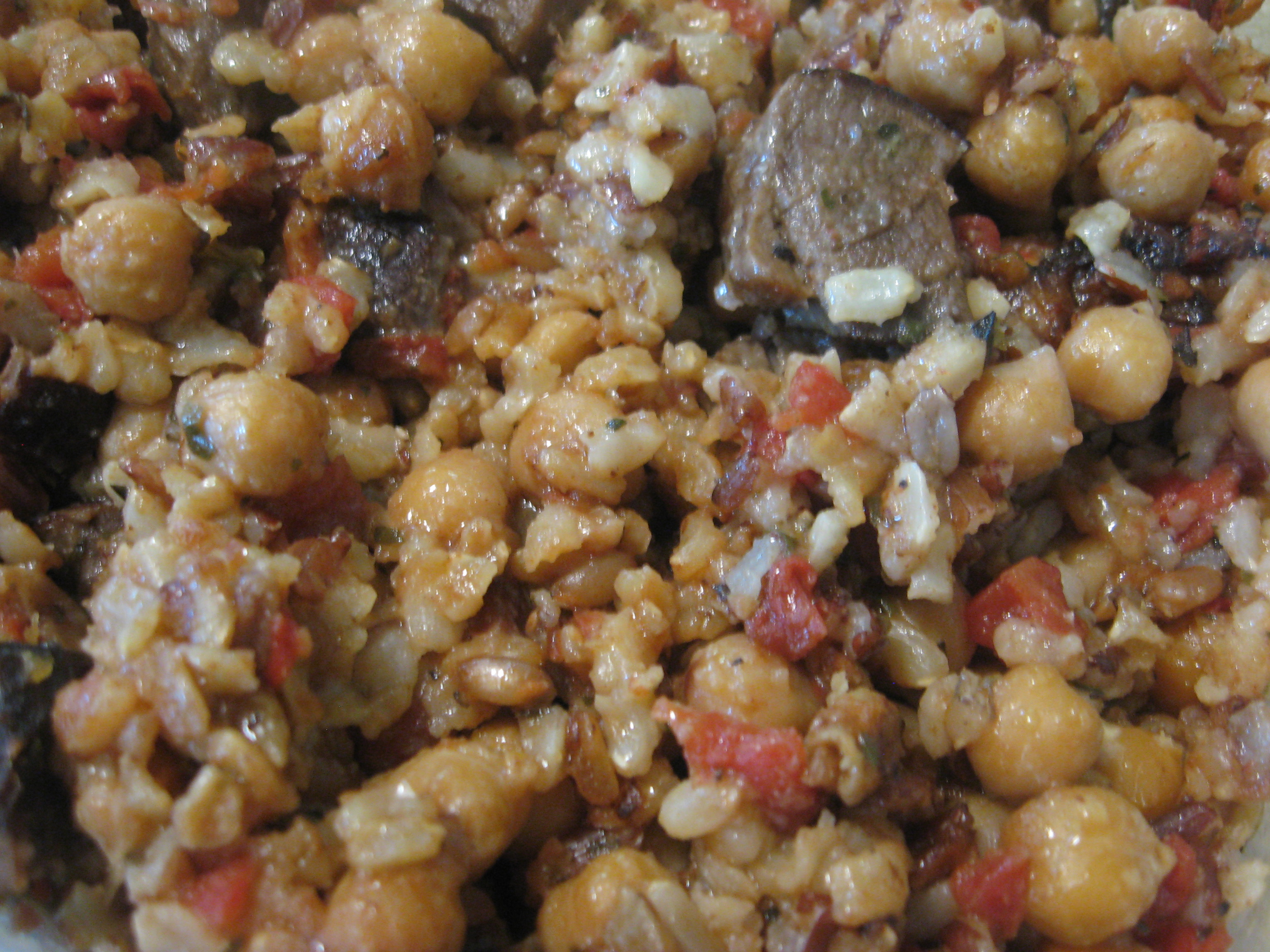
Since the lamb steak had been well-browned on the griddle, it provided good rich flavor for the grains and the garbanzo beans.  Some of this was an extra meal (with a side of ratatouille), and the rest was packed (with the Handi-Vac®) for the freezer for later (especially cooler weather) meals.

mixed grains with tomatoes and lamb

. . . more Ratatouille (Provençal vegetables)

dark purple eggplantRatatouille is a summer dish that gets us over the hump of too many zucchini, and maybe tomatoes. It’s enjoyable warm, cold, or room temperature–but it’s not an especially memorable dish.  Not usually–however, I’ve one recipe for it that is memorable.This is not the ratatouille that you put together in the slow cooker, or quickly; however, if you like ratatouille, you should take the time and effort to make this one. Go ahead and splurge on the saffron.That’s part of what makes this memorable.

The recipe from Simply French: Patricia Wells presents the cuisine of Joël Robuchon (see bibliography) gave entirely new meaning to ratatouille.

Provençal Vegetables (Ratatouille)

Adapted from Simply French, pp. 229-230. Serves: 8 to 10

Ingredients

  • 10 medium tomatoes
  • 2 medium onions finely chopped
  • 1 cup extra-virgin olive oil
  • Sea salt to taste
  • 1 green bell pepper, peeled and thinly sliced
  • 1 red bell pepper, peeled and thinly sliced
  • Bouquet garni: several parsley stems, celery leaves, sprigs thyme, wrapped in the green part of a leek and fastened with kitchen twine
  • 4 garlic cloves minced
  • Freshly ground white pepper to taste
  • 1 teaspoon tomato paste (optional)
  • 6 to 7 small zucchini scrubbed, trimmed, and cut into matchsticks (about 1-1/4 pounds)
  • 2 teaspoons fresh thyme leaves
  • 3 small eggplants peeled and cut into matchsticks (about 1-1/2 pounds)
  • Pinch of saffron threads (optional)

Preparation

  1.  Core, peel, and seed the tomatoes. Save as much juice as possible and strain. If strained juice does not measure 1 cup, add water as needed to bring to 1 cup. Finely chop the tomatoes and set aside.
  2. In a large skillet, combine onions, 1/4 cup oil, and pinch of salt. Cook over low heat until soft and translucent.
  3. Add peppers and pinch salt. Cover and continue cooking about 5 minutes more.ÒΛÓ
  4. Add chopped tomatoes, stir and continue cooking for about 5 minutes more.
  5. Stir in the tomato juice, bouquet garni, and garlic.  Taste for seasoning.
  6. Cover and simmer gently for about 30 minutes–don’t over cook–vegetables should not be mushy!
  7. If the tomatoes lack flavor, add tomato paste.
  8. In another skillet, while the tomatoes, onions and seasonings cook, heat 1/2 cup oil over moderate heat. When hot add zucchini and sauté until lightly colored (about 5 minutes). Transfer to colander and drain excess oil. Season with thyme and salt.
  9. In the same skillet, heat the remaining 1/4 cup of oil and sauté the eggplant until lightly colored. Transfer to colander and drain excess oil.
  10. Add zucchini and eggplant to the tomato mixture and taste for seasoning, add saffron if desired, and simmer gently for about 30 minutes.
  11. Serve warm, room temperature, or cold. Will keep covered and refrigerated for several days.

ÒüÓ

This is not you everyday, get rid of the zucchini, ratatouille. It’s special occasion, peak tomato season, and it take time and effort, but if you invest the time and effort, I think you’ll agree that it is a fantastic dish. This best made when tomatoes are at their peak–you don’t want to expend this effort and use canned tomatoes or supermarket ones that have no flavor–that would be a waste of effort. Neither the tomato paste nor the saffron can overcome that deficit.

Ratatouille (slow-cooker)

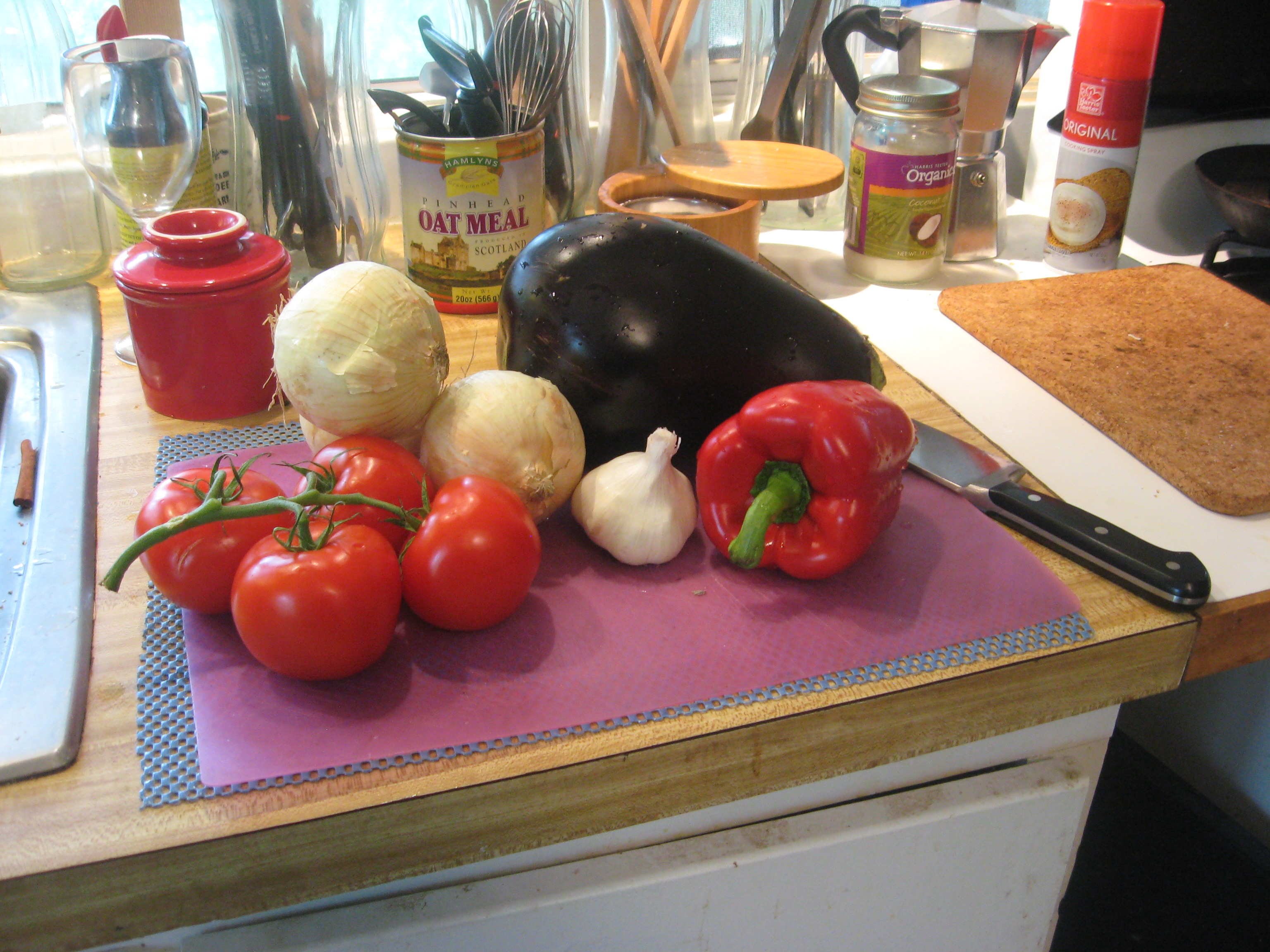
vegetables for ratatouilleDuring the summer abundance of eggplant, squash, and tomatoes  we’re often in the OMG-what-can-I-do-with-these-zucchini mode. Ratatouille and caponata  provide some good eating even when the hot weather has rather killed the appetite. I thought that being able to do this in the slow-cooker instead of stove-top would be an advantage in sweltering weather that is already taxing the A/C without adding more heat.

It’s easy to find ratatouille recipes–a quick search on the internet will provide a plethora.  The question:  are they  “good” recipes”?  I’m not sure I can tell you what (specifically) tells me “good”, “passable”, or “oh yuk”.  Most likely past experience, and reading a lot of food science, and (from America’s Test Kitchen) “why this recipe works”.

Here is a ratatouille recipe given by a friend, from Food.com, reproduced below. I’ve never made ratatouille in a slow cooker so I thought this was worth trying. In reading the recipe, I had only a couple questions, so I decided to make the recipe as directed–well, almost–as much as I can–I’m just a compulsive tinkerer, and constitutionally unable to follow a recipe strictly, but almost.  ratatouille ingredientsLooking at the recipe, I knew I’d want more garlic. Had I not been using part frozen peppers (from a Kitchen Disaster), I would not use green peppers–I prefer ripe (red, yellow, or orange) like them. I’m changing the herbs to thyme and oregano,  rather than basil (for reasons explained below in Cook’s notes).  My other question about this recipe had to do with that quantity of tomato paste. Why?

When I started the prep, I was still undecided about the tomato paste.  My inclination was to leave it out because this is an “all fresh” dish, and (to me) tomato paste tastes canned and cooked. Since this does not call for the tomato paste to be added until later, my obvious solution is to wait and see how it tastes, especially since these are summer tomatoes. If  I were wanting to supplement the “tomato” part of the flavor I would likely add some sun-dried tomatoes, rather than tomato paste–unless there is a dearth of “umami” (which is one of my reservations about slow-cooker dishes).

Slow Cooker Ratatouille (Food.com)

The modifications that I made on this recipe on the first round are shown in parentheses after the ingredient. These were just to meet my seasoning preferences, not for any other reason.  Don’t hold this on “warm”–it just doesn’t do well.

Serves: 6 to 8

Ingredients

  • 1 large eggplant, peeled and cut into 1 inch cubes
  • salt
  • 2 medium onions, chopped
  • 2 cups chopped fresh tomatoes–about 3 medium
  • 1 large green bell pepper, cut into 1/2 inch squares
  • 1 large red bell peppers or 1 large yellow bell pepper, cut into 1/2 inch squares
  • 3 medium zucchini, sliced
  • 3 tablespoons olive oil
  • 3 tablespoons dried basil (substitute 1/2 teaspoon thyme and 1/2 teaspoon Turkish oregano)
  • 2 garlic cloves, crushed through a press (4 garlic cloves)
  • 1/2 teaspoon fresh ground pepper (held until end as I think it gets bitter with long cooking)
  • 1 (6 ounce) cans tomato paste
  • 1 (5 1/2 ounce) cans pitted ripe olives, drained and chopped coarsely (oil cured black olives)
  • 3 tablespoons chopped fresh basil (substitute chopped fresh oregano)

Directions

  1. Sprinkle the eggplant with salt; let stand in a colander 1/2- 1 hour to drain.
  2. Press out excess moisture.
  3. Rinse the eggplant with water and pat dry with paper towels.
  4. Place the eggplant in crock pot.
  5. Add onions, tomatoes, bell peppers, zucchini, olive oil, basil, garlic, pepper and 1/2 tsp salt.
  6. Mix well.
  7. Cover and cook on high setting about 3 hours or until the vegetables are tender but still hold their shape.
  8. Stir in the tomato paste, olives, and the fresh basil.
  9. Serve hot, room temperature or chilled.

Notes:  Being of scientific orientation, I decided to do an experiment–half the recipe is cooked as above; and the other half cooked separately, with modifications after I had tasted the results of the original method. First, I had to cook for an additional hour–I thought my rice cooker/slow cooker ran rather hot, but not according to this.  After tasting I did add the tomato paste as the tomato flavor was not at all pronounced, but I think the tomato paste (unless browned before adding) doesn’t add the depth I want. I needed more salt (which kind of surprised me because I don’t usually need to add much. Oregano and thyme needed to be bumped up as did the garlic. Those minor things were done to the first batch. So far the onions  have stayed crispy and I think I’d prefer them a bit softer so maybe microwave them before putting into the slow cooker (that had to wait because they were already mixed with the other vegetables). This came out with more juice than I’d expected.

Now for the second batch. I’m adding more olives, more garlic (sliced rather than pressed), some red pepper flakes (about 1/8 teaspoon) for a little zing (but not a lot of heat), and sun-dried tomatoes (instead of tomato paste), a bay leaf, and increasing the oregano and thyme. Instead of increasing salt, I’m going to add just a touch of nam pla (fish sauce)–or an anchovy fillet mashed would work. This is not intended to make it at all fishy just more flavorful. This needs to be stirred after an hour so that the bottom veggies don’t mush and the top be a bit undercooked. Check for doneness–don’t just trust the time. I prefer my veggies cooked but with a little “tooth” to them, so in my slow cooker this finishes in about 2 hours. I like this one as there’s no added liquid, except the dash of nam pla and what the veggies give off. Minced fresh oregano added the last 15 minutes of cooking leaves it very fresh tasting.

Bottom line: this is quick and works if you want a very light ratatouille, not complex ratatouille.  I don’t want my ratatouille over whelmed with herbs and garlic, but I’d like to make it a bit more complex, or layered flavor–maybe it needs a little more umami It has the advantage of being very quick to assemble.

Ò¿Ó

As you likely know if you’ve read other posts, I’m somewhat partial to recipes from America’s Test Kitchen.  When the published Slow Cooker Revolution I had to check it out.  I was hoping that those recipes would improve my attitude to (and increase use of ) my slow cooker. There’s no denying it’s convenience, but generally I’ve simply not been happy with the results when compared with oven or stove-top methods.

A comparison of America’s Test Kitchen recipe with the one above is interesting. One of my “complaints” is that their recipes sometimes  seem more complicated–though they do increase flavor.  The recipe below is from the Slow Cooker Revolution (Kindle edition). This is the recipe that inspired me to try the one above.  The cooking instructions are quite extensive so I’m only going to summarize them for purposes of comparison. I’m trying to find a compromise of best flavor and easy preparation.

Slow-cooker ratatouille (America’s Test Kitchen)

Serves: 10 to 12

Ingredients

  • 6 tablespoon extra-virgin olive oil
  • 2 eggplants (2 pounds), cut into 1-inch chunks
  • 3 zucchini (1-1/2 pounds), cut into 1-inch chunks
  • 2 onions, halved and sliced 1/4-inch thick
  • 2 red bell peppers, stemmed, seeded, and cut into 1/2-inch pieces
  • 2 cloves garlic, minced
  • 2 teaspoons minced fresh thyme or 1/2 teaspoon dried
  • 1/4 cup all-purpose flour
  • 1 (28-ounce) can diced tomatoes, drained, juice reserved
  • 1/4 cup chopped fresh basil or parsley
  • Salt and pepper
  • Grated Parmesan cheese, for serving

Preparation

  1. Brown eggplant, half at a time, in olive oil (5 to 7 minutes), and transfer each batch to slow cooker.
  2. Brown zucchini, half at a time, in olive oil, transferring each batch to slow cooker.
  3. Cook onions, bell peppers, garlic, and thyme until softened and lightly browned (8 to 10 minutes), stir in flour and cook for 1 minute. Whisk in reserved tomato juice, scrape up browned  bits, and smooth out lumps, and transfer to slow cooker.
  4. Stir tomatoes into slow cooker, close and cook until vegetables are tender (4 to 6 hours).
  5. Season with salt and pepper as needed.

Notes:  The time it takes to brown the vegetables really is not that long, so it’s worth the extra flavor. It’s a drastic difference, even when you add some umami-hyping ingredients to the Food.com recipe.

The differences here are, notably, the use of flour to thicken, the lack of tomato paste, and the preparation of the eggplant. One of my reasons for trying the recipe from Food.com is the handling of the eggplant, with the idea that salting to remove fluid might eliminate the need for flour–I doubt that you’d know there was flour in this recipe simply by tasting.

After tasting the first batch of the recipe from Food.com with the adjustments noted in Notes, it’s a keeper for simplicity. The America’s Test Kitchen is a bit richer since you’ve browned the veggies. Either is good–depends on the time and effort you want (or have) to invest.

. . . a son goût

Ö¿Ö

cooked ratatouille

?

Hot & sour soup

Swanson hot and sour brothOccasionally  my curiosity gets the better of me while I’m meandering through the supermarket and I bring home something that I usually would not buy.  This time is was a box of Swanson’s Chinese Hot & Sour Flavor Infused Broth.  Usually the “flavor infused” would be a signal to walk on by. Since I do use Swanson’s chicken and beef broths and stocks, I stopped and looked at the ingredients. I was pleasantly surprised when I didn’t feel as if I were in the chemistry lab stockroom, so I bought it.
I do really like hot and sour soup–it’s my usual test of a Chinese restaurant–usually disappointing since my standard was set in Hong Kong!  I don’t see another trip to Hong Kong in the future, so I thought I’d try it.  My expectations were not really high as I opened the box and tasted it, but it was better than I’d thought–the hot and the sour were pretty well-balanced.  It’s main problem was that it tasted boxed–in other words, it needed some brightening up–like most boxed or canned stocks or broths.

Armed with my box of broth, I decided that although I wanted hot and sour flavor, I didn’t want to buy esoteric ingredients that I might not use again for a while just to try it out.  I thought maybe I could do something that was in the “spirit” of hot and sour soup with what I found in the fridge and pantry without a trip to the Asian market. So no tree ears or lily buds, and not even bamboo shoots.

vegetables on salad bar at Harris Teeter

prepared veggies

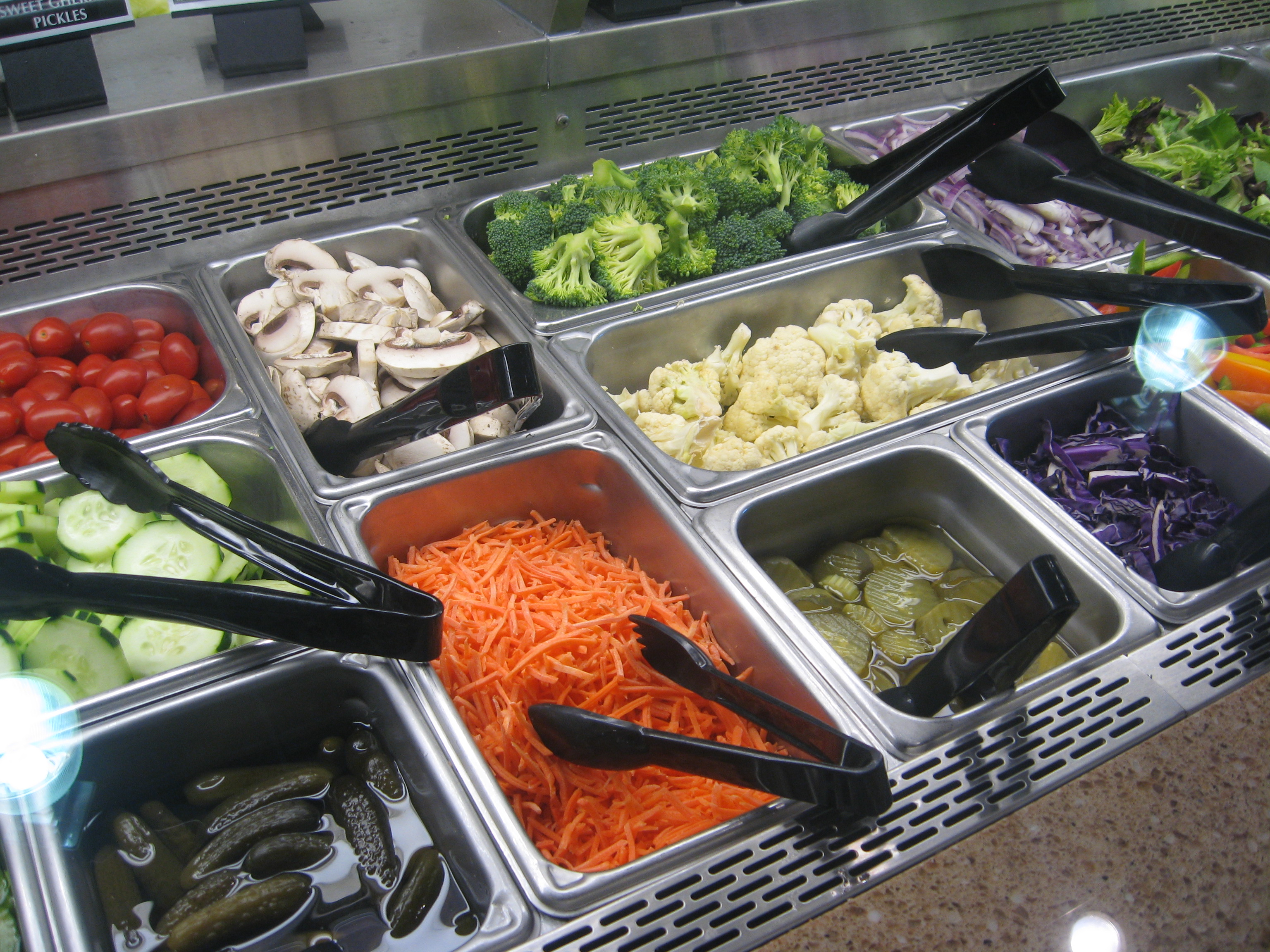
I found a basket of sliced mushrooms  in the fridge,  shelled edamame and collard greens in the freezer, water chestnuts in the pantry, and some rotisserie chicken and some pork in the fridge that needed given a re-do.  My only addition was a very large handful of julienned carrots (from the salad bar of my local Harris Teeter).

Since this was one of those OMG-I-don’t-have-time-to-cook occasions, I got out the rice cooker (cum slow-cooker) and added the hot and sour “flavor-infused” broth.  I sautéed  the mushrooms in just a bit of peanut oil until browned and gave the carrots a brief swish through the pan with the mushrooms, deglazed the skillet with a bit of the broth, and poured that into the slow-cooker. I added the edamame, collard greens, and the water chestnuts and set it for two hours.

When the collard greens and edamame were done (about 2 hours) I added the chicken and  pork  to heat through.  At the same time I added a piece of fresh ginger root and a small clove of garlic to “freshen” the flavors up a bit.

Obviously not a traditional hot and sour soup, but it was a good test of the “flavor infused” broth, and pretty tasty with the chicken and pork to add some richness, and the textural variety of the mushrooms, greens and water chestnuts.  A garnish  of green onions when served finished it off nicely. (I didn’t add the eggs, either.)

Verdict on the broth–not bad–actually much better than I expected– but if I’m going to make traditional real Chinese hot and sour soup (with tree ears and lily buds) I will start with my own stock–besides, I really like my hot and sour soup with pork. But if it’s just hot and sour I want, I might use another box of “flavor infused” broth!

A son goût!

Rice-cooker pasta with tomato sauce

Some days  a big serving of pasta with a simple tomato sauce is really necessary–it’s kind of attitude adjustment on a plate. On some of those days, it has to be really hands-off since I’m slaving at the computer with a deadline and just can’t be mucking about in the kitchen even though I want something to eat.

One of my favorite “comfort-food” sauces is the very simple one from Marcella Hazan’s Essentials of Classic Italian Cooking–“Tomato Sauce with Onions and Butter” (p. 152).  Not even any garlic.

Krups rice cooker IMG_3796Even though it’s not complicated to make, I wanted it even easier since I had to meet indexing deadline.  I decided to try it in the rice cooker since that’s work well for other pasta dishes.  (I’m NOT kidding–you can cook  pasta in the rice cooker, been doing it ever since I first made mac ‘n’ cheese that way from the recipe that was included with the Krups rice cooker).  This is one where I don’t mind having “leftovers”.

Pasta with tomato sauce

Ingredients

  • 1 14.5 ounce (411 gm) can of diced tomatoes (no added salt)
  • 1 small onion, diced fine
  • 2 tablespoons of butter (also good with olive oil, if you want to avoid the butter–or for a change)
  • salt to taste
  • grated parmigiano-reggiano (for the table)
  • 100 grams pasta of your choice
  • 200 (about 1 cup or 250 mL) water.

Preparation

  • Microwave the onion with the butter until the onion is soft and translucent. eat
  • Add the onions, butter, tomatoes (undrained), salt, and pasta to the rice cooker.
  • Turn on rice cooker and continue working until you smell it–about 15 to 20 minutes, and with a little minor adjustment, it should be ready to eat.

<><>||<><>

The Krups rice cooker (with slow-cooking and steaming functions as well) is not one of the fancy “fuzzy logic” ones.  Just simple physics of boiling water–it turns itself to warm when the temperature starts to rise when the water has been absorbed and the temperature goes above 212°F.  Simple–and easy to manipulate when you understand how it works.

For this rice cooker, the ratio of liquid to pasta needs to be 2.5:1 for al dente pasta. If it’s not quite there, just add about 1/2 cup more liquid and turn it back on.  When the rice cooker switches to warm function, the pasta will be fairly dry since this depends on all the liquid being absorbed.  If you’re hanging about in the kitchen, peek in about 15 minutes later and check the pasta and the consistency of the sauce. –

I usually  add a bit less liquid –maybe 50 mL short–let the cooker switch to warm, and then add just a bit more liquid, stirring the pasta, to thin the sauce a little, give it a few minutes to heat, and  then eat!

I used spaghetti for this, but broke it in half since full length won’t fit in the rice cooker.  So far this has worked for all the pasta types I’ve tried–penne, conchiglie, farfalle, fusilli, gemelli, macaroni, orzo, and, now spaghetti.  (I’ve only tried “flat” pasta (read “noodles”) once and that has been the only time the pasta stuck together, though that might have been lack of oil during the cooking–or the difference in flour and eggs in the pasta.

It may not be fancy, but….a son goût!

Most-used fry pan in the kitchen

Carbon Steel Fry Pans

carbon steel fry pan

Every cook has certain go-to pieces of kitchen equipment–whether it’s a favorite knife, or a particular pan. One of my particular favorite fry pans (or skillet, if you wish) is a  carbon steel fry pan. Mine is a Vollrath, but de Buyer also makes good ones.) It’s been with me for (literally) decades (though I’m not going to tell you the real numbers here).

It is a lot like cast iron–it must be seasoned before use, it doesn’t go in the dishwasher, and you don’t scrub it with a Brillo pad or soap, except maybe every decade or so. It can go into the oven, under the broiler, and be used at very high temperatures.

Why do I like it so much and use it so often?  Well, it has the advantages of cast iron without the weight of cast iron. Properly seasoned and treated with reasonable care, it’s nonstick–without the concerns of high temperature use, and it’s suitable for induction cooking, too. It’s not a really pretty thing–it’s discolored by frequent use since it’s usually the first fry pan I reach for, even though I have others–All-Clad and Calphalon–even one that is actually “nonstick”.

Occasionally you may get some stuck on food. To remove that use a salt scrub. The other “trick” to keeping it in good shape is to always dry it by putting it over heat, instead of just drying with a towel.

I have to admit that my carbon steel fry pan (the 9-3/8-inch one) finally reached the point where it was time to do a serious clean-up on it–lots of elbow grease, Brillo pads, and even oven/grill cleaner to take it back to where it started, and re-season it.  After curing it again, according to instructions is back in good form as my most used fry pan and ready for another few decades of good service.

Weighing and measuring

I just realized that the measurements for the coffee walnut cake are metric. I do either metric or US/English–but if you don’t work by weight, or have problems with the conversions, here is a link to a good converter on The Gourmet Sleuth.

1130800v2If you find you enjoy baking,
scales are a real time-saver–in terms of ease of measurement, fewer bowls to wash, and conversions. Press a button and you can do metric or pounds/ounces measurements. If you’re not using weight and need conversion, e.g. grams to ounces, The Gourmet Sleuth site has a calculator to do that for you.

These will handle up to 11 pounds, and will zero/tare at the push of a button so it’s possible to one ingredient after another into a single bowl–like the mixer bowl! The display also pulls out so that it’s easy to read even if you are using a large bowl.

My scale simple lives on the counter since I use it so often. Many times since I’m doing single-serving cooking I do ratios, as in How to Cook without a Book and by weight is much easier and faster than by volume–even for water!

A jar opener that actually works

Black & Decker Lids Off jar opener

.It works!

I’m not one for a lot of kitchen gadgets but I have one that I wouldn’t want to be without–a Black & Decker  Lids Off jar opener.  I had tried all sorts in the past and really given up on all of them until a friend brought me one of these that she found on a prowl through a thrift shop–so it was cheap.  From Amazon.com they are NOT cheap–but if mine were to crump on me I’d be trolling through thrift shops or Amazon.com looking for another one.

I’ve only found two jars that it wouldn’t open–one was a Costco-sized jar of roasted red peppers–in other word, huge–so the upper grips wouldn’t spread quite enough to hold the lid.  The other was a jar with very rounded edges to the lid–also a jar of roasted red peppers–though smaller size.

This is not a bottle opener–it’s not designed for beer bottles or lids less than about 1-1/2-inches in diameter–I’ve not had occasion to try smaller than that. I used it on jars about 2-1/2-inches in height. The jar with the lid that was too big was a 4-inch diameter, so it does do a good range of sizes. (Have another gadget from the hardware store to handle these now.)

Even with those two “failures” this is a kitchen must if you have difficulty with opening jars for any reason.  It folds down for storage so it doesn’t have to stay on the counter all the time, but the handle on top lets you move it easily–altogether a worthwhile kitchen gadget!

…and now it’s turkey soup!

Remember those turkey thighs that I roasted a couple days ago? They have really been a bargain.  I spent about $5 on the package of thighs–two small-to-medium ones.

I had my roast turkey with sides of potatoes and cabbage (with juniper berries). Then I had two full-size sandwiches, and a half sandwich for lunches. Now I’m finishing the turkey thighs with a very hearty bowl of soup (and a  glass of good wine).

small Rival Crockette

a crockette

I popped those thigh bones (with what meat wasn’t easy to carve for sandwiches) in to my tiny little single-serving crock-pot to make some stock–I just added a little salt, a bay leaf, the brown stuff that I deglazed from the roasting pan, and enough water to cover the bones. After slow cooking overnight, I removed the thigh bones.  The meat just fell off into the pot.

In the same little crock-pot (don’t want extra dishes to wash), I added a small handful of barley, some dried mushrooms of various sorts–including shiitake, chanterelle, and porcini. The other things that went into this soup were the leftover cabbage (with juniper berries) and a few potatoes that were roasted with the turkey.  (You may be thinking that this is pretty heavy on starch, but to finish the soup, I added some green stuff.)

small leaves of greens

mixed greens

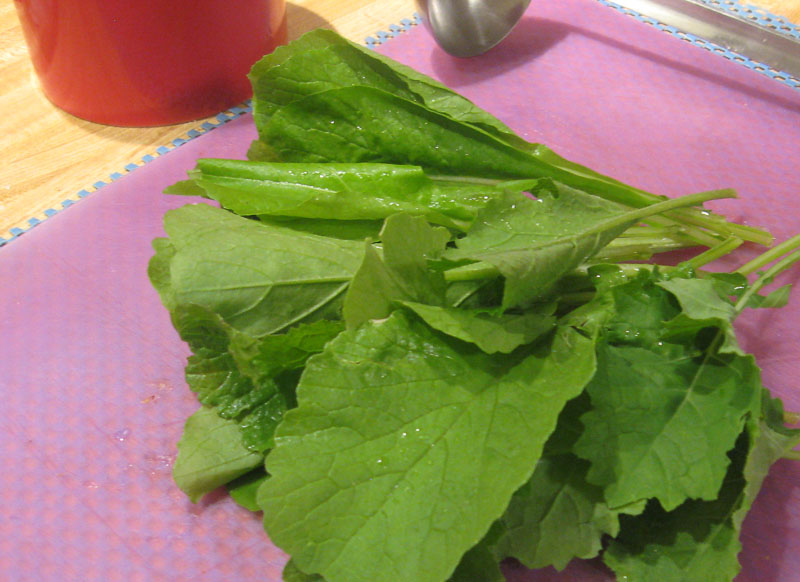
About half an hour before I was ready to eat, I went out to the garden (which I share through the good graces of a neighbor) and picked a good size handful of small kale, turnip, and mustard greens.

After washing, I cut these in bite size pieces (though that was almost unnecessary as they were really not as big as my hand). They went into the crock-pot; in about 20 minutes they were still bright green but tender.

I did a final adjustment of salt using French Grey sea salt, and finally added several drops of black truffle oil to finish the soup.

-<>^<>-

I’ve had my bowl of soup for supper this evening–and it looks as if I’ll get one more meal out of those turkey thighs–with the barley, and the amount of meat that was left on the bones, there is easily another serving of this soup for lunch or supper tomorrow. (I’m sure that by the time I reheat it, those greens won’t be quite so bright green, but the flavors may have melded with the other ingredients so it should be good–maybe even better than this evening.

bowl of soup with greens

a warm, hearty supper

-<>^<>-

I opened a bottle of wine this evening that was a completely unknown to me. It was a limited release called “Dark” from Apothic. I was completely beguiled by the description that said that it “blends dark fruit flavors of blueberry and blackberry with opulent notes of coffee and dark chocolate”.  How could I possibly pass that up? (I found it while shopping at Harris Teeter–just after I had bought a case of something called “Besieged”–more about that one later.)

I was surprised how dark it was when I poured it into the glass! (I even tried to take a picture–but it just looks almost black–so forget that.) It is definitely a “big” wine and right out of the bottle it was fruity and mellow–but after breathing for a bit it lives up to its description.

I thought it might overwhelm my bowl of turkey soup, but with the juniper berries, the rather emphatic mushrooms, the flavors of the greens, and the truffle oil, it turned out to be a great combination.  Fortunately there is some of the wine left for tomorrow’s soup! This is one time when I’m looking forward to the “leftovers”.