Sugar plums

I think that these are a special holiday treat. Too bad that we don’t see more of them.

Rufus' Food and Spirits Guide's avatarRufus' Food and Spirits Guide

Despite the title, these little treats are quite dense and spicy, but not overly sweet. Feel free to alter the fruit mix. A number of recipes only used dates and apricots. Most recipes we saw called for using a food processor, but we don’t have one and were worried the blender would gum up on the first pulse. If you have the same dilemma just remember to chop the fruit very fine.

Sugar Plums

  • 1/2 cup pecans, chopped very fine
  • 2/3 cup honey
  • 1 tsp ground cinnamon
  • 1/4 tsp ground allspice
  • 1/2 cup finely chopped dried apricots
  • 1/2 cup finely chopped pitted dates
  • 1/4 cup finely chopped dried plums
  • 1/4 cup finely chopped dried cherries
  • 1/2 cup powdered sugar (aka confectioners’ or icing sugar)

Combine nuts, fruits and spice in a large bowl. Using a wooden spoon or rubber spatula, mix in honey stirring to coat evenly. Pinch off teaspoon-sized…

View original post 19 more words

GMO or not?

I’ve seen posts on Facebook saying that the PLU codes indicate whether produce is genetically modified or not–wanting more information I did a little searching, including reading some FB posts.  I thought I’d share this commentary on the PLU codes from Snopes.com and the Huffington Post.  It would be nice if it were as simple as looking the PLU code for reliable information!

A one-dish meal.

A lot of us eventually reach the point when we realize we are getting a bit rotund (or worse) and start thinking about watching (or losing) weight, or maybe just being more conscious about nutrition.  With several of those things in mind (or should I really say on my mind) I did some web browsing.

I found a website that I’d like to share with you:  A Slice of Nutrition.  I found this through another blog that I follow, My Imperfect Kitchen, that had a post by Avital Greenbaum as a guest blogger–Chicken, Zucchini, and Quinoa. 

One dish meals are very appealing to me–at least some of the time, because I can be lazy, have a good meal and not have to wash lots of pots and pans.  (No, Frankie refuses to do that!)  I’ve had quinoa in breakfast cereals, and things like that but after reading how healthy it is, I decided I need to try it in a main dish and this looked like a great place to start.

Garlic scapes lying next to a basket of strawberries

garlic scapes

I do have to admit that, as well as being constitutionally unable to make a small pot of soup, I seem to be unable to leave a recipe alone when I’m making it.  I did almost follow this one.  Instead of garlic powder, I had fresh, green garlic scapes from the farmers’ market.  Those went it, and I added some mushrooms; otherwise, I left it alone.  This one-dish meal is now in the oven (despite the heat) getting ready for my supper.

Since my veggies are included with the dish, I think that all I’ll need to add is some of those luscious ripe strawberries as dessert!


Baking dish with chicken and quinoa

Chicken, zucchini & quinoa

This is a keeper–only a few minutes prep, and it’s unattended cooking with tasty results. The quinoa is very light–good in hot weather.  I think that it might make some very tasty “salads” with lentils for satisfying summer meals when the weather is sweltering and I want a light meal.

About lentils

lentils in Mason/Ball jar on pantry shelf.

lentils

Lentils (Lens culinaris), closely related to beans and peas, are dried after harvesting; you’ll find them on the shelves of your supermarket, gourmet stores, and online. They have been a staple food in many areas for over 8000 years, likely originating while in Turkey.  They are a staple food for many south Asian cultures, Middle Eastern, and Mediterranean countries.  The Latin word for lentils, lens, was used in the 17th century to describe eye glasses because of the similarity in shape

Like other legumes, lentils are low in fat and high in protein and fiber, but they have the added advantage of cooking quickly.  Lentils have a mild, often earthy flavor, which lets them pair well as side dishes, in salads, and soups.  Lentils have traditionally been used as a meat substitute.  Like other pulses, when paired with grains they offer excellent quality protein in our diet.

Before cooking, always rinse lentils and pick out stones and other debris–usually they are quite free of debris, but it’s always good to check them before cooking.  Unlike dried beans and peas, there’s no need to soak them. Lentils cook more slowly if they’re combined with salt or acidic ingredients, so add these last.  Bigger or older lentils take longer to cook.  Store dried lentils for up to a year in a cool, dry place. Substitutes: dal OR split peas OR black-eyed peas  More varieties are appearing even on the supermarket shelves, but specialty sources offer a wide variety with which to experiment.

The quick cooking and nutritious nature of lentils make them an obvious choice for winter soups. They are also good cooked and chilled for salads or mixed with bread crumbs to stuff vegetables. Blend lentils with middle eastern couscous and use as a bed for seafood and poultry.  Use them instead of beans  for summer salads with fresh tomatoes and other veggies.

Here is a little information about the various kinds of lentils.  More synonyms and alternative names can be found in the Cook’s Thesaurus.

  • Brown Lentils:  The average grocery store lentil is the brown lentil. You’ll likely find these on the shelves with the dried beans.  They tend to get mushy if overcooked.  If you want them to be firm, add oil to the cooking water and cook the lentils just a short while, say 15 minutes.
  • Black beluga lentils are a very popular legume in South Asia, they are used to make a beautiful black lentil soup. Some of the names that they my go by are Beluga lentil = black beluga lentil = beluga black lentil = petite beluga lentil. When they’re cooked, especially in salads with a tiny bit of oil, they glisten so that akes them look like beluga caviar.
  • Petite crimson lentils are “crimson” in color, which is a deep orange-red. These lentils tend to lose their shape when they are cooked and are an excellent choice for thickening soup.
  • Petite golden lentils are a small firm, golden lentil that is rounder in shape than many other  lentils; one of the reasons that this lentils holds its shape so well when cooked.  They have a soft texture.
  • Ivory white lentils are a creamy white colored small lentil that is really a peeled black lentils, known in India as urid dal.
  • French green lentils: (also called French green lentils, du Puy lentils,  lentilles du Puy, lentilles vertes du Puy.)  By many chefs, these are considered the “best”, most delicate lentils.  They have the typical earthy flavor, but also  are a bit “peppery”. These hold their shape well better than many other lentils,  but take longer to cook, but still do not need presoaking. While I love all lentils, and typically have several kinds in the pantry, these are the ones that I would not want to be without!)
  • Red lentils are the common seen in the supermarket.  It’s a lovely salmon pink in the dried form, but it turns golden when cooked.  These lentils cook faster than others.  They’re best in  purées or soups.
  • Spanish pardina lentils (also known as Spanish brown lentils or Continental lentils) are smaller the brown or red lentil–about the same size as a petite green or black lentil.  They have a particularly nutty flavor, and they hold their plump, round shape when cooked. This makes them a particular favorite with e for use in summer vegetable/lentil salads.
  • Dal is the Indian term for peas, beans, or lentils that have been split and often skinned, but the name is sometimes used for all lentils, peas, or beans, or to cooked dishes made with them. Split lentils don’t hold their shape well, so they’re often cooked into soups or purées.

Most of these can be interchanged in recipes as long as you take into account how quickly they cook and the final textures–some are softer than others. Generally the split ones tend to lose shape faster, so don’t do well for salads, or side dishes where you want them to keep their shape, but will be fine in soups–especially if you’d like your soup to be a little thicker.  Any of these would work in the lentil soup recipe that I gave earlier–though I usually use the lentils du Puy even for that.

Aside from using them instead of beans in summer salads, I think that lentils make an awesome side dish to go with grilled salmon–there’s something about the earthy flavor that combines SO well.  If you have “leftover” grilled salmon, try using it with some lentils to make a cool, but hearty summer salad with some tomatoes and cucumber to it.  Combined with a grain, this can be a very nutritious vegetarian dish–or not.

Here is a link to a lentil salad that makes me drool on my keyboard just looking at the recipe:  Warm Salad of Lentils with Duck Fat from the Hudson Valley.  Love’s description of the lentilles du Puy is marvelous.  (Each time I cook duck, I carefully keep some of the fat, sealed and refrigerated to use for things like this.)  Add some greens, and this is a one-dish meal that’s in my group of comfort foods.  Lentils will also work in the sausage, beans and greens one-dish meal.

Lots of uses, quick-cooking, nutritious, tasty, inexpensive…what more could you want?  Try some!

Pumpernickel with seeds

sunrising through trees

morning through the kitchen window

I’m sitting here this evening, writing and waiting for the first loaves of the pumpernickel from the Healthy Bread in Five Minutes a Day (p. 115) to come out of the oven.  I’ve peeked in and they look good and smell wonderful!

(Why does it seem that it takes so much longer for bread to bake once it smells so good that your practically drooling on the keyboard? I just know that one of these loaves is not going to get to cool as it should even though I know cutting it immediately will not help–that’s one of the reasons I like baking two smaller loaves–I can treat myself, and still have good bread for sandwiches.)

Waiting, and not very patiently….

Just because of the way that I use bread, I’ve baked these in the perforated Italian bread pan.  The crust is probably not quite what it would be directly on the baking stone, but it quite good and I have the longer, slightly skinnier loaf, and it’s easier if I want to bake a second loaf to share with friends.

This healthy bread has whole wheat flour, rye flour, and flaxseed meal in it…and I did put in the caraway seeds this time too.  I did tamper with the recipe that was given in Healthy Bread in Five Minutes a Day.  I really do make an effort NOT to play with the recipe until after I’ve made it as given once, but I did not make it this time.

Since I had white whole wheat flour which gives a milder flavor instead of regular whole wheat, my dough wasn’t very dark, and it just lacked something in the kind of “bitter” smell that I’ve liked about that last batch of pumpernickel.  The “missing ingredient was the unsweetened cocoa powder, so I got carried away and put in cocoa powder.

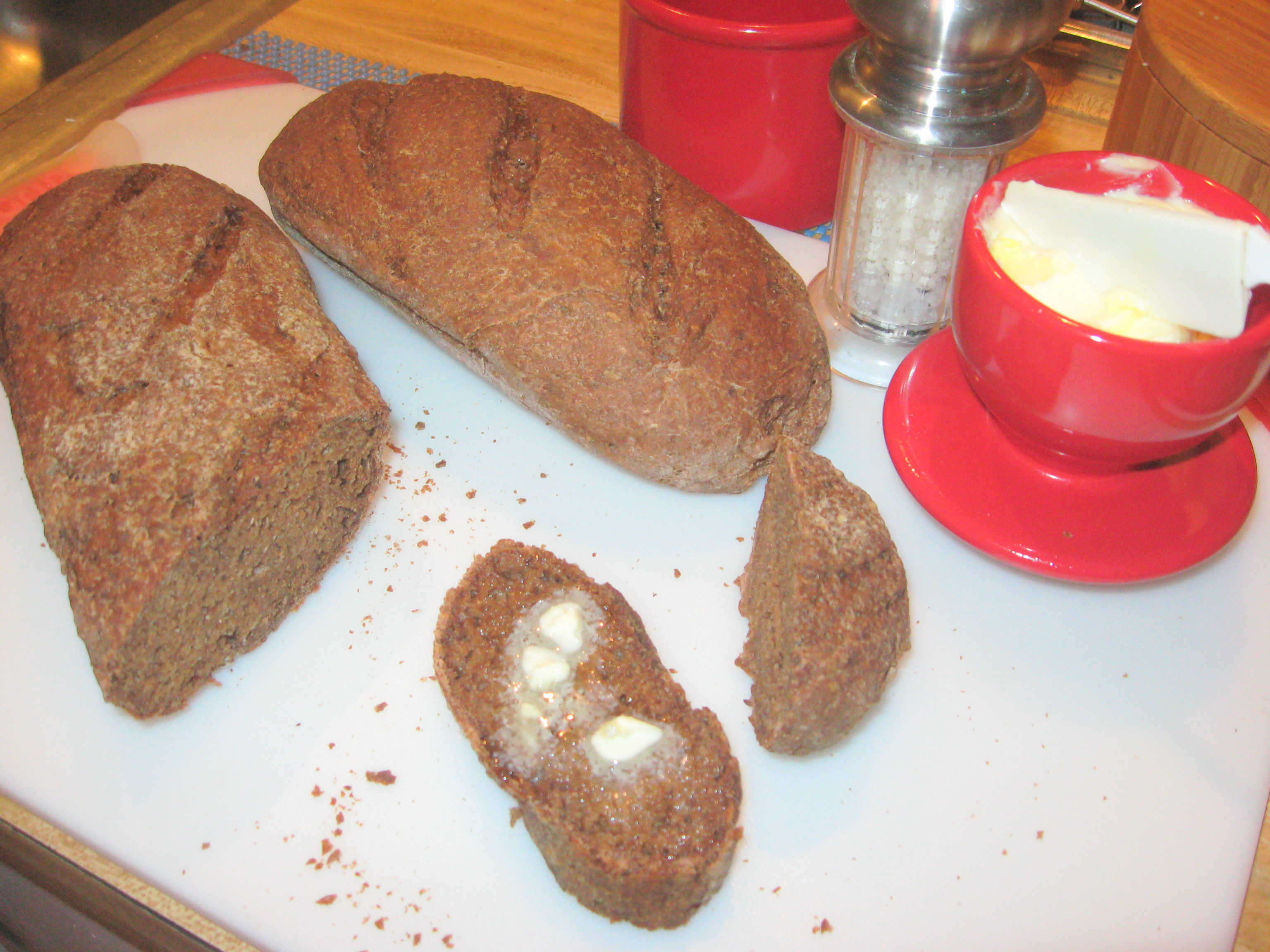
One loaf of pumpernickel bread on cutting board with butter-bellIt’s out of the oven now, and cooled just enough so I can ravage one of the loaves–I’m cutting the one that didn’t rise quite as well, but it’s a keeper.  As you would expect with more whole grain flour, it’s more dense than the first batch, but a good crumb–which I’m sure would have been better had I not cut it so soon.  The flavor is great–the cocoa powder did the trick to take up for the white whole wheat flour, and I think that the flaxseed meal is really undetectable.  The amount of caraway seed called for in this recipe was only 2 tablespoon for four loaves–so it stays as a kind of “dark” background flavor.

This will get made again–with the modifications.  I think that I can work with this (without caraway) to try to get the Russian black bread recipe (the Smitten Kitchen) adapted for the no-knead technique. (It’s not just that it’s no-knead–I have a KitchenAid® mixer.  The real attraction is that I can have this dough in the fridge for a long time–10 to 14 days–and have freshly baked bread quickly and often, too.)

I’m now enjoying my warm (actually, hot) freshly baked bread with some unsalted butter and a light sprinkle of sea salt since the butter has no salt.  I do have some radishes in the fridge to have a radish sandwich tomorrow after the bread has really cooled!  That will be time to break out the bubbly!

one whole loaf and one cut loaf with slice of bread with butter.

…A son goût!  

Tuna salad

Not that there’s anything wrong with traditional American tuna salad, but there are lots of other things to do with  tuna.  I like tuna, but I don’t want “tuna salad” in the traditional sense every time, so I’ve come up with lots of variations.  Some of the best are made with the “leftovers” from grilling a lovely big tuna steak or with my homemade tuna confit.

My “salad” might have onion and celery (if present in the refrigerator) but it’s certainly not a requirement; no mayonnaise either (though I do like the stuff).   Home from work, not going back out to the grocery store; it’s warm enough that I don’t want anything hot for lunch.  What have I got to work with from the pantry and the refrigerator?

If you think about the basic American tuna salad, it has very few ingredients:  usually mayonnaise, celery, onions, and maybe hard-boiled egg, or sometimes pickle relish.

Personally I find the usual supermarket canned tuna to be unappetizing–dry and crumbly if it’s water-packed white albacore, sometimes mushy  and fishy lacking in any real texture,  so I understand why it’s often hidden in the mayonnaise, but there are now  reasonably priced alternatives available.  If I don’t have homemade confit, I’ll be using a single-cooked canned tuna that more nearly approximates the quality of European canned tuna.

Starting with good quality  tuna, unless you want to go all the way and make salad à la niçoise you really don’t need many ingredients.  You don’t really want to overwhelm the tuna (since we are using good tuna here) so the components you need are:

  • some contrasting texture and flavor ingredients
  • just a bit of oil
  • a little acid to brighten it up.
  • fresh-ground black pepper
  • some fresh herbs for extra flavor

Starting with a six-ounce can of tuna, here are some possible things to do:

  • For something light, refreshing  and crunchy for a sweltering day, I like to use diced cucumber, scallions, red onion or sweet onion like Vidalia (depending on what’s in the fridge), fresh-ground black pepper, salt (if the tuna has no added salt), about a teaspoon of very fruity extra-virgin olive oil, a squeeze of lemon juice, and some finely chopped spearmint.
  • For something really quick, I’ve  added some  fresh onion, sweet bell pepper,  diced chile peppers for texture and some salsa  from a jar.  Chipotle salsa can give you a warmer, smoky taste.
  • If you want a heartier salad, add to your tuna some drained, rinsed white beans (great northern or cannellini are my favorites), tomatoes, chopped onion, green or black olives, some extra-virgin olive oil or aïoli (easy to make a quick version if you have decent mayonnaise in the fridge) and some fresh oregano.
  • If you have some pesto in the fridge, try chopped onion (almost always use this), diced tomato, capers, or olives. If there’s pasta around, that can be added too.
  • I usually have a jar of a fruit salsa in the fridge as well and that makes a good start.  Add sweet onion like Vidalia or Walla Walla, more fruit such as peaches or mango, some ripe bell peppers.
  • Black beans, diced tomatoes, onions, chile pepper, ripe bell pepper (I’m just not fond of green bell peppers so I don’t use them), celery, and even some corn and a vinaigrette with a light touch of chilli powder added.
  • For an oriental take on the tuna salad,  a bit of sesame oil (the kind from roasted sesame seeds) with some ginger, green onions, a little garlic if you like, with cucumbers, celery.
  • That extra serving of roasted vegetables–even potatoes–with cherry tomatoes, and a splash of vinaigrette, maybe some fresh thyme.

Obviously, a many of these suggestions would work equally well with chicken if you have that instead, or don’t like tuna.  It’s easy to improvise a quick salad if you start with a serving of meat. The possibilities are really almost endless–just follow your own taste.

A son goût! 

Tuna confit…

Steaks and chops lend themselves beautifully to cooking for one.  One of my favorites is tuna steak, griddled or grilled–served with a side of spinach risotto  and a salad it’s a very quick, easy meal.  If there is leftover from the tuna steak, it can be used in tuna salad.  But sometimes I want to tuna salad when I don’t have leftover tuna steak.  What to do then?

I dislike the “average” can to tuna that is fishy, mushy, and buy the “solid white albacore” which is likely packed in water, but still dry since it’s cooked twice in the processing (Cook’s Illustrated, July/August 2011). I love the expensive, olive-oil packed European tuna–but my budget doesn’t permit it so I’m always looking for alternatives.

One of the things that I like about Cook’s Illustrated is the comparison of products readily available in the American supermarket–that is, after all, where I do most of my shopping. Those products are reviewed without knowledge of the manufacturer, and are not supplied by the manufacturer–so I do tend to give them some credence.
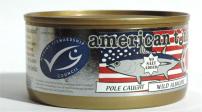
American Tuna image of canIn the July/August issue, there is a comparison of major brands of canned tuna and some newcomers on the market.  The two newcomer brands were Wild Planet Wild Albacore Tuna and American Tuna Pole Caught Wild Albacore. Both these were single-cooked products and had much less liquid and more tuna.  True there were a bit more expensive but not nearly so prohibitive as the European canned products.  There are a variety of different products available from both companies (salmon, sardines). In both cases, products are available with no salt added, or with sea salt add–such a simple ingredient list on the tuna:  albacore tuna (and maybe sea salt)–nothing else.
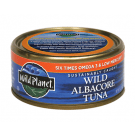
Image of Wild Planet albacore canSince I like tuna and use it both as a salad ingredient and as a staple in my “emergency” food supply, I wanted to check this out.  I went in search of some of both.  I found the Wild Planet albacore tuna and tried it in a simple non-mayonnaise tuna salad.  I was impressed–I’ll definitely be buying this for my tuna.  I have yet to find American Tuna, but given the review in Cook’s Illustrated, I suspect that I’ll like that one too.  I found the Wild Planet tuna at Whole Foods.  Though Kroger was listed on the retail list, the one closest to me did not have it on the shelf.  The American Tuna products are listed as being available at Whole Foods but apparently have not reached out local Whole Foods yet.  I’ll be watching.

I’ve tasted (and love) the expensive “gourmet” European tuna, but it’s not in my budget, so these products at a more reasonable price are welcome.

There is another alternative for good tuna which will approach the European canned tuna, though not really for the “emergency” food supply since that needs to be canned.  That is to make your own tuna confit.

Confit was originally a way of preserving meats–pork, goose, and duck–by cooking them very gently in their own fat, straining the fat and using it to seal the meat away from air for storage.  It produces meats that are markedly different in texture from those cooked in other ways–smooth, velvety are the adjectives that come to mind, at least in reference to duck and chicken.

I’m lucky to live close to a Harris Teeter which has high-grade tuna.  Every once in a while they will have it on a managers special, or will have smaller pieces left from cutting the tuna steaks which are sold at a reasonable price as “tuna medallions”.  Every time I see those (or steaks) on sale I get some and make my own tuna confit.  So for you tuna lovers, here is a master recipe from Fine Cooking 46, pp. 68-69, January 6, 2004.  I usually halve the recipe since I’m a solo cook.

Tuna Confit

Ingredients

3 cups good-quality olive oil (but not best); more if needed to cover the tuna during cooking
1 medium yellow onion, cut in 1/2-inch slices
2 sprigs fresh rosemary
6 sprigs fresh thyme
1 bay leaf
1 tsp. black peppercorns, coarsely cracked
Zest of 1 lemon, pared in strips
3 Tbs. coarse salt
2 lb. top-quality fresh tuna (yellowfin or ahi), cut into 1-inch-thick steaks

Preparation

  • Combine the oil, onion, herbs, peppercorns, lemon zest, and salt in a deep sauté pan or Dutch oven.  Heat to between 140° and 150°F, stirring occasionally and cook for 20 minutes to infuse the flavors of the aromatics into the oil and to pasteurize it for a long shelf life. Taste the oil; it should be slightly salty. Leave to cool and infuse for about 30 minutes; the oil will be warm.
  • Put the pan back over medium-low heat and slip the tuna into the barely warm oil. (Add as many pieces as will fit in one layer. The tuna must be covered by the oil; add more if needed.) Slowly bring the oil to 150°F again. Turn off the heat, take the pot off the heat, and let the tuna cook slowly in the warm oil. After a minute or two, test for doneness by breaking into the flake of the tuna. The fish should be cooked to medium rare-slightly pink inside and still tender to the touch. If the tuna isn’t quite done, return it to the oil for another minute. Repeat with any remaining pieces of tuna.
  • Transfer the tuna to a storage dish (I prefer glass or crockery, but an airtight plastic container will  do fine) and let it cool. Let the oil cool separately and then strain the oil over the fish, discarding the aromatics. If the tuna isn’t completely covered in  oil, add more fresh olive oil to the storage dish. If not using right away, cover the container tightly and refrigerate. The tuna will keep, covered in oil and refrigerated, for up to 2 weeks.

Nutrition information (per ounce of tuna)

  • Calories (kcal): 60
  • Fat (g): 3
    • Fat Calories (kcal) 30
    • Saturated Fat (g) 0.5
    • Monounsaturated Fat (g) 2
    • Polyunsaturated Fat (g) 0.5
  • Protein (g)  7
  • Carbohydrates (g) 0
  • Sodium (mg) 85
  • Cholesterol (mg) 15
  • Fiber (g) 0
♦♦♦

It’s easy to make this with much less than a pound of tuna–I occasionally do it with a single tuna steak in the summer when I’m really eating lots of salads and want to have them be a meal.

I use the confit to make tuna salad–but usually without mayonnaise–this is not dry so it’s not necessary to have the mayo to make it edible.  I generally pat it dry and use just a drizzle of extra-virgin olive oil with herbs, and some scallions, or cucumbers, or really splurge and do a salad à la niçoise.

Whole wheat pita bread

Baba ghanoush with olive oil and parsleyNow that you have baba ghanoush, you need something to dip in it.  Crudities are always good—and healthy, especially in the summer when there are grape tomatoes, cucumbers, celery, or even blanched green beans.  The traditional thing to have with baba ghanoush, however, is pita bread.  I’m sure that you can find pita at your market but it’s very easy to make and tastes so good freshly baked.

I’ve posted about the no-knead bread dough that can be kept in the refrigerator for about two weeks.  You can use that same dough to make flat breads (pita included), crackers, pizza crust, and the like as well.  It’s just a matter of how you treat the dough.

The same authors who did Artisan Bread in Five Minutes a Day now have another book out:  Healthy Bread in Five Minutes a Day.  This no-knead method is SO easy, and works so well for single-serving cooking that I had to try this one too.

The master recipe in this is for a whole-wheat bread.  That basic dough can be used for pita bread as well.   That master recipe can be found on one of my favorite food-related blogs, Former Chef–so I’ll not reproduce it here.   I’ve made this recipe using white whole wheat flour.  I’ll admit that I’m partial to King Arthur flours; it’s available in my supermarket–so that is what I’ve used.

Pita bread

just out of the oven…

To make pita bread you don’t need to let the dough rise before baking so it’s very quick.  Just develop the gluten cloak  in the usual way. Since I wanted to do smaller pitas, I used about 75 to 100 grams of dough for each portion, “cloaking” each small portion and flattening it, rolling it out to about 1/8 inch thickness.

Since I did four at a time, I baked them on parchment paper on a baking sheet rather than directly on the stone.  With the 450 to 500 ° F oven it takes only about

Remove from the oven and wrap in a towel on a cooling rack.  They may “deflate”,

but the “pocket” is still there.   Pitas made from whole-grain flours may not puff as much as if made from unbleached all-purpose  white flour.

Since these are not crusty, you can store in a plastic bag.

Healthy eating & living

I’m back from the Wake Forest Farmer’s Market–with blackberries, blueberries, sweet corn and other goodies.  One of the things I enjoy about selling at that market is the people I’m meeting.  In chatting with one of my customers today, a Health Coach, I discovered a website that has some good health and nutrition information.   Recipes here are simple, healthy and focus on good ingredients.

Keep it cool

Cleaning out the is refrigerator is such a drag!  For those of us cooking for one, it is often triggered by that appalling smell that greets us when we open the door of the refrigerator to get the milk for morning coffee.  It is the harbinger of the lost leftover or the bunch of beautiful leafy green stuff (now transformed into juicy, olive-drab color in the crisper because it was simply too much to use?  How do we avoid this kind of waste?

I’ve always disliked wasting food; I’ve also always had a dislike of most leftovers—they usually taste leftover!  Admittedly there are thing better on the second day—but that does not make them leftovers that I dislike.  It’s true leftover leftovers that I dislike so I’ve always looked for ways not to have them.  Frequently, that involves sharing the pot of soup with a friend and putting some in the freezer, because I am constitutionally incapable of making a small pot of soup!  Most of my neighbors understand about my “food crises”.

The implications of my dislike of leftovers and having too large a quantity of something was brought home to me recently when I was reading about sustainable agriculture.  In Just Food by James E. McWilliams was a discussion of the carbon footprint of food.  We typically think in “food-miles”, but he introduced the concept of “life-cycle assessment” which looked at the energy consumption of food production from seed to its appearance on the table.  There were some startling statistics there—the greatest energy consumption, according the studies cited by this author, is in production, not transportation.  What really hit me was the studies on food waste:  1.28 pounds per day per typical household (p. 28).  So?  I know I’m not a typical household, just me and the cat, but I had to wonder about the amount of waste from my food use. (Admittedly, the cat usually leaves the bits of carrot and onion from her tiny part of the beef stew, but let’s not get too picky here.)  I am interested in environmental responsibility, carbon footprint; so I need to waste less food.  How can I do that?

Assuming that I cannot buy smaller quantities, I obviously must be more efficient in my use of whatever quantity I purchase.  So I need to do some “prep”, not just put what I don’t use into a plastic bag and put it in the refrigerator.  There are two primary causes of spoilage (changes in texture and flavor that make food inedible):  microbial action, and the plant’s own enzymes (On Food and Cooking, Harold McGee, p. 166).  Obviously just simple refrigeration is not enough for my rate of usage–in order to prolong the viability, I need to protect against microbial action and against the action of enzymes.  That would suggest at least blanching the extra green stuff (or any other color veggies) before I refrigerate or freeze them.  Not anything too time consuming in that.

Blanching is a simple technique: In this process, food is simply immersed in boiling water for a short period (depending on thickness) and then plunged into ice water.  This is enough to kill surface microbes and to inactivate enzymes, so my green stuff should stay edible longer.  The down side of that is it may be an extra step–I certainly don’t want that.  Cooking also achieves these ends–so maybe I can sauté my greens in some basic way that will allow me multiple uses and eliminate the extra step (and energy expenditure) and still preserve them; however, despite the cooking, the food still needs to be treated as a “leftover” (not eaten within two hours of cooking) and safety precautions for “leftovers” observed.  The rule of thumb seems to be 4 days for things like cooked meats, chicken, et cetera; if it smells off, don’t eat it even if it’s less than four days.  Lots of additional information is available from some of the links above.

Toscano kale, or other greens can be sautéed quickly with some basic seasonings, for example, a mild olive oil, a bit of salt and then have additional seasonings added as needed for other uses.  I’ve done this basic thing and use the prepped greens in pasta sauce, filling for an omelette, as a side dish with some red pepper flakes and garlic added…very flexible and the entire batch of greens got used!  Planned, flexible leftovers!

That raises the question of how long can I store something like the cooked greens in my refrigerator and still not lose taste or have a health hazard.  First the refrigerator should be set to hold a temperature of 40 ° F  or less (USDA) or less.  You should keep a refrigerator thermometer (inexpensive and available at the grocery store) to monitor the temperature of the refrigerator.  If it is within that range, you can find suggested time for refrigeration of meats, poultry, seafood at FoodSafety.gov.  But remember that the safety of refrigerated leftovers depends on their proper cooling and storage.  Don’t leave your hot food to cool on the counter.  Put it in the refrigerator right away–that’s what refrigerators are for–to cool things and keep them cold.  See the food safety links for instructions on how to cool foods properly and how to store and use leftovers safely.