
Right along with trying to avoid waste, the French Paradox should make us think more about what and how we eat.
Category Archives: Responsible eating
attacking the problem of food waste in france
Gallery

This gallery contains 3 photos.
Great post with links to more provocative reading. We all need to think about our food, the consequences of how much we waste and ways to make better use of food resources.
Grocery shopping for one
Do you think about advertising while you’re grocery shopping? Most likely not! I know that I don’t–but I try to do “perimeter” shopping, making a foray into the center of the store only for specific items–like drain cleaner, paper towels, or dish detergent. Where I shop, the immediate thing from the entrance is produce (with a big display of locally grown goods), which leads to the meat and fish/seafood counters; a left turn there takes me past the dairy, and refrigerated juices; another left leads me to frozen goods. If I take a right turn at the butcher/fish/seafood counter, I find myself at a counter of prepared fruits and melons (usually in big quantities that are too much for one). Next in line is the bakery and then the delicatessen. Continuing through those, I end up at the Asian food bar, the rotisserie chickens and other prepared meats, and the salad bar. My usual trek through the grocery store most often involves only a quick dash to the dairy case, then meat and deli. I don’t see a lot of processed food on this circuit. I’d never really given much thought to whether or not my shopping was being manipulated by sales-motivated display methods. The links below contain some information about store layout and methods used to induce us to buy “stuff”–things that we did not come into the store to purchase: impulse purchases.
- How to Buy Food: The Psychology of the Supermarket
- How to Buy Groceries: Supermarket Shopping 101
- Reusable shopping bags encourage shoppers to buy produce–and junk food?
Õ¿Õ
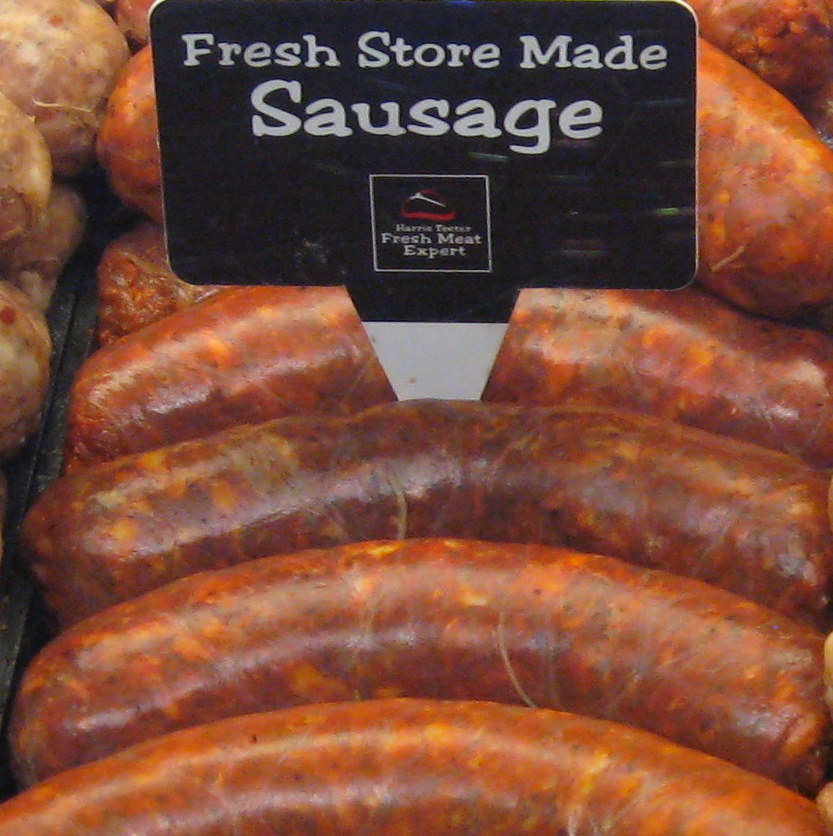 Meat purchases are pretty easy–thanks to chops, steaks, and a butcher/fish counter that will cut to order; packages of chicken parts, rather than whole birds, and house-made sausages that I can buy one or two at a time. Careful consideration of the dish that I want to make can allow alternative cuts of meet: beef shank instead of large chuck roast for post roast.
The real difficulties come in produce where things are sold bunched, bagged, or otherwise in quantities that don’t fit single-serving cooking. Some produce just grows in too large a quantity–heads of cauliflower, heads of cabbage or lettuce, a whole stalk of Brussels sprouts…waste just waiting to happen unless we make a serious effort to prevent it.
Ò¿Ó
One of the difficulties of cooking for one (or even two) is the produce that goes bad while waiting quietly in the refrigerator for you to do something with it. I love peppers–and I like variety, but I simply cannot use a whole red and orange or yellow bell pepper before they begin to get a little mushy around the edges, no matter how carefully I store them. So do I do without them? Even some ready-to-use packages that are available in the produce department are still more than I want. Buying more than I can use is like throwing money away–and it gets worse if you consider the amount of food waste by consumers after purchase, let alone the waste between harvest and the appearance in the supermarket.
My supermarket likely has something that will help with this dilemma: a salad bar.
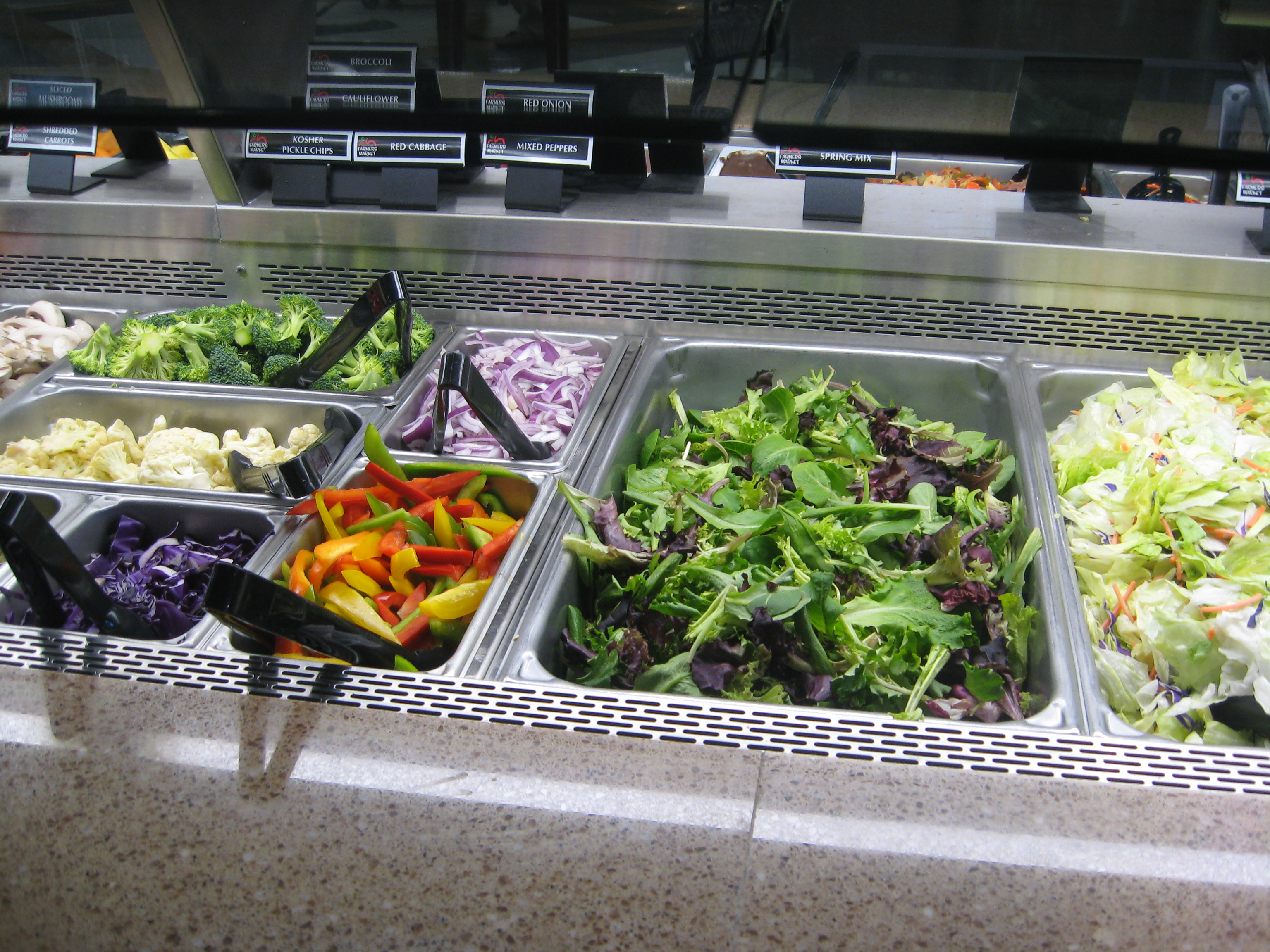 If you’ve always thought of it as a place to make a salad with all sorts of veggies and trimmings, and pour salad dressing on it, top it with some croutons, and take it back to the office to eat you need to look at the salad bar from a different perspective. Take a closer look at what’s available there to purchase by the pound–thinking about what you need for a meal, rather than making a salad.
As much as I love salads, packaged greens often go bad before I use all of them. My other objection to big 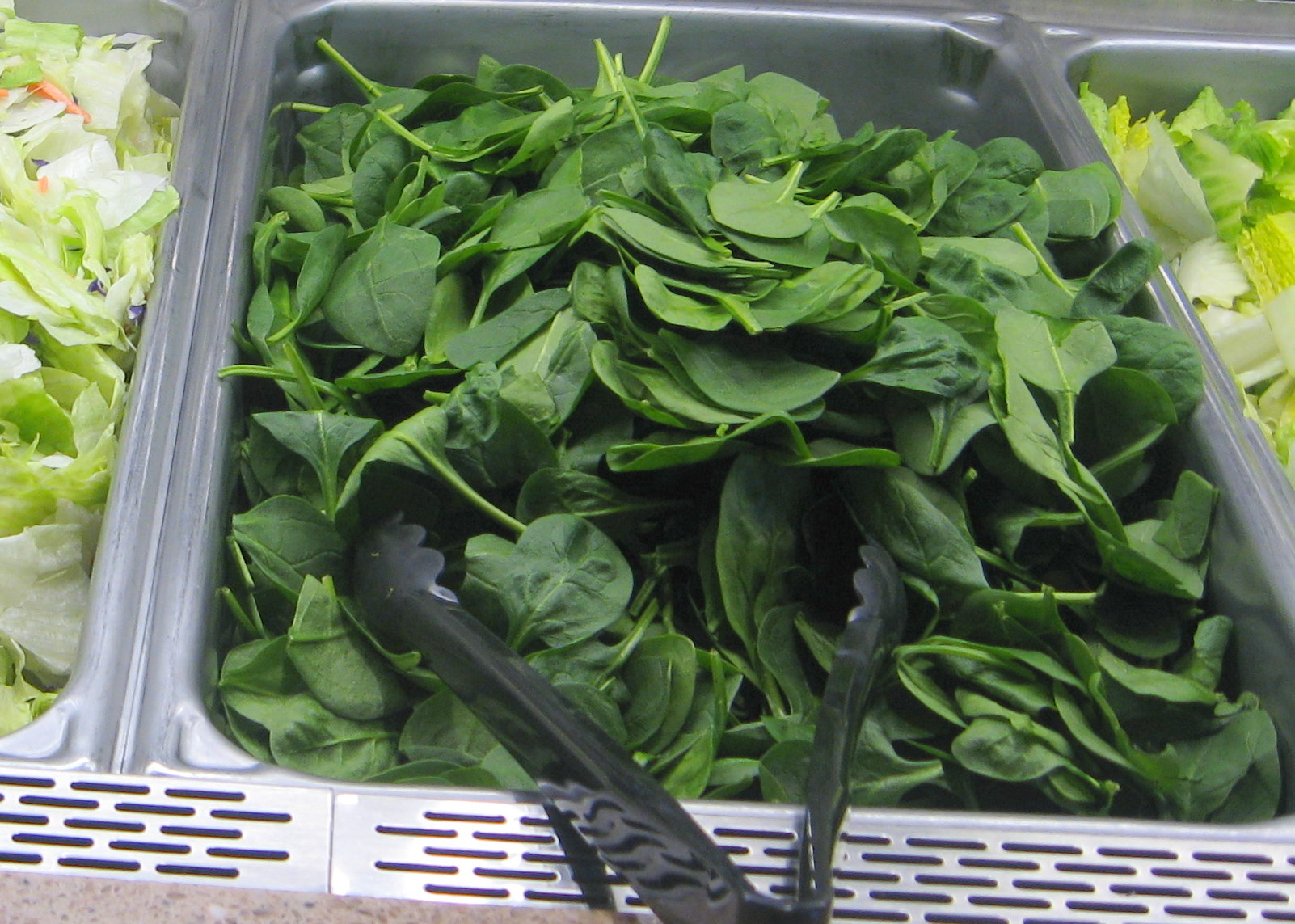 packages of greens is the lack of variety–I simply don’t want spinach as my greens for a whole week. If your market has a salad bar, you can get single-servings of mesclun, spinach, and other greens from the salad bar. I can also get some that loose greens in the produce department–I’ll purchase that either place, depending on what my schedule is and how salad-crazy I am at the time. Since the salad bar usually has several kinds of greens out, I can have mixed salad greens without buying lots of each kind.
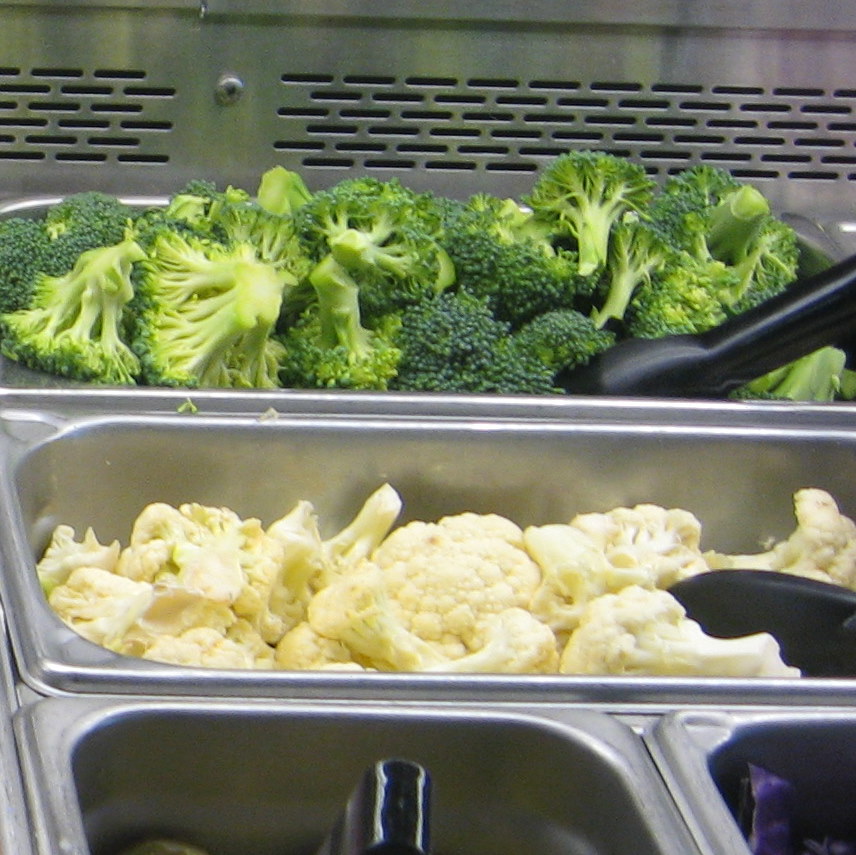 I like cauliflower and broccoli too, but again a head of cauliflower is a bit much, so even at $3.99 a pound it is less wasteful and probably cheaper in the long run for me to buy what I need for a single meal from the salad bar–and I avoid having to do the prep myself–added benefit.
My most frequent purchase from the salad bar is bell pepper strips, for salads, and sometimes for seasonings. If I need a lot, for example making the dandelion greens and sausages or chicken with sweet peppers, I will either buy whole peppers, or use frozen ones since they are to be cooked. The salad bar that I frequent usually has a variety of colors, so I can have that without red, yellow, orange, and green going bad in the fridge. (I 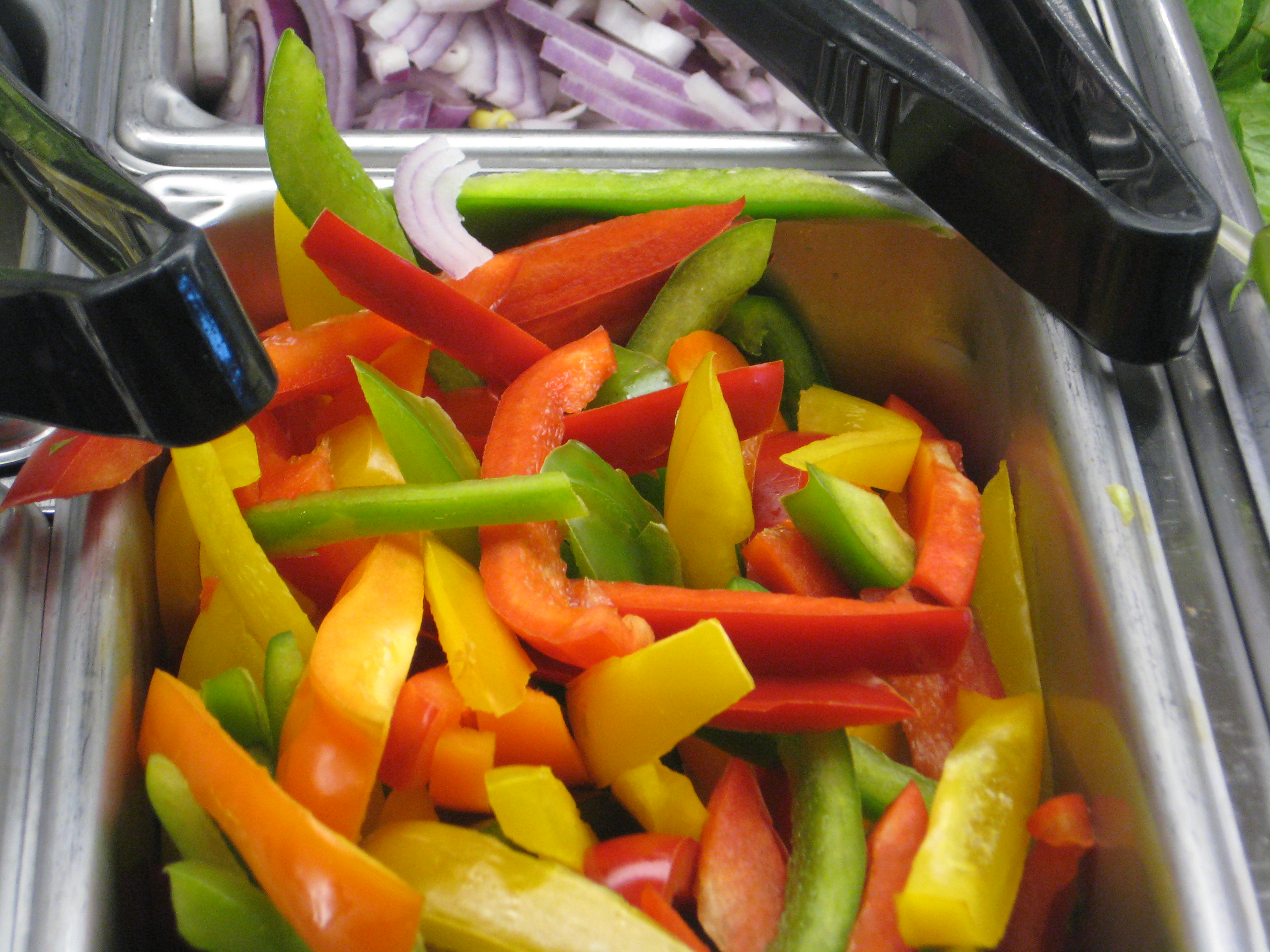 have to admit, somewhat shamefacedly, that I’m one of the people who will stand there and pick out the red, orange, and yellow and leave the green ones behind.)
I don’t buy tomatoes off the salad bar–I think that the refrigeration changes the texture of them, so I usually get grape/cherry tomatoes from the produce section. They seem to be one thing that I use easily before they get funky.
Onions and whole carrots keep well 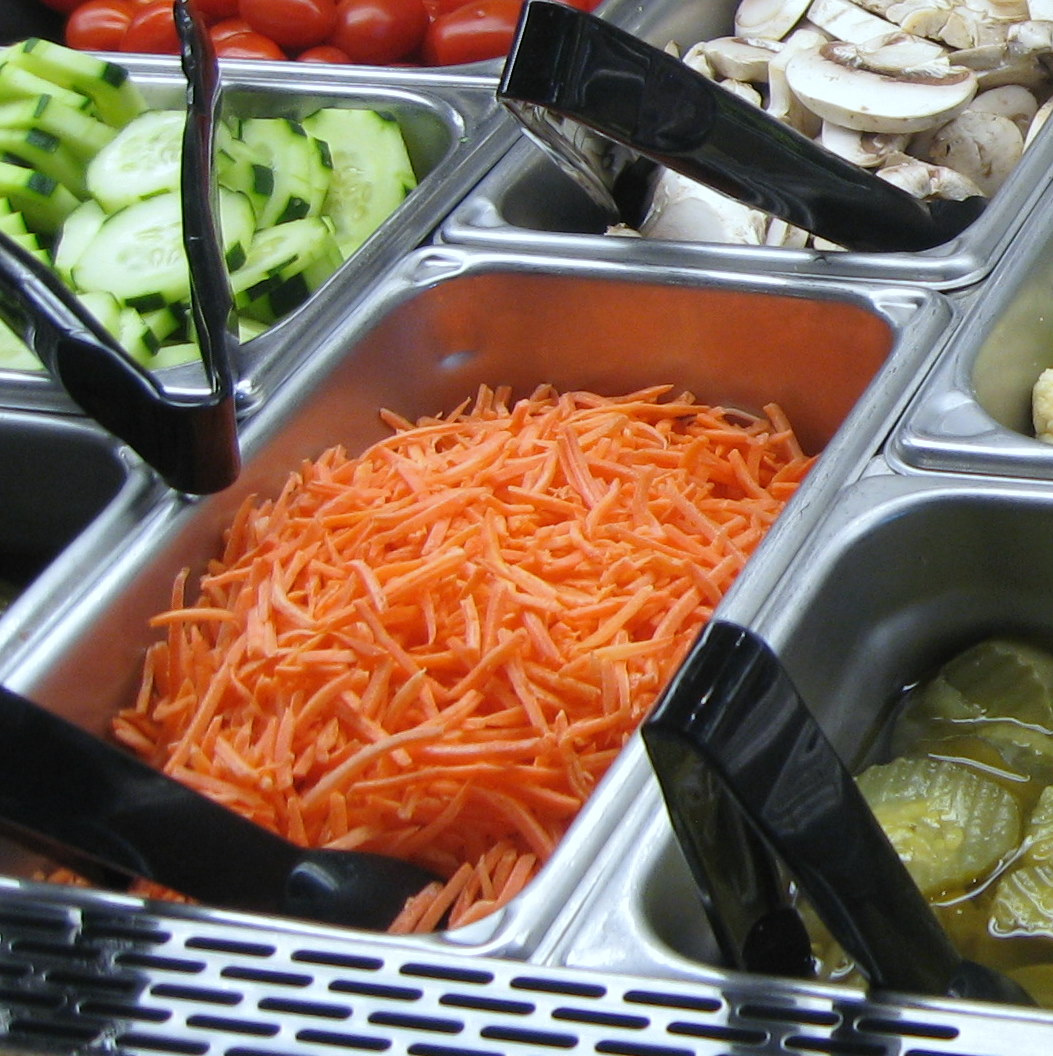 enough that I buy those in the produce department most of the time and keep them in the fridge; but if I want julienned carrots to make a quick serving for a meal or for a salad–I may just take the lazy way out and use the salad bar rather than the packaged ones in the produce department. That’s my idea of convenience food.
I don’t often by cucumbers from the salad bar since I prefer the English ones–and the salad bar usually features the American slicers so they are not worth the per pound price. Other things that may be purchased from the salad bar include sliced mushrooms, julienned radishes, or fresh mozzarella when you want just enough for one serving.
Another frustration of buying produce for one is fruit. As much as I like cantaloupe, honeydew, berries and other fruit, getting variety leads me to use the fruit side of the salad bar often. I can usually find assorted berries, mangoes, pineapple, and melons there.
Most of the items on the salad bar really aren’t that heavy–and considering that you have avoided the waste of unused produce, it seems to be a reasonable price. Even some of the heavier items like melons, broccoli and cauliflower, are a bargain for me since it allows me to have variety in my meals and minimizes waste.
Not everything I want is on the salad bar, so the solo cook has to deal with more produce than you’re going to use quickly. What are the options?
Leftovers. . . and second servings
One of the banes of refrigerator maintenance is leftovers. I work hard to avoid them, but I’m often defeated in my efforts, especially when eating out. So often restaurant servings are HUGE, and, sucker that I am, I don’t just leave the excess on my plate. I bring it home, tuck in into the refrigerator, and then likely at some too-far-in-the-future date I get an odoriferous reminder that I now have to do something with the leftovers, which are likely to be found in the back of the refrigerator. They will most likely be unidentifiable now, so they go into the garbage.

lookin’ for leftovers
The obvious first step is to think carefully about bringing home restaurant leftovers: Will it reheat well enough that you really want to eat it? After all it probably doesn’t make much difference when it gets thrown out–then or a week later. If I decide to tote it home (and I already know that the cat won’t eat it), then I need to label it, and be sure that it doesn’t end up in the back-most corner of the fridge. I have used masking tape (which comes off easily–often too easily), Sharpies (which can be removed from some things with rubbing alcohol). I recently found a suggestion to use dry erase crayons (which I didn’t even know existed). Might be worth a try, but better yet for me would be to be much more judicious in what I put into the fridge as a “leftover”.
“Leftovers” from my own cooking aren’t as much of a problem, but I’m always looking for ways to use the bits and pieces of produce or the last part of that can of beans. I’ve got a handle on the bits and pieces of bags of frozen vegetables and even partially on the celery. But there are still bits and pieces….
The Cook’s Illustrated books on cooking for two and Joe Yunan’s book (see bibliography) is the cross-indexing of recipes that use the same ingredient so you have a suggestion for what to do with the other half of that head of cauliflower.
I’ve found several tools to help reduce waste in single-serving cooking. First from the kitchn is an article titled What to Do With…? 75 Tips for Leftovers and Ingredients. There is a long list of things from produce market, the refrigerator, and the pantry with suggestions of what to do with the extras. For a lot, the suggestions are “freeze it” which does not necessarily solve the problem–just moves it to some point in the future; however, there are some good suggestions.
The flip side of this is throwing away things that could reasonably be used. For some examples, see 10 Foods You Should Never Throw Away. I can agree with the cheese rinds and chicken bones, but here again, I think it’s easy to fall into the trap of just changing where you stash the leftovers. When you’re doing single-serving cooking you do need to consider carefully what you bring home and what you keep. Also useful might be Top 10 Ways to Use Up Overripe Fruit.
Another article that is useful 15 Foods You Should Freeze in an Ice Cube Tray. There are lots of other things to freeze as “ice” cubes, and the put into zipper-lock bags for freezing. Having these portioned out can make it easier to use them. One of the things I do with excess celery and carrots is to make mirepoix (soffrito) in a big batch, then freeze it in ice-cube trays. One or two cubes will be what you need for small-time cooking–and it cuts time from preparation, and should reduce waste!
Planning use as in having thought about possibilities for that second serving (no, not meal planning–I don’t do that), and shopping with single-serving cooking in mind should help. One way to manage what gets pushed to the back is to add a triage box to the fridge. Triage refers to the process or sorting, or assigning priority to something. In the fridge it would be an eat-me-first box where you put things that have a short shelf-life, or perishables so that they don’t get pushed to the back of the fridge.
Heirloom Tomato Panzanella
Hot weather, summertime, tomatoes, and panzanella is just a natural. It’s worth looking for heirloom tomatoes to make this salad. There are so many different flavors–it’s not just “tomato”.
This post from Savory Simple brings up an issue that we should all be aware of: we are moving toward homogeneous taste as we give up the heirloom varieties. Check out Save the Flavors and Seeds of Change.
Offal–the other tasty bits
 When I look at the meat counter in the supermarket I always wonder why we use so few of the parts of the animals that we raise and slaughter for food. It seems wasteful and disrespectful of life, and we’re missing a lot of good eating that way. Obviously, I favor of using all of the beast if you’re going to slaughter it to have a steak or a roast (the skeletal muscle, in other words).
Maybe part of the reluctance to use organ meats is that many cooks don’t know how to prepare these other bits–they can be a bit more complicated to cook than a steak. Certainly many popular cookbooks don’t include recipes for them. It might also be because we are told that these are not good for us–that they are high in fats, and in cholesterol–which is supposed to be so terribly, horribly unhealthy for us. Maybe it’s also related to controversy about whether or not fat, and animal fat in particular, is actually bad for you–government and medical recommendations on what we should–or should not–eat.
There does seem to be increasing interest in “variety meats” as something other than pet food. (Yes, I will share the giblets with the cat when we’re cooking chicken or turkey but I will not give them all away.) There are some excellent cookbooks available now. I’ve added some of my favorites to the bibliography. Whatever the reasons, I’m glad to see it (and you can expect more of my opinions on the high-carb, low-fat controversy about how to get rid of the excess weight we tote around with us).
But to get to the thing that got me started on this particular topic. One of my favorite bits of offal is tongue and I found this delightful post on Fae’s Twist & Tango with a recipe for cooking tongue that is a good addition to my collection recipes for that particular bit of the beast.
(It’s really unfortunate that “offal” is pronounced like “awful” so that enunciating that word leaves a lot of people thinking that you’ve said “awful”–which is what many think of organ or “variety” meats. I’m sure there are people who love foie gras and caviar, and maybe even shad roe, who would not consider other organ meat from a cow, or a pig, or a chicken. But offal is not awful–it’s good stuff.)
Chilean sea bass (Patagonian toothfish)
 I could scarcely believe my eyes when I wandered past the seafood display in the newly opened Fresh Market. There was Chilean sea bass (this name is really a marketing ploy)! Or really, Patagonian toothfish. It’s not pretty when as the whole fish, but it’s luscious in the pan. It’s also NOT cheap. And there are some that are considered “sustainable”, so I wasn’t being totally irresponsible–just fiscally irresponsible for my budget. But it had been, literally, years since I’d eaten this luscious fish. No will power effort here–I brought some home.
When I spend this kind of money for special fish (how about 7 ounce piece for $13.00–yes fiscally irresponsible, and the hock-your-soul category) I’m going to make very sure that I don’t screw up the cooking or seasoning. The texture is firm and meaty with large flake (in that respect somewhat like monkfish, tuna, or swordfish, but still has character of its own) and moderately oily so it doesn’t dry out during cooking. The flavor is often characterized as mild, buttery, somewhat like cod, halibut, or stripped bass; not fishy in an undesirable way. It’s the combination of flavor and texture that makes the toothfish so special–and nothing else can really be substituted if you want that particular flavor-texture combination.
If you’re looking at something called just “sea bass” it’s probably not toothfish–that’s usually sold as “Chilean”. There are, however, a lot of fish sold as “sea bass”–white-fleshed, and lovely as well, but not as special, or expensive, as the toothfish, but still well worth trying.
The toothfish is oily enough to allow for lots of flexibility in method  of cooking–even broiling or grilling. To keep it simple and let this special fish really shine, I took the really easy route: seasoned with salt and baked in a covered dish in a 425°F oven for about 25 minutes since it was a thick (almost 2 inches) piece of filet. While that cooking was going one, I made a pan sauce of brown butter, shallots, and white wine, salt and pepper.
Efforts are being made to legally harvest toothfish, so before you buy check the source, but then break the budget and enjoy! (This image is from the Coalition of Legal Toothfish Operators, Inc.)
The wine? Well, another glass of my Alandra Portuguese white since this was a really simple preparation–and that’s a good all purpose white wine for causal use on a weeknight when I want a rather short glass.
New food groups?
Always looking to try new things, so here’s an interesting ideas things to eat:
- One thing to do with invasive species.
- And some more possible edibles.
- More information on invasive species
It’s that time of year again….
Yes, the New Year is almost here. I’m sure I’ll do like most of you and make some resolutions–but really all I should do is make a resolution to try to keep the ones that I made last year…and the year before that, too. My big one has to be one that was only partially successful last year–lose weight and exercise more. I guess that’s really two. Duh!
I’m trying to plan how to be more successful with keeping my well-intentioned resolutions this year–after all, my doctor did tell me (again) that I really need to lost weight (and I know that the exercise really does go with that effort). Just like so many other people needing weight loss, I’ve read, though not just about weight loss, but about responsible eating, too. Recent reading includes:
- Gary Taubes, Good Calories, Bad Calories (incredible bibliography)
- Mark Bittman, V6B (another good bibliography and interesting that it’s written by someone who is a serious “foodie”)
- Eric Westman, The New Atkins for a New You (Duke University)
- Richard Wrangham, Catching Fire: How Cooking Made Us Human (fascinating physical anthropology discussion of how cooking changed our evolution)
- Pierre Desrochers and Hiroko Shimizu, The Locovore’s Dilemma: In Praise of the 10,000-Mile Diet (interesting for the energy analysis that they do regarding the various energy expenditures related to putting food on the table)
- even some Kindle samples on the “flat belly” diet, and the “Paleo” that never got past the “sample” stage!
I have to confess that I’ve done the high-protein, low-carbohydrate one—it does work, but….true to promises made in the books, I wasn’t hungry. Now here’s the kicker, I wasn’t hungry, but I really, really, really missed some things that were “forbidden”: milk, fruit, and some of the higher carbohydrate veggies, and legumes. Even though I like greens and use a fair amount of them, I got SO tired of greens—spinach, lettuce, kale, collards, arugula, and the like. I found that as soon as I tried adding back some carbohydrates, weight loss came to a standstill. Not a sustainable program, especially when you consider the amount of energy it takes to raise meat, particularly in the quantities that we in the US consume. I’m a meat-eater, but my mind boggles at the statistics about how much meat Americans eat. Then we could go on to the “factory farming” issues.
Some of these (Gary Taubes, Eric West (MD) and Mark Bittman) actually do some impressive and almost-scholarly nutritional and metabolic literature reviews. Some have prefaces written by medical people with credentials that are impressive. The studies cited are from reputable journals. The data presented on insulin resistance and metabolic syndrome were convincing though–we really cannot continue to ignore obesity issues and the disease consequences of these.
No matter how scholarly or well documented, or which particular method they tout, it all comes down to cut calories and increase your energy expenditure. One of the ways to do that is to eat more plant-based foods since many are not as calorie-dense as animal products–more fruits and veggies. I’m not planning to give up meat or animal products, but I will opt for better quality and less to keep the budget in balance and be somewhat “green”. I am an omnivore!
I can’t escape that if I’m going to lose weight I have to expend more energy than I take in; that’s the physics of the situation–so I’m right back where I started: eat less and exercise more. Seems this is where I started this year….
But all that aside, I wish all of you a healthy, happy, prosperous 2014 with lots of good food, wine, and friends!
Oven-braised lamb and garbanzo beans
It’s another grey day–unseasonably warm, but at least not hot, sticky, and terribly humid today–the kind of day when you need to smell something cooking–long, slow, and tantalizing. I found lamb shoulder chops on special (2-1/2-pound package) at the grocery store, I decided to try the lamb/garbanzo slow-cooker thing in the oven since it’s not too hot (and I’ll use the oven to prepare a second dish for reheating tomorrow (acorn squash stuffed with Sicilian sausage).
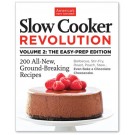 The slow cooker version of this concoction was really good, but I thought it could be improved by doing it in the oven. Even after reading the Cook’s Illustrated Slow Cooker Revolution (volume 1), I am still not a wild fan of the slow-cooker. I use it because it does some things well, and is necessary at times to fit cooking into a working schedule. The Slow Cooker Revolution has improved my slow-cooker results immensely, mostly because I’ve discovered some unusual ingredients that can improve flavor.
My impression was that many of these recipes required more preparation time than I would be able to put into a slow cooker recipe, given that I use it for utter simplicity. I’m interested in seeing what comes from volume 2 of the Slow Cooker Revolution. If I have to do a lot of preparation for the recipe, then I might as well not use the slow cooker. I still find that I like over-braising when possible; however, I do find I’m using the slow cooker even more since I read the first volume of this book. That said, I still prefer oven braising, especially if I’m working at home.
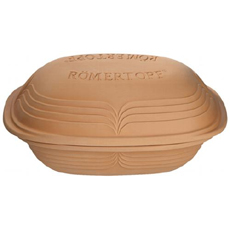 I had intended to do this in the Romertopf, (one of my favorite things for roasting and baking hearty, peasant-style comfort food in the winter) but by the time I had boned the lamb and added other ingredients, it wouldn’t fit in either of my small ones (great for single-serving cooking), and was not enough to fit in my large Romertopf (for roasting whole chicken, for example)–so it was the Dutch oven for today.
(Shoulder chops are reasonably priced, and the boning doesn’t take long if you use a boning knife rather than trying to do it with a paring knife or chef’s knife. Those bone went into a saucepan with a tad of salt and some bay leaves to make stock. After boning out, I had about 2 pounds of lamb, so that’s what I started with.)
Oven-braised lamb and garbanzo beans
 Ingredients
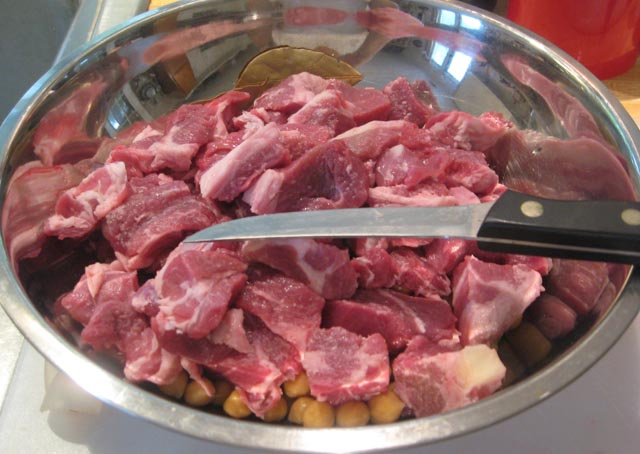
- 2 pounds lamb (from boned shoulder chops)
- 2 14.5-ounce cans of garbanzo beans, drained and rinsed
- 3 large onions, chopped
- 1 14.5-ounce can of fire-roasted, diced tomatoes with juice
- 2 tablespoons of Hatch chilli powder (used for the slow cooker), but more added after tasting this halfway through cooking
- 2 teaspoons of salt, or to taste
- 1 tablespoon fresh Mexican oregano, minced
- 1 cup water
Preparation
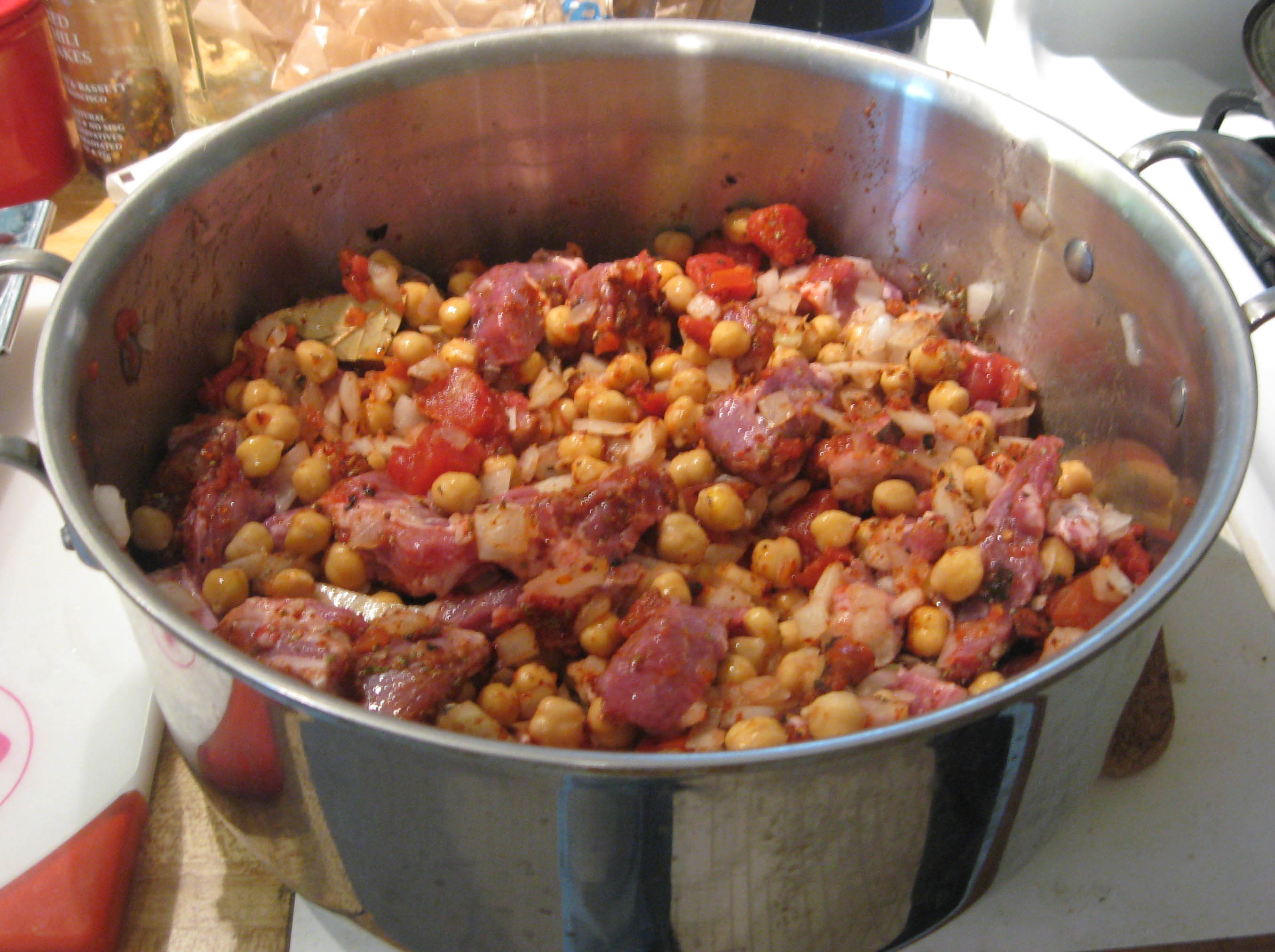
- Put everything in pot
- Cover
- Pop it into the oven, and check for liquid in an hour
- Go get laundry or whatever, then check liquid again
-<>^<>-
In order to be as much like the slow-cooker, I did not brown the meat or cook the onions separately–just combined everything, covered, and put in a preheated, 300-degree Fahrenheit oven. I added 1 cup of water to start, and checked in one hour but there was plenty of liquid.
On tasting, I found it needed more than the 2 tablespoons of chili powder so I added about 1 tablespoon more, stirred, covered, and let it continue to cook. There was plenty of liquid, so next time, I’ll not add any water–just rely on the juice from the tomatoes, onions, and meat.
-<>^<>-
The stock made with the bones smelled really good–if more liquid had been needed during baking, I would use some of the stock. There was some meat from the bones in the stock, but I not enough to spend time picking off, although I’m not compulsive about trying to get every bit off when I bone meat like these chops. Since I started the stock in cold water, the meat that was left was pretty flavorless, but the stock was good.
-<>^<>-
There will be a next time for this–and unless I’m really pushed for time, or can’t leave the oven while I’m out, I’ll opt for the oven method to cook this–a much more complex flavor with the same ingredients, likely attributable to the bit of evaporation that takes place in the oven but not in the closed slow-cooker.
Getting this added flavor lead me to consider the energy used in the various cooking methods–the energy required for cooking is certainly part of the energy required to make that food edible–the energy of production and transportation, and the cooking is all part of the picture: the footprint of feeding me. We cannot ignore the energy used for cooking when we talk about other energy costs associated with our food so I spent some time browsing to find information on different cooking methods.
In trying to research this issue, I’ve perused many different sources–and the gas/slow cooker comparison is difficult, and I get the feeling that the answer to which is more efficient is an “it depends” situation.
Interestingly, an article on slow cookers versus electric ovens from the University of Connecticut Sustainable Living suggests that there may not be a significant difference in energy use. SFGate discusses gas versus electric energy use, which gets more complicated, but I’m not sure that there difference is significant enough to make me give up oven braising, even though I’d like to minimize my “carbon footprint” as much as possible. If my slow cooker requires eight or so hours of cooking, and my oven braise requires only two or three hours on low to medium heat, then it may be a toss-up, since the slow cooker doesn’t cycle, and the oven (gas or electric) does.
Oven braising in the wintertime helps warm the house so probably cuts my heating use some, but I’m certainly NOT going to oven braise in the summer and increase the use of air-conditioning. There is lots of conflicting information out there on the ‘net. The “best” I found was from the Consumer Energy Center (California Energy Commission)–from that information, I’m not going to give up oven braising for the slow cooker anytime soon, but I’ll still use the slow cooker for some things.
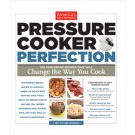 One comparison that I’d really be interested in is slow cooker versus pressure cooker energy use, and taste of the same dish prepared in both. Most data that I found suggested that the slow cooker wins on convenience, and the pressure cooker on energy saving. A taste comparison would certainly be interesting. I’m almost certain that a pressure cooker can’t replace a good old-fashioned slow braise in the over.
I’ve recently started playing with a pressure cooker–it’s a lot different than what my mother used. The recipes in Pressure Cooker Perfection have been a good starting point. I suspect that I’ll be using a pressure cooker more in the future, as well as the slow-cooker. Climate, air conditioning, and heating, are all things that will enter into my decisions. I’m also trying out an portable induction unit which is supposed to be ore energy efficient.
So many options for energy efficiency–but what about taste? I doubt that any other method is going to come out tasting like an oven braise, no matter how many umami-enhancing ingredients you add.
A son goût!
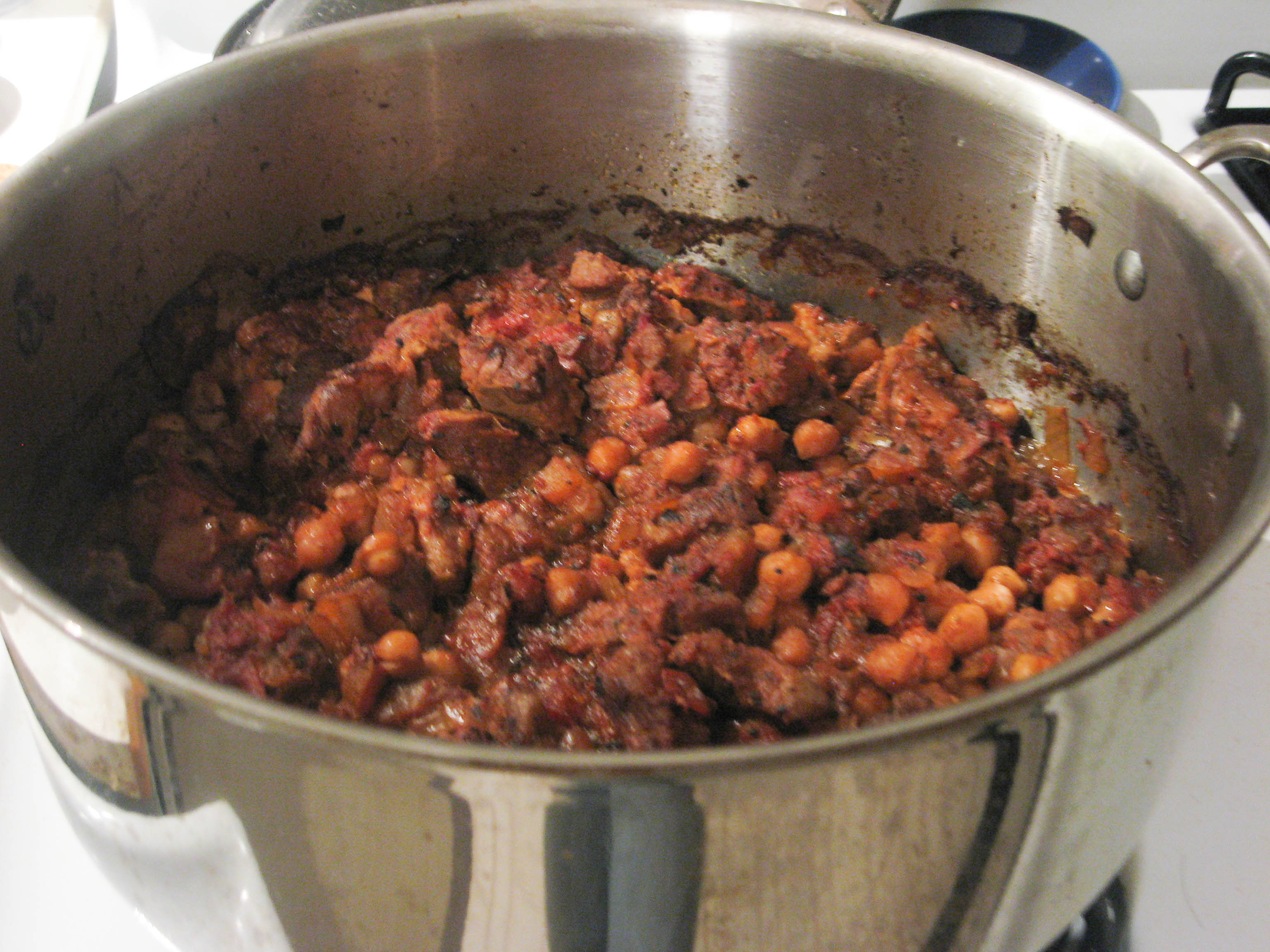
very simple, very tasty
 a-single-serving.com